

TRanscranial AlterNating current stimulation FOR patients with mild Alzheimer’s Disease (TRANSFORM-AD): a randomized controlled clinical trial
Open accessThe DOI matches its Crossref record; 55 of the 55 references it cites were found in a registry or an index; 1 of the 45 sources its claims cite were checked for support.
Abstract
BACKGROUND: The mechanistic effects of gamma transcranial alternating current stimulation (tACS) on hippocampal gamma oscillation activity in Alzheimer's Disease (AD) remains unclear. This study aimed to clarify beneficial effects of gamma tACS on cognitive functioning in AD and to elucidate effects on hippocampal gamma oscillation activity. METHODS: This is a double-blind, randomized controlled single-center trial. Participants with mild AD were randomized to tACS group or sham group, and underwent 30 one-hour sessions of either 40 Hz tACS or sham stimulation over consecutive 15 days. Cognitive functioning, structural magnetic resonance imaging (MRI), and simultaneous electroencephalography-functional MRI (EEG-fMRI) were evaluated at baseline, the end of the intervention and at 3-month follow-up from the randomization. RESULTS: A total of 46 patients were enrolled (23 in the tACS group, 23 in the sham group). There were no group differences in the change of the primary outcome, 11-item cognitive subscale of the Alzheimer's Disease Assessment Scale (ADAS-Cog) score after intervention (group*time, p = 0.449). For secondary outcomes, compared to the control group, the intervention group showed significant improvement in MMSE (group*time, p = 0.041) and MoCA scores (non-parametric test, p = 0.025), which were not sustained at 3-month follow-up. We found an enhancement of theta-gamma coupling in the hippocampus, which was positively correlated with improvements of MMSE score and delayed recall. Additionally, fMRI revealed increase of the local neural activity in the hippocampus. CONCLUSION: Effects on the enhancement of theta-gamma coupling and neural activity within the hippocampus suggest mechanistic models for potential therapeutic mechanisms of tACS. TRIAL REGISTRATION: ClinicalTrials.gov, NCT03920826; Registration Date: 2019-04-19.
Overview
CoChat Summary
TL;DR
In this double-blind, randomized, sham-controlled single-center trial of 46 patients with mild Alzheimer’s disease, 30 one-hour sessions of 40 Hz transcranial alternating current stimulation (tACS) did not improve the primary outcome, ADAS-Cog score, versus sham. However, tACS produced transient improvements in MMSE and MoCA and enhanced hippocampal theta-gamma coupling and neural activity, with effects not sustained at 3-month follow-up.
Key findings
- Primary outcome: no significant group*time difference in ADAS-Cog change from baseline to end of intervention (p = 0.449; tACS mean change −1.652 vs sham 0.130) or at 3-month follow-up (p = 0.739; tACS −0.741 vs sham 0.085).
- Secondary cognitive outcomes: MMSE improved with tACS versus sham (group*time p = 0.041; tACS mean change 3.000 vs sham 0.043), and MoCA improved (non-parametric p = 0.025; tACS mean change 2.217 vs sham 0.348); neither was sustained at 3 months (MMSE p = 0.569; MoCA p = 0.322). Delayed recall also improved at end of intervention (p = 0.027; tACS mean change 1.870 vs sham −0.130), but not at 3 months (p = 0.220).
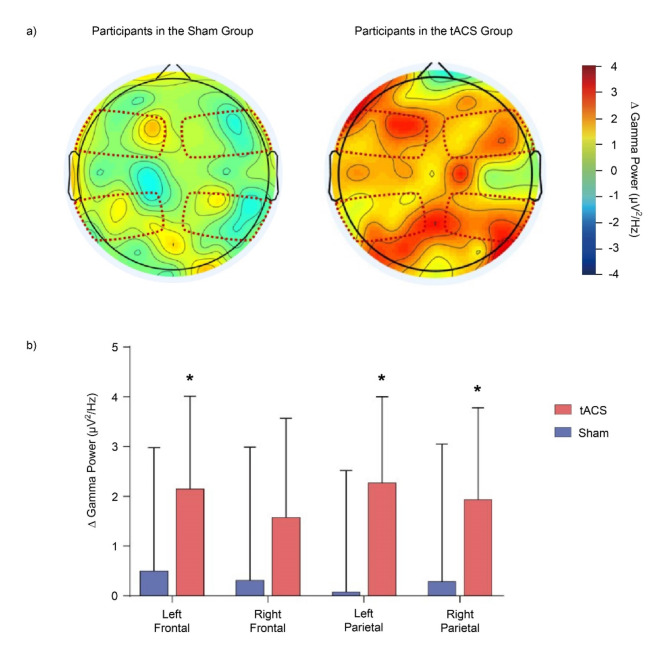
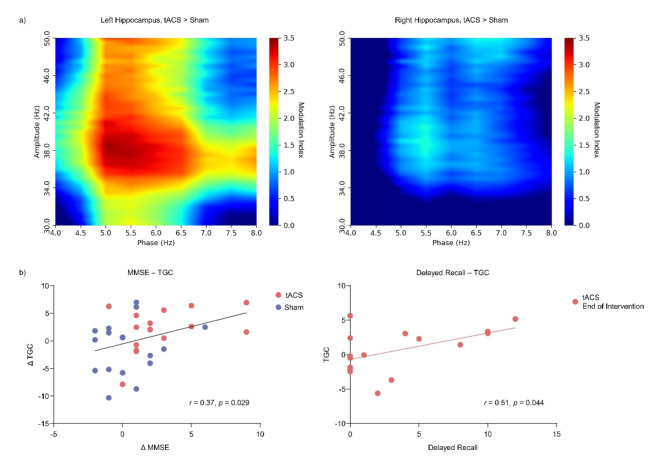
- Neurophysiology: tACS increased scalp gamma power in left frontal (t = 2.37, p = 0.032), left posterior (t = 2.68, p = 0.017), and right posterior (t = 2.13, p = 0.049) regions, though not significant after false discovery rate correction; no sham changes. Left hippocampal theta-gamma coupling increased versus sham (5–6 Hz phase, 30–42 Hz amplitude, ps < 0.05) and correlated with MMSE change (5.5–41.5 Hz: r = 0.37, p = 0.029; 5.5–40.5 Hz: r = 0.34, p = 0.049). Right hippocampal post-intervention theta-gamma coupling correlated with delayed recall in the tACS group (6.5–30 Hz: r = 0.51, p = 0.044), not in sham (r = −0.16, p = 0.519).
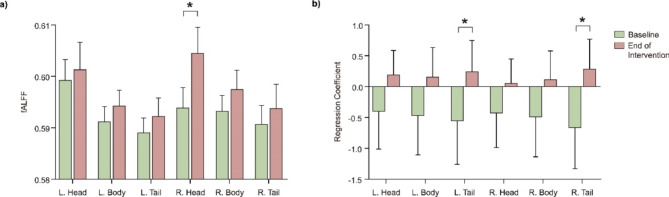
- fMRI: increased fALFF in right hippocampus head (t = 2.20, p = 0.039); increased association between BOLD signal in left and right hippocampus tails and gamma power fluctuation in PO8 (left tail t = 2.14, p = 0.049; right tail t = 2.56, p = 0.022). No significant fMRI differences at 3 months. Adverse events: one tACS participant reported tingling during first two sessions; one control reported transient itching at first session; no serious adverse events.
Methods
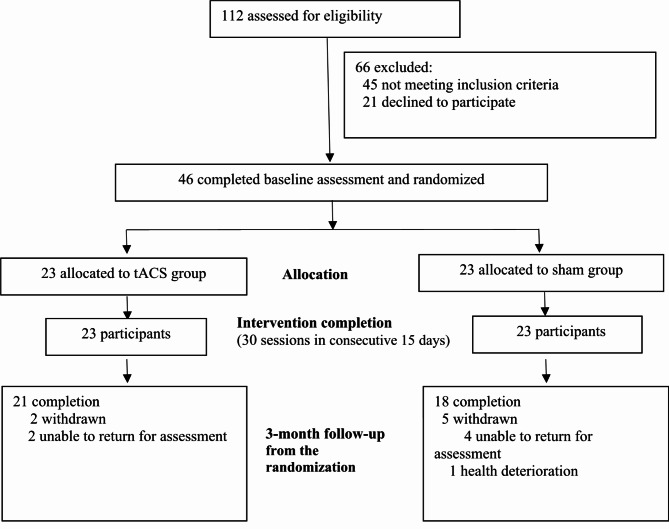
- Double-blind, randomized, sham-controlled single-center trial; 46 participants with mild AD (23 tACS, 23 sham) randomized 1:1. Inclusion required NIA-AA probable AD dementia, CDR 1.0, positive amyloid PET or low CSF Aβ42, age 45–75 years, and stable cholinesterase inhibitor/memantine dose.
- Intervention: 30 one-hour sessions of 40 Hz tACS (15 mA peak-to-peak) or sham over 15 consecutive days (twice daily, ≥4 h apart), with electrodes on forehead and mastoids. Assessments at baseline, end of intervention, and 3-month follow-up included cognitive battery, structural MRI, and simultaneous EEG-fMRI.
- Primary outcome: ADAS-Cog change from baseline to end of intervention. Secondary outcomes included MMSE, MoCA, WHO-UCLA AVLT, digit span, TMT B-A, BNT, ADL, NPI, GDS, EEG gamma power and theta-gamma coupling, and fMRI hippocampal activity. Analysis was intention-to-treat using mixed-effects models for normally distributed data, Mann-Whitney U tests for non-normal data, t-tests, and Pearson correlations; EEG source localization used Brainstorm/dSPM, and fMRI used CONN with fALFF and EEG-fMRI regression.
Limitations
- Stated by the paper: relatively small sample size; uncertainty whether stimulation locations were optimal; participants were relatively younger than those in other studies; some EEG-fMRI results did not pass correction for multiple comparisons; no substantial group difference in gamma power change between treatment and sham; null results may reflect insufficient statistical power; findings are considered exploratory and preliminary; at 3-month follow-up, 2 vs 5 participants were missing.
- Evident from the text: single-center design limits generalizability; the primary outcome was null and secondary cognitive benefits were not sustained at 3 months; several neurophysiological findings were uncorrected or did not survive FDR correction.
Model-written summary. Check it against the paper before relying on it.
Integrity signals
Registry
Cites
Statistics
Figures
Verification
Claims the paper makes
1 Valid · 0 Not valid · 32 Not checked · 78 Own results and interpretations
The sources with a verdict support this claim; the rest weren’t checked yet, have no full text we could read, or their verdicts aren’t rated yet.
In the paper
“This implies that even weak stimulation could induce large-scale modulation of neural activity via network resonance [10, 41].”
§ TRanscranial AlterNating current stimulation FOR patients with mild Alzheimer’s Disease (TRANSFORM-AD): a randomized controlled clinical trial > Discussion
What the sources say
- Supportedcites [10] Sprugnoli G, Munsch F, Cappon D, Paciorek R, Macone J, Connor A, et al. Impact of multisession 40Hz tACS on hippocampal perfusion in patients with Alzheimer’s disease. Alzheimers Res Ther. 2021;13(1):203. 34930421 10.1186/s13195-021-00922-4 PMC8690894 source
The Background section of Sprugnoli et al. (2021) states verbatim the substance of the claim: 'Simulations, supported by empirical evidence using electroencephalography (EEG), demonstrated that tACS modulates brain oscillatory activity via network resonance, suggesting that a weak stimulation at a resonant frequency could cause large-scale modulation of network activity [25]'. The hedge ('suggesting … could') matches the citing sentence's hedged 'could induce', so no overstatement is involved. Note only that the source paper reports this as background synthesis, crediting the underlying modelling/EEG evidence to its reference [25] (Schmidt, Iyengar, Foulser, Boyle & Fröhlich, 'Endogenous cortical oscillations constrain neuromodulation by weak electric fields', Brain Stimulation 2014), rather than generating it in its own experiment. (LLM, conf=0.85)
- Not checked yetcites [41] Ozen S, Sirota A, Belluscio MA, Anastassiou CA, Stark E, Koch C, et al. Transcranial electric stimulation entrains cortical neuronal populations in rats. J Neurosci. 2010;30(34):11476–85. 20739569 10.1523/JNEUROSCI.5252-09.2010 PMC2937280 source
hedgedstates a possible cause- Asserted: passes — The authors put it forward as true.
- Checkable: passes — It can be checked against evidence.
- Load-bearing: passes — The paper’s conclusions depend on it.
- Based: passes — The paper gives a reason why it holds.
- Supported
A result the paper reports from its own data — it cites no other source for it, so there is none to check. The quote shows it is in the paper.
In the paper
“However, we found a statistically significant correlation between post-intervention theta-gamma coupling in the right hippocampus and post-intervention delayed recall score in the tACS group (6.5–30 Hz: r = 0.51, p = 0.044; Pearson’s r, Fig. 3b right)”
§ TRanscranial AlterNating current stimulation FOR patients with mild Alzheimer’s Disease (TRANSFORM-AD): a randomized controlled clinical trial > Results > EEG analysis
plainstates an association- Asserted: passes — The authors put it forward as true.
- Checkable: passes — It can be checked against evidence.
- Load-bearing: unclear — It is unclear whether the paper’s conclusions depend on it.
- Based: passes — The paper gives a reason why it holds.
A result the paper reports from its own data — it cites no other source for it, so there is none to check. The quote shows it is in the paper.
In the paper
“fMRI analyses further showed an increase in local hippocampal BOLD signals.”
§ TRanscranial AlterNating current stimulation FOR patients with mild Alzheimer’s Disease (TRANSFORM-AD): a randomized controlled clinical trial > Discussion
plainstates a cause- Asserted: passes — The authors put it forward as true.
- Checkable: passes — It can be checked against evidence.
- Load-bearing: passes — The paper’s conclusions depend on it.
- Based: passes — The paper gives a reason why it holds.
A result the paper reports from its own data — it cites no other source for it, so there is none to check. The quote shows it is in the paper.
In the paper
“Among the secondary outcomes, compared to the control group, the intervention group showed significant improvement in MMSE (group*time, p = 0.041)”
§ TRanscranial AlterNating current stimulation FOR patients with mild Alzheimer’s Disease (TRANSFORM-AD): a randomized controlled clinical trial > Results > Participants and the changes of cognitive functions
plainstates a cause- Asserted: passes — The authors put it forward as true.
- Checkable: passes — It can be checked against evidence.
- Load-bearing: unclear — It is unclear whether the paper’s conclusions depend on it.
- Based: passes — The paper gives a reason why it holds.
A result the paper reports from its own data — it cites no other source for it, so there is none to check. The quote shows it is in the paper.
In the paper
“and right posterior (t = 2.13, p = 0.049, t-tests) regions in the tACS group”
§ TRanscranial AlterNating current stimulation FOR patients with mild Alzheimer’s Disease (TRANSFORM-AD): a randomized controlled clinical trial > Results > EEG analysis
plainstates a cause- Asserted: passes — The authors put it forward as true.
- Checkable: passes — It can be checked against evidence.
- Load-bearing: unclear — It is unclear whether the paper’s conclusions depend on it.
- Based: passes — The paper gives a reason why it holds.
61 more claims
Create a free account to see all 111 claims and to verify the 44 references still open.
- It may state two separate claims as one. 28
- Probably not a substantial claim. 25
Claims other papers make about this one
Each is checked against this paper’s own text: does it say what the citing paper says it does?
In the citing paper
“The TRANSFORM-AD trial reported that high-intensity tACS (15 mA) did not achieve global cognitive improvement despite increasing left hippocampal theta–gamma coupling [62].”
From Effects of 40-Hz transcranial alternating current stimulation on cognition and neural markers in Alzheimer’s disease: a randomized, sham-controlled trial (2026) · cites this paper as [62]
In the citing paper
“In addition, the improvement of tACS was not sustained at 12 weeks [31, 61–63].”
From 40 Hz biparietal transcranial alternating current stimulation for Alzheimer’s disease: a prospective study (2026) · cites this paper as [62]
Self-check
Percentages, sums and reported differences re-computed from the paper’s own numbers.
Each contradiction between two passages listed here was confirmed by an independent check.
Rated minor: it would not touch a result — a value no result rests on, a p-value that stays on the same side of the significance level, or a conflict that is clerical, resolved elsewhere in the paper, or outside its own findings.
In the paper
§ TRanscranial AlterNating current stimulation FOR patients with mild Alzheimer’s Disease (TRANSFORM-AD): a randomized controlled clinical trial > Results > Participants and the changes of cognitive functions
“No statistically significant positive results were observed for other neuropsychological tests.”
§ TRanscranial AlterNating current stimulation FOR patients with mild Alzheimer’s Disease (TRANSFORM-AD): a randomized controlled clinical trial > Results > Participants and the changes of cognitive functions
“| Delayed recall# | 1.870(0.058 to 3.681) | -0.130(-0.915 to 0.654) | - | - | 0.027 |”
Citations
Cites
Folstein, M. F., Folstein, S. E., & McHugh, P. R. (1975) · Journal of Psychiatric Research · doi:10.1016/0022-3956(75)90026-6 · Cited by 88,282
The Montreal Cognitive Assessment, MoCA: a brief screening tool for mild cognitive impairment
Nasreddine, Z. S., Phillips, N. A., Bédirian, V., Charbonneau, S., Whitehead, V., Collin, I., Cummings, J. L., & Chertkow, H. (2005) · Journal of the American Geriatrics Society · doi:10.1111/j.1532-5415.2005.53221.x · Cited by 25,553
Kok, J. S., Berg, I. J., & Scherder, E. J. A. (2013) · Dementia and Geriatric Cognitive Disorders Extra · doi:10.1159/000353441 · Cited by 20,589
McKhann, G. M., Knopman, D. S., Chertkow, H., Hyman, B. T., Jack, C. R., Kawas, C. H., Klunk, W. E., Koroshetz, W. J., Manly, J. J., Mayeux, R., et al. (2011) · Alzheimer's & Dementia · doi:10.1016/j.jalz.2011.03.005 · Cited by 18,657
Development and validation of a geriatric depression screening scale: a preliminary report
Yesavage, J. A., Brink, T. L., Rose, T. L., Lum, O., Huang, V., Adey, M., & Leirer, V. O. (1982) · Journal of Psychiatric Research · doi:10.1016/0022-3956(82)90033-4 · Cited by 15,025
Desikan, R. S., Ségonne, F., Fischl, B., Quinn, B. T., Dickerson, B. C., Blacker, D., Buckner, R. L., Dale, A. M., Maguire, R. P., Hyman, B. T., et al. (2006) · NeuroImage · doi:10.1016/j.neuroimage.2006.01.021 · Cited by 13,324
NIA‐AA Research Framework: Toward a biological definition of Alzheimer's disease
Jack, C. R., Bennett, D. A., Blennow, K., Carrillo, M. C., Dunn, B., Haeberlein, S. B., Holtzman, D. M., Jagust, W., Jessen, F., Karlawish, J., et al. (2018) · Alzheimer's & Dementia · doi:10.1016/j.jalz.2018.02.018 · Cited by 10,537
The Neuropsychiatric Inventory: Comprehensive assessment of psychopathology in dementia
Cummings, J. L., Mega, M., Gray, K., Rosenberg-Thompson, S., Carusi, D. A., & Gornbein, J. (1994) · Neurology · doi:10.1212/wnl.44.12.2308 · Cited by 7,568
A New Clinical Scale for the Staging of Dementia
Hughes, C. P., Berg, L., Danziger, W., Coben, L. A., & Martin, R. L. (1982) · British Journal of Psychiatry · doi:10.1192/bjp.140.6.566 · Cited by 7,056
Conn : A Functional Connectivity Toolbox for Correlated and Anticorrelated Brain Networks
Whitfield-Gabrieli, S., & Nieto-Castanon, A. (2012) · Brain Connectivity · doi:10.1089/brain.2012.0073 · Cited by 4,885 · cited 1×
“Details of fMRI preprocessing could be found in the supplemental methods. fMRI-based functional connectivity analysis was carried out using CONN toolbox (version 21b) [35].”
Method
Cited by
Cantoni, V., Casula, E. P., Tarantino, B., Cupidi, C., Huber, N., Altomare, D., Premi, E., Zummo, E., Esposito, R., Leonardi, C., et al. (2025) · JAMA Network Open · doi:10.1001/jamanetworkopen.2025.46556 · Cited by 28
Wang, T., Yan, S., Shan, Y., Xue, H., Xing, Y., Bi, S., Chen, Z., Xi, H., Qi, Z., Tang, Y., et al. (2025) · Radiology · doi:10.1148/radiol.241463 · Cited by 28
Self-citationEpileptic activity in Alzheimer's disease: emerging insights and therapeutic implications
Vossel, K. A., Johnson, E. L., Cretin, B., & Matsumoto, R. (2026) · The Lancet Neurology · doi:10.1016/s1474-4422(25)00425-9 · Cited by 19
Liu, Y., Chen, S., Li, S., Pei, Z., Fan, S., & Guo, Y. (2025) · Journal of Alzheimer s Disease Reports · doi:10.1177/25424823251362444 · Cited by 11
Inflammatory Bridges: Interconnections Between Alzheimer’s Disease and Bone Health
Li, H., Wang, W., Zhang, L., Wang, T., Liu, J., Wu, J., Ni, Q., Sun, B., & Sun, J. J. (2025) · Aging and Disease · doi:10.14336/ad.2025.10319 · Cited by 10
Metadata
- Authors
- Tang, Y., Xing, Y., Sun, L., Wang, Z., Wang, C., Yang, K., Zhu, W., Shi, X., Xie, B., Yin, Y., Mi, Y., Wei, T., Tong, R., Qiao, Y., Yan, S., Wei, P., Yang, Y., Shan, Y., Zhang, X., Jia, J., Teipel, S. J., Howard, R., Lu, J., Li, C., & Zhao, G.
- Affiliations
- Capital Medical University (CN)
- German Center for Neurodegenerative Diseases (DE)
- University College London (GB)
- Corresponding author
- Tang, Yi
- Lu, Jie
- Li, Chunlin
- Zhao, Guoguang
- ORCID
- Venue
- Alzheimer's Research & Therapy
- Published
- 2024-09-12
- Volume
- 16
- Issue
- 1
- Pages
- 203-203
- ISSN
- 1758-9193 (ISSN-L)
- PMC
- PMC11395938
- OpenAlex
- W4402483355
- Semantic Scholar
- e18abd967faae7bcb388f723b165bc31533e08a0
- Cited by
- 44
- References
- 54
- Citations by year
- 2026: 31 · 2025: 13
- FWCI
- 5.69
- Type
- journal article
- Language
- en
- Open access
- gold
- doi.org
- Licence
- cc-by-nc-nd
- creativecommons.org/licenses/by-nc-nd/4.0 (tdm)
- creativecommons.org/licenses/by-nc-nd/4.0 (vor)
- Locations
- Alzheimer s Research & Therapy (publishedVersion, cc-by-nc-nd)
- DZNE Pub (publishedVersion, cc-by-nc-nd)
- PubMed Central (publishedVersion, cc-by-nc-nd)
- PubMed (publishedVersion)
- PUBLISSO (German National Library of Medicine) (submittedVersion, cc-by-nc-nd)
- DOAJ (DOAJ: Directory of Open Access Journals) (submittedVersion)
- Funders
- National Natural Science Foundation of China (82220108009, 81970996, 82371199, 62271331)
- National Key Research and Development Program of China (2022YFC3602600, 2023YFC3603203)
- Topics
- Life Sciences › Neuroscience › Neurology › Transcranial Magnetic Stimulation Studies
- Life Sciences › Neuroscience › Cellular and Molecular Neuroscience › Alzheimer's disease research and treatments
- Health Sciences › Medicine › Psychiatry and Mental health › Dementia and Cognitive Impairment Research
- Keywords
- transcranial alternating current stimulation, gamma oscillations, mild Alzheimer's disease, hippocampus, theta-gamma coupling, cognitive function, non-invasive brain stimulation, EEG-fMRI, delayed recall
- MeSH terms
- Aged, Alzheimer Disease, Cognition, Double-Blind Method, Electroencephalography, Female, Hippocampus, Humans, Magnetic Resonance Imaging, Male, Middle Aged, Neuropsychological Tests, Treatment Outcome, Gamma Rhythm, Transcranial Direct Current Stimulation
About these checks
Registry, retraction, Cites and statistics results are computed, not judged, with one exception: a printed reference that no index lists is read once by a model before it counts as a citation error. Claims are extracted by a model and kept only when their quote appears verbatim in the text; each cited source is then checked, with a model’s help, for whether it says what the claim relies on. Those verdicts can be wrong — read the claim’s quote and the cited source before relying on one.
A language model drew the claims from the paper on 2026-11-27, under version 3 of the claim definition (model deepseek-v4.1-flash, prompt extract-v3).
A second model labelled each claim on 2026-11-27 (model jev-1.13-20260917, definition revision gold-guideline-v0.2).
Cited sources are checked with a language model’s help (qwen3.8-omni-flash).
Statistics and arithmetic are recomputed, not judged.
Confidence bands are shown only for fields calibrated on our annotated test set. None is calibrated yet, so no band is shown.
What counts as a claim ›How we measure confidence ›How we check this ›
Are you an author, or do you see a problem with this page? Request a review
Data sources
Bibliographic data: Semantic Scholar, OpenAlex, Crossref.
Contains information from the Semantic Scholar Academic Graph Datasets, made available under the ODC Attribution License (ODC-BY 1.0).
Semantic Scholar’s data is described in: Kinney, R., et al. (2023). The Semantic Scholar Open Data Platform. arXiv:2301.10140.
