

Diagnostic accuracy of skin-prick testing for allergic rhinitis: a systematic review and meta-analysis
Open accessThe DOI matches its Crossref record; 34 of the 34 references it cites were found in a registry or an index.
Abstract
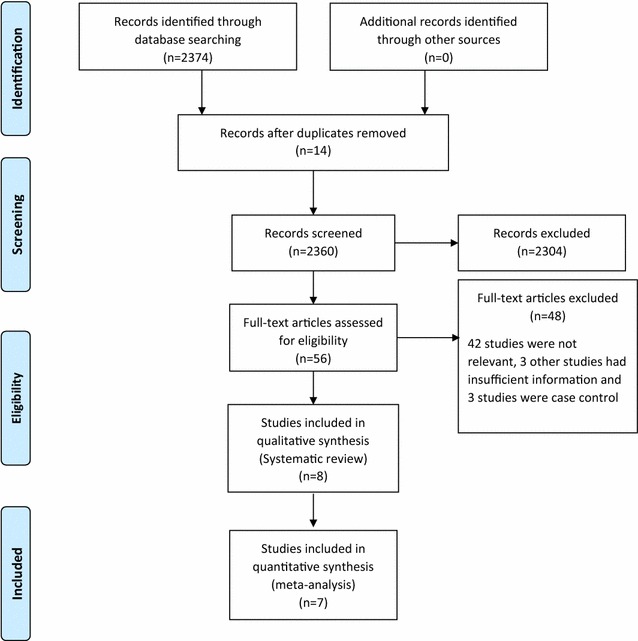
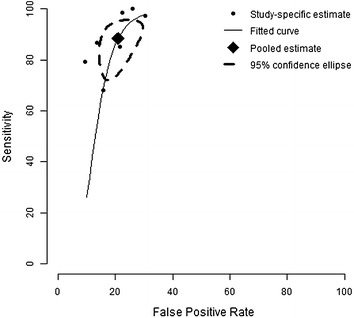
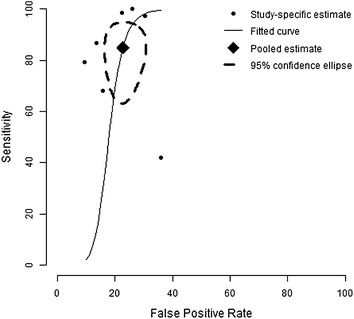
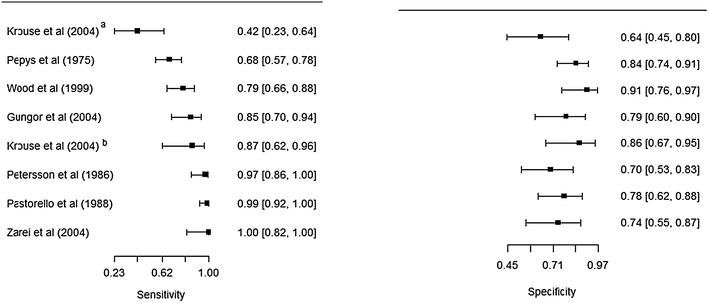
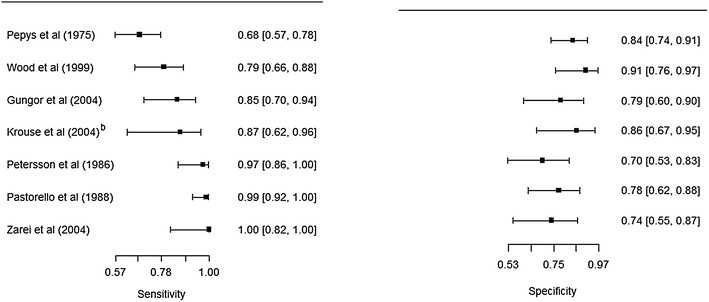
BACKGROUND: Allergic rhinitis is the most common form of allergy worldwide. The accuracy of skin testing for allergic rhinitis is still debated. Our primary objective was to evaluate the diagnostic accuracy of skin-prick testing for allergic rhinitis using the nasal provocation as the reference standard. We also evaluated the diagnostic accuracy of intradermal testing as a secondary objective. METHODS: We searched EBM Reviews from 2005 to March 2015; Embase from 1980 to March 2015; and Ovid MEDLINE(R) from 1946 to until March 2015. We included any study with at least 10 subjects including children. We excluded non-English studies. We performed data extraction and quality assessment using the QUADAS-2 tool. RESULTS: We meta-analysed seven studies assessing the accuracy of skin-prick testing using the bivariate random-effects model, including a total of 430 patients. The pooled estimate for sensitivity and specificity for skin-prick testing was 85 and 77 % respectively. We did not pool results for intradermal testing due to few number of studies (n = 4), each with very small sample size. Of these, two evaluated the accuracy of intradermal testing in confirming skin-prick testing results, with sensitivity ranging from 27 to 50 % and specificity ranging from 60 to 100 %. The other two evaluated the accuracy of intradermal testing as a stand-alone test for diagnosing allergic rhinitis with sensitivity ranging from 60 to 79 % and specificity ranging from 68 to 69 %. CONCLUSIONS: Findings from this review suggest that skin-prick testing is accurate in discriminating subjects with or without allergic rhinitis.
Overview
The claims and statistics of this paper haven’t been checked yet.
Free: it reads the open-access text and checks the first 5 claims that cite a source we can check. Create a free account to check every claim.
Integrity signals
Registry
Cites
Statistics
Figures
Verification
Claims the paper makes
The claims and statistics of this paper haven’t been checked yet.
Free: it reads the open-access text and checks the first 5 claims that cite a source we can check. Create a free account to check every claim.
Claims other papers make about this one
Each is checked against this paper’s own text: does it say what the citing paper says it does?
The source backs part of the claim, not all of it — or backs it for a different population, condition or comparison.
In the citing paper
“The average pooled sensitivity of SPT is 85% which is often slightly higher than that of serum sIgE testing830”
From International Consensus Statement on Allergy and Rhinology: Allergic Rhinitis (2018) · cites this paper as [830]
Experimental — accuracy not yet measuredThe cited source says what the claim attributes to it.
In the citing paper
“This is lower than the pooled estimates of sensitivity (85-88%) and specificity (77%) for SPT, calculated from recent meta-analyses.830,854”
From International Consensus Statement on Allergy and Rhinology: Allergic Rhinitis (2018) · cites this paper as [830]
The cited source says what the claim attributes to it.
In the citing paper
“Nevis et al.830 conducted a systematic review of 4 studies to determine the sensitivity and specificity of intradermal testing when used as a confirmatory test following negative SPT. Sensitivity ranged from 27% (95% CI, 10% to 57%) to 50% (sample sizes were too small to calculate CI), while specificity ranged from 69% (95% CI, 51% to 83%) to 100% (95% CI, 83% to 100%).”
From International Consensus Statement on Allergy and Rhinology: Allergic Rhinitis (2018) · cites this paper as [830]
The cited source says what the claim attributes to it.
In the citing paper
“Nonetheless, a recent meta-analysis indicates that SPT remains an accurate test, which when combined with a detailed clinical history, helps confirm the diagnosis of AR830”
From International Consensus Statement on Allergy and Rhinology: Allergic Rhinitis (2018) · cites this paper as [830]
Self-check
Percentages, sums and reported differences re-computed from the paper’s own numbers.
The self-check needs the paper’s full text.
Citations
Cites
Preferred Reporting Items for Systematic Reviews and Meta-Analyses: the PRISMA statement
Moher, D., Liberati, A., Tetzlaff, J., Altman, D. G., & for the PRISMA Group (2009) · BMJ · doi:10.1136/bmj.b2535 · Cited by 83,823
Preferred reporting items for systematic reviews and meta-analyses: the PRISMA Statement.
(2009) · PubMed Central · Cited by 44,859
Preferred reporting items for systematic reviews and meta-analyses: The PRISMA statement
Moher, D., Liberati, A., Tetzlaff, J., Altman, D. G., & the PRISMA Group* (2009) · Annals of Internal Medicine · doi:10.7326/0003-4819-151-4-200908180-00135 · Cited by 37,554
QUADAS-2: a revised tool for the quality assessment of diagnostic accuracy studies
Whiting, P. F., Rutjes, A. W. S., Westwood, M. E., Mallett, S., Deeks, J. J., Reitsma, J. B., Leeflang, M. M. G., Sterne, J. A. C., Bossuyt, P. M. M., & the QUADAS-2 Group* (2011) · Annals of Internal Medicine · doi:10.7326/0003-4819-155-8-201110180-00009 · Cited by 14,199
Allergic Rhinitis and its Impact on Asthma (ARIA) 2008*
Bousquet, J., Khaltaev, N., Cruz, A. A., Denburg, J., Fokkens, W. J., Togias, A., Zuberbier, T., Baena‐Cagnani, C. E., Canonica, G. W., Van Weel, C., et al. (2008) · Allergy · doi:10.1111/j.1398-9995.2007.01620.x · Cited by 4,729
Allergic Rhinitis and Its Impact on Asthma
Bousquet, J., van Cauwenberge, P., & Khaltaev, N. (2001) · Journal of Allergy and Clinical Immunology · doi:10.1067/mai.2001.118891 · Cited by 3,588
Reitsma, J. B., Glas, A. S., Rutjes, A. W. S., Scholten, R. J. P. M., Bossuyt, P. M., & Zwinderman, A. H. (2005) · Journal of Clinical Epidemiology · doi:10.1016/j.jclinepi.2005.02.022 · Cited by 3,369
Naclerio, R. M. (2003) · Cited by 985
Allergic rhinitis: Definition, epidemiology, pathophysiology, detection, and diagnosis
Skoner, D. P. (2001) · Journal of Allergy and Clinical Immunology · doi:10.1067/mai.2001.115569 · Cited by 914
Allergic Rhinitis and its Impact on Asthma (ARIA)
Bousquet, J. (2003) · Clinical & Experimental Allergy Reviews · doi:10.1046/j.1472-9725.2003.00063.x · Cited by 734
Allergy Diagnostic Testing: An Updated Practice Parameter
Bernstein, I. L., Li, J. T., Bernstein, D. I., Hamilton, R., Spector, S. L., Tan, R., Sicherer, S., Golden, D. B. K., Khan, D. A., Nicklas, R. A., et al. (2008) · Annals of Allergy, Asthma & Immunology · doi:10.1016/s1081-1206(10)60305-5 · Cited by 723 · cited 5×
“Although we could not establish the source of heterogeneity in testing accuracy across studies, several factors that influence accuracy of skin-prick testing have been reported in the literature [9, 27].”
BackgroundMethodInfluentialWheatley, L. M., & Togias, A. (2015) · New England Journal of Medicine · doi:10.1056/nejmcp1412282 · Cited by 606
Burden of allergic rhinitis: Results from the Pediatric Allergies in America survey
Meltzer, E. O., Blaiss, M. S., Derebery, M. J., Mahr, T. A., Gordon, B. R., Sheth, K. K., Simmons, A. L., Wingertzahn, M. A., & Boyle, J. M. (2009) · Journal of Allergy and Clinical Immunology · doi:10.1016/j.jaci.2009.05.013 · Cited by 553
The diagnosis of food allergy: a systematic review and meta‐analysis
Soares‐Weiser, K., Takwoingi, Y., Panesar, S. S., Muraro, A., Werfel, T., Hoffmann‐Sommergruber, K., Roberts, G., Halken, S., Poulsen, L., van Ree, R., et al. (2014) · Allergy · doi:10.1111/all.12333 · Cited by 235
Allergic rhinitis: Direct and indirect costs
Blaiss, M. S. (2010) · Allergy and Asthma Proceedings · doi:10.2500/aap.2010.31.3329 · Cited by 220
A comparison of skin prick tests, intradermal skin tests, and RASTs in the diagnosis of cat allergy
Wood, R. A., Phipatanakul, W., Hamilton, R. G., & Eggleston, P. A. (1999) · Journal of Allergy and Clinical Immunology · doi:10.1016/s0091-6749(99)70419-7 · Cited by 201 · cited 7×
“All four studies [14, 15, 20, 24] restricted the analysis to single-allergen extracts.”
BackgroundInfluentialCow's milk allergy: diagnostic accuracy of skin prick and patch tests and specific IgE
Majamaa, H., Moisio, P., Kautiainen, H., Majamaa, H., Turjanmaa, K., & Holm, K. (1999) · Allergy · doi:10.1034/j.1398-9995.1999.00834.x · Cited by 164
Skin test reactivity and clinical allergen sensitivity in infancy
van Asperen, P. P., Kemp, A. S., & Mellis, C. (1984) · Journal of Allergy and Clinical Immunology · doi:10.1016/0091-6749(84)90412-3 · Cited by 113
The burden of allergic rhinitis (AR) in Canada: perspectives of physicians and patients
Keith, P. K., Desrosiers, M., Laister, T., Schellenberg, R. R., & Waserman, S. (2012) · Allergy, Asthma & Clinical Immunology · doi:10.1186/1710-1492-8-7 · Cited by 104
Clinical relevance is associated with allergen‐specific wheal size in skin prick testing
Haahtela, T., Burbach, G. J., Bachert, C., Bindslev‐Jensen, C., Bonini, S., Bousquet, J., Bousquet‐Rouanet, L., Bousquet, P. J., Bresciani, M., Bruno, A., et al. (2014) · Clinical & Experimental Allergy · doi:10.1111/cea.12240 · Cited by 84
Bødtger, U. C. S., Poulsen, L. K., & Malling, H. (2003) · Journal of Allergy and Clinical Immunology · doi:10.1067/mai.2003.37 · Cited by 76
RAST, skin and nasal tests and the history in grass pollen allergy
PEPYS, J., ROTH, A., & CARROLL, K. B. (1975) · Clinical & Experimental Allergy · doi:10.1111/j.1365-2222.1975.tb01882.x · Cited by 72
Management of allergic and nonallergic rhinitis.
Long, A., McFadden, C., Devine, D. V., Chew, P. W., Kupelnick, B., & Lau, J. (2002) · PubMed Central · Cited by 66
Clinical History, Skin Prick Test and RAST in the Diagnosis of Birch and Timothy Pollinosis
Petersson, G., Djueborg, S., & Ingestad, R. (1986) · Allergy · doi:10.1111/j.1398-9995.1986.tb00319.x · Cited by 51
Diagnosis of food allergy: tests in vivo and in vitro
Dreborg, S. K. G. (2001) · Pediatric Allergy and Immunology · doi:10.1034/j.1399-3038.2001.121406.x · Cited by 46
Krouse, J. H., Sadrazodi, K., & Kerswill, K. (2004) · Otolaryngology–Head and Neck Surgery · doi:10.1016/j.otohns.2004.03.024 · Cited by 42 · cited 9×
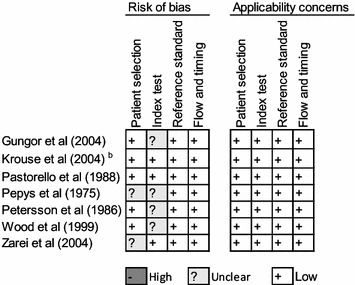
“+ + + + + + Krouse et al (2004) b + + + + + + + + Pastorello et al (1988) + + + + + + + + Pepys et al (1975) ?”
BackgroundInfluentialA Comparison of Skin Endpoint Titration and Skin-Prick Testing in the Diagnosis of Allergic Rhinitis
Gungor, A., Houser, S. M., Aquino, B. F., Akbar, I., Moinuddin, R., Mamikoglu, B., & Corey, J. P. (2004) · Ear, Nose & Throat Journal · doi:10.1177/014556130408300118 · Cited by 36 · cited 9×
“…te st R ef er en ce s ta nd ar d R ef er en ce s ta nd ar d Fl ow a nd ti m in g Fl ow a nd ti m in g P at ie nt s el ec tio n P at ie nt s el ec tio n In de x te st In de x te st R ef er en ce s ta nd ar d R ef er en ce s ta nd ar d Fl ow a nd ti m in g Fl ow a nd ti m in g Gungor et al (2004) + ?”
BackgroundMethodInfluentialSkin Testing in Predicting Response to Nasal Provocation with Alternaria
Krouse, J. H., Shah, A. G., & Kerswill, K. (2004) · The Laryngoscope · doi:10.1097/00005537-200408000-00013 · Cited by 36
Optimal skin prick wheal size for diagnosis of cat allergy
Zarei, M., Remer, C. F., Kaplan, M., Staveren, A. M., Lin, C.-K. E., Razo, E., & Goldberg, B. J. (2004) · Annals of Allergy Asthma & Immunology · doi:10.1016/s1081-1206(10)61425-1 · Cited by 28
Quality Control Tool for Screening Titles and Abstracts by seco nd Reviewer: QCTSTAR
N, N. I. S. (2015) · Journal of Biometrics & Biostatistics · doi:10.4172/2155-6180.1000230 · Cited by 22
Variability In Measurement Of Allergen Skin Testing Results Among Allergy-Immunology Specialists
Jean, T., Kwong, K. Y. C., & Redjal, N. (2014) · Journal of Allergy and Clinical Immunology · doi:10.1016/j.jaci.2013.12.767 · Cited by 20
Clinical reliability of diagnostic tests in allergic rhinoconjunctivitis.
Pastorello, E. A., Codecasa, L. R., Pravettoni, V., Qualizza, R., Incorvaia, C., Ispano, M., Stocchi, L., Guidoboni, A., & Zanussi, C. (1988) · PubMed · Cited by 14
Measured depth of subcutaneous tissue on posterolateral arm of omalizumab patients
Potts, R., Kim, L., Eeuwes, C., Dominic, A., Nevis, I., & Kim, H. L. (2012) · Allergy Asthma and Clinical Immunology · doi:10.1186/1710-1492-8-s1-a5 · Cited by 3
Self-citationAccuracy of Prick Skin Tests for Ingestant Hypersensitivity Diagnosis
Eaton, K. K. (2004) · Journal of Nutritional & Environmental Medicine · doi:10.1080/13590840410001734901 · Cited by 2
Cited by
Bousquet, J., Anto, J. M., Bachert, C., Baiardini, I., Bosnic-Anticevich, S., Walter Canonica, G., Melén, E., Palomares, O., Scadding, G. K., Togias, A., et al. (2020) · Nature Reviews Disease Primers · doi:10.1038/s41572-020-00227-0 · Cited by 942
International Consensus Statement on Allergy and Rhinology: Allergic Rhinitis
Wise, S. K., Lin, S. Y., Toskala, E., Orlandi, R. R., Akdis, C. A., Alt, J. A., Azar, A., Baroody, F. M., Bachert, C., Canonica, G. W., et al. (2018) · International Forum of Allergy & Rhinology · doi:10.1002/alr.22073 · Cited by 557
International consensus statement on allergy and rhinology: Allergic rhinitis – 2023
Wise, S. K., Damask, C., Roland, L. T., Ebert, C., Levy, J. M., Lin, S., Luong, A., Rodriguez, K., Sedaghat, A. R., Toskala, E., et al. (2023) · International Forum of Allergy & Rhinology · doi:10.1002/alr.23090 · Cited by 507
Allergic rhinitis: diagnosis and management
Siddiqui, Z., Walker, A., Pirwani, M., Tahiri, M., & Syed, I. (2022) · British Journal of Hospital Medicine · doi:10.12968/hmed.2021.0570 · Cited by 176
Allergic Rhinitis in Childhood and the New EUFOREA Algorithm
Scadding, G. K., Smith, P. K., Blaiss, M. S., Roberts, G. C., Hellings, P. W., Gevaert, P., Donald, M. M., Sih, T., Halken, S., Zieglmayer, P. U., et al. (2021) · Frontiers in Allergy · doi:10.3389/falgy.2021.706589 · Cited by 109
Metadata
- Authors
- Nevis, I. F., Binkley, K., & Kabali, C.
- Affiliations
- Ontario Health (CA)
- University of Toronto (CA)
- Corresponding author
- Nevis, Immaculate F.
- Venue
- Allergy, Asthma & Clinical Immunology
- Published
- 2016-04-27
- Volume
- 12
- Issue
- 1
- Pages
- 20-20
- ISSN
- 1710-1484 (ISSN-L)
- 1710-1492
- PMC
- PMC4848807
- OpenAlex
- W2344310330
- Cited by
- 88
- References
- 34
- Citations by year
- 2026: 7 · 2025: 7 · 2024: 10 · 2023: 10 · 2022: 9 · 2021: 11 · 2020: 17 · 2019: 9 · 2018: 4 · 2017: 3
- FWCI
- 0.79
- Type
- journal article
- Language
- en
- Open access
- gold
- doi.org
- Licence
- cc-by
- Locations
- Allergy Asthma and Clinical Immunology (publishedVersion, cc-by)
- Europe PMC (PubMed Central) (publishedVersion, cc-by)
- PubMed Central (publishedVersion, cc-by)
- PubMed (publishedVersion)
- TSpace (University of Toronto) (submittedVersion)
- Topics
- Health Sciences › Medicine › Immunology and Allergy › Allergic Rhinitis and Sensitization
- Health Sciences › Medicine › Immunology and Allergy › Food Allergy and Anaphylaxis Research
- Health Sciences › Medicine › Pulmonary and Respiratory Medicine › Asthma and respiratory diseases
- Keywords
- allergic rhinitis, skin prick test, intradermal test, diagnostic accuracy, sensitivity and specificity, nasal provocation, allergen testing, children
About these checks
Registry, retraction, Cites and statistics results are computed, not judged, with one exception: a printed reference that no index lists is read once by a model before it counts as a citation error. Claims are extracted by a model and kept only when their quote appears verbatim in the text; each cited source is then checked, with a model’s help, for whether it says what the claim relies on. Those verdicts can be wrong — read the claim’s quote and the cited source before relying on one.
Statistics and arithmetic are recomputed, not judged.
Confidence bands are shown only for fields calibrated on our annotated test set. None is calibrated yet, so no band is shown.
What counts as a claim ›How we measure confidence ›How we check this ›
Are you an author, or do you see a problem with this page? Request a review
Data sources
Bibliographic data: Semantic Scholar, OpenAlex, Crossref.
Contains information from the Semantic Scholar Academic Graph Datasets, made available under the ODC Attribution License (ODC-BY 1.0).
Semantic Scholar’s data is described in: Kinney, R., et al. (2023). The Semantic Scholar Open Data Platform. arXiv:2301.10140.
