

Hypersensitive pupillary light reflex in infants at risk for autism
Open accessThe DOI matches its Crossref record; 32 of the 32 references it cites were found in a registry or an index.
Abstract
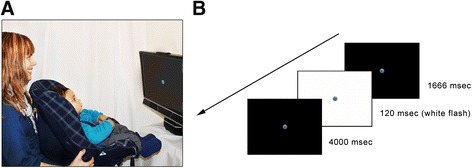
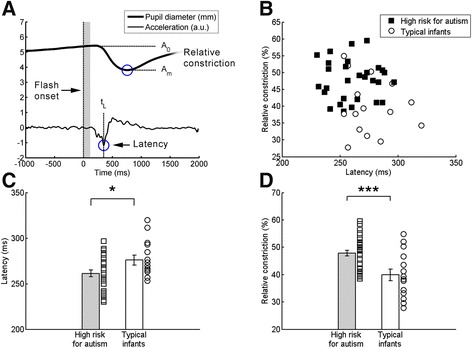
BACKGROUND: Post mortem brain tissue data and animal modeling work indicate cholinergic disruptions in autism. Moreover, the cholinergic system plays a key role in the early neurodevelopmental processes believed to be derailed early in life in individuals with the disorder. Yet, there is no data from human infants supporting a developmentally important role of this neurotransmitter system. Because the pupillary light reflex depends largely on cholinergic synaptic transmission, we assessed this reflex in a sample of infants at risk for autism as well as infants at low (average) risk. METHODS: Ten-month-old infants with an older sibling with autism (n = 29, 16 females), and thus a genetic predisposition to developing the disorder themselves, were presented with white flashes on a computer monitor, and pupillary responses were captured using eye tracking. A control group matched on age and developmental level (n = 15, seven females) was also tested. RESULTS: The siblings of children with autism had a faster and stronger pupillary light reflex compared to control infants. Baseline pupil diameter was equal in the two groups, ruling out tonic autonomic imbalance as an explanation for these differences. CONCLUSIONS: This study establishes that infant siblings of children with autism have hypersensitive pupillary light reflexes, a result which supports the view that altered sensory processing in infancy is associated with elevated autism risk. Moreover, the study indicates that individual differences in autism susceptibility are linked to differences in the cholinergic system during an early developmental period.
Overview
The claims and statistics of this paper haven’t been checked yet.
Free: it reads the open-access text and checks the first 5 claims that cite a source we can check. Create a free account to check every claim.
Integrity signals
Registry
Cites
Statistics
Figures
Verification
Claims the paper makes
The claims and statistics of this paper haven’t been checked yet.
Free: it reads the open-access text and checks the first 5 claims that cite a source we can check. Create a free account to check every claim.
Claims other papers make about this one
Each is checked against this paper’s own text: does it say what the citing paper says it does?
The source backs part of the claim, not all of it — or backs it for a different population, condition or comparison.
In the citing paper
“however, most infants had latency and constriction amplitudes that fell within the range of the control values (51).”
From Autism Spectrum Disorder in Children Is Not Associated With Abnormal Autonomic Nervous System Function: Hypothesis and Theory (2022) · cites this paper as [51]
Experimental — accuracy not yet measuredThe source backs part of the claim, not all of it — or backs it for a different population, condition or comparison.
In the citing paper
“Nyström et al. concluded that “infants at risk for autism have a hypersensitive pupillary light reflex,” suggested to be due to cholinergic autonomic “disruptions”; however, most infants had latency and constriction amplitudes that fell within the range of the control values (51).”
From Autism Spectrum Disorder in Children Is Not Associated With Abnormal Autonomic Nervous System Function: Hypothesis and Theory (2022) · cites this paper as [51]
Experimental — accuracy not yet measuredThe source backs part of the claim, not all of it — or backs it for a different population, condition or comparison.
In the citing paper
“Hence, children with autism have a robust pupillary light reflex.”
From Autism Spectrum Disorder in Children Is Not Associated With Abnormal Autonomic Nervous System Function: Hypothesis and Theory (2022) · cites this paper as [51]
Experimental — accuracy not yet measuredThe source backs part of the claim, not all of it — or backs it for a different population, condition or comparison.
In the citing paper
“They may have a response that is not different from typically developing children, or they may have a response that is different in some features but not in other characteristics.”
From Autism Spectrum Disorder in Children Is Not Associated With Abnormal Autonomic Nervous System Function: Hypothesis and Theory (2022) · cites this paper as [51]
Experimental — accuracy not yet measured
Self-check
Percentages, sums and reported differences re-computed from the paper’s own numbers.
The self-check needs the paper’s full text.
Citations
Cites
Diagnostic and Statistical Manual of Mental Disorders, 5th ed.
Carter, M. J. (2014) · Therapeutic Recreation Journal · Cited by 15,166
Genetic Heritability and Shared Environmental Factors Among Twin Pairs With Autism
Hallmayer, J. (2011) · Archives of General Psychiatry · doi:10.1001/archgenpsychiatry.2011.76 · Cited by 1,970 · cited 1×
“Recent studies indicate that shared environmental influences are negligible in autism, and the genetic risk is predominantly due to common variants ([28,29] but see [30]).”
BackgroundBehavioral manifestations of autism in the first year of life
Zwaigenbaum, L., Bryson, S., Rogers, T., Roberts, W., Brian, J., & Szatmari, P. (2005) · International Journal of Developmental Neuroscience · doi:10.1016/j.ijdevneu.2004.05.001 · Cited by 1,602 · cited 1×
“Little is known about the early neurodevelopmental events that shape the autistic behavioral phenotype, which typically emerges during toddlerhood and early childhood [1].”
BackgroundRecurrence Risk for Autism Spectrum Disorders: A Baby Siblings Research Consortium Study
Ozonoff, S., Young, G. S., Carter, A., Messinger, D., Yirmiya, N., Zwaigenbaum, L., Bryson, S., Carver, L. J., Constantino, J. N., Dobkins, K., et al. (2011) · Pediatrics · doi:10.1542/peds.2010-2825 · Cited by 1,429 · cited 2×
“Therefore, many studies are currently being carried out on infants at risk for autism (for example, siblings of children with the disorder, in which the recurrence rate may be as high as 20%) which can inform about processes in infancy that are associated with autism susceptibility [2,3].”
BackgroundAttention to eyes is present but in decline in 2–6-month-old infants later diagnosed with autism
Jones, W., & Klin, A. (2013) · Nature · doi:10.1038/nature12715 · Cited by 1,293
Most genetic risk for autism resides with common variation
Gaugler, T., Klei, L., Sanders, S. J., Bodea, C. A., Goldberg, A. P., Lee, A. B., Mahajan, M., Manaa, D., Pawitan, Y., Reichert, J., et al. (2014) · Nature Genetics · doi:10.1038/ng.3039 · Cited by 1,239 · cited 1×
“Recent studies indicate that shared environmental influences are negligible in autism, and the genetic risk is predominantly due to common variants ([28,29] but see [30]).”
BackgroundSandin, S., Lichtenstein, P., Kuja-Halkola, R., Larsson, H., Hultman, C. M., & Reichenberg, A. (2014) · JAMA · doi:10.1001/jama.2014.4144 · Cited by 1,073 · cited 1×
“Recent studies indicate that shared environmental influences are negligible in autism, and the genetic risk is predominantly due to common variants ([28,29] but see [30]).”
BackgroundBrain nicotinic acetylcholine receptors: native subtypes and their relevance
Gotti, C., Zoli, M., & Clementi, F. (2006) · Trends in Pharmacological Sciences · doi:10.1016/j.tips.2006.07.004 · Cited by 882 · cited 1×
“ceptors, which are known to modulate other autismrelated neurotransmitters as well [11,33].”
BackgroundMapping early brain development in autism
Courchesne, E., Pierce, K., Schumann, C. M., Redcay, E., Buckwalter, J. A., Kennedy, D. P., & Morgan, J. (2007) · Neuron · doi:10.1016/j.neuron.2007.10.016 · Cited by 860 · cited 1×
“ing neuronal pathfinding and cell survival [11,12].”
Wolff, J. J., Gu, H., Gerig, G., Elison, J. T., Styner, M., Gouttard, S., Botteron, K. N., Dager, S. R., Dawson, G., Estes, A. M., et al. (2012) · American Journal of Psychiatry · doi:10.1176/appi.ajp.2011.11091447 · Cited by 671 · cited 2×
“Reversal of group differences as a function of time has been reported by at least two recent studies comparing autistic infants with controls [26,27].”
BackgroundResultMullen Scales of Early Learning: Ags Edition
Dumont, R., & Willis, J. O. (2008) · Encyclopedia of Special Education · doi:10.1002/9780470373699.speced1402 · Cited by 662
The Pupil: Anatomy, Physiology, and Clinical Applications
Loewenfeld, I. E., & Lowenstein, O. E. (1999) · Cited by 627
Developmental pathways to autism: A review of prospective studies of infants at risk
Jones, E. J. H., Gliga, T., Bedford, R., Charman, T., & Johnson, M. H. (2014) · Neuroscience & Biobehavioral Reviews · doi:10.1016/j.neubiorev.2013.12.001 · Cited by 607
The Intense World Theory – A Unifying Theory of the Neurobiology of Autism
Markram, K., & Markram, H. (2010) · Frontiers in Human Neuroscience · doi:10.3389/fnhum.2010.00224 · Cited by 515
Disengagement of Visual Attention in Infancy is Associated with Emerging Autism in Toddlerhood
Elsabbagh, M., Fernandes, J., Jane Webb, S., Dawson, G., Charman, T., & Johnson, M. H. (2013) · Biological Psychiatry · doi:10.1016/j.biopsych.2012.11.030 · Cited by 431
Leblond, C. S., Heinrich, J., Delorme, R., Proepper, C., Betancur, C., Huguet, G., Konyukh, M., Chaste, P., Ey, E., Rastam, M., et al. (2012) · PLoS Genetics · doi:10.1371/journal.pgen.1002521 · Cited by 429 · cited 2×
“[13-15], rodent models [16,17], and molecular genetic studies [18] suggest that alterations of the cholinergic system are involved in the etiology of autism.”
BackgroundCholinergic Activity in Autism: Abnormalities in the Cerebral Cortex and Basal Forebrain
Perry, E. K., Lee, M. L. W., Martin-Ruiz, C. M., Court, J. A., Volsen, S. G., Merrit, J., Folly, E., Iversen, P. E., Bauman, M. L., Perry, R. H., et al. (2001) · American Journal of Psychiatry · doi:10.1176/appi.ajp.158.7.1058 · Cited by 387 · cited 2×
“[13-15], rodent models [16,17], and molecular genetic studies [18] suggest that alterations of the cholinergic system are involved in the etiology of autism.”
BackgroundThe Broader Autism Phenotype in Infancy: When Does It Emerge?
Ozonoff, S., Young, G. S., Belding, A., Hill, M., Hill, A., Hutman, T., Johnson, S., Miller, M., Rogers, S. J., Schwichtenberg, A. J., et al. (2014) · Journal of the American Academy of Child & Adolescent Psychiatry · doi:10.1016/j.jaac.2013.12.020 · Cited by 319 · cited 2×
“The detection of these group differences prior to the emergence of the symptoms of autism [24] adds credibility to the view that cholinergic disruption may have a causal role, as hypothesized earlier based on nondevelopmental human data and animal work [13-16,18].”
BackgroundNicotinic receptor abnormalities in the cerebellar cortex in autism
Lee, M. (2002) · Brain · doi:10.1093/brain/awf160 · Cited by 232 · cited 3×
“autism [14] and mediates fast excitatory synaptic transmission in the pupillary light reflex circuit in animals”
BackgroundAcetylcholine Elevation Relieves Cognitive Rigidity and Social Deficiency in a Mouse Model of Autism
Karvat, G., & Kimchi, T. (2014) · Neuropsychopharmacology · doi:10.1038/npp.2013.274 · Cited by 204 · cited 2×
“[13-15], rodent models [16,17], and molecular genetic studies [18] suggest that alterations of the cholinergic system are involved in the etiology of autism.”
BackgroundDevelopmental aspects of the cholinergic system
Abreu-Villaça, Y., Filgueiras, C. C., & Manhães, A. C. (2011) · Behavioural Brain Research · doi:10.1016/j.bbr.2009.12.049 · Cited by 162 · cited 2×
“ceptors, which are known to modulate other autismrelated neurotransmitters as well [11,33].”
BackgroundCholinergic deficiency in Alzheimer's and Parkinson's disease: Evaluation with pupillometry
Fotiou, D. F., Stergiou, V., Tsiptsios, D., Lithari, C. D., Νάκου, Μ., & Karlovasitou, A. (2009) · International Journal of Psychophysiology · doi:10.1016/j.ijpsycho.2009.01.011 · Cited by 161 · cited 1×
“Moreover, given the link between the pupillary light reflex and the cholinergic system [8-10], the study also provides specific, albeit indirect, support for the view that cholinergic disruptions could be involved in the etiology of the disorder.”
BackgroundLatency of the Pupil Light Reflex: Sample Rate, Stimulus Intensity, and Variation in Normal Subjects
Bergamin, O., & Kardon, R. H. (2003) · Investigative Opthalmology & Visual Science · doi:10.1167/iovs.02-0468 · Cited by 154 · cited 1×
“Pupillary light reflex latencies were calculated according to established standards [23]: a fivepoint second-order polynomial moving Savitzky-Golay filter was applied before resampling the signal to 300 Hz to achieve better temporal resolution.”
MethodLack of Visual Orienting to Biological Motion and Audiovisual Synchrony in 3-Year-Olds with Autism
Falck‐Ytter, T., Rehnberg, E., & Bölte, S. (2013) · PLoS ONE · doi:10.1371/journal.pone.0068816 · Cited by 140 · cited 1×
“Before each trial, a 15-s video clip with two dynamically moving point light displays (16 points) was presented, one on each side of the screen [20].”
MethodSelf-citationMcTighe, S. M., Neal, S. J., Lin, Q., Hughes, Z. A., & Smith, D. G. (2013) · PLoS ONE · doi:10.1371/journal.pone.0062189 · Cited by 131 · cited 1×
“[13-15], rodent models [16,17], and molecular genetic studies [18] suggest that alterations of the cholinergic system are involved in the etiology of autism.”
BackgroundAutonomic components of the human pupillary light reflex.
Heller, P. H., Perry, F., Jewett, D. L., & Levine, J. D. (1990) · PubMed · Cited by 130
Atypical pupillary light reflex and heart rate variability in children with autism spectrum disorder
Daluwatte, C., Miles, J. H., Christ, S. E., Beversdorf, D. Q., Takahashi, T. N., & Yao, G. (2013) · Journal of Autism and Developmental Disorders · doi:10.1007/s10803-012-1741-3 · Cited by 128 · cited 1×
“typical) was smaller (and absent for some measures) in the youngest children [25].”
BackgroundAbnormal transient pupillary light reflex in individuals with autism spectrum disorders
Fan, X., Miles, J. H., Takahashi, N., & Yao, G. (2009) · Journal of Autism and Developmental Disorders · doi:10.1007/s10803-009-0767-7 · Cited by 121 · cited 3×
“It is notable that the direction of the group difference is opposite to what could be expected from one study of the pupillary light reflex in adults, which showed hyposensitivity to light in individuals with autism [6].”
BackgroundMethodResultInfluentialUllian, E. M., McIntosh, J. M., & Sargent, P. B. (1997) · The Journal of Neuroscience · doi:10.1523/jneurosci.17-19-07210.1997 · Cited by 118 · cited 1×
“It is notable that the nicotinic acetylcholine receptor subunit alpha 7 is upregulated in individuals with autism [14] and mediates fast excitatory synaptic transmission in the pupillary light reflex circuit in animals [32].”
BackgroundLavoie, J., Maziade, M., & Hébert, M. (2013) · Progress in Neuro-Psychopharmacology and Biological Psychiatry · doi:10.1016/j.pnpbp.2013.09.020 · Cited by 115 · cited 1×
“Future studies should also evaluate whether retinal [34] or axonal [26] differences could be involved in shaping the altered pupil response in the infants at risk for autism.”
BackgroundTranslational approaches to the biology of Autism: false dawn or a new era?
Ecker, C., Spooren, W., & Murphy, D. G. M. (2013) · Molecular Psychiatry · doi:10.1038/mp.2012.102 · Cited by 92 · cited 1×
“Finally, autism research is in strong need for biological markers that can inform the search for precise molecular mechanisms and that have high translational potential [7].”
BackgroundSokol, D. K., Dunn, D. W., Edwards-Brown, M., & Feinberg, J. (2002) · Journal of Child Neurology · doi:10.1177/088307380201700401 · Cited by 52 · cited 2×
“[13-15], rodent models [16,17], and molecular genetic studies [18] suggest that alterations of the cholinergic system are involved in the etiology of autism.”
Background
Cited by
Loth, E., Charman, T., Mason, L., Tillmann, J., Jones, E. J. H., Wooldridge, C., Ahmad, J., Auyeung, B., Brogna, C., Ambrosino, S., et al. (2017) · Molecular Autism · doi:10.1186/s13229-017-0146-8 · Cited by 299
“For example, we assess the pupillary light reflex, which largely depends on cholinergic synaptic transmission [59].”
Self-citationEyeing up the Future of the Pupillary Light Reflex in Neurodiagnostics
Hall, C., & Chilcott, R. (2018) · Diagnostics · doi:10.3390/diagnostics8010019 · Cited by 230
“The difference in age among the studies' subjects, who ranged from 10-month-old infants [100] up to children >5 years of age [61, 98, 99] , may provide an explanation for the contrasting data.”
BackgroundMethodResultInfluentialJones, E. J. H., Venema, K., Earl, R., Lowy, R., Barnes, K., Estes, A., Dawson, G., & Webb, S. J. (2016) · Journal of Neurodevelopmental Disorders · doi:10.1186/s11689-016-9139-8 · Cited by 164
“Further, while children with ASD show a longer latency pupillary constriction to a sudden increase in luminance [87], infants at high familial risk show a faster constriction [88].”
BackgroundMcPartland, J. C., Bernier, R., Jeste, S., Dawson, G., Nelson, C. A., Chawarska, K., Earl, R. K., Faja, S., Johnson, S. P., Sikich, L., et al. (2020) · Frontiers in Integrative Neuroscience · doi:10.3389/fnint.2020.00016 · Cited by 163
Enhanced pupillary light reflex in infancy is associated with autism diagnosis in toddlerhood
Nyström, P., Gliga, T., Jobs, E. N., Gredebäck, G., Charman, T., Johnson, M. H., Bölte, S., & Falck‐Ytter, T. (2018) · Nature Communications · doi:10.1038/s41467-018-03985-4 · Cited by 146
Self-citation
Metadata
- Authors
- Nyström, P., Gredebäck, G., Bölte, S., Falck-Ytter, T., & EASE team
- Affiliations
- Uppsala University (SE)
- Region Stockholm (SE)
- Corresponding author
- Nyström, Pär
- Venue
- Molecular Autism
- Published
- 2015
- Volume
- 6
- Issue
- 1
- Pages
- 10
- ISSN
- 2040-2392 (ISSN-L)
- PMC
- PMC4352563
- OpenAlex
- W2116777943
- Cited by
- 79
- References
- 32
- Citations by year
- 2026: 3 · 2025: 8 · 2024: 5 · 2023: 8 · 2022: 10 · 2021: 4 · 2020: 8 · 2019: 7 · 2018: 8 · 2017: 6 · 2016: 11 · 2015: 1
- FWCI
- 5.22
- Type
- journal article
- Language
- en
- Open access
- gold
- doi.org
- Locations
- Molecular Autism (publishedVersion, cc-by)
- Europe PMC (PubMed Central) (publishedVersion, cc-by)
- PubMed Central (publishedVersion, cc-by)
- PubMed (publishedVersion)
- KTH Publication Database DiVA (KTH Royal Institute of Technology) (submittedVersion, other-oa)
- eSpace (Curtin University) (submittedVersion)
- Lund University Publications (Lund University) (submittedVersion)
- Funders
- European Federation of Pharmaceutical Industries and Associations
- European Commission (115300, FP7/2007)
- VINNOVA (259‐2012‐24)
- Svenska Forskningsrådet Formas (259-2012-24, 523-2009-7054)
- Vetenskapsrådet (523‐2009‐7054, 259-2012-24)
- Riksbankens Jubileumsfond (P12-0270:1)
- Innovative Medicines Initiative (115300)
- European Social Fund
- FP7 Ideas: European Research Council (312292)
- Topics
- Life Sciences › Neuroscience › Cognitive Neuroscience › Autism Spectrum Disorder Research
- Life Sciences › Biochemistry, Genetics and Molecular Biology › Genetics › Genetics and Neurodevelopmental Disorders
- Health Sciences › Medicine › Psychiatry and Mental health › Schizophrenia research and treatment
- Keywords
- pupillary light reflex, autism risk, infants, cholinergic system, siblings of autistic children, sensory processing, pupil size, brain development, autism susceptibility, eye tracking
About these checks
Registry, retraction, Cites and statistics results are computed, not judged, with one exception: a printed reference that no index lists is read once by a model before it counts as a citation error. Claims are extracted by a model and kept only when their quote appears verbatim in the text; each cited source is then checked, with a model’s help, for whether it says what the claim relies on. Those verdicts can be wrong — read the claim’s quote and the cited source before relying on one.
Statistics and arithmetic are recomputed, not judged.
Confidence bands are shown only for fields calibrated on our annotated test set. None is calibrated yet, so no band is shown.
What counts as a claim ›How we measure confidence ›How we check this ›
Are you an author, or do you see a problem with this page? Request a review
Data sources
Bibliographic data: Semantic Scholar, OpenAlex, Crossref.
Contains information from the Semantic Scholar Academic Graph Datasets, made available under the ODC Attribution License (ODC-BY 1.0).
Semantic Scholar’s data is described in: Kinney, R., et al. (2023). The Semantic Scholar Open Data Platform. arXiv:2301.10140.
