

Visuo-tactile integration in autism: atypical temporal binding may underlie greater reliance on proprioceptive information
Open accessThe DOI matches its Crossref record; 48 of the 48 references it cites were found in a registry or an index.
Abstract
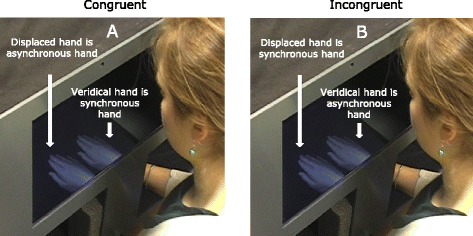
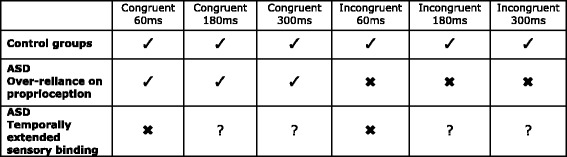
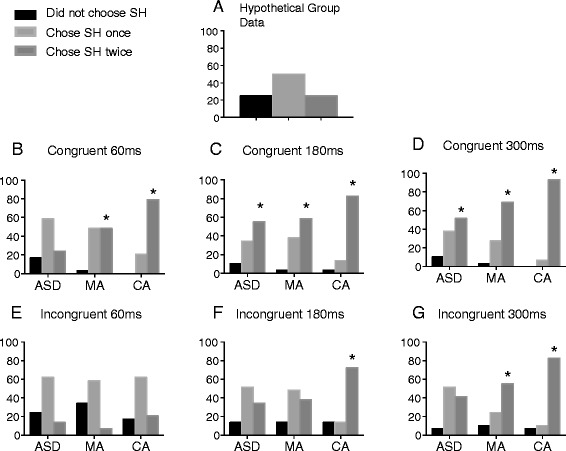
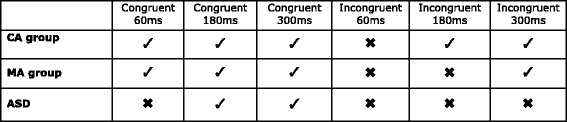
BACKGROUND: Evidence indicates that social functioning deficits and sensory sensitivities in autism spectrum disorder (ASD) are related to atypical sensory integration. The exact mechanisms underlying these integration difficulties are unknown; however, two leading accounts are (1) an over-reliance on proprioception and (2) atypical visuo-tactile temporal binding. We directly tested these theories by selectively manipulating proprioceptive alignment and visuo-tactile synchrony to assess the extent that these impact upon body ownership. METHODS: Children with ASD and typically developing controls placed their hand into a multisensory illusion apparatus, which presented two, identical live video images of their own hand in the same plane as their actual hand. One virtual hand was aligned proprioceptively with the actual hand (the veridical hand), and the other was displaced to the left or right. While a brushstroke was applied to the participants' actual (hidden) hand, they observed the two virtual images of their hand also being stroked and were asked to identify their real hand. During brushing, one of three different temporal delays was applied to either the displaced hand or the veridical hand. Thus, only one virtual hand had synchronous visuo-tactile inputs. RESULTS: Results showed that visuo-tactile synchrony overrides incongruent proprioceptive inputs in typically developing children but not in autistic children. Evidence for both temporally extended visuo-tactile binding and a greater reliance on proprioception are discussed. CONCLUSIONS: This is the first study to provide definitive evidence for temporally extended visuo-tactile binding in ASD. This may result in reduced processing of amodal inputs (i.e. temporal synchrony) over modal-specific information (i.e. proprioception). This would likely lead to failures in appropriately binding information from related events, which would impact upon sensitivity to sensory stimuli, body representation and social processes such as empathy and imitation.
Overview
The claims and statistics of this paper haven’t been checked yet.
Free: it reads the open-access text and checks the first 5 claims that cite a source we can check. Create a free account to check every claim.
Integrity signals
Registry
Cites
Statistics
Figures
Verification
Claims the paper makes
The claims and statistics of this paper haven’t been checked yet.
Free: it reads the open-access text and checks the first 5 claims that cite a source we can check. Create a free account to check every claim.
Claims other papers make about this one
Each is checked against this paper’s own text: does it say what the citing paper says it does?
The cited source says what the claim attributes to it.
In the citing paper
“ASD individuals are less susceptible to visual-tactile illusions (Cascio et al., 2012, Greenfield et al., 2015)”
From The impact of atypical sensory processing on social impairments in autism spectrum disorder (2018) · cites this paper as Greenfield et al., 2015
Self-check
Percentages, sums and reported differences re-computed from the paper’s own numbers.
The self-check needs the paper’s full text.
Citations
Cites
Diagnostic and Statistical Manual of Mental Disorders
American Psychiatric Association (2013) · doi:10.1176/appi.books.9780890425596 · Cited by 116,369
Rubber hands ‘feel’ touch that eyes see
Botvinick, M., & Cohen, J. (1998) · Nature · doi:10.1038/35784 · Cited by 4,410 · cited 2×
“This tendency is seen in RHI studies with both children [32] and adults [20] and supernumerary limb illusions [29–31, 36].”
Diagnostic and Statistical Manual of Mental Disorders, 5th Edition
(2013) · American Psychiatric Association Publishing eBooks · doi:10.1176/appi.books.9780890425596.893619 · Cited by 4,383
The weak coherence account: detail-focused cognitive style in autism spectrum disorders
Happé, F., & Frith, U. (2006) · Journal of Autism and Developmental Disorders · doi:10.1007/s10803-005-0039-0 · Cited by 2,884
The rubber hand illusion revisited: visuotactile integration and self-attribution
Tsakiris, M., & Haggard, P. (2005) · Journal of Experimental Psychology: Human Perception and Performance · doi:10.1037/0096-1523.31.1.80 · Cited by 1,328
Sensory Processing in Autism: A Review of Neurophysiologic Findings
MARCO, E. J., HINKLEY, L. B. N., HILL, S. S., & NAGARAJAN, S. S. (2011) · Pediatric Research · doi:10.1203/pdr.0b013e3182130c54 · Cited by 1,112 · cited 1×
“A growing literature indicates atypical MSI in ASD (see [2, 3] for a review), although the majority of research has focused on visuo-auditory integration.”
Social Communication Questionnaire
Lund, E. (2014) · Encyclopedia of Special Education · doi:10.1002/9781118660584.ese2224 · Cited by 972
Talent in autism: hyper-systemizing, hyper-attention to detail and sensory hypersensitivity
Baron-Cohen, S., Ashwin, E., Ashwin, C., Tavassoli, T., & Chakrabarti, B. (2009) · Philosophical Transactions of the Royal Society B: Biological Sciences · doi:10.1098/rstb.2008.0337 · Cited by 669 · cited 1×
“Such differences may be more salient for individuals with ASD since detail-focused processing is characteristic of this population [7, 23] and thus could also underlie reduced embodiment of the rubber hand.”
Rogers, S. J., & Ozonoff, S. (2005) · Journal of Child Psychology and Psychiatry · doi:10.1111/j.1469-7610.2005.01431.x · Cited by 597 · cited 2×
“lead to inappropriate integration of information from unrelated events which could be underlying the feelings of sensory overload commonly seen in the disorder [18].”
Research works printed but not linked: 1
- Dunn LM, Dunn DM. The British picture vocabulary scale, third edition. London: GL Assessment Limited; 2009.
Cited by
The impact of atypical sensory processing on social impairments in autism spectrum disorder
Thye, M. D., Bednarz, H. M., Herringshaw, A. J., Sartin, E. B., & Kana, R. K. (2018) · Developmental Cognitive Neuroscience · doi:10.1016/j.dcn.2017.04.010 · Cited by 513
“In addition, ASD individuals are less susceptible to visual-tactile illusions (Cascio et al., 2012; Greenfield et al., 2015) and struggle to integrate visual stimuli into motor planning and execution (Dowd et al., 2012).”
Zhou, H., Cai, X., Weigl, M., Bang, P., Cheung, E. F. C., & Chan, R. C. K. (2018) · Neuroscience & Biobehavioral Reviews · doi:10.1016/j.neubiorev.2017.12.013 · Cited by 162
Longa, L. D., Valori, I., & Farroni, T. (2022) · Frontiers in Psychology · doi:10.3389/fpsyg.2021.795283 · Cited by 112
Time perception and autistic spectrum condition: A systematic review
Casassus, M., Poliakoff, E., Gowen, E., Poole, D., & Jones, L. A. (2019) · Autism Research · doi:10.1002/aur.2170 · Cited by 100
The Effect of Visual Capture Towards Subjective Embodiment Within the Full Body Illusion
Carey, M., Crucianelli, L., Preston, C., & Fotopoulou, A. (2019) · Scientific Reports · doi:10.1038/s41598-019-39168-4 · Cited by 76
Self-citation
Metadata
- Authors
- Greenfield, K., Ropar, D., Smith, A. D., Carey, M., & Newport, R.
- Affiliations
- University of Nottingham (GB)
- Corresponding author
- Greenfield, Katie
- Venue
- Molecular Autism
- Published
- 2015-09-14
- Volume
- 6
- Issue
- 1
- Pages
- 51-51
- ISSN
- 2040-2392 (ISSN-L)
- PMC
- PMC4570750
- OpenAlex
- W2122847706
- Cited by
- 65
- References
- 48
- Citations by year
- 2026: 3 · 2025: 2 · 2024: 7 · 2023: 4 · 2022: 10 · 2021: 8 · 2020: 7 · 2019: 9 · 2018: 7 · 2017: 5 · 2016: 3
- FWCI
- 7.56
- Type
- journal article
- Language
- en
- Open access
- gold
- doi.org
- Licence
- cc-by
- Locations
- Molecular Autism (publishedVersion, cc-by)
- Europe PMC (PubMed Central) (publishedVersion, cc-by)
- PubMed Central (publishedVersion, cc-by)
- PubMed (publishedVersion)
- ePrints Soton (University of Southampton) (acceptedVersion)
- Repository@Nottingham (University of Nottingham) (submittedVersion, cc-by)
- PEARL (University of Plymouth) (submittedVersion)
- Funders
- Experimental Psychology Society
- Leverhulme Trust
- Economic and Social Research Council (1361040)
- Topics
- Social Sciences › Psychology › Experimental and Cognitive Psychology › Multisensory perception and integration
- Life Sciences › Neuroscience › Cognitive Neuroscience › Autism Spectrum Disorder Research
- Social Sciences › Psychology › Social Psychology › Action Observation and Synchronization
- Keywords
- autism spectrum disorder, temporal binding, proprioception, multisensory integration, body ownership, virtual hand illusion, sensory integration, representation of the body, children
About these checks
Registry, retraction, Cites and statistics results are computed, not judged, with one exception: a printed reference that no index lists is read once by a model before it counts as a citation error. Claims are extracted by a model and kept only when their quote appears verbatim in the text; each cited source is then checked, with a model’s help, for whether it says what the claim relies on. Those verdicts can be wrong — read the claim’s quote and the cited source before relying on one.
Statistics and arithmetic are recomputed, not judged.
Confidence bands are shown only for fields calibrated on our annotated test set. None is calibrated yet, so no band is shown.
What counts as a claim ›How we measure confidence ›How we check this ›
Are you an author, or do you see a problem with this page? Request a review
Data sources
Bibliographic data: Semantic Scholar, OpenAlex, Crossref.
Contains information from the Semantic Scholar Academic Graph Datasets, made available under the ODC Attribution License (ODC-BY 1.0).
Semantic Scholar’s data is described in: Kinney, R., et al. (2023). The Semantic Scholar Open Data Platform. arXiv:2301.10140.
