

Meta-analysis of GWAS of over 16,000 individuals with autism spectrum disorder highlights a novel locus at 10q24.32 and a significant overlap with schizophrenia
Open accessThe DOI matches its Crossref record; 86 of the 87 references it cites were found in a registry or an index; 18 of the 51 sources its claims cite were checked for support.
Abstract
BACKGROUND: Over the past decade genome-wide association studies (GWAS) have been applied to aid in the understanding of the biology of traits. The success of this approach is governed by the underlying effect sizes carried by the true risk variants and the corresponding statistical power to observe such effects given the study design and sample size under investigation. Previous ASD GWAS have identified genome-wide significant (GWS) risk loci; however, these studies were of only of low statistical power to identify GWS loci at the lower effect sizes (odds ratio (OR) <1.15). METHODS: We conducted a large-scale coordinated international collaboration to combine independent genotyping data to improve the statistical power and aid in robust discovery of GWS loci. This study uses genome-wide genotyping data from a discovery sample (7387 ASD cases and 8567 controls) followed by meta-analysis of summary statistics from two replication sets (7783 ASD cases and 11359 controls; and 1369 ASD cases and 137308 controls). RESULTS: at 3p25.3, and a 'neurodevelopmental hub' on chromosome 8p11.23. CONCLUSIONS: , and
Overview
CoChat Summary
TL;DR
This PGC ASD GWAS meta-analysis of 16,539 ASD cases and 157,234 controls found no genome-wide significant loci in the ASD-only discovery analysis, but identified a genome-wide significant locus at 10q24.32 after meta-analysis with iPSYCH and a significant genetic correlation with schizophrenia. Cross-disorder meta-analysis with schizophrenia identified 12 novel genome-wide significant loci.
Key findings
- The primary worldwide ASD discovery meta-analysis (7,387 ASD cases and 8,567 controls) produced no markers exceeding genome-wide significance (P ≤ 5 × 10⁻⁸).
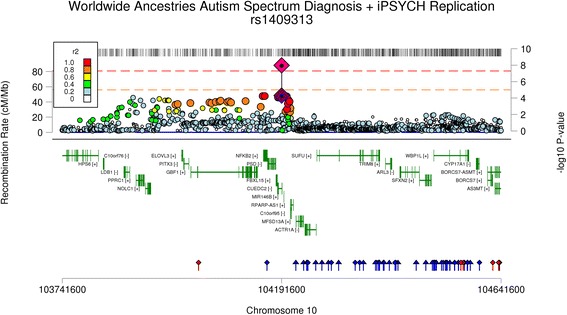
- Meta-analysis of PGC ASD with Danish iPSYCH identified one genome-wide significant association: rs1409313-T at 10q24.32 (OR = 1.12, 95% CI 1.08–1.16; P = 1.058 × 10⁻⁸), a region spanning 13 genes including PITX3 and CUEDC2.
- SNP heritability was 0.326 (SE = 0.043) on the observed scale and 0.18 (SE = 0.02) on the liability scale in the worldwide sample; the European ancestry estimate was nearly identical (observed h2 = 0.334, SE = 0.035; liability h2 = 0.19, SE = 0.02).
- ASD and schizophrenia showed a genetic correlation of Rg = 0.23 (SE = 0.05; P = 9 × 10⁻⁶), and cross-disorder meta-analysis identified 12 novel genome-wide significant loci, including rs57709857 at chromosome 8p11.23 (OR = 0.93, 95% CI 0.91–0.95; P = 4.2 × 10⁻⁹), ATP2B2 at 3p25.3, and FOXP1 at 3p13.
Methods
- Meta-analysis of 14 independent cohorts from eight academic studies: discovery sample of 7,387 ASD cases and 8,567 controls, with replication in iPSYCH (7,783 ASD cases and 11,359 controls) and deCODE/SEED (1,369 ASD cases and 137,308 controls).
- Association testing used additive logistic regression in PLINK; trio cohorts used a case-pseudocontrol design; meta-analysis used an inverse-weighted fixed-effects model in METAL, with genome-wide significance set at P ≤ 5 × 10⁻⁸.
- Secondary analyses included VEGAS2 gene-based tests, INRICH gene-set enrichment, LD score regression for SNP heritability, genetic correlation, and partitioned heritability, plus a cross-disorder meta-analysis with the PGC schizophrenia GWAS excluding the Swedish PAGES collection.
Limitations
- The paper states that the ASD-only discovery results did not exceed accepted genome-wide significance thresholds and that the results are “not definitive.”
- The paper states that the cross-disorder ASD-schizophrenia meta-analysis may be confounded by assortative mating, so the observed correlation may not be entirely due to pleiotropy and requires further investigation.
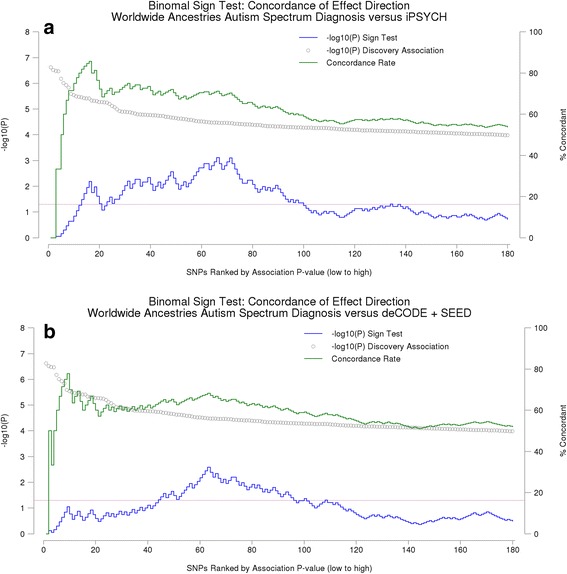
- Evident from the text: simple replication enrichment was not significant by count (11/180 iPSYCH markers and 8/159 deCODE/SEED markers nominally associated at P < 0.05), no gene-level associations survived Bonferroni correction, and no canonical gene-sets met experiment-wise correction.
Model-written summary. Check it against the paper before relying on it.
Integrity signals
Registry
Cites
Statistics
Figures
Verification
Claims the paper makes
11 Valid · 2 Not valid · 22 Not checked · 44 Own results and interpretations
At least one cited source doesn’t support this claim or points to a different paper, and none confirmed it — see the verdicts below.
In the paper
“This genetic covariance is almost threefold larger than previous reports [47].”
§ Meta-analysis of GWAS of over 16,000 individuals with autism spectrum disorder highlights a novel locus at 10q24.32 and a significant overlap with schizophrenia > Results > SNP-heritability estimate
What the sources say
- Disputedcites [47] Bulik-Sullivan B Finucane HK Anttila V Gusev A Day FR Loh PR ReproGen C, Psychiatric Genomics C, Genetic Consortium for Anorexia Nervosa of the Wellcome Trust Case Control C Duncan L An atlas of genetic correlations across human diseases and traits Nat Genet 2015 47 11 1236 1241 10.1038/ng.3406 26414676 PMC4797329 sourceExperimental — accuracy not yet measured
Our copy of the atlas never reports an ASD–schizophrenia genetic covariance, let alone one larger than earlier estimates: in Methods (Summary Statistic Datasets) the authors state that because most analysed studies used genomic-control correction, 'we do not report genetic covariance and heritability', reporting only genetic correlations. In Results (Replication of Psychiatric Cross-Disorder Results) the psychiatric cross-disorder estimates are presented as a technical validation that reproduced prior REML estimates, with results 'similar to the results from REML' — the opposite of a threefold increase over previous reports. The only ASD findings highlighted (Results, Application to Summary Statistics From 25 Phenotypes) are the new ASD–educational-attainment correlation and near-zero ASD–Alzheimer's correlation; no passage compares an ASD–schizophrenia estimate with prior reports. (LLM, conf=0.70)
Checked by a reasoning model — may be wrong.
plainstates an association- Asserted: passes — The authors put it forward as true.
- Checkable: passes — It can be checked against evidence.
- Load-bearing: passes — The paper’s conclusions depend on it.
- Based: passes — The paper gives a reason why it holds.
- Disputed
Every source the paper cites for this claim was checked and supports it.
In the paper
“We again observe evidence of an overlap with schizophrenia, with a 2.5-fold enrichment in heritability for those markers within the PGC schizophrenia GWS loci (P = 0.021).”
§ Meta-analysis of GWAS of over 16,000 individuals with autism spectrum disorder highlights a novel locus at 10q24.32 and a significant overlap with schizophrenia > Results > Gene-based and gene-set analyses
What the sources say
- Supportedcites [19] Schizophrenia Working Group of the Psychiatric Genomics Consortium Biological insights from 108 schizophrenia-associated genetic loci Nature 2014 511 7510 421 427 10.1038/nature13595 25056061 PMC4112379 source
The citation sits on the phrase 'PGC schizophrenia GWS loci' — the marker set the citing authors' own LD Score partitioned-heritability test was run against — and our copy of the PGC 2014 Nature paper is exactly that source: the abstract states 'We identify 128 independent associations spanning 108 conservatively defined loci that meet genome-wide significance', and the '108 independent associated loci' section reports '128 linkage-disequilibrium-independent SNPs exceeded genome-wide significance (P ≤ 5 × 10⁻⁸)' (Supplementary Table 2). The 2.5-fold enrichment figure and its P = 0.021 are the citing authors' own analysis, not something attributed to this paper; our copy applies LD score regression only to show the schizophrenia signal is polygenic rather than stratification (Extended Data Fig. 3, intercept 1.066), and reports no partitioned-heritability enrichment of its GWS loci against another trait. Judged for what it is offered here — identification of the PGC schizophrenia genome-wide significant loci — the source is that work. (LLM, conf=0.85)
plainstates an association- Asserted: passes — The authors put it forward as true.
- Checkable: passes — It can be checked against evidence.
- Load-bearing: passes — The paper’s conclusions depend on it.
- Based: passes — The paper gives a reason why it holds.
- Supported
The cited sources support only part of this claim — read each source’s verdict below.
In the paper
“Early GWAS [12, 14–17] were performed using a variety of genotyping arrays, and the independent samples sizes were of low statistical power to robustly identify genome-wide significant (GWS) loci at the lower effect sizes (OR <1.15) [18].”
§ Meta-analysis of GWAS of over 16,000 individuals with autism spectrum disorder highlights a novel locus at 10q24.32 and a significant overlap with schizophrenia > Background
What the sources say
- Could not verifycites [12] Pinto D Pagnamenta AT Klei L Anney R Merico D Regan R Conroy J Magalhaes TR Correia C Abrahams BS Functional impact of global rare copy number variation in autism spectrum disorders Nature 2010 466 7304 368 372 10.1038/nature09146 20531469 PMC3021798 sourceExperimental — accuracy not yet measured
The paper’s discussion on p. 3 says that association studies of individual rare CNVs often lack power to distinguish benign from disease-causing variants. That does not address the statistical power of early ASD GWAS to identify genome-wide significant loci at OR < 1.15; searches for GWAS power, sample size, and that effect-size threshold found no passage establishing the claim. (LLM, conf=0.74)
- Partly supportedcites [14] Wang K Zhang H Ma D Bucan M Glessner JT Abrahams BS Salyakina D Imielinski M Bradfield JP Sleiman PM Common genetic variants on 5p14.1 associate with autism spectrum disorders Nature 2009 459 7246 528 533 10.1038/nature07999 19404256 PMC2943511 sourceExperimental — accuracy not yet measured
The genome-wide association results (labeled Abstract in our copy; page unavailable) report no genome-wide significant association in either independent ASD cohort, but a significant locus after the cohorts were combined to boost power. The Discussion (page unavailable) also emphasizes the need for large samples. The paper does not establish a power threshold for effect sizes of OR < 1.15; its leading associated SNP has an OR of 1.19. (LLM, conf=0.88)
- Partly supportedcites [15] Ma D Salyakina D Jaworski JM Konidari I Whitehead PL Andersen AN Hoffman JD Slifer SH Hedges DJ Cukier HN A genome-wide association study of autism reveals a common novel risk locus at 5p14.1. Ann Hum Genet 2009 73 Pt 3 263 273 10.1111/j.1469-1809.2009.00523.x 19456320 PMC2918410 sourceExperimental — accuracy not yet measured
The Discussion says that, at this study’s sample size, stringent multiple-testing correction left power only to detect loci with large effects. The Results report just 30% and 2.5% power for genome-wide significance under the recessive and additive models tested. These passages support the low-power point, but the paper does not establish the specific OR < 1.15 cutoff or assess the sample sizes of early GWAS collectively. (LLM, conf=0.86)
- Partly supportedcites [16] Weiss LA Arking DE Daly MJ Chakravarti A A genome-wide linkage and association scan reveals novel loci for autism Nature 2009 461 7265 802 808 10.1038/nature08490 19812673 PMC2772655 sourceExperimental — accuracy not yet measured
The Family-Based Association Analysis section (page unavailable) says the paper’s initial scan lacked sufficient power to identify common variants definitively at genome-wide significance. It does not give an OR < 1.15 threshold or assess the independent sample sizes of early GWAS collectively. The Discussion (page unavailable) instead reports >80% power for its analysis under a specified effect-size model. (LLM, conf=0.87)
- Partly supportedcites [17] Anney R Klei L Pinto D Almeida J Bacchelli E Baird G Bolshakova N Bolte S Bolton PF Bourgeron T Individual common variants exert weak effects on the risk for autism spectrum disorders Hum Mol Genet 2012 21 21 4781 4792 10.1093/hmg/dds301 22843504 PMC3471395 sourceExperimental — accuracy not yet measured
The Introduction says that reliably detecting common variants with modest effects (relative risk <1.2) requires samples in the tens of thousands. The Results report no SNP reaching genome-wide significance in the combined sample. These passages support the low-power point, but the paper does not establish the claim’s specific OR <1.15 cutoff. (LLM, conf=0.86)
- Supportedcites [18] Devlin B Melhem N Roeder K Do common variants play a role in risk for autism? Evidence and theoretical musings Brain Res 2011 1380 78 84 10.1016/j.brainres.2010.11.026 21078308 PMC3638767 source
Section 2.4 says the early ASD GWAS had limited power to detect or replicate modest effects, including odds ratios around 1.1–1.2. The Discussion says tens of thousands of cases would likely be needed to detect weak-effect common variants, supporting the claim about effects below OR 1.15. The paper does not use 1.15 as a strict cutoff for all ASD loci. (LLM, conf=0.90)
plainstates an association- Asserted: passes — The authors put it forward as true.
- Checkable: passes — It can be checked against evidence.
- Load-bearing: passes — The paper’s conclusions depend on it.
- Based: passes — The paper gives a reason why it holds.
- Could not verify
Every source the paper cites for this claim was checked and supports it.
In the paper
“Importantly, common genetic variation explains roughly half of this genetic risk in ASD [7], making the genome-wide association study (GWAS) an efficient design for identifying risk variants.”
§ Meta-analysis of GWAS of over 16,000 individuals with autism spectrum disorder highlights a novel locus at 10q24.32 and a significant overlap with schizophrenia > Background
What the sources say
- Supportedcites [7] Gaugler T Klei L Sanders SJ Bodea CA Goldberg AP Lee AB Mahajan M Manaa D Pawitan Y Reichert J Most genetic risk for autism resides with common variation Nat Genet 2014 46 8 881 885 10.1038/ng.3039 25038753 PMC4137411 source
The paper reports that measured common SNPs explain 49.4% of the variance in autism liability and concludes that common variants explain the bulk of heritability. Thus, roughly half is a fair approximation, though the measured quantity is variation in liability rather than an individual's genetic risk. (LLM, conf=0.88)
plainstates an association- Asserted: passes — The authors put it forward as true.
- Checkable: passes — It can be checked against evidence.
- Load-bearing: passes — The paper’s conclusions depend on it.
- Based: passes — The paper gives a reason why it holds.
- Supported
Every source the paper cites for this claim was checked and supports it.
In the paper
“Exonic deletions were significantly enriched in the NDD cohort (OR = 2.69 (95% CI 1.13–7.77); P = 0.01).”
§ Meta-analysis of GWAS of over 16,000 individuals with autism spectrum disorder highlights a novel locus at 10q24.32 and a significant overlap with schizophrenia > Discussion > Genomewide association study of ASD
What the sources say
- Supportedcites [58] Lionel AC Tammimies K Vaags AK Rosenfeld JA Ahn JW Merico D Noor A Runke CK Pillalamarri VK Carter MT Disruption of the ASTN2/TRIM32 locus at 9q33.1 is a risk factor in males for autism spectrum disorders, ADHD and other neurodevelopmental phenotypes Hum Mol Genet 2014 23 10 2752 2768 10.1093/hmg/ddt669 24381304 PMC3990173 source
The section on exonic deletions in NDD cases reports significant enrichment of ASTN2 exonic deletions in NDD cases compared with non-NDD cases in the clinical cohort. Its odds ratio, confidence interval, and P-value match the claim after rounding; these figures do not describe the comparison with controls. (LLM, conf=0.95)
plainstates an association- Asserted: passes — The authors put it forward as true.
- Checkable: passes — It can be checked against evidence.
- Load-bearing: unclear — It is unclear whether the paper’s conclusions depend on it.
- Based: passes — The paper gives a reason why it holds.
- Supported
36 more claims
Create a free account to see all 79 claims and to verify the 33 references still open.
- It may state two separate claims as one. 21
- Probably not a substantial claim. 22
Claims other papers make about this one
Each is checked against this paper’s own text: does it say what the citing paper says it does?
The cited source doesn’t support the claim as written.
In the citing paper
“Here we report the first common risk variants robustly associated with ASD by more than doubling the discovery sample size compared to previous GWAS 5-8 .”
From Identification of common genetic risk variants for autism spectrum disorder (2019) · cites this paper as [5]
Checked by a reasoning model — may be wrong.
Experimental — accuracy not yet measuredThe cited source says what the claim attributes to it.
In the citing paper
“the largest GWAS to date (n=7387 cases scanned) -while providing compelling evidence for the bulk contribution of common variants -did not conclusively identify single variants at genome-wide significance 5-7 .”
From Identification of common genetic risk variants for autism spectrum disorder (2019) · cites this paper as [5]
The check wasn’t confident either way, so it gives no verdict — never disputed.
In the citing paper
“whereas ASD-associated SNVs (n = 126, P < 10−4, see Supplementary Methods) colocalize with class 2 loops anchored by activity-inducible enhancers39”
From Three-dimensional genome restructuring across timescales of activity-induced neuronal gene expression (2020) · cites this paper as [39]
Experimental — accuracy not yet measured
Self-check
Percentages, sums and reported differences re-computed from the paper’s own numbers.
Each contradiction between two passages listed here was confirmed by an independent check.
Rated minor: it would not touch a result — a value no result rests on, a p-value that stays on the same side of the significance level, or a conflict that is clerical, resolved elsewhere in the paper, or outside its own findings.
In the paper
§ Meta-analysis of GWAS of over 16,000 individuals with autism spectrum disorder highlights a novel locus at 10q24.32 and a significant overlap with schizophrenia > Results > Overlap of ASD and schizophrenia GWAS
“| rs9879311 | chr3:10317432..10520739 | T | 1.08 (1.03–1.13) | 1.05 (1.03–1.08) | 1.06 (1.04–1.08) | 1.9 × 10⁻⁸ | ATP2B2 GHRL GHRLOS LINC00852 MIR378B MIR885 SEC13 TATDN2 |”
§ Meta-analysis of GWAS of over 16,000 individuals with autism spectrum disorder highlights a novel locus at 10q24.32 and a significant overlap with schizophrenia > Discussion > Cross-disorder genome-wide association study of ASD and schizophrenia
“rs9879311-T, indexing an association signal within the ATP2B2 gene located at 3p25.3 (OR 1.06, 95% CI 1.04–1.08; P = 6.04 × 10⁻⁹)”
Citations
Cites
PLINK: a tool set for whole-genome association and population-based linkage analyses.
Purcell, S., Neale, B., Todd-Brown, K., Thomas, L., Ferreira, M. A. R., Bender, D., Maller, J., Sklar, P., de Bakker, P. I. W., Daly, M. J., et al. (2007) · The American Journal of Human Genetics · doi:10.1086/519795 · Cited by 34,089
Second-generation PLINK: rising to the challenge of larger and richer datasets
Chang, C. C., Chow, C. C., Tellier, L. C., Vattikuti, S., Purcell, S. M., & Lee, J. J. (2015) · Gigascience · doi:10.1186/s13742-015-0047-8 · Cited by 12,709
Lord, C., Rutter, M., & Le Couteur, A. (1994) · Journal of Autism and Developmental Disorders · doi:10.1007/bf02172145 · Cited by 9,065 · cited 2×
“95% CI: 95% Confidence interval boundaries; ADI-R: Autism Diagnostic Interview-Revised; ADOS: Autism diagnostic observation schedule; ASD: Autism spectrum disorder; EUR: European ancestry; FMRP: Fragile X mental tetardation protein; GWAS: Genome-wide association study; GWS: Genome-wide significant; H2: Heritability; I…”
MethodBiological insights from 108 schizophrenia-associated genetic loci
Schizophrenia Working Group of the Psychiatric Genomics Consortium (2014) · Nature · doi:10.1038/nature13595 · Cited by 7,577
LD Score regression distinguishes confounding from polygenicity in genome-wide association studies
Schizophrenia Working Group of the Psychiatric Genomics Consortium, Bulik-Sullivan, B. K., Loh, P.-R., Finucane, H. K., Ripke, S., Yang, J., Patterson, N., Daly, M. J., Price, A. L., & Neale, B. M. (2015) · Nature Genetics · doi:10.1038/ng.3211 · Cited by 5,559
METAL: fast and efficient meta-analysis of genomewide association scans
Willer, C. J., Li, Y., & Abecasis, G. R. (2010) · Bioinformatics · doi:10.1093/bioinformatics/btq340 · Cited by 5,205
An atlas of genetic correlations across human diseases and traits
ReproGen Consortium, Bulik-Sullivan, B., Psychiatric Genomics Consortium, Genetic Consortium for Anorexia Nervosa of the Wellcome Trust Case Control Consortium 3, Finucane, H. K., Anttila, V., Gusev, A., Day, F. R., Loh, P.-R., Duncan, L., et al. (2015) · Nature Genetics · doi:10.1038/ng.3406 · Cited by 4,255
Synaptic, transcriptional and chromatin genes disrupted in autism
Study, T. D., De Rubeis, S., Autism, H. M. C. F., UK10K Consortium, The Autism Sequencing Consortium, He, X., Goldberg, A. P., Poultney, C. S., Samocha, K., Ercument Cicek, A., et al. (2014) · Nature · doi:10.1038/nature13772 · Cited by 2,746 · cited 2×
“The establishment of a number of robust risk genes such as CHD8, GRIN2B, SCN2A, and SYNGAP1 [8], and gene-set analyses from associated structural variation have identified synaptic functioning, chromatin remodelling, Wnt signalling, transcriptional regulation, fragile X mental retardation protein (FMRP) interactors an…”
The contribution of de novo coding mutations to autism spectrum disorder
Iossifov, I., O’Roak, B. J., Sanders, S. J., Ronemus, M., Krumm, N., Levy, D., Stessman, H. A., Witherspoon, K. T., Vives, L., Patterson, K. E., et al. (2014) · Nature · doi:10.1038/nature13908 · Cited by 2,585 · cited 3×
“05 for the synaptic coexpression network M13 [48], Mendelian disease genes [11], and both human (HARs) and primate-accelerated regions (PARs) [49].”
BackgroundGenetic relationship between five psychiatric disorders estimated from genome-wide SNPs
Cross-Disorder Group of the Psychiatric Genomics Consortium (2013) · Nature Genetics · doi:10.1038/ng.2711 · Cited by 2,263
Cited by
Items 501–595 of 595
An empirical evaluation of executive function in Autism Spectrum Disorder
Demetriou, E. (2018) · The Sydney eScholarship Repository (The University of Sydney) · Cited by 1
PhGC: A Machine Learning Based Workflow for Phenotype-Genotype Co-analysis on Autism
Shubbar, S., Fu, C. M., Liu, Z., Wynshaw-Boris, A. J., & Guan, Q. (2020) · EPiC series in computing · doi:10.29007/ctfl
“For this reason, GWAS approach, a main genetic tool to explore genetic basis of complex traits, requires huge amount of samples (ASD patients and normal controls, each for more than several hundred, even several thousand) to be genotyped [17, 4].”
BackgroundResultInfluentialSingle-Nucleotide Polymorphism
Willsey, A. J., & Morris, M. T. (2020) · Springer eBooks · doi:10.1007/978-1-4614-6435-8_1985-3
Zheng, J., Gu, J., Fuller, C., & Li, H. (2020) · Research Square · doi:10.21203/rs.3.rs-108940/v1
Definitions of Technical Terms
Alexander, D. R. (2020) · Cambridge University Press eBooks · doi:10.1017/9781108566520.015
Alexander, D. R. (2020) · Cambridge University Press eBooks · doi:10.1017/9781108566520.005
Genes and Environments in Human Development
Alexander, D. R. (2020) · Cambridge University Press eBooks · doi:10.1017/9781108566520.004
Genes, Personality and Personality Disorders
Alexander, D. R. (2020) · Cambridge University Press eBooks · doi:10.1017/9781108566520.008
Alexander, D. R. (2020) · Cambridge University Press eBooks · doi:10.1017/9781108566520.006
Alexander, D. R. (2020) · Cambridge University Press eBooks · doi:10.1017/9781108566520.013
Maussion, G., Rocha, C., Pimentel, L. S. B., Beitel, L. K., & Durcan, T. M. (2021) · Elsevier eBooks · doi:10.1016/b978-0-323-85764-2.00007-7 · Cited by 1
Alshammery, S., Patel, S., Jones, H. F., Han, V. X., Gloss, B., Gold, W. A., & Dale, R. C. (2021) · Research Square · doi:10.21203/rs.3.rs-885680/v1
LRFN5 locus structure is influenced by the individual’s sex and associated with autismPreprint
Lybæk, H., Robson, M. I., de Leeuw, N., Hehir‐Kwa, J. Y., Jeffries, A. R., Haukanes, B. I., Berland, S., de Bruijn, D. R. H., Mundlos, S., Spielmann, M., et al. (2021) · Research Square · doi:10.21203/rs.3.rs-895724/v1
Genes, Religiosity and Political Commitment
Alexander, D. R. (2020) · Cambridge University Press eBooks · doi:10.1017/9781108566520.010 · Cited by 1
Genes, Education and Intelligence
Alexander, D. R. (2020) · Cambridge University Press eBooks · doi:10.1017/9781108566520.007
Alexander, D. R. (2020) · Cambridge University Press eBooks · doi:10.1017/9781108566520.012
Genes, Food, Exercise and Weight
Alexander, D. R. (2020) · Cambridge University Press eBooks · doi:10.1017/9781108566520.009
Alexander, D. R. (2020) · Cambridge University Press eBooks · doi:10.1017/9781108566520.002
Alexander, D. R. (2020) · Cambridge University Press eBooks · doi:10.1017/9781108566520.016
Experimental and Biological Approaches
Wright, A. G. C., & Hallquist, M. N. (2020) · Cambridge University Press eBooks · doi:10.1017/9781316995808.011
Alexander, D. R. (2020) · Cambridge University Press eBooks · doi:10.1017/9781108566520.001
Is Genetics Implicated in the Causation of Autism?
Samashaptak, S., Das, P., Bhattacharyya, S., & Datta, T. K. (2022) · Acta Scientific Medical Sciences · doi:10.31080/asms.2022.06.1194
Alexander, D. R. (2020) · Cambridge University Press eBooks · doi:10.1017/9781108566520.017
Einarsson, I. (2021) · Springer eBooks · doi:10.1007/978-3-319-91280-6_102016
Nürnberger, J. I. (2019) · Faculty Opinions – Post-Publication Peer Review of the Biomedical Literature · doi:10.3410/f.735152734.793563005 · Cited by 1
Pahlen, S., & Reynolds, C. A. (2019) · Elsevier eBooks · doi:10.1016/b978-0-12-809324-5.23621-3
Gu, J., Fuller, C., Carbonetto, P., He, X., Zheng, J., & Li, H. (2021) · bioRxiv (Cold Spring Harbor Laboratory) · doi:10.1101/2021.02.09.430368
“Examples include the autism GWAS, of which the original signal is weak (no SNP passing genome-wide significance threshold)[31].”
InfluentialAlexander, D. R. (2020) · Cambridge University Press eBooks · doi:10.1017/9781108566520.014
(2019) · Psychiatry and Clinical Psychopharmacology · doi:10.1080/24750573.2019.1608692
Einarsson, I. (2018) · Springer eBooks · doi:10.1007/978-1-4614-6435-8_102016-1
Sawada, T., Barbosa, A. D. L., Araújo, B. H. S., McCord, A. E., D’Ignazio, L., Benjamin, K. J., Feltrin, A. S., Arora, R., Brandtjen, A. C., Kleinman, J. E., et al. (2022) · bioRxiv (Cold Spring Harbor Laboratory) · doi:10.1101/2022.05.26.493589
Brain-Based Gene Expression of Putative Risk Genes for Anorexia Nervosa in the Human BrainPreprint
Murray, S. B., Rokicki, J., Sartorius, A. M., Winterton, A., Andreassen, O. A., Westlye, L. T., Nagata, J. M., & Quintana, D. S. (2022) · medRxiv · doi:10.1101/2022.09.07.22279681
WHAT HAVE QUANTITATIVE AND MOLECULAR GENETIC STUDIES BEEN ABLE TO TELL US ABOUT THE GENETICS OF ASD?
Prisecaru, A. (2021) · Psych-Talk · doi:10.53841/bpstalk.2021.1.100.48
Rebecchi, K. (2023) · PsyArXiv (OSF Preprints) · doi:10.31234/osf.io/egv2p
Genetics and Epigenetics of ASD
Mojarad, B. A., Qaiser, F., & Yuen, R. K. C. (2023) · Springer eBooks · doi:10.1007/978-3-031-20792-1_18 · Cited by 3
Statistical methods for gene selection and genetic association studies
Cao, X. (2023) · Digital Commons - Michigan Tech (Michigan Technological University) · doi:10.37099/mtu.dc.etdr/1575
Shen, J., & Feng, Y. (2023) · Research Square · doi:10.21203/rs.3.rs-3035082/v1
Feng, Y., & Shen, J. (2023) · Research Square · doi:10.21203/rs.3.rs-3402538/v1
Epigenetics in neurobehavioral disease
Løkhammer, S. (2023) · Elsevier eBooks · doi:10.1016/b978-0-443-18661-5.00012-9
Genetic Biomarkers of Psychiatric Disorders
Farhan, M., Soyebo, E., Busby, C. C., & Fries, G. R. (2023) · Springer eBooks · doi:10.1007/978-3-031-43356-6_2
Chaudhary, R., & Steinson, E. (2023) · Springer eBooks · doi:10.1007/978-3-031-42383-3_18 · Cited by 4
Early screening of autism spectrum disorders: from cellular pathway to neural marker
Zhao, W., & Li, J. (2024) · Scientia Sinica Vitae · doi:10.1360/ssv-2023-0217
Wang, T., Yu, M., Gu, X., Liang, X., Wang, P., Peng, W., Liu, D., Chen, D., Huang, C., Tan, Y., et al. (2024) · Psychiatric Genetics · doi:10.1097/ypg.0000000000000362 · Cited by 1
Liu, M., Yu, C., Zhang, Z., Song, M., Sun, X., Piálek, J., Jacob, J., Lu, J., Cong, L., Zhang, H., et al. (2022) · Figshare · doi:10.6084/m9.figshare.21213431
Costa, C. I. S. (2024) · Digital Library of Theses and Dissertations (Universidade de São Paulo) · doi:10.11606/t.41.2024.tde-22082024-180122
Moura, S., Nasciben, L. B., Ramírez, A. M., Coombs, L. E., Rivero, J., Booven, D. J. V., DeRosa, B. A., Hamilton‐Nelson, K. L., Whitehead, P. L., Adams, L. D., et al. (2024) · bioRxiv (Cold Spring Harbor Laboratory) · doi:10.1101/2024.08.27.609943
Epigenetics of Neurodevelopmental Disorders
Campbell, D. B. (2024) · Contemporary clinical neuroscience · doi:10.1007/978-3-031-66932-3_5 · Cited by 1
Lobete, M., Dionisio, L. E., McCoig, E., Piguel, N. H., Spielman, B. P., Socas, S., Santos, M. D., Boers-Escuder, C., Penzes, P., & Martin‐de‐Saavedra, M. D. (2024) · bioRxiv (Cold Spring Harbor Laboratory) · doi:10.1101/2024.11.04.621898
Korbmacher, M., Tranfa, M., Pontillo, G., van der Meer, D., Wang, M., Andreassen, O. A., Westlye, L. T., & Maximov, I. I. (2024) · bioRxiv (Cold Spring Harbor Laboratory) · doi:10.1101/2024.11.27.625603
Myers, S. M., & Challman, T. D. (2024) · Elsevier eBooks · doi:10.1016/b978-0-12-824060-1.00038-9
The Etiology of Autism Spectrum Disorder and Gender Dysphoria
Nelson, A., Somerville, P., Patel, S., & Matta, J. (2024) · Annual International Conference of the IEEE Engineering in Medicine and Biology Society (EMBC) · doi:10.1109/embc53108.2024.10781615
“Many studies attempt this approach with ASD [13].”
Lee, S., Miller, C. L., Bentley, A. R., Brown, M. R., Nagarajan, P., Noordam, R., Morrison, J., Schwander, K., Westerman, K. E., Kho, M., et al. (2025) · Research Square · doi:10.21203/rs.3.rs-6025759/v1 · Cited by 1
Jiang, Z., Zhou, Y., Zhou, Y., Yang, D., Li, J., Li, Y., Fan, Q., & Lin, J. (2025) · Medicine · doi:10.1097/md.0000000000042119
Replication of rs10099100 Association with Autism Spectrum Disorder Risk in a Polish‐Origin Cohort
Karwowska, J., Polewko-Klim, A., Panasiuk, B., Stasiewicz‐Jarocka, B., Tafazoli, A., Dobrowolska, E., Jarząbek, K., Posmyk, R., & Wawrusiewicz‐Kurylonek, N. (2025) · Research in Autism · doi:10.1016/j.reia.2025.202542
Chen, Z., Yang, Q., Zhang, S., Yang, D.-J., & Peng, T. (2025) · Journal of Psychosomatic Research · doi:10.1016/j.jpsychores.2025.112189 · Cited by 1
Bentley, A. R., Brown, M. R., Musani, S. K., Schwander, K., Winkler, T. W., Sims, M., Kilpeläinen, T. O., Aschard, H., Bartz, T. M., Bielak, L. F., et al. (2025) · Translational Psychiatry · doi:10.1038/s41398-025-03418-z
“…intronic variants in MACROD2 with complex psychosocial, neurological, and psychiatric traits, including: attention de fi cit hyperactivity disorder [45, 46], morningness (being a morning person) [47], risk-taking behavior [48], eating disorders [49], autism [50 – 52], and bipolar disorder [52, 53].”
Gu, J., Fuller, C., Carbonetto, P. S., He, X., Zheng, J., & Li, H. (2025) · eLife · doi:10.7554/elife.107957
Gu, J., Fuller, C., Carbonetto, P. S., He, X., Zheng, J., & Li, H. (2025) · eLife · doi:10.7554/elife.107957.1
Gene-based analysis identifies novel microRNA candidates for Autism Spectrum DisorderPreprint
Marques, A. R., Martiniano, H., Vilela, J. E. R., Asif, M., Sousa, L., Oliveira, G., & Vicente, A. M. (2025) · bioRxiv (Cold Spring Harbor Laboratory) · doi:10.1101/2025.09.26.678002 · Cited by 1
Li, J., Jain, N., Kiat, J., Lin, T., Oliva, M., Demanelis, K., Jasmine, F., Kibriya, M. G., Ahsan, H., Chen, L., et al. (2025) · Research Square · doi:10.21203/rs.3.rs-7895550/v1
Multi-Ancestry GWAS of Neuroticism Identifies Novel Loci and Enhances Fine-Mapping ResolutionPreprint
Kaka, M. O., Topaloudi, A., Chen, G., Gupta, P., Levey, D. F., Gao, B., & Paschou, P. (2025) · medRxiv · doi:10.64898/2025.12.12.25342160
Liu, M., Yu, C., Zhang, Z., Song, M., Sun, X., Piálek, J., Jacob, J., Lu, J., Cong, L., Zhang, H., et al. (2022) · Figshare · doi:10.6084/m9.figshare.21213428
Fass, S. B., Mulvey, B., Chase, R., Yang, W., Selmanovic, D., Chaturvedi, S. M., Tycksen, E., Weiss, L. A., & Dougherty, J. D. (2024) · Figshare · doi:10.6084/m9.figshare.26730706
Fass, S. B., Mulvey, B., Chase, R., Yang, W., Selmanovic, D., Chaturvedi, S. M., Tycksen, E., Weiss, L. A., & Dougherty, J. D. (2024) · Figshare · doi:10.6084/m9.figshare.26730724
Fass, S. B., Mulvey, B., Chase, R., Yang, W., Selmanovic, D., Chaturvedi, S. M., Tycksen, E., Weiss, L. A., & Dougherty, J. D. (2024) · Figshare · doi:10.6084/m9.figshare.26730709
Fass, S. B., Mulvey, B., Chase, R., Yang, W., Selmanovic, D., Chaturvedi, S. M., Tycksen, E., Weiss, L. A., & Dougherty, J. D. (2024) · Figshare · doi:10.6084/m9.figshare.26730715
Fass, S. B., Mulvey, B., Chase, R., Yang, W., Selmanovic, D., Chaturvedi, S. M., Tycksen, E., Weiss, L. A., & Dougherty, J. D. (2024) · Figshare · doi:10.6084/m9.figshare.26730730
Fass, S. B., Mulvey, B., Chase, R., Yang, W., Selmanovic, D., Chaturvedi, S. M., Tycksen, E., Weiss, L. A., & Dougherty, J. D. (2024) · Figshare · doi:10.6084/m9.figshare.26730718
Jia, P., Hu, R., Yan, F., Dai, Y., & Zhao, Z. (2022) · Figshare · doi:10.6084/m9.figshare.21351169
Mordaunt, C. E., Jianu, J. M., Laufer, B. I., Zhu, Y., Hwang, H., Dunaway, K. W., Bakulski, K. M., Feinberg, J. I., Volk, H. E., Lyall, K., et al. (2020) · Figshare · doi:10.6084/m9.figshare.13093822
Fass, S. B., Mulvey, B., Chase, R., Yang, W., Selmanovic, D., Chaturvedi, S. M., Tycksen, E., Weiss, L. A., & Dougherty, J. D. (2024) · Figshare · doi:10.6084/m9.figshare.26730721
Liu, M., Yu, C., Zhang, Z., Song, M., Sun, X., Piálek, J., Jacob, J., Lu, J., Cong, L., Zhang, H., et al. (2022) · Figshare · doi:10.6084/m9.figshare.21213434
Fass, S. B., Mulvey, B., Chase, R., Yang, W., Selmanovic, D., Chaturvedi, S. M., Tycksen, E., Weiss, L. A., & Dougherty, J. D. (2024) · Figshare · doi:10.6084/m9.figshare.26730727
Jia, P., Hu, R., Yan, F., Dai, Y., & Zhao, Z. (2022) · Figshare · doi:10.6084/m9.figshare.21351172
Fass, S. B., Mulvey, B., Chase, R., Yang, W., Selmanovic, D., Chaturvedi, S. M., Tycksen, E., Weiss, L. A., & Dougherty, J. D. (2024) · Figshare · doi:10.6084/m9.figshare.26730712
Hubert, J.-N. (2018) · theses.fr (ABES) · doi:10.70675/d3180991zb31fz4017z9085zfac23159b0ae · Cited by 1
Etude épidémiologique, génétique et métabolomique des Troubles du Spectre Autistique au Liban
Bitar, T. (2018) · theses.fr (ABES) · doi:10.70675/44700042z0e35z49f0z9d21zd00543f6df1c · Cited by 1
Hayot, G. (2020) · theses.fr (ABES) · doi:10.70675/68f97142z0b02z402czaf1az7158eb30dd29
ASTN2 in ASD and neurodevelopmental disorders
Govek, E., Hull, C., & Hatten, M. E. (2026) · Current topics in developmental biology/Current Topics in Developmental Biology · doi:10.1016/bs.ctdb.2026.02.003 · Cited by 1
Rôle de la phosphodiestérase 2A dans la physiopathologie du syndrome de l’X fragile
Delhaye, S. (2021) · theses.fr (ABES) · doi:10.70675/e0fac395z63d4z46a4z944aza4037215ca98
HiFiMAP: High-resolution fast identity-by-descent mapping testPreprint
Guo, B., Naseri, A., Xie, Z., Sarnowski, C., Zhi, D., & Chen, H. (2026) · medRxiv · doi:10.64898/2026.05.06.26352570
The association study of genetic variants with developing musical aptitude in humans
Казанцева, А. В., Торопова, А. В., Khusnutdinova, E. K., & Malykh, S. B. (2026) · Vavilov Journal of Genetics and Breeding · doi:10.18699/vjgb-26-51
Douceau, S., Guerrero, T. D., Borowski, C., Lourenço, C., Weber, M., Kavaliova, H., Brault, E., Pons, C., Roumier, A., Wild, R., et al. (2026) · Proceedings of the National Academy of Sciences · doi:10.1073/pnas.2531481123
miR4ASD: A Database of Human microRNAs Associated with Autism Spectrum Disorder
Marques, A. R., Martiniano, H., Vilela, J. E. R., & Vicente, A. M. (2026) · Current Issues in Molecular Biology · doi:10.3390/cimb48101044
Chen, J., Zhang, Z., Fu, Q., Hou, H., Xu, G., Li, Z., Lu, Z., Qiu, J., Wu, K., Gao, X., et al. (2026) · Frontiers in Immunology · doi:10.3389/fimmu.2026.1857945
Breunig, S., Schäffer, L., Lawrence, J. M., Sheppard, A., & Grotzinger, A. D. (2026) · Behavior Genetics · doi:10.1007/s10519-026-10281-1
Cilkiz, K. Z., Baker, E. C., Long, C. R., Randel, R. D., Ghaffari, N., Welsh, T. H., & Riley, D. G. (2026) · Genes · doi:10.3390/genes17101208
Gutiérrez, D. A. R., Prieto, R. C., Rueda‐Gaitán, P., Gómez-Lopera, N., Estrada‐Serrato, C., Isaza-Ruget, M., & Rivera, J. J. L. (2026) · International Journal of Molecular Sciences · doi:10.3390/ijms27198902
“Current evidence supports a complex genetic architecture, with most risk attributed to common variants that exert small additive effects across the genome [7,8].”
Roschyk, A., & Campbell, D. B. (2026) · Frontiers in Toxicology · doi:10.3389/ftox.2026.1893084
Translational Neuroscience of Autism Spectrum Disorder: Genetics: Contribution Not Correlation
Mendes, M., Zhou, X., Vorstman, J. A. S., & Scherer, S. W. (2026) · Current topics in behavioral neurosciences · doi:10.1007/7854_2026_616
Subsampled single cell BAMs from PRJNA665252
Orofino, J. (2025) · Zenodo (CERN European Organization for Nuclear Research) · doi:10.5281/zenodo.17604677
Metadata
- Authors
- The Autism Spectrum Disorders Working Group of The Psychiatric Genomics Consortium
- Venue
- Molecular Autism
- Published
- 2017-05-22
- Volume
- 8
- Issue
- 1
- Pages
- 21-21
- ISSN
- 2040-2392 (ISSN-L)
- PMC
- PMC5441062
- OpenAlex
- W2623056867
- Cited by
- 587
- References
- 87
- Citations by year
- 2026: 24 · 2025: 45 · 2024: 52 · 2023: 61 · 2022: 65 · 2021: 76 · 2020: 89 · 2019: 88 · 2018: 72 · 2017: 14
- FWCI
- 8.04
- Type
- journal article
- Language
- en
- Open access
- gold
- doi.org
- Licence
- cc-by
- Locations
- Molecular Autism (publishedVersion, cc-by)
- Europe PMC (PubMed Central) (publishedVersion, cc-by)
- PubMed Central (publishedVersion, cc-by)
- PubMed (publishedVersion)
- Research at the University of Copenhagen (University of Copenhagen) (publishedVersion, cc-by)
- ENLIGHTEN (Jurnal Bimbingan dan Konseling Islam) (acceptedVersion)
- ORCA Online Research @Cardiff (Cardiff University) (acceptedVersion)
- Research Portal (King's College London) (acceptedVersion, cc-by)
- Scopus (Elsevier) (submittedVersion, cc-by)
- HAL (submittedVersion, other-oa)
- Archivio istituzionale della ricerca (Alma Mater Studiorum Università di Bologna) (submittedVersion, cc-by)
- DOAJ (DOAJ: Directory of Open Access Journals) (submittedVersion, cc-by-sa)
- eScholarship (California Digital Library) (submittedVersion)
- Portuguese National Funding Agency for Science, Research and Technology (RCAAP Project by FCT) (submittedVersion, cc-by)
- Työväentutkimus Vuosikirja (submittedVersion)
- Refubium (Universitätsbibliothek der Freien Universität Berlin) (submittedVersion, cc-by)
- Portuguese National Funding Agency for Science, Research and Technology (RCAAP Project by FCT) (submittedVersion, cc-by-nc)
- Trinity's Access to Research Output (TARA) (Trinity College Dublin) (submittedVersion)
- Hirsla (Landspítali University Hospital) (submittedVersion)
- Newcastle University ePrints (Newcastle Univesity) (cc-by)
- Funders
- Autism Speaks
- Battelle
- Massachusetts General Hospital
- Yale University (CT 06520)
- University of Southern California
- Brown University
- Vanderbilt University
- University of Miami
- University of Pennsylvania
- University of Minnesota
- Nationwide Children's Hospital
- Aarhus Universitet
- Aarhus Universitetshospital
- University of Washington (WA 98195)
- Johns Hopkins University
- University of Pittsburgh
- Carnegie Mellon University
- McGill University
- Rush University
- Deutsches Krebsforschungszentrum (69120, D-69120)
- Genome Canada
- McMaster University
- Wellcome Trust
- Health Research Board
- Broad Institute
- Ukrainian Research Institute, Harvard University
- University of Alberta
- University of Oxford
- Newcastle University
- Cardiff University
- University College Dublin
- Trinity College Dublin
- Institut National de la Santé et de la Recherche Médicale
- Nederlandse Organisatie voor Wetenschappelijk Onderzoek (480- 05-003)
- Lundbeckfonden (R155-2014-1724)
- University of Toronto
- Karolinska Institutet
- Université de Toulouse
- Region Hovedstaden
- Universidade de Coimbra
- Università di Bologna
- Hospital for Sick Children
- H. Lundbeck A/S
- National Institutes of Health (5u01mh094432-04)
- Centers for Disease Control and Prevention (U10DD000184, U10DD000182, U10DD000181, U01DD000498, U10DD000183, U10DD000180)
- University of Illinois at Urbana-Champaign
- University of California, Los Angeles
- Weill Cornell Medical College
- University of North Carolina at Chapel Hill
- Johns Hopkins Bloomberg School of Public Health
- School of Medicine, Indiana University
- Research Institute, Nationwide Children's Hospital
- Stanley Center for Psychiatric Research, Broad Institute
- Friedman Brain Institute, Icahn School of Medicine at Mount Sinai
- Department of Psychiatry, University of Toronto
- Roy J. and Lucille A. Carver College of Medicine, University of Iowa
- Mindich Child Health and Development Institute, Icahn School of Medicine at Mount Sinai
- Canadian Institutes of Health Research
- Medical Research Council (MR/P005748/1, MR/L010305/1)
- Statens Serum Institut
- National Institute of Mental Health (U01MH109539, U01MH109514, U01 MH094432, R01MH094293, U24MH081810, R01MH097849, R00MH101367, R01MH100027, U01MH094421, K99MH101367, R01MH060007, R01MH081754, MH100027, R56MH097849)
- National Cancer Institute (R01CA094143, P50CA095817, P01CA095616)
- David Geffen School of Medicine, University of California, Los Angeles
- Jane and Terry Semel Institute for Neuroscience and Human Behavior, University of California, Los Angeles
- Topics
- Life Sciences › Neuroscience › Cognitive Neuroscience › Autism Spectrum Disorder Research
- Life Sciences › Biochemistry, Genetics and Molecular Biology › Genetics › Genetic Associations and Epidemiology
- Life Sciences › Biochemistry, Genetics and Molecular Biology › Genetics › Genetics and Neurodevelopmental Disorders
- Keywords
- autism spectrum disorder, genetic susceptibility loci, schizophrenia, genetic overlap, statistical power, effect size
- MeSH terms
- Autism Spectrum Disorder, Carrier Proteins, Chromosomes, Human, Pair 10, Female, Humans, Male, Membrane Proteins, Repressor Proteins, Schizophrenia, Transcription Factors, Gene Expression, Case-Control Studies, Homeodomain Proteins, Genetic Predisposition to Disease, Adaptor Proteins, Signal Transducing, Forkhead Transcription Factors, Plasma Membrane Calcium-Transporting ATPases, Genome-Wide Association Study, Genetic Loci
About these checks
Registry, retraction, Cites and statistics results are computed, not judged, with one exception: a printed reference that no index lists is read once by a model before it counts as a citation error. Claims are extracted by a model and kept only when their quote appears verbatim in the text; each cited source is then checked, with a model’s help, for whether it says what the claim relies on. Those verdicts can be wrong — read the claim’s quote and the cited source before relying on one.
The claim verdicts this report counts are experimental: their accuracy is not yet measured.
A language model drew the claims from the paper on 2026-10-06, under version 3 of the claim definition (model deepseek-v4.1-flash, prompt extract-v3).
A second model labelled each claim on 2026-10-06 (model jev-1.13-20260917, definition revision gold-guideline-v0.2).
Cited sources are checked with a language model’s help (qwen3.8-omni-flash and gpt-6-sol).
Statistics and arithmetic are recomputed, not judged.
Confidence bands are shown only for fields calibrated on our annotated test set. None is calibrated yet, so no band is shown.
What counts as a claim ›How we measure confidence ›How we check this ›
Are you an author, or do you see a problem with this page? Request a review
Data sources
Bibliographic data: Semantic Scholar, OpenAlex, Crossref.
Contains information from the Semantic Scholar Academic Graph Datasets, made available under the ODC Attribution License (ODC-BY 1.0).
Semantic Scholar’s data is described in: Kinney, R., et al. (2023). The Semantic Scholar Open Data Platform. arXiv:2301.10140.
