

The DOI matches its Crossref record; 50 of the 51 references it cites were found in a registry or an index.
The psychological impact of the COVID-19 pandemic on adults with autism: a survey study across three countries
Open accessPublished version of a preprint
Abstract
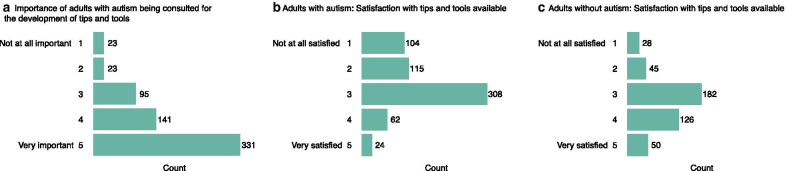
BACKGROUND: Previous studies have reported a negative psychological and mental health impact of the COVID-19 pandemic. This impact is likely to be stronger for people with autism as they are at heightened risk of mental health problems and because the pandemic directly affects social functioning and everyday routines. We therefore examined COVID-19 pandemic-related changes in mental health, the impact of the pandemic on their social life and routines, satisfaction with pandemic-related information and tips, and participants' wishes for guidance. METHODS: We used a mixed-method approach, collecting quantitative and qualitative survey data from adults with and without autism across three European countries: Belgium, the Netherlands, and the UK (N = 1044). RESULTS: We found an increase in depression and anxiety symptoms in response to the pandemic for both the non-autism and the autism group, which was greater for adults with autism. Furthermore, adults with autism showed a greater increase in worries about their pets, work, getting medication and food, and their own safety/security. They felt more relieved from social stress, yet experienced the loss of social contact as difficult. Adults with autism also felt more stressed about the loss of routines. Pleasant changes noted by adults with autism were the increase in solidarity and reduced sensory and social overload. Adults with autism frequently reported problems with cancellation of guidance due to the pandemic and expressed their wish for (more) autism-specific information and advice. LIMITATIONS: Our sample is likely to reflect some degree of selection bias, and longitudinal studies are needed to determine long-term effects. CONCLUSIONS: Results highlight the psychological burden of the pandemic on adults with autism and shed light on how to support them during this COVID-19 pandemic, which is especially important now that the pandemic is likely to have a prolonged course. There is a need for accessible, affordable (continued) support from health services. Guidance may focus on the maintenance of a social network, and adjusting routines to the rapid ongoing changes. Finally, we may learn from the COVID-19 pandemic-related changes experienced as pleasant by adults with autism to build a more autism-friendly society post-pandemic.
Overview
The claims and statistics of this paper haven’t been checked yet.
Run the check — free, no account needed. It reads the open-access text and checks the sources it cites.
Integrity signals
Registry
Cites
Statistics
Figures
Verification
Claims the paper makes
The claims and statistics of this paper haven’t been checked yet.
Run the check — free, no account needed. It reads the open-access text and checks the sources it cites.
Claims other papers make about this one
Each is checked against this paper’s own text: does it say what the citing paper says it does?
In the citing paper
“many participants (in primarily qualitative studies) described struggling with work-life balance when WFH, particularly when work needed to be balanced with childcare and home-schooling [50].”
From Homeworking experiences of neuro-divergent workers: systematic review (2024) · cites this paper as [50]
In the citing paper
“Additionally, participants with ASD in one study [50] described worrying about returning to in-person work because they feared they would be exhausted from sensory overload on their commute due to being out of the habit.”
From Homeworking experiences of neuro-divergent workers: systematic review (2024) · cites this paper as [50]
In the citing paper
“This meant they could choose to work during the hours they were most effective [57,59], taking breaks when needed [39,50], allowing them to feel they had greater autonomy [42,60].”
From Homeworking experiences of neuro-divergent workers: systematic review (2024) · cites this paper as [50]
In the citing paper
“Research suggests the pandemic and lockdowns negatively affected the mental health of neuro-divergent people [21], who often experienced greater psychological burden than neuro-typical individuals due to the loss of routines [50]”
From Homeworking experiences of neuro-divergent workers: systematic review (2024) · cites this paper as [50]
Self-check
Percentages, sums and reported differences re-computed from the paper’s own numbers.
The self-check needs the paper’s full text.
Citations
Cites
Using thematic analysis in psychology
Braun, V., & Clarke, V. (2006) · Qualitative Research in Psychology · doi:10.1191/1478088706qp063oa · Cited by 194,414
Diagnostic and Statistical Manual of Mental Disorders
American Psychiatric Association (2013) · doi:10.1176/appi.books.9780890425596 · Cited by 116,369
Controlling the False Discovery Rate: A Practical and Powerful Approach to Multiple Testing
Benjamini, Y., & Hochberg, Y. (1995) · Journal of the Royal Statistical Society Series B: Statistical Methodology · doi:10.1111/j.2517-6161.1995.tb02031.x · Cited by 109,482
Fitting Linear Mixed-Effects Models Using lme4
Bates, D., Mächler, M., Bolker, B., & Walker, S. (2015) · Journal of Statistical Software · doi:10.18637/jss.v067.i01 · Cited by 86,835
A Brief Measure for Assessing Generalized Anxiety Disorder: The GAD-7
Spitzer, R. L., Kroenke, K., Williams, J. B. W., & Löwe, B. (2006) · Archives of Internal Medicine · doi:10.1001/archinte.166.10.1092 · Cited by 31,765
Wang, C., Pan, R., Wan, X., Tan, Y., Xu, L., Ho, C. S., & Ho, R. C. (2020) · International Journal of Environmental Research and Public Health · doi:10.3390/ijerph17051729 · Cited by 9,923
The PHQ-9: A New Depression Diagnostic and Severity Measure
Kroenke, K., & Spitzer, R. L. (2002) · Psychiatric Annals · doi:10.3928/0048-5713-20020901-06 · Cited by 5,898
The psychological impact of the COVID-19 epidemic on college students in China
Cao, W., Fang, Z., Hou, G., Han, M., Xu, X., Dong, J., & Zheng, J. (2020) · Psychiatry Research · doi:10.1016/j.psychres.2020.112934 · Cited by 5,843
Holmes, E. A., O'Connor, R. C., Perry, V. H., Tracey, I., Wessely, S., Arseneault, L., Ballard, C., Christensen, H., Cohen Silver, R., Everall, I., et al. (2020) · The Lancet Psychiatry · doi:10.1016/s2215-0366(20)30168-1 · Cited by 5,715
What Is the Male-to-Female Ratio in Autism Spectrum Disorder? A Systematic Review and Meta-Analysis
Loomes, R., Hull, L., & Mandy, W. P. L. (2017) · Journal of the American Academy of Child & Adolescent Psychiatry · doi:10.1016/j.jaac.2017.03.013 · Cited by 2,804
Research works printed but not linked: 1
- Amorim R, Catarino S, Miragaia P, Ferreras C, Viana V, Guardiano M. The impact of COVID-19 on children with autism spectrum disorder. Rev Neurol. 2020;71(8):285–91.
Cited by
Sorted by citations
Pellicano, E., Brett, S., den Houting, J., Heyworth, M., Magiati, I., Steward, R., Urbanowicz, A., & Stears, M. (2022) · Autism · doi:10.1177/13623613211035936 · Cited by 113
Representativeness of autistic samples in studies recruiting through social media
Rødgaard, E., Jensen, K. L., Miskowiak, K. W., & Mottron, L. (2022) · Autism Research · doi:10.1002/aur.2777 · Cited by 100
Transtorno do Espectro do Autismo
Vital, A. A. F., GARCIA, A. H. C., SANTOS, A. P. D., Saad, A. G. D. F., DIAS, C. G. D. F., Miccas, C., de Araújo, C. O., MAGALHÃES, C. M., LOURENÇO, D. P. L., Galeti, F., et al. (2021) · doi:10.29327/558796 · Cited by 86
Neurodiversity and remote work in times of crisis: lessons for HR
Szulc, J. M., McGregor, F.-L., & Cakir, E. (2023) · Personnel Review · doi:10.1108/pr-06-2021-0469 · Cited by 63
Spain, D., Mason, D., Simone, J., Stoppelbein, L., White, S. W., & Happe, F. G. E. (2021) · Research in Autism · doi:10.1016/j.rasd.2021.101747 · Cited by 70
Metadata
- Authors
- Oomen, D., Nijhof, A. D., & Wiersema, J. R.
- Affiliations
- Ghent University (BE)
- Corresponding author
- Oomen, Danna
- Venue
- Molecular Autism
- Published
- 2021-03-03
- Volume
- 12
- Issue
- 1
- Pages
- 21-21
- ISSN
- 2040-2392 (ISSN-L)
- PMC
- PMC7927758
- OpenAlex
- W3119734246
- Cited by
- 136
- References
- 51
- Citations by year
- 2026: 3 · 2025: 6 · 2024: 16 · 2023: 41 · 2022: 55 · 2021: 15
- FWCI
- 21.64
- Type
- journal article
- Language
- en
- Open access
- gold
- doi.org
- Locations
- Molecular Autism (publishedVersion, cc-by)
- Research Square (acceptedVersion, cc-by)
- PubMed Central (publishedVersion, cc-by)
- PubMed (publishedVersion)
- Ghent University Academic Bibliography (Ghent University) (submittedVersion, cc-by)
- DOAJ (DOAJ: Directory of Open Access Journals) (submittedVersion, cc-by-sa)
- Funders
- Bijzonder Onderzoeksfonds (BOF18/DOC/348)
- Fonds Wetenschappelijk Onderzoek (FWO19/PDJ/025)
- Topics
- Social Sciences › Psychology › Clinical Psychology › COVID-19 and Mental Health
- Life Sciences › Neuroscience › Cognitive Neuroscience › Autism Spectrum Disorder Research
- Social Sciences › Sociology and Political Science › Social impacts of COVID-19
- Keywords
- COVID-19 pandemic, autism spectrum disorder, mental health, depression, anxiety, routine disruption, autistic adults
- MeSH terms
- Social Interaction, COVID-19, SARS-CoV-2, Adolescent, Adult, Aged, Anxiety, Autistic Disorder, Belgium, Depression, Female, United Kingdom, Humans, Male, Middle Aged, Netherlands, Surveys and Questionnaires, Stress, Psychological, Young Adult
About these checks
Registry, retraction, Cites and statistics results are computed, not judged, with one exception: a printed reference that no index lists is read once by a model before it counts as a citation error. Claims are extracted by a model and kept only when their quote appears verbatim in the text; each cited source is then checked, with a model’s help, for whether it says what the claim relies on. Those verdicts can be wrong — read the claim’s quote and the cited source before relying on one.
Statistics and arithmetic are recomputed, not judged.
Confidence bands are shown only for fields calibrated on our annotated test set. None is calibrated yet, so no band is shown.
What counts as a claim ›How we measure confidence ›How we check this ›
Are you an author, or do you see a problem with this page? Request a review
