

Mesenchymal stem cells: amazing remedies for bone and cartilage defects
Open accessThe DOI matches its Crossref record; 326 of the 327 references it cites were found in a registry or an index.
Abstract
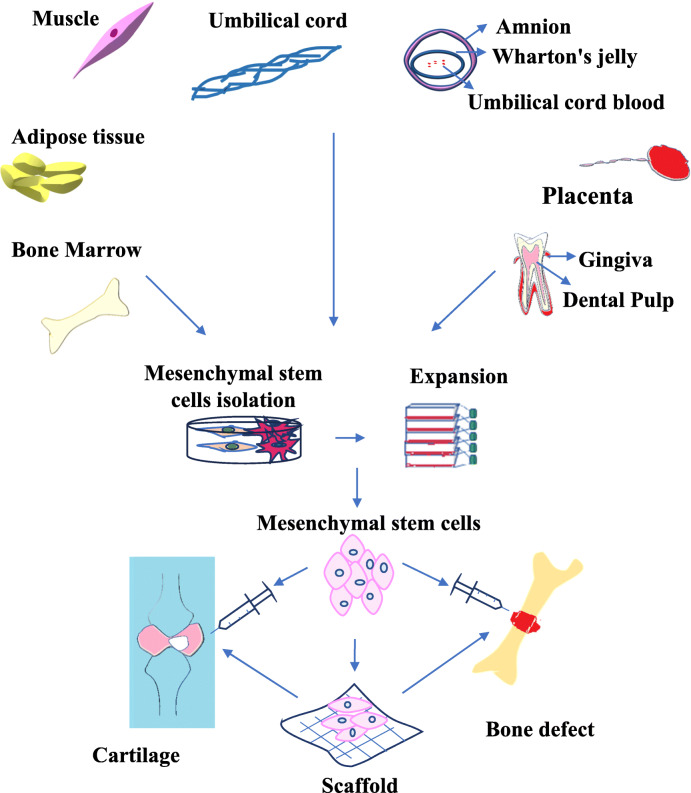
Skeletal disorders are among the leading debilitating factors affecting millions of people worldwide. The use of stem cells for tissue repair has raised many promises in various medical fields, including skeletal disorders. Mesenchymal stem cells (MSCs) are multipotent stromal cells with mesodermal and neural crest origin. These cells are one of the most attractive candidates in regenerative medicine, and their use could be helpful in repairing and regeneration of skeletal disorders through several mechanisms including homing, angiogenesis, differentiation, and response to inflammatory condition. The most widely studied sources of MSCs are bone marrow (BM), adipose tissue, muscle, umbilical cord (UC), umbilical cord blood (UCB), placenta (PL), Wharton’s jelly (WJ), and amniotic fluid. These cells are capable of differentiating into osteoblasts, chondrocytes, adipocytes, and myocytes in vitro. MSCs obtained from various sources have diverse capabilities of secreting many different cytokines, growth factors, and chemokines. It is believed that the salutary effects of MSCs from different sources are not alike in terms of repairing or reformation of injured skeletal tissues. Accordingly, differential identification of MSCs’ secretome enables us to make optimal choices in skeletal disorders considering various sources. This review discusses and compares the therapeutic abilities of MSCs from different sources for bone and cartilage diseases.
Overview
The claims and statistics of this paper haven’t been checked yet.
Free: it reads the open-access text and checks the first 5 claims that cite a source we can check. Create a free account to check every claim.
Integrity signals
Registry
Cites
Statistics
Figures
Verification
Claims the paper makes
The claims and statistics of this paper haven’t been checked yet.
Free: it reads the open-access text and checks the first 5 claims that cite a source we can check. Create a free account to check every claim.
Claims other papers make about this one
Each is checked against this paper’s own text: does it say what the citing paper says it does?
The source backs part of the claim, not all of it — or backs it for a different population, condition or comparison.
In the citing paper
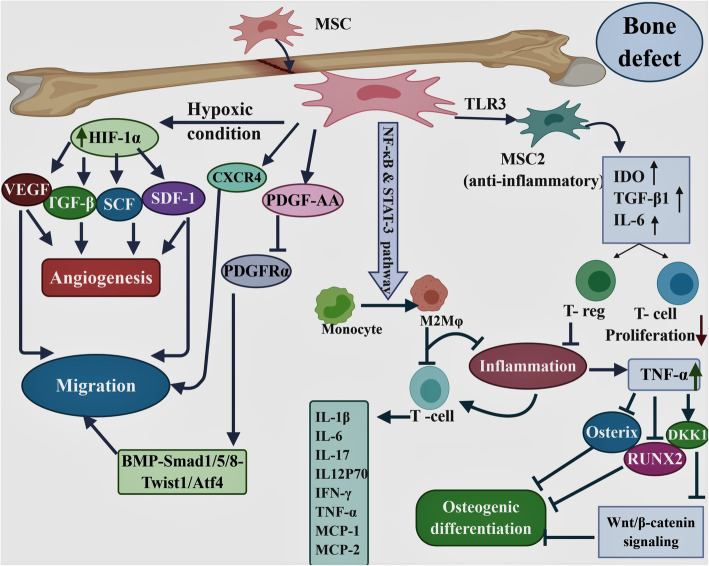
“This process is triggered by the response of MSCs to inflammatory factors released from the bone fracture site, such as PDGFs and BMPs, which activate BMP-Smad1/5/8 signaling, promoting MSC migration [40,77,78].”
From Mesenchymal Stem/Stromal Cells: Immunomodulatory and Bone Regeneration Potential after Tumor Excision in Osteosarcoma Patients (2023) · cites this paper as [40]
Experimental — accuracy not yet measuredThe cited source says what the claim attributes to it.
In the citing paper
“Specifically, in vitro and in vivo studies have demonstrated the pivotal role of MSCs in the bone healing process through their potential to enhance osteoinduction and osteogenesis.”
From Mesenchymal Stem/Stromal Cells: Immunomodulatory and Bone Regeneration Potential after Tumor Excision in Osteosarcoma Patients (2023) · cites this paper as [40]
The cited source says what the claim attributes to it.
In the citing paper
“MSC-EVs promote osteoblast proliferation, differentiation, and bone formation, contributing to bone repair and fracture healing [40,49].”
From Mesenchymal Stem/Stromal Cells: Immunomodulatory and Bone Regeneration Potential after Tumor Excision in Osteosarcoma Patients (2023) · cites this paper as [40]
The cited source says what the claim attributes to it.
In the citing paper
“Moreover, EVs produced by MSCs have emerged as a novel therapeutic method for bone diseases [40].”
From Mesenchymal Stem/Stromal Cells: Immunomodulatory and Bone Regeneration Potential after Tumor Excision in Osteosarcoma Patients (2023) · cites this paper as [40]
The cited source says what the claim attributes to it.
In the citing paper
“MSCs can contribute to bone repair and regeneration through several mechanisms, including facilitating cell migration, homing, angiogenesis, response to inflammation, and differentiation [40].”
From Mesenchymal Stem/Stromal Cells: Immunomodulatory and Bone Regeneration Potential after Tumor Excision in Osteosarcoma Patients (2023) · cites this paper as [40]
4 more claims about this paper
Create a free account to see every claim other papers make about this one.
Self-check
Percentages, sums and reported differences re-computed from the paper’s own numbers.
The self-check needs the paper’s full text.
Citations
Cites
1 retracted
Wang, N., Zhou, Z., Wu, T., Liu, W. X., Yin, P., Pan, C., & Yu, X. (2016) · Open Biology · doi:10.1098/rsob.150258 · Cited by 89 · cited 1×
“Another important effect of TNF-α in inflammatory conditions is inhibition of two essential osteogenic differentiation factors including RUNX2 and osterix, leading to the suppression of MSC differentiation [275, 276].”
BackgroundRetractedDominici, M., Le Blanc, K., Mueller, I., Slaper-Cortenbach, I., Marini, F. C., Krause, D. S., Deans, R. J., Keating, A., Prockop, D. J., & Horwitz, E. M. (2006) · Cytotherapy · doi:10.1080/14653240600855905 · Cited by 17,766 · cited 4×
“Several in vitro and in vivo studies on the degeneration of the IVD both in animal models and in clinical trials indicated that NP, AF, and CEPs contain cells with surface markers, morphology, proliferation rate, and multilineage differentiation capability similar to Table 3 Characterization of MSC from various tissue…”
BackgroundInfluentialLanger, R., & Vacanti, J. P. (1993) · Science · doi:10.1126/science.8493529 · Cited by 9,893
Kern, S., Eichler, H., Stoeve, J., Klüter, H., & Bieback, K. (2006) · STEM CELLS · doi:10.1634/stemcells.2005-0342 · Cited by 3,370
Di Nicola, M., Carlo-Stella, C., Magni, M., Milanesi, M., Longoni, P. D., Matteucci, P., Grisanti, S., & Gianni, A. M. (2002) · Blood · doi:10.1182/blood.v99.10.3838 · Cited by 3,226
Glyn-Jones, S., Palmer, A. J. R., Agricola, R., Price, A. J., Vincent, T. L., Weinans, H., & Carr, A. J. (2015) · The Lancet · doi:10.1016/s0140-6736(14)60802-3 · Cited by 3,151
Osteoarthritis: A disease of the joint as an organ
Loeser, R. F., Goldring, S. R., Scanzello, C. R., & Goldring, M. B. (2012) · Arthritis & Rheumatism · doi:10.1002/art.34453 · Cited by 3,076
Zhang, W., Moskowitz, R. W., Nuki, G., Abramson, S., Altman, R. D., Arden, N., Bierma-Zeinstra, S., Brandt, K. D., Croft, P., Doherty, M., et al. (2008) · Osteoarthritis and Cartilage · doi:10.1016/j.joca.2007.12.013 · Cited by 2,796 · cited 1×
“to manage the pain, stiffness, and swelling but are not effective to prevent the OA progression [196, 197].”
BackgroundThe Basic Science of Articular Cartilage: Structure, Composition, and Function
Sophia Fox, A. J., Bedi, A., & Rodeo, S. A. (2009) · Sports Health: A Multidisciplinary Approach · doi:10.1177/1941738109350438 · Cited by 2,774 · cited 1×
“II is the main structural protein in cartilage and forms a meshwork for entrapping proteoglycans such as aggrecan, decorin, and sendycan [187, 188].”
BackgroundBiology of Bone Tissue: Structure, Function, and Factors That Influence Bone Cells
Florencio-Silva, R., Sasso, G. R. D. S., Sasso-Cerri, E., Simões, M. J., & Cerri, P. S. (2015) · BioMed Research International · doi:10.1155/2015/421746 · Cited by 2,044 · cited 1×
“Collagen fibers are the main makeup in the organic phase while inorganic phase is mainly composed of hydroxyapatite [76, 78, 79].”
Background
Research works printed but not linked: 2
- Hasan M Shuckett R Clinical features and pathogenetic mechanisms of osteoarthritis of the hip and knee BC Med J 2010 52 8 393 398
- Ghaderi H, Razmkhah M, Kiany F, Chenari N, Haghshenas MR, Ghaderi A. Comparison of osteogenic and chondrogenic differentiation ability of buccal fat pad derived mesenchymal stem cells and gingival derived cells. J Dent. 2018;19(2):124–31. PMC5960732 29854886
Cited by
Stem cell-based therapy for human diseases
Hoang, D. M., Pham, P. T., Bach, T. Q., Ngo, A. T. L., Nguyen, Q. T., Phan, T. T. K., Nguyen, G. H., Le, P. T. T., Hoang, V. T., Forsyth, N. R., et al. (2022) · Signal Transduction and Targeted Therapy · doi:10.1038/s41392-022-01134-4 · Cited by 1,074
Inflammatory Processes Affecting Bone Health and Repair
de Oliveira, H. T., Arnold, K. M., Oviedo, M., Westendorf, J. J., & Weaver, S. R. (2023) · Current Osteoporosis Reports · doi:10.1007/s11914-023-00824-4 · Cited by 150
“Application of MPCs from various sources, including adipose tissue, bone marrow, or dental pulp, aids in fracture repair in part by inhibiting chronic inflammation [162].”
Engineering exosomes and biomaterial-assisted exosomes as therapeutic carriers for bone regeneration
Lu, Y., Mai, Z., Cui, L., & Zhao, X. (2023) · Stem Cell Research & Therapy · doi:10.1186/s13287-023-03275-x · Cited by 115
“MSCs hold great promise for wide-ranging clinical applications and regenerative medicine, as they retain the potential to differentiate into multilineages under defined conditions and the ability to self-renew [8, 9].”
BackgroundMalekpour, K., Hazrati, A., Zahar, M., Markov, A. A., Zekiy, A. O., Navashenaq, J. G., Roshangar, L., & Ahmadi, M. (2021) · Stem Cell Reviews and Reports · doi:10.1007/s12015-021-10185-z · Cited by 127
The role and applications of extracellular vesicles in osteoporosis
Fang, F., Yang, J., Wang, J., Li, T., Wang, E., Zhang, D., Liu, X., & Zhou, C. (2024) · Bone Research · doi:10.1038/s41413-023-00313-5 · Cited by 116
“103 Currently, the application paradigm of MSCs has shifted from a differentiation-and replacement-based approach to one centered around the use of secreted and paracrine effectors.”
Background
Metadata
- Authors
- Kangari, P., Talaei-Khozani, T., Razeghian-Jahromi, I., & Razmkhah, M.
- Affiliations
- Shiraz University of Medical Sciences (IR)
- Corresponding author
- Razmkhah, Mahboobeh
- Venue
- Stem Cell Research & Therapy
- Published
- 2020-11-23
- Volume
- 11
- Issue
- 1
- Pages
- 492-492
- ISSN
- 1757-6512 (ISSN-L)
- PMC
- PMC7681994
- OpenAlex
- W3108324966
- Cited by
- 286
- References
- 327
- Citations by year
- 2026: 21 · 2025: 53 · 2024: 69 · 2023: 73 · 2022: 47 · 2021: 23
- FWCI
- 5.73
- Type
- journal article
- Language
- en
- Open access
- gold
- doi.org
- Licence
- cc-by
- creativecommons.org/licenses/by/4.0/ (tdm)
- creativecommons.org/licenses/by/4.0/ (vor)
- Locations
- Stem Cell Research & Therapy (publishedVersion, cc-by)
- PubMed Central (publishedVersion, cc-by)
- PubMed (publishedVersion)
- Funders
- Shiraz University of Medical Sciences (ICR100-504)
- Shiraz University
- Shiraz Institute for Cancer Research, Shiraz University of Medical Sciences (ICR-100-504)
- Topics
- Life Sciences › Biochemistry, Genetics and Molecular Biology › Cell Biology › Mesenchymal stem cell research
- Physical Sciences › Engineering › Biomedical Engineering › Bone Tissue Engineering Materials
- Health Sciences › Dentistry › Periodontics › Periodontal Regeneration and Treatments
- Keywords
- mesenchymal stem cells, bone defects, cartilage defects, bone disease, regenerative medicine, stem cell sources, bone marrow, adipose tissue, umbilical cord, placenta, Wharton's jelly, amniotic fluid, osteogenic differentiation, chondrogenic differentiation, secretome, angiogenesis, cell homing, inflammation
- MeSH terms
- Cartilage, Cartilage Diseases, Cell Differentiation, Female, Humans, Pregnancy, Umbilical Cord, Mesenchymal Stem Cells, Wharton Jelly
About these checks
Registry, retraction, Cites and statistics results are computed, not judged, with one exception: a printed reference that no index lists is read once by a model before it counts as a citation error. Claims are extracted by a model and kept only when their quote appears verbatim in the text; each cited source is then checked, with a model’s help, for whether it says what the claim relies on. Those verdicts can be wrong — read the claim’s quote and the cited source before relying on one.
Statistics and arithmetic are recomputed, not judged.
Confidence bands are shown only for fields calibrated on our annotated test set. None is calibrated yet, so no band is shown.
What counts as a claim ›How we measure confidence ›How we check this ›
Are you an author, or do you see a problem with this page? Request a review
Data sources
Bibliographic data: Semantic Scholar, OpenAlex, Crossref.
Contains information from the Semantic Scholar Academic Graph Datasets, made available under the ODC Attribution License (ODC-BY 1.0).
Semantic Scholar’s data is described in: Kinney, R., et al. (2023). The Semantic Scholar Open Data Platform. arXiv:2301.10140.
