

The DOI matches its Crossref record; 197 of the 199 references it cites were found in a registry or an index.
Muscle metabolism and atrophy: let’s talk about sex
Open accessAbstract
Skeletal muscle health is a strong predictor of overall health and longevity. Pathologies affecting skeletal muscle such as cancer cachexia, intensive care unit treatment, muscular dystrophies, and others are associated with decreased quality of life and increased mortality. Recent research has begun to determine that these muscular pathologies appear to present and develop differently between males and females. However, to our knowledge, there has yet to be a comprehensive review on musculoskeletal differences between males and females and how these differences may contribute to sex differences in muscle pathologies. Herein, we present a review of the current literature on muscle phenotype and physiology between males and females and how these differences may contribute to differential responses to atrophic stimuli. In general, females appear to be more susceptible to disuse induced muscle wasting, yet protected from inflammation induced (such as cancer cachexia) muscle wasting compared to males. These differences may be due in part to differences in muscle protein turnover, satellite cell content and proliferation, hormonal interactions, and mitochondrial differences between males and females. However, more works specifically examining muscle pathologies in females are necessary to more fully understand the inherent sex-based differences in muscle pathologies between the sexes and how they may correspond to different clinical treatments.
Overview
The claims and statistics of this paper haven’t been checked yet.
Run the check — free, no account needed. It reads the open-access text and checks the sources it cites.
Integrity signals
Registry
Cites
Statistics
Figures
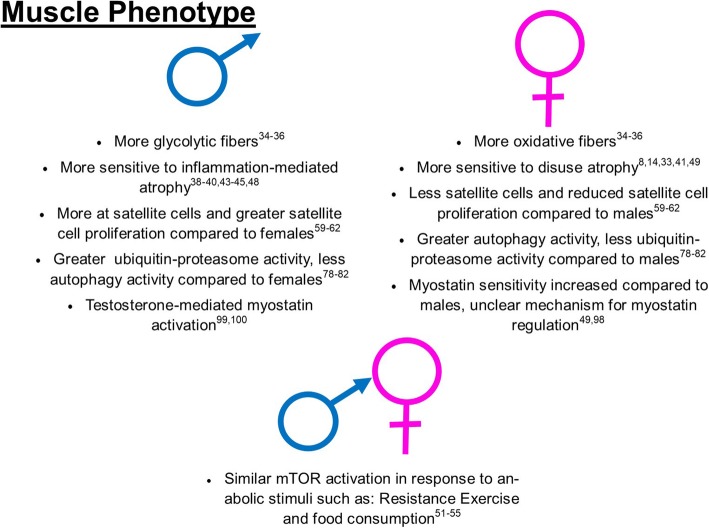
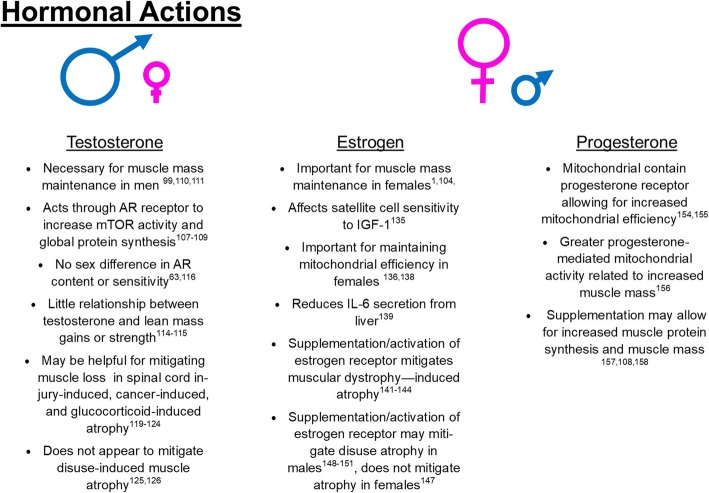
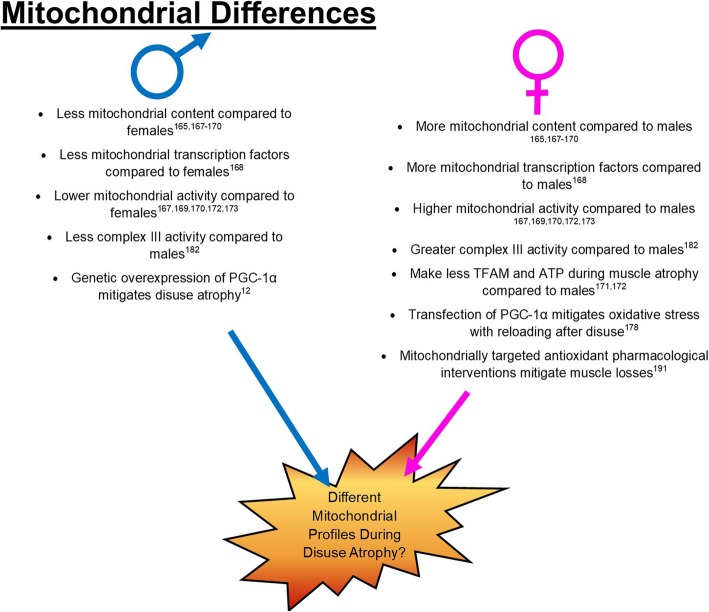
Verification
Claims the paper makes
The claims and statistics of this paper haven’t been checked yet.
Run the check — free, no account needed. It reads the open-access text and checks the sources it cites.
Claims other papers make about this one
Each is checked against this paper’s own text: does it say what the citing paper says it does?
The source backs part of the claim, not all of it — or backs it for a different population, condition or comparison.
In the citing paper
“Although muscle protein synthesis rates are greater in older women at rest [245]”
From International society of sports nutrition position stand: nutritional concerns of the female athlete (2023) · cites this paper as [245]
Experimental — accuracy not yet measuredThe check wasn’t confident either way, so it gives no verdict — never disputed.
In the citing paper
“Both an upregulation of stimulatory and inhibitory muscle growth regulatory genes in postmenopausal women compared with premenopausal women have also been reported [245].”
From International society of sports nutrition position stand: nutritional concerns of the female athlete (2023) · cites this paper as [245]
Experimental — accuracy not yet measured
Self-check
Percentages, sums and reported differences re-computed from the paper’s own numbers.
The self-check needs the paper’s full text.
Citations
Cites
Guidelines for the use and interpretation of assays for monitoring autophagy (3rd edition).
Klionsky, D. J., Abdelmohsen, K., Abe, A., Abedin, M. J., Abeliovich, H., Acevedo Arozena, A., Adachi, H., Adams, C. M., Adams, P. D., Adeli, K., et al. (2016) · Autophagy · doi:10.1080/15548627.2015.1100356 · Cited by 5,894
Transcriptional co-activator PGC-1α drives the formation of slow-twitch muscle fibres
Lin, J., Wu, H., Tarr, P. T., Zhang, C.-Y., Wu, Z., Boss, O., Michael, L. F., Puigserver, P., Isotani, E., Olson, E. N., et al. (2002) · Nature · doi:10.1038/nature00904 · Cited by 2,546
Epidemiology of women and depression
Kessler, R. (2003) · Journal of Affective Disorders · doi:10.1016/s0165-0327(02)00426-3 · Cited by 2,006
Gender Disparity in Liver Cancer Due to Sex Differences in MyD88-Dependent IL-6 Production
Naugler, W. E., Sakurai, T., Kim, S., Maeda, S., Kim, K., Elsharkawy, A. M., & Karin, M. (2007) · Science · doi:10.1126/science.1140485 · Cited by 1,955
Atrogin-1, a muscle-specific F-box protein highly expressed during muscle atrophy
Gomes, M. D., Lecker, S. H., Jagoe, R. T., Navon, A., & Goldberg, A. L. (2001) · Proceedings of the National Academy of Sciences · doi:10.1073/pnas.251541198 · Cited by 1,774
Estimation of clinical trial success rates and related parameters
Wong, C. H., Siah, K. W., & Lo, A. W. (2019) · Biostatistics · doi:10.1093/biostatistics/kxx069 · Cited by 1,585
Multiple types of skeletal muscle atrophy involve a common program of changes in gene expression
Lecker, S. H., Jagoe, R. T., Gilbert, A., Gomes, M., Baracos, V., Bailey, J., Price, S. R., Mitch, W. E., & Goldberg, A. L. (2004) · The FASEB Journal · doi:10.1096/fj.03-0610com · Cited by 1,539
Paresis Acquired in the Intensive Care Unit A Prospective Multicenter Study
Jonghe, B. D. (2002) · JAMA · doi:10.1001/jama.288.22.2859 · Cited by 1,518
Adverse Events Associated with Testosterone Administration
Basaria, S., Coviello, A. D., Travison, T. G., Storer, T. W., Farwell, W. R., Jette, A. M., Eder, R., Tennstedt, S., Ulloor, J., Zhang, A., et al. (2010) · New England Journal of Medicine · doi:10.1056/nejmoa1000485 · Cited by 1,494
Mechanisms regulating skeletal muscle growth and atrophy
Schiaffino, S., Dyar, K. A., Ciciliot, S., Blaauw, B., & Sandri, M. (2013) · The FEBS Journal · doi:10.1111/febs.12253 · Cited by 1,492
Research works printed but not linked: 2
- Mauvais-Jarvis F. Sex differences in metabolic homeostasis, diabetes, and obesity. Biol Sex Differ. 2015;6. · DOI · Paper page
- Kang C, Ji LL. PGC-1α overexpression via local transfection attenuates mitophagy pathway in muscle disuse atrophy. Free Radic Biol Med. 2015. · DOI · Paper page
Cited by
Sorted by citations
Items 201–204 of 204
Tinggaard, A. B., Wang, J., Farup, J., Bjerre, M., Brorson, J., Chousterman, B., Börgeson, E., Schulze, P. C., Nørrelund, H., Jessen, N., et al. (2026) · Circulation: Heart Failure · doi:10.1161/circheartfailure.125.014062
Oh, J. H., Ku, C. R., & Oh, C. (2026) · Ageing Research Reviews · doi:10.1016/j.arr.2026.103349
Ross, S. A., Dorscher, S. N., Leonard, T. R., Seerattan, R. A., Corbett, D., & Herzog, W. (2026) · bioRxiv (Cold Spring Harbor Laboratory) · doi:10.64898/2026.09.09.750457
Daredia, J., Valentino, T. R., Ismaeel, A., Wen, Y., McCarthy, J. J., & Burke, B. I. (2026) · Physiological Reports · doi:10.14814/phy2.71137
Metadata
- Authors
- Rosa-Caldwell, M. E., & Greene, N. P.
- Affiliations
- University of Arkansas at Fayetteville (US)
- Corresponding author
- Greene, Nicholas P.
- ORCID
- Greene, Nicholas P.
- Venue
- Biology of Sex Differences
- Published
- 2019-08-28
- Volume
- 10
- Issue
- 1
- Pages
- 43-43
- ISSN
- 2042-6410 (ISSN-L)
- PMC
- PMC6714453
- OpenAlex
- W2971287565
- Cited by
- 202
- References
- 199
- Citations by year
- 2026: 18 · 2025: 26 · 2024: 23 · 2023: 49 · 2022: 32 · 2021: 32 · 2020: 18 · 2019: 2
- FWCI
- 1.85
- Type
- journal article
- Language
- en
- Open access
- gold
- doi.org
- Locations
- Biology of Sex Differences (publishedVersion, cc-by)
- Europe PMC (PubMed Central) (publishedVersion, cc-by)
- PubMed Central (publishedVersion, cc-by)
- PubMed (publishedVersion)
- DOAJ (DOAJ: Directory of Open Access Journals) (submittedVersion, cc-by-sa)
- Funders
- National Institute of Arthritis and Musculoskeletal and Skin Diseases (R15 AR069913/AR/NIAMS)
- Topics
- Life Sciences › Biochemistry, Genetics and Molecular Biology › Molecular Biology › Muscle Physiology and Disorders
- Health Sciences › Medicine › Physiology (medical) › Nutrition and Health in Aging
- Health Sciences › Nursing › Nutrition and Dietetics › Muscle metabolism and nutrition
- Keywords
- sex differences, skeletal muscle metabolism, muscle atrophy, cancer cachexia, muscle protein turnover, satellite cells, hormonal differences
- MeSH terms
- Energy Metabolism, Female, Humans, Male, Muscular Atrophy, Risk Factors, Sex Characteristics, Muscle, Skeletal
About these checks
Registry, retraction, Cites and statistics results are computed, not judged, with one exception: a printed reference that no index lists is read once by a model before it counts as a citation error. Claims are extracted by a model and kept only when their quote appears verbatim in the text; each cited source is then checked, with a model’s help, for whether it says what the claim relies on. Those verdicts can be wrong — read the claim’s quote and the cited source before relying on one.
Statistics and arithmetic are recomputed, not judged.
Confidence bands are shown only for fields calibrated on our annotated test set. None is calibrated yet, so no band is shown.
What counts as a claim ›How we measure confidence ›How we check this ›
Are you an author, or do you see a problem with this page? Request a review
