

Towards reproducible computational drug discovery
Open accessThe DOI matches its Crossref record; 236 of the 236 references it cites were found in a registry or an index.
Abstract
The reproducibility of experiments has been a long standing impediment for further scientific progress. Computational methods have been instrumental in drug discovery efforts owing to its multifaceted utilization for data collection, pre-processing, analysis and inference. This article provides an in-depth coverage on the reproducibility of computational drug discovery. This review explores the following topics: (1) the current state-of-the-art on reproducible research, (2) research documentation (e.g. electronic laboratory notebook, Jupyter notebook, etc.), (3) science of reproducible research (i.e. comparison and contrast with related concepts as replicability, reusability and reliability), (4) model development in computational drug discovery, (5) computational issues on model development and deployment, (6) use case scenarios for streamlining the computational drug discovery protocol. In computational disciplines, it has become common practice to share data and programming codes used for numerical calculations as to not only facilitate reproducibility, but also to foster collaborations (i.e. to drive the project further by introducing new ideas, growing the data, augmenting the code, etc.). It is therefore inevitable that the field of computational drug design would adopt an open approach towards the collection, curation and sharing of data/code.
Overview
The claims and statistics of this paper haven’t been checked yet.
Free: it reads the open-access text and checks the first 5 claims that cite a source we can check. Create a free account to check every claim.
Integrity signals
Registry
Cites
Statistics
Figures
Verification
Claims the paper makes
The claims and statistics of this paper haven’t been checked yet.
Free: it reads the open-access text and checks the first 5 claims that cite a source we can check. Create a free account to check every claim.
Claims other papers make about this one
Each is checked against this paper’s own text: does it say what the citing paper says it does?
The source backs part of the claim, not all of it — or backs it for a different population, condition or comparison.
In the citing paper
“Significant advances in chemoinformatics and the application of artificial intelligence to drug compound discovery and the repurposing of existing drugs have greatly increased research into in-silico driven development of new, effective medications for a variety of indications30.”
From OnSIDES database: Extracting adverse drug events from drug labels using natural language processing models (2025) · cites this paper as [30]
Experimental — accuracy not yet measuredIn the citing paper
“A typical research project in computational drug discovery uses a variety of software, programs, and tools to read input files, pre-process data, perform one or more computations, and do post-analysis.”
From Interoperability of heterogeneous health information systems: a systematic literature review (2023) · cites this paper as [40]
In the citing paper
“Such an undertaking can be challenging and necessitate manual pre-processing of the output and input files.”
From Interoperability of heterogeneous health information systems: a systematic literature review (2023) · cites this paper as [40]
In the citing paper
“Pre-processing and connecting the outputs of one software or tool as input to another software or tool would probably be required for this.”
From Interoperability of heterogeneous health information systems: a systematic literature review (2023) · cites this paper as [40]
Self-check
Percentages, sums and reported differences re-computed from the paper’s own numbers.
The self-check needs the paper’s full text.
Citations
Cites
Items 201–236 of 236
Gleeson, M. P., & Montanari, D. (2012) · Expert Opinion on Drug Metabolism & Toxicology · doi:10.1517/17425255.2012.711317 · Cited by 25
Self-citationSilver, A. (2017) · Nature · doi:10.1038/546173a · Cited by 24
Nicola, G., Berthold, M. R., Hedrick, M. P., & Gilson, M. K. (2015) · Database · doi:10.1093/database/bav087 · Cited by 23 · cited 1×
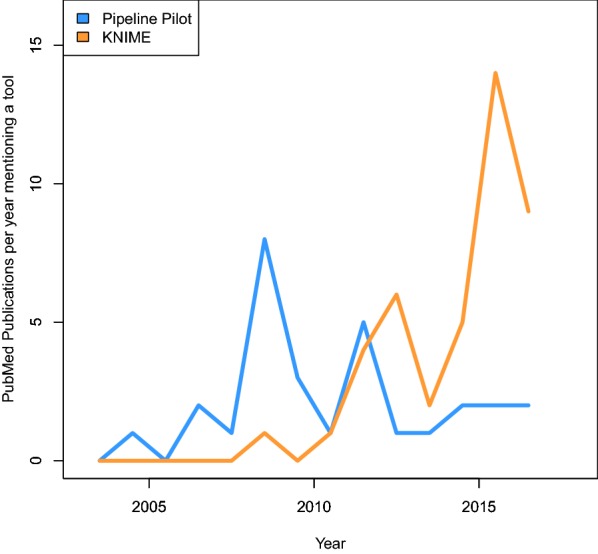
“KNIME has been used, for example, for virtual screening [200], target identification [201]; more in-depth coverage of applications are provided elsewhere [202].”
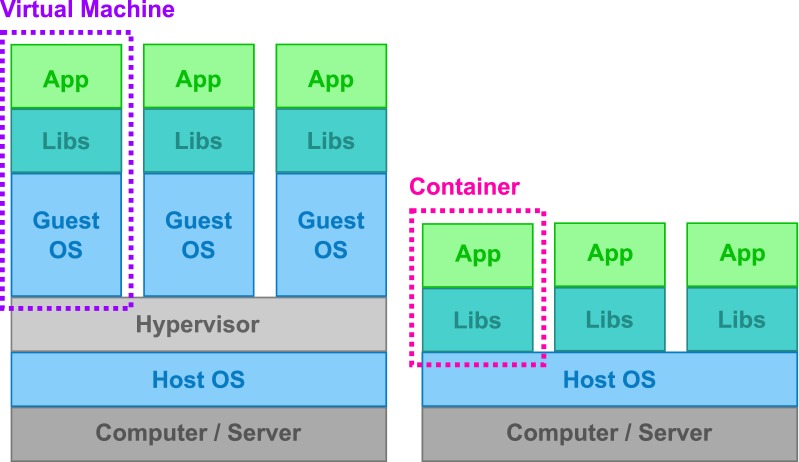
MethodmyChEMBL: a virtual machine implementation of open data and cheminformatics tools
Ochoa, R., Davies, M., Papadatos, G., Atkinson, F. L., & Overington, J. P. (2013) · Bioinformatics · doi:10.1093/bioinformatics/btt666 · Cited by 22 · cited 2×
“Furthermore, myChEMBL [230] is an open source virtual machine that Table 2 List of software and packages that implements an automated QSAR modeling workflow combines bioactivity data from ChEMBL with the latest RDKit [267] cheminformatics libraries to sustain a self-contained and user-friendly…”
MethodTeach–Discover–Treat (TDT): Collaborative computational drug discovery for neglected diseases
Jansen, J. M., Cornell, W., Tseng, Y. J., & Amaro, R. E. (2012) · Journal of Molecular Graphics and Modelling · doi:10.1016/j.jmgm.2012.07.007 · Cited by 22
Bio-Docklets: virtualization containers for single-step execution of NGS pipelines
Kim, B., Ali, T. A., Lijeron, C., Afgan, E., & Krampis, K. (2017) · GigaScience · doi:10.1093/gigascience/gix048 · Cited by 22 · cited 2×
“In this regard, many docker-based platforms have been produced such as BioContainer [71], a community-driven, open-source project based on the Docker container that can be easily accessed via GitHub; Bio-Docklets [72], a bioinformatics pipeline for next generation sequencing (NGS) data analysis; and Dugong [73], a Ubu…”
MethodLarge-scale virtual screening on public cloud resources with Apache Spark
Capuccini, M., Ahmed, L., Schaal, W., Laure, E., & Spjuth, O. (2017) · Journal of Cheminformatics · doi:10.1186/s13321-017-0204-4 · Cited by 21
Self-citationMenegídio, F. B., Jabes, D. L., de Oliveira, R. C., & Nunes, L. R. (2017) · Bioinformatics · doi:10.1093/bioinformatics/btx554 · Cited by 20
High-throughput virtual molecular docking
Ellingson, S. R., & Baudry, J. Y. (2011) · doi:10.1145/1996023.1996028 · Cited by 16
Scaling Predictive Modeling in Drug Development with Cloud Computing
Moghadam, B. T., Alvarsson, J., Holm, M., Eklund, M., Carlsson, L., & Spjuth, O. (2015) · Journal of Chemical Information and Modeling · doi:10.1021/ci500580y · Cited by 15
Self-citationEzqsar: An R Package for Developing QSAR Models Directly From Structures
Shamsara, J. (2017) · The Open Medicinal Chemistry Journal · doi:10.2174/1874104501711010212 · Cited by 15
Computation semantics of the functional scientific workflow language Cuneiform
BRANDT, J., Reisig, W., & Leser, U. (2017) · Journal of Functional Programming · doi:10.1017/s0956796817000119 · Cited by 14
Establishing Good Computer Modelling Practice (GCMP) in the Prediction of Chemical Toxicity
Judson, P. N., Barber, C., Canipa, S. J., Poignant, G., & Williams, R. D. (2015) · Molecular Informatics · doi:10.1002/minf.201400137 · Cited by 13
Ősz, Á., Pongor, L. S., Szirmai, D., & Győrffy, B. (2017) · Briefings in Bioinformatics · doi:10.1093/bib/bbx159 · Cited by 13
Proteochemometric Modeling for Drug Repositioning
Schaduangrat, N., Anuwongcharoen, N., Phanus‐umporn, C., Sriwanichpoom, N., Wikberg, J. E. S., & Nantasenamat, C. (2019) · Elsevier eBooks · doi:10.1016/b978-0-12-816125-8.00010-9 · Cited by 13
Self-citationReproducibility of Model-Based Results in Systems Biology
Waltemath, D., Henkel, R., Winter, F., & Wolkenhauer, O. (2013) · Springer eBooks · doi:10.1007/978-94-007-6803-1_10 · Cited by 10
Biolmg.org: A Catalog of Virtual Machine Images for the Life Sciences
Dahlö, M., Haziza, F., Kallio, A., Korpelainen, E., Bongcam‐Rudloff, E., & Spjuth, O. (2015) · Bioinformatics and Biology Insights · doi:10.4137/bbi.s28636 · Cited by 9
Self-citationBradley, J., & Neylon, C. (2008) · Nature · doi:10.1038/455273a · Cited by 9 · cited 1×
“Moreover, scientists are making these notebooks publicly available so as to support the open science initiative (i.e. also termed “open notebook science”) [23, 24] and in doing so foster the sharing of unpublished experimental data and analysis (i.e. known as “dark data”).”
BackgroundRiniker, S., Landrum, G. A., Montanari, F., Villalba, S. D., Maier, J., Jansen, J. M., Walters, W. P., & Shelat, A. A. (2017) · F1000Research · doi:10.12688/f1000research.11905.2 · Cited by 9
A QSAR study on some series of anti-hepatitis B virus (HBV) agents
Arora, P. K., Patil, V. M., & Gupta, S. P. (2010) · Bioinformation · doi:10.6026/97320630004417 · Cited by 8 · cited 1×
“In addition, QSAR models are able to correlate the physicochemical properties of a structure with the biological activity [157].”
BackgroundResearch tools: Jump off the page
Mascarelli, A. L. (2014) · Nature · doi:10.1038/nj7493-523a · Cited by 8
A new open source data analysis python script for QSAR study and its validation
Kurdekar, V., & Jadhav, H. R. (2014) · Medicinal Chemistry Research · doi:10.1007/s00044-014-1240-5 · Cited by 7
A path to next-generation reproducibility in cheminformatics
Clark, R. D. (2019) · Journal of Cheminformatics · doi:10.1186/s13321-019-0385-0 · Cited by 7 · cited 1×
“During the revision phase of this manuscript submission, an excellent commentary article by Clark [15] addressing the importance of reproducibility in cheminformatics was recently published.”
BackgroundSuhartanto, H. S., Pasaribu, A. P., Siddiq, M. F., Fadhila, M. I., Hilman, M. H., & Yanuar, A. (2017) · International Journal of Technology · doi:10.14716/ijtech.v8i4.9478 · Cited by 7
WeBIAS: a web server for publishing bioinformatics applications
Daniluk, P., Wilczyński, B., & Lesyng, B. (2015) · BMC Research Notes · doi:10.1186/s13104-015-1622-x · Cited by 5
Hasegawa, K., & Funatsu, K. (2014) · Molecular Informatics · doi:10.1002/minf.201400061 · Cited by 5
Garabedian, T. E. (1997) · Nature Biotechnology · doi:10.1038/nbt0897-799 · Cited by 5
Nelfinavir: A magic bullet to annihilate cancer cells
Wu, W., Zhang, R., & Salahub, D. R. (2009) · Cancer Biology & Therapy · doi:10.4161/cbt.8.3.7789 · Cited by 5
Toward reproducible disease models using the Systems Biology Markup Language
Watanabe, L. H., Barhak, J., & Myers, C. J. (2018) · SIMULATION · doi:10.1177/0037549718793214 · Cited by 5
Medicinal chemistry tools: making sense of HTS data
Kolossov, E., & Lemon, A. (2005) · European Journal of Medicinal Chemistry · doi:10.1016/j.ejmech.2005.10.005 · Cited by 4
Experimenting with reproducibility in bioinformaticsPreprint
Kim, Y.-M., Poline, J., & Dumas, G. (2017) · bioRxiv (Cold Spring Harbor Laboratory) · doi:10.1101/143503 · Cited by 4 · cited 1×
“This crisis has been described by Kim et al. [66] whereby the authors compare the hidden reproducibility issues to an iceberg which is only noticed at a fraction of its actual size, highlighting the significant gap between the apparent executable work (i.e. portion of iceberg that can be seen above…”
BackgroundChemicalToolBoX and its application on the study of the drug like and purchasable space
Lucas, X., Grüning, B. A., & Günther, S. (2014) · Journal of Cheminformatics · doi:10.1186/1758-2946-6-s1-p51 · Cited by 3
A Massive Snowball of Fraud and Deceit
Bernal, S. K. (2006) · Journal of Andrology · doi:10.2164/jandrol.06007 · Cited by 3
Helping to improve the practice of cheminformatics
Guha, R., & Willighagen, E. (2017) · Journal of Cheminformatics · doi:10.1186/s13321-017-0217-z · Cited by 3
Pasaribu, A. P., Siddiq, M. F., Fadhila, M. I., Hilman, M. H., Yanuar, A., & Suhartanto, H. S. (2017) · DOAJ (DOAJ: Directory of Open Access Journals) · doi:10.14716/ijtech.v8i4.7481 · Cited by 3
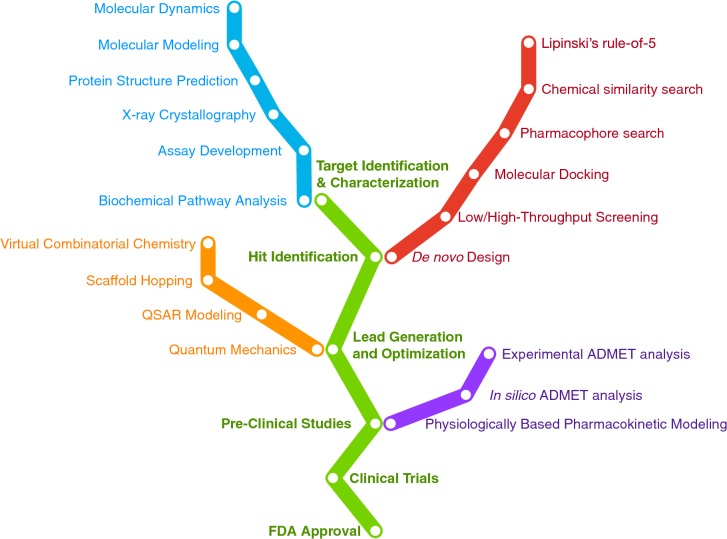
Conceptual Map of Computational Drug Discovery
Nantasenamat, C. (2018) · Figshare · doi:10.6084/m9.figshare.5979400 · Cited by 1
Self-citation
Research works printed but not linked: 13
- Stratmann HG Bad medicine: when medical research goes wrong Analog Sci Fict Fact 2010 CXXX 9 20 30
- Oudeyer P-Y Merrick K Computational modelling across disciplines IEEE Cogn Dev Syst Newslett 2016 13 2 1
- Scientific Data (2019) Recommended Data Repositories. https://www.nature.com/sdata/policies/repositories/. Accessed 9 Jan 2019
- Macmillan Publishers Limited (2019) Scientific Data. https://www.nature.com/sdata/. Accessed 9 Jan 2019
- Elsevier (2019) Data in Brief. https://www.journals.elsevier.com/data-in-brief/. Accessed 9 Jan 2019
- MDPI (2019) Data. http://www.mdpi.com/journal/data/. Accessed 9 Jan 2019
- F1000Research (2019) F1000Research | Open Access Publishing Platform | Beyond a Research Journal. https://f1000research.com/. Accessed 9 Jan 2019
- arXiv (2019) arXiv.org e-Print archive. https://arxiv.org/. Accessed 9 Jan 2019
- bioRxiv (2019) bioRxiv.org—the preprint server for Biology. https://www.biorxiv.org/. Accessed 9 Jan 2019
- ChemRxiv (2019) ChemRxiv: the Preprint Server for Chemistry. https://chemrxiv.org/. Accessed 9 Jan 2019
- PeerJ (2019) PeerJ Preprints. https://peerj.com/preprints/. Accessed 9 Jan 2019
- Barhak J (2019) MIST: Micro-simulation tool to support disease modeling. https://github.com/scipy-conference/scipy2013_talks/tree/master/talks/jacob_barhak. Accessed 1 Nov 2019
- Davie P Cloud computing: a drug discovery game changer? Innov Pharm Technol 2010 33 34 36
Cited by
Interoperability of heterogeneous health information systems: a systematic literature review
Torab-Miandoab, A., Samad-Soltani, T., Jodati, A., & Rezaei-Hachesu, P. (2023) · BMC Medical Informatics and Decision Making · doi:10.1186/s12911-023-02115-5 · Cited by 393
“If system or tool developers also take into consideration the real-world use case situation relative to the interoperability of input/output files for various software programs and tools, this problem might be resolved [40].”
BackgroundIqbal, M. J., Javed, Z., Sadia, H., Qureshi, I. A., Irshad, A., Ahmed, R., Malik, K., Raza, S., Abbas, A., Pezzani, R., et al. (2021) · Cancer Cell International · doi:10.1186/s12935-021-01981-1 · Cited by 369
“Reproducible computation drug designing has been a promising tool for future drug development with increasing specificity and low cost [71].”
Deep-PK: deep learning for small molecule pharmacokinetic and toxicity prediction
Myung, Y., de Sá, A. G. C., & Ascher, D. B. (2024) · Nucleic Acids Research · doi:10.1093/nar/gkae254 · Cited by 337
“Evaluating, understanding and optimizing pharmacokinetic and toxicity properties under the umbrella of ADMET (absorption, distribution, metabolism, elimination and toxicity) categories have become essential for reducing attrition rates in later phases of drug research and development ( 3 ,16–21 ).”
BackgroundComputer-Aided Drug Design and Drug Discovery: A Prospective Analysis
Niazi, S. K., & Mariam, Z. (2023) · Pharmaceuticals · doi:10.3390/ph17010022 · Cited by 336
“These models, while sophisticated, often require experimental validation to ascertain their predictions [9,10].”
BackgroundArtificial intelligence in drug discovery: applications and techniques
Deng, J., Yang, Z., Ojima, I., Samaras, D., & Wang, F. (2022) · Briefings in Bioinformatics · doi:10.1093/bib/bbab430 · Cited by 220
Metadata
- Authors
- Schaduangrat, N., Lampa, S., Simeon, S., Gleeson, M. P., Spjuth, O., & Nantasenamat, C.
- Affiliations
- Mahidol University (TH)
- Uppsala University (SE)
- Kasetsart University (TH)
- King Mongkut's Institute of Technology Ladkrabang (TH)
- Corresponding author
- Gleeson, Matthew Paul
- ORCID
- Venue
- Journal of Cheminformatics
- Published
- 2020-01-28
- Volume
- 12
- Issue
- 1
- Pages
- 9-9
- ISSN
- 1758-2946 (ISSN-L)
- PMC
- PMC6988305
- OpenAlex
- W3013954280
- Cited by
- 208
- References
- 236
- Citations by year
- 2026: 31 · 2025: 29 · 2024: 39 · 2023: 52 · 2022: 25 · 2021: 23 · 2020: 9
- FWCI
- 5.28
- Type
- journal article
- Language
- en
- Open access
- gold
- doi.org
- Licence
- cc-by
- creativecommons.org/licenses/by/4.0/ (tdm)
- creativecommons.org/licenses/by/4.0/ (vor)
- Locations
- Journal of Cheminformatics (publishedVersion, cc-by)
- PubMed Central (publishedVersion, cc-by)
- PubMed (publishedVersion)
- Uppsala University Publications (Uppsala University) (submittedVersion, other-oa)
- DOAJ (DOAJ: Directory of Open Access Journals) (submittedVersion)
- Greater South Information System
- Funders
- Thailand Research Fund (RSA6280075)
- Topics
- Social Sciences › Decision Sciences › Information Systems and Management › Scientific Computing and Data Management
- Life Sciences › Pharmacology, Toxicology and Pharmaceutics › Drug Discovery › Computational Drug Discovery Methods
- Physical Sciences › Computer Science › Information Systems › Research Data Management Practices
- Keywords
- reproducibility, computational drug discovery, research documentation, electronic lab notebook, Jupyter notebooks, replicability, reusability, reliability statistics, model development, model deployment, data sharing, code sharing, open science
About these checks
Registry, retraction, Cites and statistics results are computed, not judged, with one exception: a printed reference that no index lists is read once by a model before it counts as a citation error. Claims are extracted by a model and kept only when their quote appears verbatim in the text; each cited source is then checked, with a model’s help, for whether it says what the claim relies on. Those verdicts can be wrong — read the claim’s quote and the cited source before relying on one.
Statistics and arithmetic are recomputed, not judged.
Confidence bands are shown only for fields calibrated on our annotated test set. None is calibrated yet, so no band is shown.
What counts as a claim ›How we measure confidence ›How we check this ›
Are you an author, or do you see a problem with this page? Request a review
Data sources
Bibliographic data: Semantic Scholar, OpenAlex, Crossref.
Contains information from the Semantic Scholar Academic Graph Datasets, made available under the ODC Attribution License (ODC-BY 1.0).
Semantic Scholar’s data is described in: Kinney, R., et al. (2023). The Semantic Scholar Open Data Platform. arXiv:2301.10140.
