

Comparing generative and extractive approaches to information extraction from abstracts describing randomized clinical trials.
Open accessThe DOI matches its Crossref record; 68 of the 68 references it cites were found in a registry or an index.
Abstract
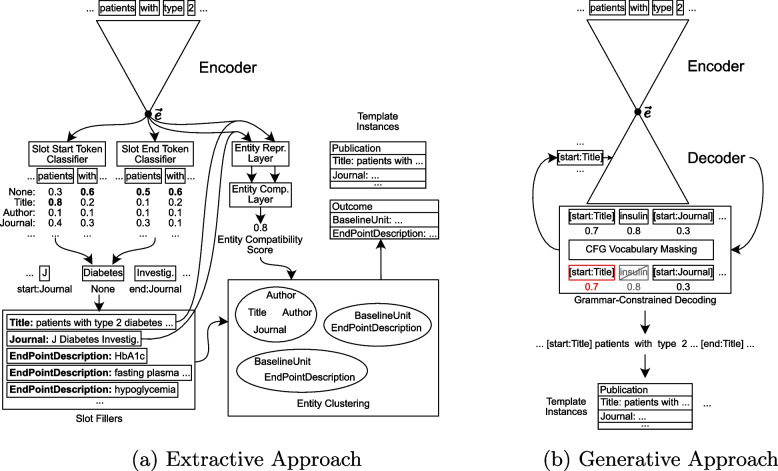
Background: Systematic reviews of Randomized Controlled Trials (RCTs) are an important part of the evidence-based medicine paradigm. However, the creation of such systematic reviews by clinical experts is costly as well as time-consuming, and results can get quickly outdated after publication. Most RCTs are structured based on the Patient, Intervention, Comparison, Outcomes (PICO) framework and there exist many approaches which aim to extract PICO elements automatically. The automatic extraction of PICO information from RCTs has the potential to significantly speed up the creation process of systematic reviews and this way also benefit the field of evidence-based medicine. Results: Previous work has addressed the extraction of PICO elements as the task of identifying relevant text spans or sentences, but without populating a structured representation of a trial. In contrast, in this work, we treat PICO elements as structured templates with slots to do justice to the complex nature of the information they represent. We present two different approaches to extract this structured information from the abstracts of RCTs. The first approach is an extractive approach based on our previous work that is extended to capture full document representations as well as by a clustering step to infer the number of instances of each template type. The second approach is a generative approach based on a seq2seq model that encodes the abstract describing the RCT and uses a decoder to infer a structured representation of a trial including its arms, treatments, endpoints and outcomes. Both approaches are evaluated with different base models on a manually annotated dataset consisting of RCT abstracts on an existing dataset comprising 211 annotated clinical trial abstracts for Type 2 Diabetes and Glaucoma. For both diseases, the extractive approach (with ) reached the best $$F_1$$ F 1 score, i.e. 0.547 ( $$\pm 0.006$$ ± 0.006 ) for type 2 diabetes and 0.636 ( $$\pm 0.006$$ ± 0.006 ) for glaucoma. Generally, the $$F_1$$ F 1 scores were higher for glaucoma than for type 2 diabetes and the standard deviation was higher for the generative approach. Conclusion: In our experiments, both approaches show promising performance extracting structured PICO information from RCTs, especially considering that most related work focuses on the far easier task of predicting less structured objects. In our experimental results, the extractive approach performs best in both cases, although the lead is greater for glaucoma than for type 2 diabetes. For future work, it remains to be investigated how the base model size affects the performance of both approaches in comparison. Although the extractive approach currently leaves more room for direct improvements, the generative approach might benefit from larger models.
Overview
The claims and statistics of this paper haven’t been checked yet.
Free: it reads the open-access text and checks the first 5 claims that cite a source we can check. Create a free account to check every claim.
Integrity signals
Registry
Cites
Statistics
Figures
Verification
Claims the paper makes
The claims and statistics of this paper haven’t been checked yet.
Free: it reads the open-access text and checks the first 5 claims that cite a source we can check. Create a free account to check every claim.
Claims other papers make about this one
Each is checked against this paper’s own text: does it say what the citing paper says it does?
In the citing paper
“Witte 2024 176 who report that their F1-score is higher on glaucoma studies compared with diabetes 2 studies (0.63 vs. 0.54)”
From Data extraction methods for systematic review (semi)automation: Update of a living systematic review (2025) · cites this paper as [176]
Self-check
Percentages, sums and reported differences re-computed from the paper’s own numbers.
The self-check needs the paper’s full text.
Citations
Cites
Vaswani, A., Shazeer, N., Parmar, N., Uszkoreit, J., Jones, L., Gomez, A. N., Kaiser, L., & Polosukhin, I. (2017) · arXiv · doi:10.48550/arxiv.1706.03762 · Cited by 120,404 · cited 3×
“Transformer-based [60] encoder-decoder models are seq2seq models which haven been used on a variety of natural language processing tasks like machine translation [61] and text summarization [62].”
MethodBERT: Pre-training of Deep Bidirectional Transformers for Language Understanding
Devlin, J., Chang, M.-W., Lee, K., & Toutanova, K. (2019) · Proceedings of the 2019 Conference of the North American Chapter of the Association for Computational Linguistics: Human Language Technologies, Volume 1 (Long and Short Papers) · doi:10.18653/v1/n19-1423 · Cited by 54,325 · cited 2×
“Several recent approaches use transformer models like BERT (Bidirectional Encoder Representations from Transformers, Devlin et al. [53]) for PICO recognition, but focus on different architectual and task-related details.”
MethodEvidence based medicine: what it is and what it isn't
Sackett, D. L., Rosenberg, W. M. C., Gray, J. A. M., Haynes, R. B., & Richardson, W. S. (1996) · BMJ · doi:10.1136/bmj.312.7023.71 · Cited by 15,769
Larian Studios Dev Team (2024) · doi:10.1145/3292500.3330701 · Cited by 8,618
Deep Learning using Rectified Linear Units (ReLU)
Agarap, A. F. (2018) · arXiv (Cornell University) · doi:10.48550/arxiv.1803.08375 · Cited by 2,399 · cited 1×
“…h s , resp. h e , ITC computes a representation e i by summing the representations of the start and end tokens followed by a dense layer with ReLU [59] activation function: The learned representations e i of the extracted slot-fill-ers (SFs) are then used as input to subsequent modules.”
MethodLongformer: The Long-Document Transformer
Beltagy, I., Peters, M. E., & Cohan, A. (2020) · arXiv · doi:10.48550/arxiv.2004.05150 · Cited by 2,281 · cited 5×
“…are the following: • We present an extension of the approach proposed by Witte and Cimiano [14] in two directions: i) relying on Longformers [16] and Flan-T5 [17] to encode the complete abstract and infer templates and slots for the complete document jointly, and ii) using a clustering step…”
BackgroundMethodInfluentialText Chunking Using Transformation-Based Learning
Ramshaw, L. A., & Marcus, M. P. (1999) · Text, Speech and Language Technology · doi:10.1007/978-94-017-2390-9_10 · Cited by 1,460
Scaling Instruction-Finetuned Language Models
Chung, H. W., Hou, L., Longpre, S., Zoph, B., Tay, Y., Fedus, W., Li, Y., Wang, X., Dehghani, M., Brahma, S., et al. (2022) · arXiv · doi:10.48550/arxiv.2210.11416 · Cited by 1,441 · cited 5×
“…• We present an extension of the approach proposed by Witte and Cimiano [14] in two directions: i) relying on Longformers [16] and Flan-T5 [17] to encode the complete abstract and infer templates and slots for the complete document jointly, and ii) using a clustering step to cluster the…”
MethodInfluentialSeventy-five trials and eleven systematic reviews a day: how will we ever keep up?
Bastian, H., Glasziou, P., & Chalmers, I. (2010) · PLoS Medicine · doi:10.1371/journal.pmed.1000326 · Cited by 1,188 · cited 1×
“The number of publications describing Randomized Controlled Trials has been increasing at an exponential pace for decades [1], thus making it more and more challenging to appropriately summarize the existing clinical evidence by way of systematic reviews.”
BackgroundHow Quickly Do Systematic Reviews Go Out of Date? A Survival Analysis
Shojania, K. G., Sampson, M., Ansari, M. T., Ji, J., Doucette, S., & Moher, D. (2007) · Annals of Internal Medicine · doi:10.7326/0003-4819-147-4-200708210-00179 · Cited by 838
Shekelle, P. G., Ortiz, E., Rhodes, S., Morton, S. C., Eccles, M. P., Grimshaw, J. M., & Woolf, S. H. (2001) · JAMA · doi:10.1001/jama.286.12.1461 · Cited by 604
The Best of Both Worlds: Combining Recent Advances in Neural Machine Translation
Chen, M. X., Firat, O., Bapna, A., Johnson, M., Macherey, W., Foster, G., Jones, L., Schuster, M., Shazeer, N., Parmar, N., et al. (2018) · Proceedings of the 56th Annual Meeting of the Association for Computational Linguistics (Volume 1: Long Papers) · doi:10.18653/v1/p18-1008 · Cited by 564 · cited 1×
“Transformer-based [60] encoder-decoder models are seq2seq models which haven been used on a variety of natural language processing tasks like machine translation [61] and text summarization [62].”
MethodSystematic review automation technologies
Tsafnat, G., Glasziou, P., Choong, M. K., Dunn, A., Galgani, F., & Coiera, E. (2014) · Systematic Reviews · doi:10.1186/2046-4053-3-74 · Cited by 472
Living systematic reviews: 2. Combining human and machine effort
Thomas, J., Noel-Storr, A., Marshall, I., Wallace, B., McDonald, S., Mavergames, C., Glasziou, P., Shemilt, I., Synnot, A., Turner, T., et al. (2017) · Journal of Clinical Epidemiology · doi:10.1016/j.jclinepi.2017.08.011 · Cited by 355 · cited 1×
“However, the proposed approach could considerably reduce the workload for teams to extract key information from a set of publications in the sense proposed by Thomas et al. [65].”
BackgroundREBEL: Relation Extraction By End-to-end Language generation
Huguet Cabot, P.-L., & Navigli, R. (2021) · Findings of the Association for Computational Linguistics: EMNLP 2021 · doi:10.18653/v1/2021.findings-emnlp.204 · Cited by 261
Neural Abstractive Text Summarization with Sequence-to-Sequence Models
Shi, T., Keneshloo, Y., Ramakrishnan, N., & Reddy, C. K. (2021) · ACM/IMS Transactions on Data Science · doi:10.1145/3419106 · Cited by 249 · cited 1×
“Transformer-based [60] encoder-decoder models are seq2seq models which haven been used on a variety of natural language processing tasks like machine translation [61] and text summarization [62].”
MethodText2Event: Controllable Sequence-to-Structure Generation for End-to-end Event Extraction
Lu, Y., Lin, H., Xu, J., Han, X., Tang, J., Li, A., Sun, L., Liao, M., & Chen, S. (2021) · Proceedings of the 59th Annual Meeting of the Association for Computational Linguistics and the 11th International Joint Conference on Natural Language Processing (Volume 1: Long Papers) · doi:10.18653/v1/2021.acl-long.217 · Cited by 229 · cited 3×
“In this paper, we slightly generalize the constrained decoding approach of Lu et al. [20] to arbitrary right-linear CFGs by applying a strategy similar to recursive descent parsing.”
MethodInfluentialAre systematic reviews up-to-date at the time of publication?
Beller, E. M., Chen, J. K.-H., Wang, U. L.-H., & Glasziou, P. P. (2013) · Systematic Reviews · doi:10.1186/2046-4053-2-36 · Cited by 196
On behalf of the founding members of the ICASR group, Beller, E., Clark, J., Tsafnat, G., Adams, C., Diehl, H., Lund, H., Ouzzani, M., Thayer, K., Thomas, J., et al. (2018) · Systematic Reviews · doi:10.1186/s13643-018-0740-7 · Cited by 191
(2016) · PubMed · Cited by 134
GenIE: Generative Information Extraction
Josifoski, M., Cao, N. D., Peyrard, M., Petroni, F., & West, R. (2022) · Conference of the North American Chapter of the Association for Computational Linguistics: Human Language Technologies (NAACL-HLT) · doi:10.18653/v1/2022.naacl-main.342 · Cited by 134
Combining classifiers for robust PICO element detection.
Boudin, F., Nie, J.-Y., Bartlett, J. C., Grad, R., Pluye, P., & Dawes, M. (2010) · BMC Medical Informatics and Decision Making · doi:10.1186/1472-6947-10-29 · Cited by 131 · cited 1×
“As a result, early IE approaches in the clinical domain classify full sentences of RCTs [11, 12] or smaller text spans [13] into the elements of the PICO framework.”
BackgroundGRIT: Generative Role-filler Transformers for Document-level Event Entity Extraction
Du, X., Rush, A. M., & Cardie, C. (2021) · Conference of the European Chapter of the Association for Computational Linguistics · doi:10.18653/v1/2021.eacl-main.52 · Cited by 122 · cited 1×
“In recent years, a number of information extraction approaches have been developed, targeting tasks such as event extraction (e.g., Lu et al. [22], Hsu et al. [23], Yang et al. [20]), relation extraction (e.g., Giorgi et al. [24]) or role/slot/template filling (e.g. Du et al. [25, 26]).”
O’Connor, A. M., Tsafnat, G., Gilbert, S. B., Thayer, K. A., Shemilt, I., Thomas, J., Glasziou, P., & Wolfe, M. S. (2019) · Systematic Reviews · doi:10.1186/s13643-019-0975-y · Cited by 110
DeepEventMine: end-to-end neural nested event extraction from biomedical texts
Trieu, H.-L., Tran, T. T., Duong, K., Nguyen, A., Miwa, M., & Ananiadou, S. (2020) · Bioinformatics · doi:10.1093/bioinformatics/btaa540 · Cited by 95
Biomedical Event Extraction with Hierarchical Knowledge Graphs
Huang, K.-H., Yang, M., & Peng, N. (2020) · Findings of the Association for Computational Linguistics: EMNLP (Findings of EMNLP) · doi:10.18653/v1/2020.findings-emnlp.114 · Cited by 92
Document-level Event Extraction via Parallel Prediction Networks
Yang, H., Sui, D., Chen, Y., Liu, K., Zhao, J., & Wang, T. (2021) · doi:10.18653/v1/2021.acl-long.492 · Cited by 84 · cited 1×
“In recent years, a number of information extraction approaches have been developed, targeting tasks such as event extraction (e.g., Lu et al. [22], Hsu et al. [23], Yang et al. [20]), relation extraction (e.g., Giorgi et al. [24]) or role/slot/template filling (e.g. Du et al. [25, 26]).”
Biomedical Event Extraction as Sequence Labeling
Ramponi, A., van der Goot, R., Lombardo, R., & Plank, B. (2020) · Conference on Empirical Methods in Natural Language Processing (EMNLP) · doi:10.18653/v1/2020.emnlp-main.431 · Cited by 81 · cited 2×
“Application domains range from event extraction (e.g., Wang et al. [27], Ramponi et al. [28], Zhu and Zheng [29], Huang et al. [30], Trieu et al. [31]) over relation extraction (e.g., Jiang and Kavu-luru [32, 33]) and question answering (e.g., Wang et al. [27]) through to named entity recognition…”
BackgroundMethodAfzal, M., Alam, F., Malik, K. M., & Malik, G. M. (2020) · Journal of Medical Internet Research · doi:10.2196/19810 · Cited by 65
PICO Element Detection in Medical Text via Long Short-Term Memory Neural Networks.
Jin, D., & Szolovits, P. (2018) · Proceedings of the BioNLP 2018 workshop · doi:10.18653/v1/w18-2308 · Cited by 61 · cited 1×
“…diverse other approaches which utilize different machine learning techniques like support vector machines (e.g., Yuan et al. [49]), convolutional neural networks (e.g., Stylianou et al. [50]), LSTMs (e.g., Jin and Szolovits [51]) or other deep learning-based approaches (e.g., Afzal et al. [52]).”
BackgroundSackett, D. L., Rosenberg, W. M., Gray, J. A., Haynes, R. B., & Richardson, W. S. (1996) · BMJ · doi:10.1136/bmj.313.7050.170c · Cited by 59
A sequence-to-sequence approach for document-level relation extraction
Giorgi, J., Bader, G., & Wang, B. (2022) · Proceedings of the 21st Workshop on Biomedical Language Processing · doi:10.18653/v1/2022.bionlp-1.2 · Cited by 58
Ensemble method–based extraction of medication and related information from clinical texts
Kim, Y., & Meystre, S. M. (2020) · Journal of the American Medical Informatics Association · doi:10.1093/jamia/ocz100 · Cited by 56
Template Filling with Generative Transformers
Du, X., Rush, A. M., & Cardie, C. (2021) · Conference of the North American Chapter of the Association for Computational Linguistics: Human Language Technologies (NAACL-HLT) · doi:10.18653/v1/2021.naacl-main.70 · Cited by 51 · cited 1×
“In recent years, a number of information extraction approaches have been developed, targeting tasks such as event extraction (e.g., Lu et al. [22], Hsu et al. [23], Yang et al. [20]), relation extraction (e.g., Giorgi et al. [24]) or role/slot/template filling (e.g. Du et al. [25, 26]).”
DEGREE: A Data-Efficient Generation-Based Event Extraction ModelPreprint
Hsu, I.-H., Huang, K.-H., Boschee, E., Miller, S. J., Natarajan, P., Chang, K.-W., & Peng, N. (2021) · arXiv (Cornell University) · doi:10.48550/arxiv.2108.12724 · Cited by 50 · cited 1×
“In recent years, a number of information extraction approaches have been developed, targeting tasks such as event extraction (e.g., Lu et al. [22], Hsu et al. [23], Yang et al. [20]), relation extraction (e.g., Giorgi et al. [24]) or role/slot/template filling (e.g. Du et al. [25, 26]).”
Biomedical Event Extraction as Multi-turn Question Answering
Wang, X. D., Weber, L., & Leser, U. (2020) · International Workshop on Health Text Mining and Information Analysis (LOUHI) · doi:10.18653/v1/2020.louhi-1.10 · Cited by 48 · cited 2×
“Application domains range from event extraction (e.g., Wang et al. [27], Ramponi et al. [28], Zhu and Zheng [29], Huang et al. [30], Trieu et al. [31]) over relation extraction (e.g., Jiang and Kavu-luru [32, 33]) and question answering (e.g., Wang et al. [27]) through to named entity recognition…”
BackgroundPretraining to Recognize PICO Elements from Randomized Controlled Trial Literature.
Tian, K., Shirui, Z., & Chunhua, W. (2019) · Studies in Health Technology and Informatics · doi:10.3233/shti190209 · Cited by 45 · cited 1×
“Other methods work with Conditional Random Fields (CRFs) in combination with (Bi-)LSTMs (e.g., Jin and Szolovits [46], Kang et al. [47]) or rule-based methods (e.g., Chabou and Iglewski [48]).”
MethodAdvancing PICO element detection in biomedical text via deep neural networks.
Jin, D., & Szolovits, P. (2020) · Bioinformatics · doi:10.1093/bioinformatics/btaa256 · Cited by 41 · cited 1×
“Other methods work with Conditional Random Fields (CRFs) in combination with (Bi-)LSTMs (e.g., Jin and Szolovits [46], Kang et al. [47]) or rule-based methods (e.g., Chabou and Iglewski [48]).”
MethodBiomedical event extraction with a novel combination strategy based on hybrid deep neural networks
Zhu, L., & Zheng, H. (2020) · BMC Bioinformatics · doi:10.1186/s12859-020-3376-2 · Cited by 35 · cited 2×
“Application domains range from event extraction (e.g., Wang et al. [27], Ramponi et al. [28], Zhu and Zheng [29], Huang et al. [30], Trieu et al. [31]) over relation extraction (e.g., Jiang and Kavu-luru [32, 33]) and question answering (e.g., Wang et al. [27]) through to named entity recognition…”
BackgroundInformation Extraction of Clinical Trial Eligibility CriteriaPreprint
Tseo, Y., Salkola, M. I., Mohamed, A. A., Kumar, A., & Abnousi, F. (2020) · arXiv (Cornell University) · doi:10.48550/arxiv.2006.07296 · Cited by 31 · cited 1×
“…support vector machines (e.g., Kim and Meys-tre [33]), conditional random fields (e.g., Stylianou et al. [35], Farnsworth et al. [34], Tseo et al. [36]), hybrid deep neural networks (e.g., Zhu and Zheng [29]) and Long Short-Term Memory networks (LSTMs, e.g., Jiang and Kavuluru [32], Kim and…”
BackgroundData Mining in Clinical Trial Text: Transformers for Classification and Question Answering Tasks
Schmidt, L., Weeds, J., & Higgins, J. P. T. (2020) · International Joint Conference on Biomedical Engineering Systems and Technologies (BIOSTEC) · doi:10.5220/0008945700830094 · Cited by 24
Stylianou, N., Razis, G., Goulis, D. G., & Vlahavas, I. (2020) · Artificial Intelligence in Medicine · doi:10.1016/j.artmed.2020.101949 · Cited by 22
Whitton, J., & Hunter, A. (2023) · Artificial Intelligence in Medicine · doi:10.1016/j.artmed.2023.102661 · Cited by 21
Shankar, R. R., Bao, Y., Han, P., Hu, J., Ma, J., Peng, Y., Wu, F., Xu, L., Engel, S. S., & Jia, W. (2016) · Journal of Diabetes Investigation · doi:10.1111/jdi.12585 · Cited by 19 · cited 1×
“For this case study, we use the same publication as considered by Witte and Cimiano [14] which is the one by Shankar et al. [64].”
MethodCombination of conditional random field with a rule based method in the extraction of PICO elements.
Chabou, S., & Iglewski, M. (2018) · BMC Medical Informatics and Decision Making · doi:10.1186/s12911-018-0699-2 · Cited by 19 · cited 1×
“Other methods work with Conditional Random Fields (CRFs) in combination with (Bi-)LSTMs (e.g., Jin and Szolovits [46], Kang et al. [47]) or rule-based methods (e.g., Chabou and Iglewski [48]).”
MethodDhrangadhariya, A., & Müller, H. (2023) · JAMIA Open · doi:10.1093/jamiaopen/ooac107 · Cited by 18 · cited 1×
“These approaches therefore utilize distant or weak supervision for training on noisy label data (e.g., Dhrangadhariya and Müller [42], Nye et al. [43], Wallace et al. [44], Liu et al. [45]).”
BackgroundUnderstanding Clinical Trial Reports: Extracting Medical Entities and Their Relations
Nye, B. E., DeYoung, J., Lehman, E., Nenkova, A., Marshall, I. J., & Wallace, B. C. (2020) · arXiv · doi:10.48550/arxiv.2010.03550 · Cited by 15 · cited 1×
“These approaches therefore utilize distant or weak supervision for training on noisy label data (e.g., Dhrangadhariya and Müller [42], Nye et al. [43], Wallace et al. [44], Liu et al. [45]).”
BackgroundDetect and Classify – Joint Span Detection and Classification for Health Outcomes
Abaho, M., Bollegala, D., Williamson, P. R., & Dodd, S. R. (2021) · Conference on Empirical Methods in Natural Language Processing (EMNLP) · doi:10.18653/v1/2021.emnlp-main.686 · Cited by 15 · cited 1×
“Some related work also deals with detecting clinical trial outcomes, outcome spans (e.g., Abaho et al. [37–39], Ganguly et al. [40]) or slot fillers (e.g., Papan-ikolaou et al. [41]) in (randomized) clinical trial abstracts.”
BackgroundSlot Filling for Biomedical Information Extraction
Papanikolaou, Y., Staib, M., Grace, J., & Bennett, F. (2022) · Workshop on Biomedical Language Processing (BioNLP) · doi:10.18653/v1/2022.bionlp-1.7 · Cited by 15
Position-based Prompting for Health Outcome Generation
Abaho, M., Bollegala, D., Williamson, P. R., & Dodd, S. R. (2022) · Workshop on Biomedical Language Processing (BioNLP) · doi:10.18653/v1/2022.bionlp-1.3 · Cited by 15
Trenta, A., Hunter, A., & Riedel, S. (2015) · arXiv (Cornell University) · doi:10.48550/arxiv.1509.05209 · Cited by 15 · cited 1×
“As a result, early IE approaches in the clinical domain classify full sentences of RCTs [11, 12] or smaller text spans [13] into the elements of the PICO framework.”
BackgroundText2Event: Controllable Sequence-to-Structure Generation for End-to-end Event ExtractionPreprint
Lu, Y., Lin, H., Xu, J., et al. (2021) · arXiv (Cornell University) · doi:10.48550/arxiv.2106.09232 · Cited by 14 · cited 3×
“In this paper, we slightly generalize the constrained decoding approach of Lu et al. [20] to arbitrary right-linear CFGs by applying a strategy similar to recursive descent parsing.”
MethodInfluentialSent2Span: Span Detection for PICO Extraction in the Biomedical Text without Span Annotations
Liu, S., Sun, Y., Li, B., Wang, W., Bourgeois, F. T., & Dunn, A. G. (2021) · Findings of the Association for Computational Linguistics: EMNLP 2021 · doi:10.18653/v1/2021.findings-emnlp.147 · Cited by 12
Extracting PICO elements from RCT abstracts using 1-2gram analysis and multitask classification.
Yuan, X., Xiaoli, L., Shilei, L., Qinwen, S., & Ke, L. (2019) · Proceedings of the third International Conference on Medical and Health Informatics 2019 - ICMHI 2019 · doi:10.1145/3340037.3340043 · Cited by 10 · cited 1×
“…there are also diverse other approaches which utilize different machine learning techniques like support vector machines (e.g., Yuan et al. [49]), convolutional neural networks (e.g., Stylianou et al. [50]), LSTMs (e.g., Jin and Szolovits [51]) or other deep learning-based approaches…”
BackgroundEnd-to-End Fine-Grained Neural Entity Recognition of Patients, Interventions, Outcomes
Dhrangadhariya, A., Aguilar, G., Solorio, T., Hilfiker, R., & Müller, H. (2021) · Lecture notes in computer science · doi:10.1007/978-3-030-85251-1_6 · Cited by 10 · cited 1×
“Dhrangadhariya et al. [57] implement PICO recognition for more fine-grained entities, which - similarly to our approach - also consider more detailed information about participants, interventions and outcomes, like sample size, age, mortality, drugs or surgical interventions.”
BackgroundAssessment of contextualised representations in detecting outcome phrases in clinical trials
Abaho, M., Bollegala, D., Williamson, P. R., & Dodd, S. (2022) · arXiv · doi:10.48550/arxiv.2203.03547 · Cited by 9 · cited 1×
“Some related work also deals with detecting clinical trial outcomes, outcome spans (e.g., Abaho et al. [37–39], Ganguly et al. [40]) or slot fillers (e.g., Papan-ikolaou et al. [41]) in (randomized) clinical trial abstracts.”
BackgroundSanchez-Graillet, O., Witte, C., Grimm, F., & Cimiano, P. (2022) · Journal of Biomedical Semantics · doi:10.1186/s13326-022-00271-7 · Cited by 9
Self-citationEnd-to-End n-ary Relation Extraction for Combination Drug Therapies
Jiang, Y., & Kavuluru, R. (2023) · IEEE International Conference on Healthcare Informatics (ICHI) · doi:10.1109/ichi57859.2023.00021 · Cited by 9 · cited 3×
“…these problems is quite diverse, comprising joint end-to-end trans-former models (e.g., Ramponi et al. [28], Trieu et al. [31], Jiang and Kavuluru [32], Stylianou et al. [34]) as well as support vector machines (e.g., Kim and Meys-tre [33]), conditional random fields (e.g., Stylianou et al. [35],…”
BackgroundEvent Extraction as Natural Language GenerationPreprint
Hsu, I.-H., Huang, K.-H., Boschee, E., Miller, S. L., Natarajan, P., Chang, K.-W., & Peng, N. (2021) · arXiv (Cornell University) · Cited by 7
Synthesizing evidence from clinical trials with dynamic interactive argument trees
Sanchez-Graillet, O., Witte, C., Grimm, F., Grautoff, S., Ell, B., & Cimiano, P. (2022) · Journal of Biomedical Semantics · doi:10.1186/s13326-022-00270-8 · Cited by 6
Self-citationUnlocking the Power of Deep PICO Extraction: Step-wise Medical NER Identification
Zhang, T., Yu, Y., Mei, J., Tang, Z., Zhang, X., & Li, S. (2020) · arXiv · doi:10.48550/arxiv.2005.06601 · Cited by 6 · cited 1×
“Zhang et al. [55] propose a multi-step approach that first identifies P, I/C and O elements in the text using either Convolutional Neural Networks (CNNs) or Bi-LSTMs.”
MethodImproved Biomedical Entity Recognition via Longer Context Modeling
Stylianou, N., Kosmoliaptsis, P., & Vlahavas, I. P. (2021) · IFIP advances in information and communication technology · doi:10.1007/978-3-030-79150-6_4 · Cited by 5 · cited 3×
“…diverse, comprising joint end-to-end trans-former models (e.g., Ramponi et al. [28], Trieu et al. [31], Jiang and Kavuluru [32], Stylianou et al. [34]) as well as support vector machines (e.g., Kim and Meys-tre [33]), conditional random fields (e.g., Stylianou et al. [35], Farnsworth et al.…”
BackgroundExtracting experimental parameter entities from scientific articles
Farnsworth, S., Gurdin, G., Vargas, J., Mulyar, A., Lewinski, N. A., & McInnes, B. T. (2021) · Journal of Biomedical Informatics · doi:10.1016/j.jbi.2021.103970 · Cited by 5 · cited 2×
“…Kim and Meys-tre [33]), conditional random fields (e.g., Stylianou et al. [35], Farnsworth et al. [34], Tseo et al. [36]), hybrid deep neural networks (e.g., Zhu and Zheng [29]) and Long Short-Term Memory networks (LSTMs, e.g., Jiang and Kavuluru [32], Kim and Meystre [33], Farnsworth et al. [35]).”
BackgroundIntra-Template Entity Compatibility based Slot-Filling for Clinical Trial Information Extraction.
Witte, C., & Cimiano, P. (2022) · Proceedings of the 21st Workshop on Biomedical Language Processing · doi:10.18653/v1/2022.bionlp-1.18 · Cited by 5 · cited 10×
“We evaluate and compare both approaches on the dataset provided by Sanchez-Graillet et al. [21] and used in previous work [14], which consists of predicting 10 templates.”
BackgroundMethodInfluentialSelf-citationGanguly, D., Gleize, M., Hou, Y., Jochim, C., Bonin, F., Pascale, A., Tommasi, P., Mac Aonghusa, P., West, R., Johnston, M., et al. (2021) · PubMed Central · doi:10.17863/cam.104384 · Cited by 3
End-to-End $n$-ary Relation Extraction for Combination Drug TherapiesPreprint
Jiang, Y., & Kavuluru, R. (2023) · arXiv (Cornell University) · doi:10.48550/arxiv.2303.16886 · Cited by 1 · cited 3×
“…these problems is quite diverse, comprising joint end-to-end trans-former models (e.g., Ramponi et al. [28], Trieu et al. [31], Jiang and Kavuluru [32], Stylianou et al. [34]) as well as support vector machines (e.g., Kim and Meys-tre [33]), conditional random fields (e.g., Stylianou et al. [35],…”
Backgroundag-sc/Clinical-Trial-IE-GCD: v1.1
Schmidt, D. M., Witte, C., & Cimiano, P. (2023) · Zenodo (CERN European Organization for Nuclear Research) · doi:10.5281/zenodo.10419785 · Cited by 1
Self-citationGenIE: Generative Information ExtractionPreprint
Josifoski, M., Cao, N. D., Peyrard, M., et al. (2021) · arXiv (Cornell University) · doi:10.48550/arxiv.2112.08340 · cited 1×
“Beyond the extractive approach, we also present a generative approach that is inspired in recent seq2seq architectures such as REBEL [18] or GenIE [19].”
Method
Research works printed but not linked: 2
- 15. Sanchez-Graillet O, Cimiano P, Witte C, Ell B. C-TrO: An Ontology for Summarization and Aggregation of the Level of Evidence in Clinical Trials. In: Proc. of the 5th Joint Ontology Workshops (JOWO): Ontologies and Data in the Life Sciences. 2019. https://ceur-ws.org/Vol-2518/paper-ODLS7.pdf.
- 51. Jin D, Szolovits P. PICO Element Detection in Medical Text via Long Short-Term Memory Neural Networks. In: Proceedings of the BioNLP 2018 Workshop. Melbourne: Association for Computational Linguistics; 2018. p. 67–75. 10.18653/v1/W18-2308. · DOI · Paper page
Cited by
Data extraction methods for systematic review (semi)automation: a living systematic review
Schmidt, L., Olorisade, B. K., McGuinness, L. A., Thomas, J., & Higgins, J. P. T. (2021) · F1000Research · doi:10.12688/f1000research.51117.1 · Cited by 106
Data extraction methods for systematic review (semi)automation: Update of a living systematic review
Schmidt, L., Finnerty Mutlu, A. N., Elmore, R., Olorisade, B. K., Thomas, J., & Higgins, J. P. T. (2025) · F1000Research · doi:10.12688/f1000research.51117.3 · Cited by 27
Schmidt, D. M., & Cimiano, P. (2025) · Frontiers in Artificial Intelligence · doi:10.3389/frai.2024.1406857 · Cited by 15
“We consider this to be a more meaningful and fair evaluation, albeit having the drawback of our results not being directly comparable to those reported by Witte et al. (2024) and Witte and Cimiano (2022).”
InfluentialSelf-citationArtificial intelligence for clinical trial design, conduct, and analysis: a narrative review
Knapen, D. G., van Kruchten, M., de Groot, D. J. A., Broekman, K. E., & Fehrmann, R. S. N. (2026) · ESMO Real World Data and Digital Oncology · doi:10.1016/j.esmorw.2026.100682 · Cited by 13
Natural Language Processing in Support of Evidence-based Medicine: A Scoping Review
Xu, Z., Ma, H., Ding, Y., Zhang, G., Weng, C., & Peng, Y. (2025) · Findings of the Association for Computational Linguistics: ACL (Findings of ACL) · doi:10.18653/v1/2025.findings-acl.1103 · Cited by 11
Metadata
- Authors
- Witte, C., Schmidt, D. M., & Cimiano, P.
- Affiliations
- Bielefeld University (DE)
- Corresponding author
- Schmidt, David M.
- Venue
- Journal of Biomedical Semantics
- Published
- 2024-04-23
- Volume
- 15
- Issue
- 1
- Pages
- 3-3
- ISSN
- 2041-1480 (ISSN-L)
- PMC
- PMC11036632
- OpenAlex
- W4395039840
- Cited by
- 7
- References
- 62
- Citations by year
- 2026: 3 · 2025: 3 · 2024: 1
- FWCI
- 0.95
- Type
- journal article
- Language
- en
- Open access
- gold
- doi.org
- Licence
- cc-by
- creativecommons.org/licenses/by/4.0 (tdm)
- creativecommons.org/licenses/by/4.0 (vor)
- Locations
- Journal of Biomedical Semantics (publishedVersion, cc-by)
- PubMed Central (publishedVersion, cc-by)
- PubMed (publishedVersion)
- DOAJ (DOAJ: Directory of Open Access Journals) (submittedVersion, cc-by-sa)
- PUB – Publications at Bielefeld University (Bielefeld University) (submittedVersion, cc-by)
- Funders
- Federal Ministry of Health (BMG), Germany (KINBIOTICS)
- Ministry of Culture and Science of the State of North Rhine-Westphalia, Germany (NW21-059A (SAIL))
- Deutsche Forschungsgemeinschaft (Transregional Collaborative Research Centre TRR 318 "Constructing Explainability" (Projects B1 and C5))
- Universität Bielefeld
- Topics
- Health Sciences › Medicine › Health Informatics › Biomedical Text Mining and Ontologies
- Social Sciences › Decision Sciences › Statistics, Probability and Uncertainty › Meta-analysis and systematic reviews
- Physical Sciences › Computer Science › Artificial Intelligence › Advanced Text Analysis Techniques
- Keywords
- randomized controlled trials, clinical trial abstracts, structured data extraction, sequence-to-sequence models, template-based extraction, systematic reviews, type 2 diabetes, glaucoma, clinical text mining, document clustering, PICO framework, evidence-based medicine, clinical trial comparison
- MeSH terms
- Abstracting and Indexing, Humans, Natural Language Processing, Randomized Controlled Trials as Topic, Information Storage and Retrieval
About these checks
Registry, retraction, Cites and statistics results are computed, not judged, with one exception: a printed reference that no index lists is read once by a model before it counts as a citation error. Claims are extracted by a model and kept only when their quote appears verbatim in the text; each cited source is then checked, with a model’s help, for whether it says what the claim relies on. Those verdicts can be wrong — read the claim’s quote and the cited source before relying on one.
Statistics and arithmetic are recomputed, not judged.
Confidence bands are shown only for fields calibrated on our annotated test set. None is calibrated yet, so no band is shown.
What counts as a claim ›How we measure confidence ›How we check this ›
Are you an author, or do you see a problem with this page? Request a review
Data sources
Bibliographic data: Semantic Scholar, OpenAlex, Crossref.
Contains information from the Semantic Scholar Academic Graph Datasets, made available under the ODC Attribution License (ODC-BY 1.0).
Semantic Scholar’s data is described in: Kinney, R., et al. (2023). The Semantic Scholar Open Data Platform. arXiv:2301.10140.
