

The hidden burden of adult allergic rhinitis: UK healthcare resource utilisation survey
Open accessThe DOI matches its Crossref record; 47 of the 47 references it cites were found in a registry or an index.
Abstract
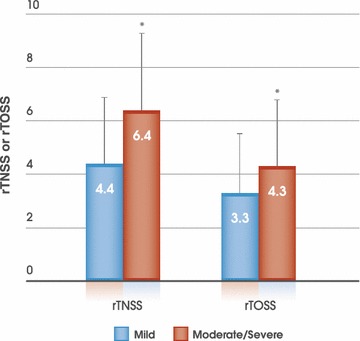
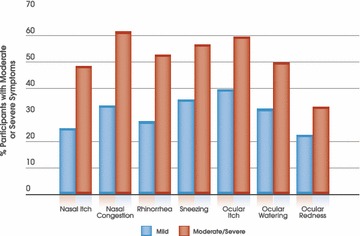
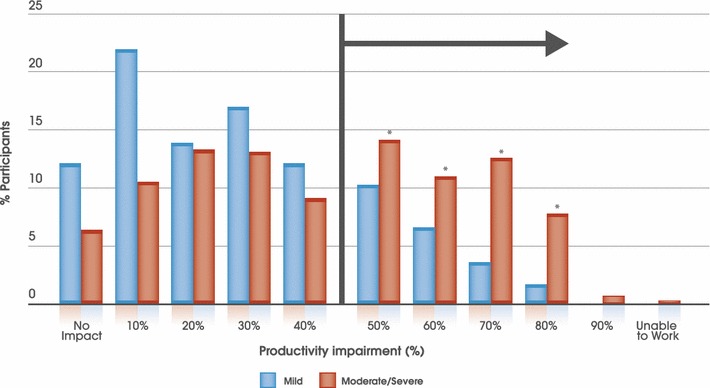
Background: The affliction of allergic rhinitis (AR) has been trivialised in the past. Recent initiatives by the European Academy of Allergy & Clinical Immunology and by the EU parliament seek to rectify that situation. The aim of this study was to provide a comprehensive picture of the burden and unmet need of AR patients. Methods: This was a cross‐sectional, online, questionnaire‐based study (June–July 2011) including symptomatic seasonal AR (SAR) patients (≥18 years) from a panel. SAR episode pattern, severity, medication/co‐medication usage, residual symptoms on treatment, number of healthcare visits, absenteeism and presenteeism were collected. Results: One thousand patients were recruited (mild: n = 254; moderate/severe: n = 746). Patients with moderate/severe disease had significantly more symptomatic episodes/year (8.0 vs 6.0/year; p = 0.025) with longer episode‐duration (12.5 vs 9.8 days; p = 0.0041) and more commonly used ≥2 AR therapies (70.5 vs 56.1 %; OR 1.87; p = 0.0001), looking for better and faster nasal and ocular symptom relief. The reported symptom burden was high irrespective of treatment, and significantly (p < 0.0001) higher in the moderate/severe group. Patients with moderate/severe AR were more likely to visit their GP (1.61 vs 1.19 times/year; OR: 1.49; p = 0.0061); due to dissatisfaction with therapy in 35.4 % of cases. Patients reported SAR‐related absenteeism from work on 4.1 days/year (total cost to UK: £1.25 billion/year) and noted presenteeism for a mean of 37.7 days/year (vs 21.0 days/year; OR 1.71; p = 0.0048). Asthma co‐morbid patients reported the need to increase their reliever‐ (1 in 2 patients) and controller‐medication (1 in 5 patients) if they did not take their rhinitis medication. Conclusions: This study differentiated between patients with mild and moderate/severe AR, demonstrating a burden of poorly controlled symptoms and high co‐medication use. The deficiency in obtaining symptom control with what are currently considered firstline treatments suggests the need for a novel therapeutic approach.
Overview
The claims and statistics of this paper haven’t been checked yet.
Free: it reads the open-access text and checks the first 5 claims that cite a source we can check. Create a free account to check every claim.
Integrity signals
Registry
Cites
Statistics
Figures
Verification
Claims the paper makes
The claims and statistics of this paper haven’t been checked yet.
Free: it reads the open-access text and checks the first 5 claims that cite a source we can check. Create a free account to check every claim.
Claims other papers make about this one
Each is checked against this paper’s own text: does it say what the citing paper says it does?
The source backs part of the claim, not all of it — or backs it for a different population, condition or comparison.
In the citing paper
“Impaired productivity and/or missed work occurred as a result of AR in 52% of patients.753”
From International Consensus Statement on Allergy and Rhinology: Allergic Rhinitis (2018) · cites this paper as [753]
Experimental — accuracy not yet measuredThe cited source says what the claim attributes to it.
In the citing paper
“In another UK study, patients with moderate to severe AR reported 37.7 days a year when their productivity was affected by their AR symptoms; this is almost double that reported by patients in the same study with mild AR symptoms (21.0 days).753”
From International Consensus Statement on Allergy and Rhinology: Allergic Rhinitis (2018) · cites this paper as [753]
The cited source says what the claim attributes to it.
In the citing paper
“Patients with moderate to severe AR reported visiting their primary care provider for their AR more frequently than those with mild AR (1.61 vs 1.19 times per year).753”
From International Consensus Statement on Allergy and Rhinology: Allergic Rhinitis (2018) · cites this paper as [753]
Self-check
Percentages, sums and reported differences re-computed from the paper’s own numbers.
The self-check needs the paper’s full text.
Citations
Cites
Allergic Rhinitis and its Impact on Asthma (ARIA) 2008*
Bousquet, J., Khaltaev, N., Cruz, A. A., Denburg, J., Fokkens, W. J., Togias, A., Zuberbier, T., Baena‐Cagnani, C. E., Canonica, G. W., Van Weel, C., et al. (2008) · Allergy · doi:10.1111/j.1398-9995.2007.01620.x · Cited by 4,729
Self-citationAllergic Rhinitis and its Impact on Asthma (ARIA)
Bousquet, J. (2003) · Clinical & Experimental Allergy Reviews · doi:10.1046/j.1472-9725.2003.00063.x · Cited by 734
Self-citationBurden of allergic rhinitis: Results from the Pediatric Allergies in America survey
Meltzer, E. O., Blaiss, M. S., Derebery, M. J., Mahr, T. A., Gordon, B. R., Sheth, K. K., Simmons, A. L., Wingertzahn, M. A., & Boyle, J. M. (2009) · Journal of Allergy and Clinical Immunology · doi:10.1016/j.jaci.2009.05.013 · Cited by 553
The burden of allergic rhinitis
Nathan, R. A. (2007) · Allergy and Asthma Proceedings · doi:10.2500/aap.2007.28.2934 · Cited by 472
A survey of the burden of allergic rhinitis in Europe
Canonica, G. W., Bousquet, J., Mullol, J., Scadding, G. K., & Virchow, J. C. (2007) · Allergy · doi:10.1111/j.1398-9995.2007.01549.x · Cited by 454
Self-citationWalker, S., Khan-Wasti, S., Fletcher, M., Cullinan, P., Harris, J., & Sheikh, A. (2007) · Journal of Allergy and Clinical Immunology · doi:10.1016/j.jaci.2007.03.034 · Cited by 431 · cited 1×
“productivity loss or under-performance at work and school) [18–21].”
BackgroundBSACI guidelines for the management of allergic and non‐allergic rhinitis
Scadding, G. K., Durham, S. R., Mirakian, R., Jones, N. S., Leech, S. C., Farooque, S., Ryan, D., Walker, S. M., Clark, A. T., Dixon, T. A., et al. (2008) · Clinical & Experimental Allergy · doi:10.1111/j.1365-2222.2007.02888.x · Cited by 375 · cited 1×
“Allergenspecific immunotherapy should be strongly considered for patients who fail to respond to symptomatic therapy, particularly for those patients for whom symptoms are predominantly caused by one allergen [43], and may significantly reduce the burden of AR in these patients.”
BackgroundSelf-citationLamb, C. E., Ratner, P. H., Johnson, C. E., Ambegaonkar, A. J., Joshi, A. V., Day, D., Sampson, N., & Eng, B. (2006) · Current Medical Research and Opinion · doi:10.1185/030079906x112552 · Cited by 288 · cited 1×
“productivity loss or under-performance at work and school) [18–21].”
BackgroundA novel intranasal therapy of azelastine with fluticasone for the treatment of allergic rhinitis
Carr, W., Bernstein, J., Lieberman, P., Meltzer, E., Bachert, C., Price, D., Munzel, U., & Bousquet, J. (2012) · Journal of Allergy and Clinical Immunology · doi:10.1016/j.jaci.2012.01.077 · Cited by 242 · cited 1×
“These rTNSS and nasal congestion score cut-offs were chosen in order to align with moderate/severe definitions from a recently conducted clinical trial [38].”
MethodSelf-citationCharacteristics of intermittent and persistent allergic rhinitis: DREAMS study group
Bousquet, J., Annesi‐Maesano, I., Carat, F., Léger, D., Rugina, M., Pribil, C., El Hasnaoui, A., & Chanal, I. (2005) · Clinical & Experimental Allergy · doi:10.1111/j.1365-2222.2005.02274.x · Cited by 237 · cited 1×
“Most AR patients visiting their physician have moderate/severe disease with persistent symptoms [2, 17, 23–25].”
BackgroundSelf-citationPrevalence, classification and perception of allergic and nonallergic rhinitis in Belgium
Bachert, C., Van Cauwenberge, P., Olbrecht, J., & Van Schoor, J. (2006) · Allergy · doi:10.1111/j.1398-9995.2006.01054.x · Cited by 236
Self-citationA survey of the burden of allergic rhinitis in the USA
Schatz, M. (2007) · Allergy · doi:10.1111/j.1398-9995.2007.01548.x · Cited by 223
Update on nonallergic rhinitis
Settipane, R. A., & Lieberman, P. (2001) · Annals of Allergy, Asthma & Immunology · doi:10.1016/s1081-1206(10)62896-7 · Cited by 206 · cited 1×
“mixed rhinitis) [35] and confounded by phenotypes such as severe chronic upper airway disease (SCUAD) [36].”
BackgroundImpact of Allergic Rhinitis Symptoms on Quality of Life in Primary Care
Bousquet, P. J., Demoly, P., Devillier, P., Mesbah, K., & Bousquet, J. (2013) · International Archives of Allergy and Immunology · doi:10.1159/000342991 · Cited by 204 · cited 6×
“Fortunately, the burden of AR is now being recognised both by the European Academy of Allergy & Clinical Immunology (EAACI) as well as at the EU parliament level, in order to highlight the profound impact this prevalent condition has on the quality of life (QoL) of AR sufferers and their families [8, 9].”
BackgroundResultInfluentialSelf-citationBousquet, J., Schunemann, H. J., Fonseca, J., Samolinski, B., Bachert, C., Canonica, G. W., Casale, T., Cruz, A. A., Demoly, P., Hellings, P., et al. (2015) · Allergy · doi:10.1111/all.12686 · Cited by 201
Self-citationAllergic rhinitis and the common cold – high cost to society
Hellgren, J., Cervin, A., Nordling, S., Bergman, A., & Cardell, L. O. (2010) · Allergy · doi:10.1111/j.1398-9995.2009.02269.x · Cited by 183 · cited 1×
“This figure does not take presenteeism into consideration, which was reportedly negatively impacted on 38 days/year and carries a substantial indirect cost [19].”
BackgroundIntegrated care pathways for airway diseases (AIRWAYS-ICPs)
Bousquet, J., Addis, A., Adcock, I., Agache, I., Agusti, A., Alonso, A., Annesi-Maesano, I., Anto, J. M., Bachert, C., Baena-Cagnani, C. E., et al. (2014) · European Respiratory Journal · doi:10.1183/09031936.00014614 · Cited by 174
Self-citationThe value of self-report assessment of adherence, rhinitis and smoking in relation to asthma control
Clatworthy, J., Price, D., Ryan, D., Haughney, J., & Horne, R. (2009) · Primary Care Respiratory Journal · doi:10.4104/pcrj.2009.00037 · Cited by 163
Self-citationThe voice of the patients: allergic rhinitis is not a trivial disease
Valovirta, E., Myrseth, S.-E., & Palkonen, S. (2008) · Current Opinion in Allergy & Clinical Immunology · doi:10.1097/aci.0b013e3282f3f42f · Cited by 143 · cited 2×
“activities [6, 13], well-being, cognitive functioning [14] even mood [15] and sleep [16].”
BackgroundBousquet, P., Bachert, C., Canonica, G. W., Casale, T. B., Mullol, J., Klossek, J. M., Zuberbier, T., & Bousquet, J. J. (2010) · Journal of Allergy and Clinical Immunology · doi:10.1016/j.jaci.2010.06.034 · Cited by 128 · cited 3×
“Management is often complicated by polysensitization [13, 34], the presence of allergic and non-allergic disease in the same patient (i.e. mixed rhinitis) [35] and confounded by phenotypes such as severe chronic upper airway disease (SCUAD) [36].”
BackgroundSelf-citationRatner, P. H., van Bavel, J. H., Martin, B. G., Hampel, F. C., Howland, W. C., Rogenes, P., WESTLUND, R. E., Bowers, B., & Cook, C. K. (1998) · PubMed · Cited by 127
Relationship between allergic rhinitis, disturbed cognitive functions and psychological well‐being
Kremer, B., Den Hartog, H. M., & Jolles, J. (2002) · Clinical & Experimental Allergy · doi:10.1046/j.1365-2745.2002.01483.x · Cited by 123 · cited 1×
“activities [6, 13], well-being, cognitive functioning [14] even mood [15] and sleep [16].”
BackgroundAnolik, R. (2008) · Annals of Allergy Asthma & Immunology · doi:10.1016/s1081-1206(10)60452-8 · Cited by 118
Meltzer, E., Ratner, P., Bachert, C., Carr, W., Berger, W., Canonica, G. W., Hadley, J., Lieberman, P., Hampel, F. C., Mullol, J., et al. (2013) · International Archives of Allergy and Immunology · doi:10.1159/000351404 · Cited by 116 · cited 3×
“A recently published state of the art analysis of a new AR therapy, is an important first step in this direction [39]; (1) patients included in the trial had moderate/severe disease, representing the type of patient commonly seen in practice, (2) first-line AR medications were used as active comparators (in addition t…”
BackgroundMethodSelf-citationDemoly, P., Allaert, F. ‐., Lecasble, M., & PRAGMA (2002) · Allergy · doi:10.1034/j.1398-9995.2002.t01-1-13370.x · Cited by 116 · cited 8×
“12 University Hospital, Montpellier, France.”
BackgroundResultInfluentialToday’s allergic rhinitis patients are different: new factors that may play a role
Mösges, R., & Klimek, L. (2007) · Allergy · doi:10.1111/j.1398-9995.2007.01440.x · Cited by 115 · cited 1×
“Management is often complicated by polysensitization [13, 34], the presence of allergic and non-allergic disease in the same patient (i.”
BackgroundSelf-citationBousquet, J. J., Michel, J., Strandberg, T. E., Crooks, G., Iakovidis, I., & Iglesia-Gomez, M. (2014) · European Geriatric Medicine · doi:10.1016/j.eurger.2014.09.010 · Cited by 102
Self-citationMeltzer, E. O., Gross, G. N., Katial, R. K., & Storms, W. W. (2012) · PubMed · Cited by 90
Patient Perceptions of Allergic Rhinitis and Quality of Life
Canonica, G. W., Mullol, J., Pradalier, A., & Didier, A. (2008) · World Allergy Organization Journal · doi:10.1097/wox.0b013e3181865faf · Cited by 78 · cited 3×
“Reports in the literature already tell us that the daily burden of AR symptoms can be intrusive and debilitating, negatively impacting patients’ QoL [4, 5], normal Open Access”
BackgroundSelf-citationSamolinski, B. K., Fronczak, A., Kuna, P., Akdiş, C. A., Anto, J. M., Białoszewski, A. Z., Burney, P., Bush, A., Czupryniak, A., Dahl, R., et al. (2012) · Allergy · doi:10.1111/j.1398-9995.2012.02822.x · Cited by 73
Self-citationHellings, P. W., Dobbels, F., Denhaerynck, K., Piessens, M., Ceuppens, J. L., & Geest, S. D. (2012) · Clinical and Translational Allergy · doi:10.1186/2045-7022-2-9 · Cited by 68 · cited 1×
“AR patients have high expectations from their treatment [31], but most are dissatisfied with the results [32, 33].”
BackgroundSmall, M., Piercy, J., Demoly, P., & Marsden, H. (2013) · Clinical and Translational Allergy · doi:10.1186/2045-7022-3-33 · Cited by 65 · cited 1×
“productivity loss or under-performance at work and school) [18–21].”
BackgroundHow representative are clinical study patients with allergic rhinitis in primary care?
Costa, D. J., Amouyal, M., Lambert, P., Ryan, D., Schünemann, H. J., Daures, J. P., Bousquet, J., & Bousquet, P. J. (2011) · Journal of Allergy and Clinical Immunology · doi:10.1016/j.jaci.2010.10.058 · Cited by 63 · cited 1×
“Conversely, AR patients recruited into randomized controlled trials (RCTs) are poorly representative of those seen in primary care [40].”
BackgroundSelf-citationKlimek, L., Bachert, C., Mösges, R., Munzel, U., Price, D., Virchow, J. C., Wahn, U., & Bousquet, J. (2015) · Allergy and Asthma Proceedings · doi:10.2500/aap.2015.36.3823 · Cited by 58 · cited 1×
“MP29-02, comprising azelastine hydrochloride, fluticasone propionate and a novel formulation in a single spray, is the newest addition to the AR treatment arsenal and is promising in this regard [39, 42].”
BackgroundSelf-citationA survey of the burden of allergic rhinitis in Spain.
Aragonés, A. M., Toledo, R. F., Calatayud, A. M., & Mir, J. C. C. (2009) · PubMed · Cited by 58
Patient-related factors in rhinitis and asthma: the satisfaction with allergy treatment survey
Ciprandi, G., Incorvaia, C., Scurati, S., Puccinelli, P., Soffia, S., Frati, F., & Rossi, O. (2011) · Current Medical Research and Opinion · doi:10.1185/03007995.2011.559580 · Cited by 45 · cited 1×
“AR patients have high expectations from their treatment [31], but most are dissatisfied with the results [32, 33].”
BackgroundEsteitie, R., deTineo, M., Naclerio, R. M., & Baroody, F. M. (2010) · Annals of Allergy Asthma & Immunology · doi:10.1016/j.anai.2010.05.017 · Cited by 45 · cited 1×
“The present survey results confirm the results obtained in randomized clinical trials [29, 30].”
ResultNavarro, A. M., Valero, A., Rosales, M. J., & Mullol, J. (2011) · PubMed · Cited by 44
Self-citationConcerns of patients with allergic rhinitis: the Allergic Rhinitis Care Programme in South Africa
Green, R. J., Davis, G., & Price, D. B. (2007) · Primary Care Respiratory Journal · doi:10.3132/pcrj.2007.00062 · Cited by 35 · cited 1×
“activities [6, 13], well-being, cognitive functioning [14] even mood [15] and sleep [16].”
BackgroundSelf-citationPatient adherence to allergic rhinitis treatment: results from patient surveys.
Valovirta, E. J., & Ryan, D. P. (2008) · PubMed Central · Cited by 27
Self-citationBraido, F., Baiardini, I., Scichilone, N., Musarra, A., Menoni, S., Ridolo, E., Gani, F., Pravettoni, V., Colombo, G., Crivellaro, M., et al. (2014) · Rhinology Journal · doi:10.4193/rhino13.040 · Cited by 24
Self-citationSpecialist‐based treatment reduces the severity of allergic rhinitis
Mullol, J., Bartra, J., del Cuvillo, A., Izquierdo, I., Muñoz‐Cano, R., & Valero, A. (2013) · Clinical & Experimental Allergy · doi:10.1111/cea.12081 · Cited by 22
Self-citationBraido, F., Baiardini, I., Scichilone, N., Musarra, A., Menoni, S., Ridolo, E., Gani, F., Pravettoni, V., Colombo, G., Crivellaro, M., et al. (2014) · Rhinology Journal · doi:10.4193/rhin13.040 · Cited by 11
Self-citationAcaster, S., Carr, W., Lieberman, P., Bachert, C., & Price, A. (2012) · Ghent University Academic Bibliography (Ghent University) · Cited by 7
Self-citationBurden of rhinitis among European Academy of Allergy & Clinical Immunology (EAACI) members
Bousquet, J., Bachert, C., Price, D. D., Acaster, S., Papadopoulos, N. G., & Muraro, A. M. (2015) · Ghent University Academic Bibliography (Ghent University) · Cited by 2
Self-citationAYDIN, Ö., Sin, B. A., Mısırlıgil, Z., MUNGAN, V. D., & SOYYİĞİT, Ş. (2014) · Allergy · doi:10.1111/all.12493 · Cited by 1 · cited 1×
“Others have confirmed that co-mediation prescribing behaviour has been steadily rising in the UK in the last 2 decades; dual therapy has doubled since 1992, whilst use of triple therapy has increased eight-fold [41].”
BackgroundPrice, D., Scadding, G. K., Bachert, C., Saleh, H., Nasser, S., Carter, V, Bichel, K., & Ryan, D. (2014) · Ghent University Academic Bibliography (Ghent University) · Cited by 1
Self-citation
Cited by
International Consensus Statement on Allergy and Rhinology: Allergic Rhinitis
Wise, S. K., Lin, S. Y., Toskala, E., Orlandi, R. R., Akdis, C. A., Alt, J. A., Azar, A., Baroody, F. M., Bachert, C., Canonica, G. W., et al. (2018) · International Forum of Allergy & Rhinology · doi:10.1002/alr.22073 · Cited by 557
Self-citationInternational consensus statement on allergy and rhinology: Allergic rhinitis – 2023
Wise, S. K., Damask, C., Roland, L. T., Ebert, C., Levy, J. M., Lin, S., Luong, A., Rodriguez, K., Sedaghat, A. R., Toskala, E., et al. (2023) · International Forum of Allergy & Rhinology · doi:10.1002/alr.23090 · Cited by 507
Self-citationImpact of Rhinitis on Work Productivity: A Systematic Review
Vandenplas, O., Vinnikov, D., Blanc, P. D., Agache, I., Bachert, C., Bewick, M., Cardell, L.-O., Cullinan, P., Demoly, P., Descatha, A., et al. (2018) · The Journal of Allergy and Clinical Immunology: In Practice · doi:10.1016/j.jaip.2017.09.002 · Cited by 243
“25 11 Outcomes 1 Seven surveys collected data on the impact of AR on work productivity using validated 2 instruments (Table 1): the WPAI instrument either in its specific version for allergic diseases 3 (WPAI-AS) (17, 19, 30, 43) or in its generic version (25), the Stanford Presenteeism Scale 4 (SPS) (44), and the Wor…”
BackgroundInfluentialSelf-citationTreatment of seasonal allergic rhinitis
Dykewicz, M. S., Wallace, D. V., Baroody, F., Bernstein, J., Craig, T., Finegold, I., Huang, F., Larenas-Linnemann, D., Meltzer, E., Steven, G., et al. (2017) · Annals of Allergy, Asthma & Immunology · doi:10.1016/j.anai.2017.08.012 · Cited by 167
Bousquet, J., Hellings, P. W., Agache, I., Bedbrook, A., Bachert, C., Bergmann, K. C., Bewick, M., Bindslev-Jensen, C., Bosnic-Anticevitch, S., Bucca, C., et al. (2016) · Clinical and Translational Allergy · doi:10.1186/s13601-016-0137-4 · Cited by 160
“Most patients receive combinations of oral antihistamines and intra-nasal corticosteroids (INS) [31–33] which are not evaluated in guidelines using an appropriate methodology.”
Self-citation
Metadata
- Authors
- Price, D., Scadding, G., Ryan, D., Bachert, C., Canonica, G. W., Mullol, J., Klimek, L., Pitman, R., Acaster, S., Murray, R., & Bousquet, J.
- Affiliations
- University of Aberdeen (GB)
- Royal National Throat Nose and Ear Hospital (GB)
- University of Edinburgh (GB)
- Ghent University Hospital (BE)
- Ospedale Policlinico San Martino (IT)
- Consorci Institut D'Investigacions Biomediques August Pi I Sunyer (ES)
- Zentrum für Rhinologie und Allergologie (DE)
- ICON Oxford UK
- Acaster Consulting London UK
- Medscript Ltd Dundalk Ireland
- Inserm (FR)
- Corresponding author
- Price, David
- ORCID
- Venue
- Clinical and Translational Allergy
- Publisher
- Wiley
- Published
- 2015-01
- Volume
- 5
- Issue
- 1
- Pages
- 39-39
- ISSN
- 2045-7022 (ISSN-L)
- PMC
- PMC4650835
- OpenAlex
- W2174402243
- Cited by
- 105
- References
- 47
- Citations by year
- 2026: 1 · 2025: 5 · 2024: 3 · 2023: 5 · 2022: 8 · 2021: 9 · 2020: 19 · 2019: 18 · 2018: 15 · 2017: 13 · 2016: 9
- FWCI
- 10.81
- Type
- journal article
- Language
- en
- Open access
- gold
- doi.org
- Licence
- Locations
- Clinical and Translational Allergy (publishedVersion, cc-by)
- PubMed Central (publishedVersion, cc-by)
- PubMed (publishedVersion)
- Ghent University Academic Bibliography (Ghent University) (submittedVersion, cc-by)
- Aberdeen University Research Archive (Aberdeen University) (submittedVersion)
- HAL (submittedVersion, cc-by)
- CINECA IRIS Institutial Research Information System (University of Genoa) (submittedVersion)
- Topics
- Health Sciences › Medicine › Immunology and Allergy › Allergic Rhinitis and Sensitization
- Health Sciences › Medicine › Pulmonary and Respiratory Medicine › Asthma and respiratory diseases
- Health Sciences › Medicine › Immunology and Allergy › Food Allergy and Anaphylaxis Research
- Keywords
- allergic rhinitis, disease burden, health care utilization, absenteeism, presenteeism, symptom severity, asthma comorbidity, concomitant medications, unmet needs, symptom management, health care costs, UK adults, second-line therapy
About these checks
Registry, retraction, Cites and statistics results are computed, not judged, with one exception: a printed reference that no index lists is read once by a model before it counts as a citation error. Claims are extracted by a model and kept only when their quote appears verbatim in the text; each cited source is then checked, with a model’s help, for whether it says what the claim relies on. Those verdicts can be wrong — read the claim’s quote and the cited source before relying on one.
Statistics and arithmetic are recomputed, not judged.
Confidence bands are shown only for fields calibrated on our annotated test set. None is calibrated yet, so no band is shown.
What counts as a claim ›How we measure confidence ›How we check this ›
Are you an author, or do you see a problem with this page? Request a review
Data sources
Bibliographic data: Semantic Scholar, OpenAlex, Crossref.
Contains information from the Semantic Scholar Academic Graph Datasets, made available under the ODC Attribution License (ODC-BY 1.0).
Semantic Scholar’s data is described in: Kinney, R., et al. (2023). The Semantic Scholar Open Data Platform. arXiv:2301.10140.
