

The DOI matches its Crossref record; 105 of the 105 references it cites were found in a registry or an index.
Principles of fluid management and stewardship in septic shock: it is time to consider the four D’s and the four phases of fluid therapy
Open accessAbstract
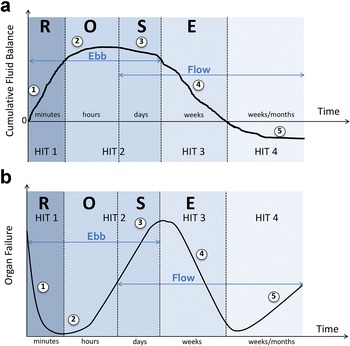
In patients with septic shock, the administration of fluids during initial hemodynamic resuscitation remains a major therapeutic challenge. We are faced with many open questions regarding the type, dose and timing of intravenous fluid administration. There are only four major indications for intravenous fluid administration: aside from resuscitation, intravenous fluids have many other uses including maintenance and replacement of total body water and electrolytes, as carriers for medications and for parenteral nutrition. In this paradigm-shifting review, we discuss different fluid management strategies including early adequate goal-directed fluid management, late conservative fluid management and late goal-directed fluid removal. In addition, we expand on the concept of the "four D's" of fluid therapy, namely drug, dosing, duration and de-escalation. During the treatment of patients with septic shock, four phases of fluid therapy should be considered in order to provide answers to four basic questions. These four phases are the resuscitation phase, the optimization phase, the stabilization phase and the evacuation phase. The four questions are "When to start intravenous fluids?", "When to stop intravenous fluids?", "When to start de-resuscitation or active fluid removal?" and finally "When to stop de-resuscitation?" In analogy to the way we handle antibiotics in critically ill patients, it is time for fluid stewardship.
Overview
The claims and statistics of this paper haven’t been checked yet.
Run the check — free, no account needed. It reads the open-access text and checks the sources it cites.
Integrity signals
Registry
Cites
Statistics
Figures
Verification
Claims the paper makes
The claims and statistics of this paper haven’t been checked yet.
Run the check — free, no account needed. It reads the open-access text and checks the sources it cites.
Claims other papers make about this one
Each is checked against this paper’s own text: does it say what the citing paper says it does?
The source backs part of the claim, not all of it — or backs it for a different population, condition or comparison.
In the citing paper
“Poor or incomplete source control may additionally lead to a state of ongoing capillary leak and fluid accumulation, referred to as GIPS (global increased permeability syndrome) [8].”
From Nutrition in Sepsis: A Bench-to-Bedside Review. (2020) · cites this paper as [8]
Experimental — accuracy not yet measuredThe cited source says what the claim attributes to it.
In the citing paper
“since nutrition may also contribute to fluid accumulation [8].”
From Nutrition in Sepsis: A Bench-to-Bedside Review. (2020) · cites this paper as [8]
Self-check
Percentages, sums and reported differences re-computed from the paper’s own numbers.
The self-check needs the paper’s full text.
Citations
Cites
Early goal-directed therapy in the treatment of severe sepsis and septic shock
Rivers, E., Nguyen, B., Havstad, S., Ressler, J., Muzzin, A., Knoblich, B., Peterson, E., & Tomlanovich, M. (2001) · New England Journal of Medicine · doi:10.1056/nejmoa010307 · Cited by 10,743
Surviving Sepsis Campaign: International Guidelines for Management of Severe Sepsis and Septic Shock
Dellinger, R. P., Levy, M. M., Rhodes, A., Annane, D., Gerlach, H., Opal, S. M., Sevransky, J. E., Sprung, C. L., Douglas, I. S., Jaeschke, R., et al. (2013) · Critical Care Medicine · doi:10.1097/ccm.0b013e31827e83af · Cited by 9,694
Intravenous Fluids and Acute Kidney Injury
Ding, X., Cheng, Z., & Qian, Q. (2017) · Blood Purification · doi:10.1159/000452702 · Cited by 6,869
Surviving Sepsis Campaign: International guidelines for management of sepsis and septic shock: 2016.
Rhodes, A., Evans, L. E., Alhazzani, W., Levy, M. M., Antonelli, M., Ferrer, R., Kumar, A., Sevransky, J. E., Sprung, C. L., Nunnally, M. E., et al. (2017) · Intensive Care Medicine · doi:10.1007/s00134-017-4683-6 · Cited by 6,621
Sepsis in European intensive care units: Results of the SOAP study*
Vincent, J., Sakr, Y. L., Sprung, C. L., Ranieri, V. M., Reinhart, K., Gerlach, H., Moreno, R. P., Carlet, J. M., Gall, J. L., & Payen, D. M. (2006) · Critical Care Medicine · doi:10.1097/01.ccm.0000194725.48928.3a · Cited by 2,823
A randomized trial of protocol-based care for early septic shock.
The ProCESS Investigators (2014) · New England Journal of Medicine · doi:10.1056/nejmoa1401602 · Cited by 2,414
Time to treatment and mortality during mandated emergency care for sepsis.
Seymour, C. W., Gesten, F., Prescott, H. C., Friedrich, M. E., Iwashyna, T. J., Phillips, G. S., Lemeshow, S., Osborn, T., Terry, K. M., & Levy, M. M. (2017) · New England Journal of Medicine · doi:10.1056/nejmoa1703058 · Cited by 2,225
Goal-Directed Resuscitation for Patients with Early Septic Shock
The ARISE Investigators and the ANZICS Clinical Trials Group (2014) · New England Journal of Medicine · doi:10.1056/nejmoa1404380 · Cited by 2,055
Hydroxyethyl Starch 130/0.42 versus Ringer's Acetate in Severe Sepsis
Perner, A., Haase, N., Guttormsen, A. B., Tenhunen, J. J., Klemenzson, G., Åneman, A., Madsen, K. R., Møller, M. H., Elkjær, J. M., Poulsen, L. M., et al. (2012) · New England Journal of Medicine · doi:10.1056/nejmoa1204242 · Cited by 1,808
Hydroxyethyl Starch or Saline for Fluid Resuscitation in Intensive Care
Myburgh, J., Finfer, S. R., Bellomo, R., Billot, L., Cass, A., Gattas, D. J., Glass, P., Lipman, J., Liu, B. C., McArthur, C. J., et al. (2012) · New England Journal of Medicine · doi:10.1056/nejmoa1209759 · Cited by 1,681
Research works printed but not linked: 1
- Monnet, 2016, Prediction of fluid responsiveness: an update, Ann Intensive Care, 6, 111, 10.1186/s13613-016-0216-7 · DOI
Cited by
Sorted by citations
Malbrain, M. L. N. G., Länger, T., Annane, D., Gattinoni, L., Elbers, P., Hahn, R. G., laet, I. D., Minini, A., Wong, A. V.-K., İnce, C., et al. (2020) · Annals of Intensive Care · doi:10.1186/s13613-020-00679-3 · Cited by 350
Self-citationPrediction of fluid responsiveness. What’s new?
Monnet, X., Shi, R., & Teboul, J. (2022) · Annals of Intensive Care · doi:10.1186/s13613-022-01022-8 · Cited by 259
Self-citationCytokine removal in human septic shock: Where are we and where are we going?
Honore, P. M., Hoste, E., Molnár, Z., Jacobs, R., Joannes-Boyau, O., Malbrain, M. L. N. G., & Forni, L. G. (2019) · Annals of Intensive Care · doi:10.1186/s13613-019-0530-y · Cited by 192
Self-citationFluid Therapy for Critically Ill Adults With Sepsis: A Review
Zampieri, F. G., Bagshaw, S. M., & Semler, M. W. (2023) · JAMA · doi:10.1001/jama.2023.7560 · Cited by 184
Effective hemodynamic monitoring
Pinsky, M. R., Cecconi, M., Chew, M. S., De Backer, D., Douglas, I., Edwards, M., Hamzaoui, O., Hernandez, G., Martin, G., Monnet, X., et al. (2022) · Critical Care · doi:10.1186/s13054-022-04173-z · Cited by 167
Self-citation
Metadata
- Authors
- Malbrain, M. L. N. G., Van Regenmortel, N., Saugel, B., De Tavernier, B., Van Gaal, P.-J., Joannes-Boyau, O., Teboul, J.-L., Rice, T. W., Mythen, M., & Monnet, X.
- Affiliations
- Vrije Universiteit Brussel (BE)
- University Medical Center Hamburg-Eppendorf (DE)
- Université Paris-Sud (FR)
- University College London (GB)
- Vanderbilt University (US)
- Corresponding author
- Malbrain, Manu L. N.G.
- Venue
- Annals of Intensive Care
- Publisher
- Elsevier BV
- Published
- 2018
- Volume
- 8
- Issue
- 1
- Pages
- 66
- ISSN
- 2110-5820 (ISSN-L)
- PMC
- PMC5964054
- OpenAlex
- W2807356795
- Cited by
- 632
- References
- 105
- Citations by year
- 2026: 84 · 2025: 92 · 2024: 76 · 2023: 96 · 2022: 70 · 2021: 84 · 2020: 76 · 2019: 41 · 2018: 13
- FWCI
- 7.68
- Type
- journal article
- Language
- en
- Open access
- gold
- doi.org
- Licence
- Locations
- Annals of Intensive Care (publishedVersion, cc-by)
- Europe PMC (PubMed Central) (publishedVersion, cc-by)
- PubMed Central (publishedVersion, cc-by)
- PubMed (publishedVersion)
- HAL (submittedVersion)
- DOAJ (DOAJ: Directory of Open Access Journals) (submittedVersion, cc-by-sa)
- UCL Discovery (University College London) (submittedVersion)
- VUBIR (Vrije Universiteit Brussel) (submittedVersion)
- Topics
- Health Sciences › Medicine › Critical Care and Intensive Care Medicine › Sepsis Diagnosis and Treatment
- Health Sciences › Medicine › Surgery › Hemodynamic Monitoring and Therapy
- Health Sciences › Medicine › Surgery › Abdominal Surgery and Complications
- Keywords
- septic shock, fluid management, goal-directed fluid therapy, fluid resuscitation, intravenous fluid therapy, fluid removal
About these checks
Registry, retraction, Cites and statistics results are computed, not judged, with one exception: a printed reference that no index lists is read once by a model before it counts as a citation error. Claims are extracted by a model and kept only when their quote appears verbatim in the text; each cited source is then checked, with a model’s help, for whether it says what the claim relies on. Those verdicts can be wrong — read the claim’s quote and the cited source before relying on one.
Statistics and arithmetic are recomputed, not judged.
Confidence bands are shown only for fields calibrated on our annotated test set. None is calibrated yet, so no band is shown.
What counts as a claim ›How we measure confidence ›How we check this ›
Are you an author, or do you see a problem with this page? Request a review
