

The DOI matches its Crossref record; 105 of the 105 references it cites were found in a registry or an index.
Principles of fluid management and stewardship in septic shock: it is time to consider the four D’s and the four phases of fluid therapy
Open accessAbstract
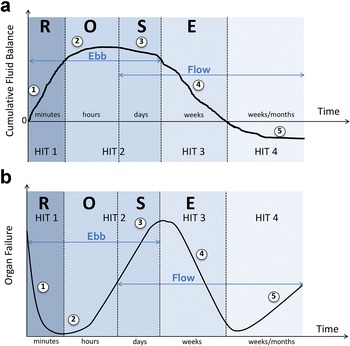
In patients with septic shock, the administration of fluids during initial hemodynamic resuscitation remains a major therapeutic challenge. We are faced with many open questions regarding the type, dose and timing of intravenous fluid administration. There are only four major indications for intravenous fluid administration: aside from resuscitation, intravenous fluids have many other uses including maintenance and replacement of total body water and electrolytes, as carriers for medications and for parenteral nutrition. In this paradigm-shifting review, we discuss different fluid management strategies including early adequate goal-directed fluid management, late conservative fluid management and late goal-directed fluid removal. In addition, we expand on the concept of the "four D's" of fluid therapy, namely drug, dosing, duration and de-escalation. During the treatment of patients with septic shock, four phases of fluid therapy should be considered in order to provide answers to four basic questions. These four phases are the resuscitation phase, the optimization phase, the stabilization phase and the evacuation phase. The four questions are "When to start intravenous fluids?", "When to stop intravenous fluids?", "When to start de-resuscitation or active fluid removal?" and finally "When to stop de-resuscitation?" In analogy to the way we handle antibiotics in critically ill patients, it is time for fluid stewardship.
Overview
The claims and statistics of this paper haven’t been checked yet.
Run the check — free, no account needed. It reads the open-access text and checks the sources it cites.
Integrity signals
Registry
Cites
Statistics
Figures
Verification
Claims the paper makes
The claims and statistics of this paper haven’t been checked yet.
Run the check — free, no account needed. It reads the open-access text and checks the sources it cites.
Claims other papers make about this one
Each is checked against this paper’s own text: does it say what the citing paper says it does?
The source backs part of the claim, not all of it — or backs it for a different population, condition or comparison.
In the citing paper
“Poor or incomplete source control may additionally lead to a state of ongoing capillary leak and fluid accumulation, referred to as GIPS (global increased permeability syndrome) [8].”
From Nutrition in Sepsis: A Bench-to-Bedside Review. (2020) · cites this paper as [8]
Experimental — accuracy not yet measuredThe cited source says what the claim attributes to it.
In the citing paper
“since nutrition may also contribute to fluid accumulation [8].”
From Nutrition in Sepsis: A Bench-to-Bedside Review. (2020) · cites this paper as [8]
Self-check
Percentages, sums and reported differences re-computed from the paper’s own numbers.
The self-check needs the paper’s full text.
Citations
Cites
Early goal-directed therapy in the treatment of severe sepsis and septic shock
Rivers, E., Nguyen, B., Havstad, S., Ressler, J., Muzzin, A., Knoblich, B., Peterson, E., & Tomlanovich, M. (2001) · New England Journal of Medicine · doi:10.1056/nejmoa010307 · Cited by 10,743
Surviving Sepsis Campaign: International Guidelines for Management of Severe Sepsis and Septic Shock
Dellinger, R. P., Levy, M. M., Rhodes, A., Annane, D., Gerlach, H., Opal, S. M., Sevransky, J. E., Sprung, C. L., Douglas, I. S., Jaeschke, R., et al. (2013) · Critical Care Medicine · doi:10.1097/ccm.0b013e31827e83af · Cited by 9,694
Intravenous Fluids and Acute Kidney Injury
Ding, X., Cheng, Z., & Qian, Q. (2017) · Blood Purification · doi:10.1159/000452702 · Cited by 6,869
Surviving Sepsis Campaign: International guidelines for management of sepsis and septic shock: 2016.
Rhodes, A., Evans, L. E., Alhazzani, W., Levy, M. M., Antonelli, M., Ferrer, R., Kumar, A., Sevransky, J. E., Sprung, C. L., Nunnally, M. E., et al. (2017) · Intensive Care Medicine · doi:10.1007/s00134-017-4683-6 · Cited by 6,621
Sepsis in European intensive care units: Results of the SOAP study*
Vincent, J., Sakr, Y. L., Sprung, C. L., Ranieri, V. M., Reinhart, K., Gerlach, H., Moreno, R. P., Carlet, J. M., Gall, J. L., & Payen, D. M. (2006) · Critical Care Medicine · doi:10.1097/01.ccm.0000194725.48928.3a · Cited by 2,823
A randomized trial of protocol-based care for early septic shock.
The ProCESS Investigators (2014) · New England Journal of Medicine · doi:10.1056/nejmoa1401602 · Cited by 2,414
Time to treatment and mortality during mandated emergency care for sepsis.
Seymour, C. W., Gesten, F., Prescott, H. C., Friedrich, M. E., Iwashyna, T. J., Phillips, G. S., Lemeshow, S., Osborn, T., Terry, K. M., & Levy, M. M. (2017) · New England Journal of Medicine · doi:10.1056/nejmoa1703058 · Cited by 2,225
Goal-Directed Resuscitation for Patients with Early Septic Shock
The ARISE Investigators and the ANZICS Clinical Trials Group (2014) · New England Journal of Medicine · doi:10.1056/nejmoa1404380 · Cited by 2,055
Hydroxyethyl Starch 130/0.42 versus Ringer's Acetate in Severe Sepsis
Perner, A., Haase, N., Guttormsen, A. B., Tenhunen, J. J., Klemenzson, G., Åneman, A., Madsen, K. R., Møller, M. H., Elkjær, J. M., Poulsen, L. M., et al. (2012) · New England Journal of Medicine · doi:10.1056/nejmoa1204242 · Cited by 1,808
Hydroxyethyl Starch or Saline for Fluid Resuscitation in Intensive Care
Myburgh, J., Finfer, S. R., Bellomo, R., Billot, L., Cass, A., Gattas, D. J., Glass, P., Lipman, J., Liu, B. C., McArthur, C. J., et al. (2012) · New England Journal of Medicine · doi:10.1056/nejmoa1209759 · Cited by 1,681
Mortality after Fluid Bolus in African Children with Severe Infection
Maitland, K., Kiguli, S., Opoka, R. O., Engoru, C., Olupot‐Olupot, P., Akech, S., Nyeko, R., Mtove, G. A., Reyburn, H., Lang, T. A., et al. (2011) · New England Journal of Medicine · doi:10.1056/nejmoa1101549 · Cited by 1,595
Vincent, J., & Backer, D. D. (2013) · New England Journal of Medicine · doi:10.1056/nejmra1208943 · Cited by 1,532
Balanced crystalloids versus saline in critically ill adults.
Semler, M. W., Self, W. H., Wanderer, J. P., Ehrenfeld, J. M., Wang, L., Byrne, D. W., Stollings, J. L., Kumar, A. B., Hughes, C. G., Hernandez, A., et al. (2018) · New England Journal of Medicine · doi:10.1056/nejmoa1711584 · Cited by 1,433
Self-citationAlbumin Replacement in Patients with Severe Sepsis or Septic Shock
Caironi, P., Tognoni, G., Masson, S., Fumagalli, R., Pesenti, A. M., Romero, M., Fanizza, C., Caspani, L., Faenza, S., Grasselli, G., et al. (2014) · New England Journal of Medicine · doi:10.1056/nejmoa1305727 · Cited by 1,342
Yunos, N. M., Bellomo, R., Hegarty, C., Story, D., Ho, L., & Bailey, M. (2012) · JAMA · doi:10.1001/jama.2012.13356 · Cited by 1,206
Balanced Crystalloids versus Saline in Noncritically Ill Adults
Self, W. H., Semler, M. W., Wanderer, J. P., Wang, L., Byrne, D. W., Collins, S. P., Slovis, C. M., Lindsell, C. J., Ehrenfeld, J. M., Siew, E. D., et al. (2018) · New England Journal of Medicine · doi:10.1056/nejmoa1711586 · Cited by 1,170
Self-citationWoodcock, T. E., & Woodcock, T. M. (2012) · British Journal of Anaesthesia · doi:10.1093/bja/aer515 · Cited by 811
Chowdhury, A. H., Cox, E. F., Francis, S. T., & Lobo, D. N. (2012) · Annals of Surgery · doi:10.1097/sla.0b013e318256be72 · Cited by 764
Malbrain, M. L. N. G., Marik, P. E., Witters, I., Cordemans, C., Kirkpatrick, A. W., Roberts, D. J., & Regenmortel, N. V. (2014) · Anestezjologia, Intensywna Terapia · doi:10.5603/ait.2014.0060 · Cited by 736
Self-citationMyburgh, J., & Mythen, M. G. (2013) · New England Journal of Medicine · doi:10.1056/nejmra1208627 · Cited by 688
Self-citationPeng, K., Li, J., Cheng, H. M., & Ji, F. (2014) · Medical Principles and Practice · doi:10.1159/000363573 · Cited by 643
Prediction of fluid responsiveness: an update
Monnet, X., Marik, P. E., & Teboul, J. (2016) · Annals of Intensive Care · doi:10.1186/s13613-016-0216-7 · Cited by 629
Self-citationFluid challenges in intensive care: the FENICE study
on behalf of the FENICE Investigators and the ESICM Trial Group, Cecconi, M., Hofer, C. K., Teboul, J., Pettilä, V., Wilkman, E., Molnar, Z., Rocca, G. D., Aldecoa, C., Artigas, A., et al. (2015) · Intensive Care Medicine · doi:10.1007/s00134-015-3850-x · Cited by 610
Self-citationA positive fluid balance is an independent prognostic factor in patients with sepsis
Acheampong, A., & Vincent, J. (2015) · Critical Care · doi:10.1186/s13054-015-0970-1 · Cited by 509
POST-SHOCK METABOLIC RESPONSE*1
Cuthbertson, D. P. (1942) · The Lancet · doi:10.1016/s0140-6736(00)79605-x · Cited by 448
The Importance of Fluid Management in Acute Lung Injury Secondary to Septic Shock
Murphy, C. V., Schramm, G. E., Doherty, J. A., Reichley, R. M., Gajic, O., Afessa, B., Micek, S. T., & Kollef, M. H. (2009) · CHEST Journal · doi:10.1378/chest.08-2706 · Cited by 442
Passive leg raising: five rules, not a drop of fluid!
Monnet, X., & Teboul, J. (2015) · Critical Care · doi:10.1186/s13054-014-0708-5 · Cited by 426
Self-citationVaara, S. T., Korhonen, A., Kaukonen, K., Nisula, S., Inkinen, O., Hoppu, S., Laurila, J. J., Mildh, L. H., Reinikainen, M., Lund, V., et al. (2012) · Critical Care · doi:10.1186/cc11682 · Cited by 421
Fluid accumulation, recognition and staging of acute kidney injury in critically-ill patients
Macedo, E. M., Bouchard, J., Soroko, S. H., Chertow, G. M., Himmelfarb, J., Ikizler, T. A., Paganini, E. P., Mehta, R. L., & study, F. T. P. T. I. C. I. A. R. D. (. (2010) · Critical Care · doi:10.1186/cc9004 · Cited by 421
Andrews, B., Semler, M. W., Muchemwa, L., Kelly, P., Lakhi, S., Heimburger, D. C., Mabula, C., Bwalya, M., & Bernard, G. R. (2017) · JAMA · doi:10.1001/jama.2017.10913 · Cited by 418
Commentary from Westminster. ECT at Broadmoor.
Deitch, R. (1980) · PubMed · Cited by 408
Abdominal contributions to cardiorenal dysfunction in congestive heart failure.
Verbrugge, F. H., Dupont, M., Steels, P., Grieten, L., Malbrain, M., Tang, W. H. W., & Mullens, W. (2013) · Journal of the American College of Cardiology · doi:10.1016/j.jacc.2013.04.070 · Cited by 380
Self-citationThe CLASSIC Trial Group, Hjortrup, P. B., The Scandinavian Critical Care Trials Group, Haase, N., Bundgaard, H., Thomsen, S. L., Winding, R., Pettilä, V., Aaen, A., Lodahl, D., et al. (2016) · Intensive Care Medicine · doi:10.1007/s00134-016-4500-7 · Cited by 376
Four phases of intravenous fluid therapy: a conceptual model
Hoste, E. A. J., Maitland, K., Brudney, C. S., Mehta, R. L., Vincent, J., Yates, D., Kellum, J. A., Mythen, M. G., & Shaw, A. (2014) · British Journal of Anaesthesia · doi:10.1093/bja/aeu300 · Cited by 369
Self-citationSakr, Y. L., Birri, P. N. R., Kotfis, K., Nanchal, R. S., Shah, B., Kluge, S., Schroeder, M. E., Marshall, J. C., & Vincent, J. (2016) · Critical Care Medicine · doi:10.1097/ccm.0000000000002189 · Cited by 353
Guidet, B., Martinet, O., Boulain, T., Philippart, F., Poussel, J. F., Maizel, J., Forceville, X., Feissel, M., Hasselmann, M., Heininger, A., et al. (2012) · Critical Care · doi:10.1186/cc11358 · Cited by 348
Will This Hemodynamically Unstable Patient Respond to a Bolus of Intravenous Fluids?
Bentzer, P., Griesdale, D. E. G., Boyd, J. H., MacLean, K. A., Sirounis, D., & Ayas, N. (2016) · JAMA · doi:10.1001/jama.2016.12310 · Cited by 347
Monnet, X., Osman, D., Ridel, C., Lamia, B., Richard, C., & Teboul, J. (2009) · Critical Care Medicine · doi:10.1097/ccm.0b013e3181968fe1 · Cited by 296
Self-citationWang, N., Jiang, L., Zhu, B., Wen, Y., Xi, X., & Workgroup, T. B. A. K. I. T. (. (2015) · Critical Care · doi:10.1186/s13054-015-1085-4 · Cited by 286
The RENAL Replacement Therapy Study Investigators (2012) · Critical Care Medicine · doi:10.1097/ccm.0b013e318246b9c6 · Cited by 285
Transpulmonary thermodilution: advantages and limits
Monnet, X., & Teboul, J. (2017) · Critical Care · doi:10.1186/s13054-017-1739-5 · Cited by 285
Self-citationCordemans, C., laet, I. D., Regenmortel, N. V., Schoonheydt, K., Dits, H., Huber, W., & Malbrain, M. L. N. G. (2012) · Annals of Intensive Care · doi:10.1186/2110-5820-2-s1-s1 · Cited by 279
Self-citationJozwiak, M., Silva, S., Persichini, R., Anguel, N., Osman, D., Richard, C., Teboul, J., & Monnet, X. (2012) · Critical Care Medicine · doi:10.1097/ccm.0b013e31826ab377 · Cited by 266
Self-citationBellamy, M. C. (2006) · British Journal of Anaesthesia · doi:10.1093/bja/ael290 · Cited by 262
Balanced crystalloids versus saline in the intensive care unit. The SALT randomized trial.
Semler, M. W., Wanderer, J. P., Ehrenfeld, J. M., Stollings, J. L., Self, W. H., Siew, E. D., Wang, L., Byrne, D. W., Shaw, A. D., Bernard, G. R., et al. (2017) · American Journal of Respiratory and Critical Care Medicine · doi:10.1164/rccm.201607-1345oc · Cited by 249
Self-citationSaline Versus Plasma-Lyte A in Initial Resuscitation of Trauma Patients
Young, J. B., Utter, G. H., Schermer, C. R., Galante, J. M., Phan, H. H., Yang, Y., Anderson, B. A., & Scherer, L. A. (2013) · Annals of Surgery · doi:10.1097/sla.0b013e318295feba · Cited by 243
Bagshaw, S. M., Brophy, P. D., Cruz, D. N., & Ronco, C. (2008) · Critical Care · doi:10.1186/cc6948 · Cited by 221
Extravascular lung water in critical care: recent advances and clinical applications
Jozwiak, M., Teboul, J., & Monnet, X. (2015) · Annals of Intensive Care · doi:10.1186/s13613-015-0081-9 · Cited by 211
Self-citationVolume Kinetics for Infusion Fluids
Hahn, R. G., & Warner, D. S. (2010) · Anesthesiology · doi:10.1097/aln.0b013e3181dcd88f · Cited by 209
Hemodynamic Evaluation and Monitoring in the ICU
Pinsky, M. R. (2007) · CHEST Journal · doi:10.1378/chest.07-0073 · Cited by 208
Precision of the transpulmonary thermodilution measurements
Monnet, X., Persichini, R., Ktari, M., Jozwiak, M., Richard, C., & Teboul, J. (2011) · Critical Care · doi:10.1186/cc10421 · Cited by 194
Self-citationMaintenance Intravenous Fluids in Acutely Ill Patients
Moritz, M. L., & Ayus, J. C. (2015) · New England Journal of Medicine · doi:10.1056/nejmra1412877 · Cited by 181
Iatrogenic salt water drowning and the hazards of a high central venous pressure
Marik, P. E. (2014) · Annals of Intensive Care · doi:10.1186/s13613-014-0021-0 · Cited by 170
Andrews, B., Muchemwa, L., Kelly, P., Lakhi, S., Heimburger, D. C., & Bernard, G. R. (2014) · Critical Care Medicine · doi:10.1097/ccm.0000000000000541 · Cited by 166
Effects of Normal Saline vs. Lactated Ringer's during Renal Transplantation
Khajavi, M. R., Etezadi, F., Moharari, R. S., Imani, F., Meysamie, A. P., Khashayar, P., & Najafi, A. (2008) · Renal Failure · doi:10.1080/08860220802064770 · Cited by 165
McNab, S., Duke, T., South, M., Babl, F. E., Lee, K. J., Arnup, S. J., Young, S., Turner, H., & Davidson, A. J. (2014) · The Lancet · doi:10.1016/s0140-6736(14)61459-8 · Cited by 164
Fluid management in sepsis: The potential beneficial effects of albumin
Vincent, J., Backer, D. D., & Wiedermann, C. J. (2016) · Journal of Critical Care · doi:10.1016/j.jcrc.2016.04.019 · Cited by 149
O’Connor, M. E., & Prowle, J. R. (2015) · Critical Care Clinics · doi:10.1016/j.ccc.2015.06.013 · Cited by 149
New Concepts in the Diagnosis and Fluid Treatment of Circulatory Shock
Weil, M. H., & Henning, R. J. (1979) · Anesthesia & Analgesia · doi:10.1213/00000539-197903000-00013 · Cited by 145
The half-life of infusion fluids
Hahn, R. G., & Lyons, G. (2016) · European Journal of Anaesthesiology · doi:10.1097/eja.0000000000000436 · Cited by 141
Lobo, D. N., Stanga, Z. G., Simpson, J. A., Anderson, J. A. D., Rowlands, B. J., & Allison, S. P. (2001) · Clinical Science · doi:10.1042/cs20000316 · Cited by 141
Kalil, A. C., Johnson, D. W., Lisco, S. J., & Sun, J. (2017) · Critical Care Medicine · doi:10.1097/ccm.0000000000002235 · Cited by 138
Weil, M. H., & Henning, R. J. (1979) · PubMed · Cited by 132
Monnet, X., Dres, M., Ferré, A., Teuff, G. L., Jozwiak, M., Bleibtreu, A., Deley, M. L., Chemla, D., Richard, C., & Teboul, J. (2012) · British Journal of Anaesthesia · doi:10.1093/bja/aes182 · Cited by 130
Self-citationIntravenous fluid therapy for adults in hospital: summary of NICE guidance
Padhi, S., Bullock, I., Li, L., Stroud, M. A., & on behalf of the Guideline Development Group (2013) · BMJ · doi:10.1136/bmj.f7073 · Cited by 128
Soni, N. (2009) · Anaesthesia · doi:10.1111/j.1365-2044.2009.05886_1.x · Cited by 127
Mouncey, P., Osborn, T. M., Power, G. S., Harrison, D. A., Sadique, Z., Grieve, R., Jahan, R., Tan, J. C., Harvey, S. E., Bell, D., et al. (2015) · Health Technology Assessment · doi:10.3310/hta19970 · Cited by 125
Aya, H. D., Rhodes, A., Chis Ster, I., Fletcher, N., Grounds, R. M., & Cecconi, M. (2017) · Critical Care Medicine · doi:10.1097/ccm.0000000000002067 · Cited by 121
Cordemans, C., laet, I. D., Regenmortel, N. V., Schoonheydt, K., Martin, G., Huber, W., Malbrain, M. L. N. G., & Dits, H. (2012) · Annals of Intensive Care · doi:10.1186/2110-5820-2-s1-s15 · Cited by 117
Self-citationJozwiak, M., Dépret, F., Teboul, J., Alphonsine, J.-E., Lai, C., Richard, C., & Monnet, X. (2017) · Critical Care Medicine · doi:10.1097/ccm.0000000000002704 · Cited by 104
Self-citationFluid-Management Strategies in Acute Lung Injury — Liberal, Conservative, or Both?
Rivers, E. P. (2006) · New England Journal of Medicine · doi:10.1056/nejme068105 · Cited by 94
Post-shock metabolic response. 1942.
Dp, C., Zanuy, A. V., & Ml, L. S. (2001) · PubMed · Cited by 91
The neglected role of abdominal compliance in organ-organ interactions
Malbrain, M. L. N. G., Peeters, Y., & Wise, R. (2016) · Critical Care · doi:10.1186/s13054-016-1220-x · Cited by 86
Self-citationSevere Sepsis and Septic Shock Trials (ProCESS, ARISE, ProMISe)
Osborn, T. M. (2017) · Critical Care Clinics · doi:10.1016/j.ccc.2016.12.004 · Cited by 77
Guérin, L., Teboul, J., Persichini, R., Dres, M., Richard, C., & Monnet, X. (2015) · Critical Care · doi:10.1186/s13054-015-1115-2 · Cited by 70
Self-citationDuchesne, J. C., Kaplan, L. J., Balogh, Z. J., & Malbrain, M. L. N. G. (2015) · Anestezjologia, Intensywna Terapia · doi:10.5603/ait.a2014.0052 · Cited by 67
Self-citationBiais, M., Larghi, M., Henriot, J., de Courson, H., Sesay, M., & Nouette‐Gaulain, K. (2017) · Anesthesia & Analgesia · doi:10.1213/ane.0000000000002322 · Cited by 65
Controversies in fluid therapy: Type, dose and toxicity
McDermid, R. C. (2014) · World Journal of Critical Care Medicine · doi:10.5492/wjccm.v3.i1.24 · Cited by 64
Hemodynamic Management of Septic Shock
Saugel, B., Trepte, C. J. C., Heckel, K., Wagner, J. Y., & Reuter, D. A. (2015) · Shock · doi:10.1097/shk.0000000000000345 · Cited by 63
Self-citationRegenmortel, N. V., Weerdt, T. D., Craenenbroeck, A. H. V., Roelant, E., Verbrugghe, W., Dams, K., Malbrain, M. L. N. G., WYNGAERT, T. V. D., & Jorens, P. G. (2017) · British Journal of Anaesthesia · doi:10.1093/bja/aex118 · Cited by 62
Self-citationIntravenous balanced solutions: from physiology to clinical evidence
Länger, T., Santini, A., Scotti, E., Regenmortel, N. V., Malbrain, M. L. N. G., & Caironi, P. (2015) · Anaesthesiology Intensive Therapy · doi:10.5603/ait.a2015.0079 · Cited by 61
Self-citationHofkens, P., Verrijcken, A., Merveille, K., Neirynck, S., Regenmortel, N. V., laet, I. D., Schoonheydt, K., Dits, H., Bein, B., Huber, W., et al. (2014) · Anaesthesiology Intensive Therapy · doi:10.5603/ait.a2014.0068 · Cited by 60
Self-citationThe influence of volume management on outcome
Bagshaw, S. M., & Bellomo, R. (2007) · Current Opinion in Critical Care · doi:10.1097/mcc.0b013e3282e2a978 · Cited by 58
Malbrain, M. L. N. G., & laet, I. D. (2008) · Intensive Care Medicine · doi:10.1007/s00134-008-1135-3 · Cited by 58
Self-citationFluid Therapy: Double-Edged Sword during Critical Care?
Beneš, J., Кirov, М. Y., Владимирович, К. В., Lainščak, M., Molnár, Z., Voga, G., & Monnet, X. (2015) · BioMed Research International · doi:10.1155/2015/729075 · Cited by 54
Self-citationPerel, A., Saugel, B., Teboul, J., Malbrain, M. L. N. G., Belda, F. J., Fernández‐Mondejar, E., Кirov, М. Y., Wendon, J. A., Lussmann, R., & Maggiorini, M. (2015) · Journal of Clinical Monitoring and Computing · doi:10.1007/s10877-015-9811-7 · Cited by 48
Self-citationFluid management before, during and after elective surgery
Regenmortel, N. V., Jorens, P. G., & Malbrain, M. L. N. G. (2014) · Current Opinion in Critical Care · doi:10.1097/mcc.0000000000000113 · Cited by 44
Self-citationThe SEP-1 quality mandate may be harmful: How to drown a patient with 30 mL per kg fluid!
Marik, P. E., & Malbrain, M. L. N. G. (2017) · Anaesthesiology Intensive Therapy · doi:10.5603/ait.a2017.0056 · Cited by 38
Self-citationHuynh, T. T., Nguyen, V. C., & Wills, B. A. (2013) · New England Journal of Medicine · doi:10.1056/nejmc1313345 · Cited by 38
Teboul, J., & Monnet, X. (2009) · Critical Care · doi:10.1186/cc7979 · Cited by 36
Self-citationInitial resuscitation from severe sepsis: one size does not fit all
Vandervelden, S., & Malbrain, M. L. N. G. (2015) · Anaesthesiology Intensive Therapy · doi:10.5603/ait.a2015.0075 · Cited by 36
Self-citationPeeters, Y., Lebeer, M., Wise, R. A., & Malbrain, M. L. N. G. (2015) · Anaesthesiology Intensive Therapy · doi:10.5603/ait.a2015.0064 · Cited by 35
Self-citationRight dose, right now: using big data to optimize antibiotic dosing in the critically ill
Elbers, P., Girbes, A. R. J., Malbrain, M. L. N. G., & Bosman, R. J. (2015) · Anaesthesiology Intensive Therapy · doi:10.5603/ait.a2015.0061 · Cited by 28
Self-citationWhy crystalloids will do the job in the operating room
Hahn, R. G. (2014) · Anestezjologia, Intensywna Terapia · doi:10.5603/ait.2014.0058 · Cited by 28
It is time to consider the four D's of fluid management.
Malbrain, M., van Regenmortel, N., & Owczuk, R. (2015) · Anaesthesiology Intensive Therapy · doi:10.5603/ait.a2015.0070 · Cited by 27
Self-citationHemodynamic monitoring in the era of evidence-based medicine
Saugel, B., Malbrain, M. L. N. G., & Perel, A. (2016) · Critical Care · doi:10.1186/s13054-016-1534-8 · Cited by 27
Self-citationDoes the use of indirect calorimetry change outcome in the ICU? Yes it does
Waele, E. D., Honoré, P. M., & Malbrain, M. L. N. G. (2018) · Current Opinion in Clinical Nutrition & Metabolic Care · doi:10.1097/mco.0000000000000452 · Cited by 25
Self-citationHypo‐ and Hypernatraemia in Surgical Patients: Is There Room for Improvement?
Herrod, P., Awad, S., Redfern, A., Morgan, L., & Lobo, D. N. (2009) · World Journal of Surgery · doi:10.1007/s00268-009-0374-y · Cited by 20
Hidden Obligatory Fluid Intake in Critical Care Patients
Bashir, M. U., Tawil, A., Mani, V. R. K., Farooq, U., & DeVita, M. A. (2016) · Journal of Intensive Care Medicine · doi:10.1177/0885066615625181 · Cited by 20
Guérin, L., Teboul, J., Persichini, R., Dres, M., Richard, C., & Monnet, X. (2015) · Intensive Care Medicine Experimental · doi:10.1186/2197-425x-3-s1-a16 · Cited by 19
Self-citationBioimpedance as a measure of fluid overload in patients recently admitted to intensive care
O’Connor, M. E., Galtrey, E., Kirwan, C., & Prowle, J. R. (2015) · Critical Care · doi:10.1186/cc14268 · Cited by 14
Drivers of choice of resuscitation fluid in the intensive care unit: a discrete choice experiment
Taylor, C. B., Hammond, N. E., Laba, T., Watts, N. R., Thompson, K., Saxena, M. K., Micallef, S., Finfer, S. R., & Myburgh, J. (2017) · Critical Care and Resuscitation · doi:10.1016/s1441-2772(23)00785-8 · Cited by 9
The future of evidence-based medicine: is the frog still boiling?
Muckart, D. J. J., & Malbrain, M. L. N. G. (2017) · Anaesthesiology Intensive Therapy · doi:10.5603/ait.a2017.0059 · Cited by 8
Self-citationResults of a survey on fuid management and hemodynamic monitoring
Gilleman, M., Adam, S., Smet, D. R. D., Tierens, S., Noori, H., Peyls, N., & Malbrain, M. L. N. G. (2019) · VUBIR (Vrije Universiteit Brussel) · Cited by 3
Self-citation
Research works printed but not linked: 1
- Monnet, 2016, Prediction of fluid responsiveness: an update, Ann Intensive Care, 6, 111, 10.1186/s13613-016-0216-7 · DOI
Cited by
Sorted by citations
Malbrain, M. L. N. G., Länger, T., Annane, D., Gattinoni, L., Elbers, P., Hahn, R. G., laet, I. D., Minini, A., Wong, A. V.-K., İnce, C., et al. (2020) · Annals of Intensive Care · doi:10.1186/s13613-020-00679-3 · Cited by 350
Self-citationPrediction of fluid responsiveness. What’s new?
Monnet, X., Shi, R., & Teboul, J. (2022) · Annals of Intensive Care · doi:10.1186/s13613-022-01022-8 · Cited by 259
Self-citationCytokine removal in human septic shock: Where are we and where are we going?
Honore, P. M., Hoste, E., Molnár, Z., Jacobs, R., Joannes-Boyau, O., Malbrain, M. L. N. G., & Forni, L. G. (2019) · Annals of Intensive Care · doi:10.1186/s13613-019-0530-y · Cited by 192
Self-citationFluid Therapy for Critically Ill Adults With Sepsis: A Review
Zampieri, F. G., Bagshaw, S. M., & Semler, M. W. (2023) · JAMA · doi:10.1001/jama.2023.7560 · Cited by 184
Effective hemodynamic monitoring
Pinsky, M. R., Cecconi, M., Chew, M. S., De Backer, D., Douglas, I., Edwards, M., Hamzaoui, O., Hernandez, G., Martin, G., Monnet, X., et al. (2022) · Critical Care · doi:10.1186/s13054-022-04173-z · Cited by 167
Self-citation
Metadata
- Authors
- Malbrain, M. L. N. G., Van Regenmortel, N., Saugel, B., De Tavernier, B., Van Gaal, P.-J., Joannes-Boyau, O., Teboul, J.-L., Rice, T. W., Mythen, M., & Monnet, X.
- Affiliations
- Vrije Universiteit Brussel (BE)
- University Medical Center Hamburg-Eppendorf (DE)
- Université Paris-Sud (FR)
- University College London (GB)
- Vanderbilt University (US)
- Corresponding author
- Malbrain, Manu L. N.G.
- Venue
- Annals of Intensive Care
- Publisher
- Elsevier BV
- Published
- 2018
- Volume
- 8
- Issue
- 1
- Pages
- 66
- ISSN
- 2110-5820 (ISSN-L)
- PMC
- PMC5964054
- OpenAlex
- W2807356795
- Cited by
- 632
- References
- 105
- Citations by year
- 2026: 84 · 2025: 92 · 2024: 76 · 2023: 96 · 2022: 70 · 2021: 84 · 2020: 76 · 2019: 41 · 2018: 13
- FWCI
- 7.68
- Type
- journal article
- Language
- en
- Open access
- gold
- doi.org
- Licence
- Locations
- Annals of Intensive Care (publishedVersion, cc-by)
- Europe PMC (PubMed Central) (publishedVersion, cc-by)
- PubMed Central (publishedVersion, cc-by)
- PubMed (publishedVersion)
- HAL (submittedVersion)
- DOAJ (DOAJ: Directory of Open Access Journals) (submittedVersion, cc-by-sa)
- UCL Discovery (University College London) (submittedVersion)
- VUBIR (Vrije Universiteit Brussel) (submittedVersion)
- Topics
- Health Sciences › Medicine › Critical Care and Intensive Care Medicine › Sepsis Diagnosis and Treatment
- Health Sciences › Medicine › Surgery › Hemodynamic Monitoring and Therapy
- Health Sciences › Medicine › Surgery › Abdominal Surgery and Complications
- Keywords
- septic shock, fluid management, goal-directed fluid therapy, fluid resuscitation, intravenous fluid therapy, fluid removal
About these checks
Registry, retraction, Cites and statistics results are computed, not judged, with one exception: a printed reference that no index lists is read once by a model before it counts as a citation error. Claims are extracted by a model and kept only when their quote appears verbatim in the text; each cited source is then checked, with a model’s help, for whether it says what the claim relies on. Those verdicts can be wrong — read the claim’s quote and the cited source before relying on one.
Statistics and arithmetic are recomputed, not judged.
Confidence bands are shown only for fields calibrated on our annotated test set. None is calibrated yet, so no band is shown.
What counts as a claim ›How we measure confidence ›How we check this ›
Are you an author, or do you see a problem with this page? Request a review
