

Automating data extraction in systematic reviews: a systematic review
Open accessThe DOI matches its Crossref record; 80 of the 80 references it cites were found in a registry or an index.
Abstract
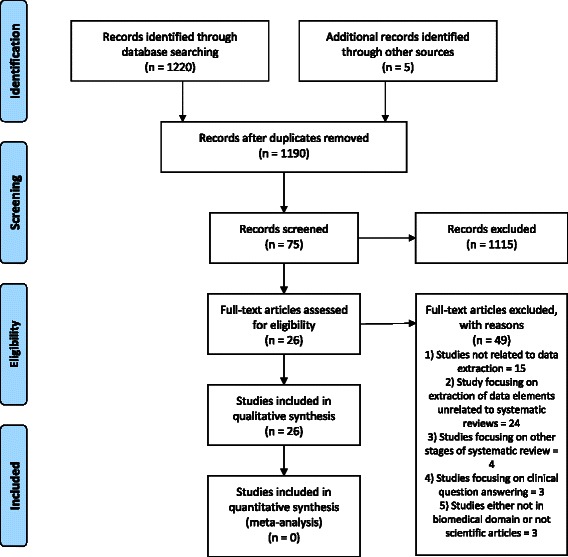
BACKGROUND: Automation of the parts of systematic review process, specifically the data extraction step, may be an important strategy to reduce the time necessary to complete a systematic review. However, the state of the science of automatically extracting data elements from full texts has not been well described. This paper performs a systematic review of published and unpublished methods to automate data extraction for systematic reviews. METHODS: We systematically searched PubMed, IEEEXplore, and ACM Digital Library to identify potentially relevant articles. We included reports that met the following criteria: 1) methods or results section described what entities were or need to be extracted, and 2) at least one entity was automatically extracted with evaluation results that were presented for that entity. We also reviewed the citations from included reports. RESULTS: Out of a total of 1190 unique citations that met our search criteria, we found 26 published reports describing automatic extraction of at least one of more than 52 potential data elements used in systematic reviews. For 25 (48 %) of the data elements used in systematic reviews, there were attempts from various researchers to extract information automatically from the publication text. Out of these, 14 (27 %) data elements were completely extracted, but the highest number of data elements extracted automatically by a single study was 7. Most of the data elements were extracted with F-scores (a mean of sensitivity and positive predictive value) of over 70 %. CONCLUSIONS: We found no unified information extraction framework tailored to the systematic review process, and published reports focused on a limited (1-7) number of data elements. Biomedical natural language processing techniques have not been fully utilized to fully or even partially automate the data extraction step of systematic reviews.
Overview
The claims and statistics of this paper haven’t been checked yet.
Free: it reads the open-access text and checks the first 5 claims that cite a source we can check. Create a free account to check every claim.
Integrity signals
Registry
Cites
Statistics
Figures
Verification
Claims the paper makes
The claims and statistics of this paper haven’t been checked yet.
Free: it reads the open-access text and checks the first 5 claims that cite a source we can check. Create a free account to check every claim.
Claims other papers make about this one
Each is checked against this paper’s own text: does it say what the citing paper says it does?
The source backs part of the claim, not all of it — or backs it for a different population, condition or comparison.
In the citing paper
“The time from the last search to publication takes commonly over 1 year for an SLR study”
From Automation of systematic literature reviews: A systematic literature review (2021) · cites this paper as [8]
Experimental — accuracy not yet measuredThe source backs part of the claim, not all of it — or backs it for a different population, condition or comparison.
In the citing paper
“However, almost all of this work has considered retrospective evaluation of ML/NLP methods applied to existing datasets, providing only indirect evidence of the utility of such methods for EBM.”
From Machine learning to help researchers evaluate biases in clinical trials: a prospective, randomized user study (2019) · cites this paper as [6]
Experimental — accuracy not yet measuredThe cited source says what the claim attributes to it.
In the citing paper
“The most efficient use and application of the machine-learning technologies would be in the areas allowing automation of specific SR processes, in particular those involving time-consuming and resource-intensive tasks such as language translation [15], study selection [11, 16–18], data extraction [19] and risk of bias assessment [20].”
From How to conduct systematic reviews more expeditiously? (2015) · cites this paper as [19]
The cited source says what the claim attributes to it.
In the citing paper
“for a primary study, it takes 2.5 - 6.5 years before it is incorporated in an SLR study [7,8].”
From Automation of systematic literature reviews: A systematic literature review (2021) · cites this paper as [8]
The cited source says what the claim attributes to it.
In the citing paper
“Additionally, 23% of all SLR studies are outdated within 2 years of publication, as reviewers failed to incorporate novel evidence on their subject of interest [8,9].”
From Automation of systematic literature reviews: A systematic literature review (2021) · cites this paper as [8]
1 more claim about this paper
Create a free account to see every claim other papers make about this one.
Self-check
Percentages, sums and reported differences re-computed from the paper’s own numbers.
The self-check needs the paper’s full text.
Citations
Cites
(2003) · Journal of Machine Learning Research · doi:10.5555/944919.944937 · Cited by 32,337
Conditional Random Fields: Probabilistic Models for Segmenting and Labeling Sequence Data
Lafferty, J., McCallum, A., & Pereira, F. C. N. (2001) · ScholarlyCommons (University of Pennsylvania) · Cited by 12,935
Text categorization with Support Vector Machines: Learning with many relevant features
Joachims, T. (1998) · Lecture Notes in Computer Science · doi:10.1007/bfb0026683 · Cited by 7,999
Whiting, P., Rutjes, A. W., Reitsma, J. B., Bossuyt, P. M., & Kleijnen, J. (2003) · BMC Medical Research Methodology · doi:10.1186/1471-2288-3-25 · Cited by 3,592
Towards complete and accurate reporting of studies of diagnostic accuracy: The STARD Initiative.
Bossuyt, P. M., Reitsma, J. B., Bruns, D. E., Gatsonis, C. A., Glasziou, P. P., Irwig, L. M., Lijmer, J. G., Moher, D., Rennie, D., de Vet, H. C. W., et al. (2003) · Annals of Internal Medicine · doi:10.7326/0003-4819-138-1-200301070-00010 · Cited by 3,219
Towards complete and accurate reporting of studies of diagnostic accuracy: the STARD initiative
Bossuyt, P. M., Reitsma, J. B., Bruns, D. E., Gatsonis, C. A., Glasziou, P. P., Irwig, L. M., Lijmer, J. G., Moher, D., Rennie, D., & de Vet, H. C. W. (2003) · BMJ · doi:10.1136/bmj.326.7379.41 · Cited by 3,215
Towards Complete and Accurate Reporting of Studies of Diagnostic Accuracy: The STARD Initiative
Bossuyt, P. M., Reitsma, J. B., Bruns, D. E., Gatsonis, C. A., Glasziou, P. P., Irwig, L. M., Lijmer, J. G., Moher, D., Rennie, D., & de Vet, H. C. W. (2003) · Radiology · doi:10.1148/radiol.2261021292 · Cited by 3,215
Improving the Quality of Reporting of Randomized Controlled Trials: The CONSORT Statement
Begg, C. (1996) · JAMA · doi:10.1001/jama.1996.03540080059030 · Cited by 3,127
The well-built clinical question: A key to evidence-based decisions
(1995) · ACP Journal Club · doi:10.7326/acpjc-1995-123-3-a12 · Cited by 2,931 · cited 2×
“…the Cochrane Handbook for Systematic Reviews [1], the CONsolidated Standards Of Reporting Trials (CONSORT) [9] statement, the Standards for Reporting of Diagnostic Accuracy (STARD) initiative [10], and PICO [11], PECODR [12], and PIBOSO [13] frameworks to obtain the data elements to be considered.”
MethodEddy, S. R. (1996) · Current Opinion in Structural Biology · doi:10.1016/s0959-440x(96)80056-x · Cited by 1,430
Clinical practice guidelines : directions for a new program
Field, M. J., & Lohr, K. N. (1990) · Cited by 1,415
Seventy-five trials and eleven systematic reviews a day: how will we ever keep up?
Bastian, H., Glasziou, P., & Chalmers, I. (2010) · PLoS Medicine · doi:10.1371/journal.pmed.1000326 · Cited by 1,188 · cited 1×
“Medical science is currently witnessing a rapid pace at which medical knowledge is being created — 75 clinical trials a day [66].”
BackgroundFinding What Works in Health Care: Standards for Systematic Reviews
Eden, J., Levit, L. A., Berg, A. O., & Morton, S. C. (2013) · Cited by 948
General practitioners' perceptions of the route to evidence based medicine: a questionnaire survey
McColl, A., Smith, H., White, P., & Field, J. (1998) · BMJ · doi:10.1136/bmj.316.7128.361 · Cited by 888
Hearst, M. A. (1999) · Proceedings of the 37th annual meeting of the Association for Computational Linguistics on Computational Linguistics - · doi:10.3115/1034678.1034679 · Cited by 867 · cited 1×
“Natural language processing (NLP), including text mining, involves information extraction, which is the discovery by computer of new, previously unfound information by automatically extracting information from different written resources [7].”
BackgroundHow Quickly Do Systematic Reviews Go Out of Date? A Survival Analysis
Shojania, K. G., Sampson, M., Ansari, M. T., Ji, J., Doucette, S., & Moher, D. (2007) · Annals of Internal Medicine · doi:10.7326/0003-4819-147-4-200708210-00179 · Cited by 838 · cited 1×
“Further, within 2 years of the publication of systematic reviews, 23 % are out of date because they have not incorporated new evidence that might change the systematic review ’ s primary results [6].”
BackgroundClinical Practice Guidelines: Directions for a New Program
Committee to Advise the Public Health Service on Clinical Practice Guidelines, & Institute of Medicine (1990) · National Academies Press eBooks · doi:10.17226/1626 · Cited by 803
O’Mara-Eves, A., Thomas, J., McNaught, J., Miwa, M., & Ananiadou, S. (2015) · Systematic Reviews · doi:10.1186/2046-4053-4-5 · Cited by 681
Living Systematic Reviews: An Emerging Opportunity to Narrow the Evidence-Practice Gap
Elliott, J. H., Turner, T., Clavisi, O., Thomas, J., Higgins, J. P. T., Mavergames, C., & Gruen, R. L. (2014) · PLoS Medicine · doi:10.1371/journal.pmed.1001603 · Cited by 596 · cited 1×
“5 years for a primary study publication to be included and published in a new systematic review [5].”
BackgroundSystematic review automation technologies
Tsafnat, G., Glasziou, P., Choong, M. K., Dunn, A., Galgani, F., & Coiera, E. (2014) · Systematic Reviews · doi:10.1186/2046-4053-3-74 · Cited by 472 · cited 3×
“Tsafnat et al. [43] surveyed the informatics systems that automate some of the tasks of systematic review and report systems for each stage of systematic review.”
BackgroundMethodInfluentialReducing Workload in Systematic Review Preparation Using Automated Citation Classification
Cohen, A. M., Hersh, W. R., Peterson, K., & Yen, P.-Y. (2006) · Journal of the American Medical Informatics Association · doi:10.1197/jamia.m1929 · Cited by 411 · cited 1×
“Cohen et al. [54] constructed a voting perceptron-based automated citation classification system to classify each article as to whether it contains high-quality, drug-specific evidence.”
BackgroundAnswering Physicians' Clinical Questions: Obstacles and Potential Solutions
Ely, J. W., Osheroff, J. A., Chambliss, M. L., Ebell, M. H., & Rosenbaum, M. E. (2005) · Journal of the American Medical Informatics Association · doi:10.1197/jamia.m1608 · Cited by 388
O’Mara-Eves, A., Thomas, J., McNaught, J., Miwa, M., & Ananiadou, S. (2015) · Systematic Reviews · doi:10.1186/s13643-015-0031-5 · Cited by 353
Semi-automated screening of biomedical citations for systematic reviews
Wallace, B. C., Trikalinos, T. A., Lau, J., Brodley, C., & Schmid, C. H. (2010) · BMC Bioinformatics · doi:10.1186/1471-2105-11-55 · Cited by 351 · cited 1×
“Wallace et al. [48, 49] and Miwa et al. [50] an active learning framework to reduce the workload in citation screening for inclusion in the systematic reviews.”
BackgroundAnswering Clinical Questions with Knowledge-Based and Statistical Techniques
Demner-Fushman, D., & Lin, J. (2007) · Computational Linguistics · doi:10.1162/coli.2007.33.1.63 · Cited by 296 · cited 5×
“Spectrum of presenting symptoms, current treatments, recruitment centers Participants STARD Yes [21, 24, 28, 29, 32, 41]”
BackgroundMethodInfluentialFinding What Works in Health Care: Standards for Systematic Reviews
Committee on Standards for Systematic Reviews of Comparative Effectiveness Research, Board on Health Care Services, & Institute of Medicine (2011) · doi:10.17226/13059 · Cited by 289
Clinical Decision Support: The Road Ahead
Greenes, R. A. (2006) · Cited by 262
Hersh, W. R., & Hickam, D. H. (1998) · JAMA · doi:10.1001/jama.280.15.1347 · Cited by 246 · cited 1×
““On demand” access to summarized evidence and best practices has been considered a sound strategy to satisfy clinicians’ information needs and enhance decisionmaking [57–65].”
BackgroundRousseau, N., McColl, E., Newton, J., Grimshaw, J., & Eccles, M. (2003) · BMJ · doi:10.1136/bmj.326.7384.314 · Cited by 221 · cited 1×
““On demand” access to summarized evidence and best practices has been considered a sound strategy to satisfy clinicians’ information needs and enhance decisionmaking [57–65].”
BackgroundAutomatic classification of sentences to support Evidence Based Medicine.
Kim, S. N., Martinez, D., Cavedon, L., & Yencken, L. (2011) · BMC Bioinformatics · doi:10.1186/1471-2105-12-s2-s5 · Cited by 214 · cited 4×
“…the Cochrane Handbook for Systematic Reviews [1], the CONsolidated Standards Of Reporting Trials (CONSORT) [9] statement, the Standards for Reporting of Diagnostic Accuracy (STARD) initiative [10], and PICO [11], PECODR [12], and PIBOSO [13] frameworks to obtain the data elements to be considered.”
MethodInfluentialApplications of text mining within systematic reviews
Thomas, J., McNaught, J., & Ananiadou, S. (2011) · Research Synthesis Methods · doi:10.1002/jrsm.27 · Cited by 212 · cited 1×
“Thomas et al. [44] described the application of text mining technologies such as automatic term recognition, document clustering, classification, and summarization to support the identification of relevant studies in systematic reviews.”
BackgroundReducing systematic review workload through certainty-based screening
Miwa, M., Thomas, J., O’Mara-Eves, A., & Ananiadou, S. (2014) · Journal of Biomedical Informatics · doi:10.1016/j.jbi.2014.06.005 · Cited by 190 · cited 1×
“Wallace et al. [48, 49] and Miwa et al. [50] an active learning framework to reduce the workload in citation screening for inclusion in the systematic reviews.”
BackgroundExaCT: automatic extraction of clinical trial characteristics from journal publications
Kiritchenko, S., de Bruijn, B., Carini, S., Martin, J., & Sim, I. (2010) · BMC Medical Informatics and Decision Making · doi:10.1186/1472-6947-10-56 · Cited by 188 · cited 1×
“Kiritchenko et al. [36] developed ExaCT, a tool that assists users with locating and extracting key trial characteristics such as eligibility criteria, sample size, drug dosage, and primary outcomes from full-text journal articles.”
MethodDo Online Information Retrieval Systems Help Experienced Clinicians Answer Clinical Questions?
Westbrook, J. I. (2005) · Journal of the American Medical Informatics Association · doi:10.1197/jamia.m1717 · Cited by 181 · cited 1×
““ On demand ” access to summarized evidence and best practices has been considered a sound strategy to satisfy clinicians ’ information needs and enhance decision-making [57 – 65].”
BackgroundShemilt, I., Simon, A., Hollands, G. J., Marteau, T. M., Ogilvie, D., O'Mara‐Eves, A., Kelly, M. P., & Thomas, J. (2014) · Research Synthesis Methods · doi:10.1002/jrsm.1093 · Cited by 170 · cited 1×
“[56] also discussed the use of text mining to reduce screening workload in systematic reviews.”
BackgroundIn search of evidence: family practitioners' use of the Internet for clinical information.
(2002) · Europe PMC (PubMed Central) · Cited by 156
Clinician Use of a Palmtop Drug Reference Guide
Rothschild, J. M. (2002) · Journal of the American Medical Informatics Association · doi:10.1197/jamia.m1001 · Cited by 153 · cited 1×
““On demand” access to summarized evidence and best practices has been considered a sound strategy to satisfy clinicians’ information needs and enhance decisionmaking [57–65].”
BackgroundKuperberg, M. (2008) · Springer eBooks · doi:10.1007/978-3-540-68947-8_8 · Cited by 149
The automation of systematic reviews
Tsafnat, G., Dunn, A., Glasziou, P., & Coiera, E. (2013) · BMJ · doi:10.1136/bmj.f139 · Cited by 131 · cited 1×
“Tsafnat et al. [46] described four main tasks in systematic review: identifying the relevant studies, evaluating risk of bias in selected trials, synthesis of the evidence, and publishing the systematic reviews by generating human-readable text from trial reports.”
BackgroundCombining classifiers for robust PICO element detection.
Boudin, F., Nie, J.-Y., Bartlett, J. C., Grad, R., Pluye, P., & Dawes, M. (2010) · BMC Medical Informatics and Decision Making · doi:10.1186/1472-6947-10-29 · Cited by 131 · cited 1×
“Boudin et al. [16] utilized a combination of multiple supervised classification techniques for detecting PICO elements in the medical abstracts.”
MethodAutomatic text classification to support systematic reviews in medicine
García Adeva, J. J., Pikatza Atxa, J. M., Ubeda Carrillo, M., & Ansuategi Zengotitabengoa, E. (2014) · Expert Systems with Applications · doi:10.1016/j.eswa.2013.08.047 · Cited by 125 · cited 1×
“[55] also proposed a classification system for screening articles for systematic review.”
BackgroundActive learning for biomedical citation screening
Wallace, B. C., Small, K., Brodley, C. E., & Trikalinos, T. A. (2010) · Proceedings of the 16th ACM SIGKDD international conference on Knowledge discovery and data mining · doi:10.1145/1835804.1835829 · Cited by 123
Pluye, P., Grad, R. M., Dunikowski, L. G., & Stephenson, R. (2005) · International Journal of Medical Informatics · doi:10.1016/j.ijmedinf.2005.05.004 · Cited by 121 · cited 1×
“A systematic review of 26 studies concluded that information-retrieval technology produces positive impact on physicians in terms of decision enhancement, learning, recall, reassurance, and confirmation [62].”
BackgroundGeneral practitioners’ use of online evidence during consultations
Magrabi, F., Coiera, E. W., Westbrook, J. I., Gosling, A. S., & Vickland, V. (2004) · International Journal of Medical Informatics · doi:10.1016/j.ijmedinf.2004.10.003 · Cited by 104
On the impossibility of being expert
Fraser, A. G., & Dunstan, F. D. (2010) · BMJ · doi:10.1136/bmj.c6815 · Cited by 97 · cited 1×
“However, it has been shown that it is practically impossible to do that even within a narrow specialty [68].”
BackgroundAutomatic Evidence Retrieval for Systematic Reviews
Choong, M. K., Galgani, F., Dunn, A. G., & Tsafnat, G. (2014) · Journal of Medical Internet Research · doi:10.2196/jmir.3369 · Cited by 84 · cited 1×
“Choong et al. [53] proposed an automated method for automatic citation snowballing to recursively pursue relevant literature for helping in evidence retrieval for systematic reviews.”
MethodTowards Complete and Accurate Reporting of Studies of Diagnostic Accuracy: The STARD Initiative
Bossuyt, P. M., Reitsma, J. B., Bruns, D. E., et al. (2003) · Clinical Chemistry and Laboratory Medicine · doi:10.1515/cclm.2003.012 · Cited by 78
The impact of evidence on physicians’ inpatient treatment decisions
Lucas, B., Evans, A. T., Reilly, B. M., Khodakov, Y. V., Perumal, K., Rohr, L., Akamah, J. A., Alausa, T., Smith, C. A., & Smith, J. P. (2004) · Journal of General Internal Medicine · doi:10.1111/j.1525-1497.2004.30306.x · Cited by 69 · cited 1×
““On demand” access to summarized evidence and best practices has been considered a sound strategy to satisfy clinicians’ information needs and enhance decisionmaking [57–65].”
BackgroundPatient-Care Questions that Physicians Are Unable to Answer
Ely, J., Osheroff, J. A., Maviglia, S. M., & Rosenbaum, M. (2007) · Journal of the American Medical Informatics Association · doi:10.1197/jamia.m2398 · Cited by 68 · cited 1×
“A critical barrier is that finding relevant information, which may be located in several documents, takes an amount of time and cognitive effort that is incompatible with the busy clinical workflow [69, 70].”
BackgroundIdentifying scientific artefacts in biomedical literature: The Evidence Based Medicine use case.
Hassanzadeh, H., Groza, T., & Hunter, J. (2014) · Journal of Biomedical Informatics · doi:10.1016/j.jbi.2014.02.006 · Cited by 62 · cited 1×
“…First sentence of the section: F-scores for P: 0.74, I: 0.66, and O: 0.73 All sentences in the section: F-scores for P: 0.73, I: 0.73, and O: 0.74 Hassanzadeh et al. (2014) [20] PIBOSO (PopulationIntervention-BackgroundOutcome-Study Design-Other) PIBOSO corpus, 1000 structured and unstructured…”
InfluentialA new iterative method to reduce workload in systematic review process
Jonnalagadda, S., & Petitti, D. (2013) · International Journal of Computational Biology and Drug Design · doi:10.1504/ijcbdd.2013.052198 · Cited by 61 · cited 1×
“Jonnalagadda et al. [51] designed a distributional semantics-based relevance feedback model to semi-automatically screen citations.”
BackgroundSelf-citationAutomating Risk of Bias Assessment for Clinical Trials
Marshall, I. J., Kuiper, J., & Wallace, B. C. (2015) · IEEE Journal of Biomedical and Health Informatics · doi:10.1109/jbhi.2015.2431314 · Cited by 59
Proceedings of the 1st ACM International Health Informatics Symposium
Veinot, T. C., Çatalyürek, Ü. V., Luo, G., Andrade, H. C. M., & Smalheiser, N. R. (2010) · Cited by 55
Automated information extraction of key trial design elements from clinical trial publications.
(2008) · PubMed Central · Cited by 54
PICO element detection in medical text without metadata: are first sentences enough?
Huang, K.-C., Chiang, I.-J., Xiao, F., Liao, C.-C., Liu, C. C.-H., & Wong, J.-M. (2013) · Journal of Biomedical Informatics · doi:10.1016/j.jbi.2013.07.009 · Cited by 52 · cited 1×
“…relational learning with kernels, kLog Sentence Abstract Micro-averaged F of 84.29 % on structured abstracts and 67.14 % on unstructured abstracts Huang et al. (2013) [19] PICO (except C) 19,854 structured abstracts of randomized controlled trials First sentence of the section or all sentences…”
BackgroundInfluentialA Statistical Relational Learning Approach to Identifying Evidence Based Medicine Categories
Verbeke, M., Asch, V. V., Morante, R., Frasconi, P., Daelemans, W. M. P., & Raedt, L. D. (2012) · Lirias · Cited by 52
Automatic Summarization of Results from Clinical Trials
Summerscales, R. L., Argamon, S., Bai, S., Hupert, J., & Schwartz, A. (2011) · 2011 IEEE International Conference on Bioinformatics and Biomedicine · doi:10.1109/bibm.2011.72 · Cited by 49 · cited 5×
“(2011) [35] Groups, outcomes, group sizes, outcome numbers 263 abstracts from BMJ between 2005 and 2009 CRF, MaxEnt, template filling Concept Abstract F-scores for groups: 0.”
BackgroundMethodInfluentialDawes, M., Pluye, P., Shea, L., Grad, R., Greenberg, A., & Nie, J.-Y. (2007) · Journal of Innovation in Health Informatics · doi:10.14236/jhi.v15i1.640 · Cited by 47 · cited 3×
“Dawes et al. [12] identified 20 evidence-based medicine journal synopses with 759 extracts in the corresponding PubMed abstracts.”
BackgroundMethodCohen, A. M., Adams, C. E., Davis, J. M., Yu, C., Yu, P. S., Meng, W., Duggan, L., McDonagh, M., & Smalheiser, N. R. (2010) · Proceedings of the 1st ACM International Health Informatics Symposium · doi:10.1145/1882992.1883046 · Cited by 45 · cited 1×
“Cohen et al. [52] proposed a module for grouping studies that are closely related and an automated system to rank publications according to the likelihood for meeting the inclusion criteria of a systematic review.”
MethodHansen, M. J., Rasmussen, N. Ø., & Chung, G. (2008) · Journal of Telemedicine and Telecare · doi:10.1258/jtt.2008.007007 · Cited by 38 · cited 1×
“Hansen et al. [30] used support machines [31] to extract number of trial participants from abstracts of the randomized control trials.”
BackgroundChung, G. Y.-C. (2009) · Journal of Biomedical Informatics · doi:10.1016/j.jbi.2008.12.011 · Cited by 34 · cited 7×
“…of life 1356 PubMed abstracts SVM, NB, multinomial NB, logistic regression Sentence Abstract Best results achieved via SVM: F-measure of 0.86 Chung (2009) [22] Intervention, comparisons 203 RCT abstracts for training and 124 for testing Coordinating constructs are identified using a full…”
BackgroundMethodInfluential(2007) · PubMed · Cited by 32
Hsu, W. W. Y., Speier, W. F., & Taira, R. K. (2012) · PubMed · Cited by 30
Automating risk of bias assessment for clinical trials
Marshall, I. J., Kuiper, J., & Wallace, B. C. (2014) · Proceedings of the 5th ACM Conference on Bioinformatics, Computational Biology, and Health Informatics · doi:10.1145/2649387.2649406 · Cited by 28 · cited 1×
“Marshall et al. (2014) [27] Risk of bias concerning sequence generation, allocation concealment and blinding 2200 clinical trial reports Soft-margin SVM for a joint model of risk of bias prediction and supporting sentence extraction Sentence Full text For sentence identification: F-score of 0.56,…”
BackgroundInfluentialClassification of PICO elements by text features systematically extracted from PubMed abstracts.
Huang, K.-C., Liu, C. C.-H., Yang, S.-S., Xiao, F., Wong, J.-M., Liao, C.-C., & Chiang, I.-J. (2011) · 2011 IEEE International Conference on Granular Computing · doi:10.1109/grc.2011.6122608 · Cited by 26 · cited 1×
“…support vector machines (SVM), and multi-layer perceptron (MLP) Sentence Abstract F-score of 86.3 % for P, 67 % for I (and C), and 56.3 % for O Huang et al. (2011) [17] PICO (except C) 23,472 sentences from the structured abstracts naïve Bayes Sentence Abstract F-measure of 0.91 for…”
BackgroundInfluentialIdentifying treatments, groups and outcomes in medical abstracts
Summerscales, R. (2009) · Touro Scholar (Touro College) · Cited by 22
Lin, S., Ng, J.-P., Pradhan, S. S., Shah, J. Y., Pietrobon, R. S., & Kan, M. (2010) · Cited by 22
Extracting Clinical Trial Design Information from MEDLINE Abstracts.
Hara, K., & Matsumoto, Y. (2007) · New Generation Computing · doi:10.1007/s00354-007-0017-5 · Cited by 21 · cited 1×
“Hara and Matsumoto [23] dealt with the problem of extracting “ patient population ” and “ compared treatments ” from medical abstracts.”
BackgroundAutomatic Extracting of Patient-related Attributes: Disease, Age, Gender and Race
Huijia, Z., Yuan, N., Peng, C., Zhaoming, Q., & Feng, C. (2012) · Studies in Health Technology and Informatics · doi:10.3233/978-1-61499-101-4-589 · Cited by 17
Exploiting classification correlations for the extraction of evidence-based practice information.
(2012) · PubMed Central · Cited by 16
Inferring appropriate eligibility criteria in clinical trial protocols without labeled data
Restificar, A. C., & Ananiadou, S. (2012) · Data and Text Mining in Bioinformatics · doi:10.1145/2390068.2390074 · Cited by 12 · cited 6×
“Participant flow: flow of participants through each stage: randomly assigned, received intended treatment, completed study, analyzed for primary outcome, inclusion and exclusion criteria Method CONSORT Yes [36, 37, 40]”
BackgroundMethodInfluentialA System for Extracting Study Design Parameters from Nutritional Genomics Abstracts
Kelly, C., & Yang, H. (2013) · Berichte aus der medizinischen Informatik und Bioinformatik/Journal of integrative bioinformatics · doi:10.1515/jib-2013-222 · Cited by 11 · cited 1×
“Kelly and Yang [29] used regular expressions and gaz-etteer to extract the number of participants, participant age, gender, ethnicity, and study characteristics.”
BackgroundEnabling Living Systematic Reviews and Clinical Guidelines through Semantic Technologies
Slaughter, L. A., Berntsen, C. F., Brandt, L., & Mavergames, C. (2015) · D-Lib Magazine · doi:10.1045/january2015-slaughter · Cited by 9 · cited 1×
“[45] discussed necessary next steps towards developing “living systematic reviews” rather than a static publication, where the systematic reviews can be continuously updated with the latest knowledge available.”
BackgroundRestificar, A. C., Korkontzelos, I., & Ananiadou, S. (2013) · BMC Medical Informatics and Decision Making · doi:10.1186/1472-6947-13-s1-s6 · Cited by 8
A System for Extracting Study Design Parameters from Nutritional Genomics Abstracts
Kelly, C., & Yang, H. (2013) · PubMed · doi:10.2390/biecoll-jib-2013-222 · Cited by 8
Evidence-based medicine and meta-analysis
Lau, J. (2007) · Elsevier eBooks · doi:10.1016/b978-012369377-8/50012-x · Cited by 6
Song, M. H., Lee, Y. H., & Kang, U. G. (2013) · Healthcare Informatics Research · doi:10.4258/hir.2013.19.1.16 · Cited by 5 · cited 1×
“Song et al. [26] used machine learning-based classifiers such as maximum entropy classifier (MaxEnt), support vector machines (SVM), multi-layer perceptron (MLP), naive Bayes (NB), and radial basis function network (RBFN) to classify the sentences into categories such as analysis (statistical facts…”
MethodFinding patient-oriented evidence in PubMed abstracts
Robinson, D. A. (2012) · Cited by 5
Detection of evidence in clinical research papers
Davis-Desmond, P., & Mollá, D. (2012) · Cited by 4
Research works printed but not linked: 2
- Khan KS Ter Riet G Glanville J Sowden AJ Kleijnen J Undertaking systematic reviews of research on effectiveness: CRD’s guidance for carrying out or commissioning reviews, NHS Centre for Reviews and Dissemination 2001
- Woolf SH Manual for conducting systematic reviews, Agency for Health Care Policy and Research 1996
Cited by
Page, M. J., Moher, D., Bossuyt, P. M., Boutron, I., Hoffmann, T. C., Mulrow, C. D., Shamseer, L., Tetzlaff, J. M., Akl, E. A., Brennan, S. E., et al. (2021) · BMJ · doi:10.1136/bmj.n160 · Cited by 13,262
Page, M. J., Moher, D., Bossuyt, P., Boutron, I., Hoffmann, T., mulrow, C., Shamseer, L., Tetzlaff, J., Akl, E., Brennan, S. E., et al. (2020) · doi:10.31222/osf.io/gwdhk · Cited by 916
Borah, R., Brown, A. W., Capers, P. L., & Kaiser, K. A. (2017) · BMJ Open · doi:10.1136/bmjopen-2016-012545 · Cited by 737
“Others who have evaluated the use of text mining 13 and automated data extraction 14 report that these methods may have some utility in certain types of reviews (eg, scoping), but more work is needed to provide signi fi cant reductions in work required by humans.”
MethodMarshall, I. J., & Wallace, B. C. (2019) · Systematic Reviews · doi:10.1186/s13643-019-1074-9 · Cited by 638
Automation of systematic literature reviews: A systematic literature review
van Dinter, R., Tekinerdogan, B., & Catal, C. (2021) · Information and Software Technology · doi:10.1016/j.infsof.2021.106589 · Cited by 432
“Jonnalagadda et al. [8] collected published reports and lists their methods to automate data extraction for various data points.”
BackgroundMethodInfluential
Metadata
- Authors
- Jonnalagadda, S. R., Goyal, P., & Huffman, M. D.
- Affiliations
- Northwestern University (US)
- Indian Institute of Technology Kharagpur (IN)
- Corresponding author
- Jonnalagadda, Siddhartha R.
- Venue
- Systematic Reviews
- Published
- 2015-06-15
- Volume
- 4
- Issue
- 1
- Pages
- 78-78
- ISSN
- 2046-4053 (ISSN-L)
- PMC
- PMC4514954
- OpenAlex
- W1629765770
- Cited by
- 287
- References
- 79
- Citations by year
- 2026: 21 · 2025: 43 · 2024: 31 · 2023: 32 · 2022: 32 · 2021: 42 · 2020: 25 · 2019: 24 · 2018: 17 · 2017: 11 · 2016: 8 · 2015: 1
- FWCI
- 2.03
- Type
- journal article
- Language
- en
- Open access
- gold
- doi.org
- Locations
- Systematic Reviews (publishedVersion, cc-by)
- Europe PMC (PubMed Central) (publishedVersion, cc-by)
- PubMed Central (publishedVersion, cc-by)
- PubMed (publishedVersion)
- Funders
- Feinberg School of Medicine
- U.S. National Library of Medicine (R00LM011389)
- Topics
- Social Sciences › Decision Sciences › Statistics, Probability and Uncertainty › Meta-analysis and systematic reviews
- Health Sciences › Medicine › Health Informatics › Biomedical Text Mining and Ontologies
- Physical Sciences › Computer Science › Artificial Intelligence › Advanced Text Analysis Techniques
- Keywords
- automated data extraction, information extraction, natural language processing, biomedical text mining, data elements
- MeSH terms
- Humans, Publishing, Review Literature as Topic, Information Storage and Retrieval, Data Mining, Research Report
About these checks
Registry, retraction, Cites and statistics results are computed, not judged, with one exception: a printed reference that no index lists is read once by a model before it counts as a citation error. Claims are extracted by a model and kept only when their quote appears verbatim in the text; each cited source is then checked, with a model’s help, for whether it says what the claim relies on. Those verdicts can be wrong — read the claim’s quote and the cited source before relying on one.
Statistics and arithmetic are recomputed, not judged.
Confidence bands are shown only for fields calibrated on our annotated test set. None is calibrated yet, so no band is shown.
What counts as a claim ›How we measure confidence ›How we check this ›
Are you an author, or do you see a problem with this page? Request a review
Data sources
Bibliographic data: Semantic Scholar, OpenAlex, Crossref.
Contains information from the Semantic Scholar Academic Graph Datasets, made available under the ODC Attribution License (ODC-BY 1.0).
Semantic Scholar’s data is described in: Kinney, R., et al. (2023). The Semantic Scholar Open Data Platform. arXiv:2301.10140.
