

Automating data extraction in systematic reviews: a systematic review
Open accessThe DOI matches its Crossref record; 80 of the 80 references it cites were found in a registry or an index.
Abstract
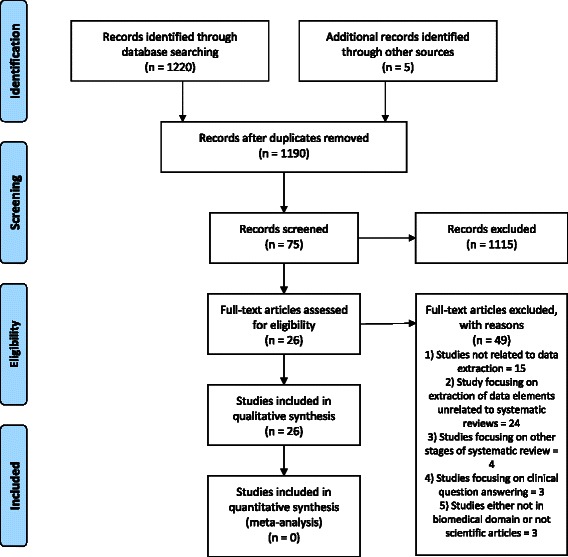
BACKGROUND: Automation of the parts of systematic review process, specifically the data extraction step, may be an important strategy to reduce the time necessary to complete a systematic review. However, the state of the science of automatically extracting data elements from full texts has not been well described. This paper performs a systematic review of published and unpublished methods to automate data extraction for systematic reviews. METHODS: We systematically searched PubMed, IEEEXplore, and ACM Digital Library to identify potentially relevant articles. We included reports that met the following criteria: 1) methods or results section described what entities were or need to be extracted, and 2) at least one entity was automatically extracted with evaluation results that were presented for that entity. We also reviewed the citations from included reports. RESULTS: Out of a total of 1190 unique citations that met our search criteria, we found 26 published reports describing automatic extraction of at least one of more than 52 potential data elements used in systematic reviews. For 25 (48 %) of the data elements used in systematic reviews, there were attempts from various researchers to extract information automatically from the publication text. Out of these, 14 (27 %) data elements were completely extracted, but the highest number of data elements extracted automatically by a single study was 7. Most of the data elements were extracted with F-scores (a mean of sensitivity and positive predictive value) of over 70 %. CONCLUSIONS: We found no unified information extraction framework tailored to the systematic review process, and published reports focused on a limited (1-7) number of data elements. Biomedical natural language processing techniques have not been fully utilized to fully or even partially automate the data extraction step of systematic reviews.
Overview
The claims and statistics of this paper haven’t been checked yet.
Free: it reads the open-access text and checks the first 5 claims that cite a source we can check. Create a free account to check every claim.
Integrity signals
Registry
Cites
Statistics
Figures
Verification
Claims the paper makes
The claims and statistics of this paper haven’t been checked yet.
Free: it reads the open-access text and checks the first 5 claims that cite a source we can check. Create a free account to check every claim.
Claims other papers make about this one
Each is checked against this paper’s own text: does it say what the citing paper says it does?
The source backs part of the claim, not all of it — or backs it for a different population, condition or comparison.
In the citing paper
“The time from the last search to publication takes commonly over 1 year for an SLR study”
From Automation of systematic literature reviews: A systematic literature review (2021) · cites this paper as [8]
Experimental — accuracy not yet measuredThe source backs part of the claim, not all of it — or backs it for a different population, condition or comparison.
In the citing paper
“However, almost all of this work has considered retrospective evaluation of ML/NLP methods applied to existing datasets, providing only indirect evidence of the utility of such methods for EBM.”
From Machine learning to help researchers evaluate biases in clinical trials: a prospective, randomized user study (2019) · cites this paper as [6]
Experimental — accuracy not yet measuredThe cited source says what the claim attributes to it.
In the citing paper
“The most efficient use and application of the machine-learning technologies would be in the areas allowing automation of specific SR processes, in particular those involving time-consuming and resource-intensive tasks such as language translation [15], study selection [11, 16–18], data extraction [19] and risk of bias assessment [20].”
From How to conduct systematic reviews more expeditiously? (2015) · cites this paper as [19]
The cited source says what the claim attributes to it.
In the citing paper
“for a primary study, it takes 2.5 - 6.5 years before it is incorporated in an SLR study [7,8].”
From Automation of systematic literature reviews: A systematic literature review (2021) · cites this paper as [8]
The cited source says what the claim attributes to it.
In the citing paper
“Additionally, 23% of all SLR studies are outdated within 2 years of publication, as reviewers failed to incorporate novel evidence on their subject of interest [8,9].”
From Automation of systematic literature reviews: A systematic literature review (2021) · cites this paper as [8]
1 more claim about this paper
Create a free account to see every claim other papers make about this one.
Self-check
Percentages, sums and reported differences re-computed from the paper’s own numbers.
The self-check needs the paper’s full text.
Citations
Cites
(2003) · Journal of Machine Learning Research · doi:10.5555/944919.944937 · Cited by 32,337
Text categorization with Support Vector Machines: Learning with many relevant features
Joachims, T. (1998) · Lecture Notes in Computer Science · doi:10.1007/bfb0026683 · Cited by 7,999
Whiting, P., Rutjes, A. W., Reitsma, J. B., Bossuyt, P. M., & Kleijnen, J. (2003) · BMC Medical Research Methodology · doi:10.1186/1471-2288-3-25 · Cited by 3,592
Towards complete and accurate reporting of studies of diagnostic accuracy: The STARD Initiative.
Bossuyt, P. M., Reitsma, J. B., Bruns, D. E., Gatsonis, C. A., Glasziou, P. P., Irwig, L. M., Lijmer, J. G., Moher, D., Rennie, D., de Vet, H. C. W., et al. (2003) · Annals of Internal Medicine · doi:10.7326/0003-4819-138-1-200301070-00010 · Cited by 3,219
Towards complete and accurate reporting of studies of diagnostic accuracy: the STARD initiative
Bossuyt, P. M., Reitsma, J. B., Bruns, D. E., Gatsonis, C. A., Glasziou, P. P., Irwig, L. M., Lijmer, J. G., Moher, D., Rennie, D., & de Vet, H. C. W. (2003) · BMJ · doi:10.1136/bmj.326.7379.41 · Cited by 3,215
Towards Complete and Accurate Reporting of Studies of Diagnostic Accuracy: The STARD Initiative
Bossuyt, P. M., Reitsma, J. B., Bruns, D. E., Gatsonis, C. A., Glasziou, P. P., Irwig, L. M., Lijmer, J. G., Moher, D., Rennie, D., & de Vet, H. C. W. (2003) · Radiology · doi:10.1148/radiol.2261021292 · Cited by 3,215
Improving the Quality of Reporting of Randomized Controlled Trials: The CONSORT Statement
Begg, C. (1996) · JAMA · doi:10.1001/jama.1996.03540080059030 · Cited by 3,127
The well-built clinical question: A key to evidence-based decisions
(1995) · ACP Journal Club · doi:10.7326/acpjc-1995-123-3-a12 · Cited by 2,931 · cited 2×
“…the Cochrane Handbook for Systematic Reviews [1], the CONsolidated Standards Of Reporting Trials (CONSORT) [9] statement, the Standards for Reporting of Diagnostic Accuracy (STARD) initiative [10], and PICO [11], PECODR [12], and PIBOSO [13] frameworks to obtain the data elements to be considered.”
MethodEddy, S. R. (1996) · Current Opinion in Structural Biology · doi:10.1016/s0959-440x(96)80056-x · Cited by 1,430
Clinical practice guidelines : directions for a new program
Field, M. J., & Lohr, K. N. (1990) · Cited by 1,415
Research works printed but not linked: 2
- Khan KS Ter Riet G Glanville J Sowden AJ Kleijnen J Undertaking systematic reviews of research on effectiveness: CRD’s guidance for carrying out or commissioning reviews, NHS Centre for Reviews and Dissemination 2001
- Woolf SH Manual for conducting systematic reviews, Agency for Health Care Policy and Research 1996
Cited by
Page, M. J., Moher, D., Bossuyt, P. M., Boutron, I., Hoffmann, T. C., Mulrow, C. D., Shamseer, L., Tetzlaff, J. M., Akl, E. A., Brennan, S. E., et al. (2021) · BMJ · doi:10.1136/bmj.n160 · Cited by 13,262
Page, M. J., Moher, D., Bossuyt, P., Boutron, I., Hoffmann, T., mulrow, C., Shamseer, L., Tetzlaff, J., Akl, E., Brennan, S. E., et al. (2020) · doi:10.31222/osf.io/gwdhk · Cited by 916
Borah, R., Brown, A. W., Capers, P. L., & Kaiser, K. A. (2017) · BMJ Open · doi:10.1136/bmjopen-2016-012545 · Cited by 737
“Others who have evaluated the use of text mining 13 and automated data extraction 14 report that these methods may have some utility in certain types of reviews (eg, scoping), but more work is needed to provide signi fi cant reductions in work required by humans.”
MethodMarshall, I. J., & Wallace, B. C. (2019) · Systematic Reviews · doi:10.1186/s13643-019-1074-9 · Cited by 638
Automation of systematic literature reviews: A systematic literature review
van Dinter, R., Tekinerdogan, B., & Catal, C. (2021) · Information and Software Technology · doi:10.1016/j.infsof.2021.106589 · Cited by 432
“Jonnalagadda et al. [8] collected published reports and lists their methods to automate data extraction for various data points.”
BackgroundMethodInfluentialGrames, E. M., Stillman, A. N., Tingley, M. W., & Elphick, C. S. (2019) · Methods in Ecology and Evolution · doi:10.1111/2041-210x.13268 · Cited by 377
“…ad - vancements have enabled automation of key tasks such as re - moving duplicate articles, prioritizing articles for screening, and extracting data from tables and figures (Jonnalagadda, Goyal, & Huffman, 2015; Przybyla et al., 2018; Rathbone, Hoffmann, & Glasziou, 2015; Shemilt et al., 2014).”
MethodArtificial intelligence and the conduct of literature reviews
Wagner, G., Lukyanenko, R., & Paré, G. (2022) · Journal of Information Technology · doi:10.1177/02683962211048201 · Cited by 296
“…in the health sciences, which have established relatively consistent reporting practices, corresponding tools designed to extract study characteristics like the PICO (population, intervention, context, and outcome) elements are still in the early stages of development (Jonnalagadda et al., 2015).”
Kusmaryono, I., Wijayanti, D., & Maharani, H. R. (2022) · International Journal of Educational Methodology · doi:10.12973/ijem.8.4.625 · Cited by 283
“Data extraction is the most important phase in research using a systematic literature review method (Jonnalagadda et al., 2015) .”
Defining artificial intelligence for librarians
Cox, A. M., & Mazumdar, S. (2024) · Journal of Librarianship and Information Science · doi:10.1177/09610006221142029 · Cited by 150
“What could be considered a variation on this application, is the use of AI techniques to create living systematic literature reviews (SLRs) (Grbin et al., 2022; Jonnalagadda et al., 2015).”
BackgroundMathes, T., Klaßen, P., & Pieper, D. (2017) · BMC Medical Research Methodology · doi:10.1186/s12874-017-0431-4 · Cited by 240
“Biomedical natural language processing techniques will be developed further in the near future [27].”
BackgroundNye, B., Li, J. J., Patel, R., Yang, Y., Marshall, I., Nenkova, A., & Wallace, B. (2018) · Proceedings of the 56th Annual Meeting of the Association for Computational Linguistics (Volume 1: Long Papers) · doi:10.18653/v1/p18-1019 · Cited by 224
“There is even, perhaps inevitably, a systematic review of such approaches (Jonnalagadda et al., 2015).”
BackgroundSWIFT-Review: a text-mining workbench for systematic review
Howard, B. E., Phillips, J., Miller, K., Tandon, A., Mav, D., Shah, M. R., Holmgren, S., Pelch, K. E., Walker, V., Rooney, A. A., et al. (2016) · Systematic Reviews · doi:10.1186/s13643-016-0263-z · Cited by 196
“Various methods taken from the fields of text-mining, machine learning, and information retrieval have the potential to greatly reduce the amount of time it takes to conduct a systematic review and to minimize bias in identifying relevant studies [3, 4].”
Assay of renewable energy transition: A systematic literature review
Bhattarai, U., Maraseni, T., & Apan, A. (2022) · Science of The Total Environment · doi:10.1016/j.scitotenv.2022.155159 · Cited by 173
Data extraction for evidence synthesis using a large language model: A proof-of-concept study
Gartlehner, G., Kahwati, L., Hilscher, R., Thomas, I., Kugley, S., Crotty, K., Viswanathan, M., Nussbaumer‐Streit, B., Booth, G., Erskine, N., et al. (2024) · Research Synthesis Methods · doi:10.1002/jrsm.1710 · Cited by 164
Scherbakov, D., Hubig, N., Jansari, V., Bakumenko, A., & Lenert, L. A. (2024) · arXiv · doi:10.48550/arxiv.2409.04600 · Cited by 156
Scherbakov, D., Hubig, N., Jansari, V., Bakumenko, A., & Lenert, L. A. (2025) · Journal of the American Medical Informatics Association · doi:10.1093/jamia/ocaf063 · Cited by 154
Automating Research Synthesis with Domain-Specific Large Language Model Fine-Tuning
Sušnjak, T., Hwang, P., Reyes, N. H., Barczak, A. L. C., McIntosh, T. R., & Ranathunga, S. (2025) · ACM Transactions on Knowledge Discovery from Data · doi:10.1145/3715964 · Cited by 145
“Techniques such as text mining and machine learning algorithms have demonstrated potential in automating various stages of the review process, from literature retrieval to data extraction [44].”
BackgroundCréquit, P., Trinquart, L., Yavchitz, A., & Ravaud, P. (2016) · BMC Medicine · doi:10.1186/s12916-016-0555-0 · Cited by 125
“Future automated technologies could help experts to extract data or to assess the risk of bias within trials [49, 50, 62, 63]”
MethodLi, T., Higgins, J. P., & Deeks, J. J. (2019) · Cochrane Handbook for Systematic Reviews of Interventions · doi:10.1002/9781119536604.ch5 · Cited by 127
Hyperspectral imaging in wound care: A systematic review
Saiko, G., Lombardi, P., Au, Y., Queen, D., Armstrong, D. G., & Harding, K. G. (2020) · International Wound Journal · doi:10.1111/iwj.13474 · Cited by 118
“Data extraction was performed via manual synthesis by three reviewers based on Problem/Patient/Population, Intervention/Indicator, Comparison, Outcome criteria.(49) Data variables extracted for consideration included year of publication, article type, number of patients/participants included in the study, population s…”
MethodSummarising good practice guidelines for data extraction for systematic reviews and meta-analysis
Taylor, K. S., Mahtani, K. R., & Aronson, J. K. (2021) · BMJ Evidence-Based Medicine · doi:10.1136/bmjebm-2020-111651 · Cited by 115
“Data extraction is both time consuming and error-prone, and automation of data extraction is still in its infancy.(1,18) Following both formal and informal guidelines for good practice (Table 1) will make the process efficient and reduce the risk of errors and bias when extracting data.”
BackgroundData extraction methods for systematic review (semi)automation: a living systematic review
Schmidt, L., Olorisade, B. K., McGuinness, L. A., Thomas, J., & Higgins, J. P. T. (2021) · F1000Research · doi:10.12688/f1000research.51117.1 · Cited by 106
Systematic Review of the Literature: Best Practices
Gupta, S., Rajiah, P., Middlebrooks, E. H., Baruah, D., Carter, B. W., Burton, K. R., Chatterjee, A. R., & Miller, M. M. (2018) · Academic Radiology · doi:10.1016/j.acra.2018.04.025 · Cited by 105
How to conduct systematic reviews more expeditiously?
Tsertsvadze, A., Chen, Y.-F., Moher, D., Sutcliffe, P., & McCarthy, N. (2015) · Systematic Reviews · doi:10.1186/s13643-015-0147-7 · Cited by 104
“[11, 16–18], data extraction [19] and risk of bias assess-”
Can abstract screening workload be reduced using text mining? User experiences of the tool Rayyan
Olofsson, H., Brolund, A., Hellberg, C., Silverstein, R., Stenström, K., Österberg, M., & Dagerhamn, J. (2017) · Research Synthesis Methods · doi:10.1002/jrsm.1237 · Cited by 102
He, M., Blye, C.-J., & Halpenny, E. A. (2022) · Journal of Sustainable Tourism · doi:10.1080/09669582.2022.2095392 · Cited by 103
“Checklists assisted with the process of data extraction (Harris et al., 2014; Jonnalagadda et al., 2015).”
MethodSami, A. M., Rasheed, Z., Kemell, K., Waseem, M., Kilamo, T., Saari, M., Nguyen‐Duc, A., Systä, K., & Abrahamsson, P. (2024) · arXiv (Cornell University) · doi:10.48550/arxiv.2403.08399 · Cited by 92
“Jonnalagadda et al. [2015] detailed methods for data extraction from published reports, which has been instrumental in shaping our tool’s data handling capabilities.”
Michie, S., & Johnston, M. (2017) · Implementation Science · doi:10.1186/s13012-017-0660-2 · Cited by 83
“However, a review of automated evidence extraction methods noted the incompleteness of methods, pointing to the importance of having a strong framework or ‘ ontology ’ for organising the information that might be extracted [14].”
BackgroundRediscovering Don Swanson:The Past, Present and Future of Literature-based Discovery
Smalheiser, N. R. (2017) · Journal of Data and Information Science · doi:10.1515/jdis-2017-0019 · Cited by 74
Feng, Y., Liang, S., Zhang, Y., Chen, S., Wang, Q., Huang, T., Sun, F., Liu, X., Zhu, H., & Pan, H. (2022) · Journal of the American Medical Informatics Association · doi:10.1093/jamia/ocac066 · Cited by 59
“12 For literature screening, automated classification systems 13 or hybrid relevance rating models 14 have been evaluated in specific datasets, requiring further extension and performance improvement.”
BackgroundThe Cooperation Databank: Machine-Readable Science Accelerates Research Synthesis
Spadaro, G., Tiddi, I., Columbus, S., Jin, S., ten Teije, A., CoDa Team, & Balliet, D. P. (2022) · Perspectives on Psychological Science · doi:10.1177/17456916211053319 · Cited by 86
“To date, however, the performance of these automated tools is suboptimal in terms of achieving the accuracy that is required for systematic reviews (Bosco et al., 2020; Jonnalagadda et al., 2015; Marshall & Wallace, 2019).”
MethodResuming the discussion of AMSTAR: What can (should) be made better?
Wegewitz, U. E., Weikert, B., Fishta, A., Jacobs, A., & Pieper, D. (2016) · BMC Medical Research Methodology · doi:10.1186/s12874-016-0183-6 · Cited by 83
“This item will also need to be updated for future applications, as automated (computerized) data extraction is bound to emerge as an issue in systematic reviews [25].”
Screening articles for systematic reviews with ChatGPT
Syriani, E., David, I., & Kumar, G. (2024) · Journal of Computer Languages · doi:10.1016/j.cola.2024.101287 · Cited by 82
Artificial Intelligence in Software Testing: A Systematic Review
Islam, M., Khan, F., Alam, S., & Hasan, M. (2023) · IEEE Region 10 Conference (TENCON) · doi:10.1109/tencon58879.2023.10322349 · Cited by 82
“Data extraction means the process of retrieving relevant data from various sources for a specific purpose, such as a literature review [21].”
Performance of two large language models for data extraction in evidence synthesis
Konet, A., Thomas, I., Gartlehner, G., Kahwati, L., Hilscher, R., Kugley, S., Crotty, K., Viswanathan, M., & Chew, R. (2024) · Research Synthesis Methods · doi:10.1002/jrsm.1732 · Cited by 79
Santos, Á. O. D., da Silva, E. S., Couto, L. M., Reis, G. V. L., & Belo, V. S. (2023) · Journal of Biomedical Informatics · doi:10.1016/j.jbi.2023.104389 · Cited by 64
Abad‐Segura, E., Batlles‐delaFuente, A., González-Zamar, M.-D., & Ureña, L. J. B. (2021) · Sustainability · doi:10.3390/su13137182 · Cited by 78
“These qualitative reviews focus on synthesizing the state of the art in a specific field of study, based on publications of primary studies [54].”
BackgroundCollaborative large language models for automated data extraction in living systematic reviews
Khan, M. A., Ayub, U., Naqvi, S. A. A., Khakwani, K. Z. R., Sipra, Z. B. R., Raina, A., Zhou, S., He, H., Saeidi, A., Hasan, B., et al. (2025) · Journal of the American Medical Informatics Association · doi:10.1093/jamia/ocae325 · Cited by 50
Data extraction methods for systematic review (semi)automation: Update of a living systematic review
Schmidt, L., Finnerty Mutlu, A. N., Elmore, R., Olorisade, B. K., Thomas, J., & Higgins, J. P. T. (2023) · F1000Research · doi:10.12688/f1000research.51117.2 · Cited by 44
Patient healthcare trajectory. An essential monitoring tool: a systematic review
Pinaire, J., Azé, J., Bringay, S., & Landais, P. (2017) · Health Information Science and Systems · doi:10.1007/s13755-017-0020-2 · Cited by 73
Tóth, B., Berek, L., Gulácsi, L., Péntek, M., & Zrubka, Z. (2024) · Systematic Reviews · doi:10.1186/s13643-024-02592-3 · Cited by 48
“…illustrated by the study of Dinter et al. [29], which, despite including automation studies in all stages of the SR workflow and extending the electronic search with a manual snow-ball technique, yielded fewer reports than earlier reviews focusing on a more specific aspect of SR automation [28].”
MethodInfluentialCowie, K., Rahmatullah, A., Hardy, N., Holub, K., & Kallmes, K. (2022) · JMIR Medical Informatics · doi:10.2196/33219 · Cited by 68
“To quote a recent review on the subject of automated extraction, “[automation] techniques have not been fully utilized to fully or even partially automate the data extraction step of systematic review” [21].”
MethodEmilie Lance, A., Arnich, N., Maignien, T., & Biré, R. (2018) · Toxins · doi:10.3390/toxins10020083 · Cited by 68
Study-based registers reduce waste in systematic reviewing: discussion and case report
Shokraneh, F., & Adams, C. E. (2019) · Systematic Reviews · doi:10.1186/s13643-019-1035-3 · Cited by 65
Automating Systematic Literature Review
Felizardo, K. R., & Carver, J. C. (2020) · Springer eBooks · doi:10.1007/978-3-030-32489-6_12 · Cited by 64
Improving reference prioritisation with PICO recognition.
Brockmeier, A. J., Ju, M., Przybyła, P., & Ananiadou, S. (2019) · BMC Medical Informatics and Decision Making · doi:10.1186/s12911-019-0992-8 · Cited by 62
“Matching the focus of the work, we review previous work on data extraction [39] to automatically isolate PICO and other study characteristics, can be methods for aiding abstract-level screening.”
Andersen, T. H., Marcussen, T. M., Termannsen, A., Lawaetz, T. W. H., & Nørgaard, O. (2025) · Cochrane Evidence Synthesis and Methods · doi:10.1002/cesm.70036 · Cited by 63
Zhang, Y., Liang, S., Feng, Y., Wang, Q., Sun, F., Chen, S., Yang, Y., He, X., Zhu, H., & Pan, H. (2022) · Systematic Reviews · doi:10.1186/s13643-021-01881-5 · Cited by 39
“We set this time range because to the best of our knowledge, AI algorithms prior to 2000 are unlikely to be applicable in evidence synthesis [20].”
BackgroundAutomatic extraction of quantitative data from ClinicalTrials.gov to conduct meta-analyses
Pradhan, R., Hoaglin, D. C., Cornell, M., Liu, W., Wang, V., & Yu, H. (2019) · Journal of Clinical Epidemiology · doi:10.1016/j.jclinepi.2018.08.023 · Cited by 51
“(2,8) Most of these algorithms, however, extract only baseline data elements such as the demographic characteristics of the patients, the clinical indication, the nature of the interventions, the study design, and the names of the outcomes studied.”
BackgroundLi, T., Saldanha, I. J., Jap, J., Smith, B. T., Canner, J., Hutfless, S. M., Branch, V., Carini, S., Chan, W., de Bruijn, B., et al. (2019) · Journal of Clinical Epidemiology · doi:10.1016/j.jclinepi.2019.07.005 · Cited by 54
Soboczenski, F., Trikalinos, T. A., Kuiper, J., Bias, R. G., Wallace, B. C., & Marshall, I. J. (2019) · BMC Medical Informatics and Decision Making · doi:10.1186/s12911-019-0814-z · Cited by 53
Nama, N., Hennawy, M., Barrowman, N., O’Hearn, K., Sampson, M., & McNally, J. D. (2021) · Systematic Reviews · doi:10.1186/s13643-021-01632-6 · Cited by 53
“Given this lengthy period for review completion, close to 25% of SRs are out of date within 2 years due to emergence of new evidence [3].”
BackgroundFelizardo, K. R., Lima, M. H. T. D. F., Deizepe, A., Conte, T. U., & Steinmacher, I. (2024) · Proceedings of the ... ACM-IEEE International Symposium on Empirical Software Engineering and Measurement/International Symposium on Empirical Software Engineering and Measurement · doi:10.1145/3674805.3686666 · Cited by 53
A roadmap toward the automatic composition of systematic literature reviews
Júnior, E. M. D. S., & Dutra, M. L. (2021) · Iberoamerican Journal of Science Measurement and Communication · doi:10.47909/ijsmc.52 · Cited by 50
“For example, in 2015, while Jonnalagadda et al. (2015) published a review that exclusively covers data extraction works in SLR, while O’Mara-Eves et al. (2015) dedicated to reviewing papers related to automatic identification of relevant studies.”
Seed-driven Document Ranking for Systematic Reviews in Evidence-Based Medicine
Lee, G. E., & Sun, A. (2018) · International ACM SIGIR Conference on Research and Development in Information Retrieval (SIGIR) · doi:10.1145/3209978.3209994 · Cited by 48
“Improving the process of collecting data in this step is also an active research area [9, 17, 24].”
BackgroundSundaram, G., & Berleant, D. (2023) · Lecture notes in networks and systems · doi:10.1007/978-981-99-3243-6_7 · Cited by 48
Methods for using Bing’s AI-powered search engine for data extraction for a systematic review
Hill, J. E., Harris, C., & Clegg, A. (2024) · Research Synthesis Methods · doi:10.1002/jrsm.1689 · Cited by 45
“1,9 By harnessing the power of NLP, systematic reviewers may save substantial time and resources, accelerate the review process, and enhance the overall quality and reliability of the extracted data.”
BackgroundImproving the conduct of systematic reviews: a process mining perspective
Pham, B., Bagheri, E., Rios, P., Pourmasoumi, A., Robson, R. C., Hwee, J., Isaranuwatchai, W., Darvesh, N., Page, M. J., & Tricco, A. C. (2018) · Journal of Clinical Epidemiology · doi:10.1016/j.jclinepi.2018.06.011 · Cited by 40
Saldanha, I. J., Smith, B. T., Ntzani, E., Jap, J., Balk, E. M., & Lau, J. (2019) · Systematic Reviews · doi:10.1186/s13643-019-1250-y · Cited by 44
Orel, E., Ciglenečki, I., Thiabaud, A., Temerev, A., Calmy, A., Keiser, O., & Merzouki, A. (2023) · Journal of Medical Internet Research · doi:10.2196/39736 · Cited by 44
“To shorten the time to completion, automation tools have been developed to either fully automate or semiautomate one or more specific tasks involved in conducting an LR, such as screening titles and abstracts [4,5], sourcing full texts, or automating data extraction [6].”
Olorisade, B. K., de Quincey, E., Brereton, P., & Andras, P. (2016) · Proceedings of the 20th International Conference on Evaluation and Assessment in Software Engineering · doi:10.1145/2915970.2915982 · Cited by 42
“One of the major problems faced by SR users is the amount of time and effort required to conduct a thorough SR [36, 42].”
BackgroundMethodInfluentialEvaluation of text mining to reduce screening workload for injury-focused systematic reviews
Giummarra, M. J., Lau, G., & Gabbe, B. J. (2020) · Injury Prevention · doi:10.1136/injuryprev-2019-043247 · Cited by 39
“The review was restricted to papers published from 2000 onwards as previous studies suggested that Abstrackr (beta version; Rhode Island, USA)(18) would not accurately extract the metadata for citations preceding 2000.(7)”
MethodThe views of health guideline developers on the use of automation in health evidence synthesis
Arno, A., Elliott, J., Wallace, B., Turner, T., & Thomas, J. (2021) · Systematic Reviews · doi:10.1186/s13643-020-01569-2 · Cited by 40
Appraising the Potential Uses and Harms of LLMs for Medical Systematic Reviews
Yun, H., Marshall, I. J., Trikalinos, T. A., & Wallace, B. (2023) · Conference on Empirical Methods in Natural Language Processing (EMNLP) · doi:10.18653/v1/2023.emnlp-main.626 · Cited by 41
Mutinda, F. W., Liew, K., Yada, S., Wakamiya, S., & Aramaki, E. (2022) · BMC Medical Informatics and Decision Making · doi:10.1186/s12911-022-01897-4 · Cited by 27
“Techniques for data extraction from research abstracts and full-text articles have been widely studied [6].”
BackgroundMethodOn the Use of Generative AI for Literature Reviews: An Exploration of Tools and Techniques
Mozelius, P., & Humble, N. (2024) · European Conference on Research Methodology for Business and Management Studies · doi:10.34190/ecrm.23.1.2528 · Cited by 39
“The idea of automatising literature reviews is older that the current spring of Generative AI (Jonnalagadda, Goyal and Huffman, 2015; Marshall, 2016).”
BackgroundScotti, K. L., Young, S. M. N., Gainey, M. A., & Lan, H. (2025) · Cochrane Evidence Synthesis and Methods · doi:10.1002/cesm.70046 · Cited by 37
Machine learning techniques for the automation of literature reviews and systematic reviews in EFSA
Jaspers, S., De Troyer, E., & Aerts, M. (2018) · EFSA Supporting Publications · doi:10.2903/sp.efsa.2018.en-1427 · Cited by 36
“The fourth article, being Jonnalagadda et al. (2015) specifically focused on the data extraction step of the review.”
BackgroundPotdukhe, S., Iyer, J., & Nadgere, J. B. (2023) · Journal of Prosthetic Dentistry · doi:10.1016/j.prosdent.2023.04.021 · Cited by 36
Mahmoudi, H., Chang, D., Lee, H., Ghaffarzadegan, N., & Jalali, M. S. (2025) · JMIR AI · doi:10.2196/68097 · Cited by 35
“We calculated individual researchers’ average accuracy rates (the percentage of their correct responses before any consensus was reached), allowing us to directly compare ChatGPT’s performance against the individual researchers’ average accuracy for each measure throughout prompt iterations [8].”
Burns, J. K., Etherington, C., Cheng‐Boivin, O., & Boet, S. (2021) · Health Information & Libraries Journal · doi:10.1111/hir.12413 · Cited by 35
Toward assessing clinical trial publications for reporting transparency
Kilicoglu, H., Rosemblat, G., Hoang, L., Wadhwa, S., Peng, Z., Malički, M., Schneider, J., & ter Riet, G. (2021) · Journal of Biomedical Informatics · doi:10.1016/j.jbi.2021.103717 · Cited by 34
Semi-Automated evidence synthesis in health psychology: current methods and future prospects
Marshall, I. J., Johnson, B. T., Wang, Z., Rajasekaran, S., & Wallace, B. (2020) · Health Psychology Review · doi:10.1080/17437199.2020.1716198 · Cited by 34
“…data extraction from reports of clinical trials (Kiritchenko, de Bruijn, Carini, Martin, & Sim, 2010; Marshall, Kuiper, Banner, & Wallace, 2017; Sum-merscales, Argamon, Bai, Hupert, & Schwartz, 2011; Thomas, McNaught, & Ananiadou, 2011; for a survey, see Jonnalagadda, Goyal, & Hu ff man, 2015).”
Rosemblat, G., Fiszman, M., Shin, D., & Kilicoglu, H. (2019) · Journal of Biomedical Informatics · doi:10.1016/j.jbi.2019.103275 · Cited by 34
“The significant manual effort and time involved in such studies have led researchers to automated and semi-automated text mining methods for some aspects of the systematic review process, such as study screening [6, 7].”
Giummarra, M. J., Lau, G., Grant, G. M., & Gabbe, B. J. (2019) · Accident Analysis & Prevention · doi:10.1016/j.aap.2019.105333 · Cited by 34
AI-assisted Living Evidence Databases for Conservation SciencePreprint
Jaffer, S., Morgan, W. H., Reynolds, S., Christie, A. P., Madhavapeddy, A., & Sutherland, W. J. (2025) · doi:10.33774/coe-2025-rmsqf · Cited by 33
Decoding semi-automated title-abstract screening: findings from a convenience sample of reviews
Gates, A., Gates, M., DaRosa, D., Elliott, S. A., Pillay, J., Rahman, S., Vandermeer, B., & Hartling, L. (2020) · Systematic Reviews · doi:10.1186/s13643-020-01528-x · Cited by 31
Comparing machine and human reviewers to evaluate the risk of bias in randomized controlled trials
Armijo‐Olivo, S., Craig, R., & Campbell, S. (2020) · Research Synthesis Methods · doi:10.1002/jrsm.1398 · Cited by 31
“Several technologies have been developed 4,5,7,8 ; however, most of them remain in early stages of testing.”
BackgroundKarystianis, G., Thayer, K., Wolfe, M., & Tsafnat, G. (2017) · Journal of Biomedical Informatics · doi:10.1016/j.jbi.2017.04.004 · Cited by 31
“Manually extracting information about observational studies from papers is a time-consuming task [2,3] that is nonetheless required in order to synthesize and compare the results of multiple studies in a systematic review [4,5].”
Data extraction methods for systematic review (semi)automation: A living review protocol.
Schmidt, L., Olorisade, B. K., McGuinness, L. A., Thomas, J., & Higgins, J. P. T. (2020) · F1000Research · doi:10.12688/f1000research.22781.2 · Cited by 30
Rethinking the production and publication of machine-readable expressions of research findings
Stocker, M., Snyder, L. D., Anfuso, M., Ludwig, O., Thießen, F., Farfar, K. E., Haris, M., Oelen, A., & Jaradeh, M. Y. (2025) · Scientific Data · doi:10.1038/s41597-025-04905-0 · Cited by 32
“In this third use case, we highlight how reborn supports expressing rich scientific knowledge, including complex tabular data, in machine-reusable form.”
Artificial Intelligence–Assisted Data Extraction With a Large Language Model: A Study Within Reviews
Gartlehner, G., Kugley, S., Crotty, K., Viswanathan, M., Dobrescu, A., Nussbaumer-Streit, B., Booth, G., Treadwell, J. R., Han, J. M., Wagner, J., et al. (2025) · Annals of Internal Medicine · doi:10.7326/annals-25-00739 · Cited by 36
Walker, V. R., Schmitt, C. P., Wolfe, M. S., Nowak, A. J., Kulesza, K., Williams, A. R., Shin, R., Cohen, J., Burch, D., Stout, M. D., et al. (2022) · Environment International · doi:10.1016/j.envint.2021.107025 · Cited by 28
Gates, A., Gates, M., Sim, S., Elliott, S. A., Pillay, J., & Hartling, L. (2021) · BMC Medical Research Methodology · doi:10.1186/s12874-021-01354-2 · Cited by 28
AlpaPICO: Extraction of PICO frames from clinical trial documents using LLMs.
Ghosh, M., Mukherjee, S., Ganguly, A., Basuchowdhuri, P., Naskar, S. K., & Ganguly, D. (2024) · Methods · doi:10.1016/j.ymeth.2024.04.005 · Cited by 27
“Meta analysis is highly labor intensive and time-consuming process, due to the necessity for manually scrutinizing an extensive number of research articles and extracting pertinent information from them [3].”
Data extraction methods for systematic review (semi)automation: Update of a living systematic review
Schmidt, L., Finnerty Mutlu, A. N., Elmore, R., Olorisade, B. K., Thomas, J., & Higgins, J. P. T. (2025) · F1000Research · doi:10.12688/f1000research.51117.3 · Cited by 27
“• We included reports published from 2005 until the present day, similar to.(3) We would have translated nonEnglish reports, had we found any.”
Abogunrin, S., Muir, J. M., Zerbini, C., & Sarri, G. (2025) · Frontiers in Pharmacology · doi:10.3389/fphar.2025.1454245 · Cited by 27
Codepori: Large-Scale System for Autonomous Software Development Using Multi-Agent Technology
Rasheed, Z., Malik, S., Kemell, K.-K., Muhammad, W., Saari, M., Systä, K., & Abrahamsson, P. (2024) · doi:10.2139/ssrn.4979510 · Cited by 27
Assessing the Ability of ChatGPT to Screen Articles for Systematic Reviews
Syriani, E., David, I., & Kumar, G. (2023) · arXiv · doi:10.48550/arxiv.2307.06464 · Cited by 27
“Several studies [18, 27, 53] have acknowledged this need, leading to the development of various software tools that assist reviewers throughout the review process.”
Spillias, S., Ollerhead, K. M., Andreotta, M., Annand-Jones, R., Boschetti, F., Duggan, J., Karcher, D. B., Paris, C. L., Shellock, R., & Trebilco, R. (2025) · Environmental Evidence · doi:10.1186/s13750-025-00362-9 · Cited by 28
“Historically, a range of natural language processing algorithms have been used to extract entities or metadata from either abstracts or full-texts in the literature [18–20].”
Sudirman, A., Gemilang, A. V., & Kristanto, T. M. A. (2021) · International Journal of Learning Teaching and Educational Research · doi:10.26803/ijlter.20.12.11 · Cited by 27
“It is critical to extract data from the studies that have been included (Jonnalagadda et al., 2015).”
BackgroundMethodŠuster, S., Baldwin, T., Lau, J. H., Yepes, A. J., Martínez, D., Otmakhova, Y., & Verspoor, K. M. (2023) · Journal of Medical Internet Research · doi:10.2196/35568 · Cited by 27
“…like to study the effect of replacing individual review elements (carried out by human experts in our study) with existing automated tools, such as tools for extracting PICO elements or recognizing medical concepts, detecting numerical values, and assigning the RoB to individual studies [12,52-54].”
How good are large language models for automated data extraction from randomized trials?Preprint
Sun, Z., Zhang, R., Doi, S. A. R., Furuya‐Kanamori, L., Yu, T., Lin, L., & Xu, C. (2024) · medRxiv · doi:10.1101/2024.02.20.24303083 · Cited by 26
“However, data extraction is time-intensive 15 and susceptive to human errors 16 .”
BackgroundAdvancing Meta-Analysis With Knowledge-Management Platforms: Using metaBUS in Psychology
Bosco, F. A., Field, J. G., Larsen, K. R. T., Chang, Y., & Uggerslev, K. L. (2019) · Advances in Methods and Practices in Psychological Science · doi:10.1177/2515245919882693 · Cited by 25
Tercero-Hidalgo, J. R., Khan, K. S., Bueno‐Cavanillas, A., López, R. F., Huete, J. F., Amezcua‐Prieto, C., Zamora, J., & Fernández-Luna, J. M. (2022) · Journal of Clinical Epidemiology · doi:10.1016/j.jclinepi.2022.04.027 · Cited by 24
“Are these unavoidable tradeoffs for timelier results? Instead, artificial intelligence (AI) based solutions (that automate parts of the workflow by mimicking human problem-solving, comprising machine-learning, nature language processing, data mining and other subfields) [10] are now available to either complement or s…”
Artificial intelligence methods for a Bayesian epistemology‐powered evidence evaluation
Pretis, F. D., Landes, J., & Peden, W. (2021) · Journal of Evaluation in Clinical Practice · doi:10.1111/jep.13542 · Cited by 24
Data extraction methods for systematic review (semi)automation: A living review protocol
Schmidt, L., Olorisade, B. K., McGuinness, L. A., & Higgins, J. P. T. (2020) · F1000Research · doi:10.12688/f1000research.22781.1 · Cited by 24
“A further review of the same year also described methods for data extraction, focusing on PICOs and related fields 4 .”
Alshawush, K., Hallett, N., & Bradbury‐Jones, C. (2020) · BMJ Open · doi:10.1136/bmjopen-2020-038893 · Cited by 23
Artificial Intelligence Software to Accelerate Screening for Living Systematic Reviews
Fuller‐Tyszkiewicz, M., Jones, A., Vasa, R., Vasa, R., Grbin, L., Macdonald, J. A., Deane, C., Samuel, D., Evans-Whipp, T., & Olsson, C. A. (2025) · Clinical Child and Family Psychology Review · doi:10.1007/s10567-025-00519-5 · Cited by 22
“Despite growing enthusiasm for AI-based assistance for conducting reviews of the scientific literature across multiple knowledge domains, uses of artificial intelligence remain a nascent area of inquiry (Jonnalagadda et al., 2015; van Dinter et al., 2021).”
Metadata
- Authors
- Jonnalagadda, S. R., Goyal, P., & Huffman, M. D.
- Affiliations
- Northwestern University (US)
- Indian Institute of Technology Kharagpur (IN)
- Corresponding author
- Jonnalagadda, Siddhartha R.
- Venue
- Systematic Reviews
- Published
- 2015-06-15
- Volume
- 4
- Issue
- 1
- Pages
- 78-78
- ISSN
- 2046-4053 (ISSN-L)
- PMC
- PMC4514954
- OpenAlex
- W1629765770
- Cited by
- 287
- References
- 79
- Citations by year
- 2026: 21 · 2025: 43 · 2024: 31 · 2023: 32 · 2022: 32 · 2021: 42 · 2020: 25 · 2019: 24 · 2018: 17 · 2017: 11 · 2016: 8 · 2015: 1
- FWCI
- 2.03
- Type
- journal article
- Language
- en
- Open access
- gold
- doi.org
- Locations
- Systematic Reviews (publishedVersion, cc-by)
- Europe PMC (PubMed Central) (publishedVersion, cc-by)
- PubMed Central (publishedVersion, cc-by)
- PubMed (publishedVersion)
- Funders
- Feinberg School of Medicine
- U.S. National Library of Medicine (R00LM011389)
- Topics
- Social Sciences › Decision Sciences › Statistics, Probability and Uncertainty › Meta-analysis and systematic reviews
- Health Sciences › Medicine › Health Informatics › Biomedical Text Mining and Ontologies
- Physical Sciences › Computer Science › Artificial Intelligence › Advanced Text Analysis Techniques
- Keywords
- automated data extraction, information extraction, natural language processing, biomedical text mining, data elements
- MeSH terms
- Humans, Publishing, Review Literature as Topic, Information Storage and Retrieval, Data Mining, Research Report
About these checks
Registry, retraction, Cites and statistics results are computed, not judged, with one exception: a printed reference that no index lists is read once by a model before it counts as a citation error. Claims are extracted by a model and kept only when their quote appears verbatim in the text; each cited source is then checked, with a model’s help, for whether it says what the claim relies on. Those verdicts can be wrong — read the claim’s quote and the cited source before relying on one.
Statistics and arithmetic are recomputed, not judged.
Confidence bands are shown only for fields calibrated on our annotated test set. None is calibrated yet, so no band is shown.
What counts as a claim ›How we measure confidence ›How we check this ›
Are you an author, or do you see a problem with this page? Request a review
Data sources
Bibliographic data: Semantic Scholar, OpenAlex, Crossref.
Contains information from the Semantic Scholar Academic Graph Datasets, made available under the ODC Attribution License (ODC-BY 1.0).
Semantic Scholar’s data is described in: Kinney, R., et al. (2023). The Semantic Scholar Open Data Platform. arXiv:2301.10140.
