

Progesterone vs. synthetic progestins and the risk of breast cancer: a systematic review and meta-analysis
Open accessThe DOI matches its Crossref record; 26 of the 26 references it cites were found in a registry or an index.
Abstract
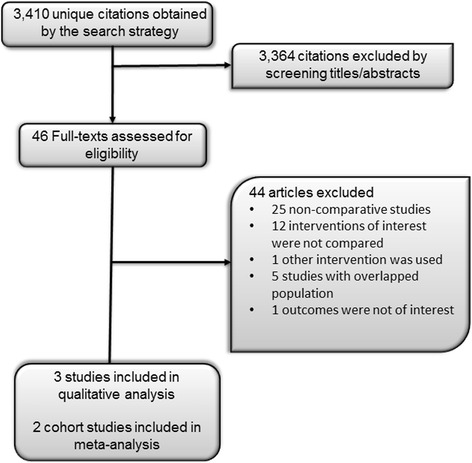
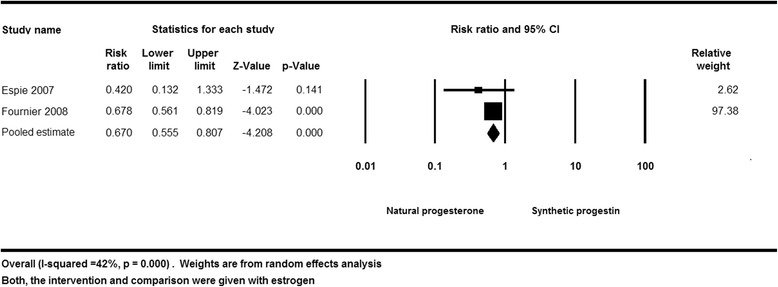
BACKGROUND: Use of menopausal hormonal therapy (MHT)-containing estrogen and a synthetic progestin is associated with an increased risk of breast cancer. It is unclear if progesterone in combination with estrogen carries a lower risk of breast cancer. Limited data suggest differences between progesterone and progestins on cardiovascular risk factors, including cholesterol and glucose metabolism. Whether this translates to differences in cardiovascular outcomes is uncertain. We conducted a systematic review and meta-analysis to synthesize the existing evidence about the effect of progesterone in comparison to synthetic progestins, each in combination with estrogens, on the risk of breast cancer and cardiovascular events. METHODS: We searched MEDLINE, EMBASE, Cochrane Central Register of Controlled Trials, and Scopus through 17 May 2016 for studies that enrolled postmenopausal women using progesterone vs. synthetic progestins and reported the outcomes of interest. Study selection and data extraction were performed by two independent reviewers. Meta-analysis was conducted using the random effects model. RESULTS: We included two cohort studies and one population-based case-control study out of 3410 citations identified by the search. The included studies enrolled 86,881 postmenopausal women with mean age of 59 years and follow-up range from 3 to 20 years. The overall risk of bias of the included cohort studies in the meta-analysis was moderate. There was no data on cardiovascular events. Progesterone was associated with lower breast cancer risk compared to synthetic progestins when each is given in combination with estrogen, relative risk 0.67; 95 % confidence interval 0.55-0.81. CONCLUSIONS: Observational studies suggest that in menopausal women, estrogen and progesterone use may be associated with lower breast cancer risk compared to synthetic progestin.
Overview
The claims and statistics of this paper haven’t been checked yet.
Free: it reads the open-access text and checks the first 5 claims that cite a source we can check. Create a free account to check every claim.
Integrity signals
Registry
Cites
Statistics
Figures
Verification
Claims the paper makes
The claims and statistics of this paper haven’t been checked yet.
Free: it reads the open-access text and checks the first 5 claims that cite a source we can check. Create a free account to check every claim.
Claims other papers make about this one
Each is checked against this paper’s own text: does it say what the citing paper says it does?
The source backs part of the claim, not all of it — or backs it for a different population, condition or comparison.
In the citing paper
“As mentioned above, although long-term use of progestins is associated with a small increase in the risk of breast cancer, the use of progesterone seems to be free of that risk [16,17].”
From HRT in Women Undergoing Pelvic Clearance for Endometriosis—A Case Report and a National Survey (2023) · cites this paper as [17]
Experimental — accuracy not yet measuredThe source backs part of the claim, not all of it — or backs it for a different population, condition or comparison.
In the citing paper
“However, current evidence suggests that the use of progesterone with oestrogen is not associated with any long-term increase in breast cancer risk, while the use of progestins carries 16–69% increased risk (depending on the type of progestin) compared with HRT never-use [16,17].”
From HRT in Women Undergoing Pelvic Clearance for Endometriosis—A Case Report and a National Survey (2023) · cites this paper as [17]
Experimental — accuracy not yet measured
Self-check
Percentages, sums and reported differences re-computed from the paper’s own numbers.
The self-check needs the paper’s full text.
Citations
Cites
(2014) · Medical Entomology and Zoology · Cited by 17,633
Writing Group for the Women's Health Initiative Investigators (2002) · JAMA: The Journal of the American Medical Association · doi:10.1001/jama.288.3.321 · Cited by 15,889
Reprint—Preferred Reporting Items for Systematic Reviews and Meta-Analyses: The PRISMA Statement
Moher, D., Liberati, A., Tetzlaff, J., Altman, D. G., & and the PRISMA Group (2009) · Physical Therapy · doi:10.1093/ptj/89.9.873 · Cited by 2,486 · cited 1×
“Items for Systematic Reviews and Meta-analysis (PRISMA) [13] statement for reporting this review as shown in”
Chlebowski, R. T., Hendrix, S. L., Langer, R. D., Stefanick, M. L., Gass, M., Lane, D., Rodabough, R. J., Gilligan, M. A., Cyr, M. G., Thomson, C. A., et al. (2003) · JAMA · doi:10.1001/jama.289.24.3243 · Cited by 1,872
Fournier, A., Berrino, F., & Clavel-Chapelon, F. (2007) · Breast Cancer Research and Treatment · doi:10.1007/s10549-007-9523-x · Cited by 693 · cited 5×
“Go to: with no difference between various progestins [8].”
InfluentialProgesterone receptor modulates ERα action in breast cancer
Mohammed, H., Russell, I. A., Stark, R., Rueda, O. M., Hickey, T. E., Tarulli, G. A., Serandour, A. A., Birrell, S. N., Bruna, A., Saadi, A., et al. (2015) · Nature · doi:10.1038/nature14583 · Cited by 659
Stanczyk, F. Z., Hapgood, J. P., Winer, S., & Mishell, D. R. (2013) · Endocrine Reviews · doi:10.1210/er.2012-1008 · Cited by 429 · cited 1×
“The biochemistry, metabolism, and both beneficial and harmful effects of the various synthetic progestins differ widely from native progesterone and from each other [3].”
Anderson, G. L., Chlebowski, R. T., Aragaki, A. K., Kuller, L. H., Manson, J. E., Gass, M., Bluhm, E., Connelly, S., Hubbell, F. A., Lane, D., et al. (2012) · The Lancet Oncology · doi:10.1016/s1470-2045(12)70075-x · Cited by 364 · cited 1×
“In fact, CEE alone was associated with a lower risk of breast cancer than placebo after 11 years of observation [20].”
Swiglo, B. A., Murad, M. H., Schünemann, H. J., Kunz, R., Vigersky, R. A., Guyatt, G. H., & Montori, V. M. (2008) · The Journal of Clinical Endocrinology & Metabolism · doi:10.1210/jc.2007-1907 · Cited by 302 · cited 1×
“of Recommendations Assessment, Development and Evaluation (GRADE) [15] methods.”
Self-citationHealth, N. I. O. (2005) · doi:10.7326/0003-4819-142-12_part_1-200506210-00117 · Cited by 290
Cited by
Items 101–121 of 121
Safety and Efficacy of Bioidentical Hormone Therapy in Menopause: A Literature Review
Akre, K. (2021) · Cornerstone (Minnesota State University, Mankato)
Menopause – ein Organ verabschiedet sich
Krug, M. (2022) · Erfahrungsheilkunde · doi:10.1055/a-1718-1360
Bazán-Steffens, C., & González, Ó. C. (2023) · Revista chilena de obstetricia y ginecología · doi:10.24875/rechog.22000059
Jain, G. K., Sharma, J., Modi, N., Kothari, T., Hassan, N., Sharma, N., & Kesharwani, P. (2023) · INTERNATIONAL JOURNAL OF SCIENTIFIC RESEARCH · doi:10.36106/ijsr/4310675
Eduardo, M. B., Keller, I., Schuster, N., Aebi, S. P., & Jaggi, R. B. (2023) · Figshare · doi:10.6084/m9.figshare.23902893
Hereditary Gynecologic Cancer Predisposition Syndromes
Daniels, M. S., Nebgen, D. R., & Ryan, N. A. J. (2024) · Cambridge University Press eBooks · doi:10.1017/9781009279864.003
Weimer, A. K. (2024) · Springer eBooks · doi:10.1007/978-3-031-69997-9_3
Menopausal Hormone Therapy and Prevention of Chronic Disease
Mauvais‐Jarvis, F., & Lovre, D. (2025) · Springer eBooks · doi:10.1007/978-3-031-89650-7_3
Current Concepts in Menopausal Hormone Therapy and Breast Cancer
Kling, J. M., & Pederson, H. J. (2025) · Springer eBooks · doi:10.1007/978-3-031-89650-7_9 · Cited by 1
Bustamante Eduardo, M., Keller, I., Schuster, N., Aebi, S., & Jaggi, R. B. (2023) · Figshare · doi:10.6084/m9.figshare.23902890
Terapia hormonal na pós-menopausa e risco de cancro da mama e ginecológico
Silva, A. F., Castro, A. C., Figueiredo, C. J., & Santos, E. D. (2023) · Portuguese National Funding Agency for Science, Research and Technology (RCAAP Project by FCT)
Tavčar Kunstič, T. (2023) · Repository of the University of Ljubljana (University of Ljubljana)
Hormone replacement therapy—Estrogens + progestogens
Roni, M. A. (2026) · Elsevier eBooks · doi:10.1016/b978-0-443-44037-3.00001-4
Meeta, M., Tanvir, T., & Madan, A. (2026) · Springer eBooks · doi:10.1007/978-981-95-7498-8_16
Management of Menopausal Symptoms
James, L. (2026) · Cambridge University Press eBooks · doi:10.1017/9781009689489.010
Devabhaktuni, P., Yelamanchi, S. D., & Singh, M. (2026) · International Journal of Reproduction Contraception Obstetrics and Gynecology · doi:10.18203/2320-1770.ijrcog20261480
Nelis, M., & Chichura, A. M. (2026) · O&G Open · doi:10.1097/og9.0000000000000172
“71,72 Systemic hormones should be used with extreme caution in this population and may be considered only after nonhormonal options are exhausted and in consultation with the patient ’ s oncologist.”
Orrange, S., Guttentag, A., Nguyen, A., & Currid‐Halkett, E. (2026) · Journal of Women s Health · doi:10.1177/15409996261465480
“40,41 Persistent anxiety about harm re fl ects a broader communication gap rather than scienti fi c uncertainty, emphasizing the need for risk framing that is contextual, personalized, and culturally sensitive.”
Postmenopausal endometriosis: current evidence and clinical challenges in diagnosis and treatment
Lalla, A., Kohn, J. R., Pasternak, D., & Guan, X. (2026) · Current Opinion in Obstetrics & Gynecology · doi:10.1097/gco.0000000000001127
Sitorus, F. L. A. M., Gusmira, A., Purnamasari, H. Y., Nasrulnugroho, D., Balamantri, R., Khayrani, A. C., Elya, B., Mun’im, A., & Setiawan, H. (2026) · Journal of Applied Pharmaceutical Science · doi:10.1177/22313354261485410
Metadata
- Authors
- Asi, N., Mohammed, K., Haydour, Q., Gionfriddo, M. R., Vargas, O. L. M., Prokop, L. J., Faubion, S. S., & Murad, M. H.
- Affiliations
- Mayo Clinic (US)
- Corresponding author
- Asi, Noor
- ORCID
- Venue
- Systematic Reviews
- Published
- 2016-07-26
- Volume
- 5
- Issue
- 1
- Pages
- 121-121
- ISSN
- 2046-4053 (ISSN-L)
- PMC
- PMC4960754
- OpenAlex
- W2483993775
- Cited by
- 114
- References
- 26
- Citations by year
- 2026: 14 · 2025: 7 · 2024: 11 · 2023: 12 · 2022: 15 · 2021: 12 · 2020: 9 · 2019: 11 · 2018: 13 · 2017: 8 · 2016: 1
- FWCI
- 1.62
- Type
- journal article
- Language
- en
- Open access
- gold
- doi.org
- Licence
- cc-by
- Locations
- Systematic Reviews (publishedVersion, cc-by)
- PubMed Central (publishedVersion, cc-by)
- PubMed (publishedVersion)
- Funders
- Endocrine Society (US)
- Topics
- Health Sciences › Medicine › Endocrinology, Diabetes and Metabolism › Menopause: Health Impacts and Treatments
- Life Sciences › Biochemistry, Genetics and Molecular Biology › Endocrinology › Estrogen and related hormone effects
- Life Sciences › Biochemistry, Genetics and Molecular Biology › Cancer Research › Breast Cancer Treatment Studies
- Keywords
- progesterone, synthetic progestins, hormone replacement therapy, breast cancer risk, estrogen-progestin combination, postmenopausal women, cardiovascular events, cholesterol, glucose metabolism
- MeSH terms
- Breast Neoplasms, Cardiovascular Diseases, Female, Humans, Progestins, Progesterone, Risk Factors, Estrogen Replacement Therapy, Progesterone Congeners, Observational Studies as Topic
About these checks
Registry, retraction, Cites and statistics results are computed, not judged, with one exception: a printed reference that no index lists is read once by a model before it counts as a citation error. Claims are extracted by a model and kept only when their quote appears verbatim in the text; each cited source is then checked, with a model’s help, for whether it says what the claim relies on. Those verdicts can be wrong — read the claim’s quote and the cited source before relying on one.
Statistics and arithmetic are recomputed, not judged.
Confidence bands are shown only for fields calibrated on our annotated test set. None is calibrated yet, so no band is shown.
What counts as a claim ›How we measure confidence ›How we check this ›
Are you an author, or do you see a problem with this page? Request a review
Data sources
Bibliographic data: Semantic Scholar, OpenAlex, Crossref.
Contains information from the Semantic Scholar Academic Graph Datasets, made available under the ODC Attribution License (ODC-BY 1.0).
Semantic Scholar’s data is described in: Kinney, R., et al. (2023). The Semantic Scholar Open Data Platform. arXiv:2301.10140.
