

Progesterone vs. synthetic progestins and the risk of breast cancer: a systematic review and meta-analysis
Open accessThe DOI matches its Crossref record; 26 of the 26 references it cites were found in a registry or an index.
Abstract
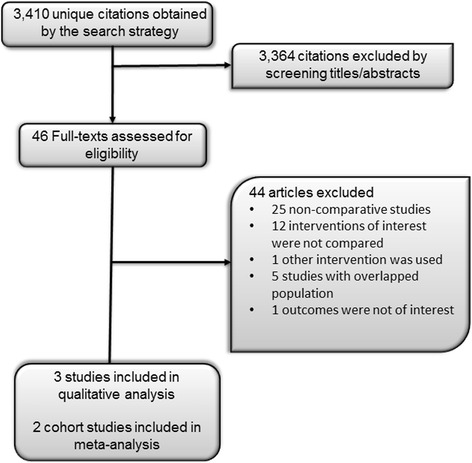
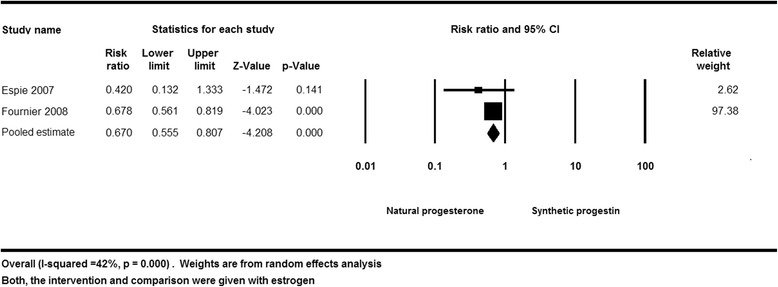
BACKGROUND: Use of menopausal hormonal therapy (MHT)-containing estrogen and a synthetic progestin is associated with an increased risk of breast cancer. It is unclear if progesterone in combination with estrogen carries a lower risk of breast cancer. Limited data suggest differences between progesterone and progestins on cardiovascular risk factors, including cholesterol and glucose metabolism. Whether this translates to differences in cardiovascular outcomes is uncertain. We conducted a systematic review and meta-analysis to synthesize the existing evidence about the effect of progesterone in comparison to synthetic progestins, each in combination with estrogens, on the risk of breast cancer and cardiovascular events. METHODS: We searched MEDLINE, EMBASE, Cochrane Central Register of Controlled Trials, and Scopus through 17 May 2016 for studies that enrolled postmenopausal women using progesterone vs. synthetic progestins and reported the outcomes of interest. Study selection and data extraction were performed by two independent reviewers. Meta-analysis was conducted using the random effects model. RESULTS: We included two cohort studies and one population-based case-control study out of 3410 citations identified by the search. The included studies enrolled 86,881 postmenopausal women with mean age of 59 years and follow-up range from 3 to 20 years. The overall risk of bias of the included cohort studies in the meta-analysis was moderate. There was no data on cardiovascular events. Progesterone was associated with lower breast cancer risk compared to synthetic progestins when each is given in combination with estrogen, relative risk 0.67; 95 % confidence interval 0.55-0.81. CONCLUSIONS: Observational studies suggest that in menopausal women, estrogen and progesterone use may be associated with lower breast cancer risk compared to synthetic progestin.
Overview
The claims and statistics of this paper haven’t been checked yet.
Free: it reads the open-access text and checks the first 5 claims that cite a source we can check. Create a free account to check every claim.
Integrity signals
Registry
Cites
Statistics
Figures
Verification
Claims the paper makes
The claims and statistics of this paper haven’t been checked yet.
Free: it reads the open-access text and checks the first 5 claims that cite a source we can check. Create a free account to check every claim.
Claims other papers make about this one
Each is checked against this paper’s own text: does it say what the citing paper says it does?
The source backs part of the claim, not all of it — or backs it for a different population, condition or comparison.
In the citing paper
“As mentioned above, although long-term use of progestins is associated with a small increase in the risk of breast cancer, the use of progesterone seems to be free of that risk [16,17].”
From HRT in Women Undergoing Pelvic Clearance for Endometriosis—A Case Report and a National Survey (2023) · cites this paper as [17]
Experimental — accuracy not yet measuredThe source backs part of the claim, not all of it — or backs it for a different population, condition or comparison.
In the citing paper
“However, current evidence suggests that the use of progesterone with oestrogen is not associated with any long-term increase in breast cancer risk, while the use of progestins carries 16–69% increased risk (depending on the type of progestin) compared with HRT never-use [16,17].”
From HRT in Women Undergoing Pelvic Clearance for Endometriosis—A Case Report and a National Survey (2023) · cites this paper as [17]
Experimental — accuracy not yet measured
Self-check
Percentages, sums and reported differences re-computed from the paper’s own numbers.
The self-check needs the paper’s full text.
Citations
Cites
(2014) · Medical Entomology and Zoology · Cited by 17,633
Writing Group for the Women's Health Initiative Investigators (2002) · JAMA: The Journal of the American Medical Association · doi:10.1001/jama.288.3.321 · Cited by 15,889
Reprint—Preferred Reporting Items for Systematic Reviews and Meta-Analyses: The PRISMA Statement
Moher, D., Liberati, A., Tetzlaff, J., Altman, D. G., & and the PRISMA Group (2009) · Physical Therapy · doi:10.1093/ptj/89.9.873 · Cited by 2,486 · cited 1×
“Items for Systematic Reviews and Meta-analysis (PRISMA) [13] statement for reporting this review as shown in”
Chlebowski, R. T., Hendrix, S. L., Langer, R. D., Stefanick, M. L., Gass, M., Lane, D., Rodabough, R. J., Gilligan, M. A., Cyr, M. G., Thomson, C. A., et al. (2003) · JAMA · doi:10.1001/jama.289.24.3243 · Cited by 1,872
Fournier, A., Berrino, F., & Clavel-Chapelon, F. (2007) · Breast Cancer Research and Treatment · doi:10.1007/s10549-007-9523-x · Cited by 693 · cited 5×
“Go to: with no difference between various progestins [8].”
InfluentialProgesterone receptor modulates ERα action in breast cancer
Mohammed, H., Russell, I. A., Stark, R., Rueda, O. M., Hickey, T. E., Tarulli, G. A., Serandour, A. A., Birrell, S. N., Bruna, A., Saadi, A., et al. (2015) · Nature · doi:10.1038/nature14583 · Cited by 659
Stanczyk, F. Z., Hapgood, J. P., Winer, S., & Mishell, D. R. (2013) · Endocrine Reviews · doi:10.1210/er.2012-1008 · Cited by 429 · cited 1×
“The biochemistry, metabolism, and both beneficial and harmful effects of the various synthetic progestins differ widely from native progesterone and from each other [3].”
Anderson, G. L., Chlebowski, R. T., Aragaki, A. K., Kuller, L. H., Manson, J. E., Gass, M., Bluhm, E., Connelly, S., Hubbell, F. A., Lane, D., et al. (2012) · The Lancet Oncology · doi:10.1016/s1470-2045(12)70075-x · Cited by 364 · cited 1×
“In fact, CEE alone was associated with a lower risk of breast cancer than placebo after 11 years of observation [20].”
Swiglo, B. A., Murad, M. H., Schünemann, H. J., Kunz, R., Vigersky, R. A., Guyatt, G. H., & Montori, V. M. (2008) · The Journal of Clinical Endocrinology & Metabolism · doi:10.1210/jc.2007-1907 · Cited by 302 · cited 1×
“of Recommendations Assessment, Development and Evaluation (GRADE) [15] methods.”
Self-citationHealth, N. I. O. (2005) · doi:10.7326/0003-4819-142-12_part_1-200506210-00117 · Cited by 290
Breast Cancer Risk in Postmenopausal Women Using Estradiol–Progestogen Therapy
Lyytinen, H., Pukkala, E., & Ylikorkala, O. (2009) · Obstetrics & Gynecology · doi:10.1097/aog.0b013e31818e8cd6 · Cited by 199
Cordina-Duverger, E., Truong, T., Anger, A., Sanchez, M., Arveux, P., Kerbrat, P., & Guénel, P. (2013) · PLoS ONE · doi:10.1371/journal.pone.0078016 · Cited by 141 · cited 1×
“2013 [17] 1555 postmenopausal woman, 739 cases treated with combined estrogen and progestagen.”
Prescribing menopausal hormone therapy: an evidence-based approach
Sood, R., Faubion, S., Kuhle, C., Thielen, J., & Shuster, L. (2014) · International Journal of Women's Health · doi:10.2147/ijwh.s38342 · Cited by 106 · cited 1×
“risk of breast cancer [6], the risk of breast cancer may differ depending on the type of MHT used.”
Self-citationFiles, J. A., Ko, M. G., & Pruthi, S. (2011) · Mayo Clinic Proceedings · doi:10.4065/mcp.2010.0714 · Cited by 77
Courtin, A., Communal, L., Vilasco, M., Cimino, D., Mourra, N., Bortoli, M. D., Taverna, D., Faussat, A., Chaouat, M., Forgez, P., et al. (2011) · Breast Cancer Research and Treatment · doi:10.1007/s10549-011-1394-5 · Cited by 67 · cited 1×
“These compounds mimic some of the effects of progesterone but may have different actions on progesterone receptors [4].”
The levonorgestrel intrauterine system for use in peri- and postmenopausal women
Sitruk-Ware, R. L. (2007) · Contraception · doi:10.1016/j.contraception.2007.01.010 · Cited by 60 · cited 1×
“While the levonorgestrel intrauterine system has been shown to be adequate for endometrial protection [18], it is not currently approved by the US FDA for this indication.”
Risk of breast cancer with progestins: critical assessment of current data
Santen, R. J. (2003) · Steroids · doi:10.1016/s0039-128x(03)00138-7 · Cited by 59 · cited 1×
“The effects of progesterone have been shown to be growth-promoting, neutral, or anti-proliferative in breast cells, whereas in women, synthetic progestins, especially the combination of CEE and MPA, have been found to be growth-promoting [9].”
Prior, J. C., Elliott, T. G., Norman, E. G., Stajic, V., & Hitchcock, C. L. (2014) · PLoS ONE · doi:10.1371/journal.pone.0084698 · Cited by 55 · cited 1×
“Although HDL-C was decreased on treatment, the change was not believed to be clinically relevant [12].”
Espié, M., Daures, J.-P., Chevallier, T., Mares, P., Micheletti, M.-C., & de Reilhac, P. (2007) · Gynecological Endocrinology · doi:10.1080/09513590701382104 · Cited by 50 · cited 6×
“31) in Espie [16], whereas Fournier [8] showed a RR 0.”
InfluentialFournier, A., Berrino, F., & Clavel‐Chapelon, F. (2007) · Breast Cancer Research and Treatment · doi:10.1007/s10549-007-9604-x · Cited by 43
Menopausal hormone therapy and breast cancer
Santen, R. J. (2014) · The Journal of Steroid Biochemistry and Molecular Biology · doi:10.1016/j.jsbmb.2013.06.010 · Cited by 41 · cited 1×
“While an additional study is needed to confirm these results, data suggest lower risk of breast cancer with progesterone and dydrogesterone and do not support a class effect of progestins on breast cancer risk [24].”
Progestogens in postmenopausal hormone therapy and the risk of breast cancer
Lambrinoudaki, I. V. (2014) · Maturitas · doi:10.1016/j.maturitas.2014.01.001 · Cited by 31 · cited 1×
“In addition to binding to progesterone receptors, these compounds may also have an affinity for androgen, glucocorticoid, and mineralocorticoid receptors [5].”
Cardiovascular risk markers during treatment with estradiol and trimegestone or dydrogesterone
Hellgren, M., Conard, J., Norris, L., & Kluft, C. (2009) · Maturitas · doi:10.1016/j.maturitas.2009.01.004 · Cited by 27 · cited 1×
“Progesterone and synthetic progestins also demonstrate varied effects on lipids, coagulation factors, glucose, and insulin and may therefore differentially impact cardiovascular risk, though data are sparse [11].”
Espié, M., Marès, P., Reilhac, P. D., Chevallier, T., & Daurès, J. (2006) · Gynecological Endocrinology · doi:10.1080/09513590600900386 · Cited by 17
Lyytinen, H. K., Dyba, T. A., Pukkala, ., & Ylikorkala, O. (2009) · International Journal of Cancer · doi:10.1002/ijc.24996 · Cited by 13
A CASE-CONTROL STUDY ON HORMONE THERAPY AS A RISK FACTOR FOR BREAST CANCER IN FINLAND
Lyytinen, H. K., Dyba, T., Ylikorkala, O., & Pukkala, E. (2009) · Maturitas · doi:10.1016/s0378-5122(09)70190-2 · Cited by 4
Cited by
Clinical practice guidelines for the care of girls and women with Turner syndrome.
Gravholt, C. H., Andersen, N. H., Christin-Maitre, S., Davis, S. M., Duijnhouwer, A., Gawlik, A., Maciel-Guerra, A. T., Gutmark-Little, I., Fleischer, K., Hong, D., et al. (2024) · European Journal of Endocrinology · doi:10.1093/ejendo/lvae050 · Cited by 224
Hilton, H. N., Clarke, C. L., & Graham, J. D. (2017) · Molecular and Cellular Endocrinology · doi:10.1016/j.mce.2017.08.011 · Cited by 189
“Moreover, the use of HRT and oral contraceptives (and particularly when synthetic progestins are included in these formulations (Asi et al., 2016; Li et al., 2012) is associated with a higher risk of breast c ncer, directly implicating exogenous M AN US CR IP T AC CE PT ED 12 hormone use in the…”
BackgroundSignaling pathways and steroid receptors modulating estrogen receptor α function in breast cancer
Siersbæk, R., Kumar, S. S., & Carroll, J. S. (2018) · Genes & Development · doi:10.1101/gad.316646.118 · Cited by 157
“…patients, certain specific progestogens have been shown to increase breast cancer incidence in healthy women (Hankinson et al. 2004; Chlebowski et al. 2013; Asi et al. 2016), although, importantly, this is not associated with longterm increased risk of all-cause mortality (Manson et al. 2017).”
BackgroundDeciphering the divergent roles of progestogens in breast cancer
Carroll, J. S., Hickey, T. E., Tarulli, G. A., Williams, M. R., & Tilley, W. D. (2016) · Nature reviews. Cancer · doi:10.1038/nrc.2016.116 · Cited by 148
Menopause-associated risk of cardiovascular disease
Anagnostis, P. G., Lambrinoudaki, I. V., Stevenson, J. C., & Goulis, D. G. (2022) · Endocrine Connections · doi:10.1530/ec-21-0537 · Cited by 138
Metadata
- Authors
- Asi, N., Mohammed, K., Haydour, Q., Gionfriddo, M. R., Vargas, O. L. M., Prokop, L. J., Faubion, S. S., & Murad, M. H.
- Affiliations
- Mayo Clinic (US)
- Corresponding author
- Asi, Noor
- ORCID
- Venue
- Systematic Reviews
- Published
- 2016-07-26
- Volume
- 5
- Issue
- 1
- Pages
- 121-121
- ISSN
- 2046-4053 (ISSN-L)
- PMC
- PMC4960754
- OpenAlex
- W2483993775
- Cited by
- 114
- References
- 26
- Citations by year
- 2026: 14 · 2025: 7 · 2024: 11 · 2023: 12 · 2022: 15 · 2021: 12 · 2020: 9 · 2019: 11 · 2018: 13 · 2017: 8 · 2016: 1
- FWCI
- 1.62
- Type
- journal article
- Language
- en
- Open access
- gold
- doi.org
- Licence
- cc-by
- Locations
- Systematic Reviews (publishedVersion, cc-by)
- PubMed Central (publishedVersion, cc-by)
- PubMed (publishedVersion)
- Funders
- Endocrine Society (US)
- Topics
- Health Sciences › Medicine › Endocrinology, Diabetes and Metabolism › Menopause: Health Impacts and Treatments
- Life Sciences › Biochemistry, Genetics and Molecular Biology › Endocrinology › Estrogen and related hormone effects
- Life Sciences › Biochemistry, Genetics and Molecular Biology › Cancer Research › Breast Cancer Treatment Studies
- Keywords
- progesterone, synthetic progestins, hormone replacement therapy, breast cancer risk, estrogen-progestin combination, postmenopausal women, cardiovascular events, cholesterol, glucose metabolism
- MeSH terms
- Breast Neoplasms, Cardiovascular Diseases, Female, Humans, Progestins, Progesterone, Risk Factors, Estrogen Replacement Therapy, Progesterone Congeners, Observational Studies as Topic
About these checks
Registry, retraction, Cites and statistics results are computed, not judged, with one exception: a printed reference that no index lists is read once by a model before it counts as a citation error. Claims are extracted by a model and kept only when their quote appears verbatim in the text; each cited source is then checked, with a model’s help, for whether it says what the claim relies on. Those verdicts can be wrong — read the claim’s quote and the cited source before relying on one.
Statistics and arithmetic are recomputed, not judged.
Confidence bands are shown only for fields calibrated on our annotated test set. None is calibrated yet, so no band is shown.
What counts as a claim ›How we measure confidence ›How we check this ›
Are you an author, or do you see a problem with this page? Request a review
Data sources
Bibliographic data: Semantic Scholar, OpenAlex, Crossref.
Contains information from the Semantic Scholar Academic Graph Datasets, made available under the ODC Attribution License (ODC-BY 1.0).
Semantic Scholar’s data is described in: Kinney, R., et al. (2023). The Semantic Scholar Open Data Platform. arXiv:2301.10140.
