

Use of cost-effectiveness analysis to compare the efficiency of study identification methods in systematic reviews
Open accessThe DOI matches its Crossref record; 36 of the 38 references it cites were found in a registry or an index.
Abstract
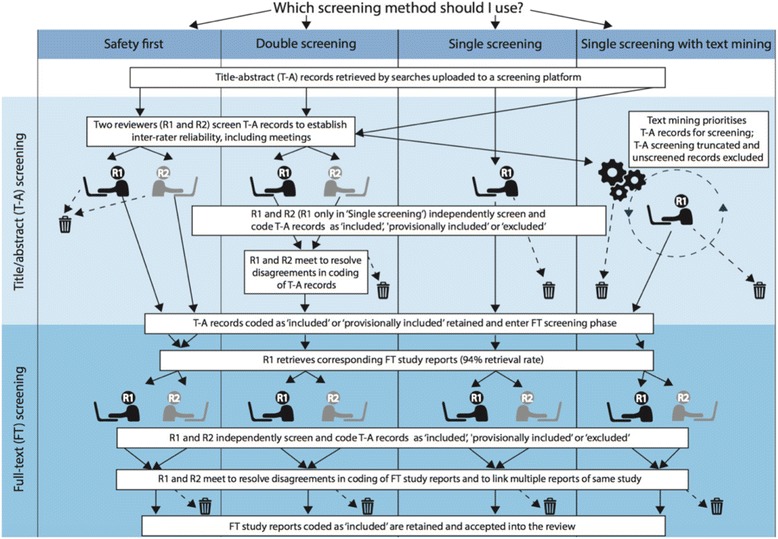
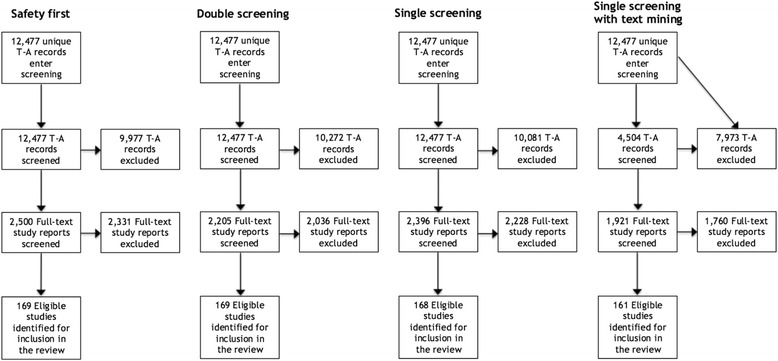
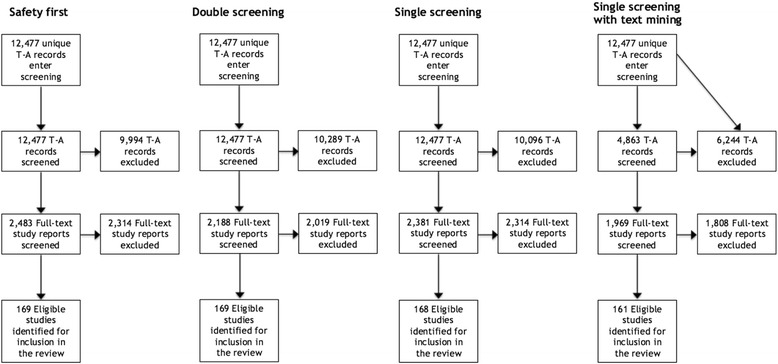
BACKGROUND: Meta-research studies investigating methods, systems, and processes designed to improve the efficiency of systematic review workflows can contribute to building an evidence base that can help to increase value and reduce waste in research. This study demonstrates the use of an economic evaluation framework to compare the costs and effects of four variant approaches to identifying eligible studies for consideration in systematic reviews. METHODS: A cost-effectiveness analysis was conducted using a basic decision-analytic model, to compare the relative efficiency of 'safety first', 'double screening', 'single screening' and 'single screening with text mining' approaches in the title-abstract screening stage of a 'case study' systematic review about undergraduate medical education in UK general practice settings. Incremental cost-effectiveness ratios (ICERs) were calculated as the 'incremental cost per citation 'saved' from inappropriate exclusion' from the review. Resource use and effect parameters were estimated based on retrospective analysis of 'review process' meta-data curated alongside the 'case study' review, in conjunction with retrospective simulation studies to model the integrated use of text mining. Unit cost parameters were estimated based on the 'case study' review's project budget. A base case analysis was conducted, with deterministic sensitivity analyses to investigate the impact of variations in values of key parameters. RESULTS: Use of 'single screening with text mining' would have resulted in title-abstract screening workload reductions (base case analysis) of >60 % compared with other approaches. Across modelled scenarios, the 'safety first' approach was, consistently, equally effective and less costly than conventional 'double screening'. Compared with 'single screening with text mining', estimated ICERs for the two non-dominated approaches (base case analyses) ranged from £1975 ('single screening' without a 'provisionally included' code) to £4427 ('safety first' with a 'provisionally included' code) per citation 'saved'. Patterns of results were consistent between base case and sensitivity analyses. CONCLUSIONS: Alternatives to the conventional 'double screening' approach, integrating text mining, warrant further consideration as potentially more efficient approaches to identifying eligible studies for systematic reviews. Comparable economic evaluations conducted using other systematic review datasets are needed to determine the generalisability of these findings and to build an evidence base to inform guidance for review authors.
Overview
The claims and statistics of this paper haven’t been checked yet.
Free: it reads the open-access text and checks the first 5 claims that cite a source we can check. Create a free account to check every claim.
Integrity signals
Registry
Cites
Statistics
Figures
Verification
Claims the paper makes
The claims and statistics of this paper haven’t been checked yet.
Free: it reads the open-access text and checks the first 5 claims that cite a source we can check. Create a free account to check every claim.
Claims other papers make about this one
Each is checked against this paper’s own text: does it say what the citing paper says it does?
The cited source doesn’t support the claim as written.
In the citing paper
“The estimated costs are also considerable: amounting to £13 000 for a single review.7”
From Prioritising references for systematic reviews with RobotAnalyst: A user study (2018) · cites this paper as [7]
Checked by a reasoning model — may be wrong.
Experimental — accuracy not yet measuredThe source backs part of the claim, not all of it — or backs it for a different population, condition or comparison.
In the citing paper
“this would increase the total hours saved by not having to access and screen the 5% of title/abstract false negatives”
From An evaluation of DistillerSR’s machine learning-based prioritization tool for title/abstract screening – impact on reviewer-relevant outcomes (2020) · cites this paper as [11]
Experimental — accuracy not yet measuredThe source backs part of the claim, not all of it — or backs it for a different population, condition or comparison.
In the citing paper
“A significant impact on both the total cost of a review and the time required to produce a review can be achieved with even small increases in precision [33,46,78].”
From Automation of systematic literature reviews: A systematic literature review (2021) · cites this paper as [78]
Experimental — accuracy not yet measuredThe source backs part of the claim, not all of it — or backs it for a different population, condition or comparison.
In the citing paper
“A common estimate for the time taken to screen a title-abstract record is a minute (Shemilt et al., 2016).”
From SYMBALS: A Systematic Review Methodology Blending Active Learning and Snowballing (2021) · cites this paper as Shemilt et al., 2016
Experimental — accuracy not yet measuredThe cited source says what the claim attributes to it.
In the citing paper
“the balance between efficiency gains and risk tolerance will be review-specific52 53”
From PRISMA 2020 explanation and elaboration: updated guidance and exemplars for reporting systematic reviews (2021) · cites this paper as [52]
10 more claims about this paper
Create a free account to see every claim other papers make about this one.
Self-check
Percentages, sums and reported differences re-computed from the paper’s own numbers.
The self-check needs the paper’s full text.
Citations
Cites
Preferred Reporting Items for Systematic Reviews and Meta-Analyses: the PRISMA statement
Moher, D., Liberati, A., Tetzlaff, J., Altman, D. G., & for the PRISMA Group (2009) · BMJ · doi:10.1136/bmj.b2535 · Cited by 83,823
Preferred Reporting Items for Systematic Reviews and Meta-Analyses: The PRISMA Statement
Moher, D., Liberati, A., Tetzlaff, J., Altman, D. G., & The PRISMA Group (2009) · PLoS Medicine · doi:10.1371/journal.pmed.1000097 · Cited by 64,042
Preferred reporting items for systematic reviews and meta-analyses: the PRISMA Statement.
(2009) · PubMed Central · Cited by 44,859
Wang, G., Ma, R., Qiao, G., Wada, K., Aizawa, Y., & Satoh, T. (2015) · Integrative Medicine International · doi:10.1159/000368408 · Cited by 18,657
Methods for the Economic Evaluation of Health Care Programmes
Drummond, M. E., Sculpher, M. J., Torrance, G. W., O’Brien, B. J., & Stoddart, G. L. (2005) · doi:10.1093/oso/9780198529446.001.0001 · Cited by 13,648
Methods for the economic evaluation of health care programmes
Wilson, S. H. (1987) · Journal of Epidemiology and Community Health · doi:10.1136/jech.41.4.355-a · Cited by 4,275
Greenhalgh, T., & Peacock, R. (2005) · BMJ · doi:10.1136/bmj.38636.593461.68 · Cited by 2,045
Consolidated Health Economic Evaluation Reporting Standards (CHEERS) statement
Husereau, D., Drummond, M., Petrou, S., Carswell, C., Moher, D., Greenberg, D., Augustovski, F., Briggs, A. H., Mauskopf, J., Loder, E., et al. (2013) · BMJ · doi:10.1136/bmj.f1049 · Cited by 1,776
Increasing value and reducing waste in research design, conduct, and analysis
Ioannidis, J. P. A., Greenland, S., Hlatky, M. A., Khoury, M. J., Macleod, M. R., Moher, D., Schulz, K. F., & Tibshirani, R. (2014) · The Lancet · doi:10.1016/s0140-6736(13)62227-8 · Cited by 1,597
Reducing waste from incomplete or unusable reports of biomedical research
Glasziou, P., Altman, D. G., Bossuyt, P., Boutron, I., Clarke, M., Julious, S., Michie, S., Moher, D., & Wager, E. (2014) · The Lancet · doi:10.1016/s0140-6736(13)62228-x · Cited by 1,319
Research works printed but not linked: 3
- Higgins JPT, Deeks JJ, editors. Chapter 7: Selecting studies and collecting data. In: Higgins JPT, Green S, editors. Cochrane Handbook for Systematic Reviews of Interventions, Version 5.1.0 [updated March 2011]. http://handbook.cochrane.org. Accessed 1 July 2016.
- Cochrane methodology reviews. Cochrane Methodology Review Group. 2016. http://methodology.cochrane.org. Accessed 1 July 2016.
- Thomas J Brunton J Graziosi S EPPI-Reviewer 4.0: software for research synthesis 2010 London EPPI-Centre Software, Social Science Research Unit, Institute of Education
Cited by
Items 101–180 of 180
Liu, R., Li, J., Zivkovic, M., & Abbasi, A. (2025) · MIS Quarterly · doi:10.25300/misq/2024/18573 · Cited by 10
“In contrast, for ML-augmented SR, a single screening, where a single expert validates the ML extraction results, is recommended (Shemilt et al., 2016).”
Reducing waste in collection of quality-of-life data through better reporting: a case study
McCreanor, V., Lum, E., Graves, N., Luo, N., Parsonage, W. A., & Barnett, A. G. (2022) · Quality of Life Research · doi:10.1007/s11136-022-03079-1 · Cited by 7
“The rate at which full text documents were retrieved and screened for the “slow” scenario were taken from a cost-effectiveness study of systematic review methods [17].”
MethodStorhaug, I., Lane, C. E., Moore, N., Engelbert, M., Sparling, T. M., Franich, A., Rolker, H. B., & Snilstveit, B. (2022) · BMJ Open · doi:10.1136/bmjopen-2021-055062 · Cited by 7
Li, X., Zhang, A., Al-Zaidy, R. A., Rao, A., Baral, S., Bao, L., & Giles, C. L. (2022) · PLoS ONE · doi:10.1371/journal.pone.0270034 · Cited by 6
Griebler, U., Dobrescu, A., Ledinger, D., Klingenstein, P., Sommer, I., Emprechtinger, R., Persad, E., Gadinger, A., Trivella, M., Klerings, I., et al. (2023) · Research Synthesis Methods · doi:10.1002/jrsm.1656 · Cited by 5
“However, dual screening takes twice as long, 25 and it is, therefore, questionable whether it should be implemented in RR conduct.”
BackgroundLukersmith, S., Woods, C., Sarma, H., de Miquel, C., & Salvador‐Carulla, L. (2025) · Public Health · doi:10.1016/j.puhe.2024.12.056 · Cited by 5
König, L., Zitzmann, S., & Hecht, M. (2025) · Research Synthesis Methods · doi:10.1017/rsm.2025.10053 · Cited by 5
“4,18,24 These tools typically employ an active learning approach—a human-in-the-loop method in which an ML algorithm determines the screening order and continuously updates its predictions based on the decisions of a human reviewer (see Figure 1).”
Silva, G., Neto, P. D. A. D. S., Moura, R. S., Araujo, A. C., Castro, O. C. C., & Ibiapina, I. M. D. S. (2019) · Brazilian Conference on Intelligent Systems · doi:10.1109/bracis.2019.00147 · Cited by 5
“Finally, it cannot be guaranteed that all studies considered relevant have been identified [16].”
BackgroundMacleod, G., Dozier, M., Marvell, R., Matthews‐Smith, G., Macleod, M. R., & Liao, J. (2023) · Oxford Review of Education · doi:10.1080/03054985.2023.2203376 · Cited by 5
“The ML implementation used here hosted on the CAMARADES Systematic Review Facility (SyRF) (Bahor et al., 2021) with API linkage to EPPI-Centre London (Shemilt et al., 2016) provides a score from 0 to 1, along which a threshold can be set to provide the desired sensitivity.”
MethodSalim, S., Yeom, S.-Y., & Ham, D.-H. (2024) · Applied Sciences · doi:10.3390/app14041407 · Cited by 5
“Cost-effectiveness analysis showed that citation screening with text mining reduced more than 60% of the title–abstract screening workload compared with other screening approaches without text mining [53].”
BackgroundNordmann, K., Schaller, M., Sauter, S., & Fischer, F. (2026) · JAMIA Open · doi:10.1093/jamiaopen/ooaf098 · Cited by 4
“13,39 Lastly, ranking the articles according to relevance might influence researchers’ decisions, potentially causing complacency and a tendency to underestimate the importance of articles presented at a later stage.”
Improving Ranking for Systematic Reviews Using Query Adaptation
Alharbi, A., & Stevenson, M. (2019) · Lecture notes in computer science · doi:10.1007/978-3-030-28577-7_9 · Cited by 6
Timely, Efficient, and Living Systematic Reviews: Opportunities in International Development
Snilstveit, B., Stevenson, J., Shemilt, I., Clarke, M. J., Jiménez, E., & Thomas, J. (2018) · doi:10.51744/cip7 · Cited by 6
“In other fields, primarily biomedicine and clinical health, interdisciplinary collaboration between systematic review methodologists, knowledge managers, information scientists and computer scientists have made significant progress in developing approaches which help produce reviews that are both rapid and systematic…”
BackgroundMethodInfluentialSelf-citationFood systems and nutrition: Describing the evidence from 2000 to 2023
(3ie), I. I. F. I. E., Lane, C. E., Storhaug, I., (3ie), I. I. F. I. E., Córdova-Aráuz, D. B., (3ie), I. I. F. I. E., Engelbert, M., (3ie), I. I. F. I. E., Snilstveit, B., (3ie), I. I. F. I. E., et al. (2023) · doi:10.23846/egm025 · Cited by 4
The FAIR database: facilitating access to public health research literature
Zhao, Z., Thomas, J., Kell, G., Stansfield, C., Clowes, M., Graziosi, S., Brunton, J., Marshall, I. J., & Stevenson, M. (2024) · JAMIA Open · doi:10.1093/jamiaopen/ooae139 · Cited by 3
Self-citationSilva, D. T. N. D., Moore, B. R., Strunk, T., Petrovski, M., Varis, V., Chai, K. E. K., Ng, L., & Batty, K. T. (2024) · Pharmacology Research & Perspectives · doi:10.1002/prp2.1170 · Cited by 4
Ruby, E., Brunton, G., Rack, J., Balkhi, S. A., Banfield, L. E., Grenier, L. N., Ghandi, S., Ahmed, M., Hutton, E. K., Darling, E., et al. (2024) · BMJ Open · doi:10.1136/bmjopen-2024-087698 · Cited by 4
Gartlehner, G., Wagner, G., Lux, L. J., Affengruber, L., Dobrescu, A. I., Kaminski-Hartenthaler, A., & Viswanathan, M. (2019) · doi:10.23970/ahrqepcmethmachinedistiller · Cited by 3
Strengthening civil society: an Evidence Gap Map
(3ie), I. I. F. I. E., Berretta, M., Lane, C. E., (3ie), I. I. F. I. E., Garcia, K., (3ie), I. I. F. I. E., Lee, S.-H., (3ie), I. I. F. I. E., Yue, W., (3ie), I. I. F. I. E., et al. (2023) · doi:10.23846/egm022 · Cited by 3
Janoudi, G., Uzun, M., Jurdana, M., Fuzul, E., & Ivkovic, J. (2024) · medRxiv · doi:10.1101/2024.09.06.24313186 · Cited by 3
Sampurna, P. S., Hartati, N., & Mardianto (2026) · IJIP Indonesian Journal of Islamic Psychology · doi:10.18326/ijip.v7i2.5895 · Cited by 2
Challenges in teaching systematic reviews to non-clinicians
Pieper, D., Müller, D., & Stock, S. (2019) · Zeitschrift für Evidenz Fortbildung und Qualität im Gesundheitswesen · doi:10.1016/j.zefq.2019.10.004 · Cited by 3
Rule of Law and Justice: an evidence gap map
(3ie), I. I. F. I. E., Sonnenfeld, A., Kozakiewicz, T., (3ie), I. I. F. I. E., Khan, L., consultant, I., Doherty, J., (3ie), I. I. F. I. E., Garcia, K., (3ie), I. I. F. I. E., et al. (2023) · doi:10.23846/egm019 · Cited by 2
Addressing the systemic causes of malnutrition: The nutrition-sensitive agriculture evidence gap map
(3ie), I. I. F. I. E., Lane, C. E., Storhaug, I., (3ie), I. I. F. I. E., Tree, V., (3ie), I. I. F. I. E., Córdova-Aráuz, D. B., (3ie), I. I. F. I. E., Huang, C. J., (3ie), I. I. F. I. E., et al. (2023) · doi:10.23846/egm024 · Cited by 4
Vembye, M. H., Christensen, J., Bondebjerg, A., & Schytt, F. L. W. (2024) · OSF Preprints (OSF Preprints) · doi:10.31219/osf.io/yrhzm · Cited by 2
Syatriana, E., Syamsuri, A. S., Jones, E., & Ratnawati, R. (2025) · Research Square · doi:10.21203/rs.3.rs-6983381/v1 · Cited by 2
The use of cost analysis in examinations of health coaching interventions: a scoping review protocol
Dougherty, M., Bartels, S. M., Smith, J. G., Zeliadt, S. B., Hyde, J. K., & Kim, B. (2025) · BMJ Open · doi:10.1136/bmjopen-2025-104082 · Cited by 1
Virendrakumar, B., Waddington, H. S., Scheelbeek, P., Jolley, E., & Schmidt, E. (2026) · Systematic Reviews · doi:10.1186/s13643-026-03101-4 · Cited by 1
“Text mining has been shown to support managing the screening of large amounts of literature [22], and as an alternative to the traditional double screening approach [16, 23].”
Cal-X: Enhancing Systematic Review Screening with LLMs and Next-Token Likelihood Calibration
Sandner, E., Negovetić, M., Kothari, K. U., Taj, I., Fontana, L., Henriques, A., Jakovljevic, I., Simniceanu, A., Wagner, A., & Gütl, C. (2025) · International Conference on Foundation and Large Language Models (FLLM) · doi:10.1109/fllm67465.2025.11391146 · Cited by 1
“Shemilt et al. [4] analyzed the resource requirements for various screening scenarios and concluded that double blinded screening of 12,477 records required 943 person hours which translated to costs of £75,139.”
Wang, M. (2020) · Carolina Digital Repository (University of North Carolina at Chapel Hill) · doi:10.17615/r9yk-k096 · Cited by 2
Independent media and free flow of information: An Evidence Gap Map
(3ie), I. I. F. I. E., Berretta, M., Lane, C. E., (3ie), I. I. F. I. E., Garcia, K., (3ie), I. I. F. I. E., Lee, S.-H., (3ie), I. I. F. I. E., Storhaug, I., (3ie), I. I. F. I. E., et al. (2023) · doi:10.23846/egm021 · Cited by 1
Adverse events following cervical manual physical therapy techniques
Kranenburg, R. (2019) · University of Groningen research database (University of Groningen / Centre for Information Technology) · doi:10.33612/diss.108344065
Wisener, L. V. (2021) · The Atrium (University of Guelph) · doi:10.1017/s1466252319000252
Facteurs déterminants de l'activité physique en rhumatologie
Davergne, T. (2020) · theses.fr (ABES) · doi:10.70675/05d3b0b2z01e8z42a9z9de9z25c6748c5dbd
Human Rights: an evidence gap map
(3ie), I. I. F. I. E., Kozakiewicz, T., van Buskirk, H., (3ie), I. I. F. I. E., Franich, A., (3ie), I. I. F. I. E., Hammaker, J., (3ie), I. I. F. I. E., Prasad, S. K., 3ie, et al. (2023) · doi:10.23846/egm020
Sonnenfeld, N. A., Niacaris, L., Alfaro, G. D., Nguyen, B., Daniliv, V., Newton, O. B., Jentsch, F. G., & Fiore, S. M. (2024) · Proceedings of the Human Factors and Ergonomics Society Annual Meeting · doi:10.1177/10711813241275508
“After title-abstract screening, researchers began searching for available full-texts and screening full-text articles according to the inclusion/exclusion criteria, using the single screening with text mining approach (Shemilt et al., 2016) facilitated through MAXQDA.”
Vembye, M. H., Christensen, J., Bondebjerg, A., & Schytt, F. L. W. (2024) · OSF Preprints (OSF Preprints) · doi:10.31219/osf.io/yrhzm_v1
Vembye, M. H., Christensen, J., Bondebjerg, A., & Schytt, F. L. W. (2025) · OSF Preprints (OSF Preprints) · doi:10.31219/osf.io/yrhzm_v2
Nama, N., Hennawy, M., Barrowman, N., O'Hearn, K., Sampson, M., & McNally, J. D. (2021) · Figshare · doi:10.6084/m9.figshare.14374721
Joseph, N., Burn, A., & Anderson, J. (2024) · Figshare · doi:10.6084/m9.figshare.26620045
Rosendahl, K., de Horatio, L. T., Habre, C., Shelmerdine, S. C., Patsch, J., Kvist, O., Lein, R. K., Plut, D., Enoksen, E. J., Avenarius, R., et al. (2024) · Figshare · doi:10.6084/m9.figshare.26231143
Nama, N., Hennawy, M., Barrowman, N., O'Hearn, K., Sampson, M., & McNally, J. D. (2021) · Figshare · doi:10.6084/m9.figshare.14374727
Nama, N., Hennawy, M., Barrowman, N., O'Hearn, K., Sampson, M., & McNally, J. D. (2021) · Figshare · doi:10.6084/m9.figshare.14374724
Affengruber, L., Dobrescu, A., Persad, E., Klerings, I., Wagner, G., Sommer, I., & Gartlehner, G. (2022) · Figshare · doi:10.6084/m9.figshare.21532782
Rosendahl, K., de Horatio, L. T., Habre, C., Shelmerdine, S. C., Patsch, J., Kvist, O., Lein, R. K., Plut, D., Enoksen, E. J., Avenarius, R., et al. (2024) · Figshare · doi:10.6084/m9.figshare.26231293
Hamel, C., Kelly, S. E., Thavorn, K., Rice, D. B., Wells, G. A., & Hutton, B. (2020) · Figshare · doi:10.6084/m9.figshare.13100809
Affengruber, L., Dobrescu, A., Persad, E., Klerings, I., Wagner, G., Sommer, I., & Gartlehner, G. (2022) · Figshare · doi:10.6084/m9.figshare.21532770
Pham, B., Jovanovic, J., Bagheri, E., Antony, J., Ashoor, H. M., Nguyen, T. T., Rios, P., Robson, R. C., Thomas, S. M., Watt, J., et al. (2021) · Figshare · doi:10.6084/m9.figshare.14684514
Joseph, N., Burn, A., & Anderson, J. (2024) · Figshare · doi:10.6084/m9.figshare.26620048
Affengruber, L., Dobrescu, A., Persad, E., Klerings, I., Wagner, G., Sommer, I., & Gartlehner, G. (2022) · Figshare · doi:10.6084/m9.figshare.21532773
Nama, N., Hennawy, M., Barrowman, N., O'Hearn, K., Sampson, M., & McNally, J. D. (2021) · Figshare · doi:10.6084/m9.figshare.14374733
Nama, N., Hennawy, M., Barrowman, N., O'Hearn, K., Sampson, M., & McNally, J. D. (2021) · Figshare · doi:10.6084/m9.figshare.14374745
Affengruber, L., Dobrescu, A., Persad, E., Klerings, I., Wagner, G., Sommer, I., & Gartlehner, G. (2022) · Figshare · doi:10.6084/m9.figshare.21532779
Hamel, C., Kelly, S. E., Thavorn, K., Rice, D. B., Wells, G. A., & Hutton, B. (2020) · Figshare · doi:10.6084/m9.figshare.13100812
Nama, N., Hennawy, M., Barrowman, N., O'Hearn, K., Sampson, M., & McNally, J. D. (2021) · Figshare · doi:10.6084/m9.figshare.14374739
Nama, N., Hennawy, M., Barrowman, N., O'Hearn, K., Sampson, M., & McNally, J. D. (2021) · Figshare · doi:10.6084/m9.figshare.14374730
Nama, N., Hennawy, M., Barrowman, N., O'Hearn, K., Sampson, M., & McNally, J. D. (2021) · Figshare · doi:10.6084/m9.figshare.14374736
Affengruber, L., Dobrescu, A., Persad, E., Klerings, I., Wagner, G., Sommer, I., & Gartlehner, G. (2022) · Figshare · doi:10.6084/m9.figshare.21532776
Joseph, N., Burn, A., & Anderson, J. (2024) · Figshare · doi:10.6084/m9.figshare.26620042
Nama, N., Hennawy, M., Barrowman, N., O'Hearn, K., Sampson, M., & McNally, J. D. (2021) · Figshare · doi:10.6084/m9.figshare.14374742
Hamel, C., Kelly, S. E., Thavorn, K., Rice, D. B., Wells, G. A., & Hutton, B. (2020) · Figshare · doi:10.6084/m9.figshare.13100815
Joseph, N., Burn, A., & Anderson, J. (2024) · Figshare · doi:10.6084/m9.figshare.26620039
Joseph, N., Burn, A., & Anderson, J. (2024) · Figshare · doi:10.6084/m9.figshare.26620036
Goulet, J. (2024) · Papyrus : Institutional Repository (Université de Montréal) · doi:10.71781/23845
Risk Minimization Models for Technology-Assisted Review and their Application to e-discovery
Molinari, A. (2019) · Electronic Theses and Dissertations Repository (University of Pisa) · Cited by 3
Ofori-Boateng, R. (2025) · Open Access Institutional Repository at Robert Gordon University (Robert Gordon University) · doi:10.48526/rgu-wt-3020586
Evidence synthesis: key steps and design considerations
Duddy, C., & Park, S. E. (2023) · Wiley eBooks · doi:10.1002/9781394391646.ch9
Self-citationAffengruber, L., Emprechtinger, R., Persad, E., Kleijnen, J., & Gartlehner, G. (2026) · BMC Medical Research Methodology · doi:10.1186/s12874-026-02838-9
“To address research questions in a timely manner, rapid reviews often only use one reviewer to screen the literature, which has been shown to reduce screening time by approximately 60% compared to dual independent screening [1, 2].”
Falcon, Y. M. C. (2024) · LA Referencia (Red Federada de Repositorios Institucionales de Publicaciones Científicas)
Guadarrama-Atrizco, M. D., Prado-Galbarro, F. J., Sánchez‐Piedra, C., Milán‐Segovia, R. D. C., Sánchez-Herrera, K., & Martínez-Núñez, J. M. (2026) · Applied Sciences · doi:10.3390/app16125816
Moreno, F. (2026) · Tesis Doctorals en Xarxa (Consorci de Serveis Universitaris de Catalunya)
Sandner, E., Fontana, L., Solomon, M. T., Abdella, S. B., Caracci, E., Stabile, L., Buonanno, G., Simniceanu, A., Jakovljevic, I., Henriques, A., et al. (2026) · Research Square · doi:10.21203/rs.3.rs-10080817/v1
van der Kleij, R., Spinnler, O., Broderick-Hale, J., Hendriks, K., Drenth, A., & van Wijgerden, J. (2026) · Computers in Human Behavior · doi:10.1016/j.chb.2026.109127
Outes, I. T., Gómez-Carmona, D., & Coronil, A. G. (2026) · European Journal of Oncology Nursing · doi:10.1016/j.ejon.2026.103286
Use of cost analysis in examinations of health coaching interventions: a scoping review
Dougherty, M., Bartels, S. M., Smith, J. G., Zeliadt, S. B., Hyde, J. K., & Kim, B. (2026) · BMJ Open · doi:10.1136/bmjopen-2026-116243
“This additional extraction process was only conducted for articles that had ‘N/A’ or ‘Not mentioned’ listed in the extraction field for a coaching intervention description and only the extraction fields related to the health coaching details were pulled from these supplementary articles.”
Abhishek, A., Carroll, C., Essat, M., Leaviss, J., Nakafero, G., Fuller, A., Grainge, M. J., Hancox, J. E., Williams, H. C., Card, T. R., et al. (2026) · Health Technology Assessment · doi:10.3310/plrf8845
Truong, N. L. T., Andrews, M. R., Ritschl, V., Ferk-Dornstauder, M., & Stamm, T. (2026) · BMJ Open · doi:10.1136/bmjopen-2026-120663
From Existential Vacuum to Thriving: Meaning-Centered Group Interventions for University Students
Mulia, F. D., Neviyarni, N., Netrawati, N., & Hariko, R. (2025) · Counseling and Humanities Review · doi:10.24036/0001338chr2025
Marion, P., Hutchinson, B. W., Lee, S., Pande, S., Sempé, L., Engelbert, M., Witter, S., Kutzin, J., & Thota, A. B. (2026) · Wellcome Open Research · doi:10.12688/wellcomeopenres.27542.1
Guidelines for the responsible use of artificial intelligence (AI) in scientific research
Alsobaie, S. F. (2026) · Elsevier eBooks · doi:10.1016/b978-0-443-44253-7.00013-8
Metadata
- Authors
- Shemilt, I., Khan, N., Park, S., & Thomas, J.
- Affiliations
- University College London (GB)
- Corresponding author
- Shemilt, Ian
- Venue
- Systematic Reviews
- Published
- 2016-08-17
- Volume
- 5
- Issue
- 1
- Pages
- 140-140
- ISSN
- 2046-4053 (ISSN-L)
- PMC
- PMC4989498
- OpenAlex
- W2512040454
- Cited by
- 168
- References
- 38
- Citations by year
- 2026: 11 · 2025: 17 · 2024: 24 · 2023: 22 · 2022: 17 · 2021: 27 · 2020: 9 · 2019: 19 · 2018: 15 · 2017: 7
- FWCI
- 4.16
- Type
- journal article
- Language
- en
- Open access
- gold
- doi.org
- Licence
- Locations
- Systematic Reviews (publishedVersion, cc-by)
- Europe PMC (PubMed Central) (publishedVersion, cc-by)
- PubMed Central (publishedVersion, cc-by)
- PubMed (publishedVersion)
- UCL Discovery (University College London) (submittedVersion)
- Funders
- Medical Research Council (MR/J005037/1)
- Topics
- Social Sciences › Decision Sciences › Statistics, Probability and Uncertainty › Meta-analysis and systematic reviews
- Social Sciences › Economics, Econometrics and Finance › Economics and Econometrics › Health Systems, Economic Evaluations, Quality of Life
- Social Sciences › Library and Information Sciences › scientometrics and bibliometrics research
- Keywords
- cost-effectiveness analysis, study identification, title and abstract screening, text mining, safety-first approach, incremental cost-effectiveness ratio, research waste, undergraduate medical education, general practice
- MeSH terms
- Cost-Benefit Analysis, Humans, Research Design, Data Mining, Patient Safety
About these checks
Registry, retraction, Cites and statistics results are computed, not judged, with one exception: a printed reference that no index lists is read once by a model before it counts as a citation error. Claims are extracted by a model and kept only when their quote appears verbatim in the text; each cited source is then checked, with a model’s help, for whether it says what the claim relies on. Those verdicts can be wrong — read the claim’s quote and the cited source before relying on one.
Statistics and arithmetic are recomputed, not judged.
Confidence bands are shown only for fields calibrated on our annotated test set. None is calibrated yet, so no band is shown.
What counts as a claim ›How we measure confidence ›How we check this ›
Are you an author, or do you see a problem with this page? Request a review
Data sources
Bibliographic data: Semantic Scholar, OpenAlex, Crossref.
Contains information from the Semantic Scholar Academic Graph Datasets, made available under the ODC Attribution License (ODC-BY 1.0).
Semantic Scholar’s data is described in: Kinney, R., et al. (2023). The Semantic Scholar Open Data Platform. arXiv:2301.10140.
