

Use of cost-effectiveness analysis to compare the efficiency of study identification methods in systematic reviews
Open accessThe DOI matches its Crossref record; 36 of the 38 references it cites were found in a registry or an index.
Abstract
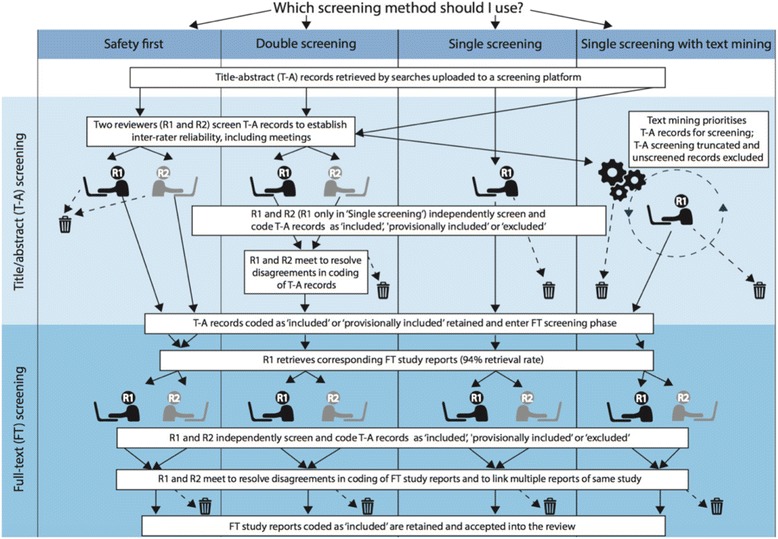
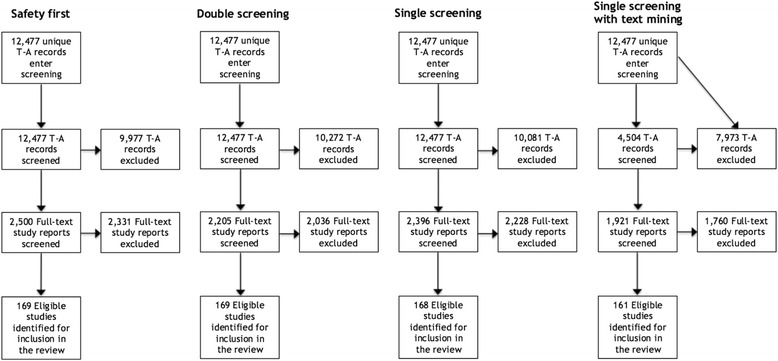
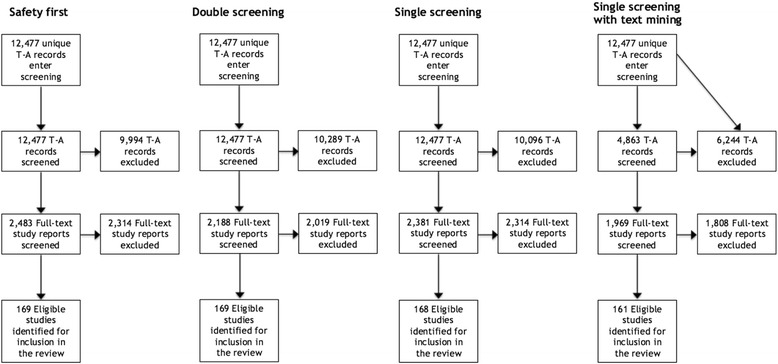
BACKGROUND: Meta-research studies investigating methods, systems, and processes designed to improve the efficiency of systematic review workflows can contribute to building an evidence base that can help to increase value and reduce waste in research. This study demonstrates the use of an economic evaluation framework to compare the costs and effects of four variant approaches to identifying eligible studies for consideration in systematic reviews. METHODS: A cost-effectiveness analysis was conducted using a basic decision-analytic model, to compare the relative efficiency of 'safety first', 'double screening', 'single screening' and 'single screening with text mining' approaches in the title-abstract screening stage of a 'case study' systematic review about undergraduate medical education in UK general practice settings. Incremental cost-effectiveness ratios (ICERs) were calculated as the 'incremental cost per citation 'saved' from inappropriate exclusion' from the review. Resource use and effect parameters were estimated based on retrospective analysis of 'review process' meta-data curated alongside the 'case study' review, in conjunction with retrospective simulation studies to model the integrated use of text mining. Unit cost parameters were estimated based on the 'case study' review's project budget. A base case analysis was conducted, with deterministic sensitivity analyses to investigate the impact of variations in values of key parameters. RESULTS: Use of 'single screening with text mining' would have resulted in title-abstract screening workload reductions (base case analysis) of >60 % compared with other approaches. Across modelled scenarios, the 'safety first' approach was, consistently, equally effective and less costly than conventional 'double screening'. Compared with 'single screening with text mining', estimated ICERs for the two non-dominated approaches (base case analyses) ranged from £1975 ('single screening' without a 'provisionally included' code) to £4427 ('safety first' with a 'provisionally included' code) per citation 'saved'. Patterns of results were consistent between base case and sensitivity analyses. CONCLUSIONS: Alternatives to the conventional 'double screening' approach, integrating text mining, warrant further consideration as potentially more efficient approaches to identifying eligible studies for systematic reviews. Comparable economic evaluations conducted using other systematic review datasets are needed to determine the generalisability of these findings and to build an evidence base to inform guidance for review authors.
Overview
The claims and statistics of this paper haven’t been checked yet.
Free: it reads the open-access text and checks the first 5 claims that cite a source we can check. Create a free account to check every claim.
Integrity signals
Registry
Cites
Statistics
Figures
Verification
Claims the paper makes
The claims and statistics of this paper haven’t been checked yet.
Free: it reads the open-access text and checks the first 5 claims that cite a source we can check. Create a free account to check every claim.
Claims other papers make about this one
Each is checked against this paper’s own text: does it say what the citing paper says it does?
The cited source doesn’t support the claim as written.
In the citing paper
“The estimated costs are also considerable: amounting to £13 000 for a single review.7”
From Prioritising references for systematic reviews with RobotAnalyst: A user study (2018) · cites this paper as [7]
Checked by a reasoning model — may be wrong.
Experimental — accuracy not yet measuredThe source backs part of the claim, not all of it — or backs it for a different population, condition or comparison.
In the citing paper
“this would increase the total hours saved by not having to access and screen the 5% of title/abstract false negatives”
From An evaluation of DistillerSR’s machine learning-based prioritization tool for title/abstract screening – impact on reviewer-relevant outcomes (2020) · cites this paper as [11]
Experimental — accuracy not yet measuredThe source backs part of the claim, not all of it — or backs it for a different population, condition or comparison.
In the citing paper
“A significant impact on both the total cost of a review and the time required to produce a review can be achieved with even small increases in precision [33,46,78].”
From Automation of systematic literature reviews: A systematic literature review (2021) · cites this paper as [78]
Experimental — accuracy not yet measuredThe source backs part of the claim, not all of it — or backs it for a different population, condition or comparison.
In the citing paper
“A common estimate for the time taken to screen a title-abstract record is a minute (Shemilt et al., 2016).”
From SYMBALS: A Systematic Review Methodology Blending Active Learning and Snowballing (2021) · cites this paper as Shemilt et al., 2016
Experimental — accuracy not yet measuredThe cited source says what the claim attributes to it.
In the citing paper
“the balance between efficiency gains and risk tolerance will be review-specific52 53”
From PRISMA 2020 explanation and elaboration: updated guidance and exemplars for reporting systematic reviews (2021) · cites this paper as [52]
8 more claims about this paper
Create a free account to see every claim other papers make about this one.
Self-check
Percentages, sums and reported differences re-computed from the paper’s own numbers.
The self-check needs the paper’s full text.
Citations
Cites
Preferred Reporting Items for Systematic Reviews and Meta-Analyses: the PRISMA statement
Moher, D., Liberati, A., Tetzlaff, J., Altman, D. G., & for the PRISMA Group (2009) · BMJ · doi:10.1136/bmj.b2535 · Cited by 83,823
Preferred Reporting Items for Systematic Reviews and Meta-Analyses: The PRISMA Statement
Moher, D., Liberati, A., Tetzlaff, J., Altman, D. G., & The PRISMA Group (2009) · PLoS Medicine · doi:10.1371/journal.pmed.1000097 · Cited by 64,042
Preferred reporting items for systematic reviews and meta-analyses: the PRISMA Statement.
(2009) · PubMed Central · Cited by 44,859
Wang, G., Ma, R., Qiao, G., Wada, K., Aizawa, Y., & Satoh, T. (2015) · Integrative Medicine International · doi:10.1159/000368408 · Cited by 18,657
Methods for the Economic Evaluation of Health Care Programmes
Drummond, M. E., Sculpher, M. J., Torrance, G. W., O’Brien, B. J., & Stoddart, G. L. (2005) · doi:10.1093/oso/9780198529446.001.0001 · Cited by 13,648
Methods for the economic evaluation of health care programmes
Wilson, S. H. (1987) · Journal of Epidemiology and Community Health · doi:10.1136/jech.41.4.355-a · Cited by 4,275
Greenhalgh, T., & Peacock, R. (2005) · BMJ · doi:10.1136/bmj.38636.593461.68 · Cited by 2,045
Consolidated Health Economic Evaluation Reporting Standards (CHEERS) statement
Husereau, D., Drummond, M., Petrou, S., Carswell, C., Moher, D., Greenberg, D., Augustovski, F., Briggs, A. H., Mauskopf, J., Loder, E., et al. (2013) · BMJ · doi:10.1136/bmj.f1049 · Cited by 1,776
Increasing value and reducing waste in research design, conduct, and analysis
Ioannidis, J. P. A., Greenland, S., Hlatky, M. A., Khoury, M. J., Macleod, M. R., Moher, D., Schulz, K. F., & Tibshirani, R. (2014) · The Lancet · doi:10.1016/s0140-6736(13)62227-8 · Cited by 1,597
Reducing waste from incomplete or unusable reports of biomedical research
Glasziou, P., Altman, D. G., Bossuyt, P., Boutron, I., Clarke, M., Julious, S., Michie, S., Moher, D., & Wager, E. (2014) · The Lancet · doi:10.1016/s0140-6736(13)62228-x · Cited by 1,319
Research works printed but not linked: 3
- Higgins JPT, Deeks JJ, editors. Chapter 7: Selecting studies and collecting data. In: Higgins JPT, Green S, editors. Cochrane Handbook for Systematic Reviews of Interventions, Version 5.1.0 [updated March 2011]. http://handbook.cochrane.org. Accessed 1 July 2016.
- Cochrane methodology reviews. Cochrane Methodology Review Group. 2016. http://methodology.cochrane.org. Accessed 1 July 2016.
- Thomas J Brunton J Graziosi S EPPI-Reviewer 4.0: software for research synthesis 2010 London EPPI-Centre Software, Social Science Research Unit, Institute of Education
Cited by
Page, M. J., Moher, D., Bossuyt, P. M., Boutron, I., Hoffmann, T. C., Mulrow, C. D., Shamseer, L., Tetzlaff, J. M., Akl, E. A., Brennan, S. E., et al. (2021) · BMJ · doi:10.1136/bmj.n160 · Cited by 13,262
Self-citationPage, M. J., Moher, D., Bossuyt, P., Boutron, I., Hoffmann, T., mulrow, C., Shamseer, L., Tetzlaff, J., Akl, E., Brennan, S. E., et al. (2020) · doi:10.31222/osf.io/gwdhk · Cited by 916
Self-citationSearching for and selecting studies
Lefebvre, C., Glanville, J., Briscoe, S., Littlewood, A., Marshall, C., Metzendorf, M., Noel‐Storr, A., Rader, T., Shokraneh, F., Thomas, J., et al. (2019) · Cochrane Handbook for Systematic Reviews of Interventions · doi:10.1002/9781119536604.ch4 · Cited by 647
Self-citationMarshall, I. J., & Wallace, B. C. (2019) · Systematic Reviews · doi:10.1186/s13643-019-1074-9 · Cited by 638
Waffenschmidt, S., Knelangen, M., Sieben, W., Bühn, S., & Pieper, D. (2019) · BMC Medical Research Methodology · doi:10.1186/s12874-019-0782-0 · Cited by 626
“Two re-ran the meta-analysis without the missed studies (Pham 2016, Shemilt 2016).”
BackgroundMethodInfluentialMarshall, I. J., Noel‐Storr, A., Kuiper, J., Thomas, J., & Wallace, B. C. (2018) · Research Synthesis Methods · doi:10.1002/jrsm.1287 · Cited by 435
“31 The researcher may then make an informed decision to stop early based on either low likelihood that the remainder contains RCTs (for example in a conventional systematic review), or when resources (time or money) have been spent (for example in a rapid review).”
BackgroundSelf-citationAutomation of systematic literature reviews: A systematic literature review
van Dinter, R., Tekinerdogan, B., & Catal, C. (2021) · Information and Software Technology · doi:10.1016/j.infsof.2021.106589 · Cited by 432
“A significant impact on both the total cost of a review and the time required to produce a review can be achieved with even small increases in precision [33,46,78].”
BackgroundThe value of a second reviewer for study selection in systematic reviews
Stoll, C. R. T., Izadi, S., Fowler, S., Green, P., Suls, J., & Colditz, G. A. (2019) · Research Synthesis Methods · doi:10.1002/jrsm.1369 · Cited by 297
“A previous study explored various methods of study selection using a cost-effectiveness analysis and found that using two reviewers in the title/abstract stage and moving all records marked by at least one reviewer as eligible, rather than resolving disagreements, was equally effective and less costly than traditional…”
MethodLiving systematic reviews: 2. Combining human and machine effort
Thomas, J., Noel-Storr, A., Marshall, I., Wallace, B., McDonald, S., Mavergames, C., Glasziou, P., Shemilt, I., Synnot, A., Turner, T., et al. (2017) · Journal of Clinical Epidemiology · doi:10.1016/j.jclinepi.2017.08.011 · Cited by 355
“Identifying studies for inclusion is one of the most laborintensive and time-consuming tasks of the systematic review process [11,12].”
BackgroundSelf-citationReviewing retrieved references for inclusion in systematic reviews using EndNote
Bramer, W. M., Milic, J., & Mast, F. (2017) · Journal of the Medical Library Association · doi:10.5195/jmla.2017.111 · Cited by 264
Artificial intelligence for literature reviews: opportunities and challenges
Bolaños, F., Salatino, A., Osborne, F., & Motta, E. (2024) · Artificial Intelligence Review · doi:10.1007/s10462-024-10902-3 · Cited by 246
“…by specific training [10]; significant financial implications arising from database subscriptions, specialised software utilisation, and personnel remunerations [11]; the growing rate of the number of publication [12], and the periodic need for updates to ensure continued relevance [13].”
Mathes, T., Klaßen, P., & Pieper, D. (2017) · BMC Medical Research Methodology · doi:10.1186/s12874-017-0431-4 · Cited by 240
“liberal acceleration) are more cost-effective than independent study selection [6].”
BackgroundPage, M. J., McKenzie, J. E., Bossuyt, P. M., Boutron, I., Hoffmann, T., Mulrow, C. D., Shamseer, L., & Moher, D. (2020) · Journal of Clinical Epidemiology · doi:10.1016/j.jclinepi.2019.11.010 · Cited by 211
“These developments include novel guidance on how to identify studies for inclusion (9-11), synthesise and present findings when meta-analysis is not possible or appropriate (12, 13), report and synthesise intervention characteristics of included studies (14, 15), and enhance the reproducibility of meta-analytic result…”
BackgroundGartlehner, G., Affengruber, L., Titscher, V., Noel-Storr, A., Dooley, G., Ballarini, N., & König, F. (2020) · Journal of Clinical Epidemiology · doi:10.1016/j.jclinepi.2020.01.005 · Cited by 206
Chai, K. E. K., Lines, R. L. J., Gucciardi, D. F., & Ng, L. (2021) · Systematic Reviews · doi:10.1186/s13643-021-01635-3 · Cited by 190
“Past work suggests that it takes between 30 [7] and 60 s [38] to screen each abstract.”
BackgroundYates, J., Deeney, M., Rolker, H. B., White, H., Kalamatianou, S., & Kadiyala, S. (2021) · Nature Food · doi:10.1038/s43016-021-00221-z · Cited by 164
Prioritising references for systematic reviews with RobotAnalyst: A user study
Przybyła, P., Brockmeier, A. J., Kontonatsios, G., Le Pogam, M., McNaught, J., von Elm, E., Nolan, K., & Ananiadou, S. (2018) · Research Synthesis Methods · doi:10.1002/jrsm.1311 · Cited by 148
Parental Risk and Protective Factors in Child Maltreatment: A Systematic Review of the Evidence
Younas, F., & Gutman, L. M. (2022) · Trauma Violence & Abuse · doi:10.1177/15248380221134634 · Cited by 162
“While double screening is the recommended approach, Shemilt et al. (2016) notes that the decision to use a single reviewer in the searching and selecting of studies in a systematic review can “. . . substantively reduce the overall workload and total costs of systematic review production” (p. 11).”
BackgroundHamel, C., Kelly, S. E., Thavorn, K., Rice, D. B., Wells, G. A., & Hutton, B. (2020) · BMC Medical Research Methodology · doi:10.1186/s12874-020-01129-1 · Cited by 140
“The number of hours saved was calculated by multiplying the expected time to review a record (i.e., one record per minute, based on Shemilt 2016 [11] and the experience of our own research groups) by the total number of records that did not need to be screened by one reviewer (i.e., the total…”
MethodVeteran help-seeking behaviour for mental health issues: a systematic review
Randles, R., & Finnegan, A. P. (2021) · BMJ Military Health · doi:10.1136/bmjmilitary-2021-001903 · Cited by 147
Mandrik, O. (., Severens, J. L. (., Bardach, A., Ghabri, S., Hamel, C., Mathes, T., Vale, L., Wisløff, T., & Goldhaber-Fiebert, J. D. (2021) · Value in Health · doi:10.1016/j.jval.2021.01.002 · Cited by 110
“This should mitigate any issues with a single reviewer and balance the risk of overinclusion (which comes with more research costs) with the risk of excluding relevant citations.(30,31) Another strategy is using tools with machine learning capabilities (eg, Abstrackr, DistillerSR, SWIFT-Active Screener, and”
Salvador‐Carulla, L., Woods, C., de Miquel, C., & Lukersmith, S. (2024) · Heliyon · doi:10.1016/j.heliyon.2024.e29930 · Cited by 121
“Single screening has been demonstrated to be a robust method for experienced reviewers [32,33] and is useful for scoping reviews aimed at establishing the knowledge base in a new area .”
MethodDavergne, T., Pallot, A., Dechartres, A., Fautrel, B., & Gossec, L. (2019) · Arthritis Care & Research · doi:10.1002/acr.23752 · Cited by 102
“Indeed, alternatives to the conventional double screening approach exist and appear to be potentially more efficient approaches to identifying eligible studies for systematic reviews (44).”
BackgroundSoftware Tools for Literature Screening in Systematic Reviews in Biomedical Research
van der Mierden, S. (2019) · ALTEX · doi:10.14573/altex.1902131 · Cited by 99
Resource use during systematic review production varies widely: a scoping review
Nussbaumer-Streit, B., Ellen, M., Klerings, I., Sfetcu, R., Riva, N., Mahmić-Kaknjo, M., Poulentzas, G., Martinez, P., Baladia, E., Ziganshina, L. E., et al. (2021) · Journal of Clinical Epidemiology · doi:10.1016/j.jclinepi.2021.05.019 · Cited by 98
“retrieving full-text articles took 4 minutes per full text (56).”
BackgroundInfluentialSelf-citationRapid reviews may produce different results to systematic reviews: a meta-epidemiological study
Marshall, I. J., Marshall, R., Wallace, B. C., Brassey, J., & Thomas, J. (2019) · Journal of Clinical Epidemiology · doi:10.1016/j.jclinepi.2018.12.015 · Cited by 95
“evaluated the cost-effectiveness of different abstract-screening workflows, including the use of two reviewers, one reviewer, and automation [31].”
Self-citationRobson, R. C., Pham, B., Hwee, J., Thomas, S. M., Rios, P., Page, M. J., & Tricco, A. C. (2019) · Journal of Clinical Epidemiology · doi:10.1016/j.jclinepi.2018.10.003 · Cited by 86
Finding better active learners for faster literature reviews
Yu, Z., Kraft, N. A., & Menzies, T. (2018) · Empirical Software Engineering · doi:10.1007/s10664-017-9587-0 · Cited by 83
“Similar conclusion was derived by Shemilt et al. in 2016 [56].”
BackgroundMethodResultPage, M. J., Altman, D. G., McKenzie, J. E., Shamseer, L., Ahmadzai, N., Wolfe, D., Yazdi, F., Catalá-López, F., Tricco, A. C., & Moher, D. (2018) · Journal of Clinical Epidemiology · doi:10.1016/j.jclinepi.2017.11.022 · Cited by 82
“All titles and abstracts were screened using the method of liberal acceleration (also known as ‘‘safety first’’ [18]) via the web-based review software, DistillerSR (Evidence Partners, Ottawa, Canada).”
MethodAssessing the accuracy of machine-assisted abstract screening with DistillerAI: a user study
Gartlehner, G., Wagner, G., Lux, L., Affengruber, L., Dobrescu, A., Kaminski-Hartenthaler, A., & Viswanathan, M. (2019) · Systematic Reviews · doi:10.1186/s13643-019-1221-3 · Cited by 73
FAST2: An intelligent assistant for finding relevant papers
Yu, Z., & Menzies, T. (2019) · Expert Systems with Applications · doi:10.1016/j.eswa.2018.11.021 · Cited by 80
“The only two applicable stopping rules found in literature are: a) stop when running out of budget; b) read through all candidate studies (but the subsequent process can happen early given that most relevant studies have been found in the early stage of the reading process) [27].”
BackgroundSYMBALS: A Systematic Review Methodology Blending Active Learning and Snowballing
van Haastrecht, M., Sarhan, I., Yigit Ozkan, B., Brinkhuis, M., & Spruit, M. (2021) · Frontiers in Research Metrics and Analytics · doi:10.3389/frma.2021.685591 · Cited by 80
“A common estimate for the time taken to screen a title-abstract record is a minute (Shemilt et al., 2016).”
BackgroundHow is AMSTAR applied by authors – a call for better reporting
Pieper, D., Könsgen, N., Breuing, J., Ge, L., & Wegewitz, U. E. (2018) · BMC Medical Research Methodology · doi:10.1186/s12874-018-0520-z · Cited by 85
“All full texts were screened by one review author (DP, NK, or LG); those deemed not relevant were verified by a second person (DP, NK, or JB) for exclusion (liberal acceleration, also known as the safety first approach [17]).”
BackgroundCampos, D. G., Fütterer, T., Gfrörer, T., Lavelle-Hill, R., Murayama, K., König, L., Hecht, M., Zitzmann, S., & Scherer, R. (2024) · Educational Psychology Review · doi:10.1007/s10648-024-09862-5 · Cited by 75
“Thus, systematic reviews that only rely on human resources are neither efficient nor sustainable, particularly with the rapid increase of scientific information (Shemilt et al., 2016).”
Scells, H., Zuccon, G., Koopman, B., Deacon, A. J., Azzopardi, L. A., & Geva, S. (2017) · ACM International Conference on Information and Knowledge Management (CIKM) · doi:10.1145/3132847.3133080 · Cited by 86
Snilsveit, B., Stevenson, J., Langer, L., Tannous, N., Ravat, Z., Nduku, P. M., Polanin, J. R., Shemilt, I., Eyers, J. E., & Ferraro, P. J. (2019) · Campbell Systematic Reviews · doi:10.1002/cl2.1045 · Cited by 88
Self-citationText mining to support abstract screening for knowledge syntheses: a semi-automated workflow
Pham, B., Jovanovic, J., Bagheri, E., Antony, J., Ashoor, H., Nguyen, T. T., Rios, P., Robson, R., Thomas, S. M., Watt, J., et al. (2021) · Systematic Reviews · doi:10.1186/s13643-021-01700-x · Cited by 63
“…of abstracts and the number of abstracts screened by the workflow, assuming each abstract is screened by two reviewers [11] Person-hours saved — the reduction in person-hours associated with the workload reduction, assuming that on average, a reviewer screens about 200 abstracts per hour [44, 45].”
Improving reference prioritisation with PICO recognition.
Brockmeier, A. J., Ju, M., Przybyła, P., & Ananiadou, S. (2019) · BMC Medical Informatics and Decision Making · doi:10.1186/s12911-019-0992-8 · Cited by 62
Firoozi, A. A., Tshambane, M., Firoozi, A. A., & Sheikh, S. M. (2024) · Results in Engineering · doi:10.1016/j.rineng.2024.102890 · Cited by 77
Informing conservation decisions through evidence synthesis and communication
Pullin, A. S., Cheng, S. H., Cooke, S. J., Haddaway, N., Macura, B., McKinnon, M., & Taylor, J. J. (2020) · Cambridge University Press eBooks · doi:10.1017/9781108638210.007 · Cited by 56
“In a policy space where decision-making timelines are short and demands for rigorous, reliable evidence are high, methods assisted by advances in computing can support rapid evidence collation as well as increase cost efficiency (Shemilt et al., 2016).”
MethodNama, N., Hennawy, M., Barrowman, N., O’Hearn, K., Sampson, M., & McNally, J. D. (2021) · Systematic Reviews · doi:10.1186/s13643-021-01632-6 · Cited by 53
“50 [15], this saves approximately 83 h of screening and $7500 while”
BackgroundHaby, M. M., Barreto, J. O. M., Kim, J. Y. H., Peiris, S., Mansilla, C., Torres, M., Guerrero‐Magaña, D. E., & Revéiz, L. (2023) · Research Synthesis Methods · doi:10.1002/jrsm.1664 · Cited by 53
“31,39,51,58,59,63,76,81,90,101,104,112 The use of a single electronic database as a source of studies is also not justified by the evidence.”
BackgroundOngachi, W., & Belinder, I. (2025) · BMC Agriculture · doi:10.1186/s44399-025-00005-x · Cited by 61
“This kind of screening approach permitted the authors to conclude the screening process once most relevant literature review articles had been identified, as the remaining ones were considered unlikely to be relevant [14].”
Improving the conduct of systematic reviews: a process mining perspective
Pham, B., Bagheri, E., Rios, P., Pourmasoumi, A., Robson, R. C., Hwee, J., Isaranuwatchai, W., Darvesh, N., Page, M. J., & Tricco, A. C. (2018) · Journal of Clinical Epidemiology · doi:10.1016/j.jclinepi.2018.06.011 · Cited by 40
Caldwell, D. M., Davies, S. R., Thorn, J. C., Palmer, J. C., Caro, P., Hetrick, S. E., Gunnell, D., Anwer, S., López-López, J. A., French, C. E., et al. (2021) · Public Health Research · doi:10.3310/phr09080 · Cited by 45
Self-citationStansfield, C., O'Mara‐Eves, A., & Thomas, J. (2017) · Research Synthesis Methods · doi:10.1002/jrsm.1250 · Cited by 39
Self-citationWaffenschmidt, S., Sieben, W., Jakubeit, T., Knelangen, M., Overesch, I., Bühn, S., Pieper, D., Skoetz, N., & Hausner, E. (2023) · Systematic Reviews · doi:10.1186/s13643-023-02334-x · Cited by 43
“Only two other studies have assessed the relevance of missed studies for conclusions: Shemilt 2016 [31] also investigated single screening with prioritization tools and found no change in conclusions.”
BackgroundAyano, G., Belete, A., Duko, B., Tsegay, L., & Dachew, B. A. (2021) · BMJ Open · doi:10.1136/bmjopen-2020-040061 · Cited by 46
A question-answering framework for automated abstract screening using large language models
Akinseloyin, O., Jiang, X., & Palade, V. (2024) · Journal of the American Medical Informatics Association · doi:10.1093/jamia/ocae166 · Cited by 28
Yao, X., Kumar, M. V., Su, E., Flores Miranda, A., Saha, A., & Sussman, J. (2024) · Cancer Epidemiology · doi:10.1016/j.canep.2023.102511 · Cited by 37
König, L., Zitzmann, S., Fütterer, T., Campos, D., Scherer, R., & Hecht, M. (2024) · Research Synthesis Methods · doi:10.1002/jrsm.1762 · Cited by 40
Leenaars, C. H. C., Tsaioun, K., Stafleu, F. R., Rooney, K. B., Meijboom, F. L. B., Ritskes-Hoitinga, M. J., & Bleich, A. (2020) · Laboratory Animals · doi:10.1177/0023677220968599 · Cited by 39
“Previous work has estimated the average time to screen one title and abstract at around one minute.(35,36) With well-defined criteria, in our experience a trained screener can screen up to 200 titles and abstracts per hour, but not for more than 2 hours per day.”
BackgroundMunar, W. A., Snilstveit, B., Aranda, L. E., Biswas, N., Baffour, T., & Stevenson, J. (2019) · BMJ Global Health · doi:10.1136/bmjgh-2019-001451 · Cited by 38
König, L., Zitzmann, S., Fütterer, T., Campos, D., Scherer, R., & Hecht, M. (2023) · doi:10.31234/osf.io/ybu3w · Cited by 33
A mapping review of sacrococcygeal pilonidal sinus disease
Kumar, M., Clay, W. H., Lee, M. J., Brown, S. R., & Hind, D. (2021) · Techniques in Coloproctology · doi:10.1007/s10151-021-02432-9 · Cited by 32
Burgard, T., & Bittermann, A. (2023) · Zeitschrift für Psychologie · doi:10.1027/2151-2604/a000509 · Cited by 29
Query Variation Performance Prediction for Systematic Reviews
Scells, H., Azzopardi, L. A., Zuccon, G., & Koopman, B. (2018) · International ACM SIGIR Conference on Research and Development in Information Retrieval (SIGIR) · doi:10.1145/3209978.3210078 · Cited by 27
“1 INTRODUCTION Systematic reviews form the cornerstone of evidence basedmedicine, aiming to answer complex medical questions based on all evidence currently available [20].”
BackgroundCarey, N., Harte, M., & McCullagh, L. (2022) · Journal of Clinical Epidemiology · doi:10.1016/j.jclinepi.2022.05.017 · Cited by 28
Park, S. E., & Thomas, J. (2018) · BMJ Evidence-Based Medicine · doi:10.1136/bmjebm-2018-110962 · Cited by 26
Self-citationKranenburg, R., Tyer, R., Schmitt, M. A., Luijckx, G. J., van der Schans, C. P., Hutting, N., & Kerry, R. (2019) · Journal of Orthopaedic and Sports Physical Therapy · doi:10.2519/jospt.2019.8578 · Cited by 30
Economic evaluations and costing studies of lung transplantation: A scoping review
Peel, J. K., Keshavjee, S. H., Krahn, M. D., & Sander, B. (2021) · The Journal of Heart and Lung Transplantation · doi:10.1016/j.healun.2021.08.007 · Cited by 22
Systematic Literature Reviews: Why I Rejected Your Review
Crawford, J. (2025) · Journal of University Teaching and Learning Practice · doi:10.53761/10vb5076 · Cited by 22
“The decision factor in many studies is balancing workload/funding expectations and robustness of outcomes (Shemilt et al., 2016).”
Wang, Y., Ram, S., & Scahill, S. L. (2023) · International Journal for Quality in Health Care · doi:10.1093/intqhc/mzad114 · Cited by 20
“To expedite the process, a rapid review approach “single screening” was adopted for abstract and full-text screening [19].”
MethodNeural Rankers for Effective Screening Prioritisation in Medical Systematic Review Literature Search
Wang, S., Scells, H., Koopman, B., & Zuccon, G. (2022) · Australasian Document Computing Symposium · doi:10.1145/3572960.3572980 · Cited by 31
Tang, Y., Xiao, Z., Li, X., Fang, Q., Zhang, Q., Fong, D. Y. T., Lai, F. T. T., Chui, C. S. L., Chan, E. W., & Wong, I. C. K. (2024) · medRxiv · doi:10.1101/2024.03.20.24304572 · Cited by 26
Affengruber, L., Dobrescu, A. I., Persad, E., Klerings, I., Wagner, G., Sommer, I., & Gartlehner, G. (2022) · Systematic Reviews · doi:10.1186/s13643-022-02109-w · Cited by 20
“Single-reviewer screening reduces screening time by approximately 60% when compared to dual-reviewer screening (4).”
BackgroundStopping Methods for Technology-assisted Reviews Based on Point Processes
Stevenson, M., & Bin-Hezam, R. (2023) · ACM Transactions on Information Systems · doi:10.1145/3631990 · Cited by 22
“The standard approach to identifying relevant literature is to construct a Boolean query designed to optimise recall over precision and manually screen the results, an expensive and time-consuming process that can involve manual assessment of tens of thousands of documents [43, 53].”
BackgroundJoseph, N., Burn, A., & Anderson, J. (2023) · BMC Public Health · doi:10.1186/s12889-023-16668-7 · Cited by 20
“In addition, the team capacity, funding and time frame to conduct the search and screening is shorter than 12 months in comparison to other community engagement systematic review studies which may contribute to further omission and potential selection bias [63, 64].”
BackgroundWound fluid sampling methods for proteomic studies: A scoping review
Harvey, J., Mellody, K. T., Cullum, N. A., Watson, R. E. B., & Dumville, J. C. (2022) · Wound Repair and Regeneration · doi:10.1111/wrr.13009 · Cited by 19
Hildebrand, F., Gray, M., & McCullough, K. (2023) · Australian Journal of Rural Health · doi:10.1111/ajr.13038 · Cited by 16
Reniewicz, J., Suryaprakash, V., Kowalczyk, J., Blacha, A., Kostello, G., Tan, H., Wang, Y., Reineke, P., & Manissero, D. (2023) · New Biotechnology · doi:10.1016/j.nbt.2023.11.005 · Cited by 17
Fütterer, T., Campos, D., Gfrörer, T., Lavelle-Hill, R. E., Murayama, K., & Scherer, R. (2025) · Learning and Individual Differences · doi:10.1016/j.lindif.2025.102849 · Cited by 18
Li, J., Kabouji, J., Bouhadoun, S., Tanveer, S., Filion, K. B., Gore, G. C., Josephson, C. B., Kwon, C., Jetté, N., Bauer, P. R., et al. (2023) · Journal of Clinical Epidemiology · doi:10.1016/j.jclinepi.2023.07.010 · Cited by 15
The incidence of fractures in children under two years of age: a systematic review
Rosendahl, K., de Horatio, L. T., Habre, C., Shelmerdine, S. C., Patsch, J., Kvist, O., Lein, T. E., Plut, D., Enoksen, E. J., Avenarius, R., et al. (2024) · BMC Musculoskeletal Disorders · doi:10.1186/s12891-024-07633-5 · Cited by 15
“Titles and abstracts were screened by one investigator (KR) for possible inclusion according to the pre-specified eligibility criteria [8, 9].”
MethodEdelman, A., Taylor, J., Ovseiko, P. V., & Topp, S. M. (2017) · BMJ Open · doi:10.1136/bmjopen-2016-015435 · Cited by 18
Shemilt, I., Arno, A., Thomas, J., Lorenc, T., Khouja, C., Raine, G., Sutcliffe, K., D’Souza, P., Kwan, I., Wright, K. E., et al. (2021) · Wellcome Open Research · doi:10.12688/wellcomeopenres.17141.1 · Cited by 16
“The outcome measure of benefit was the number of eligible records ‘saved’ from inappropriate exclusion from our living map 13 .”
Self-citationOfori-Boateng, R., Aceves‐Martins, M., Jayne, C., Wiratunga, N., & Moreno‐García, C. F. (2023) · Procedia Computer Science · doi:10.1016/j.procs.2023.08.149 · Cited by 15
Systematic reviews in restorative dentistry: discussing relevant aspects
Sarkis‐Onofre, R., Pereira‐Cenci, T., Tricco, A. C., Demarco, F. F., Moher, D., & Cenci, M. S. (2019) · Journal of Esthetic and Restorative Dentistry · doi:10.1111/jerd.12463 · Cited by 17
Luhnen, M., Prediger, B., Neugebauer, E. A. M., & Mathes, T. (2018) · International Journal of Technology Assessment in Health Care · doi:10.1017/s0266462318000624 · Cited by 13
“An efficient way to duplicate study selection is the method of liberal acceleration, in which one reviewer screens all identified studies with a second reviewer rescreening only excluded studies (37).”
Levay, P., Heath, A., & Tuvey, D. (2022) · Research Synthesis Methods · doi:10.1002/jrsm.1577 · Cited by 14
“There would be related savings in the number of full-text articles to order, discrepancies to resolve and other screening decisions to make.(2) The maximum saving of 1097 results is in line with the estimate that 500–1000 titles and abstracts can be screened in 8 h.”
BackgroundSemi-automated title-abstract screening using natural language processing and machine learning
Pilz, M., Zimmermann, S., Friedrichs, J., Wördehoff, E., Ronellenfitsch, U., Kieser, M., & Vey, J. A. (2024) · Systematic Reviews · doi:10.1186/s13643-024-02688-w · Cited by 14
“This second approach could help to avoid time that is spent with publications that do not at all fit to the scope of the intended review, in particular with regards to the fact that a human screener needs on average one minute per title/abstract [44].”
BackgroundMunar, W. A., Snilstveit, B., Stevenson, J., Biswas, N., Eyers, J. E., Butera, G., Baffour, T., & Aranda, L. E. (2018) · Gates Open Research · doi:10.12688/gatesopenres.12826.1 · Cited by 15
“Following this initial set of 100, we will move to single screening with “safety approach”, whereby there is an option to mark unclear studies for review by a second reviewer 113 .”
Christopoulou, S. C. (2022) · BioMedInformatics · doi:10.3390/biomedinformatics2030032 · Cited by 11
Rapid Reviews to Support Practice: A Guide for Professional Organization Practice Networks
MacPherson, M., Wang, R. H., Smith, E., Sithamparanathan, G., Sadiq, C. A., & Braunizer, A. R. (2022) · Canadian Journal of Occupational Therapy · doi:10.1177/00084174221123721 · Cited by 10
“It is important to note that, while use of a single reviewer has been estimated to reduce screening time by 60%, it also results in 8%–20% of eligible studies being missed (Edwards et al., 2002; Glasziou et al., 2002; Shemilt et al., 2016).”
Backgrounddo Vale, M. L., Farmer, A. P., Ball, G. D. C., Gokiert, R., Maximova, K., & Thorlakson, J. J. D. (2020) · American Journal of Health Promotion · doi:10.1177/0890117119895951 · Cited by 9
“), which is considered an efficient method similar to double screening.(27) The reasons for excluding studies and uncertainties were recorded and coded.”
MethodBrand, S. L., Morgan, F. M., Stabler, L., Weightman, A. L., Willis, S., Searchfield, L., Nurmatov, U. B., Kemp, A., Turley, R., Scourfield, J., et al. (2019) · BMJ Open · doi:10.1136/bmjopen-2018-026967 · Cited by 12
“A safety first approach will be adopted whereby if one reviewer included at title/abstract, then the full text will be examined.(33) Reasons for exclusion will be recorded at full text.”
BackgroundEnablers and Barriers of Compassionate Care From a Nurses' Perspective: A Scoping Review
van den Berg, N. M., van der Wal‐Huisman, H., van Leeuwen, B. L., Paans, W., & Schroevers, M. J. (2025) · Scandinavian Journal of Caring Sciences · doi:10.1111/scs.13319 · Cited by 10
Vembye, M. H., Christensen, J., Bondebjerg, A., & Schytt, F. L. W. (2025) · Psychological Methods · doi:10.1037/met0000769 · Cited by 10
SALτ: efficiently stopping TAR by improving priors estimates
Molinari, A., & Esuli, A. (2023) · Data Mining and Knowledge Discovery · doi:10.1007/s10618-023-00961-5 · Cited by 10
“The production of a systematic review is usually carried out by one or more physicians and can span even years (Michel-son and Reuter 2019; Shemilt et al. 2016).”
Rapid review: A review of methods and recommendations based on current evidence
Guo, Q., Jiang, G., Zhao, Q., Long, Y., Feng, K., Gu, X., Xu, Y., Li, Z., Huang, J., & Du, L. (2024) · Journal of Evidence-Based Medicine · doi:10.1111/jebm.12594 · Cited by 8
Effective study selection using text mining or a single-screening approach: a study protocol
Waffenschmidt, S., Hausner, E., Sieben, W., Jaschinski, T., Knelangen, M., & Overesch, I. (2018) · Systematic Reviews · doi:10.1186/s13643-018-0839-x · Cited by 8
“As Shemilt 2016 [17] concluded, such a decision depends on “the willingness of review teams and funders to sacrifice recall in order to substantively reduce the overall workload and total costs of systematic review production”.”
BackgroundA Mixed‐Method Usability Study on User Experience with Systematic Review Software
Wang, M., Sharmin, S., Wang, M., & Yu, F. (2021) · Proceedings of the Association for Information Science and Technology · doi:10.1002/pra2.462 · Cited by 10
“…(true positive rate), specificity (true negative rate), precision, false-negative rate, proportion missed, and workload savings (i.e., the proportion that would not need to be screened manually) (Gates et al., 2018, 2019; Giummarra et al., 2020; Rathbone et al., 2015; Shemilt et al., 2016).”
Background(3ie), I. I. F. I. E., Berretta, M., Lee, S., consultant, I., Kupfer, M., consultant, I., Huang, C. J., (3ie), I. I. F. I. E., Ridlehoover, W., (3ie), I. I. F. I. E., et al. (2023) · doi:10.23846/egm023 · Cited by 8
Al-Marridi, A. Z., Said, A. B., Ulde, S. M., & Khwaileh, T. (2025) · Systematic Reviews · doi:10.1186/s13643-025-02895-z · Cited by 8
“Tools such as EPPI Reviewer [8], SWIFT-Review [9], Colandr [10], and Rayyan [11] demonstrate this approach as well.”
Hilkenmeier, F., Stoltenberg, M., & Stierle, C. M. G. (2026) · Systematic Reviews · doi:10.1186/s13643-026-03228-4 · Cited by 8
“These tools aim to make the title-and-abstract screening process more manageable by incorporating features such as abstract organization, deduplication, key-term highlighting, or ranking studies based on likelihood of inclusion [40, 51, 60, 71, 79].”
Transferring knowledge between topics in systematic reviews
Molinari, A., & Kanoulas, E. (2022) · Intelligent Systems with Applications · doi:10.1016/j.iswa.2022.200150 · Cited by 7
“Conducting an SR however is a laborious and expensive task (Shemilt et al., 2016, Michelson & Reuter, 2019, Tsafnat et al., 2014), which takes on average 1.72 years to complete (Michelson & Reuter, 2019), jeopardizing the quality of healthcare.”
InfluentialEffizientere Leitlinienerstellung – eine narrative Übersichtsarbeit
Pieper, D., Ober, P., Dressler, C., Schmidt, S., Mathes, T., & Becker, M. (2019) · Zeitschrift für Evidenz Fortbildung und Qualität im Gesundheitswesen · doi:10.1016/j.zefq.2019.08.004 · Cited by 11
Modelling Stopping Criteria for Search Results using Poisson Processes
Sneyd, A., & Stevenson, M. (2019) · Conference on Empirical Methods in Natural Language Processing (EMNLP) · doi:10.18653/v1/d19-1351 · Cited by 9
Cassell, K., Ologunowa, A., Rastegar-Mojarad, M., Chun, B., Huang, Y.-L., Wang, D., & Cossrow, N. (2025) · Frontiers in Artificial Intelligence · doi:10.3389/frai.2025.1662202 · Cited by 15
Janoudi, G., Uzun, M., Disher, T. C., Jurdana, M., Fuzul, E., Ivkovic, J., & Hutton, B. (2025) · Value in Health · doi:10.1016/j.jval.2025.09.008 · Cited by 8
Metadata
- Authors
- Shemilt, I., Khan, N., Park, S., & Thomas, J.
- Affiliations
- University College London (GB)
- Corresponding author
- Shemilt, Ian
- Venue
- Systematic Reviews
- Published
- 2016-08-17
- Volume
- 5
- Issue
- 1
- Pages
- 140-140
- ISSN
- 2046-4053 (ISSN-L)
- PMC
- PMC4989498
- OpenAlex
- W2512040454
- Cited by
- 168
- References
- 38
- Citations by year
- 2026: 11 · 2025: 17 · 2024: 24 · 2023: 22 · 2022: 17 · 2021: 27 · 2020: 9 · 2019: 19 · 2018: 15 · 2017: 7
- FWCI
- 4.16
- Type
- journal article
- Language
- en
- Open access
- gold
- doi.org
- Licence
- Locations
- Systematic Reviews (publishedVersion, cc-by)
- Europe PMC (PubMed Central) (publishedVersion, cc-by)
- PubMed Central (publishedVersion, cc-by)
- PubMed (publishedVersion)
- UCL Discovery (University College London) (submittedVersion)
- Funders
- Medical Research Council (MR/J005037/1)
- Topics
- Social Sciences › Decision Sciences › Statistics, Probability and Uncertainty › Meta-analysis and systematic reviews
- Social Sciences › Economics, Econometrics and Finance › Economics and Econometrics › Health Systems, Economic Evaluations, Quality of Life
- Social Sciences › Library and Information Sciences › scientometrics and bibliometrics research
- Keywords
- cost-effectiveness analysis, study identification, title and abstract screening, text mining, safety-first approach, incremental cost-effectiveness ratio, research waste, undergraduate medical education, general practice
- MeSH terms
- Cost-Benefit Analysis, Humans, Research Design, Data Mining, Patient Safety
About these checks
Registry, retraction, Cites and statistics results are computed, not judged, with one exception: a printed reference that no index lists is read once by a model before it counts as a citation error. Claims are extracted by a model and kept only when their quote appears verbatim in the text; each cited source is then checked, with a model’s help, for whether it says what the claim relies on. Those verdicts can be wrong — read the claim’s quote and the cited source before relying on one.
Statistics and arithmetic are recomputed, not judged.
Confidence bands are shown only for fields calibrated on our annotated test set. None is calibrated yet, so no band is shown.
What counts as a claim ›How we measure confidence ›How we check this ›
Are you an author, or do you see a problem with this page? Request a review
Data sources
Bibliographic data: Semantic Scholar, OpenAlex, Crossref.
Contains information from the Semantic Scholar Academic Graph Datasets, made available under the ODC Attribution License (ODC-BY 1.0).
Semantic Scholar’s data is described in: Kinney, R., et al. (2023). The Semantic Scholar Open Data Platform. arXiv:2301.10140.
