

A comparison of quality of abstracts of systematic reviews including meta-analysis of randomized controlled trials in high-impact general medicine journals before and after the publication of PRISMA extension for abstracts: a systematic review and meta-analysis
Open accessThe DOI matches its Crossref record; 41 of the 41 references it cites were found in a registry or an index.
Abstract
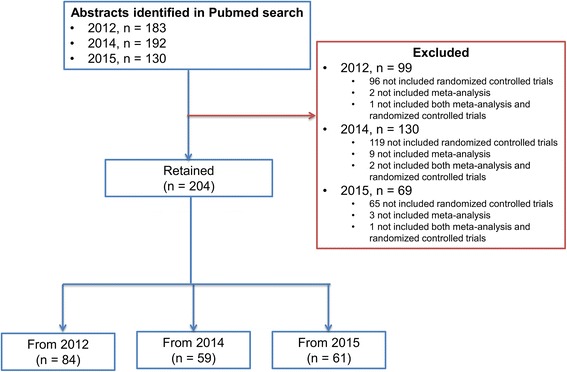
BACKGROUND: Journal abstracts including those reporting systematic reviews (SR) should contain sufficiently clear and accurate information for adequate comprehension and interpretation. The aim was to compare the quality of reporting of abstracts of SRs including meta-analysis published in high-impact general medicine journals before and after publication of the Preferred Reporting Items for Systematic Reviews and Meta-Analyses (PRISMA) extension for abstracts (PRISMA-A) released in April 2013. METHODS: SRs including meta-analysis of randomized controlled trials published in 2012, 2014, and 2015 in top-tier general medicine journals were searched in PubMed. Data was selected and extracted by two reviewers based on the PRISMA-A guidelines which recommend to include 12 items. The primary outcome was the adjusted mean number of items reported; the secondary outcome was the reporting of each item and factors associated with a better reporting. Adjustment was made for abstract word count and format, number of authors, PRISMA endorsement, and publication on behalf of a group. RESULTS: We included 84 abstracts from 2012, 59 from 2014, and 61 from 2015. The mean number of items reported in 2015 (7.5; standard deviation [SD] 1.6) and in 2014 (6.8; SD 1.6) differed and did not differ from that reported in 2012 (7.2; SD 1.7), respectively; adjusted mean difference: 0.9 (95 % CI 0.4; 1.3) and -0.1 (95 % CI -0.6; 0.4). From 2012 to 2014, the quality of reporting was in regression for "strengths and limitations of evidence" and "funding"; contrariwise, it remained unchanged for the others items. Between 2012 and 2015, the quality of reporting rose up for "description of the effect", "synthesis of results", "interpretation", and "registration"; but decreased for "strengths and limitations of evidence"; it remained unchanged for the other items. The overall better reporting was associated with abstracts structured in the 8-headings format in 2014 and abstracts with a word count <300 in 2014 and 2015. CONCLUSIONS: Not surprisingly, the quality of reporting did not improve in 2014 and suboptimally improved in 2015. There is still room for improvement to meet the standards of PRISMA-A guidelines. Stricter adherence to these guidelines by authors, reviewers, and journal editors is highly warranted and will surely contribute to a better reporting.
Overview
The claims and statistics of this paper haven’t been checked yet.
Free: it reads the open-access text and checks the first 5 claims that cite a source we can check. Create a free account to check every claim.
Integrity signals
Registry
Cites
Statistics
Figures
Verification
Claims the paper makes
The claims and statistics of this paper haven’t been checked yet.
Free: it reads the open-access text and checks the first 5 claims that cite a source we can check. Create a free account to check every claim.
Claims other papers make about this one
Each is checked against this paper’s own text: does it say what the citing paper says it does?
The cited source says what the claim attributes to it.
In the citing paper
“Research indicates that abstracts of articles typically receive more attention from readers than complete manuscripts, and this pattern likely extends to SR and MA as well.[3,4]”
From Quality of Reporting Abstracts of Systematic Reviews and Meta-Analysis in Preventive Dentistry: An Assessment Using the PRISMA 2020 Extension (2026) · cites this paper as [3]
The cited source says what the claim attributes to it.
In the citing paper
“Notably, assessments of the completeness of reporting of SRs/MAs abstracts have been undertaken in other fields e.g. dental specialties [3,5], anesthesiology [17], or general medical literature [18,19].”
From Reporting quality of abstracts of systematic reviews/meta-analyses: An appraisal of Arab Journal of Urology across 12 years: the PRISMA-Abstracts checklist (2023) · cites this paper as [19]
Self-check
Percentages, sums and reported differences re-computed from the paper’s own numbers.
The self-check needs the paper’s full text.
Citations
Cites
Preferred Reporting Items for Systematic Reviews and Meta-Analyses: the PRISMA statement
Moher, D., Liberati, A., Tetzlaff, J., Altman, D. G., & for the PRISMA Group (2009) · BMJ · doi:10.1136/bmj.b2535 · Cited by 83,823
Preferred reporting items for systematic reviews and meta-analyses: the PRISMA Statement.
(2009) · PubMed Central · Cited by 44,859
PRISMA-P Group, Moher, D., Shamseer, L., Clarke, M., Ghersi, D., Liberati, A., Petticrew, M., Shekelle, P., & Stewart, L. A. (2015) · Systematic Reviews · doi:10.1186/2046-4053-4-1 · Cited by 26,223 · cited 1×
“Besides, they are the reference standard for synthesizing evidence in healthcare about interventions because of their methodological rigor [4].”
BackgroundPreferred Reporting Items for Systematic Reviews and Meta-Analyses: The PRISMA Statement
Moher, D., Liberati, A., Tetzlaff, J., & Altman, D. G. (2009) · Journal of Clinical Epidemiology · doi:10.1016/j.jclinepi.2009.06.005 · Cited by 19,575
Hutton, B., Salanti, G., Caldwell, D. M., Chaimani, A., Schmid, C. H., Cameron, C., Ioannidis, J. P. A., Straus, S., Thorlund, K., Jansen, J. P., et al. (2015) · Annals of Internal Medicine · doi:10.7326/m14-2385 · Cited by 8,269 · cited 1×
“Background Systematic reviews and meta-analyses of randomized controlled trials (RCTs) are fundamental tools which can be used to generate reliable summaries of health care information directed to clinicians, decision makers, and patients as well [1].”
Background(2005) · PubMed · Cited by 7,011
Randomized, Controlled Trials, Observational Studies, and the Hierarchy of Research Designs
Concato, J., Shah, N., & Horwitz, R. I. (2000) · New England Journal of Medicine · doi:10.1056/nejm200006223422507 · Cited by 3,563 · cited 1×
“RCTs by their design generally provide the best quality of evidence required for health care decisions about interventions compared to observational studies [2, 3].”
BackgroundPanic, N., Leoncini, E., de Belvis, G., Ricciardi, W., & Boccia, S. (2013) · PLoS ONE · doi:10.1371/journal.pone.0083138 · Cited by 883 · cited 1×
“As demonstrated by Hopewell and colleagues, there are serious deficiencies in the reporting of abstracts of systematic reviews which make it difficult for readers to reliably assess study findings [36], although it has been bolstered that the endorsement of PRISMA guidelines increases adherence to recommendations [37].”
BackgroundUsers' Guides to the Medical Literature: VI. How to Use an Overview
Oxman, A. D. (1994) · JAMA · doi:10.1001/jama.1994.03520170077040 · Cited by 775 · cited 1×
“Clinicians read them to keep up to date with their field [5, 6].”
BackgroundPRISMA for Abstracts: Reporting Systematic Reviews in Journal and Conference Abstracts
Beller, E. M., Glasziou, P. P., Altman, D. G., Hopewell, S., Bastian, H., Chalmers, I., Gøtzsche, P. C., Lasserson, T., Tovey, D., & for the PRISMA for Abstracts Group (2013) · PLoS Medicine · doi:10.1371/journal.pmed.1001419 · Cited by 706 · cited 5×
“We assessed the reporting of these abstracts according to PRISMA-A recommendations [14].”
BackgroundMethodInfluentialHolm, J. C., Nowicka, P., Farpour-Lambert, N. J., O'Malley, G., Hassapidou, M., Weiss, R., & Baker, J. L. (2014) · Obesity Facts · doi:10.1159/000365773 · Cited by 592
Oxman, A. D. (1994) · JAMA · doi:10.1001/jama.272.17.1367 · Cited by 486
CONSORT for reporting randomised trials in journal and conference abstracts
Hopewell, S., Clarke, M., Moher, D., Wager, E., Middleton, P., Altman, D. G., & Schulz, K. F. (2008) · The Lancet · doi:10.1016/s0140-6736(07)61835-2 · Cited by 458 · cited 3×
“The 300-word cut-off was chosen as it has been shown, like for other abstract reporting guidelines such as the Consolidated Standards of Reporting Trials (CONSORT) extension for abstracts, that a word count around 300 is sufficient to fill all items [20].”
BackgroundMethodInfluentialUnderstanding PubMed(R) user search behavior through log analysis
Islamaj Dogan, R., Murray, G. C., Neveol, A., & Lu, Z. (2009) · Database · doi:10.1093/database/bap018 · Cited by 265 · cited 2×
“Within queries to PubMed, most readers look only at titles; only half of searches result in any click on content [9].”
BackgroundScientific Collaboration Results in Higher Citation Rates of Published Articles
Figg, W. D., Dunn, L., Liewehr, D. J., Steinberg, S. M., Thurman, P. W., Barrett, J. C., & Birkinshaw, J. (2006) · Pharmacotherapy: The Journal of Human Pharmacology and Drug Therapy · doi:10.1592/phco.26.6.759 · Cited by 241
Gutzwiller, F., & Paccaud, F. (1987) · PubMed · Cited by 240
Hopewell, S., Ravaud, P., Baron, G., & Boutron, I. (2012) · BMJ · doi:10.1136/bmj.e4178 · Cited by 235
A Proposal for More Informative Abstracts of Clinical Articles
AD HOC WORKING GROUP FOR CRITICAL APPRAISAL OF THE MEDICAL LITERATURE (1987) · Annals of Internal Medicine · doi:10.7326/0003-4819-106-4-598 · Cited by 233
Stolberg, H. O., Norman, G., & Trop, I. (2004) · American Journal of Roentgenology · doi:10.2214/ajr.183.6.01831539 · Cited by 211 · cited 1×
“RCTs by their design generally provide the best quality of evidence required for health care decisions about interventions compared to observational studies [2, 3].”
BackgroundA systematic scoping review of adherence to reporting guidelines in health care literature
Thabane, L., Samaan, Mbuagbaw, L., Kosa, S., Debono, B., Dillenburg, Zhang, Fruci, V., Dennis, & Bawor (2013) · Journal of Multidisciplinary Healthcare · doi:10.2147/jmdh.s43952 · Cited by 192
Ghimire, S., Kyung, E., Kang, W., & Kim, E. (2012) · Trials · doi:10.1186/1745-6215-13-77 · Cited by 140
Number of published systematic reviews and global burden of disease: database analysis
Swingler, G. H., Volmink, J., & Ioannidis, J. P. A. (2003) · BMJ · doi:10.1136/bmj.327.7423.1083 · Cited by 112 · cited 1×
“Clinicians read them to keep up to date with their field [5, 6].”
BackgroundPresentation Deficiencies in structured medical abstracts
FROOM, P. (1993) · Journal of Clinical Epidemiology · doi:10.1016/0895-4356(93)90029-z · Cited by 97
Can, O. S., Yilmaz, A. A., Hasdogan, M., Alkaya, F., Turhan, S. C., Can, M. F., & Alanoglu, Z. (2011) · European Journal of Anaesthesiology · doi:10.1097/eja.0b013e32833fb96f · Cited by 89
Access to electronic health knowledge in five countries in Africa: a descriptive study
Smith, H., Bukirwa, H., Mukasa, O., Snell, P., Adeh-Nsoh, S., Mbuyita, S., Honorati, M., Orji, B., & Garner, P. (2007) · BMC Health Services Research · doi:10.1186/1472-6963-7-72 · Cited by 80
Fleming, P. S., Buckley, N., Seehra, J., Polychronopoulou, A., & Pandis, N. (2012) · American Journal of Orthodontics and Dentofacial Orthopedics · doi:10.1016/j.ajodo.2012.05.013 · Cited by 80
Mbuagbaw, L., Thabane, M., Vanniyasingam, T., Debono, V. B., Kosa, S., Zhang, S., Ye, C., Parpia, S., Dennis, B. B., & Thabane, L. (2014) · Contemporary Clinical Trials · doi:10.1016/j.cct.2014.05.012 · Cited by 77
Ghimire, S., Kyung, E., Lee, H., & Kim, E. (2014) · Journal of Clinical Epidemiology · doi:10.1016/j.jclinepi.2013.10.012 · Cited by 76 · cited 2×
“The adjustment was done for abstract format because there are previous studies reporting relationship between abstract format and quality reporting [21, 22].”
BackgroundPredictors of citations in the urological literature
Willis, D. L., Bahler, C. D., Neuberger, M. M., & Dahm, P. (2011) · BJU International · doi:10.1111/j.1464-410x.2010.10028.x · Cited by 74 · cited 1×
“The adjustment was also done for number of authors and publication on behalf a group because it was reported an association between higher quality of work and increased number of collaborators [23, 24], though some other studies did not end up with the same finding [25, 26].”
BackgroundClarifying the abstracts of systematic literature reviews.
Hartley, J. R. (2000) · Europe PMC (PubMed Central) · Cited by 59
The Impact of Open Access upon Public Health
Editors, T. P. M. (2006) · PLoS Medicine · doi:10.1371/journal.pmed.0030252 · Cited by 55
Chen, Y., Li, J., Ai, C., Duan, Y., Wang, L., Zhang, M., & Hopewell, S. (2010) · PLoS ONE · doi:10.1371/journal.pone.0011926 · Cited by 51
Quality of Abstracts in 3 Clinical Dermatology Journals
Dupuy, A., Khosrotehrani, K., Lebbé, C., Rybojad, M., & Morel, P. (2003) · Archives of Dermatology · doi:10.1001/archderm.139.5.589 · Cited by 48 · cited 2×
“The adjustment was done for abstract format because there are previous studies reporting relationship between abstract format and quality reporting [21, 22].”
BackgroundHopewell, S., Boutron, I., Altman, D. G., & Ravaud, P. (2015) · Journal of Clinical Epidemiology · doi:10.1016/j.jclinepi.2015.03.006 · Cited by 47 · cited 2×
“As demonstrated by Hopewell and colleagues, there are serious deficiencies in the reporting of abstracts of systematic reviews which make it difficult for readers to reliably assess study findings [36], although it has been bolstered that the endorsement of PRISMA guidelines increases adherence to recommendations [37].”
BackgroundMore Informative Abstracts Revisited
Haynes, R. B., Altman, D. G., Mulrow, C. D., Gardner, M. J., & Huth, E. J. (1991) · Regional Anesthesia: The Journal of Neural Blockade in Obstetrics, Surgery, & Pain Control · doi:10.1136/rapm-00115550-199116060-00011 · Cited by 47
Seehra, J., Wright, N. S., Polychronopoulou, A., Cobourne, M. T., & Pandis, N. (2013) · Journal of Evidence Based Dental Practice · doi:10.1016/j.jebdp.2012.11.001 · Cited by 44
Compliance of randomized controlled trials in trauma surgery with the CONSORT statement
Lee, S.-Y., Teoh, P. J., Camm, C. F., & Agha, R. A. (2013) · Journal of Trauma and Acute Care Surgery · doi:10.1097/ta.0b013e3182a5399e · Cited by 44 · cited 1×
“The adjustment was also done for number of authors and publication on behalf a group because it was reported an association between higher quality of work and increased number of collaborators [23, 24], though some other studies did not end up with the same finding [25, 26].”
BackgroundReporting of Effect Direction and Size in Abstracts of Systematic Reviews
Beller, E. M., Glasziou, P. P., Hopewell, S., & Altman, D. G. (2011) · JAMA: The Journal of the American Medical Association · doi:10.1001/jama.2011.1620 · Cited by 42
More Informative Abstracts Revisited
Haynes, R. B., Mulrow, C. D., Huth, E. J., Altman, D. G., & Gardner, M. J. (1996) · The Cleft Palate-Craniofacial Journal · doi:10.1597/1545-1569-33.1.1 · Cited by 19
Camm, C. F., Chen, Y., Sunderland, N. P., Nagendran, M., Maruthappu, M., & Camm, A. J. (2013) · International Journal of Cardiology · doi:10.1016/j.ijcard.2012.12.020 · Cited by 17 · cited 1×
“The adjustment was also done for number of authors and publication on behalf a group because it was reported an association between higher quality of work and increased number of collaborators [23, 24], though some other studies did not end up with the same finding [25, 26].”
BackgroundKnobloch, K., & Vogt, P. M. (2011) · Annals of Surgery · doi:10.1097/sla.0b013e31822ad829 · Cited by 11
Cited by
Page, M. J., & Moher, D. (2017) · Systematic Reviews · doi:10.1186/s13643-017-0663-8 · Cited by 769
“Data on SR abstract adherence to the PRISMA-Abstracts extension [74, 100, 101] 3”
Cooper, C., Booth, A., Varley-Campbell, J., Britten, N., & Garside, R. (2018) · BMC Medical Research Methodology · doi:10.1186/s12874-018-0545-3 · Cited by 561
Scoping review on interventions to improve adherence to reporting guidelines in health research
Blanco, D., Altman, D., Moher, D., Boutron, I., Kirkham, J. J., & Cobo, E. (2019) · BMJ Open · doi:10.1136/bmjopen-2018-026589 · Cited by 154
Helbach, J., Hoffmann, F., Pieper, D., & Allers, K. (2022) · Journal of Clinical Epidemiology · doi:10.1016/j.jclinepi.2022.12.019 · Cited by 70
Sims, M. T., Henning, N. M., Wayant, C. C., & Vassar, M. (2016) · Scandinavian Journal of Trauma, Resuscitation and Emergency Medicine · doi:10.1186/s13049-016-0331-3 · Cited by 51
Metadata
- Authors
- Bigna, J. J. R., Um, L. N., & Nansseu, J. R. N.
- Affiliations
- Université de Yaoundé I (CM)
- Venue
- Systematic Reviews
- Published
- 2016-10-13
- Volume
- 5
- Issue
- 1
- Pages
- 174-174
- ISSN
- 2046-4053 (ISSN-L)
- PMC
- PMC5064935
- OpenAlex
- W2530668418
- Cited by
- 51
- References
- 41
- Citations by year
- 2026: 3 · 2025: 6 · 2024: 2 · 2023: 2 · 2022: 7 · 2021: 10 · 2020: 5 · 2019: 9 · 2018: 2 · 2017: 4 · 2016: 1
- FWCI
- 1.83
- Type
- journal article
- Language
- en
- Open access
- gold
- doi.org
- Licence
- Locations
- Systematic Reviews (publishedVersion, cc-by)
- PubMed Central (publishedVersion, cc-by)
- PubMed (publishedVersion)
- Topics
- Social Sciences › Decision Sciences › Statistics, Probability and Uncertainty › Meta-analysis and systematic reviews
- Social Sciences › Library and Information Sciences › Academic Writing and Publishing
- Social Sciences › Library and Information Sciences › Academic Publishing and Open Access
- Keywords
- reporting quality, abstract structure, funding disclosure, clinical trial registration, general medicine journals, reporting guidelines adherence
About these checks
Registry, retraction, Cites and statistics results are computed, not judged, with one exception: a printed reference that no index lists is read once by a model before it counts as a citation error. Claims are extracted by a model and kept only when their quote appears verbatim in the text; each cited source is then checked, with a model’s help, for whether it says what the claim relies on. Those verdicts can be wrong — read the claim’s quote and the cited source before relying on one.
Statistics and arithmetic are recomputed, not judged.
Confidence bands are shown only for fields calibrated on our annotated test set. None is calibrated yet, so no band is shown.
What counts as a claim ›How we measure confidence ›How we check this ›
Are you an author, or do you see a problem with this page? Request a review
Data sources
Bibliographic data: Semantic Scholar, OpenAlex, Crossref.
Contains information from the Semantic Scholar Academic Graph Datasets, made available under the ODC Attribution License (ODC-BY 1.0).
Semantic Scholar’s data is described in: Kinney, R., et al. (2023). The Semantic Scholar Open Data Platform. arXiv:2301.10140.
