

A proposed framework for developing quality assessment tools
Open accessThe DOI matches its Crossref record; 22 of the 22 references it cites were found in a registry or an index.
Abstract
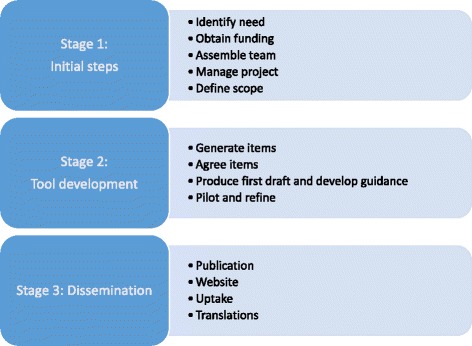
BACKGROUND: Assessment of the quality of included studies is an essential component of any systematic review. A formal quality assessment is facilitated by using a structured tool. There are currently no guidelines available for researchers wanting to develop a new quality assessment tool. METHODS: This paper provides a framework for developing quality assessment tools based on our experiences of developing a variety of quality assessment tools for studies of differing designs over the last 14 years. We have also drawn on experience from the work of the EQUATOR Network in producing guidance for developing reporting guidelines. RESULTS: We do not recommend a single 'best' approach. Instead, we provide a general framework with suggestions as to how the different stages can be approached. Our proposed framework is based around three key stages: initial steps, tool development and dissemination. CONCLUSIONS: We recommend that anyone who would like to develop a new quality assessment tool follow the stages outlined in this paper. We hope that our proposed framework will increase the number of tools developed using robust methods.
Overview
The claims and statistics of this paper haven’t been checked yet.
Free: it reads the open-access text and checks the first 5 claims that cite a source we can check. Create a free account to check every claim.
Integrity signals
Registry
Cites
Statistics
Figures
Verification
Claims the paper makes
The claims and statistics of this paper haven’t been checked yet.
Free: it reads the open-access text and checks the first 5 claims that cite a source we can check. Create a free account to check every claim.
Claims other papers make about this one
Each is checked against this paper’s own text: does it say what the citing paper says it does?
The source backs part of the claim, not all of it — or backs it for a different population, condition or comparison.
In the citing paper
“Existing tools typically take the form of composite scales and domain-based tools.”
From PRISMA 2020 explanation and elaboration: updated guidance and exemplars for reporting systematic reviews (2021) · cites this paper as [85]
Experimental — accuracy not yet measured
Self-check
Percentages, sums and reported differences re-computed from the paper’s own numbers.
The self-check needs the paper’s full text.
Citations
Cites
The Cochrane Collaboration's tool for assessing risk of bias in randomised trials
Higgins, J. P. T., Altman, D. G., Gotzsche, P. C., Juni, P., Moher, D., Oxman, A. D., Savovic, J., Schulz, K. F., Weeks, L., Sterne, J. A. C., et al. (2011) · BMJ · doi:10.1136/bmj.d5928 · Cited by 33,817
Self-citationDermyshi, E., Wang, Y., Yan, C., Hong, W., Qiu, G., Gong, X., & Zhang, T. (2017) · Neonatology · doi:10.1159/000454668 · Cited by 24,451
ROBINS-I: a tool for assessing risk of bias in non-randomised studies of interventions
Sterne, J. A., Hernán, M. A., Reeves, B. C., Savović, J., Berkman, N. D., Viswanathan, M., Henry, D., Altman, D. G., Ansari, M. T., Boutron, I., et al. (2016) · BMJ · doi:10.1136/bmj.i4919 · Cited by 20,329 · cited 6×
“ROBIS, [9] ROBINS-I [11] and Cochrane ROB 2.”
BackgroundMethodInfluentialSelf-citationQUADAS-2: a revised tool for the quality assessment of diagnostic accuracy studies
Whiting, P. F., Rutjes, A. W. S., Westwood, M. E., Mallett, S., Deeks, J. J., Reitsma, J. B., Leeflang, M. M. G., Sterne, J. A. C., Bossuyt, P. M. M., & the QUADAS-2 Group* (2011) · Annals of Internal Medicine · doi:10.7326/0003-4819-155-8-201110180-00009 · Cited by 14,199
Self-citationGRADE guidelines: 3. Rating the quality of evidence
Balshem, H., Helfand, M., Schünemann, H. J., Oxman, A. D., Kunz, R., Brozek, J., Vist, G. E., Falck-Ytter, Y., Meerpohl, J., & Norris, S. (2011) · Journal of Clinical Epidemiology · doi:10.1016/j.jclinepi.2010.07.015 · Cited by 8,285 · cited 1×
“Risk of bias is a key component of this along with publication bias, imprecision, inconsistency, indirectness and magnitude of effect [5, 6].”
BackgroundMoons, K. G. M., Altman, D. G., Reitsma, J. B., Ioannidis, J. P. A., Macaskill, P., Steyerberg, E. W., Vickers, A. J., Ransohoff, D. F., & Collins, G. S. (2015) · Annals of Internal Medicine · doi:10.7326/m14-0698 · Cited by 5,147
Development of AMSTAR: A measurement tool to assess the methodological quality of systematic reviews
Shea, B. J., Grimshaw, J. M., Wells, G. A., Boers, M., Andersson, N., Hamel, C., Porter, A. C., Tugwell, P., Moher, D., & Bouter, L. M. (2007) · BMC Medical Research Methodology · doi:10.1186/1471-2288-7-10 · Cited by 4,374
Whiting, P., Rutjes, A. W., Reitsma, J. B., Bossuyt, P. M., & Kleijnen, J. (2003) · BMC Medical Research Methodology · doi:10.1186/1471-2288-3-25 · Cited by 3,592
Self-citationGRADE guidelines: 4. Rating the quality of evidence—study limitations (risk of bias)
Guyatt, G. H., Oxman, A. D., Vist, G., Kunz, R., Brozek, J., Alonso-Coello, P., Montori, V., Akl, E. A., Djulbegovic, B., & Falck-Ytter, Y. (2011) · Journal of Clinical Epidemiology · doi:10.1016/j.jclinepi.2010.07.017 · Cited by 2,798 · cited 1×
“Risk of bias is a key component of this along with publication bias, imprecision, inconsistency, indirectness and magnitude of effect [5, 6].”
BackgroundROBIS: A new tool to assess risk of bias in systematic reviews was developed
Whiting, P., Savović, J., Higgins, J. P. T., Caldwell, D. M., Reeves, B. C., Shea, B., Davies, P., Kleijnen, J., & Churchill, R. (2016) · Journal of Clinical Epidemiology · doi:10.1016/j.jclinepi.2015.06.005 · Cited by 2,272
Self-citation
Research works printed but not linked: 3
- Higgins JPT, Green S (eds.): Cochrane handbook for systematic reviews of interventions [Internet]. Version 5.1.0 [updated March 2011]: The Cochrane Collaboration; 2011. [accessed 23 Mar 2011].
- Mallett S Wolff R Whiting P Riley R Westwood M Kleinen J Collins G Reitsma H Moons K Methods for evaluating medical tests and biomarkers. 04 prediction model study risk of bias assessment tool (PROBAST) Diagn Prognostic Res 2017 1 1 7
- Whiting P Davies P Savović J Caldwell D Churchill R Evidence to inform the development of ROBIS, a new tool to assess the risk of bias in systematic reviews 2013
Cited by
Page, M. J., Moher, D., Bossuyt, P. M., Boutron, I., Hoffmann, T. C., Mulrow, C. D., Shamseer, L., Tetzlaff, J. M., Akl, E. A., Brennan, S. E., et al. (2021) · BMJ · doi:10.1136/bmj.n160 · Cited by 13,262
Self-citationPROBAST: A Tool to Assess the Risk of Bias and Applicability of Prediction Model Studies
Wolff, R. F., Moons, K. G. M., Riley, R. D., Whiting, P. F., Westwood, M., Collins, G. S., Reitsma, J. B., Kleijnen, J., Mallett, S., & for the PROBAST Group† (2019) · Annals of Internal Medicine · doi:10.7326/m18-1376 · Cited by 2,984
“(31) Guidelines explicitly aimed at the development of quality assessment tools were not available at the time.(32)”
BackgroundSelf-citationHong, Q. N., Gonzalez‐Reyes, A., & Pluye, P. (2018) · Journal of Evaluation in Clinical Practice · doi:10.1111/jep.12884 · Cited by 1,107
Improving the content validity of the mixed methods appraisal tool: a modified e-Delphi study
Hong, Q. N., Pluye, P., Fàbregues, S., Bartlett, G., Boardman, F., Cargo, M., Dagenais, P., Gagnon, M.-P., Griffiths, F., Nicolau, B., et al. (2019) · Journal of Clinical Epidemiology · doi:10.1016/j.jclinepi.2019.03.008 · Cited by 1,082
Page, M. J., Moher, D., Bossuyt, P., Boutron, I., Hoffmann, T., mulrow, C., Shamseer, L., Tetzlaff, J., Akl, E., Brennan, S. E., et al. (2020) · doi:10.31222/osf.io/gwdhk · Cited by 916
Self-citationSchandelmaier, S., Briel, M., Varadhan, R., Schmid, C. H., Devasenapathy, N., Hayward, R. A., Gagnier, J., Borenstein, M., van der Heijden, G. J. M. G., Dahabreh, I. J., et al. (2020) · Canadian Medical Association Journal · doi:10.1503/cmaj.200077 · Cited by 749
QUADAS-C: A Tool for Assessing Risk of Bias in Comparative Diagnostic Accuracy Studies
Yang, B., Mallett, S., Takwoingi, Y., Davenport, C. F., Hyde, C. J., Whiting, P. F., Deeks, J. J., Leeflang, M. M. G., & the QUADAS-C Group† (2021) · Annals of Internal Medicine · doi:10.7326/m21-2234 · Cited by 324
Self-citationAppraising Qualitative Research for Evidence Syntheses: A Compendium of Quality Appraisal Tools
Majid, U., & Vanstone, M. (2018) · Qualitative Health Research · doi:10.1177/1049732318785358 · Cited by 301
“Some researchers believe that using a structured appraisal tool for quality assessment provides an objective evaluation of the rigor of research (Whiting et al., 2017).”
BackgroundPage, M. J., Sterne, J. A. C., Boutron, I., Hróbjartsson, A., Kirkham, J. J., Li, T., Lundh, A., Mayo-Wilson, E., McKenzie, J. E., Stewart, L. A., et al. (2023) · BMJ · doi:10.1136/bmj-2023-076754 · Cited by 134
“We followed the framework for developing risk of bias tools recommended by Whiting et al. 10 A core group (MJP, JACS, and JPTH) coordinated development of the tool, which included assembling the team of collaborators, preparing meeting materials, and leading the drafting and revising of the tool.”
MethodTod, D., Booth, A., & Smith, B. M. (2021) · International Review of Sport and Exercise Psychology · doi:10.1080/1750984x.2021.1952471 · Cited by 172
“Developing or adapting checklists, however, requires similar rigour to other research instruments; requirements typically include a literature review, a nominal group or ‘consensus’ process, and a mechanism for item selection (Whiting et al., 2017).”
Guni, A., Sounderajah, V., Whiting, P. F., Bossuyt, P. M., Darzi, A. W., & Ashrafian, H. (2024) · JMIR Research Protocols · doi:10.2196/58202 · Cited by 100
Self-citationLaw, E. L., & Heintz, M. (2021) · International Journal of Child-Computer Interaction · doi:10.1016/j.ijcci.2021.100321 · Cited by 116
Munthe‐Kaas, H. M., Glenton, C., Booth, A., Noyes, J., & Lewin, S. A. (2019) · BMC Medical Research Methodology · doi:10.1186/s12874-019-0728-6 · Cited by 108
Bahadoran, Z., Mirmiran, P., Kashfi, K., & Ghasemi, A. (2020) · Journal of the American Association for Laboratory Animal Science · doi:10.30802/aalas-jaalas-19-000139 · Cited by 58
A unified framework for bias assessment in clinical research
Stone, J. C., Glass, K., Clark, J., Munn, Z., Tugwell, P., & Doi, S. A. R. (2019) · International Journal of Evidence-Based Healthcare · doi:10.1097/xeb.0000000000000165 · Cited by 40
Initiating Palliative Care Referrals in Pediatric Oncology
Cuviello, A., Raisanen, J. C., Donohue, P., Wiener, L. S., & Boss, R. D. (2020) · Journal of Pain and Symptom Management · doi:10.1016/j.jpainsymman.2020.07.008 · Cited by 54
Triggers for Palliative Care Referral in Pediatric Oncology
Cuviello, A., Yip, C., Battles, H. B., Wiener, L. S., & Boss, R. D. (2021) · Cancers · doi:10.3390/cancers13061419 · Cited by 35
The Nordic Nutrition Recommendations 2022 – structure and rationale of qualified systematic reviews
Arnesen, E., Christensen, J. J., Andersen, R., Eneroth, H., Erkkola, M., Høyer, A., Lemming, E. W., Meltzer, H. M., Halldorsson, T. I., Þórsdóttir, I., et al. (2020) · Food & Nutrition Research · doi:10.29219/fnr.v64.4403 · Cited by 32
Risk of Bias in Network Meta-Analysis (RoB NMA) tool
Lunny, C., Higgins, J. P. T., White, I. R., Dias, S., Hutton, B., Wright, J. M., Veroniki, A. A., Whiting, P. F., & Tricco, A. C. (2025) · BMJ · doi:10.1136/bmj-2024-079839 · Cited by 41
Self-citationSignal, N., Gomes, E., Olsen, S., & Alder, G. (2024) · BMJ Open · doi:10.1136/bmjopen-2024-084320 · Cited by 47
Lu, C., Ke, L., Li, J., Wu, S., Feng, L., Wang, Y., Mentis, A. A., Xu, P., Zhao, X., & Yang, K. (2022) · Frontiers in Pharmacology · doi:10.3389/fphar.2021.797753 · Cited by 30
Lunny, C., Thirugnanasampanthar, S. S., Kanji, S., Ferri, N., Pieper, D., Whitelaw, S., Tasnim, S., Nelson, H. H., Reid, E. K., Zhang, J. H., et al. (2022) · BMC Medical Research Methodology · doi:10.1186/s12874-022-01750-2 · Cited by 27
A Systematic Review of Cognition in Cervical Dystonia
O’Connor, S. S., Hevey, D., Burke, T., Rafee, S., Pender, N. P., & O’Keeffe, F. M. (2023) · Neuropsychology Review · doi:10.1007/s11065-022-09558-z · Cited by 27
“It is important to note that there is no current gold standard tool for assessing the quality of an individual study, that there are limitations to the use of different tools and that the quality can be under or overestimated (Mallen et al., 2006 ; Whiting et al., 2017).”
Verhoef, N. C., & Blomme, R. J. (2022) · Frontiers in Psychology · doi:10.3389/fpsyg.2022.1064889 · Cited by 27
“This makes it possible to compare studies based on the risk of bias (Whiting et al., 2017).”
BackgroundCampbell, F., Weeks, L., Booth, A., Kaunelis, D., & Smith, A. L. (2019) · Journal of Clinical Epidemiology · doi:10.1016/j.jclinepi.2019.05.032 · Cited by 26
Fabbri, A., Rasmussen, K., Hróbjartsson, A., & Lundh, A. (2021) · International Journal of Health Policy and Management · doi:10.34172/ijhpm.2021.12 · Cited by 24
Heise, T. L., Seidler, A., Girbig, M., Freiberg, A., Alayli, A., Fischer, M., Haß, W., & Zeeb, H. (2022) · BMC Medical Research Methodology · doi:10.1186/s12874-022-01821-4 · Cited by 20
A meta-analysis of teacher well-being: A job demands and resources perspective
Li, Y., Chen, J., Lu, J., & Wang, X. (2025) · Educational Research Review · doi:10.1016/j.edurev.2025.100719 · Cited by 19
Signal, N., Olsen, S., Gomes, E., McGeorge, C., Taylor, D., & Alder, G. (2024) · BMJ Open · doi:10.1136/bmjopen-2024-084319 · Cited by 30
“24 Furthermore, they provided advice and confirmed consensus decisions, including the termination of survey rounds.”
Lunny, C., Veroniki, A. A., Hutton, B., White, I. R., Higgins, J. P. T., Wright, J. M., Kim, J. Y., Thirugnanasampanthar, S. S., Siddiqui, S., Watt, J. A., et al. (2022) · BMJ Evidence-Based Medicine · doi:10.1136/bmjebm-2022-111944 · Cited by 22
Lunny, C., Veroniki, A. A., Higgins, J. P. T., Dias, S., Hutton, B., Wright, J. M., White, I. R., Whiting, P. F., & Tricco, A. C. (2024) · Systematic Reviews · doi:10.1186/s13643-023-02388-x · Cited by 21
“Guidance on how to develop quality and risk of bias tools has been proposed by Moher [26] and Whiting [27], and one of their first recommended steps is to create a systematically developed list of bias items.”
BackgroundMethodSelf-citationProposal for a critical appraisal tool for studies using the Delphi method (DCAT)
Grant, S., & Khodyakov, D. (2025) · BMJ · doi:10.1136/bmj-2025-084509 · Cited by 28
Reven, M. E., Bowles, E. J., Audia, D., Cohen, M., Joswiak, D., Lee, B. A. K., May-Fitzgerald, A. C., Peppers-Citizen, M., Resnick, J., Tomaino, J. M., et al. (2023) · Journal of Integrative and Complementary Medicine · doi:10.1089/jicm.2023.0006 · Cited by 16
“Creation of the TREATS followed a similar three-stage process of a peer-reviewed framework for creation of quality assessment checklists as outlined by Whiting et al. The three stages are (1) assessment of need/interest, (2) development, and (3) dissemination 9 (Fig.”
Sun, M., Yang, Z., Wu, Q., Li, Y.-Z., Li, X., Liu, F.-H., Wei, Y., Wen, Z.-Y., Lin, B., & Gong, T. (2022) · Frontiers in Medicine · doi:10.3389/fmed.2022.842002 · Cited by 15
Jiu, L., Hartog, M., Wang, J., Vreman, R. A., Klungel, O. H., Mantel-Teeuwisse, A. K., & Goettsch, W. (2024) · BMJ Open · doi:10.1136/bmjopen-2023-075173 · Cited by 16
“25 For the content analysis, we adopted both deductive and inductive coding techniques.”
MethodVo, T., Cashin, A. G., Superchi, C., Tu, P. H. T., Nguyen, T., Boutron, I., MacKinnon, D. P., VanderWeele, T. J., Lee, H., & Vansteelandt, S. (2021) · Journal of Clinical Epidemiology · doi:10.1016/j.jclinepi.2021.12.013 · Cited by 21
Jung, A., Braun, T., Armijo-Olivo, S. L., Challoumas, D., & Luedtke, K. (2023) · Research Synthesis Methods · doi:10.1002/jrsm.1688 · Cited by 15
“Whiting et al. 40 published a framework with recommendations for developing quality assessment tools.”
BackgroundRelationship Between Chronic Obstructive Pulmonary Disease and Osteoporosis: A Scoping Review
Penedones, A., Mendes, D., Alves, C., Filipe, A., de Oliveira, T. T., & Marques, F. B. (2024) · COPD Journal of Chronic Obstructive Pulmonary Disease · doi:10.1080/15412555.2024.2356510 · Cited by 16
“This makes difficult to assess the representativeness of the results and, consequently, to extrapolate them into clinical practice [45].”
Lunny, C., Tricco, A. C., Veroniki, A. A., Dias, S., Hutton, B., Salanti, G., Wright, J. M., White, I. R., & Whiting, P. F. (2021) · BMJ Open · doi:10.1136/bmjopen-2020-045987 · Cited by 17
Self-citationA scoping review of knowledge syntheses in the field of evaluation across four decades of practice
Lawarée, J., Jacob, S., & Ouimet, M. (2019) · Evaluation and Program Planning · doi:10.1016/j.evalprogplan.2019.101761 · Cited by 12
Rendell, N., Rosewell, A. E., Lokuge, K., & Field, E. J. (2022) · International Journal of Health Policy and Management · doi:10.34172/ijhpm.2022.6239 · Cited by 15
Farhart, P. J., Beakley, D., Diwan, A. D., Duffield, R., Rodriguez, E., Chamoli, U., & Watsford, M. L. (2023) · BMC Sports Science Medicine and Rehabilitation · doi:10.1186/s13102-023-00732-1 · Cited by 15
“The Cochrane Risk of Bias Tool recommends when assessing the risk of bias in studies, it is advisable to select a tool that does not present assessments as summary numerical scores [27], as these have been demonstrated to be poor indicators of study quality [28].”
BackgroundNikolic, M., Konić‐Ristić, A., González‐Sarrías, A., Istas, G., Urpí-Sardà, M., Dall’Asta, M., Monfoulet, L., Cloetens, L., Bayram, B., Tumolo, M. R., et al. (2019) · European Journal of Nutrition · doi:10.1007/s00394-019-02069-3 · Cited by 11
“Other available and relevant recommendations on designing tools and general guidelines in the area of medical research, reporting on research data but also the dissemination of outcomes and medical practice [28, 29], were also taken into account.”
BackgroundMerino, M., del Barrio, J., Nuño-Solínis, R., & Rodríguez, M. E. (2024) · Digital Health · doi:10.1177/20552076241277438 · Cited by 23
McDermott, K., Perry, M., Linden, W., Croft, R., Wolff, R. F., & Kleijnen, J. (2024) · Systematic Reviews · doi:10.1186/s13643-024-02552-x · Cited by 13
“These components fundamentally regulate the notion of ‘quality’, and the impact of quality at the most explicit level, being concerned with the question of ‘to what extent can SR data be used and trusted to answer a particular question [9].’”
BackgroundSelf-citationNagendrababu, V., Abbott, P. V., Boutsioukis, C., Duncan, H. F., Faggion, C. M., Kishen, A., Murray, P. E., Pulikkotil, S. J., & Dummer, P. M. H. (2022) · International Endodontic Journal · doi:10.1111/iej.13682 · Cited by 12
Protocol for designing INVITES-IN, a tool for assessing the internal validity of in vitro studies
Svendsen, C., Whaley, P., Vist, G. E., Husøy, T., Beronius, A., Consiglio, E. D., Druwe, I. L., Härtung, T., Hatzi, V. I., Hoffmann, S., et al. (2023) · Evidence-Based Toxicology · doi:10.1080/2833373x.2023.2232415 · Cited by 12
“The approach chosen fulfils the framework for developing quality assessment tools (Whiting et al. 2017), which is to our knowledge the only existing framework for how to develop quality appraisal tools.”
MethodHotel career research: a systematic literature review
Akosa, F., Huang, S. S., Abadi, H. A., & Wen, J. (2024) · Current Issues in Tourism · doi:10.1080/13683500.2024.2428762 · Cited by 9
“Quality and bias assessment of the 124 screened articles was essential for the review’s robustness (Tricco et al., 2018; Whiting et al., 2017).”
Liu, C., Chu, H., Li, G., He, J., Ma, Y. L., Du, C., Hai, B., & Zhu, B. (2021) · BMJ Open · doi:10.1136/bmjopen-2021-049902 · Cited by 8
Methodological quality assessment tools for diagnosis and prognosis research: overview and guidance
Kaul, T., Kellerhuis, B. E., Damen, J. A., Schuit, E., Jenniskens, K., van Smeden, M., Reitsma, J. B., Hooft, L., Moons, K. G. M., & Yang, B. (2024) · Journal of Clinical Epidemiology · doi:10.1016/j.jclinepi.2024.111609 · Cited by 10
Barbosa, V. P., Silveira, B. B., dos Santos, J. A., Monteiro, M. M., Coletta, R. D., Canto, G. D. L., Stefani, C. M., & Guerra, E. N. S. (2023) · Research Synthesis Methods · doi:10.1002/jrsm.1657 · Cited by 13
Mwape, A. K., Schmidtke, K. A., & Brown, C. (2022) · PLoS ONE · doi:10.1371/journal.pone.0267305 · Cited by 8
A comprehensive item bank of internal validity issues of relevance to in vitro toxicology studies
Vist, G. E., Ames, H. M. R., Mathisen, G. H., Husøy, T., Svendsen, C., Beronius, A., Consiglio, E. D., Druwe, I. L., Härtung, T., Hoffmann, S., et al. (2024) · Evidence-Based Toxicology · doi:10.1080/2833373x.2024.2418045 · Cited by 5
“Through our normalisation process we believe we advance on the methods recommended by Whiting et al. (2017) and used by Page et al. (2020).”
Mathisen, G. H., Vist, G. E., Whaley, P., White, R. A., Husøy, T., Ames, H. M., Beronius, A., Consiglio, E. D., Druwe, I. L., Härtung, T., et al. (2023) · Evidence-Based Toxicology · doi:10.1080/2833373x.2023.2293289 · Cited by 5
The development of a cultural validity assessment tool for First Nations people
O’Gradey‐Lee, M., Schultz, C., & Hudson, J. L. (2025) · Australian & New Zealand Journal of Psychiatry · doi:10.1177/00048674251393167 · Cited by 4
“Following the publication of the Meta-Analysis Reporting Standards (MARS), quality assessments using structured tools within standardised frameworks has gained recognition and implementation (Whiting et al., 2017).”
InfluentialMathisen, G. H., Svendsen, C., Vist, G. E., Husøy, T., Ames, H. M., Bearth, A., Audebert, M., Bernhard, A., Beronius, A., Bruzell, E. M., et al. (2025) · Evidence-Based Toxicology · doi:10.1080/2833373x.2025.2551013 · Cited by 3
Okeke-Uzodike, O. E., & Ngo-Henha, P. E. (2025) · Administrative Sciences · doi:10.3390/admsci15030092 · Cited by 18
Zile, A., Owen, J., Gorick, H., Orford, A., & Panagiotaki, G. (2025) · Journal of Medical Education and Curricular Development · doi:10.1177/23821205251320152 · Cited by 3
“…of evidence is essential when carrying out systematic reviews or making recommendations for future development of services and interventions, 41,42 the fi ndings of our review regarding the mixed quality of the current literature point towards a need to consider these issues in depth before…”
Faltinsen, E. G., Østengaard, L., Boutron, I., Stewart, L. A., Hróbjartsson, A., & Lundh, A. (2025) · Journal of Clinical Epidemiology · doi:10.1016/j.jclinepi.2025.112003 · Cited by 5
Creation of an online inventory for choosing critical appraisal tools
Hong, Q. N., Bouix‐Picasso, J., & Ruchon, C. (2022) · Education for Information · doi:10.3233/efi-211567 · Cited by 3
Naidoo, M. M., Brijlal, P., Cader, R., Gordon, N., Rayner, C. A., & Viljoen, K. (2022) · BMC Oral Health · doi:10.1186/s12903-022-02498-3 · Cited by 3
Alashram, A. R. (2024) · Applied Neuropsychology Adult · doi:10.1080/23279095.2024.2306133 · Cited by 3
“Bias or systematic error has the potential to either inflate or underestimate the ‘true’ effect of an intervention or exposure (Whiting et al., 2017).”
Whiting, P. F., Wolff, R. F., Savović, J., Devine, B., & Mallett, S. (2024) · Journal of Clinical Epidemiology · doi:10.1016/j.jclinepi.2024.111486 · Cited by 4
Self-citationDonkor, A., Luckett, T., Aranda, S. K., Vanderpuye, V. D. N. K., & Phillips, J. L. (2020) · Physica Medica · doi:10.1016/j.ejmp.2020.02.015 · Cited by 4
Systematic Review and Meta-Analysis
Eliya, Y., Zakharia, A., Gazendam, A., & de SA, D. L. (2023) · Springer eBooks · doi:10.1007/978-3-030-65430-6_80-1 · Cited by 3
Alashram, A. R. (2025) · Journal of Bodywork and Movement Therapies · doi:10.1016/j.jbmt.2025.03.010 · Cited by 2
Hong, Q. N., & Brunton, G. (2025) · Education for Information · doi:10.1177/01678329251323445 · Cited by 2
“A large number of risk of bias and critical appraisal tools have been developed over the past decades, which make it challenging to choose the most appropriate tools to use (Munthe-Kaas et al., 2019; Quigley et al., 2019; Whiting et al., 2017).”
AMSTAR-PF: a critical appraisal tool for systematic reviews of prognostic factor studies
Henry, M. L., O'Connell, N. E., Riley, R. D., Moons, K. G. M., Shea, B., Hooft, L., Damen, J. A., Skoetz, N., Wallwork, S. B., & Moseley, G. L. (2025) · BMJ · doi:10.1136/bmj-2025-085718 · Cited by 2
“We developed AMSTAR-PF using a rigorous, multistage design and validation process, which aligned with recommendations for developing quality assessment tools, 31 and had input from diverse international experts within and external to the core research group.”
InfluentialYan, S., Guyatt, G. H., Ren, X., Alonso‐Coello, P., Dahm, P., Huang, Q. Y., Wang, Y., Jin, Y., & Yao, X. (2026) · Journal of Clinical Epidemiology · doi:10.1016/j.jclinepi.2026.112186 · Cited by 2
STrategies for developing REseArch Methods guidance (STREAM): Protocol
Chiaborelli, M., Hirt, J., Briel, M., Shiely, F., Boulesteix, A., Guyatt, G. H., Bretz, F., Moher, D., Stewart, D., & Schandelmaier, S. (2026) · Journal of Clinical Epidemiology · doi:10.1016/j.jclinepi.2026.112184 · Cited by 3
Rajbhoj, A. A., Speyer, R., Crèvecoeur, I., Begnoni, G., Willems, G., & de Llano‐Pérula, M. C. (2022) · Archaeometry · doi:10.1111/arcm.12786 · Cited by 3
Antimicrobial Activities of Mangrove Species in Southeast Asia: A Systematic Review
CARNAJE, M. M. D. D. C., REBENQUE, J. D. T., & Lirio, G. A. (2023) · Jurnal Sains Kesihatan Malaysia · doi:10.17576/jskm-2023-2102-08 · Cited by 3
A guide to evaluating systematic reviews for the busy clinicians or reluctant readers
Innes, S. I., & Leboeuf‐Yde, C. (2023) · Chiropractic & Manual Therapies · doi:10.1186/s12998-023-00501-4 · Cited by 3
“, clinical trials, outcome, qualitative and animal experimentation studies) [15].”
BackgroundDu, F. Y., Chng, S., Suhaila, Z. S., & Neo, H. (2025) · International Journal of Public Administration · doi:10.1080/01900692.2025.2485247 · Cited by 6
Moving towards a standards-based methodological quality assessment scheme for clinical research
Stone, J., & Doi, S. A. R. (2019) · International Journal of Evidence-Based Healthcare · doi:10.1097/xeb.0000000000000170 · Cited by 2
Lunny, C., Thirugnanasampanthar, S. S., Kanji, S., Ferri, N., Pieper, D., Whitelaw, S., Tasmin, S., Nelson, H. H., Reid, E. K., Zhang, J. H., et al. (2021) · Research Square · doi:10.21203/rs.3.rs-1143357/v1 · Cited by 2
Evidence Communication Rules for Policy (ECR-P) critical appraisal tool
Danopoulos, E., Aston, J. A. D., Shah, A., & Schneider, C. R. (2025) · Systematic Reviews · doi:10.1186/s13643-025-02757-8 · Cited by 3
“The development of ECR-P was guided by a published framework for developing quality assessment tools [21] and established methods of evidence-based research [4, 5, 22].”
Reven, M. E., Bowles, E. J., Ablard, K., Peppers-Citizen, M., May-Fitzgerald, A. C., Joswiak, D., & Unger, B. (2025) · PLoS ONE · doi:10.1371/journal.pone.0318379 · Cited by 3
Bardon, L. A., Bennett, G., Weech, M., Hwang, F., Kelly, E. F. A., Lovegrove, J. A., Panov, P., ASTLEY, S. B., Finglas, P. M., & Gibney, E. R. (2025) · Frontiers in Nutrition · doi:10.3389/fnut.2025.1519401 · Cited by 1
O’Shea, L., Corbally, M., & Daly, D. (2025) · PLoS ONE · doi:10.1371/journal.pone.0303407 · Cited by 1
“Assessment of methodological quality of studies included in a QES can provide useful information on the robustness of the conduct of studies and the credibility of conclusions and increase understanding of the transferability of the findings [28].”
Katsapi, A., Karanikas, H., Kaitelidou, D., Thireos, E., Karaiskou, A., Tsana, M. A., & Rizos, F. (2025) · International Journal for Quality in Health Care · doi:10.1093/intqhc/mzaf068 · Cited by 1
“The development of the MaQPS tool was based on three core steps of existing methodologies, in particular the QUADAS series [8], and additional concrete elements for advancing the effectiveness of the tool.”
Developing a quality assessment rubric for online videos used for teaching procedural skills
Srinivasa, K. K., Moir, F., Henning, M. A., Chen, Y., & Goodyear‐Smith, F. (2025) · Medical Teacher · doi:10.1080/0142159x.2025.2603349 · Cited by 2
“Additionally, current non-standardised assessment methods or author-modified assessment systems [14], introduce potential bias by including inappropriate assessment items or overemphasising subjective opinions, thus limiting reproducibility [15].”
Liu, X., Peng, Y., Li, N., Tang, X., Cai, S., Yan, R., Zhang, C., Chen, G., Chen, Y., Huang, L., et al. (2025) · Journal of Evidence-Based Medicine · doi:10.1111/jebm.70106 · Cited by 3
Hoare, E., Harrison, M., Timperley, S., Riordan, J., Rowlings, J., Hedley, D., Brown, C. M., Bennett, B., John, T., Upward, K., et al. (2026) · Neurodiversity · doi:10.1177/27546330261464728 · Cited by 1
The Impact of Childhood Neglect on Cognition in School-Aged Children
Trainor, G. (2021) · Biomedical Journal of Scientific & Technical Research · doi:10.26717/bjstr.2021.34.005629 · Cited by 2
(2021) · International Journal of Development Research · doi:10.37118/ijdr.20837.06.2021 · Cited by 1
O’Leary, R., & Costanzo, F. D. (2020) · medRxiv · doi:10.1101/2020.05.25.20112524 · Cited by 1
Clinical Decision-Making by Acute Medicine Advanced Nurse Practitioners
Barnard, J. (2019) · Sheffield Hallam University · doi:10.7190/shu-thesis-00281 · Cited by 5
Lunny, C., Veroniki, A. A., Higgins, J. P. T., Dias, S., Hutton, B., Wright, J. M., White, I. R., Whiting, P. F., & Tricco, A. C. (2022) · Research Square · doi:10.21203/rs.3.rs-2010358/v1 · Cited by 1
Self-citationJiu, L., Wang, J., Kamusheva, M., Dimitrova, M. J., Tachkov, K., Milushewa, P., Mitkova, Z. E., Petrova, G. I., Vreman, R. A., Mantel-Teeuwisse, A. K., et al. (2023) · Research Square · doi:10.21203/rs.3.rs-2223544/v1 · Cited by 2
Lunny, C., Veroniki, A. A., Higgins, J. P. T., Dias, S., Hutton, B., Wright, J. M., White, I. R., Whiting, P. F., & Tricco, A. C. (2023) · Research Square · doi:10.21203/rs.3.rs-2010358/v2 · Cited by 1
Self-citationAgile Scrum in Monitoring DepEd's Programs, Projects and Activities (PPA)
Timbal, M. A. (2019) · International Conference on Education and Multimedia Technology (ICEMT) · doi:10.1145/3345120.3345125
“[1] in their study express that a formal quality assessment is facilitated by using a structured tool, a convenient standardized way to assess key components of quality that has been considered by an organization in achieving success.”
MethodLunny, C., Thirugnanasampanthar, S. S., Kanji, S., Ferri, N., Pieper, D., Whitelaw, S., Tasmin, S., Nelson, H. H., Reid, E. K., Zhang, J. H., et al. (2022) · Research Square · doi:10.21203/rs.3.rs-1143357/v2
Lunny, C., Thirugnanasampanthar, S. S., Kanji, S., Ferri, N., Pieper, D., Whitelaw, S., Tasnim, S., Reid, E. K., Zhang, J. H., Kalkat, B., et al. (2022) · Research Square · doi:10.21203/rs.3.rs-1143357/v3
Tools for assessing the methodological limitations of a QES—a short note
Nøkleby, H., Ames, H. M. R., Langøien, L. J., & Hestevik, C. H. (2024) · Systematic Reviews · doi:10.1186/s13643-024-02511-6 · Cited by 1
“None of them have been developed through best practice meth-ods [6, 7].”
BackgroundSuyasa, P. W. A., Divayana, D. G. H., & Ariawan, I. P. W. (2024) · AIP conference proceedings · doi:10.1063/5.0214097
Evidence Communication Rules for Policy (ECR-P) critical appraisal toolPreprint
Danopoulos, E., Aston, J. A. D., Shah, A., & Schneider, C. R. (2024) · doi:10.31235/osf.io/shwfu
Staibano, P., McKechnie, T., Thabane, A., Olteanu, D., Nanji, K., Zhang, H., Lunny, C., Au, M., Gupta, M. K., Pasternak, J. D., et al. (2024) · PLoS ONE · doi:10.1371/journal.pone.0303315
“Our final knowledge translation strategy will include publication and presentation of the final tool, housing the tool in an accessible website, and providing training sessions and webinars to future tool users [29].”
InfluentialQuality Assessment Group for Quantitative Research, S. R. A. G. O. C. G. P. (2024) · Chinese general practice journal. · doi:10.1016/j.cgpj.2024.11.004
Metadata
- Authors
- Whiting, P., Wolff, R., Mallett, S., Simera, I., & Savović, J.
- Affiliations
- University Hospitals Bristol NHS Foundation Trust (GB)
- Kleijnen Systematic Reviews (United Kingdom) (GB)
- National Institute for Health and Care Research (GB)
- University of Oxford (GB)
- Corresponding author
- Whiting, Penny
- Venue
- Systematic Reviews
- Published
- 2017-10-17
- Volume
- 6
- Issue
- 1
- Pages
- 204-204
- ISSN
- 2046-4053 (ISSN-L)
- PMC
- PMC5646161
- OpenAlex
- W2766749648
- Cited by
- 121
- References
- 21
- Citations by year
- 2026: 19 · 2025: 20 · 2024: 19 · 2023: 14 · 2022: 16 · 2021: 13 · 2020: 8 · 2019: 9 · 2018: 3
- FWCI
- 4.85
- Type
- journal article
- Language
- en
- Open access
- gold
- doi.org
- Licence
- cc-by
- Locations
- Systematic Reviews (publishedVersion, cc-by)
- PubMed Central (publishedVersion, cc-by)
- PubMed (publishedVersion)
- Explore Bristol Research (publishedVersion, cc-by)
- DOAJ (DOAJ: Directory of Open Access Journals) (submittedVersion)
- University of Birmingham Research Portal (University of Birmingham) (submittedVersion, cc-by)
- Funders
- Medical Research Council (G0801405/1, MR/K01465X/1, MR/L004933/1- N61, MR/K025643/1)
- NIHR CLAHRC West
- NIHR Birmingham Biomedical Research Centre
- Topics
- Social Sciences › Decision Sciences › Statistics, Probability and Uncertainty › Meta-analysis and systematic reviews
- Social Sciences › Sociology and Political Science › Delphi Technique in Research
- Health Sciences › Medicine › Public Health, Environmental and Occupational Health › Clinical practice guidelines implementation
- Keywords
- quality assessment tools, study quality assessment, reporting guidelines, EQUATOR Network, research methodology
- MeSH terms
- Humans, Quality Control, Surveys and Questionnaires, Research Design, Review Literature as Topic, Bias, Biomedical Research
About these checks
Registry, retraction, Cites and statistics results are computed, not judged, with one exception: a printed reference that no index lists is read once by a model before it counts as a citation error. Claims are extracted by a model and kept only when their quote appears verbatim in the text; each cited source is then checked, with a model’s help, for whether it says what the claim relies on. Those verdicts can be wrong — read the claim’s quote and the cited source before relying on one.
Statistics and arithmetic are recomputed, not judged.
Confidence bands are shown only for fields calibrated on our annotated test set. None is calibrated yet, so no band is shown.
What counts as a claim ›How we measure confidence ›How we check this ›
Are you an author, or do you see a problem with this page? Request a review
Data sources
Bibliographic data: Semantic Scholar, OpenAlex, Crossref.
Contains information from the Semantic Scholar Academic Graph Datasets, made available under the ODC Attribution License (ODC-BY 1.0).
Semantic Scholar’s data is described in: Kinney, R., et al. (2023). The Semantic Scholar Open Data Platform. arXiv:2301.10140.
