

A proposed framework for developing quality assessment tools
Open accessThe DOI matches its Crossref record; 22 of the 22 references it cites were found in a registry or an index.
Abstract
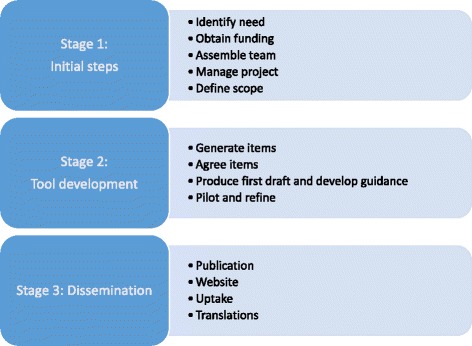
BACKGROUND: Assessment of the quality of included studies is an essential component of any systematic review. A formal quality assessment is facilitated by using a structured tool. There are currently no guidelines available for researchers wanting to develop a new quality assessment tool. METHODS: This paper provides a framework for developing quality assessment tools based on our experiences of developing a variety of quality assessment tools for studies of differing designs over the last 14 years. We have also drawn on experience from the work of the EQUATOR Network in producing guidance for developing reporting guidelines. RESULTS: We do not recommend a single 'best' approach. Instead, we provide a general framework with suggestions as to how the different stages can be approached. Our proposed framework is based around three key stages: initial steps, tool development and dissemination. CONCLUSIONS: We recommend that anyone who would like to develop a new quality assessment tool follow the stages outlined in this paper. We hope that our proposed framework will increase the number of tools developed using robust methods.
Overview
The claims and statistics of this paper haven’t been checked yet.
Free: it reads the open-access text and checks the first 5 claims that cite a source we can check. Create a free account to check every claim.
Integrity signals
Registry
Cites
Statistics
Figures
Verification
Claims the paper makes
The claims and statistics of this paper haven’t been checked yet.
Free: it reads the open-access text and checks the first 5 claims that cite a source we can check. Create a free account to check every claim.
Claims other papers make about this one
Each is checked against this paper’s own text: does it say what the citing paper says it does?
The source backs part of the claim, not all of it — or backs it for a different population, condition or comparison.
In the citing paper
“Existing tools typically take the form of composite scales and domain-based tools.”
From PRISMA 2020 explanation and elaboration: updated guidance and exemplars for reporting systematic reviews (2021) · cites this paper as [85]
Experimental — accuracy not yet measured
Self-check
Percentages, sums and reported differences re-computed from the paper’s own numbers.
The self-check needs the paper’s full text.
Citations
Cites
The Cochrane Collaboration's tool for assessing risk of bias in randomised trials
Higgins, J. P. T., Altman, D. G., Gotzsche, P. C., Juni, P., Moher, D., Oxman, A. D., Savovic, J., Schulz, K. F., Weeks, L., Sterne, J. A. C., et al. (2011) · BMJ · doi:10.1136/bmj.d5928 · Cited by 33,817
Self-citationDermyshi, E., Wang, Y., Yan, C., Hong, W., Qiu, G., Gong, X., & Zhang, T. (2017) · Neonatology · doi:10.1159/000454668 · Cited by 24,451
ROBINS-I: a tool for assessing risk of bias in non-randomised studies of interventions
Sterne, J. A., Hernán, M. A., Reeves, B. C., Savović, J., Berkman, N. D., Viswanathan, M., Henry, D., Altman, D. G., Ansari, M. T., Boutron, I., et al. (2016) · BMJ · doi:10.1136/bmj.i4919 · Cited by 20,329 · cited 6×
“ROBIS, [9] ROBINS-I [11] and Cochrane ROB 2.”
BackgroundMethodInfluentialSelf-citationQUADAS-2: a revised tool for the quality assessment of diagnostic accuracy studies
Whiting, P. F., Rutjes, A. W. S., Westwood, M. E., Mallett, S., Deeks, J. J., Reitsma, J. B., Leeflang, M. M. G., Sterne, J. A. C., Bossuyt, P. M. M., & the QUADAS-2 Group* (2011) · Annals of Internal Medicine · doi:10.7326/0003-4819-155-8-201110180-00009 · Cited by 14,199
Self-citationGRADE guidelines: 3. Rating the quality of evidence
Balshem, H., Helfand, M., Schünemann, H. J., Oxman, A. D., Kunz, R., Brozek, J., Vist, G. E., Falck-Ytter, Y., Meerpohl, J., & Norris, S. (2011) · Journal of Clinical Epidemiology · doi:10.1016/j.jclinepi.2010.07.015 · Cited by 8,285 · cited 1×
“Risk of bias is a key component of this along with publication bias, imprecision, inconsistency, indirectness and magnitude of effect [5, 6].”
BackgroundMoons, K. G. M., Altman, D. G., Reitsma, J. B., Ioannidis, J. P. A., Macaskill, P., Steyerberg, E. W., Vickers, A. J., Ransohoff, D. F., & Collins, G. S. (2015) · Annals of Internal Medicine · doi:10.7326/m14-0698 · Cited by 5,147
Development of AMSTAR: A measurement tool to assess the methodological quality of systematic reviews
Shea, B. J., Grimshaw, J. M., Wells, G. A., Boers, M., Andersson, N., Hamel, C., Porter, A. C., Tugwell, P., Moher, D., & Bouter, L. M. (2007) · BMC Medical Research Methodology · doi:10.1186/1471-2288-7-10 · Cited by 4,374
Whiting, P., Rutjes, A. W., Reitsma, J. B., Bossuyt, P. M., & Kleijnen, J. (2003) · BMC Medical Research Methodology · doi:10.1186/1471-2288-3-25 · Cited by 3,592
Self-citationGRADE guidelines: 4. Rating the quality of evidence—study limitations (risk of bias)
Guyatt, G. H., Oxman, A. D., Vist, G., Kunz, R., Brozek, J., Alonso-Coello, P., Montori, V., Akl, E. A., Djulbegovic, B., & Falck-Ytter, Y. (2011) · Journal of Clinical Epidemiology · doi:10.1016/j.jclinepi.2010.07.017 · Cited by 2,798 · cited 1×
“Risk of bias is a key component of this along with publication bias, imprecision, inconsistency, indirectness and magnitude of effect [5, 6].”
BackgroundROBIS: A new tool to assess risk of bias in systematic reviews was developed
Whiting, P., Savović, J., Higgins, J. P. T., Caldwell, D. M., Reeves, B. C., Shea, B., Davies, P., Kleijnen, J., & Churchill, R. (2016) · Journal of Clinical Epidemiology · doi:10.1016/j.jclinepi.2015.06.005 · Cited by 2,272
Self-citation
Research works printed but not linked: 3
- Higgins JPT, Green S (eds.): Cochrane handbook for systematic reviews of interventions [Internet]. Version 5.1.0 [updated March 2011]: The Cochrane Collaboration; 2011. [accessed 23 Mar 2011].
- Mallett S Wolff R Whiting P Riley R Westwood M Kleinen J Collins G Reitsma H Moons K Methods for evaluating medical tests and biomarkers. 04 prediction model study risk of bias assessment tool (PROBAST) Diagn Prognostic Res 2017 1 1 7
- Whiting P Davies P Savović J Caldwell D Churchill R Evidence to inform the development of ROBIS, a new tool to assess the risk of bias in systematic reviews 2013
Cited by
Items 101–119 of 119
A protocol to develop a Quality Assessment Tool for Realist Synthesis (QUATRES)
Mukumbang, F. C., Gilmore, B., Hunter, R. L., Dada, S., Dalkin, S. M., & Booth, A. (2025) · PLoS ONE · doi:10.1371/journal.pone.0332250
“An efficient way to complete such a process is to invite people working on realist syntheses to try out the tool [20].”
Heise, T. L., Seidler, A., Girbig, M., Freiberg, A., Alayli, A., Fischer, M. I., Haß, W., & Zeeb, H. (2023) · Figshare · doi:10.6084/m9.figshare.22612964
Naidoo, M., Brijlal, P., Cader, R., Gordon, N., Rayner, C. A., & Viljoen, K. (2022) · Figshare · doi:10.6084/m9.figshare.21393646
Lunny, C., Veroniki, A. A., Higgins, J. P. T., Dias, S., Hutton, B., Wright, J. M., White, I. R., Whiting, P., & Tricco, A. C. (2024) · Figshare · doi:10.6084/m9.figshare.24993697
Self-citationMethodological gaps and domain imbalances in flipped learning reviews: A critical umbrella review
Arslan, A. N. (2026) · International Journal of Assessment Tools in Education · doi:10.21449/ijate.1692300
“Inadequate quality assessment undermines evidence validity (Whiting et al ., 2017) and becomes an obstacle in comprehensive methodological and evidence quality appraisal (Harrison et al., 2021), particularly challenging for complex pedagogical frameworks like FL that involve multiple components,…”
A systematic review of automatic mapping of clinical terminologies
Anik, M. M., Ahmmed, S., & Mondal, M. R. H. (2026) · Array · doi:10.1016/j.array.2026.100735 · Cited by 2
Ezedigbo, C. (2026) · 3 INTERNATIONAL RESEARCH JOURNAL OF MULTIDISCIPLINARY-PRACTICES PUBLIC AND COMMUNITY HEALTH · doi:10.66001/nyrm1929
Integrated Strategies for Assessing Student Learning in Pre-Clinical Curriculum
Thai, L. S., Prasad, P. D., Moon, H., Ange, B., & Rockich‐Winston, N. (2026) · Medical Science Educator · doi:10.1007/s40670-026-02674-y
Qi, Z., Nimsky, C., & Bopp, M. H. A. (2026) · IEEE International Conference on Artificial Intelligence and eXtended and Virtual Reality (AIxVR) · doi:10.1109/aixvr67263.2026.00039
“Tool development and refinement follow established methodological guidance for QA instrument development and reporting [86], [87].”
Deng, Y.-N., Wu, S.-Q., Luo, X.-F., Tang, B.-B., Feng, Y.-C., Feng, H., Guo, H.-L., Li, Y., Shi, L., Zhi-rui, X. U., et al. (2026) · Evidence-Based Chinese Medicine and Technology Assessment · doi:10.26599/ecmta.2026.9570031
Montaño, V. E., & Reyes, A. (2026) · Journal of Learning Theory and Methodology · doi:10.17309/jltm.2026.7.1.04
“Additionally, a hierarchical structure in educational institutions facilitates leadership and decision-making processes, enabling the implementation of a more systematic and structured assessment method (Whiting et al., 2017).”
Blurring evidence with advocacy: a systematic review of policy recommendations for net zero
Danopoulos, E., Shah, A., Schneider, C. R., & Aston, J. A. D. (2026) · npj Environmental Social Sciences · doi:10.1038/s44432-026-00012-6 · Cited by 2
“The development of the tool was carried out by an inter-disciplinary team and followed a robust and transparent methodology 47,48,51 .”
Li, S., Lai, W. H., Ruan, T., Deng, Y., Li, H., & Xie, R. (2026) · Critical Public Health · doi:10.1080/09581596.2026.2681251
Addressing Conflicts of Interest in Clinical Trials
Lundh, A., & Hróbjartsson, A. (2026) · Springer eBooks · doi:10.1007/978-3-032-27479-3_6
Jonsson, M. L., Gustavell, T., Sissala, N., Babačić, H., & Eriksson, L. E. (2026) · PLoS ONE · doi:10.1371/journal.pone.0352015
“In addition, established principles are followed for conducting scoping reviews [34–36], systematic reviews of the literature [41–43], and review quality assessments [44].”
The Development of the Tool for Rating the qUality of Services sTandards (TRUST)
Bai, Z., Zhu, Y., Gao, X., Shi, N., Cheng, X., Bai, R., Fan, J., Estill, J., Xing, W., Tong, F., et al. (2026) · Journal of Evidence-Based Medicine · doi:10.1111/jebm.70173
“We followed the three-stage framework for developing quality assessment tools proposed by Whiting et al. [ 22 ] (Figure 1 ).”
Development of a tool to assess the risk of bias in statistical simulation studies: study protocol
Arnup, S. J., Turner, S., Page, M. J., Korevaar, E., McDonald, S. J., Higgins, J. P. T., & McKenzie, J. E. (2026) · F1000Research · doi:10.12688/f1000research.184100.1
Risk-of-bias tools for causal inference studies using real-world data: a rapid scoping review
Nieto-Gutiérrez, W., Zapata, S. M., Medina-Ramírez, S. A., & de Val, S. I. (2026) · Journal of Clinical Epidemiology · doi:10.1016/j.jclinepi.2026.112486
Reven, M. E., Ablard, K., Bowles, E. J., Joswiak, D., May-Fitzgerald, A. C., Peppers-Citizen, M., Unger, B., & Quazi, M. A. (2026) · Research Square · doi:10.21203/rs.3.rs-10437580/v1
Metadata
- Authors
- Whiting, P., Wolff, R., Mallett, S., Simera, I., & Savović, J.
- Affiliations
- University Hospitals Bristol NHS Foundation Trust (GB)
- Kleijnen Systematic Reviews (United Kingdom) (GB)
- National Institute for Health and Care Research (GB)
- University of Oxford (GB)
- Corresponding author
- Whiting, Penny
- Venue
- Systematic Reviews
- Published
- 2017-10-17
- Volume
- 6
- Issue
- 1
- Pages
- 204-204
- ISSN
- 2046-4053 (ISSN-L)
- PMC
- PMC5646161
- OpenAlex
- W2766749648
- Cited by
- 121
- References
- 21
- Citations by year
- 2026: 19 · 2025: 20 · 2024: 19 · 2023: 14 · 2022: 16 · 2021: 13 · 2020: 8 · 2019: 9 · 2018: 3
- FWCI
- 4.85
- Type
- journal article
- Language
- en
- Open access
- gold
- doi.org
- Licence
- cc-by
- Locations
- Systematic Reviews (publishedVersion, cc-by)
- PubMed Central (publishedVersion, cc-by)
- PubMed (publishedVersion)
- Explore Bristol Research (publishedVersion, cc-by)
- DOAJ (DOAJ: Directory of Open Access Journals) (submittedVersion)
- University of Birmingham Research Portal (University of Birmingham) (submittedVersion, cc-by)
- Funders
- Medical Research Council (G0801405/1, MR/K01465X/1, MR/L004933/1- N61, MR/K025643/1)
- NIHR CLAHRC West
- NIHR Birmingham Biomedical Research Centre
- Topics
- Social Sciences › Decision Sciences › Statistics, Probability and Uncertainty › Meta-analysis and systematic reviews
- Social Sciences › Sociology and Political Science › Delphi Technique in Research
- Health Sciences › Medicine › Public Health, Environmental and Occupational Health › Clinical practice guidelines implementation
- Keywords
- quality assessment tools, study quality assessment, reporting guidelines, EQUATOR Network, research methodology
- MeSH terms
- Humans, Quality Control, Surveys and Questionnaires, Research Design, Review Literature as Topic, Bias, Biomedical Research
About these checks
Registry, retraction, Cites and statistics results are computed, not judged, with one exception: a printed reference that no index lists is read once by a model before it counts as a citation error. Claims are extracted by a model and kept only when their quote appears verbatim in the text; each cited source is then checked, with a model’s help, for whether it says what the claim relies on. Those verdicts can be wrong — read the claim’s quote and the cited source before relying on one.
Statistics and arithmetic are recomputed, not judged.
Confidence bands are shown only for fields calibrated on our annotated test set. None is calibrated yet, so no band is shown.
What counts as a claim ›How we measure confidence ›How we check this ›
Are you an author, or do you see a problem with this page? Request a review
Data sources
Bibliographic data: Semantic Scholar, OpenAlex, Crossref.
Contains information from the Semantic Scholar Academic Graph Datasets, made available under the ODC Attribution License (ODC-BY 1.0).
Semantic Scholar’s data is described in: Kinney, R., et al. (2023). The Semantic Scholar Open Data Platform. arXiv:2301.10140.
