

Evaluations of the uptake and impact of the Preferred Reporting Items for Systematic reviews and Meta-Analyses (PRISMA) Statement and extensions: a scoping review
Open accessThe DOI matches its Crossref record; 162 of the 163 references it cites were found in a registry or an index.
Abstract
BACKGROUND: The PRISMA Statement is a reporting guideline designed to improve transparency of systematic reviews (SRs) and meta-analyses. Seven extensions to the PRISMA Statement have been published to address the reporting of different types or aspects of SRs, and another eight are in development. We performed a scoping review to map the research that has been conducted to evaluate the uptake and impact of the PRISMA Statement and extensions. We also synthesised studies evaluating how well SRs published after the PRISMA Statement was disseminated adhere to its recommendations. METHODS: We searched for meta-research studies indexed in MEDLINE® from inception to 31 July 2017, which investigated some component of the PRISMA Statement or extensions (e.g. SR adherence to PRISMA, journal endorsement of PRISMA). One author screened all records and classified the types of evidence available in the studies. We pooled data on SR adherence to individual PRISMA items across all SRs in the included studies and across SRs published after 2009 (the year PRISMA was disseminated). RESULTS: We included 100 meta-research studies. The most common type of evidence available was data on SR adherence to the PRISMA Statement, which has been evaluated in 57 studies that have assessed 6487 SRs. The pooled results of these studies suggest that reporting of many items in the PRISMA Statement is suboptimal, even in the 2382 SRs published after 2009 (where nine items were adhered to by fewer than 67% of SRs). Few meta-research studies have evaluated the adherence of SRs to the PRISMA extensions or strategies to increase adherence to the PRISMA Statement and extensions. CONCLUSIONS: Many studies have evaluated how well SRs adhere to the PRISMA Statement, and the pooled result of these suggest that reporting of many items is suboptimal. An update of the PRISMA Statement, along with a toolkit of strategies to help journals endorse and implement the updated guideline, may improve the transparency of SRs.
Overview
The claims and statistics of this paper haven’t been checked yet.
Free: it reads the open-access text and checks the first 5 claims that cite a source we can check. Create a free account to check every claim.
Integrity signals
Registry
Cites
Statistics
Figures
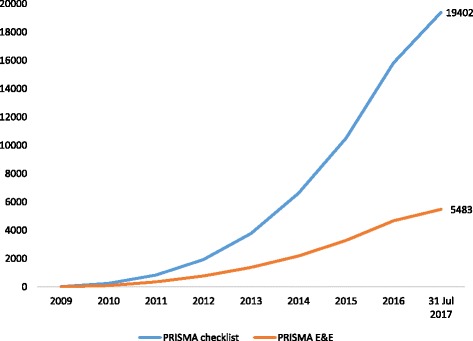
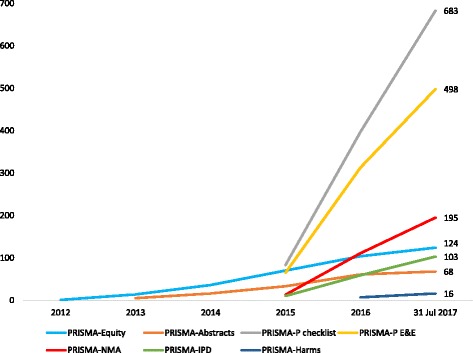
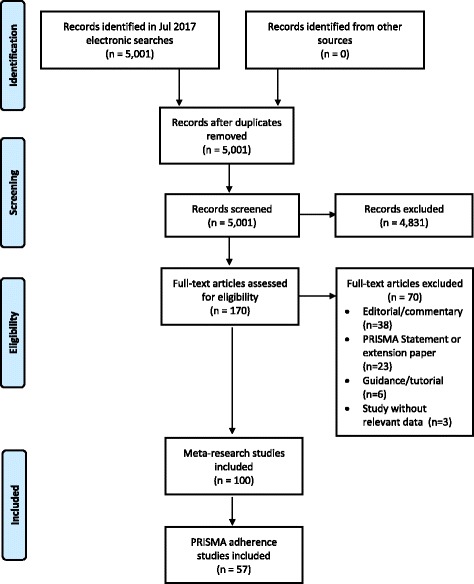
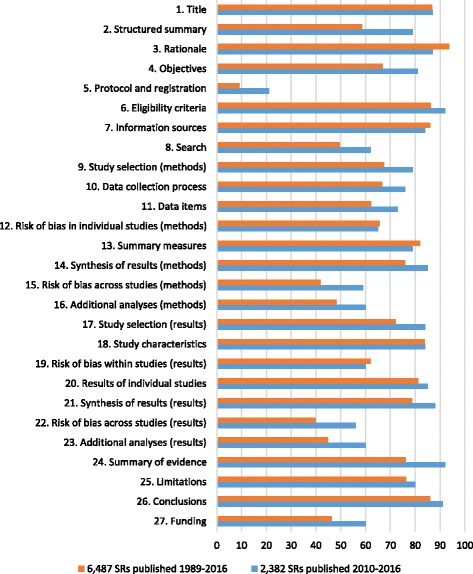
Verification
Claims the paper makes
The claims and statistics of this paper haven’t been checked yet.
Free: it reads the open-access text and checks the first 5 claims that cite a source we can check. Create a free account to check every claim.
Claims other papers make about this one
Each is checked against this paper’s own text: does it say what the citing paper says it does?
The source backs part of the claim, not all of it — or backs it for a different population, condition or comparison.
In the citing paper
“The Preferred Reporting Items for Systematic reviews and Meta-Analyses (PRISMA) 2020 statement is intended to facilitate transparent, complete, and accurate reporting of systematic reviews. 9 10 11 12”
From Extension of the PRISMA 2020 statement for living systematic reviews (PRISMA-LSR): checklist and explanation (2024) · cites this paper as [9]
Experimental — accuracy not yet measuredThe source backs part of the claim, not all of it — or backs it for a different population, condition or comparison.
In the citing paper
“The PRISMA 2020 statement was designed primarily to provide guidance for systematic reviews of studies that evaluate the effects of interventions.”
From Extension of the PRISMA 2020 statement for living systematic reviews (PRISMA-LSR): checklist and explanation (2024) · cites this paper as [9]
Experimental — accuracy not yet measuredThe source backs part of the claim, not all of it — or backs it for a different population, condition or comparison.
In the citing paper
“The PRISMA Statement and its extensions are an evidence-based, minimum set of recommendations designed primarily to encourage transparent and complete reporting of SRs.”
From How to properly use the PRISMA Statement (2021) · cites this paper as [3]
Experimental — accuracy not yet measuredThe source backs part of the claim, not all of it — or backs it for a different population, condition or comparison.
In the citing paper
“La evidencia proveniente de estudios observacionales sugiere que el uso de la declaracio ´ n PRISMA 2009 esta ´ asociada a publicaciones ma ´ s completas de revisiones sistema ´ticas 16-19 aunque se podrı ´a hacer ma ´ s para mejorar la adhesio ´ n a la guı ´a 20 .”
From Declaración PRISMA 2020: una guía actualizada para la publicación de revisiones sistemáticas (2021) · cites this paper as [20]
Experimental — accuracy not yet measuredThe cited source says what the claim attributes to it.
In the citing paper
“The Preferred Reporting Items for Systematic reviews and Meta-Analyses (PRISMA) statement published in 2009 (hereafter referred to as PRISMA 2009)1 2 3 4 5 6 7 8 9 10 11 12 was designed to help authors prepare transparent accounts of their reviews, and its recommendations have been widely endorsed and adopted.13”
From PRISMA 2020 explanation and elaboration: updated guidance and exemplars for reporting systematic reviews (2021) · cites this paper as [13]
13 more claims about this paper
Create a free account to see every claim other papers make about this one.
Self-check
Percentages, sums and reported differences re-computed from the paper’s own numbers.
The self-check needs the paper’s full text.
Citations
Cites
Preferred Reporting Items for Systematic Reviews and Meta-Analyses: the PRISMA statement
Moher, D., Liberati, A., Tetzlaff, J., Altman, D. G., & for the PRISMA Group (2009) · BMJ · doi:10.1136/bmj.b2535 · Cited by 83,823
Self-citationPreferred Reporting Items for Systematic Reviews and Meta-Analyses: The PRISMA Statement
Moher, D., Liberati, A., Tetzlaff, J., Altman, D. G., & The PRISMA Group (2009) · PLoS Medicine · doi:10.1371/journal.pmed.1000097 · Cited by 64,042 · cited 1×
“The guideline was renamed the PRISMA (Preferred Reporting Items for Systematic reviews and MetaAnalyses) Statement, and published in 2009 [11].”
Self-citationPreferred reporting items for systematic reviews and meta-analyses: the PRISMA Statement.
(2009) · PubMed Central · Cited by 44,859
Self-citationPreferred reporting items for systematic reviews and meta-analyses: The PRISMA statement
Moher, D., Liberati, A., Tetzlaff, J., Altman, D. G., & the PRISMA Group* (2009) · Annals of Internal Medicine · doi:10.7326/0003-4819-151-4-200908180-00135 · Cited by 37,554
Self-citationLiberati, A., Altman, D. G., Tetzlaff, J., Mulrow, C., Gøtzsche, P. C., Ioannidis, J. P. A., Clarke, M., Devereaux, P. J., Kleijnen, J., & Moher, D. (2009) · PLoS Medicine · doi:10.1371/journal.pmed.1000100 · Cited by 28,164
Self-citationPRISMA-P Group, Moher, D., Shamseer, L., Clarke, M., Ghersi, D., Liberati, A., Petticrew, M., Shekelle, P., & Stewart, L. A. (2015) · Systematic Reviews · doi:10.1186/2046-4053-4-1 · Cited by 26,223 · cited 3×
“PRISMA-Protocols 2015 Protocols for systematic reviews and meta-analyses that summarise aggregate data from studies, particularly those which evaluate the effects of interventions [30, 31].”
BackgroundMethodSelf-citationDermyshi, E., Wang, Y., Yan, C., Hong, W., Qiu, G., Gong, X., & Zhang, T. (2017) · Neonatology · doi:10.1159/000454668 · Cited by 24,451
von Elm, E., Altman, D. G., Egger, M., Pocock, S. J., Gøtzsche, P. C., Vandenbroucke, J. P., & Initiative, F. T. S. (2007) · PLoS Medicine · doi:10.1371/journal.pmed.0040296 · Cited by 23,020
Preferred Reporting Items for Systematic Reviews and Meta-Analyses: The PRISMA Statement
Moher, D., Liberati, A., Tetzlaff, J., & Altman, D. G. (2009) · Journal of Clinical Epidemiology · doi:10.1016/j.jclinepi.2009.06.005 · Cited by 19,575
Self-citationWang, G., Ma, R., Qiao, G., Wada, K., Aizawa, Y., & Satoh, T. (2015) · Integrative Medicine International · doi:10.1159/000368408 · Cited by 18,657
Research works printed but not linked: 4
- Churchill R Lasserson T Chandler J Tovey D Higgins JPT Higgins JPT Lasserson T Chandler J Tovey D Churchill R Standards for the reporting of new Cochrane Intervention Reviews Methodological Expectations of Cochrane Intervention Reviews 2016 London Cochrane
- Chandler J Lasserson T Higgins JPT Tovey D Churchill R Higgins JPT Lasserson T Chandler J Tovey D Churchill R Standards for the planning, conduct and reporting of updates of Cochrane Intervention Reviews Methodological Expectations of Cochrane Irntervention Reviews 2016 London Cochrane
- Rethlefsen M, Koffel J, Kirtley S. PRISMA-Search: guidelines for reporting systematic review literature searches (registered 17 February 2016) http://www.equator-network.org/library/reporting-guidelines-under-development/#57 [Accessed 16 Aug 2017].
- Bian Z. Preferred Reporting Items for Systematic Review and Meta-Analyses of traditional Chinese medicine: the PRISMA-TCM Statement (registered 18 August 2016) http://www.equator-network.org/library/reporting-guidelines-under-development/#65 [Accessed 16 Aug 2017].
Cited by
Items 801–850 of 850
Stark, R. K., Clemens, S. M., Lee, S., Love, S., Verbsky, M., GAILEY, R. S., Carnahan, K. J., Crunkhorn, A. E., & MacLeod, T. D. (2026) · JPO Journal of Prosthetics and Orthotics · doi:10.1097/jpo.0000000000000643
Strategic Human Resource Interventions to Enhance Workforce Resilience
Kumari, S., & Sudha, S. (2026) · IGI Global eBooks · doi:10.4018/979-8-3373-5218-3.ch013
The Impact of Publicly Funded Research Education: A Systematic Literature Review
Godin, C. T. (2026) · Indonesian Journal of Education Research (IJoER) · doi:10.37251/ijoer.v7i3.2743
Bridging the Gap: Advancements in Interactive Technology to Support Dementia Care – A Scoping Review
Ma, Y., Nordberg, O. E., Zhang, Y., Rongve, A., Bachinski, M., & Fjeld, M. (2026) · Lecture notes in computer science · doi:10.1007/978-3-032-30041-6_11
Maesara, N., Juliantine, T., Hidayat, Y., Sucipto, Carsiwan, & Abduljabar, B. (2026) · Journal of Educational Studies · doi:10.58218/jes.v4i1.3442
Piroozi, B., Ahmed, H. M., Safari, H., Moameri, H., & Rahmati, S. (2026) · BMC Pregnancy and Childbirth · doi:10.1186/s12884-026-09621-0
“However, this systematic review adheres to the PRISMA 2020 guidelines for reporting [23].”
Climate Change Advocacy in Libraries: Practices, Challenges and Future Research Directions
Oladokun, B. D., Obim, I. E., Olatunbosun, I. E., Enakrire, R. T., Ajani, Y. A., & Ebhonu, S. I. (2026) · Environmental Communication · doi:10.1080/17524032.2026.2702627
Emadi, N., Mohammadi-Qasriyan, S., Moghadam, M., Pahlavani, N., & Hadi, S. (2026) · Next research. · doi:10.1016/j.nexres.2026.102173
Karbin, K., Patel, V., Shafiee, M., Baxter-Jones, A. D. G., ERLANDSON, M. C., Lane, G. L., Chilibeck, P. D., Rayan, S., & Vatanparast, H. (2026) · Critical Reviews in Food Science and Nutrition · doi:10.1080/10408398.2026.2691231 · Cited by 1
“A search protocol based on the PRISMA extension for scoping reviews (PRISMA-ScR) Field statement was developed to systematically identify, evaluate, and select appropriate articles from the literature (Page and Moher 2017).”
Färnqvist, K., Karlsson, P., Wachtmeister, V., Vallance, P., & Sinervo, E. (2026) · Cochrane Evidence Synthesis and Methods · doi:10.1002/cesm.70096
“Guidelines and recommendations have been established to encourage researchers to adopt these practices [3–5], with the aim of improving the quality and transparency of research [6].”
Khan, N., Sikandar, H., Falahat, M., & Akhtar, N. (2026) · Sustainable Environment · doi:10.1080/27658511.2026.2693347
Thi, H. P., Viet, P. Q., & Nguyễn, T. H. Á. (2026) · Tạp chí Nghiên cứu Tài chính - Marketing · doi:10.52932/jfmr.v17i1visp.923
Sholeh, M. N., Arifai, A. M., & Karlina, L. (2026) · Archives of Computational Methods in Engineering · doi:10.1007/s11831-026-10728-y · Cited by 1
“These stages are conducted in accordance with the Preferred Reporting Items for Systematic Reviews and Meta-Analyses (PRISMA) guidelines [ 64, 65], which are widely applied in systematic reviews within the fields Fig.”
Ramôa, A., & Pires, S. M. (2026) · Environmental Science & Policy · doi:10.1016/j.envsci.2026.104461
Mengistu, G., Geta, M., Nuru, A., Gelaw, B., & Moges, F. (2026) · One Health · doi:10.1016/j.onehlt.2026.101535
“The study followed the procedures outlined in the Preferred Reporting Items for Systematic Reviews and Meta-Analyses (PRISMA) [39,40].”
Ichana, C., Boulanger, C., Blanchard, C., Charuel, É., Ménini, T., Vaillant-Roussel, H., & Boussageon, R. (2026) · French Academic Journal of Primary Care · doi:10.46298/fajpc.18899
Chanduco, C. E. C., & Deza, Y. A. D. (2026) · LACCEI International Multi-Conference for Engineering, Education and Technology (LACCEI) · doi:10.18687/laccei2026.1.1.2181
Appiah, E. K. (2026) · SSRN Electronic Journal · doi:10.2139/ssrn.7208178
The application of big data in rural tourism: A systematic review
Ramos, J. A. M., Espinoza, J. Y., & Ayala, G. R. C. (2026) · Multidisciplinary Reviews · doi:10.31893/multirev.2027249
“Tools such as AMSTAR and PRISMA were used to assess the quality of rapid reviews Kelly et al. (2016) and Page and Moher (2017).”
School-Based Interventions for Suicidal Behavior Prevention in Adolescence: An Integrative Review
Eguiarte, B. E. B., Trejo, L. A. H., Gómez-Maqueo, M. E. L., & Vázquez-Cortés, V. G. (2026) · Acta Colombiana de Psicología · doi:10.14718/acp.2026.29.6
“This study is an integrative review conducted using a structured search strategy, guided by selected elements of the PRISMA statement (Page & Moher, 2017; Page et al. , 2021).”
Laccone, R. P., Mauceri, S., Bisogni, F., Romano, M., & Patera, S. (2026) · Communications in computer and information science · doi:10.1007/978-3-032-31853-4_3
Adediran, S. A., Gorham, C. L., & Omotayo, A. O. (2026) · Smart Agricultural Technology · doi:10.1016/j.atech.2026.102495
Haryanto, Ulum, M., Widiyaningtyas, T., & Afandi, A. N. (2026) · Acta Polytechnica Hungarica · doi:10.12700/aph.23.8.2026.8.9
Adithya, M. A., Geetha, R., Sundar, S., & Velmurugan, P. R. (2026) · Discover Sustainability · doi:10.1007/s43621-026-04605-8
“…the studies met the inclusion criteria for methodological reasons, thus following the Preferred Reporting Items for Systematic Reviews and Meta-Analyses (PRISMA 2020) framework, which facilitates the description of the identification, screening, eligibility, and inclusion of publications [56].”
Alwusaidi, H., Alahmadi, M. A., Alghamdi, S. M. H., Almulla, S. A., Khoj, Z., Mashhrawi, Y. M. A., Aleid, S., & Alwusaidi, J. (2026) · Dermatology Reports · doi:10.4081/dr.2026.10560
Examining Whiteness in the Context of Anti-Racism Work: A Critical Discursive Psychology Analysis
Esterhuizen, J. (2025) · University of Hertfordshire Research Archive (University of Hertfordshire)
Felix, G. A., & Figueiredo, R. D. A. (2026) · Revista Acadêmica Online · doi:10.36238/2359-5787.2026.v12n65.2473
Arianti, R. E., Puspita, A. M. I., & Setyowati, R. R. N. (2025) · ELSE (Elementary School Education Journal) Jurnal Pendidikan dan Pembelajaran Sekolah Dasar · doi:10.30651/else.v8i3.25694
Amelia, P., Setyowati, S., Ningrum, M. A., Istiq'faroh, M. P. D. N., Haq, M. S., Kristanto, A., & Fitri, R. (2026) · Murhum Jurnal Pendidikan Anak Usia Dini
Tan, S. M. B. S. M. (2024) · Library Progress (International)
SANTOS, B. C., & Clemente-Faustino, J. A. R. (2025) · TPM Testing, psychometrics, methodology in applied psychology
Ramadhia, M., & Santoso, I. (2023) · Jurnal Ekonomi
Challenges of Science Teachers in Designing Inquiry Learning: A Systematic Literature Review
Setiyani, A., Munfaridah, N., & Hidayat, A. (2025) · Kasuari Physics Education Journal (KPEJ)
Tawakkal, I. (2025) · International Journal of Islamic Education Studies
Oliveros, B. E. S. (2021) · Repositorio Institucional Académico , Sistema de Bibliotecas Universidad Andrés Bello (UNAB) (Universidad Andrés Bello (UNAB))
salim, D., Salim, D. R., Safitri, H., Nuriansyah, F., & Hakam, L. I. (2025) · Jurnal Ekonomis · Cited by 10
Olugbade, D., Nurhayati, S., Ayanwale, M. A., & Owolabi, T. J. (2026) · Emerald Group Publishing Limited eBooks · doi:10.1108/978-1-80592-200-120261010
The Impact of Artificial Intelligence on Industrial-Organizational Psychology: A Systematic Review
Asfahani, A. M. (2022) · The Journal of Behavioral Science · Cited by 20
Huang, J., Wu, Z., Xi, L., & Xie, Q. (2026) · Journal of Oral Rehabilitation · doi:10.1111/joor.70321
Krzywonos, M., Schnieder, M., & Dora, M. K. (2026) · Journal of Cleaner Production · doi:10.1016/j.jclepro.2026.149667
Tan, M. (2024) · Linguistic and Philosophical Investigations
Lin, Y., Wang, D., Yang, W., & Li, C. (2026) · Buildings · doi:10.3390/buildings16204088
Padilla, C. E. E. (2026) · Athena Latino-Americana · doi:10.69720/3086-5182.2026.000086
Medrano, D. J. A., Campos, L. E. L., Robles, N. M. H., & Alfaro, E. F. R. (2026) · International Research Journal of Multidisciplinary Scope · doi:10.47857/irjms.2026.v07i04.011813
Krzywonos, M., Piekara, A., Błaszczyk, A., Sady, S., Pachołek, B., Syguła‐Cholewińska, J., Sawoszczuk, T., & Popek, S. (2026) · European Food Research and Technology · doi:10.1007/s00217-026-05342-y
“The PRISMA framework [26] was applied to ensure transparency and reproducibility, and the selection process is summarized in Table S1.”
William, S. P., Khan, M. A., & Hussain, F. (2026) · Balneo and PRM Research Journal · doi:10.12680/balneo.2026.1069
Blockchain in green buildings: Research trends, enablers, challenges, and future opportunities
Manzoor, B., Zayed, T., Haroglu, H., Alfalah, G., Antwi‐Afari, M. F., Edwards, D. J., & Bortey, L. (2026) · Journal of Engineering Research · doi:10.1016/j.jer.2026.10.042
Setiawan, Y., Abdullah, A. G., & Salam, H. (2026) · Journal of Vocational Education Studies · doi:10.12928/joves.v9i2.16211
“The review protocol was validated by a professor in the field of vocational technology education (the second author) to ensure transparency and rigor (Page and Moher, 2017; Perestelo, 2013).”
Critical success factors for the adoption of 3D printing to advance sustainable building projects
Manzoor, B., Zayed, T. M., Haroglu, H., Edwards, D. J., Mahmoud, A. A. B., & Jen, T. M. (2026) · Smart and Sustainable Built Environment · doi:10.1108/sasbe-02-2026-0135
Naimi, I., Annaz, H., & Bouamama, H. (2026) · Crop Protection · doi:10.1016/j.cropro.2026.107934
Metadata
- Authors
- Page, M. J., & Moher, D.
- Affiliations
- Monash University (AU)
- University of Ottawa (CA)
- Corresponding author
- Page, Matthew J.
- Venue
- Systematic Reviews
- Published
- 2017-12
- Volume
- 6
- Issue
- 1
- Pages
- 263-263
- ISSN
- 2046-4053 (ISSN-L)
- PMC
- PMC5738221
- OpenAlex
- W2779588463
- Semantic Scholar
- c0532294ce78a405626299e94fb8158c50b0f2fe
- Cited by
- 769
- References
- 163
- Citations by year
- 2026: 70 · 2025: 106 · 2024: 120 · 2023: 121 · 2022: 107 · 2021: 116 · 2020: 64 · 2019: 44 · 2018: 11 · 2017: 7
- FWCI
- 8.49
- Type
- journal article
- Language
- en
- Open access
- gold
- doi.org
- Licence
- cc-by
- Locations
- Systematic Reviews (publishedVersion, cc-by)
- Europe PMC (PubMed Central) (publishedVersion, cc-by)
- PubMed Central (publishedVersion, cc-by)
- PubMed (publishedVersion)
- uO Research (University of Ottawa) (submittedVersion, public-domain)
- Monash University Research Portal (Monash University) (submittedVersion, other-oa)
- DOAJ (DOAJ: Directory of Open Access Journals) (submittedVersion)
- OSF Preprints (OSF Preprints) (submittedVersion)
- Funders
- University of Ottawa
- Medical Research Council
- National Health and Medical Research Council (1088535)
- Topics
- Social Sciences › Decision Sciences › Statistics, Probability and Uncertainty › Meta-analysis and systematic reviews
- Health Sciences › Medicine › Public Health, Environmental and Occupational Health › Clinical practice guidelines implementation
- Social Sciences › Library and Information Sciences › Academic Publishing and Open Access
- Keywords
- PRISMA statement, reporting guidelines, meta-analysis, guideline uptake, meta-research, transparency
- MeSH terms
- Systematic Reviews as Topic, Humans, Periodicals as Topic, Publishing, Meta-Analysis as Topic, Guidelines as Topic, Editorial Policies
About these checks
Registry, retraction, Cites and statistics results are computed, not judged, with one exception: a printed reference that no index lists is read once by a model before it counts as a citation error. Claims are extracted by a model and kept only when their quote appears verbatim in the text; each cited source is then checked, with a model’s help, for whether it says what the claim relies on. Those verdicts can be wrong — read the claim’s quote and the cited source before relying on one.
Statistics and arithmetic are recomputed, not judged.
Confidence bands are shown only for fields calibrated on our annotated test set. None is calibrated yet, so no band is shown.
What counts as a claim ›How we measure confidence ›How we check this ›
Are you an author, or do you see a problem with this page? Request a review
Data sources
Bibliographic data: Semantic Scholar, OpenAlex, Crossref.
Contains information from the Semantic Scholar Academic Graph Datasets, made available under the ODC Attribution License (ODC-BY 1.0).
Semantic Scholar’s data is described in: Kinney, R., et al. (2023). The Semantic Scholar Open Data Platform. arXiv:2301.10140.
