

The DOI matches its Crossref record; 21 of the 21 references it cites were found in a registry or an index.
Understanding the mental health of doctoral researchers: a mixed methods systematic review with meta-analysis and meta-synthesis
Abstract
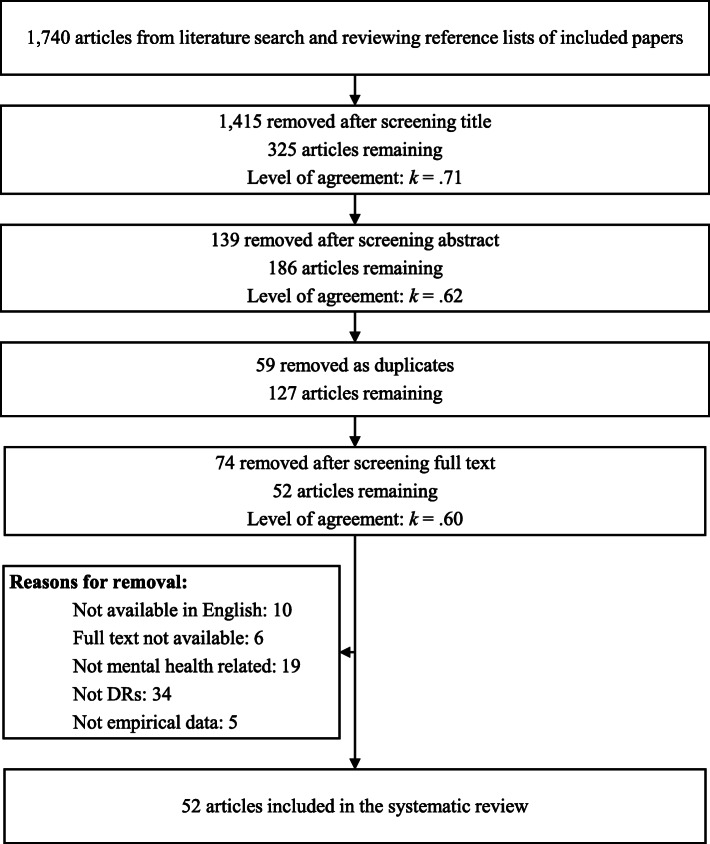
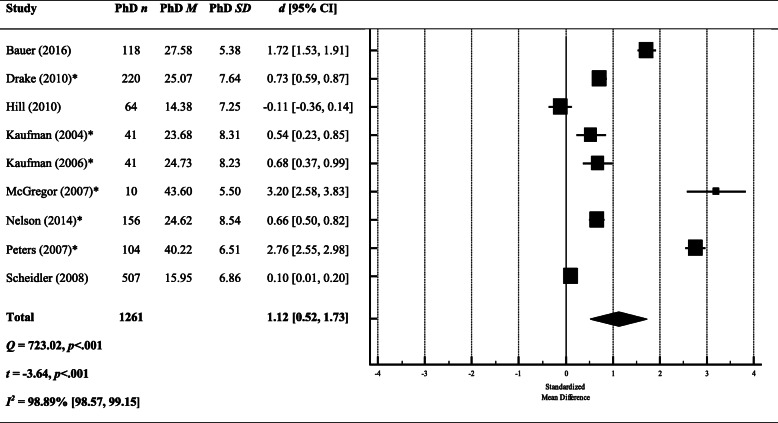
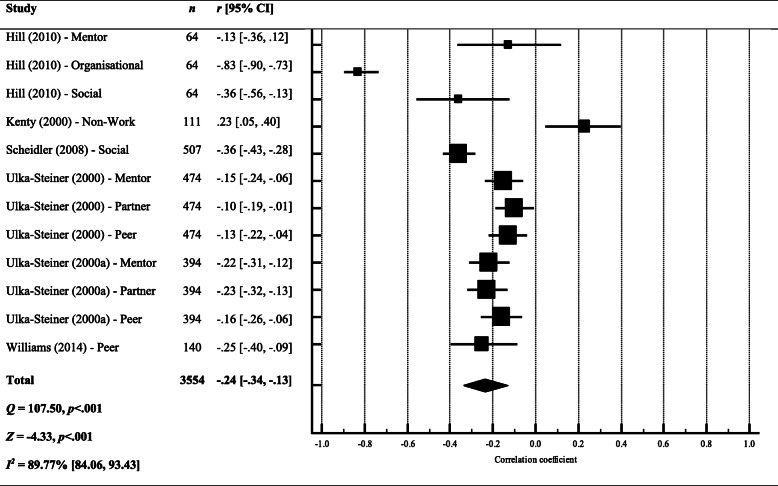
Background: Data from studies with undergraduate and postgraduate taught students suggest that they are at an increased risk of having mental health problems, compared to the general population. By contrast, the literature on doctoral researchers (DRs) is far more disparate and unclear. There is a need to bring together current findings and identify what questions still need to be answered. Methods: We conducted a mixed methods systematic review to summarise the research on doctoral researchers’ (DRs) mental health. Our search revealed 52 articles that were included in this review. Results: The results of our meta-analysis found that DRs reported significantly higher stress levels compared with population norm data. Using meta-analyses and meta-synthesis techniques, we found the risk factors with the strongest evidence base were isolation and identifying as female. Social support, viewing the PhD as a process, a positive student-supervisor relationship and engaging in self-care were the most well-established protective factors. Conclusions: We have identified a critical need for researchers to better coordinate data collection to aid future reviews and allow for clinically meaningful conclusions to be drawn. Systematic review registration: PROSPERO registration CRD42018092867
Overview
The claims and statistics of this paper haven’t been checked yet.
Run the check — free, no account needed. It reads the open-access text and checks the sources it cites.
Integrity signals
Registry
Cites
Statistics
Figures
Verification
Claims the paper makes
The claims and statistics of this paper haven’t been checked yet.
Run the check — free, no account needed. It reads the open-access text and checks the sources it cites.
Claims other papers make about this one
Each is checked against this paper’s own text: does it say what the citing paper says it does?
In the citing paper
“A lack of comfort, minimal leisure, and limited engagement in social activities contribute to the PhD students' anxiety (Hazell et al., 2020).”
From A narrative review of anxiety regulation in PhD students based on Green model (2024) · cites this paper as Hazell et al., 2020
In the citing paper
“Unconscious comparisons and consolation may exacerbate feelings of incompetence and anxiety (Zhong et al., 2011; Hazell et al., 2020).”
From A narrative review of anxiety regulation in PhD students based on Green model (2024) · cites this paper as Hazell et al., 2020
In the citing paper
“Peer pressure, conflicts, and negative feedback from colleagues can lead to distraction from scientific research.”
From A narrative review of anxiety regulation in PhD students based on Green model (2024) · cites this paper as Hazell et al., 2020
In the citing paper
“Doctoral students and postdoctoral researchers share many of these challenges, though some stressors may be more pronounced in doctoral students (for example, supervisor dependency, thesis progress pressure, financial strain and impostor feelings)2,13,14”
From Prevalence and severity of mental health problems in early-career researchers: a systematic review and meta-analysis (2026) · cites this paper as [14]
In the citing paper
“ECRs cite a range of structural and individual stressors, such as short-term employment contracts and related job insecurity, high competition, perceived isolation, feeling like an impostor, lack of feedback and power abuse as contributors to poor mental health12–18.”
From Prevalence and severity of mental health problems in early-career researchers: a systematic review and meta-analysis (2026) · cites this paper as [14]
In the citing paper
“Supervisor relationships have been described as either a risk or protective factor depending on their quality14,46.”
From Prevalence and severity of mental health problems in early-career researchers: a systematic review and meta-analysis (2026) · cites this paper as [14]
In the citing paper
“Four databases14,52,118,208 were included.”
From Prevalence and severity of mental health problems in early-career researchers: a systematic review and meta-analysis (2026) · cites this paper as [14]
In the citing paper
“Additionally, a substantial proportion of our participants (27%) fell in the severe and extremely severe categories of the stress sub-scale, which is in line with previous studies and meta-analyses (e.g., Hazell et al., 2020).”
From The supervisory relationship as a predictor of mental health outcomes in doctoral students in the United Kingdom (2024) · cites this paper as Hazell et al., 2020
Self-check
Percentages, sums and reported differences re-computed from the paper’s own numbers.
The self-check needs the paper’s full text.
Citations
Cites
Using thematic analysis in psychology
Braun, V., & Clarke, V. (2006) · Qualitative Research in Psychology · doi:10.1191/1478088706qp063oa · Cited by 194,414
von Elm, E., Altman, D. G., Egger, M., Pocock, S. J., Gøtzsche, P. C., Vandenbroucke, J. P., & Initiative, F. T. S. (2007) · PLoS Medicine · doi:10.1371/journal.pmed.0040296 · Cited by 23,020
Maslow, A. H. (1943) · Psychological Review · doi:10.1037/h0054346 · Cited by 21,563
Methods for the thematic synthesis of qualitative research in systematic reviews
Thomas, J., & Harden, A. (2008) · BMC Medical Research Methodology · doi:10.1186/1471-2288-8-45 · Cited by 9,312
Loneliness and Social Isolation as Risk Factors for Mortality: A Meta-Analytic Review
Holt-Lunstad, J., Smith, T. B., Baker, M., Harris, T., & Stephenson, D. (2015) · Perspectives on Psychological Science · doi:10.1177/1745691614568352 · Cited by 6,043
Enhancing transparency in reporting the synthesis of qualitative research: ENTREQ
Tong, A., Flemming, K., McInnes, E., Oliver, S., & Craig, J. (2012) · BMC Medical Research Methodology · doi:10.1186/1471-2288-12-181 · Cited by 3,569
Auerbach, R. P., Collaborators, W. W.-I., Mortier, P., Bruffaerts, R., Alonso, J., Benjet, C., Cuijpers, P., Demyttenaere, K., Ebert, D. D., Green, J. G., et al. (2018) · Journal of Abnormal Psychology · doi:10.1037/abn0000362 · Cited by 2,522
Leigh-Hunt, N., Bagguley, D., Bash, K., Turner, V., Turnbull, S., Valtorta, N., & Caan, W. (2017) · Public Health · doi:10.1016/j.puhe.2017.07.035 · Cited by 2,158
Bias and Efficiency of Meta-Analytic Variance Estimators in the Random-Effects Model
Viechtbauer, W. (2005) · Journal of Educational and Behavioral Statistics · doi:10.3102/10769986030003261 · Cited by 1,699
Seedat, S., Scott, K. M., Angermeyer, M. C., Berglund, P., Bromet, E. J., Brugha, T. S., Demyttenaere, K., de Girolamo, G., Haro, J. M., Jin, R., et al. (2009) · Archives of General Psychiatry · doi:10.1001/archgenpsychiatry.2009.36 · Cited by 1,518
Research works printed but not linked: 66
- YouGov. One in four students suffer from mental health problems. 2016. Available from: https://d25d2506sfb94s.cloudfront.net/cumulus_uploads/document/obtomdatp4/Survey_Results.pdf. Cited 2017 Oct 6.
- Oswalt SB, Lederer AM, Chestnut-Steich K, Day C, Halbritter A, Ortiz D. Trends in college students’ mental health diagnoses and utilization of services, 2009–2015. J Am Coll Health. 2018;68:41–51. · DOI
- NCES. Number of doctoral degrees earned in the United States from 1949/50 to 2028/29, by gender. 2019. Available from: https://www.statista.com/statistics/185167/number-of-doctoral-degrees-by-gender-since-1950/.
- Cohen J. A coefficient of agreement for nominal scales. Educ Psychol Meas. 1960;20:37–46 Available from: http://psycnet.apa.org/index.cfm?fa=search.displayRecord&uid=1960-06759-001. · DOI · Paper page
- Landis JR, Koch GG. The measurement of observer agreement for categorical data. Biometrics. 1977;33(1):159 Available from: http://www.jstor.org/stable/2529310?origin=crossref. Cited 2017 Mar 8. · DOI · Paper page
- Noblit GW, Hare RD. Meta-ethnography: Synthesizing qualitative studies: Sage Publications; 1988. p. 88. · DOI · Paper page
- Cohen S, Williamson GM. Perceived stress in a probability sample of the U.S. In: Spacapam S, Oskamp S, editors. The social psychology of health: Claremont Symposium on Applied Social Psychology. Newbury Park, CA: Sage; 1988.
- Cohen S, Kamarck T, Mermelstein R. A global measure of perceived stress. J Health Soc Behav. 1983;24(4):385–96. · DOI · Paper page
- MedCalc Software bvba. MedCalc Statistical Software. Belgium: Ostend; 2016.
- Hedges LV, Ollkin L. Statistical methods for meta-analysis. New York: Academic Press; 1985. Available from:. https://doi.org/10.1002/9780470743386.refs. · DOI
- Borenstein M, Hedges LV, Higgins JPT, Rothstein HR. Introduction to meta-analysis. Chichester: Wiley; 2009. Cited 2019 Jan 10. Available from. https://doi.org/10.1002/9780470743386. · DOI · Paper page
- Fisher RA. Frequency distribution of the values of the correlation coefficient in samples from an indefinitely large population. Biometrika. 1915;10(4):507–21 Available from: https://www.statista.com/statistics/185167/number-of-doctoral-degrees-by-gender-since-1950/.
- Lachal J, Revah-Levy A, Orri M, Moro MR. Metasynthesis: an original method to synthesize qualitative literature in psychiatry. Front Psychiatry. 2017;8:269. · DOI
- Braun V, Clarke V. Successful qualitative research: a practical guide for beginners. London: Sage Publications Ltd; 2013.
- Bhaskar R. The possibility of naturalism: a philosophical critique of the contemporary human sciences. London: Routledge; 2014. · DOI
- Fletcher AJ. Applying critical realism in qualitative research: methodology meets method. Int J Soc Res Methodol. 2017;20(2):181–94. · DOI · Paper page
- Walsh D, Downe S. Meta-synthesis method for qualitative research: a literature review. J Adv Nurs. 2005;50(2):204–11. · DOI · Paper page
- Maton K. Reflexivity, relationism, & research: Pierre Bourdieu and the epistemic conditions of social scientific knowledge. Sp Cult. 2003;6(1):52–65. · DOI
- Acker S, Haque E. The struggle to make sense of doctoral study. High Educ Res Dev. 2015;34(2):229–41. Available from. https://doi.org/10.1080/07294360.2014.956699. · DOI
- Devonport TJ, Lane AM. In it together: Dyadic coping among doctoral students and partners. J Hosp Leis Sport Tour Educ. 2014;15:124–34. Available from. https://doi.org/10.1016/j.jhlste.2014.08.002. · DOI
- Bazrafkan L, Shokrpour N, Yousefi A, Yamani N. Management of stress and anxiety among PhD students during thesis writing: a qualitative study. The Health Care Manager. 2016;35:231–40. · DOI · Paper page
- Cotterall S. More than just a brain: emotions and the doctoral experience. High Educ Res Dev. 2013;32(2):174–87. · DOI · Paper page
- Kenty JR. Stress management strategies for women doctoral students. Nurse Educ. 2000;25(5):251–4 Available from: http://pesquisa.bvsalud.org/portal/resource/pt/mdl-16646205. · DOI
- Usman Yousaf S, Akram M, Usman B. Exploring the causes of stress and coping with it amongst doctoral level students: highlighting the importance of information collection and management. Pakistan J Inf Manag Libr. 2016;18(2):12–25 Available from: https://search.proquest.com/openview/68246cbba8a9da0ec067d56631b479f1/1?pq-origsite=gscholar&cbl=54989.
- Sandelowski M, Voils CI, Barroso J. Defining and designing mixed research synthesis Studies. Res Sch. 2006;13(1):29 Available from: http://www.ncbi.nlm.nih.gov/pubmed/20098638%0Ahttp://www.pubmedcentral.nih.gov/articlerender.fcgi?artid=PMC2809982.
- Begun AL, Carter JR. Career Implications of Doctoral Social Work Student Debt Load. J Soc Work Educ. 2017;53(2):161–73. Available from. https://doi.org/10.1080/10437797.2016.1243500. · DOI
- Benjamin S, Williams J, Maher MA. Focusing the lens to share the story: using photographs and interviews to explore doctoral students’ sense of well-being. Int J Dr Stud. 2017;12:197–217.
- Bireda AD. Challenges to the doctoral journey: a case of female doctoral students from Ethiopia. Open Prax. 2015;7(4):287–97. · DOI
- Bolliger DU, Halupa C. Student perceptions of satisfaction and anxiety in an online doctoral program. Distance Educ. 2012;33(1):81–98. · DOI
- Devine K, Hunter KH. PhD student emotional exhaustion: the role of supportive supervision and self-presentation behaviours. Innov Educ Teach Int. 2017;54(4):335–44. · DOI
- Dumitrescu GA. Self-efficacy, locus of control , perceived stress and student satisfaction as correlates of dissertation completion: Andrews University; 2016.
- El-Ghoroury NH, Galper DI, Sawaqdeh A, Bufka LF. Stress, coping, and barriers to wellness among psychology graduate students. Train Educ Prof Psychol. 2012;6(2):122–34.
- Haynes C, Bulosan M, Citty J, Grant-Harris M, Hudson J, Koro-Ljungberg M. My world is not my doctoral program…Or is it?: Female students’ perceptions of well-being. Int J Dr Stud. 2012;7:001–17.
- Hill LM. Perceived stress, academic support, social support, and professional support factors as predictors of student success in distributed-learning doctoral education: Fielding Graduate University; 2010. · DOI
- Holahan CK. Stress experienced by women doctoral students, need for support, and occupational sex typing: An interactional view. Sex Roles. 1979;5(4):425–36. · DOI
- Hunter KH, Devine K. Doctoral students’ emotional exhaustion and intentions to leave academia. Int J Doctoral Stud. 2016;11. · DOI
- Kaufman JA. Stress and social support among online doctoral psychology students. J College Stud Psychother. 2006;20(3):79–88 Available from: http://search.proquest.com/docview/57185202?accountid=12253%5Cnhttp://man-fe.hosted.exlibrisgroup.com/openurl/44MAN/44MAN_services_page?url_ver=Z39.88-2004&rft_val_fmt=journal&genre=unknown&sid=ProQ:ProQ%3Aeducation&atitle=Stress+and+Social+Support+among+. · DOI
- Lonka K, Chow A, Keskinen J, Hakkarainen K, Sandström N, Pyhältö K. How to measure PhD students’ conceptions of academic writing - and are they related to wellbeing? J Writ Res. 2014;5(3):245–69. · DOI
- Marais GAB, Shankland R, Haag P, Fiault R, Juniper B. A survey and a positive psychology intervention on French PhD student well-being. Int J Dr Stud. 2018;13:109–38.
- Martinez E, Ordu C, Sala MRD, McFarlane A. Striving to obtain a school-work-life balance: The full-time doctoral student. Int J Dr Stud. 2013;8:39–59.
- McGregor BA, Antoni MH, Ceballos R, communication BBBS. very low CD19+ B-lymphocyte percentage is associated with high levels of academic stress among healthy graduate students. Stress Heal. 2008;24(5):413–8. · DOI
- Pifer MJ, Baker VL. “It could be just because I’m different”: Otherness and its outcomes in doctoral education. J Divers High Educ. 2014;7(1):14–30. · DOI
- Platt J, Schaefer C. Clinical psychological students’ subjective stress ratings during their doctoral training. Psychol Rep. 1995;76:994 Available from: http://www.ncbi.nlm.nih.gov/pubmed/7568619. · DOI
- Pychyl TA. Personal projects, subjective well-being and the lives of doctoral students. Ottawa: Carleton University; 1995.
- Pychyl TA, Little BR. Dimensional specificity in the prediction of subjective well-being: Personal projects in pursuit of the PhD. Soc Indic Res. 1998;45(1–3):423–73 Available from: file://d/d/Texte/Guenter/Literatu/Original/Journals/SIR98-45-423-473.pdf. · DOI
- Rocha-Singh IA. Perceived stress among graduate students: development and validation of the Graduate Stress Inventory. Educ Psychol Meas. 1994;54(3):714–27. · DOI
- Sekas G, Wile MZ. Stress-related illnesses and sources of stress: comparing M.D., Ph.D., M.D. and Ph.D. students. J Med Educ. 1980;55:440–6 Available from: http://www.embase.com/search/results?subaction=viewrecord&from=export&id=L10000589%5Cnhttp://sfx.library.uu.nl/utrecht?sid=EMBASE&issn=00222577&id=doi:&atitle=Stress-related+illnesses+and+sources+of+stress%3A+comparing+M.D.-Ph.D.%2C+M.D.+and+Ph.D.+student.
- Stubb J, Pyhältö K, Lonka K. Balancing between inspiration and exhaustion: PhD students’ experienced socio-psychological well-being. Stud Contin Educ. 2011;33(1):33–50. · DOI · Paper page
- Ülkü-Steiner B, Kurtz-Costes B, Kinlaw CR. Doctoral student experiences in gender-balanced and male-dominated graduate programs. J Educ Psychol. 2000;92(2):296–307. · DOI
- Volkert D, Candela L, Bernacki M. Student motivation, stressors, and intent to leave nursing doctoral study: a national study using path analysis. Nurse Educ Today. 2018;61:210–5. Available from. https://doi.org/10.1016/j.nedt.2017.11.033. · DOI
- Waaijer CJF, Heyer A, Kuli S. Effects of appointment types on the availability of research infrastructure, work pressure, stress, and career attitudes of PhD candidates of a Dutch university. Res Eval. 2016;25(4):349–57.
- Wang C-H, Chen Y-W, Wu T-Y. Self-guided bibliotherapy: a case study of a Taiwanese doctoral student. Int J Humanties. 2010;8(1):413–22.
- Wright T. Issues in brief counselling with postgraduate research students. Couns Psychol Q. 2006;19(4):357–72. · DOI
- Scrubb MM. An examination of the Doctoral Student Stress Survey (DSSS) as an instrument for measuring the effects of stress as perceived by doctoral students in a distance learning university, vol. 58: Walden University; 1998. p. 3041. Dissertation Abstracts International Section A: Humanities and Social Sciences. Available from: http://ovidsp.ovid.com/ovidweb.cgi?T=JS&PAGE=reference&D=psyc3&NEWS=N&AN=1998-95003-070.
- Hadden BW, Smith CV. I gotta say, today was a good (and meaningful) day: daily meaning in life as a potential basic psychological need. J Happiness Stud. 2017:1–18. · DOI
- Butler G. Definitions of stress. Occas Pap R Coll Gen Pract. 1993;(61):1–5 Available from: http://www.ncbi.nlm.nih.gov/pubmed/8199583%0Ahttp://www.pubmedcentral.nih.gov/articlerender.fcgi?artid=PMC2560943.
- Lazarus RS, Folkman S. Stress, Appraisal, and Coping. New York: Springer Publishing Company; 1984.
- Marin MF, Lord C, Andrews J, Juster RP, Sindi S, Arsenault-Lapierre G, et al. Chronic stress, cognitive functioning and mental health. Neurobiol Learn Mem. 2011;96(4):583–95. Available from. https://doi.org/10.1016/j.nlm.2011.02.016. · DOI · Paper page
- Ward M. The gender salary gap in British academia. Appl Econ. 2001;33(13):1669–81. Cited 2019 May 23. Available from. https://doi.org/10.1080/00036840010014445. · DOI
- Howe-Walsh L, Turnbull S. Barriers to women leaders in academia: tales from science and technology. Stud High Educ. 2016;41(3):415–28. Cited 2019 May 23. Available from. https://doi.org/10.1080/03075079.2014.929102. · DOI
- Gardiner M, Tiggemann M. Gender differences in leadership style, job stress and mental health in male- and female-dominated industries. J Occup Organ Psychol. 1999;72(3):301–15. · DOI
- Brook AT, Garcia J, Fleming M. The effects of multiple identities on psychological well-being. Personal Soc Psychol Bull. 2008;34(12):1588–600. · DOI
- Faragher EB, Cass M, Cooper CL. The relationship between job satisfaction and health: a meta-analysis. Occup Environ Med. 2005;62(2):105–12. · DOI
- Macfarlane B. Student performativity in higher education: converting learning as a private space into a public performance. High Educ Res Dev. 2015;34(2):338–50. · DOI
- Daniels K. Perceived risk from occupational stress: a survey of 15 European countries. Occup Environ Med. 2004;61(5):467–70. · DOI
- Twenge JM. Time period and birth cohort differences in depressive symptoms in the U.S., 1982–2013. Soc Indic Res. 2015;121(2):437–54. · DOI
Cited by
Sorted by citations
Sheldon, E., Simmonds-Buckley, M., Bone, C., Mascarenhas, T., Chan, N., Wincott, M., Gleeson, H., Sow, K., Hind, D., & Barkham, M. (2021) · Journal of Affective Disorders · doi:10.1016/j.jad.2021.03.054 · Cited by 644
Mavrogalou-Foti, A. P., Kambouri, M. A., & Çili, S. (2024) · Frontiers in Psychology · doi:10.3389/fpsyg.2024.1437819 · Cited by 34
A narrative review of anxiety regulation in PhD students based on Green model
Ma, Y., Yu, A., Ma, H., Zhao, Y., Liu, X., Zhai, H., & Gao, Y. (2024) · Frontiers in Psychology · doi:10.3389/fpsyg.2024.1351386 · Cited by 13
Dreisoerner, A., Goetz, V., Frohnmayer, D., Tran, U. S., Voracek, M., & Nater, U. M. (2026) · Nature Human Behaviour · doi:10.1038/s41562-026-02505-5 · Cited by 2
Metadata
- Authors
- Hazell, C. M., Chapman, L., Valeix, S. F., Roberts, P., Niven, J. E., & Berry, C.
- ORCID
- Hazell, Cassie M.
- Venue
- Systematic Reviews
- Published
- 2020-08-26
- Volume
- 9
- Issue
- 1
- ISSN
- 2046-4053
- PMC
- PMC7450565
- Cited by
- 138
- References
- 21
- Language
- en
- Funders
- Office for Students
About these checks
Registry, retraction, Cites and statistics results are computed, not judged, with one exception: a printed reference that no index lists is read once by a model before it counts as a citation error. Claims are extracted by a model and kept only when their quote appears verbatim in the text; each cited source is then checked, with a model’s help, for whether it says what the claim relies on. Those verdicts can be wrong — read the claim’s quote and the cited source before relying on one.
Statistics and arithmetic are recomputed, not judged.
Confidence bands are shown only for fields calibrated on our annotated test set. None is calibrated yet, so no band is shown.
What counts as a claim ›How we measure confidence ›How we check this ›
Are you an author, or do you see a problem with this page? Request a review
How to cite
Cite CoChat for the checks on this page, and the paper for its own findings.
- This page
- CoChat. (2026). Citation check: Understanding the mental health of doctoral researchers: a mixed methods systematic review with meta-analysis and meta-synthesis. https://app.cochat.ai/papers/10.1186/s13643-020-01443-1
- The paper
- Hazell, C. M., Chapman, L., Valeix, S. F., Roberts, P., Niven, J. E., & Berry, C. (2020). Understanding the mental health of doctoral researchers: a mixed methods systematic review with meta-analysis and meta-synthesis. Systematic Reviews. https://doi.org/10.1186/s13643-020-01443-1
