

The PRISMA 2020 statement: an updated guideline for reporting systematic reviews
Open accessThe DOI matches its Crossref record; 82 of the 82 references it cites were found in a registry or an index; 47 of the 62 sources its claims cite were checked for support.
Abstract
See the PRISMA 2020 for Abstracts checklist (Table 2).
Overview
CoChat Summary
TL;DR
PRISMA 2020 replaces the 2009 PRISMA statement as updated reporting guidance for systematic reviews, reflecting advances in methods to identify, select, appraise, and synthesise studies. It provides a 27-item checklist, an expanded checklist, an abstract checklist, and revised flow diagrams for original and updated reviews.
Key findings
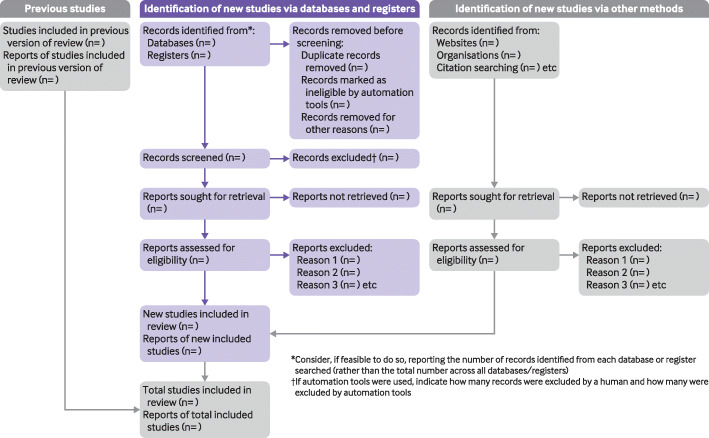
- PRISMA 2020 consists of a 27-item checklist, an expanded checklist detailing reporting recommendations for each item, the PRISMA 2020 abstract checklist, and revised flow diagrams for original and updated reviews.
- Noteworthy changes include inclusion of the abstract reporting checklist within PRISMA 2020; moving protocol and registration to a new Other section with a sub-item on amendments; recommending full search strategies for all databases, registers, and websites; more detail on reviewer screening, data collection, and automation; splitting synthesis methods into six sub-items and synthesis results into four sub-items; and adding items on certainty assessment, competing interests, and availability of data, code, and other materials.
- Development drew on reviews of reporting completeness, 60 documents providing reporting guidance, a survey to which 110 of 220 invited methodologists and journal editors responded, a 21-member two-day in-person meeting in September 2018 in Edinburgh, and feedback from 15 of 22 invited systematic reviewers.
- PRISMA 2009 was cited in over 60,000 reports (Scopus, August 2020) and endorsed by almost 200 journals and systematic review organisations; evidence from observational studies suggests its use is associated with more complete reporting, although more could be done to improve adherence.
Methods
- Guideline update: PRISMA 2020 was developed by adapting the EQUATOR Network’s guidance for developing health research reporting guidelines, identifying incompletely reported PRISMA 2009 items, reviewing 60 guidance documents, surveying methodologists and journal editors, discussing findings at a 21-member two-day meeting, and iteratively revising drafts with co-authors.
- Scope: designed primarily for systematic reviews of studies evaluating effects of health interventions, irrespective of included study design; applicable to other interventions and objectives, reviews with or without synthesis, mixed-methods reviews, and original, updated, or living systematic reviews.
- Analysis: no empirical meta-analysis is reported; the paper presents consensus-based reporting guidance, checklists, and flow diagram templates.
Limitations
- The paper states that it is unclear which strategies should be used to increase adherence to reporting guidelines, because of 31 interventions proposed, the effects of only 11 have been evaluated, mostly in observational studies at high risk of bias due to confounding.
- The paper states PRISMA 2020 is not intended to guide systematic review conduct, assess conduct or methodological quality, or inform reporting of systematic review protocols; separate tools and statements exist for those purposes.
- Evident from the text: PRISMA 2020 is a reporting guideline and consensus statement, not an empirical evaluation of its own impact; the paper notes future research is needed on barriers and facilitators, think-aloud studies, and reliability studies.
Model-written summary. Check it against the paper before relying on it.
Integrity signals
Registry
Cites
Statistics
Figures
Verification
Claims the paper makes
24 Valid · 0 Not valid · 1 Not checked · 25 Own results and interpretations
The sources with a verdict support this claim; the rest weren’t checked yet, have no full text we could read, or their verdicts aren’t rated yet.
In the paper
“Evidence from observational studies suggests that use of the PRISMA 2009 statement is associated with more complete reporting of systematic reviews [17–20], although more could be done to improve adherence to the guideline [21].”
What the sources say
- Supportedcites [17] Page MJ Shamseer L Altman DG Epidemiology and reporting characteristics of systematic reviews of biomedical research: a cross-sectional study PLoS Med 2016 13 e1002028 10.1371/journal.pmed.1002028 27218655 PMC4878797 source
The Results section reports that nearly all 26 characteristics were reported more often in therapeutic systematic reviews that self-reported using PRISMA. The Discussion describes mention of PRISMA as associated with more complete reporting, while cautioning that mention may only be a surrogate for actual use. (LLM, conf=0.92)
- Supportedcites [18] Panic N Leoncini E de Belvis G Ricciardi W Boccia S Evaluation of the endorsement of the preferred reporting items for systematic reviews and meta-analysis (PRISMA) statement on the quality of published systematic review and meta-analyses PLoS One 2013 8 e83138 10.1371/journal.pone.0083138 24386151 PMC3873291 source
The Abstract Results report higher adherence to the PRISMA reporting checklist after gastroenterology and hepatology journals endorsed PRISMA (90.1% versus 83.1%). The evidence concerns journal endorsement; the same section says that explicitly referencing PRISMA in an individual manuscript was not associated with better reporting. (LLM, conf=0.88)
- Not checked — no full text of the sourcecites [19] Agha RA Fowler AJ Limb C Impact of the mandatory implementation of reporting guidelines on reporting quality in a surgical journal: a before and after study Int J Surg 2016 30 169 172 10.1016/j.ijsu.2016.04.032 27112835 source
- Not checked — no full text of the sourcecites [20] Leclercq V Beaudart C Ajamieh S Rabenda V Tirelli E Bruyère O Meta-analyses indexed in PsycINFO had a better completeness of reporting when they mention PRISMA J Clin Epidemiol 2019 115 46 54 10.1016/j.jclinepi.2019.06.014 31254618 source
hedgedstates an association- Asserted: passes — The authors put it forward as true.
- Checkable: passes — It can be checked against evidence.
- Load-bearing: unclear — It is unclear whether the paper’s conclusions depend on it.
- Based: passes — The paper gives a reason why it holds.
- Supported
Every source the paper cites for this claim was checked and supports it.
In the paper
“technological advances have enabled the use of natural language processing and machine learning to identify relevant evidence [22–24]”
What the sources say
- Supportedcites [22] O’Mara-Eves A Thomas J McNaught J Miwa M Ananiadou S Using text mining for study identification in systematic reviews: a systematic review of current approaches Syst Rev 2015 4 5 10.1186/2046-4053-4-5 25588314 PMC4320539 source
The Results section on the suitability of text mining describes natural language processing techniques for improving how studies are classified. The Results section on review updates also describes machine-learning features used to classify studies, and the Discussion notes advances in text-mining technology. Together, these support the broad claim about using these technologies to identify relevant evidence. (LLM, conf=0.88)
- Supportedcites [23] Marshall IJ Noel-Storr A Kuiper J Thomas J Wallace BC Machine learning for identifying randomized controlled trials: an evaluation and practitioner’s guide Res Synth Methods 2018 9 602 614 10.1002/jrsm.1287 29314757 PMC6030513 source
The Aims section describes evaluating machine learning to identify RCTs in health research databases, and the Discussion reports that these approaches outperform traditional filters for systematic reviews. The paper also places its text-classification methods within NLP, supporting the broad claim about using these technologies to identify relevant evidence. (LLM, conf=0.88)
- Supportedcites [24] Marshall IJ Wallace BC Toward systematic review automation: a practical guide to using machine learning tools in research synthesis Syst Rev 2019 8 163 10.1186/s13643-019-1074-9 31296265 PMC6621996 source
The Search section (page not available in our copy) says that machine learning can use a small set of relevant articles to identify other relevant articles and describes semantic search by concept. The methods introduction explains how machine learning classifies articles for inclusion or exclusion, supporting the claim that these technologies can identify relevant evidence. (LLM, conf=0.91)
plainstates a cause- Asserted: passes — The authors put it forward as true.
- Checkable: passes — It can be checked against evidence.
- Load-bearing: unclear — It is unclear whether the paper’s conclusions depend on it.
- Based: passes — The paper gives a reason why it holds.
- Supported
The cited sources support only part of this claim — read each source’s verdict below.
In the paper
“We evaluated the reporting completeness of published systematic reviews [17, 21, 36, 37]”
§ The PRISMA 2020 statement: an updated guideline for reporting systematic reviews > Discussion
What the sources say
- Supportedcites [17] Page MJ Shamseer L Altman DG Epidemiology and reporting characteristics of systematic reviews of biomedical research: a cross-sectional study PLoS Med 2016 13 e1002028 10.1371/journal.pmed.1002028 27218655 PMC4878797 source
The Methods > Data Analysis section says the study assessed whether 26 characteristics of published systematic reviews were reported, and the Discussion > Explanation of Results and Implications discusses how complete that reporting was (page numbers unavailable). This supports citing the paper as an evaluation of reporting completeness. The PRISMA 2020 development context is the citing authors’ framing, not a finding attributed to this 2016 paper. (LLM, conf=0.91)
- Supportedcites [21] Page MJ Moher D Evaluations of the uptake and impact of the preferred reporting items for systematic reviews and meta-analyses (PRISMA) statement and extensions: a scoping review Syst Rev 2017 6 263 10.1186/s13643-017-0663-8 29258593 PMC5738221 source
The Methods section says the authors pooled studies assessing how often published systematic reviews adhered to PRISMA reporting items. The Results section reports their pooled assessment of adherence across 57 studies, supporting the citation’s use as an example of evaluating reporting completeness. (LLM, conf=0.90)
- Supportedcites [36] Page MJ Altman DG Shamseer L Reproducible research practices are underused in systematic reviews of biomedical interventions J Clin Epidemiol 2018 94 8 18 10.1016/j.jclinepi.2017.10.017 29113936 source
The Discussion (p. 20) reports the authors’ assessment of how completely published systematic reviews reported data needed to recreate their meta-analyses and other reproducible research practices. This supports the citation for evaluating reporting completeness; the PRISMA 2020 development context belongs to the citing document, not to this source. (LLM, conf=0.90)
- Partly supportedcites [37] Page MJ Altman DG McKenzie JE Flaws in the application and interpretation of statistical analyses in systematic reviews of therapeutic interventions were common: a cross-sectional analysis J Clin Epidemiol 2018 95 7 18 10.1016/j.jclinepi.2017.11.022 29203419 sourceExperimental — accuracy not yet measured
The Methods (section 2.3) and Results (section 3.6) show that the paper assessed whether selected statistical methods and their rationales were reported in published systematic reviews. It did not assess the completeness of reporting across the reviews as a whole. The citing authors’ PRISMA 2020 development context is their own framing, not a finding attributed to this source. (LLM, conf=0.82)
plain- Asserted: passes — The authors put it forward as true.
- Checkable: passes — It can be checked against evidence.
- Load-bearing: passes — The paper’s conclusions depend on it.
- Based: passes — The paper gives a reason why it holds.
- Supported
Every source the paper cites for this claim was checked and supports it.
In the paper
“new methods have been developed to assess the risk of bias in results of included studies [28, 29]”
What the sources say
- Supportedcites [28] Sterne JAC Savović J Page MJ RoB 2: a revised tool for assessing risk of bias in randomised trials BMJ 2019 366 l4898 10.1136/bmj.l4898 31462531 source
The Summary Points state that the authors developed and piloted RoB 2, a revised tool for assessing risk of bias in randomised trials, and that it produces a judgment for each result assessed. The introduction places risk-of-bias assessment in the context of studies included in systematic reviews. This paper therefore supports the claim as an example of a new method, specifically for randomised trials. (LLM, conf=0.93)
- Supportedcites [29] Sterne JA Hernán MA Reeves BC ROBINS-I: a tool for assessing risk of bias in non-randomised studies of interventions BMJ 2016 355 i4919 10.1136/bmj.i4919 27733354 PMC5062054 source
The Discussion says ROBINS-I was developed primarily for systematic reviews. The ‘Assessing a specific study’ section describes judging risk of bias for an outcome and result in each included non-randomised study, supporting the claim as an example of a new method. (LLM, conf=0.92)
plain- Asserted: passes — The authors put it forward as true.
- Checkable: passes — It can be checked against evidence.
- Load-bearing: unclear — It is unclear whether the paper’s conclusions depend on it.
- Based: passes — The paper gives a reason why it holds.
- Supported
Every source the paper cites for this claim was checked and supports it.
In the paper
“We identified PRISMA 2009 items that were often reported incompletely by examining the results of studies investigating the transparency of reporting of published reviews [17, 21, 36, 37].”
§ The PRISMA 2020 statement: an updated guideline for reporting systematic reviews > Development of PRISMA 2020
What the sources say
- Supportedcites [17] Page MJ Shamseer L Altman DG Epidemiology and reporting characteristics of systematic reviews of biomedical research: a cross-sectional study PLoS Med 2016 13 e1002028 10.1371/journal.pmed.1002028 27218655 PMC4878797 source
The Results (Reporting Characteristics of SRs; page unavailable) quantify incomplete reporting of review characteristics, including review flow and reasons for excluding studies. The Discussion (Explanation of Results and Implications; page unavailable) says reporting of many systematic reviews remains poor despite PRISMA 2009 and explains how individual PRISMA items may be reported incompletely. This supports using the study’s results to identify frequently incomplete reporting items. (LLM, conf=0.90)
- Supportedcites [21] Page MJ Moher D Evaluations of the uptake and impact of the preferred reporting items for systematic reviews and meta-analyses (PRISMA) statement and extensions: a scoping review Syst Rev 2017 6 263 10.1186/s13643-017-0663-8 29258593 PMC5738221 source
In Results (“Evaluations of SR adherence to the PRISMA Statement”), the review pools studies of published systematic reviews and identifies PRISMA items with low reporting adherence. It also reports nine items adhered to by fewer than 67% of reviews published in 2010 or later. The supplied passages do not give page numbers. (LLM, conf=0.94)
- Supportedcites [36] Page MJ Altman DG Shamseer L Reproducible research practices are underused in systematic reviews of biomedical interventions J Clin Epidemiol 2018 94 8 18 10.1016/j.jclinepi.2017.10.017 29113936 source
The Introduction (p. 6) describes studies finding low adherence to a PRISMA reporting item. This paper also examines published systematic reviews and reports incomplete reporting of that item in the Discussion (p. 20), making it a relevant study for identifying incompletely reported PRISMA items. (LLM, conf=0.90)
- Supportedcites [37] Page MJ Altman DG McKenzie JE Flaws in the application and interpretation of statistical analyses in systematic reviews of therapeutic interventions were common: a cross-sectional analysis J Clin Epidemiol 2018 95 7 18 10.1016/j.jclinepi.2017.11.022 29203419 source
The Results (sections 3.5 and 3.6) examine published systematic reviews and report frequent omissions in how statistical analyses were described, including missing rationales for subgroup and sensitivity analyses. This supports citing the paper as a study whose results could be examined to identify incompletely reported items; the identification of PRISMA 2009 items is the citing authors’ own step. (LLM, conf=0.86)
plain- Asserted: passes — The authors put it forward as true.
- Checkable: passes — It can be checked against evidence.
- Load-bearing: passes — The paper’s conclusions depend on it.
- Based: passes — The paper gives a reason why it holds.
- Supported
5 more claims · 2 with their cited sources checked
Create a free account to see all 50 claims and to verify the 3 references still open.
- Probably not a substantial claim. 36
- It may state two separate claims as one. 14
- The quote only partly states this claim. 1
Claims other papers make about this one
Each is checked against this paper’s own text: does it say what the citing paper says it does?
The source backs part of the claim, not all of it — or backs it for a different population, condition or comparison.
In the citing paper
“The PRISMA 2020 statement was designed primarily to provide guidance for systematic reviews of studies that evaluate the effects of interventions.”
From Extension of the PRISMA 2020 statement for living systematic reviews (PRISMA-LSR): checklist and explanation (2024) · cites this paper as [10]
Experimental — accuracy not yet measuredThe source backs part of the claim, not all of it — or backs it for a different population, condition or comparison.
In the citing paper
“This systematic review followed the PRISMA-NMA (Preferred Reporting Items for Systematic Review and Meta-Analyses extension for Network Meta-Analysis) 2020 statement for designing and reporting [38].”
From Assessing the Effectiveness of Digital Health Behavior Strategies on Type 2 Diabetes Management: Systematic Review and Network Meta-Analysis (2025) · cites this paper as [38]
Experimental — accuracy not yet measuredThe source backs part of the claim, not all of it — or backs it for a different population, condition or comparison.
In the citing paper
“This review was planned, conducted, and reported according to the updated guidelines for reporting systematic reviews of the 2020 Preferred Reporting Items for Systematic Reviews and Meta-Analyses (PRISMA) (Page et al., 2021).”
From A Competency Framework for AI Literacy: Variations by Different Learner Groups and an Implied Learning Pathway (2025) · cites this paper as Page et al., 2021
Experimental — accuracy not yet measuredThe source backs part of the claim, not all of it — or backs it for a different population, condition or comparison.
In the citing paper
“First, a systematic review was conducted, based on the PRISMA (Preferred Reporting Items for Systematic Review and Meta-Analysis) methodology (Page et al. 2021) to identify studies about the interaction of citizens with digital public services.”
From Recommendations for digital inclusion in the use of European digital public services (2025) · cites this paper as Page et al. 2021
Experimental — accuracy not yet measuredThe source backs part of the claim, not all of it — or backs it for a different population, condition or comparison.
In the citing paper
“This meta-analytical review was conducted and reported in accordance with the PRISMA 2020 guidelines (Page et al., 2021).”
From Child Maltreatment as a Risk Factor for Rejection Sensitivity: A Three-Level Meta-Analytic Review (2024) · cites this paper as Page et al., 2021
Experimental — accuracy not yet measured
41 more claims about this paper
Create a free account to see every claim other papers make about this one.
Citations
Cites
Preferred Reporting Items for Systematic Reviews and Meta-Analyses: the PRISMA statement
Moher, D., Liberati, A., Tetzlaff, J., Altman, D. G., & for the PRISMA Group (2009) · BMJ · doi:10.1136/bmj.b2535 · Cited by 83,823
Self-citationPreferred Reporting Items for Systematic Reviews and Meta-Analyses: The PRISMA Statement
Moher, D., Liberati, A., Tetzlaff, J., Altman, D. G., & The PRISMA Group (2009) · PLoS Medicine · doi:10.1371/journal.pmed.1000097 · Cited by 64,042
Self-citationPreferred reporting items for systematic reviews and meta-analyses: the PRISMA Statement.
(2009) · PubMed Central · Cited by 44,859
Self-citationPRISMA Extension for Scoping Reviews (PRISMA-ScR): Checklist and Explanation
Tricco, A. C., Lillie, E., Zarin, W., O'Brien, K. K., Colquhoun, H., Levac, D., Moher, D., Peters, M. D. J., Horsley, T., Weeks, L., et al. (2018) · Annals of Internal Medicine · doi:10.7326/m18-0850 · Cited by 43,565
Self-citationPreferred reporting items for systematic reviews and meta-analyses: The PRISMA statement
Moher, D., Liberati, A., Tetzlaff, J., Altman, D. G., & the PRISMA Group* (2009) · Annals of Internal Medicine · doi:10.7326/0003-4819-151-4-200908180-00135 · Cited by 37,554
Self-citationRoB 2: a revised tool for assessing risk of bias in randomised trials
Sterne, J. A. C., Savović, J., Page, M. J., Elbers, R. G., Blencowe, N. S., Boutron, I., Cates, C. J., Cheng, H.-Y., Corbett, M. S., Eldridge, S. M., et al. (2019) · BMJ · doi:10.1136/bmj.l4898 · Cited by 34,787
Self-citationLiberati, A., Altman, D. G., Tetzlaff, J., Mulrow, C., Gøtzsche, P. C., Ioannidis, J. P. A., Clarke, M., Devereaux, P. J., Kleijnen, J., & Moher, D. (2009) · PLoS Medicine · doi:10.1371/journal.pmed.1000100 · Cited by 28,164
Self-citationPRISMA-P Group, Moher, D., Shamseer, L., Clarke, M., Ghersi, D., Liberati, A., Petticrew, M., Shekelle, P., & Stewart, L. A. (2015) · Systematic Reviews · doi:10.1186/2046-4053-4-1 · Cited by 26,223
Self-citationDermyshi, E., Wang, Y., Yan, C., Hong, W., Qiu, G., Gong, X., & Zhang, T. (2017) · Neonatology · doi:10.1159/000454668 · Cited by 24,451
ROBINS-I: a tool for assessing risk of bias in non-randomised studies of interventions
Sterne, J. A., Hernán, M. A., Reeves, B. C., Savović, J., Berkman, N. D., Viswanathan, M., Henry, D., Altman, D. G., Ansari, M. T., Boutron, I., et al. (2016) · BMJ · doi:10.1136/bmj.i4919 · Cited by 20,329
Self-citation
Research works printed but not linked: 1
- Liberati A, Altman DG, Tetzlaff J, et al. The PRISMA statement for reporting. systematic reviews and meta-analyses of studies that evaluate health care. interventions: explanation and elaboration. PLoS Med. 2009;6:e1000100. 10.1371/journal.pmed.1000100. PMC2707010 19621070 · DOI · Paper page
Cited by
Items 12,601–12,700 of 14,579
Portrayals of suicide and suicide attempts among LGBTQ+ individuals in Indian digital news
Jetubhai, K. B. (2025) · Dialogues in Health · doi:10.1016/j.dialog.2025.100230 · Cited by 1
Choomanee, S., Nitivattananon, V., Silva, K., Kanitpong, K., & SINGH, J. G. (2025) · Regional Sustainability · doi:10.1016/j.regsus.2025.100231
Prelicensure peer mentoring: An integrative review
Yarbrough, A., Phillips, L. K., Morales, K., & Capponi, N. (2025) · Journal of Professional Nursing · doi:10.1016/j.profnurs.2025.06.009
Sawada, N. O., dos Reis, T. M., Freitas, P. S., de Moraes, C. M., Peloso-Carvalho, B. D. M., Assunção, M. R. S., Paraizo-Horvath, C. M. S., Silva, R. S., & Mendes, K. D. S. (2025) · Revista Latino-Americana de Enfermagem · doi:10.1590/1518-8345.7568.4608
Mouselimis, D., Topalidou, X., Papadopoulos, K., Brucker, M., Molnár, G., Zahedi, A. R., & Lüring, C. (2025) · Journal of Orthopaedics · doi:10.1016/j.jor.2025.07.005
Assessment of Attention in Extended Reality Using fNIRS: A Preliminary Literature Review
LE, T. D. H., & Choi, H.-S. (2025) · Proceedings of the Human Factors and Ergonomics Society Annual Meeting · doi:10.1177/10711813251358249
Endocrine Disorders and COVID-19 Severity in Pediatric Populations: A Systematic Review
Alla, A. M. A. A., Osman, H. M. M., Babikir, T. A. K., Eltoum, A. H. H. E., ALAWAD, S., & Hassanin, S. H. A. (2025) · Cureus · doi:10.7759/cureus.88458
Spoken Language Dual-Task Effects in Typical Aging: A Systematic Review
Salis, C., Murray, L. L., & Jarrar, R. (2025) · Journal of Speech Language and Hearing Research · doi:10.1044/2025_jslhr-24-00826
Use and misuse of the sedimentation sign in lumbar spine stenosis
Levy, G., & Schizas, C. (2025) · European Spine Journal · doi:10.1007/s00586-025-09160-w
Zahed, M., Alesawy, A. F., Zahed, Z. S., Samir, R., & Eleisawy, M. (2025) · Cureus · doi:10.7759/cureus.88501
Sawada, N. O., dos Reis, T. M., Freitas, P. S., de Moraes, C. M., Peloso-Carvalho, B. D. M., Assunção, M. R. S., Paraizo-Horvath, C. M. S., Silva, R. S., & Mendes, K. D. S. (2025) · Revista Latino-Americana de Enfermagem · doi:10.1590/1518-8345.7568.4609
Sawada, N. O., dos Reis, T. M., Freitas, P. S., de Moraes, C. M., Peloso-Carvalho, B. D. M., Assunção, M. R. S., Paraizo-Horvath, C. M. S., Silva, R. S., & Mendes, K. D. S. (2025) · Revista Latino-Americana de Enfermagem · doi:10.1590/1518-8345.7568.4607
Hidden Markov Models: A Cutting-Edge Review of Their Role in Text Classification
Mathivanan, N. M. N., Kiat, C. H., Janor, R. M., & Ghani, N. A. M. (2025) · IEEE Symposium on Computer Applications & Industrial Electronics (ISCAIE) · doi:10.1109/iscaie64985.2025.11081016
Dornelles, R. A. D. S., & Furlanetto, M. P. (2024) · Femina · doi:10.61622/0100-7254521202403 · Cited by 1
Corwin, L., Tran, C., Paul, E., Oldham, E. P., Duncan, J., Elfar, A., Hagood, A., Ford, A. I., & Vassar, M. B. (2025) · Drug and Alcohol Dependence · doi:10.1016/j.drugalcdep.2025.112794 · Cited by 2
Pathare, N. C., & Ness, B. M. (2025) · Topics in Geriatric Rehabilitation · doi:10.1097/tgr.0000000000000479
Abola, P., & Lefebvre, K. M. (2025) · Topics in Geriatric Rehabilitation · doi:10.1097/tgr.0000000000000475
Efficacy of Beetroot Juice in Patients With Peripheral Artery Disease: A Systematic Review
Mejia, C. A. U., Aguilar, Y. G., González, Y. N. C., Lara, V. F. N., Corona, M. F. M., Moreno, W. M. L., Abrego, C. R., Montiel, J. D. J. T., Lam, D. A. M., Cortés, K. G., et al. (2025) · Cureus · doi:10.7759/cureus.88590
Vanne, I., Hostikka, S., Kujala, P., & Banda, O. A. V. (2025) · Safety Science · doi:10.1016/j.ssci.2025.106944
Interventions to Improve Sexual Health in Iranian Cancer Patients: A Systematic Review
Bahrami, M., Norouzi, A., Kooshesh, F., & Masoumy, M. (2025) · Iranian Journal of Nursing and Midwifery Research · doi:10.4103/ijnmr.ijnmr_21_24
Liao, Z., Hu, X., Yu, S., Wang, J., Deng, B., Ao, F., & Yang, J. (2025) · Journal of Clinical Pharmacy and Therapeutics · doi:10.1155/jcpt/7614368
Martins, R., Bagu, F. S., Tasik, S., & Rahmadani, E. (2025) · International Journal of Technology & Energy · doi:10.71364/ijte.v1i2.10
Lee, T. C., Förster, C. A., & Ziegler, M. D. (2024) · PsyArXiv (OSF Preprints) · doi:10.31234/osf.io/csgjv_v1
Next-generation Onyx DES for elective intracranial atherosclerosis: A meta-analysis
Hassan, T. A., Bhatt, A., Otite, F. O., Hoover, S., Kherani, D., Killory, M., Limaye, K. S., Mehta, T., Hassan, A. E., & Patel, S. D. (2025) · Interventional Neuroradiology · doi:10.1177/15910199251361312
Hohlfeld, A., bennie, L., Kredo, T., & Clarke, M. J. (2026) · Trials · doi:10.1186/s13063-026-09753-w
A Systematic Review of the Clinical Study Landscape for Eumycetoma, 1990-2024Preprint
Erber, A. C., Dahal, P., Bonifáz, A., Brack, M., Brodersen, J., Harriss, E., Jeleff, M., Maguire, B., Nyaoke, B. A., Regensburger, S., et al. (2025) · SSRN Electronic Journal · doi:10.2139/ssrn.5368722
Eslamiamirabadi, N., Garber, P., Dudubo, O., dos Santos, B. F., & Macdonald, M. E. (2025) · Social Sciences & Humanities Open · doi:10.1016/j.ssaho.2025.101826
Complex Regional Pain Syndrome Type I and risk factors in adult population: A systematic review
Silva, S. B.-B. D., Palma, B. E. P., Rodas, A. G., Ceretta-Maestro, M., & Ugarte, R. E. (2025) · Fisioterapia · doi:10.1016/j.ft.2025.06.001
Critical pedagogies in online instructional design within academic libraries: A scoping review
Peuler, M., & Harlow, S. (2025) · The Journal of Academic Librarianship · doi:10.1016/j.acalib.2025.103116
Trisnawati, D., Kamaruddin, A. Y., & Zakaria, A. R. (2025) · Curriculum and Teaching · doi:10.7459/ct/400106 · Cited by 1
Suratman, S., Ali, K., & Rizaldi, M. A. (2025) · JURNAL KESEHATAN LINGKUNGAN · doi:10.20473/jkl.v17i3.2025.230-244
Hallen, F. H., Skejø, S. D., Nielsen, R. O., & Bueno, S. V. (2025) · Scandinavian Journal of Medicine and Science in Sports · doi:10.1111/sms.70108
Elsheikh, N. E. A., Osman, H. M. M., Ahmed, S. A. A., Mohamed, S. A. E., Saidahmed, R. O. A., Eltalkhawy, R. S. S. A., & Elbashir, H. M. A. (2025) · Cureus · doi:10.7759/cureus.89215
Risk of Recurrent Ischemic Stroke in Patients With a Cardiac Thrombus
Nio, S. S., Beemsterboer, C. F. P., Goedman, A. F., Planken, R. N., Coutinho, J. M., & Rinkel, L. A. (2025) · Neurology Open Access · doi:10.1212/wn9.0000000000000030
Vidya, A. P., Wijaya, N. J., Gathmir, D. Z. P., Kornel, N. A. K., Farhan, M., & Sianipar, I. R. (2025) · Transplant Immunology · doi:10.1016/j.trim.2025.102270
Hu, J., Sang, J., & Huang, X. (2025) · Clinical Neurology and Neurosurgery · doi:10.1016/j.clineuro.2025.109087
Morales, M. O., Alcántar, D. S., Ramírez, J. M., Chávez, J. A. R., Álvarez-Gutierrez, J. A., Carbajal, J. R. V., Moreno, J. R., Rosas, J. L. J., González, J. C. H., Quetuc, J. P. P., et al. (2025) · Cureus · doi:10.7759/cureus.89264 · Cited by 2
Sintesa, N., & Hidayat, R. (2025) · Jurnal Pengabdian Masyarakat dan Riset Pendidikan · doi:10.31004/jerkin.v4i1.1875
Neronov, A., & Bircan, T. (2025) · International Migration · doi:10.1111/imig.70077
Characterization of drug-related oral and dental adverse events
Billings, M., Lee, H., Mendoza, J. L., Hyman, F. N., Weatherspoon, D. J., Dhar, V. K., Fazilatkhoo, F., Zhang, Y., Kim, K., Choi, L. H., et al. (2025) · The Journal of the American Dental Association · doi:10.1016/j.adaj.2025.05.016
Rodríguez-Sánchez, A., Rodríguez-Suárez, C.-A., Díaz–González, C. D. L. M., & la Torre, H. G. (2025) · Cureus · doi:10.7759/cureus.88891
Functional and Aesthetic Treatment of Patients With Tooth Structure Anomalies: A Narrative Review
Reuter, A. K., & Ehlers, V. (2025) · Cureus · doi:10.7759/cureus.88878
Utilization of Adipose-Derived Stem Cells in Cranial Nerve Regeneration: A Comprehensive Review.
Brown, N. J., Patel, S., Khan, M. F., Gensler, R. T., Khan, H. I., Munjal, V., Gendreau, J. L., & Reardon, T. (2025) · PubMed Central · doi:10.7759/cureus.88706
Ariffin, S. N. M., Ahmad, S., & Diah, N. M. (2025) · International Journal of Education Psychology and Counseling · doi:10.35631/ijepc.1058048
Methodological Considerations on the systematic review of dementia care during COVID-19
dos Santos, K. D. A. (2025) · Dementia & Neuropsychologia · doi:10.1590/1980-5764-dn-2025-0309
He, L., Wei, M., Yang, Q., Huang, Y., & Wei, Z. (2025) · Anais Brasileiros de Dermatologia (Versão em Português) · doi:10.1016/j.abdp.2025.501161
Franco-Domingo, N., Saiz-López, P., & Carmona, L. (2025) · Reumatología Clínica · doi:10.1016/j.reuma.2025.501938
Mozafar, M., Samiee, R., Sabet, F. M., Mozafar, M., & Rahimi, M. (2025) · JVS-Vascular Insights · doi:10.1016/j.jvsvi.2025.100278
Tan, Y., Yaojian, W., Boya, Z., Jiang, Y., & Chen, K. (2026) · Reviews in Cardiovascular Medicine · doi:10.31083/rcm46683
Muzammil, R., Mohammad, A., Hammad, M., Ahmed, A. R., Hussain, A., Rashid, W., Yousaf, R., Singla, S., Singla, B., Ekomwereren, O., et al. (2025) · Cureus · doi:10.7759/cureus.89408
Neumann, D., Nauts, L., Odisho, J., Park, A., Moschke, K., Cole, A. S., Brady, C., & Coleman, A. (2025) · Global Pediatrics · doi:10.1016/j.gpeds.2025.100281 · Cited by 1
Camarotti, T. D. A. F., Camarotti, M. T., Donato, K. O., Montenegro, M. V., de França, G. J. S. M., & Joviliano, E. É. (2025) · Journal of Vascular Surgery · doi:10.1016/j.jvs.2025.07.050
Gymnadenia conopsea orchid: a systematic review
Wu, J., Tang, R.-N., Wang, J., Chen, W., Liu, X., Wang, J., Li, M.-Y., & Jiang, F. (2025) · Frontiers in Pharmacology · doi:10.3389/fphar.2025.1595714
A systematic literature review on the definition and core components of learning analytics systems
Mun, S., & Jo, I. (2025) · The Journal of Korean Association of Computer Education · doi:10.32431/kace.2025.28.7.001
The value of the occupational therapy workforce in primary care: A rapid review
Coomber, C., Smyth, G., & Taylor, E. (2025) · British Journal of Occupational Therapy · doi:10.1177/03080226251329811
Tarasova, N., Ivan, K., Yirui, H., Benjamin, H., Xiaopeng, Z., & HUSAIN, K. (2025) · The Journal of Vascular Access · doi:10.1177/11297298251362912 · Cited by 1
Gobbi, E., Pagnoni, I., Campana, E., Manenti, R., & Cotelli, M. (2025) · Brain Sciences · doi:10.3390/brainsci15080839 · Cited by 1
Александров, В. В., Maskin, S. S., Matyukhin, V. V., Михайлович, С. С., Biriulev, D. S., Rachid, A., & Павловна, О. М. (2025) · Pirogov Russian Journal of Surgery · doi:10.17116/hirurgia202508175
Gergi, M., Kim, J., Dolan, A., Haines, L., Li, A., & Zakai, N. A. (2025) · Research and Practice in Thrombosis and Haemostasis · doi:10.1016/j.rpth.2025.102998
Santi, O. D., Orellana, M., Niro, C. A. D., & Greco, V. (2025) · Clinical Toxicology · doi:10.1080/15563650.2025.2526116
de Sousa, E. S., da Silva, L. A. C., Paiva, R. D. M., Soares, K. D., de Azevedo, I. C., & Santos, V. E. P. (2025) · Revista Brasileira de Enfermagem · doi:10.1590/0034-7167-2024-0297
Ndlangalavu, Y. F., & Christian, C. S. (2025) · BMJ Open · doi:10.1136/bmjopen-2025-099124
Diffuse tenossinovial giant cell tumor: A systematic review on management and treatment strategies
Mendes, C. E., da Silva, G. V., Serra, F., Marto, É., Nelas, J., Carrapatoso, M., Cardoso, P., & Oliveira, V. C. C. (2025) · Journal of Orthopaedic Reports · doi:10.1016/j.jorep.2025.100761
Bakr, M., Eleiwa, T. K., Saeed, H. N., & Elhusseiny, A. M. (2025) · Cornea · doi:10.1097/ico.0000000000003960
Becker, S., Bash, G. N., Begolka, W. S., Wallace-Hood, T., Takeshita, J., Drucker, A. M., Silverberg, J. I., Eichenfield, L. F., Abuabara, K., Dosono, B., et al. (2025) · Journal of Investigative Dermatology · doi:10.1016/j.jid.2025.07.025
Assessment tools for the risk of pressure injury in children: A systematic review
Dessi, F. A., Valeille, J., Béloni, P., & Toniolo, J. (2025) · International Journal of Nursing Studies Advances · doi:10.1016/j.ijnsa.2025.100410
Impact of psoriasis on THA and TKA outcomes: A systematic review
Chin, R., Chow, A. K., Reiter, C. R., Ernst, B. S., Smith, M. R., Setliff, J. C., Cyrus, J. W. W., & Satpathy, J. (2025) · Journal of Orthopaedics · doi:10.1016/j.jor.2025.08.007
Fetal and maternal adverse cardiac outcomes in rheumatic diseases: A systematic review
Manouchehri, E., Jazayerinezhad, N., Oskoueyan, Z., Larki, M., Khodashahi, M., & Sahebari, M. (2025) · European Journal of Obstetrics & Gynecology and Reproductive Biology · doi:10.1016/j.ejogrb.2025.114642
Nadeem-Tariq, A., Michelberger, M., Fang, C. J., Hii, J. L., Maitra, S., & Wentz, B. (2025) · Healthcare · doi:10.3390/healthcare13161987
Afolabi, O. G., Adebisi, A. A., Anyamene, E. L., Opone, D.-D., Akande, E., & Zubair, A. (2025) · Cureus · doi:10.7759/cureus.89947
Kim, D.-Y., Yoon, D. J., Yoon, D.-J., Yeum, J.-S., Yun, Y. R., Cho, I.-J., Shin, J.-Y., Youn, J., & Choi, J. Y. (2025) · Journal of Acupuncture Research · doi:10.13045/jar.25.0013
The Need for Sustainable Leadership in Africa: A Systematic Literature Review
Olusesi, L. D., & Harrison, C. (2025) · Emerald Group Publishing Limited eBooks · doi:10.1108/978-1-83797-466-520251022
Systematic Review: The Effect of Omega-3 Consumption on Individuals with Autism Spectrum Disorder
Abdellatif, L., & Haubrick, K. (2025) · Journal of Food Studies · doi:10.5296/jfs.v14i1.22821
Holm, S., Löfgren, J., Landström, F., Ali, R., Tabrisi, R., Wyckman, A., Bazsefidpay, N., ZDOLSEK, J. M., & Berner, J. E. (2025) · JPRAS Open · doi:10.1016/j.jpra.2025.08.005 · Cited by 1
Tse, M. T. H., Chan, V. W.-K., Qiu, J., Jin, Y., Lai, G. Z.-Y., Wong, M. M. H., Yang, A., Zeng, F., & Lo, K. K.-H. (2025) · Pharmacological Research · doi:10.1016/j.phrs.2025.107914
Nop, O. K., & Hammond, M. D. (2025) · Current Research in Ecological and Social Psychology · doi:10.1016/j.cresp.2025.100238
Delving into data on students’ instructional knowledge: A scoping review of the empirical research
Stevens, M., Depaepe, F., & Elen, J. (2025) · Educational Research Review · doi:10.1016/j.edurev.2025.100717
Silva, M., & Carvalho, A. S. (2025) · SSRN Electronic Journal · doi:10.2139/ssrn.5396319
Menstrual inequities and menstrual justice: A scoping review of social work literature
Bell, K., Cash, B., Moorhead, B., Boetto, H., & Ivory, N. J. (2025) · International Social Work · doi:10.1177/00208728251360602
Clam research in Nunavut: A scoping review of the literature
Gerend, S., Caughey, A., Banuet-Martínez, M., Vriezen, R., Shapiro, K., Jamieson, R., Koonoo, T., & Harper, S. L. (2025) · One Health · doi:10.1016/j.onehlt.2025.101168
Dong, Y. (2025) · Journal of Gerontological Social Work · doi:10.1080/01634372.2025.2544298
hussien, B., sameir, M., Bakhoom, R. Y. F., farag, M. N. H., & Abdelhameed, M. A. (2025) · Research Square · doi:10.21203/rs.3.rs-7387912/v1
Monge, K. M., Conrado, L. E. A., Fulginiti, D., Domene, S. S., Vidal-Gallardo, A., & Idrovo, J. (2025) · The Journal of Trauma: Injury, Infection, and Critical Care · doi:10.1097/ta.0000000000004762
RetractedSciandra, O. F., Anderson, W. M., Zohdy, S., & Dunning, K. (2025) · Diversity · doi:10.3390/d17080582
Almeira, M. Á. S., Burgos, P. G. C., de Sanchez, S. M. E., Torero, Y. Y. L., & Quichiz, J. Á. M. (2025) · doi:10.48209/978-65-5417-517-3
Fajar, J. (2025) · Deka in Medicine · doi:10.69863/dim.2025.e669
Fercho, K. A., Beringer, D. B., & Donovan, C. M. (2025) · Proceedings of the Human Factors and Ergonomics Society Annual Meeting · doi:10.1177/10711813251363185
Assessing the relationship between dietary factors and hair health: A systematic review
Gomes, N., Silva, N., & Teixeira, B. (2025) · Nutrition and Health · doi:10.1177/02601060251367206
Dietary Interventions for Treating Symptoms Associated With Autism Spectrum Disorder
Batarseh, H., AbuMweis, S. S., & DeLany, J. V. (2025) · Oxford University Press eBooks · doi:10.1093/oso/9780197635841.003.0034
López, A. D. Q., Cohen, A. S., Vega, F. R., & Champagne‐Langabeer, T. (2025) · Drug and Alcohol Dependence Reports · doi:10.1016/j.dadr.2025.100375
Hübenthal, S., & Hoffmann, H. (2025) · Notarzt · doi:10.1055/a-2678-0251
Jie, Y., Wu, D., Xie, Z., Weng, H., & Huang, X. (2025) · International Journal of Clinical Practice · doi:10.1155/ijcp/5272962
Tapia, M. J., & Prieto, C. (2025) · MQRInvestigar · doi:10.56048/mqr20225.9.3.2025.e946
de Souza, M. H. G., Al‐Sharif, L., Khalil, S. M., & Diaz, I. (2025) · Journal of Clinical and Experimental Hepatology · doi:10.1016/j.jceh.2025.103173
Boz, A. G., & Mermer, G. (2025) · Hemşirelik Bilimi Dergisi · doi:10.54189/hbd.1573090
Fonseca, M. Z. D. A., & da Silva, A. M. C. (2025) · Revista Foco · doi:10.54751/revistafoco.v18n8-093
Fung, Y. K., Gardener, C., & Farquhar, M. C. (2025) · Palliative Medicine · doi:10.1177/02692163251363476 · Cited by 1
Horner’s syndrome post tonsillectomy—a systematic review
Boot, M., Tharmarajah, B., Le, D. T.-M., Yates, W., Winters, R. D., & Eisenberg, R. L. (2025) · Australian Journal of Otolaryngology · doi:10.21037/ajo-24-65
Phthiriasis palpebrarum: A systematic review and illustrative case presentation
Yuan, F., Tang, D., & Zhou, Z. (2025) · European Journal of Ophthalmology · doi:10.1177/11206721251371361
Sousa, M. P., Almeida, C. V. F., Junior, S. G. C., Borges, P., Brenner, L. B. O., Ferreira, M. Y., Andreão, F. F., Batista, S., Ribeiro, F. F. T., Pinto, F. C. G., et al. (2025) · Journal of Clinical Neuroscience · doi:10.1016/j.jocn.2025.111582
Metadata
- Authors
- Page, M. J., McKenzie, J. E., Bossuyt, P. M., Boutron, I., Hoffmann, T. C., Mulrow, C. D., Shamseer, L., Tetzlaff, J. M., Akl, E. A., Brennan, S. E., Chou, R., Glanville, J., Grimshaw, J. M., Hróbjartsson, A., Lalu, M. M., Li, T., Loder, E. W., Mayo-Wilson, E., McDonald, S., McGuinness, L. A., Stewart, L. A., Thomas, J., Tricco, A. C., Welch, V. A., Whiting, P., & Moher, D.
- Affiliations
- Monash University (AU)
- Amsterdam University Medical Centers (NL)
- Inserm (FR)
- Bond University (AU)
- The University of Texas at San Antonio Health Science Center (US)
- University of Ottawa (CA)
- McMaster University (CA)
- Oregon Health & Science University (US)
- University of York (GB)
- University of Southern Denmark (DK)
- Ottawa Hospital (CA)
- Johns Hopkins University (US)
- Brigham and Women's Hospital (US)
- University of Bristol (GB)
- University College London (GB)
- St. Michael's Hospital (CA)
- Corresponding author
- Page, Matthew J.
- ORCID
- Page, Matthew J.
- McKenzie, Joanne E.
- Bossuyt, Patrick M.
- Boutron, Isabelle
- Hoffmann, Tammy C.
- Mulrow, Cynthia D.
- Shamseer, Larissa
- Tetzlaff, Jennifer M.
- Akl, Elie A.
- Brennan, Sue E.
- Chou, Roger
- Glanville, Julie
- Grimshaw, Jeremy M.
- Hróbjartsson, Asbjørn
- Lalu, Manoj M.
- Li, Tianjing
- Loder, Elizabeth W.
- McDonald, Steve
- McGuinness, Luke A.
- Stewart, Lesley A.
- Thomas, James
- Tricco, Andrea C.
- Welch, Vivian A.
- Whiting, Penny
- Moher, David
- Venue
- Systematic Reviews
- Published
- 2021-03-29
- Volume
- 10
- Issue
- 1
- Pages
- 89-89
- ISSN
- 2046-4053 (ISSN-L)
- PMC
- PMC8008539
- OpenAlex
- W3144543375
- Semantic Scholar
- f4de50b3dc5d1d850d281ef0cfefb80be2af34f2
- Cited by
- 13,874
- References
- 79
- Citations by year
- 2026: 1504 · 2025: 4332 · 2024: 3201 · 2023: 2847 · 2022: 1643 · 2021: 342
- FWCI
- 83.45
- Type
- journal article
- Language
- en
- Open access
- gold
- doi.org
- Licence
- cc-by
- creativecommons.org/licenses/by/4.0/ (tdm)
- creativecommons.org/licenses/by/4.0/ (vor)
- Locations
- Systematic Reviews (publishedVersion, cc-by)
- PubMed Central (publishedVersion, cc-by)
- PubMed (publishedVersion)
- Pure Amsterdam UMC (publishedVersion, cc-by)
- Bond University Research Portal (Bond University) (submittedVersion, other-oa)
- Monash University Research Portal (Monash University) (submittedVersion, cc-by)
- uO Research (University of Ottawa) (submittedVersion, public-domain)
- Data Archiving and Networked Services (DANS) (submittedVersion, other-oa)
- DOAJ (DOAJ: Directory of Open Access Journals) (submittedVersion, cc-by-sa)
- Bristol Research (University of Bristol) (submittedVersion, cc-by)
- University of Southern Denmark Research Portal (University of Southern Denmark) (submittedVersion, cc-by)
- Zenodo (CERN European Organization for Nuclear Research) (submittedVersion, cc-by)
- Funders
- University of Ottawa (Tier 1)
- National Institute for Health and Care Research (DRF-2018-11-ST2-048)
- National Institutes of Health
- Medical Research Council
- Australian Research Council (DE200101618)
- National Health and Medical Research Council (1088535, 1154607, 1143429)
- National Eye Institute (UG1EY020522)
- Topics
- Social Sciences › Decision Sciences › Statistics, Probability and Uncertainty › Meta-analysis and systematic reviews
- Health Sciences › Medicine › Public Health, Environmental and Occupational Health › Clinical practice guidelines implementation
- Social Sciences › Library and Information Sciences › Academic Publishing and Open Access
- Keywords
- PRISMA 2020, reporting guidelines, abstracts, reporting checklist, transparency
- MeSH terms
- Systematic Reviews as Topic, Humans, Publishing, Quality Control
About these checks
Registry, retraction, Cites and statistics results are computed, not judged, with one exception: a printed reference that no index lists is read once by a model before it counts as a citation error. Claims are extracted by a model and kept only when their quote appears verbatim in the text; each cited source is then checked, with a model’s help, for whether it says what the claim relies on. Those verdicts can be wrong — read the claim’s quote and the cited source before relying on one.
The claim verdicts this report counts are experimental: their accuracy is not yet measured.
A language model drew the claims from the paper on 2026-10-10, under version 3 of the claim definition (model deepseek-v4.1-flash, prompt extract-v3).
A second model labelled each claim on 2026-10-10 (model jev-1.13-20260917, definition revision gold-guideline-v0.2).
Cited sources are checked with a language model’s help (gpt-6-sol).
Statistics and arithmetic are recomputed, not judged.
Confidence bands are shown only for fields calibrated on our annotated test set. None is calibrated yet, so no band is shown.
What counts as a claim ›How we measure confidence ›How we check this ›
Are you an author, or do you see a problem with this page? Request a review
Data sources
Bibliographic data: Semantic Scholar, OpenAlex, Crossref.
Contains information from the Semantic Scholar Academic Graph Datasets, made available under the ODC Attribution License (ODC-BY 1.0).
Semantic Scholar’s data is described in: Kinney, R., et al. (2023). The Semantic Scholar Open Data Platform. arXiv:2301.10140.
