

The PRISMA 2020 statement: an updated guideline for reporting systematic reviews
Open accessThe DOI matches its Crossref record; 82 of the 82 references it cites were found in a registry or an index; 47 of the 62 sources its claims cite were checked for support.
Abstract
See the PRISMA 2020 for Abstracts checklist (Table 2).
Overview
CoChat Summary
TL;DR
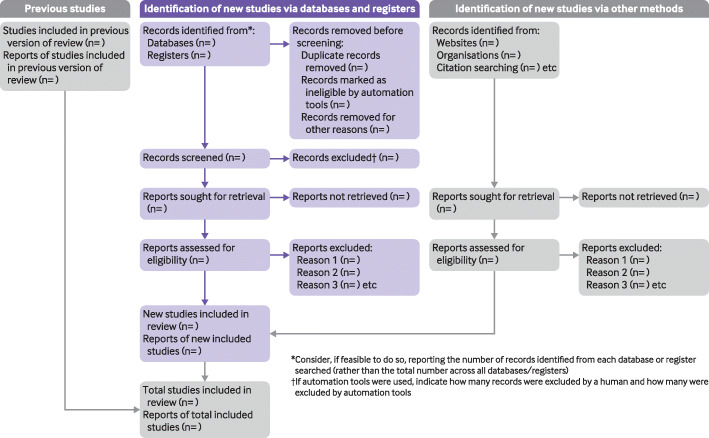
PRISMA 2020 replaces the 2009 PRISMA statement as updated reporting guidance for systematic reviews, reflecting advances in methods to identify, select, appraise, and synthesise studies. It provides a 27-item checklist, an expanded checklist, an abstract checklist, and revised flow diagrams for original and updated reviews.
Key findings
- PRISMA 2020 consists of a 27-item checklist, an expanded checklist detailing reporting recommendations for each item, the PRISMA 2020 abstract checklist, and revised flow diagrams for original and updated reviews.
- Noteworthy changes include inclusion of the abstract reporting checklist within PRISMA 2020; moving protocol and registration to a new Other section with a sub-item on amendments; recommending full search strategies for all databases, registers, and websites; more detail on reviewer screening, data collection, and automation; splitting synthesis methods into six sub-items and synthesis results into four sub-items; and adding items on certainty assessment, competing interests, and availability of data, code, and other materials.
- Development drew on reviews of reporting completeness, 60 documents providing reporting guidance, a survey to which 110 of 220 invited methodologists and journal editors responded, a 21-member two-day in-person meeting in September 2018 in Edinburgh, and feedback from 15 of 22 invited systematic reviewers.
- PRISMA 2009 was cited in over 60,000 reports (Scopus, August 2020) and endorsed by almost 200 journals and systematic review organisations; evidence from observational studies suggests its use is associated with more complete reporting, although more could be done to improve adherence.
Methods
- Guideline update: PRISMA 2020 was developed by adapting the EQUATOR Network’s guidance for developing health research reporting guidelines, identifying incompletely reported PRISMA 2009 items, reviewing 60 guidance documents, surveying methodologists and journal editors, discussing findings at a 21-member two-day meeting, and iteratively revising drafts with co-authors.
- Scope: designed primarily for systematic reviews of studies evaluating effects of health interventions, irrespective of included study design; applicable to other interventions and objectives, reviews with or without synthesis, mixed-methods reviews, and original, updated, or living systematic reviews.
- Analysis: no empirical meta-analysis is reported; the paper presents consensus-based reporting guidance, checklists, and flow diagram templates.
Limitations
- The paper states that it is unclear which strategies should be used to increase adherence to reporting guidelines, because of 31 interventions proposed, the effects of only 11 have been evaluated, mostly in observational studies at high risk of bias due to confounding.
- The paper states PRISMA 2020 is not intended to guide systematic review conduct, assess conduct or methodological quality, or inform reporting of systematic review protocols; separate tools and statements exist for those purposes.
- Evident from the text: PRISMA 2020 is a reporting guideline and consensus statement, not an empirical evaluation of its own impact; the paper notes future research is needed on barriers and facilitators, think-aloud studies, and reliability studies.
Model-written summary. Check it against the paper before relying on it.
Integrity signals
Registry
Cites
Statistics
Figures
Verification
Claims the paper makes
24 Valid · 0 Not valid · 1 Not checked · 25 Own results and interpretations
The sources with a verdict support this claim; the rest weren’t checked yet, have no full text we could read, or their verdicts aren’t rated yet.
In the paper
“Evidence from observational studies suggests that use of the PRISMA 2009 statement is associated with more complete reporting of systematic reviews [17–20], although more could be done to improve adherence to the guideline [21].”
What the sources say
- Supportedcites [17] Page MJ Shamseer L Altman DG Epidemiology and reporting characteristics of systematic reviews of biomedical research: a cross-sectional study PLoS Med 2016 13 e1002028 10.1371/journal.pmed.1002028 27218655 PMC4878797 source
The Results section reports that nearly all 26 characteristics were reported more often in therapeutic systematic reviews that self-reported using PRISMA. The Discussion describes mention of PRISMA as associated with more complete reporting, while cautioning that mention may only be a surrogate for actual use. (LLM, conf=0.92)
- Supportedcites [18] Panic N Leoncini E de Belvis G Ricciardi W Boccia S Evaluation of the endorsement of the preferred reporting items for systematic reviews and meta-analysis (PRISMA) statement on the quality of published systematic review and meta-analyses PLoS One 2013 8 e83138 10.1371/journal.pone.0083138 24386151 PMC3873291 source
The Abstract Results report higher adherence to the PRISMA reporting checklist after gastroenterology and hepatology journals endorsed PRISMA (90.1% versus 83.1%). The evidence concerns journal endorsement; the same section says that explicitly referencing PRISMA in an individual manuscript was not associated with better reporting. (LLM, conf=0.88)
- Not checked — no full text of the sourcecites [19] Agha RA Fowler AJ Limb C Impact of the mandatory implementation of reporting guidelines on reporting quality in a surgical journal: a before and after study Int J Surg 2016 30 169 172 10.1016/j.ijsu.2016.04.032 27112835 source
- Not checked — no full text of the sourcecites [20] Leclercq V Beaudart C Ajamieh S Rabenda V Tirelli E Bruyère O Meta-analyses indexed in PsycINFO had a better completeness of reporting when they mention PRISMA J Clin Epidemiol 2019 115 46 54 10.1016/j.jclinepi.2019.06.014 31254618 source
hedgedstates an association- Asserted: passes — The authors put it forward as true.
- Checkable: passes — It can be checked against evidence.
- Load-bearing: unclear — It is unclear whether the paper’s conclusions depend on it.
- Based: passes — The paper gives a reason why it holds.
- Supported
Every source the paper cites for this claim was checked and supports it.
In the paper
“technological advances have enabled the use of natural language processing and machine learning to identify relevant evidence [22–24]”
What the sources say
- Supportedcites [22] O’Mara-Eves A Thomas J McNaught J Miwa M Ananiadou S Using text mining for study identification in systematic reviews: a systematic review of current approaches Syst Rev 2015 4 5 10.1186/2046-4053-4-5 25588314 PMC4320539 source
The Results section on the suitability of text mining describes natural language processing techniques for improving how studies are classified. The Results section on review updates also describes machine-learning features used to classify studies, and the Discussion notes advances in text-mining technology. Together, these support the broad claim about using these technologies to identify relevant evidence. (LLM, conf=0.88)
- Supportedcites [23] Marshall IJ Noel-Storr A Kuiper J Thomas J Wallace BC Machine learning for identifying randomized controlled trials: an evaluation and practitioner’s guide Res Synth Methods 2018 9 602 614 10.1002/jrsm.1287 29314757 PMC6030513 source
The Aims section describes evaluating machine learning to identify RCTs in health research databases, and the Discussion reports that these approaches outperform traditional filters for systematic reviews. The paper also places its text-classification methods within NLP, supporting the broad claim about using these technologies to identify relevant evidence. (LLM, conf=0.88)
- Supportedcites [24] Marshall IJ Wallace BC Toward systematic review automation: a practical guide to using machine learning tools in research synthesis Syst Rev 2019 8 163 10.1186/s13643-019-1074-9 31296265 PMC6621996 source
The Search section (page not available in our copy) says that machine learning can use a small set of relevant articles to identify other relevant articles and describes semantic search by concept. The methods introduction explains how machine learning classifies articles for inclusion or exclusion, supporting the claim that these technologies can identify relevant evidence. (LLM, conf=0.91)
plainstates a cause- Asserted: passes — The authors put it forward as true.
- Checkable: passes — It can be checked against evidence.
- Load-bearing: unclear — It is unclear whether the paper’s conclusions depend on it.
- Based: passes — The paper gives a reason why it holds.
- Supported
The cited sources support only part of this claim — read each source’s verdict below.
In the paper
“We evaluated the reporting completeness of published systematic reviews [17, 21, 36, 37]”
§ The PRISMA 2020 statement: an updated guideline for reporting systematic reviews > Discussion
What the sources say
- Supportedcites [17] Page MJ Shamseer L Altman DG Epidemiology and reporting characteristics of systematic reviews of biomedical research: a cross-sectional study PLoS Med 2016 13 e1002028 10.1371/journal.pmed.1002028 27218655 PMC4878797 source
The Methods > Data Analysis section says the study assessed whether 26 characteristics of published systematic reviews were reported, and the Discussion > Explanation of Results and Implications discusses how complete that reporting was (page numbers unavailable). This supports citing the paper as an evaluation of reporting completeness. The PRISMA 2020 development context is the citing authors’ framing, not a finding attributed to this 2016 paper. (LLM, conf=0.91)
- Supportedcites [21] Page MJ Moher D Evaluations of the uptake and impact of the preferred reporting items for systematic reviews and meta-analyses (PRISMA) statement and extensions: a scoping review Syst Rev 2017 6 263 10.1186/s13643-017-0663-8 29258593 PMC5738221 source
The Methods section says the authors pooled studies assessing how often published systematic reviews adhered to PRISMA reporting items. The Results section reports their pooled assessment of adherence across 57 studies, supporting the citation’s use as an example of evaluating reporting completeness. (LLM, conf=0.90)
- Supportedcites [36] Page MJ Altman DG Shamseer L Reproducible research practices are underused in systematic reviews of biomedical interventions J Clin Epidemiol 2018 94 8 18 10.1016/j.jclinepi.2017.10.017 29113936 source
The Discussion (p. 20) reports the authors’ assessment of how completely published systematic reviews reported data needed to recreate their meta-analyses and other reproducible research practices. This supports the citation for evaluating reporting completeness; the PRISMA 2020 development context belongs to the citing document, not to this source. (LLM, conf=0.90)
- Partly supportedcites [37] Page MJ Altman DG McKenzie JE Flaws in the application and interpretation of statistical analyses in systematic reviews of therapeutic interventions were common: a cross-sectional analysis J Clin Epidemiol 2018 95 7 18 10.1016/j.jclinepi.2017.11.022 29203419 sourceExperimental — accuracy not yet measured
The Methods (section 2.3) and Results (section 3.6) show that the paper assessed whether selected statistical methods and their rationales were reported in published systematic reviews. It did not assess the completeness of reporting across the reviews as a whole. The citing authors’ PRISMA 2020 development context is their own framing, not a finding attributed to this source. (LLM, conf=0.82)
plain- Asserted: passes — The authors put it forward as true.
- Checkable: passes — It can be checked against evidence.
- Load-bearing: passes — The paper’s conclusions depend on it.
- Based: passes — The paper gives a reason why it holds.
- Supported
Every source the paper cites for this claim was checked and supports it.
In the paper
“new methods have been developed to assess the risk of bias in results of included studies [28, 29]”
What the sources say
- Supportedcites [28] Sterne JAC Savović J Page MJ RoB 2: a revised tool for assessing risk of bias in randomised trials BMJ 2019 366 l4898 10.1136/bmj.l4898 31462531 source
The Summary Points state that the authors developed and piloted RoB 2, a revised tool for assessing risk of bias in randomised trials, and that it produces a judgment for each result assessed. The introduction places risk-of-bias assessment in the context of studies included in systematic reviews. This paper therefore supports the claim as an example of a new method, specifically for randomised trials. (LLM, conf=0.93)
- Supportedcites [29] Sterne JA Hernán MA Reeves BC ROBINS-I: a tool for assessing risk of bias in non-randomised studies of interventions BMJ 2016 355 i4919 10.1136/bmj.i4919 27733354 PMC5062054 source
The Discussion says ROBINS-I was developed primarily for systematic reviews. The ‘Assessing a specific study’ section describes judging risk of bias for an outcome and result in each included non-randomised study, supporting the claim as an example of a new method. (LLM, conf=0.92)
plain- Asserted: passes — The authors put it forward as true.
- Checkable: passes — It can be checked against evidence.
- Load-bearing: unclear — It is unclear whether the paper’s conclusions depend on it.
- Based: passes — The paper gives a reason why it holds.
- Supported
Every source the paper cites for this claim was checked and supports it.
In the paper
“We identified PRISMA 2009 items that were often reported incompletely by examining the results of studies investigating the transparency of reporting of published reviews [17, 21, 36, 37].”
§ The PRISMA 2020 statement: an updated guideline for reporting systematic reviews > Development of PRISMA 2020
What the sources say
- Supportedcites [17] Page MJ Shamseer L Altman DG Epidemiology and reporting characteristics of systematic reviews of biomedical research: a cross-sectional study PLoS Med 2016 13 e1002028 10.1371/journal.pmed.1002028 27218655 PMC4878797 source
The Results (Reporting Characteristics of SRs; page unavailable) quantify incomplete reporting of review characteristics, including review flow and reasons for excluding studies. The Discussion (Explanation of Results and Implications; page unavailable) says reporting of many systematic reviews remains poor despite PRISMA 2009 and explains how individual PRISMA items may be reported incompletely. This supports using the study’s results to identify frequently incomplete reporting items. (LLM, conf=0.90)
- Supportedcites [21] Page MJ Moher D Evaluations of the uptake and impact of the preferred reporting items for systematic reviews and meta-analyses (PRISMA) statement and extensions: a scoping review Syst Rev 2017 6 263 10.1186/s13643-017-0663-8 29258593 PMC5738221 source
In Results (“Evaluations of SR adherence to the PRISMA Statement”), the review pools studies of published systematic reviews and identifies PRISMA items with low reporting adherence. It also reports nine items adhered to by fewer than 67% of reviews published in 2010 or later. The supplied passages do not give page numbers. (LLM, conf=0.94)
- Supportedcites [36] Page MJ Altman DG Shamseer L Reproducible research practices are underused in systematic reviews of biomedical interventions J Clin Epidemiol 2018 94 8 18 10.1016/j.jclinepi.2017.10.017 29113936 source
The Introduction (p. 6) describes studies finding low adherence to a PRISMA reporting item. This paper also examines published systematic reviews and reports incomplete reporting of that item in the Discussion (p. 20), making it a relevant study for identifying incompletely reported PRISMA items. (LLM, conf=0.90)
- Supportedcites [37] Page MJ Altman DG McKenzie JE Flaws in the application and interpretation of statistical analyses in systematic reviews of therapeutic interventions were common: a cross-sectional analysis J Clin Epidemiol 2018 95 7 18 10.1016/j.jclinepi.2017.11.022 29203419 source
The Results (sections 3.5 and 3.6) examine published systematic reviews and report frequent omissions in how statistical analyses were described, including missing rationales for subgroup and sensitivity analyses. This supports citing the paper as a study whose results could be examined to identify incompletely reported items; the identification of PRISMA 2009 items is the citing authors’ own step. (LLM, conf=0.86)
plain- Asserted: passes — The authors put it forward as true.
- Checkable: passes — It can be checked against evidence.
- Load-bearing: passes — The paper’s conclusions depend on it.
- Based: passes — The paper gives a reason why it holds.
- Supported
5 more claims · 2 with their cited sources checked
Create a free account to see all 50 claims and to verify the 3 references still open.
- Probably not a substantial claim. 36
- It may state two separate claims as one. 14
- The quote only partly states this claim. 1
Claims other papers make about this one
Each is checked against this paper’s own text: does it say what the citing paper says it does?
The source backs part of the claim, not all of it — or backs it for a different population, condition or comparison.
In the citing paper
“The PRISMA 2020 statement was designed primarily to provide guidance for systematic reviews of studies that evaluate the effects of interventions.”
From Extension of the PRISMA 2020 statement for living systematic reviews (PRISMA-LSR): checklist and explanation (2024) · cites this paper as [10]
Experimental — accuracy not yet measuredThe source backs part of the claim, not all of it — or backs it for a different population, condition or comparison.
In the citing paper
“This systematic review followed the PRISMA-NMA (Preferred Reporting Items for Systematic Review and Meta-Analyses extension for Network Meta-Analysis) 2020 statement for designing and reporting [38].”
From Assessing the Effectiveness of Digital Health Behavior Strategies on Type 2 Diabetes Management: Systematic Review and Network Meta-Analysis (2025) · cites this paper as [38]
Experimental — accuracy not yet measuredThe source backs part of the claim, not all of it — or backs it for a different population, condition or comparison.
In the citing paper
“This review was planned, conducted, and reported according to the updated guidelines for reporting systematic reviews of the 2020 Preferred Reporting Items for Systematic Reviews and Meta-Analyses (PRISMA) (Page et al., 2021).”
From A Competency Framework for AI Literacy: Variations by Different Learner Groups and an Implied Learning Pathway (2025) · cites this paper as Page et al., 2021
Experimental — accuracy not yet measuredThe source backs part of the claim, not all of it — or backs it for a different population, condition or comparison.
In the citing paper
“First, a systematic review was conducted, based on the PRISMA (Preferred Reporting Items for Systematic Review and Meta-Analysis) methodology (Page et al. 2021) to identify studies about the interaction of citizens with digital public services.”
From Recommendations for digital inclusion in the use of European digital public services (2025) · cites this paper as Page et al. 2021
Experimental — accuracy not yet measuredThe source backs part of the claim, not all of it — or backs it for a different population, condition or comparison.
In the citing paper
“This meta-analytical review was conducted and reported in accordance with the PRISMA 2020 guidelines (Page et al., 2021).”
From Child Maltreatment as a Risk Factor for Rejection Sensitivity: A Three-Level Meta-Analytic Review (2024) · cites this paper as Page et al., 2021
Experimental — accuracy not yet measured
41 more claims about this paper
Create a free account to see every claim other papers make about this one.
Citations
Cites
Preferred Reporting Items for Systematic Reviews and Meta-Analyses: the PRISMA statement
Moher, D., Liberati, A., Tetzlaff, J., Altman, D. G., & for the PRISMA Group (2009) · BMJ · doi:10.1136/bmj.b2535 · Cited by 83,823
Self-citationPreferred Reporting Items for Systematic Reviews and Meta-Analyses: The PRISMA Statement
Moher, D., Liberati, A., Tetzlaff, J., Altman, D. G., & The PRISMA Group (2009) · PLoS Medicine · doi:10.1371/journal.pmed.1000097 · Cited by 64,042
Self-citationPreferred reporting items for systematic reviews and meta-analyses: the PRISMA Statement.
(2009) · PubMed Central · Cited by 44,859
Self-citationPRISMA Extension for Scoping Reviews (PRISMA-ScR): Checklist and Explanation
Tricco, A. C., Lillie, E., Zarin, W., O'Brien, K. K., Colquhoun, H., Levac, D., Moher, D., Peters, M. D. J., Horsley, T., Weeks, L., et al. (2018) · Annals of Internal Medicine · doi:10.7326/m18-0850 · Cited by 43,565
Self-citationPreferred reporting items for systematic reviews and meta-analyses: The PRISMA statement
Moher, D., Liberati, A., Tetzlaff, J., Altman, D. G., & the PRISMA Group* (2009) · Annals of Internal Medicine · doi:10.7326/0003-4819-151-4-200908180-00135 · Cited by 37,554
Self-citationRoB 2: a revised tool for assessing risk of bias in randomised trials
Sterne, J. A. C., Savović, J., Page, M. J., Elbers, R. G., Blencowe, N. S., Boutron, I., Cates, C. J., Cheng, H.-Y., Corbett, M. S., Eldridge, S. M., et al. (2019) · BMJ · doi:10.1136/bmj.l4898 · Cited by 34,787
Self-citationLiberati, A., Altman, D. G., Tetzlaff, J., Mulrow, C., Gøtzsche, P. C., Ioannidis, J. P. A., Clarke, M., Devereaux, P. J., Kleijnen, J., & Moher, D. (2009) · PLoS Medicine · doi:10.1371/journal.pmed.1000100 · Cited by 28,164
Self-citationPRISMA-P Group, Moher, D., Shamseer, L., Clarke, M., Ghersi, D., Liberati, A., Petticrew, M., Shekelle, P., & Stewart, L. A. (2015) · Systematic Reviews · doi:10.1186/2046-4053-4-1 · Cited by 26,223
Self-citationDermyshi, E., Wang, Y., Yan, C., Hong, W., Qiu, G., Gong, X., & Zhang, T. (2017) · Neonatology · doi:10.1159/000454668 · Cited by 24,451
ROBINS-I: a tool for assessing risk of bias in non-randomised studies of interventions
Sterne, J. A., Hernán, M. A., Reeves, B. C., Savović, J., Berkman, N. D., Viswanathan, M., Henry, D., Altman, D. G., Ansari, M. T., Boutron, I., et al. (2016) · BMJ · doi:10.1136/bmj.i4919 · Cited by 20,329
Self-citation
Research works printed but not linked: 1
- Liberati A, Altman DG, Tetzlaff J, et al. The PRISMA statement for reporting. systematic reviews and meta-analyses of studies that evaluate health care. interventions: explanation and elaboration. PLoS Med. 2009;6:e1000100. 10.1371/journal.pmed.1000100. PMC2707010 19621070 · DOI · Paper page
Cited by
Updating guidance for reporting systematic reviews: development of the PRISMA 2020 statement
Page, M. J., McKenzie, J. E., Bossuyt, P. M., Boutron, I., Hoffmann, T. C., Mulrow, C. D., Shamseer, L., Tetzlaff, J. M., & Moher, D. (2021) · Journal of Clinical Epidemiology · doi:10.1016/j.jclinepi.2021.02.003 · Cited by 3,490
Self-citationGlobal Burden of Cardiovascular Diseases and Risks, 1990-2022
Mensah, G. A., Fuster, V., Murray, C. J. L., Roth, G. A., Mensah, G. A., Abate, Y. H., Abbasian, M., Abd-Allah, F., Abdollahi, A., Abdollahi, M., et al. (2023) · Journal of the American College of Cardiology · doi:10.1016/j.jacc.2023.11.007 · Cited by 1,659
Chen, C., Haupert, S. R., Zimmermann, L., Shi, X., Fritsche, L. G., & Mukherjee, B. (2022) · The Journal of Infectious Diseases · doi:10.1093/infdis/jiac136 · Cited by 1,366
CONSORT 2025 statement: updated guideline for reporting randomised trials
Hopewell, S., Chan, A.-W., Collins, G. S., Hróbjartsson, A., Moher, D., Schulz, K. F., Tunn, R., Aggarwal, R., Berkwits, M., Berlin, J. A., et al. (2025) · BMJ · doi:10.1136/bmj-2024-081123 · Cited by 1,195
“32 The expanded checklist comprises an abridged version of elements presented in the CONSORT 2025 explanation and elaboration document, 29 with examples and references removed (appendix p 5).”
Self-citationHow to properly use the PRISMA Statement
Sarkis-Onofre, R., Catalá-López, F., Aromataris, E., & Lockwood, C. (2021) · Systematic Reviews · doi:10.1186/s13643-021-01671-z · Cited by 1,104
Stark, B. A., DeCleene, N. K., Desai, E. C., Hsu, J. M., Johnson, C. O., Lara-Castor, L., LeGrand, K. E., A, P. B., Aalipour, M. A., Aalruz, H., et al. (2025) · JACC · doi:10.1016/j.jacc.2025.08.015 · Cited by 672
Gates, M., Gates, A., Pieper, D., Fernandes, R. M., Tricco, A. C., Moher, D., Brennan, S. E., Li, T., Pollock, M., Lunny, C., et al. (2022) · BMJ · doi:10.1136/bmj-2022-070849 · Cited by 856
Self-citationThe Electronic Journal of e-Learning
(2023) · The Electronic Journal of e-Learning · doi:10.34190/ejel · Cited by 765
Do AI chatbots improve students learning outcomes? Evidence from a meta‐analysis
Wu, R., & Yu, Z. (2024) · British Journal of Educational Technology · doi:10.1111/bjet.13334 · Cited by 576
Coffey, Y., Bhullar, N., Durkin, J., Islam, M. S., & Usher, K. (2021) · The Journal of Climate Change and Health · doi:10.1016/j.joclim.2021.100047 · Cited by 541
Cohen, C., Pignata, S., Bezak, E., Tie, M., & Childs, J. (2023) · BMJ open · doi:10.1136/bmjopen-2022-071203 · Cited by 514
CONSORT 2025 statement: updated guideline for reporting randomised trials
Hopewell, S., Chan, A.-W., Collins, G. S., Hróbjartsson, A., Moher, D., Schulz, K. F., Tunn, R., Aggarwal, R., Berkwits, M., Berlin, J. A., et al. (2025) · The Lancet · doi:10.1016/s0140-6736(25)00672-5 · Cited by 510
Self-citationClimate Change and Mental Health: A Scoping Review
Charlson, F., Ali, S., Benmarhnia, T., Pearl, M., Massazza, A., Augustinavicius, J., & Scott, J. G. (2021) · International Journal of Environmental Research and Public Health · doi:10.3390/ijerph18094486 · Cited by 507
Mahmud, M. R., Akter, S., Tamanna, S. K., Mazumder, L., Esti, I. Z., Banerjee, S., Akter, S., Hasan, M. R., Acharjee, M., Hossain, M. S., et al. (2022) · Gut Microbes · doi:10.1080/19490976.2022.2096995 · Cited by 466
Rethlefsen, M. L., Kirtley, S., Waffenschmidt, S., Ayala, A. P., Moher, D., Page, M. J., Koffel, J. B., & Group, P.-S. (2021) · Journal of the Medical Library Association · doi:10.5195/jmla.2021.962 · Cited by 409
“DISCUSSION AND CONCLUSIONS The PRISMA-S extension is designed to be used in conjunction with PRISMA 2020 [34] and PRISMA extensions including PRISMA-P for protocols [35], PRISMA-ScR for scoping reviews [139], the PRISMA Network Meta-analyses statement [140], and PRISMA-IPD for systematic reviews using individual patie…”
BackgroundMethodInfluentialSelf-citationLim, W. M., Kumar, S., & Donthu, N. (2024) · Journal of Business Research · doi:10.1016/j.jbusres.2024.114760 · Cited by 383
SPIRIT 2025 statement: updated guideline for protocols of randomised trials
Chan, A.-W., Boutron, I., Hopewell, S., Moher, D., Schulz, K. F., Collins, G. S., Tunn, R., Aggarwal, R., Berkwits, M., Berlin, J. A., et al. (2025) · BMJ · doi:10.1136/bmj-2024-081477 · Cited by 460
Self-citationArdern, C. L., Büttner, F., Andrade, R., Weir, A., Ashe, M. C., Holden, S., Impellizzeri, F. M., Delahunt, E., Dijkstra, H. P., Mathieson, S., et al. (2022) · British Journal of Sports Medicine · doi:10.1136/bjsports-2021-103987 · Cited by 458
Self-citationAhmad, H., Yaqub, M., & Lee, S. H. (2023) · Environment, Development and Sustainability · doi:10.1007/s10668-023-02921-x · Cited by 345
“Moreover, it helps to replicate and validate review methods if needed, prevents random decision-making regarding inclusion conditions and data extraction, and can decrease duplication of literature (Moher et al., 2015; Page et al., 2021).”
Cyber risk and cybersecurity: a systematic review of data availability
Cremer, F., Sheehan, B., Fortmann, M., Kia, A. N., Mullins, M., Murphy, F., & Materne, S. (2022) · The Geneva Papers on Risk and Insurance - Issues and Practice · doi:10.1057/s41288-022-00266-6 · Cited by 355
Montazeri, A., Mohammadi, S., M.Hesari, P., Ghaemi, M., Riazi, H., & Sheikhi-Mobarakeh, Z. (2023) · Systematic Reviews · doi:10.1186/s13643-023-02410-2 · Cited by 433
“The use of BIBLIO similar to other guidelines [3, 4, 75] has the potential to benefit many stakeholders.”
MethodVimbi, V., Shaffi, N., & Mahmud, M. (2024) · Brain Informatics · doi:10.1186/s40708-024-00222-1 · Cited by 433
“We followed PRISMA [85] and Kitchenham [84] guidelines to identify relevant papers for this review.”
MethodCONSORT 2025 Statement: Updated Guideline for Reporting Randomized Trials
Hopewell, S., Chan, A.-W., Collins, G. S., Hróbjartsson, A., Moher, D., Schulz, K. F., Tunn, R., Aggarwal, R., Berkwits, M., Berlin, J. A., et al. (2025) · JAMA · doi:10.1001/jama.2025.4347 · Cited by 369
Self-citationFazzini, B., Märkl, T., Costas, C., Blobner, M., Schaller, S. J., Prowle, J., Puthucheary, Z., & Wackerhage, H. (2023) · Critical Care · doi:10.1186/s13054-022-04253-0 · Cited by 384
“We conducted this systematic review and meta-analysis in accordance with the Joanna-Briggs Institute (JBI) Reviewer’s Manual for Systematic Reviews of Literature [18] and the Preferred Reporting Items for Systematic Reviews and Meta-Analyses (PRISMA 2020) guidelines [19, 20].”
MethodSociodemographic determinants of digital health literacy: A systematic review and meta-analysis
Estrela, M., Semedo, G., Roque, F., Ferreira, P. L., & Herdeiro, M. T. (2023) · International Journal of Medical Informatics · doi:10.1016/j.ijmedinf.2023.105124 · Cited by 414
Artificial intelligence in teaching and teacher professional development: A systematic review
Tan, X., Cheng, G., & Ling, M. H. (2025) · Computers and Education: Artificial Intelligence · doi:10.1016/j.caeai.2024.100355 · Cited by 420
Nadimi-Shahraki, M. H., Zamani, H., Asghari Varzaneh, Z., & Mirjalili, S. (2023) · Archives of Computational Methods in Engineering · doi:10.1007/s11831-023-09928-7 · Cited by 385
Sharifi, A., Allam, Z., Bibri, S. E., & Khavarian-Garmsir, A. R. (2024) · Cities · doi:10.1016/j.cities.2023.104659 · Cited by 351
The impact of wearable technologies in health research: scoping review
Huhn, S., Axt, M., Gunga, H.-C., Maggioni, M. A., Munga, S., Obor, D., Sié, A., Boudo, V., Bunker, A., Sauerborn, R., et al. (2022) · JMIR mHealth and uHealth · doi:10.2196/34384 · Cited by 379
Ram, B. G., Oduor, P., Igathinathane, C., Howatt, K., & Sun, X. (2024) · Computers and Electronics in Agriculture · doi:10.1016/j.compag.2024.109037 · Cited by 315
AGA Clinical Practice Guideline on Pharmacological Interventions for Adults With Obesity
Grunvald, E., Shah, R., Hernaez, R., Chandar, A. K., Pickett-Blakely, O., Teigen, L. M., Harindhanavudhi, T., Sultan, S., Singh, S., & Davitkov, P. (2022) · Gastroenterology · doi:10.1053/j.gastro.2022.08.045 · Cited by 347
Lane, M. M., Gamage, E., Travica, N., Dissanayaka, T., Ashtree, D. N., Gauci, S., Lotfaliany, M., O’Neil, A., Jacka, F. N., & Marx, W. (2022) · Nutrients · doi:10.3390/nu14132568 · Cited by 320
“This review was prospectively registered with the International Prospective Register of Systematic Reviews, better known as PROSPERO (ID: CRD42022311620), and has been reported in accordance with the Preferred Reporting Items for Systematic Reviews and Meta-Analyses (PRISMA) guidelines (see Figure S1 for PRISMA flowch…”
MethodAlmatrafi, O., Johri, A., & Lee, H. (2024) · Computers and Education Open · doi:10.1016/j.caeo.2024.100173 · Cited by 341
Mhlongo, S., Mbatha, K., Ramatsetse, B., & Dlamini, R. (2023) · Heliyon · doi:10.1016/j.heliyon.2023.e16348 · Cited by 337
“PRISMA flow diagram for the identification, screening, and inclusion of articles for final review and analysis (Source: Adopted from Page et al. [15] and García-Peñalvo [16]). make education accessible to all, an alternative to the ‘brick-and-mortar’ approach is a necessity.”
Hybrid approaches to optimization and machine learning methods: a systematic literature review
Azevedo, B. F., Rocha, A. M. A. C., & Pereira, A. I. (2024) · Machine Learning · doi:10.1007/s10994-023-06467-x · Cited by 291
Gawde, S., Patil, S., Kumar, S., Kamat, P., Kotecha, K., & Abraham, A. (2023) · Engineering Applications of Artificial Intelligence · doi:10.1016/j.engappai.2023.106139 · Cited by 306
Ye, Z., Hu, T., Wang, J., Xiao, R., Liao, X., Liu, M., & Sun, Z. (2022) · Frontiers in Cardiovascular Medicine · doi:10.3389/fcvm.2022.933913 · Cited by 314
“This study was reported based on the Preferred Reporting Items for Systematic Reviews and Meta-Analyses guidelines (24).”
MethodAxfors, C., Schmitt, A. M., Janiaud, P., van’t Hooft, J., Abd-Elsalam, S., Abdo, E. F., Abella, B. S., Akram, J., Amaravadi, R. K., Angus, D. C., et al. (2021) · Nature Communications · doi:10.1038/s41467-021-22446-z · Cited by 295
“Participant 3 (5) 1 (4) 2 (6) Participant, caregiver 25 (40) 11 (39) 14 (41)”
Self-citationJabed, M. A., & Azmi Murad, M. A. (2024) · Heliyon · doi:10.1016/j.heliyon.2024.e40836 · Cited by 250
“Article selection adheres to PRISMA guidelines [33], using databases like Scopus, Google Scholar, Science Direct, PubMed, Web of Science, Mendeley Research Networks, and Wiley.”
CONSORT 2025 statement: updated guideline for reporting randomized trials
Hopewell, S., Chan, A.-W., Collins, G. S., Hróbjartsson, A., Moher, D., Schulz, K. F., Tunn, R., Aggarwal, R., Berkwits, M., Berlin, J. A., et al. (2025) · Nature Medicine · doi:10.1038/s41591-025-03635-5 · Cited by 283
“This is similar to the model proposed by the COBWEB (CONSORT-based web tool) 30 and COBPeer (CONSORT-based peer review tool) 31 studies and used in the 2020 PRISMA guidance for reporting systematic reviews 32 .”
Self-citationA Comprehensive Systematic Review of YOLO for Medical Object Detection (2018 to 2023)
Ragab, M. G., Abdulkadir, S. J., Muneer, A., Alqushaibi, A., Sumiea, E. H., Qureshi, R., Al-Selwi, S. M., & Alhussian, H. (2024) · IEEE Access · doi:10.1109/access.2024.3386826 · Cited by 306
“The search strategy employed a combination of keywords, specifically ((YOLO) AND (medical application)) OR (medical imaging) and adhered to the vi VOLUME 11, 2023 Preferred Reporting Items for Systematic Reviews and Meta-Analyses (PRISMA) guidelines [74].”
MethodA systematic review and meta-analysis of nonrelapse mortality after CAR T cell therapy
Cordas dos Santos, D. M., Tix, T., Shouval, R., Gafter-Gvili, A., Alberge, J.-B., Cliff, E. R. S., Theurich, S., von Bergwelt-Baildon, M., Ghobrial, I. M., Subklewe, M., et al. (2024) · Nature Medicine · doi:10.1038/s41591-024-03084-6 · Cited by 287
“P) guidelines (see study protocol and PRISMA checklist in Supplementary Information) and was prospectively registered to the PROSPERO database (study number CRD42023494252) 112 .”
Process mining for healthcare: Characteristics and challenges
Munoz-Gama, J., Martin, N., Fernandez-Llatas, C., Johnson, O. A., Sepúlveda, M., Helm, E., Galvez-Yanjari, V., Rojas, E., Martinez-Millana, A., Aloini, D., et al. (2022) · Journal of Biomedical Informatics · doi:10.1016/j.jbi.2022.103994 · Cited by 287
“cross-organisational [90] and cross-national [75] studies are also an interesting research line to advance the PM4H state-of-the-art, as well as the generation of methodologies to conduct meta-analyses based on outcomes and metrics obtained with PM4H techniques [119].”
MethodIntroduction to PRISMA 2020 and implications for research synthesis methodologists
Page, M. J., Moher, D., & McKenzie, J. E. (2022) · Research Synthesis Methods · doi:10.1002/jrsm.1535 · Cited by 270
Self-citationAn umbrella review of the evidence linking oral health and systemic noncommunicable diseases
Botelho, J., Mascarenhas, P., Viana, J., Proença, L., Orlandi, M., Leira, Y., Chambrone, L., Mendes, J. J., & Machado, V. (2022) · Nature Communications · doi:10.1038/s41467-022-35337-8 · Cited by 260
Behnood, S. A., Shafran, R., Bennett, S. D., Zhang, A. X. D., O'Mahoney, L. L., Stephenson, T. J., Ladhani, S. N., De Stavola, B. L., Viner, R. M., & Swann, O. V. (2022) · Journal of Infection · doi:10.1016/j.jinf.2021.11.011 · Cited by 267
Song, S., Ding, Y., Li, W., Meng, Y., Zhou, J., Gou, R., Zhang, C., Ye, S., Saintilan, N., Krauss, K. W., et al. (2023) · Nature Communications · doi:10.1038/s41467-023-36477-1 · Cited by 251
Digitally-induced change in the public sector: a systematic review and research agenda
Haug, N., Dan, S., & Mergel, I. (2024) · Public Management Review · doi:10.1080/14719037.2023.2234917 · Cited by 266
“To answer our review questions, a systematic review is well suited as a comprehensive, transparent, and replicable way of identifying, selecting, and analysing the literature (Page et al. 2021).”
InfluentialSystematic review of artificial intelligence in education: trends, benefits, and challenges
Garzón, J., Patiño, E., & Marulanda, C. (2025) · Multimodal Technologies and Interaction · doi:10.3390/mti9080084 · Cited by 265
“This systematic review adopted the PRISMA statement approach [34] and followed the recommendations of Kitchenham and Charters [35].”
Culturally tailored interventions for ethnic minorities: A scoping review
Joo, J. Y., & Liu, M. F. (2021) · Nursing Open · doi:10.1002/nop2.733 · Cited by 241
“In addition, this review was guided by the Preferred Reporting Items for Systematic Reviews and Meta-Analyses (PRISMA) statement (Page et al. 2020).”
MethodAutomated Grading and Feedback Tools for Programming Education: A Systematic Review
Messer, M., Brown, N. C. C., Kölling, M., & Shi, M. (2024) · ACM Transactions on Computing Education · doi:10.1145/3636515 · Cited by 262
Financial fraud detection using graph neural networks: A systematic review
Motie, S., & Raahemi, B. (2024) · Expert Systems with Applications · doi:10.1016/j.eswa.2023.122156 · Cited by 209
Batista, J., Mesquita, A., & Carnaz, G. (2024) · Information · doi:10.3390/info15110676 · Cited by 256
Chan, J. K. N., Correll, C. U., Wong, C. S. M., Chu, R. S. T., Fung, V. S. C., Wong, G. H. S., Lei, J. H. C., & Chang, W. C. (2023) · eClinicalMedicine · doi:10.1016/j.eclinm.2023.102294 · Cited by 233
“This systematic review and meta-analysis was conducted and reported in accordance with the Preferred Reporting Items for Systematic Reviews and Meta-analyses 14 (PRISMA).”
MethodYe, H., Liang, B., Ng, O.-L., & Chai, C. S. (2023) · International Journal of STEM Education · doi:10.1186/s40594-023-00396-w · Cited by 159
“We used the PRISMA systematic review method (Page et al., 2021a, b) to review the impact of CT-based mathematics instruction on student learning.”
MethodHui, H. B., & Mahmud, M. S. (2023) · Frontiers in Psychology · doi:10.3389/fpsyg.2023.1105806 · Cited by 365
Marougkas, A., Troussas, C., Krouska, A., & Sgouropoulou, C. (2023) · Multimedia Tools and Applications · doi:10.1007/s11042-023-15986-7 · Cited by 200
“The guidelines and instructions regarding the PRISMA statement [77], as well as the recommended flow chart, will assist in dynamically documenting and projecting any changes as evidence to provide method transparency [84].”
Khan, Z., Nath, N., Rauf, A., Emran, T. B., Mitra, S., Islam, F., Chandran, D., Barua, J., Khandaker, M. U., Idris, A. M., et al. (2022) · Chemico-Biological Interactions · doi:10.1016/j.cbi.2022.110117 · Cited by 246
Schulten, S. F. M., Claas-Quax, M. J., Weemhoff, M., van Eijndhoven, H. W., van Leijsen, S. A., Vergeldt, T. F., IntHout, J., & Kluivers, K. B. (2022) · American Journal of Obstetrics and Gynecology · doi:10.1016/j.ajog.2022.04.046 · Cited by 245
“This systematic review and metaanalysis was conducted in accordance with a prospectively registered protocol (International Prospective Register of Systematic Reviews [PROSPERO]; PROSPERO number CRD42021230813, March 26, 2021), the Preferred Reporting Items for Systematic reviews and Meta-Analyses (PRISMA) guidelines,…”
MethodArtificial Intelligence in Digital Marketing: Insights from a Comprehensive Review
Ziakis, C., & Vlachopoulou, M. (2023) · Information · doi:10.3390/info14120664 · Cited by 168
Majoie, C. B., Cavalcante, F., Gralla, J., Yang, P., Kaesmacher, J., Treurniet, K. M., Kappelhof, M., Yan, B., Suzuki, K., Zhang, Y., et al. (2023) · The Lancet · doi:10.1016/s0140-6736(23)01142-x · Cited by 225
Wang, Y., Wang, H., Wang, S., Wind, S. A., & Gill, C. (2024) · Learning and Motivation · doi:10.1016/j.lmot.2024.102015 · Cited by 335
Understanding and measuring skill gaps in Industry 4.0 — A review
Rikala, P., Braun, G., Järvinen, M., Stahre, J., & Hämäläinen, R. (2024) · Technological Forecasting and Social Change · doi:10.1016/j.techfore.2024.123206 · Cited by 167
“These guidelines help authors report transparently why the literature review was done, what was done, and what was found (Page et al., 2021).”
BackgroundLiang, S., Wang, C., Zhang, J., Liu, Z., Bai, Y., Chen, Z., Huang, H., & He, Y. (2023) · Cardiovascular Diabetology · doi:10.1186/s12933-023-01906-4 · Cited by 214
“This meta-analysis followed the guidelines for the Preferred Reporting Items for Systematic Reviews and Meta-analyses (PRISMA) [9].”
MethodInfluentialKossek, E. E., Perrigino, M. B., & Lautsch, B. A. (2023) · Journal of Management · doi:10.1177/01492063221140354 · Cited by 179
Virtual reality in the diagnostic and therapy for mental disorders: A systematic review
Wiebe, A., Kannen, K., Selaskowski, B., Mehren, A., Thöne, A.-K., Pramme, L., Blumenthal, N., Li, M., Asché, L., Jonas, S., et al. (2022) · Clinical Psychology Review · doi:10.1016/j.cpr.2022.102213 · Cited by 223
Choi, W.-S., Woo, Y. S., Wang, S.-M., Lim, H. K., & Bahk, W.-M. (2022) · PLOS ONE · doi:10.1371/journal.pone.0277175 · Cited by 221
“Study search and data sources The methodology of the present review followed the Preferred Reporting Items for Systematic Reviews and Meta-Analysis (PRISMA) [17].”
MethodInfluentialSmith, S. M., Wallace, E., Clyne, B., Boland, F., & Fortin, M. (2021) · Systematic Reviews · doi:10.1186/s13643-021-01817-z · Cited by 214
Artificial Intelligence in the Tourism Industry: An Overview of Reviews
García-Madurga, M.-Á., & Grilló-Méndez, A.-J. (2023) · Administrative Sciences · doi:10.3390/admsci13080172 · Cited by 166
Zamiri, M., & Esmaeili, A. (2024) · Administrative Sciences · doi:10.3390/admsci14090231 · Cited by 218
Accelerated Brain Volume Loss Caused by Anti–β-Amyloid Drugs: A Systematic Review and Meta-analysis
Alves, F., Kalinowski, P., & Ayton, S. (2023) · Neurology · doi:10.1212/wnl.0000000000207156 · Cited by 212
“This systematic review and meta-analysis is reported according to the Preferred Reporting Items for Systematic Reviews and Meta-Analyses (PRISMA) guidelines.(16,17) A prespecified protocol was not published before conducting this study.”
MethodSarcopenia and cardiovascular diseases: A systematic review and meta‐analysis
Zuo, X., Li, X., Tang, K., Zhao, R., Wu, M., Wang, Y., & Li, T. (2023) · Journal of Cachexia, Sarcopenia and Muscle · doi:10.1002/jcsm.13221 · Cited by 207
Self-citationToward a sustainability organizational culture model
Assoratgoon, W., & Kantabutra, S. (2023) · Journal of Cleaner Production · doi:10.1016/j.jclepro.2023.136666 · Cited by 213
Artificial intelligence in physical rehabilitation: A systematic review
Sumner, J., Lim, H. W., Chong, L. S., Bundele, A., Mukhopadhyay, A., & Kayambu, G. (2023) · Artificial Intelligence in Medicine · doi:10.1016/j.artmed.2023.102693 · Cited by 176
Gladysz, B., Tran, T.-A., Romero, D., van Erp, T., Abonyi, J., & Ruppert, T. (2023) · Journal of Manufacturing Systems · doi:10.1016/j.jmsy.2023.07.008 · Cited by 188
“The PRISMA 2020 guideline [33] was applied in this paper.”
MethodPedagogical Applications of Generative AI in Higher Education: A Systematic Review of the Field
Qian, Y. (2025) · TechTrends · doi:10.1007/s11528-025-01100-1 · Cited by 206
“The Preferred Reporting Items for Systematic Reviews and Meta-Analyses (PRISMA) guidelines were followed to ensure transparency, reproducibility, and reliability in the process of article identification, screening, and selection (Page et al., 2021).”
LGBTQ + cultural competency training for health professionals: a systematic review
Yu, H., Flores, D. D., Bonett, S., & Bauermeister, J. A. (2023) · BMC Medical Education · doi:10.1186/s12909-023-04373-3 · Cited by 185
Balalle, H. (2024) · Social Sciences & Humanities Open · doi:10.1016/j.ssaho.2024.100870 · Cited by 302
Lakhoo, D. P., Brink, N., Radebe, L., Craig, M. H., Pham, M. D., Haghighi, M. M., Wise, A., Solarin, I., Luchters, S., Maimela, G., et al. (2025) · Nature Medicine · doi:10.1038/s41591-024-03395-8 · Cited by 173
“We conducted a systematic review following the 2020 PRISMA guidelines 83 .”
Teacher burnout and physical health: A systematic review
Madigan, D. J., Kim, L. E., Glandorf, H. L., & Kavanagh, O. V. (2023) · International Journal of Educational Research · doi:10.1016/j.ijer.2023.102173 · Cited by 286
Impact of Nurse Leaders Behaviors on Nursing Staff Performance: A Systematic Review of Literature
Alsadaan, N., Salameh, B. S., Reshia, F. A. A., Alruwaili, R. F., Alruwaili, M. M., Ali, S. A. A., Alruwaili, A. N., Hefnawy, G. R., Alshammari, M. S. S., Alrumayh, A. G. R., et al. (2023) · INQUIRY The Journal of Health Care Organization Provision and Financing · doi:10.1177/00469580231178528 · Cited by 291
Explainable artificial intelligence in Alzheimer’s disease classification: a systematic review
Viswan, V., Shaffi, N., Mahmud, M., Subramanian, K., & Hajamohideen, F. (2024) · Cognitive Computation · doi:10.1007/s12559-023-10192-x · Cited by 195
“We adopted concrete guidelines proposed by PRISMA [136] and Kitchenham [135] to retrieve relevant papers for this systematic review.”
Yu-peng, L., & Yu, Z. (2023) · International Journal of Educational Technology in Higher Education · doi:10.1186/s41239-023-00403-8 · Cited by 250
“Following a literature filtration paradigm suggested by the Preferred Reporting Items of Systematic reviews and Meta-Analyses (PRISMA) flow-chart (Page et al., 2021), we screened the search records according to a set of systematic criteria (cf. Duran et al., 2006).”
MethodInfluentialUsing gamification to support learning in K‐12 education: A systematic literature review
Dehghanzadeh, H., Farrokhnia, M., Dehghanzadeh, H., Taghipour, K., & Noroozi, O. (2024) · British Journal of Educational Technology · doi:10.1111/bjet.13335 · Cited by 130
Recent advancements in multimodal human–robot interaction
Su, H., Qi, W., Chen, J., Yang, C., Sandoval, J., & Laribi, M. A. (2023) · Frontiers in Neurorobotics · doi:10.3389/fnbot.2023.1084000 · Cited by 181
“Interaction between robots and humans can be crucial in human–robot collaboration.”
MethodAllgaier, J., Mulansky, L., Draelos, R. L., & Pryss, R. (2023) · Artificial Intelligence in Medicine · doi:10.1016/j.artmed.2023.102616 · Cited by 170
Seighali, N., Abdollahi, A., Shafiee, A., Amini, M. J., Teymouri Athar, M. M., Safari, O., Faghfouri, P., Eskandari, A., Rostaii, O., Salehi, A. H., et al. (2024) · BMC Psychiatry · doi:10.1186/s12888-023-05481-6 · Cited by 161
“The present systematic review was conducted based on Preferred Reporting Items for Systematic Reviews and Meta-Analyses (PRISMA) guidelines and guideline retrieved from the Cochrane Handbook for Systematic Reviews of Interventions [9, 10].”
MethodYan, E., Veitch, M., Saripella, A., Alhamdah, Y., Butris, N., Tang-Wai, D. F., Tartaglia, M. C., Nagappa, M., Englesakis, M., He, D., et al. (2023) · Journal of Clinical Anesthesia · doi:10.1016/j.jclinane.2023.111221 · Cited by 176
A systematic literature review of indicators measuring food security
Manikas, I., Ali, B. M., & Sundarakani, B. (2023) · Agriculture & Food Security · doi:10.1186/s40066-023-00415-7 · Cited by 186
“The literature screening process that we followed is also in line with the guidelines in the Preferred Reporting Items for Systematic Reviews and Meta-Analyses Statement (PRISMA) [44].”
MethodJustice in climate change education: a systematic review
Trott, C. D., Lam, S., Roncker, J., Gray, E.-S., Courtney, R. H., & Even, T. L. (2023) · Environmental Education Research · doi:10.1080/13504622.2023.2181265 · Cited by 239
“Systematic reviews use ‘explicit, systematic methods to collate and synthesise findings of studies that address a clearly formulated question’ (Page et al. 2021, p. 3)”
MethodFernández-de-las-Peñas, C., Notarte, K. I., Peligro, P. J., Velasco, J. V., Ocampo, M. J., Henry, B. M., Arendt-Nielsen, L., Torres-Macho, J., & Plaza-Manzano, G. (2022) · Viruses · doi:10.3390/v14122629 · Cited by 184
Emmanouilidou, E., Mitkidou, S., Agapiou, A., & Kokkinos, N. C. (2023) · Renewable Energy · doi:10.1016/j.renene.2023.02.113 · Cited by 175
Social determinants of multimorbidity patterns: A systematic review
Álvarez-Gálvez, J., Ortega-Martín, E., Carretero-Bravo, J., Pérez-Muñoz, C., Suárez-Lledó, V., & Ramos-Fiol, B. (2023) · Frontiers in Public Health · doi:10.3389/fpubh.2023.1081518 · Cited by 175
“This systematic review was conducted according to the Preferred Reporting Items for Systematic Reviews and Meta-Analyses (PRISMA) guidelines (40).”
MethodCalculating sample size for reliability studies
Borg, D. N., Bach, A. J. E., O'Brien, J. L., & Sainani, K. L. (2022) · PM&R · doi:10.1002/pmrj.12850 · Cited by 173
Li, B., Tan, Y. L., Wang, C., & Lowell, V. L. (2025) · Computers and Education Artificial Intelligence · doi:10.1016/j.caeai.2025.100445 · Cited by 301
Big five model personality traits and job burnout: a systematic literature review
Angelini, G. (2023) · BMC Psychology · doi:10.1186/s40359-023-01056-y · Cited by 287
The Role of Social Determinants of Health in Cardiovascular Diseases: An Umbrella Review
Teshale, A. B., Htun, H. L., Owen, A., Gasevic, D., Phyo, A. Z. Z., Fancourt, D., Ryan, J., Steptoe, A., & Freak‐Poli, R. (2023) · Journal of the American Heart Association · doi:10.1161/jaha.123.029765 · Cited by 163
Urban mobility scenarios until the 2030s
Miskolczi, M., Földes, D., Munkácsy, A., & Jászberényi, M. (2021) · Sustainable Cities and Society · doi:10.1016/j.scs.2021.103029 · Cited by 175
Gusenbauer, M., & Gauster, S. P. (2024) · Technological Forecasting and Social Change · doi:10.1016/j.techfore.2024.123833 · Cited by 227
A systematic review and framework for digital leadership research maturity in higher education
Jameson, J., Rumyantseva, N. L., Cai, M., Markowski, M., Essex, R., & McNay, I. (2022) · Computers and Education Open · doi:10.1016/j.caeo.2022.100115 · Cited by 248
Metadata
- Authors
- Page, M. J., McKenzie, J. E., Bossuyt, P. M., Boutron, I., Hoffmann, T. C., Mulrow, C. D., Shamseer, L., Tetzlaff, J. M., Akl, E. A., Brennan, S. E., Chou, R., Glanville, J., Grimshaw, J. M., Hróbjartsson, A., Lalu, M. M., Li, T., Loder, E. W., Mayo-Wilson, E., McDonald, S., McGuinness, L. A., Stewart, L. A., Thomas, J., Tricco, A. C., Welch, V. A., Whiting, P., & Moher, D.
- Affiliations
- Monash University (AU)
- Amsterdam University Medical Centers (NL)
- Inserm (FR)
- Bond University (AU)
- The University of Texas at San Antonio Health Science Center (US)
- University of Ottawa (CA)
- McMaster University (CA)
- Oregon Health & Science University (US)
- University of York (GB)
- University of Southern Denmark (DK)
- Ottawa Hospital (CA)
- Johns Hopkins University (US)
- Brigham and Women's Hospital (US)
- University of Bristol (GB)
- University College London (GB)
- St. Michael's Hospital (CA)
- Corresponding author
- Page, Matthew J.
- ORCID
- Page, Matthew J.
- McKenzie, Joanne E.
- Bossuyt, Patrick M.
- Boutron, Isabelle
- Hoffmann, Tammy C.
- Mulrow, Cynthia D.
- Shamseer, Larissa
- Tetzlaff, Jennifer M.
- Akl, Elie A.
- Brennan, Sue E.
- Chou, Roger
- Glanville, Julie
- Grimshaw, Jeremy M.
- Hróbjartsson, Asbjørn
- Lalu, Manoj M.
- Li, Tianjing
- Loder, Elizabeth W.
- McDonald, Steve
- McGuinness, Luke A.
- Stewart, Lesley A.
- Thomas, James
- Tricco, Andrea C.
- Welch, Vivian A.
- Whiting, Penny
- Moher, David
- Venue
- Systematic Reviews
- Published
- 2021-03-29
- Volume
- 10
- Issue
- 1
- Pages
- 89-89
- ISSN
- 2046-4053 (ISSN-L)
- PMC
- PMC8008539
- OpenAlex
- W3144543375
- Semantic Scholar
- f4de50b3dc5d1d850d281ef0cfefb80be2af34f2
- Cited by
- 13,874
- References
- 79
- Citations by year
- 2026: 1504 · 2025: 4332 · 2024: 3201 · 2023: 2847 · 2022: 1643 · 2021: 342
- FWCI
- 83.45
- Type
- journal article
- Language
- en
- Open access
- gold
- doi.org
- Licence
- cc-by
- creativecommons.org/licenses/by/4.0/ (tdm)
- creativecommons.org/licenses/by/4.0/ (vor)
- Locations
- Systematic Reviews (publishedVersion, cc-by)
- PubMed Central (publishedVersion, cc-by)
- PubMed (publishedVersion)
- Pure Amsterdam UMC (publishedVersion, cc-by)
- Bond University Research Portal (Bond University) (submittedVersion, other-oa)
- Monash University Research Portal (Monash University) (submittedVersion, cc-by)
- uO Research (University of Ottawa) (submittedVersion, public-domain)
- Data Archiving and Networked Services (DANS) (submittedVersion, other-oa)
- DOAJ (DOAJ: Directory of Open Access Journals) (submittedVersion, cc-by-sa)
- Bristol Research (University of Bristol) (submittedVersion, cc-by)
- University of Southern Denmark Research Portal (University of Southern Denmark) (submittedVersion, cc-by)
- Zenodo (CERN European Organization for Nuclear Research) (submittedVersion, cc-by)
- Funders
- University of Ottawa (Tier 1)
- National Institute for Health and Care Research (DRF-2018-11-ST2-048)
- National Institutes of Health
- Medical Research Council
- Australian Research Council (DE200101618)
- National Health and Medical Research Council (1088535, 1154607, 1143429)
- National Eye Institute (UG1EY020522)
- Topics
- Social Sciences › Decision Sciences › Statistics, Probability and Uncertainty › Meta-analysis and systematic reviews
- Health Sciences › Medicine › Public Health, Environmental and Occupational Health › Clinical practice guidelines implementation
- Social Sciences › Library and Information Sciences › Academic Publishing and Open Access
- Keywords
- PRISMA 2020, reporting guidelines, abstracts, reporting checklist, transparency
- MeSH terms
- Systematic Reviews as Topic, Humans, Publishing, Quality Control
About these checks
Registry, retraction, Cites and statistics results are computed, not judged, with one exception: a printed reference that no index lists is read once by a model before it counts as a citation error. Claims are extracted by a model and kept only when their quote appears verbatim in the text; each cited source is then checked, with a model’s help, for whether it says what the claim relies on. Those verdicts can be wrong — read the claim’s quote and the cited source before relying on one.
The claim verdicts this report counts are experimental: their accuracy is not yet measured.
A language model drew the claims from the paper on 2026-10-10, under version 3 of the claim definition (model deepseek-v4.1-flash, prompt extract-v3).
A second model labelled each claim on 2026-10-10 (model jev-1.13-20260917, definition revision gold-guideline-v0.2).
Cited sources are checked with a language model’s help (gpt-6-sol).
Statistics and arithmetic are recomputed, not judged.
Confidence bands are shown only for fields calibrated on our annotated test set. None is calibrated yet, so no band is shown.
What counts as a claim ›How we measure confidence ›How we check this ›
Are you an author, or do you see a problem with this page? Request a review
Data sources
Bibliographic data: Semantic Scholar, OpenAlex, Crossref.
Contains information from the Semantic Scholar Academic Graph Datasets, made available under the ODC Attribution License (ODC-BY 1.0).
Semantic Scholar’s data is described in: Kinney, R., et al. (2023). The Semantic Scholar Open Data Platform. arXiv:2301.10140.
