

The PRISMA 2020 statement: an updated guideline for reporting systematic reviews
Open accessThe DOI matches its Crossref record; 82 of the 82 references it cites were found in a registry or an index; 47 of the 62 sources its claims cite were checked for support.
Abstract
See the PRISMA 2020 for Abstracts checklist (Table 2).
Overview
CoChat Summary
TL;DR
PRISMA 2020 replaces the 2009 PRISMA statement as updated reporting guidance for systematic reviews, reflecting advances in methods to identify, select, appraise, and synthesise studies. It provides a 27-item checklist, an expanded checklist, an abstract checklist, and revised flow diagrams for original and updated reviews.
Key findings
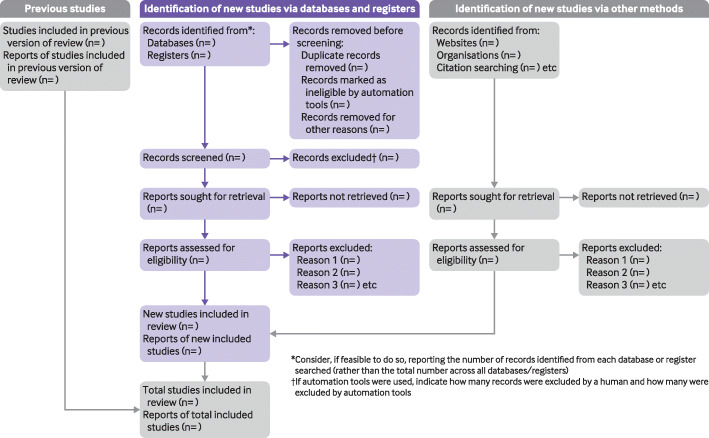
- PRISMA 2020 consists of a 27-item checklist, an expanded checklist detailing reporting recommendations for each item, the PRISMA 2020 abstract checklist, and revised flow diagrams for original and updated reviews.
- Noteworthy changes include inclusion of the abstract reporting checklist within PRISMA 2020; moving protocol and registration to a new Other section with a sub-item on amendments; recommending full search strategies for all databases, registers, and websites; more detail on reviewer screening, data collection, and automation; splitting synthesis methods into six sub-items and synthesis results into four sub-items; and adding items on certainty assessment, competing interests, and availability of data, code, and other materials.
- Development drew on reviews of reporting completeness, 60 documents providing reporting guidance, a survey to which 110 of 220 invited methodologists and journal editors responded, a 21-member two-day in-person meeting in September 2018 in Edinburgh, and feedback from 15 of 22 invited systematic reviewers.
- PRISMA 2009 was cited in over 60,000 reports (Scopus, August 2020) and endorsed by almost 200 journals and systematic review organisations; evidence from observational studies suggests its use is associated with more complete reporting, although more could be done to improve adherence.
Methods
- Guideline update: PRISMA 2020 was developed by adapting the EQUATOR Network’s guidance for developing health research reporting guidelines, identifying incompletely reported PRISMA 2009 items, reviewing 60 guidance documents, surveying methodologists and journal editors, discussing findings at a 21-member two-day meeting, and iteratively revising drafts with co-authors.
- Scope: designed primarily for systematic reviews of studies evaluating effects of health interventions, irrespective of included study design; applicable to other interventions and objectives, reviews with or without synthesis, mixed-methods reviews, and original, updated, or living systematic reviews.
- Analysis: no empirical meta-analysis is reported; the paper presents consensus-based reporting guidance, checklists, and flow diagram templates.
Limitations
- The paper states that it is unclear which strategies should be used to increase adherence to reporting guidelines, because of 31 interventions proposed, the effects of only 11 have been evaluated, mostly in observational studies at high risk of bias due to confounding.
- The paper states PRISMA 2020 is not intended to guide systematic review conduct, assess conduct or methodological quality, or inform reporting of systematic review protocols; separate tools and statements exist for those purposes.
- Evident from the text: PRISMA 2020 is a reporting guideline and consensus statement, not an empirical evaluation of its own impact; the paper notes future research is needed on barriers and facilitators, think-aloud studies, and reliability studies.
Model-written summary. Check it against the paper before relying on it.
Integrity signals
Registry
Cites
Statistics
Figures
Verification
Claims the paper makes
24 Valid · 0 Not valid · 1 Not checked · 25 Own results and interpretations
The sources with a verdict support this claim; the rest weren’t checked yet, have no full text we could read, or their verdicts aren’t rated yet.
In the paper
“Evidence from observational studies suggests that use of the PRISMA 2009 statement is associated with more complete reporting of systematic reviews [17–20], although more could be done to improve adherence to the guideline [21].”
What the sources say
- Supportedcites [17] Page MJ Shamseer L Altman DG Epidemiology and reporting characteristics of systematic reviews of biomedical research: a cross-sectional study PLoS Med 2016 13 e1002028 10.1371/journal.pmed.1002028 27218655 PMC4878797 source
The Results section reports that nearly all 26 characteristics were reported more often in therapeutic systematic reviews that self-reported using PRISMA. The Discussion describes mention of PRISMA as associated with more complete reporting, while cautioning that mention may only be a surrogate for actual use. (LLM, conf=0.92)
- Supportedcites [18] Panic N Leoncini E de Belvis G Ricciardi W Boccia S Evaluation of the endorsement of the preferred reporting items for systematic reviews and meta-analysis (PRISMA) statement on the quality of published systematic review and meta-analyses PLoS One 2013 8 e83138 10.1371/journal.pone.0083138 24386151 PMC3873291 source
The Abstract Results report higher adherence to the PRISMA reporting checklist after gastroenterology and hepatology journals endorsed PRISMA (90.1% versus 83.1%). The evidence concerns journal endorsement; the same section says that explicitly referencing PRISMA in an individual manuscript was not associated with better reporting. (LLM, conf=0.88)
- Not checked — no full text of the sourcecites [19] Agha RA Fowler AJ Limb C Impact of the mandatory implementation of reporting guidelines on reporting quality in a surgical journal: a before and after study Int J Surg 2016 30 169 172 10.1016/j.ijsu.2016.04.032 27112835 source
- Not checked — no full text of the sourcecites [20] Leclercq V Beaudart C Ajamieh S Rabenda V Tirelli E Bruyère O Meta-analyses indexed in PsycINFO had a better completeness of reporting when they mention PRISMA J Clin Epidemiol 2019 115 46 54 10.1016/j.jclinepi.2019.06.014 31254618 source
hedgedstates an association- Asserted: passes — The authors put it forward as true.
- Checkable: passes — It can be checked against evidence.
- Load-bearing: unclear — It is unclear whether the paper’s conclusions depend on it.
- Based: passes — The paper gives a reason why it holds.
- Supported
Every source the paper cites for this claim was checked and supports it.
In the paper
“technological advances have enabled the use of natural language processing and machine learning to identify relevant evidence [22–24]”
What the sources say
- Supportedcites [22] O’Mara-Eves A Thomas J McNaught J Miwa M Ananiadou S Using text mining for study identification in systematic reviews: a systematic review of current approaches Syst Rev 2015 4 5 10.1186/2046-4053-4-5 25588314 PMC4320539 source
The Results section on the suitability of text mining describes natural language processing techniques for improving how studies are classified. The Results section on review updates also describes machine-learning features used to classify studies, and the Discussion notes advances in text-mining technology. Together, these support the broad claim about using these technologies to identify relevant evidence. (LLM, conf=0.88)
- Supportedcites [23] Marshall IJ Noel-Storr A Kuiper J Thomas J Wallace BC Machine learning for identifying randomized controlled trials: an evaluation and practitioner’s guide Res Synth Methods 2018 9 602 614 10.1002/jrsm.1287 29314757 PMC6030513 source
The Aims section describes evaluating machine learning to identify RCTs in health research databases, and the Discussion reports that these approaches outperform traditional filters for systematic reviews. The paper also places its text-classification methods within NLP, supporting the broad claim about using these technologies to identify relevant evidence. (LLM, conf=0.88)
- Supportedcites [24] Marshall IJ Wallace BC Toward systematic review automation: a practical guide to using machine learning tools in research synthesis Syst Rev 2019 8 163 10.1186/s13643-019-1074-9 31296265 PMC6621996 source
The Search section (page not available in our copy) says that machine learning can use a small set of relevant articles to identify other relevant articles and describes semantic search by concept. The methods introduction explains how machine learning classifies articles for inclusion or exclusion, supporting the claim that these technologies can identify relevant evidence. (LLM, conf=0.91)
plainstates a cause- Asserted: passes — The authors put it forward as true.
- Checkable: passes — It can be checked against evidence.
- Load-bearing: unclear — It is unclear whether the paper’s conclusions depend on it.
- Based: passes — The paper gives a reason why it holds.
- Supported
The cited sources support only part of this claim — read each source’s verdict below.
In the paper
“We evaluated the reporting completeness of published systematic reviews [17, 21, 36, 37]”
§ The PRISMA 2020 statement: an updated guideline for reporting systematic reviews > Discussion
What the sources say
- Supportedcites [17] Page MJ Shamseer L Altman DG Epidemiology and reporting characteristics of systematic reviews of biomedical research: a cross-sectional study PLoS Med 2016 13 e1002028 10.1371/journal.pmed.1002028 27218655 PMC4878797 source
The Methods > Data Analysis section says the study assessed whether 26 characteristics of published systematic reviews were reported, and the Discussion > Explanation of Results and Implications discusses how complete that reporting was (page numbers unavailable). This supports citing the paper as an evaluation of reporting completeness. The PRISMA 2020 development context is the citing authors’ framing, not a finding attributed to this 2016 paper. (LLM, conf=0.91)
- Supportedcites [21] Page MJ Moher D Evaluations of the uptake and impact of the preferred reporting items for systematic reviews and meta-analyses (PRISMA) statement and extensions: a scoping review Syst Rev 2017 6 263 10.1186/s13643-017-0663-8 29258593 PMC5738221 source
The Methods section says the authors pooled studies assessing how often published systematic reviews adhered to PRISMA reporting items. The Results section reports their pooled assessment of adherence across 57 studies, supporting the citation’s use as an example of evaluating reporting completeness. (LLM, conf=0.90)
- Supportedcites [36] Page MJ Altman DG Shamseer L Reproducible research practices are underused in systematic reviews of biomedical interventions J Clin Epidemiol 2018 94 8 18 10.1016/j.jclinepi.2017.10.017 29113936 source
The Discussion (p. 20) reports the authors’ assessment of how completely published systematic reviews reported data needed to recreate their meta-analyses and other reproducible research practices. This supports the citation for evaluating reporting completeness; the PRISMA 2020 development context belongs to the citing document, not to this source. (LLM, conf=0.90)
- Partly supportedcites [37] Page MJ Altman DG McKenzie JE Flaws in the application and interpretation of statistical analyses in systematic reviews of therapeutic interventions were common: a cross-sectional analysis J Clin Epidemiol 2018 95 7 18 10.1016/j.jclinepi.2017.11.022 29203419 sourceExperimental — accuracy not yet measured
The Methods (section 2.3) and Results (section 3.6) show that the paper assessed whether selected statistical methods and their rationales were reported in published systematic reviews. It did not assess the completeness of reporting across the reviews as a whole. The citing authors’ PRISMA 2020 development context is their own framing, not a finding attributed to this source. (LLM, conf=0.82)
plain- Asserted: passes — The authors put it forward as true.
- Checkable: passes — It can be checked against evidence.
- Load-bearing: passes — The paper’s conclusions depend on it.
- Based: passes — The paper gives a reason why it holds.
- Supported
Every source the paper cites for this claim was checked and supports it.
In the paper
“new methods have been developed to assess the risk of bias in results of included studies [28, 29]”
What the sources say
- Supportedcites [28] Sterne JAC Savović J Page MJ RoB 2: a revised tool for assessing risk of bias in randomised trials BMJ 2019 366 l4898 10.1136/bmj.l4898 31462531 source
The Summary Points state that the authors developed and piloted RoB 2, a revised tool for assessing risk of bias in randomised trials, and that it produces a judgment for each result assessed. The introduction places risk-of-bias assessment in the context of studies included in systematic reviews. This paper therefore supports the claim as an example of a new method, specifically for randomised trials. (LLM, conf=0.93)
- Supportedcites [29] Sterne JA Hernán MA Reeves BC ROBINS-I: a tool for assessing risk of bias in non-randomised studies of interventions BMJ 2016 355 i4919 10.1136/bmj.i4919 27733354 PMC5062054 source
The Discussion says ROBINS-I was developed primarily for systematic reviews. The ‘Assessing a specific study’ section describes judging risk of bias for an outcome and result in each included non-randomised study, supporting the claim as an example of a new method. (LLM, conf=0.92)
plain- Asserted: passes — The authors put it forward as true.
- Checkable: passes — It can be checked against evidence.
- Load-bearing: unclear — It is unclear whether the paper’s conclusions depend on it.
- Based: passes — The paper gives a reason why it holds.
- Supported
Every source the paper cites for this claim was checked and supports it.
In the paper
“We identified PRISMA 2009 items that were often reported incompletely by examining the results of studies investigating the transparency of reporting of published reviews [17, 21, 36, 37].”
§ The PRISMA 2020 statement: an updated guideline for reporting systematic reviews > Development of PRISMA 2020
What the sources say
- Supportedcites [17] Page MJ Shamseer L Altman DG Epidemiology and reporting characteristics of systematic reviews of biomedical research: a cross-sectional study PLoS Med 2016 13 e1002028 10.1371/journal.pmed.1002028 27218655 PMC4878797 source
The Results (Reporting Characteristics of SRs; page unavailable) quantify incomplete reporting of review characteristics, including review flow and reasons for excluding studies. The Discussion (Explanation of Results and Implications; page unavailable) says reporting of many systematic reviews remains poor despite PRISMA 2009 and explains how individual PRISMA items may be reported incompletely. This supports using the study’s results to identify frequently incomplete reporting items. (LLM, conf=0.90)
- Supportedcites [21] Page MJ Moher D Evaluations of the uptake and impact of the preferred reporting items for systematic reviews and meta-analyses (PRISMA) statement and extensions: a scoping review Syst Rev 2017 6 263 10.1186/s13643-017-0663-8 29258593 PMC5738221 source
In Results (“Evaluations of SR adherence to the PRISMA Statement”), the review pools studies of published systematic reviews and identifies PRISMA items with low reporting adherence. It also reports nine items adhered to by fewer than 67% of reviews published in 2010 or later. The supplied passages do not give page numbers. (LLM, conf=0.94)
- Supportedcites [36] Page MJ Altman DG Shamseer L Reproducible research practices are underused in systematic reviews of biomedical interventions J Clin Epidemiol 2018 94 8 18 10.1016/j.jclinepi.2017.10.017 29113936 source
The Introduction (p. 6) describes studies finding low adherence to a PRISMA reporting item. This paper also examines published systematic reviews and reports incomplete reporting of that item in the Discussion (p. 20), making it a relevant study for identifying incompletely reported PRISMA items. (LLM, conf=0.90)
- Supportedcites [37] Page MJ Altman DG McKenzie JE Flaws in the application and interpretation of statistical analyses in systematic reviews of therapeutic interventions were common: a cross-sectional analysis J Clin Epidemiol 2018 95 7 18 10.1016/j.jclinepi.2017.11.022 29203419 source
The Results (sections 3.5 and 3.6) examine published systematic reviews and report frequent omissions in how statistical analyses were described, including missing rationales for subgroup and sensitivity analyses. This supports citing the paper as a study whose results could be examined to identify incompletely reported items; the identification of PRISMA 2009 items is the citing authors’ own step. (LLM, conf=0.86)
plain- Asserted: passes — The authors put it forward as true.
- Checkable: passes — It can be checked against evidence.
- Load-bearing: passes — The paper’s conclusions depend on it.
- Based: passes — The paper gives a reason why it holds.
- Supported
5 more claims · 2 with their cited sources checked
Create a free account to see all 50 claims and to verify the 3 references still open.
- Probably not a substantial claim. 36
- It may state two separate claims as one. 14
- The quote only partly states this claim. 1
Claims other papers make about this one
Each is checked against this paper’s own text: does it say what the citing paper says it does?
The source backs part of the claim, not all of it — or backs it for a different population, condition or comparison.
In the citing paper
“The PRISMA 2020 statement was designed primarily to provide guidance for systematic reviews of studies that evaluate the effects of interventions.”
From Extension of the PRISMA 2020 statement for living systematic reviews (PRISMA-LSR): checklist and explanation (2024) · cites this paper as [10]
Experimental — accuracy not yet measuredThe source backs part of the claim, not all of it — or backs it for a different population, condition or comparison.
In the citing paper
“This systematic review followed the PRISMA-NMA (Preferred Reporting Items for Systematic Review and Meta-Analyses extension for Network Meta-Analysis) 2020 statement for designing and reporting [38].”
From Assessing the Effectiveness of Digital Health Behavior Strategies on Type 2 Diabetes Management: Systematic Review and Network Meta-Analysis (2025) · cites this paper as [38]
Experimental — accuracy not yet measuredThe source backs part of the claim, not all of it — or backs it for a different population, condition or comparison.
In the citing paper
“This review was planned, conducted, and reported according to the updated guidelines for reporting systematic reviews of the 2020 Preferred Reporting Items for Systematic Reviews and Meta-Analyses (PRISMA) (Page et al., 2021).”
From A Competency Framework for AI Literacy: Variations by Different Learner Groups and an Implied Learning Pathway (2025) · cites this paper as Page et al., 2021
Experimental — accuracy not yet measuredThe source backs part of the claim, not all of it — or backs it for a different population, condition or comparison.
In the citing paper
“First, a systematic review was conducted, based on the PRISMA (Preferred Reporting Items for Systematic Review and Meta-Analysis) methodology (Page et al. 2021) to identify studies about the interaction of citizens with digital public services.”
From Recommendations for digital inclusion in the use of European digital public services (2025) · cites this paper as Page et al. 2021
Experimental — accuracy not yet measuredThe source backs part of the claim, not all of it — or backs it for a different population, condition or comparison.
In the citing paper
“This meta-analytical review was conducted and reported in accordance with the PRISMA 2020 guidelines (Page et al., 2021).”
From Child Maltreatment as a Risk Factor for Rejection Sensitivity: A Three-Level Meta-Analytic Review (2024) · cites this paper as Page et al., 2021
Experimental — accuracy not yet measured
41 more claims about this paper
Create a free account to see every claim other papers make about this one.
Citations
Cites
Preferred Reporting Items for Systematic Reviews and Meta-Analyses: the PRISMA statement
Moher, D., Liberati, A., Tetzlaff, J., Altman, D. G., & for the PRISMA Group (2009) · BMJ · doi:10.1136/bmj.b2535 · Cited by 83,823
Self-citationPreferred Reporting Items for Systematic Reviews and Meta-Analyses: The PRISMA Statement
Moher, D., Liberati, A., Tetzlaff, J., Altman, D. G., & The PRISMA Group (2009) · PLoS Medicine · doi:10.1371/journal.pmed.1000097 · Cited by 64,042
Self-citationPreferred reporting items for systematic reviews and meta-analyses: the PRISMA Statement.
(2009) · PubMed Central · Cited by 44,859
Self-citationPRISMA Extension for Scoping Reviews (PRISMA-ScR): Checklist and Explanation
Tricco, A. C., Lillie, E., Zarin, W., O'Brien, K. K., Colquhoun, H., Levac, D., Moher, D., Peters, M. D. J., Horsley, T., Weeks, L., et al. (2018) · Annals of Internal Medicine · doi:10.7326/m18-0850 · Cited by 43,565
Self-citationPreferred reporting items for systematic reviews and meta-analyses: The PRISMA statement
Moher, D., Liberati, A., Tetzlaff, J., Altman, D. G., & the PRISMA Group* (2009) · Annals of Internal Medicine · doi:10.7326/0003-4819-151-4-200908180-00135 · Cited by 37,554
Self-citationRoB 2: a revised tool for assessing risk of bias in randomised trials
Sterne, J. A. C., Savović, J., Page, M. J., Elbers, R. G., Blencowe, N. S., Boutron, I., Cates, C. J., Cheng, H.-Y., Corbett, M. S., Eldridge, S. M., et al. (2019) · BMJ · doi:10.1136/bmj.l4898 · Cited by 34,787
Self-citationLiberati, A., Altman, D. G., Tetzlaff, J., Mulrow, C., Gøtzsche, P. C., Ioannidis, J. P. A., Clarke, M., Devereaux, P. J., Kleijnen, J., & Moher, D. (2009) · PLoS Medicine · doi:10.1371/journal.pmed.1000100 · Cited by 28,164
Self-citationPRISMA-P Group, Moher, D., Shamseer, L., Clarke, M., Ghersi, D., Liberati, A., Petticrew, M., Shekelle, P., & Stewart, L. A. (2015) · Systematic Reviews · doi:10.1186/2046-4053-4-1 · Cited by 26,223
Self-citationDermyshi, E., Wang, Y., Yan, C., Hong, W., Qiu, G., Gong, X., & Zhang, T. (2017) · Neonatology · doi:10.1159/000454668 · Cited by 24,451
ROBINS-I: a tool for assessing risk of bias in non-randomised studies of interventions
Sterne, J. A., Hernán, M. A., Reeves, B. C., Savović, J., Berkman, N. D., Viswanathan, M., Henry, D., Altman, D. G., Ansari, M. T., Boutron, I., et al. (2016) · BMJ · doi:10.1136/bmj.i4919 · Cited by 20,329
Self-citation
Research works printed but not linked: 1
- Liberati A, Altman DG, Tetzlaff J, et al. The PRISMA statement for reporting. systematic reviews and meta-analyses of studies that evaluate health care. interventions: explanation and elaboration. PLoS Med. 2009;6:e1000100. 10.1371/journal.pmed.1000100. PMC2707010 19621070 · DOI · Paper page
Cited by
Items 13,601–13,700 of 14,579
Giuricich, A., Gayaparsad, M., Green-Thompson, L., & Guzgay, M. (2026) · Southern African Journal of Anaesthesia and Analgesia · doi:10.4102/sajaa.v32i1.1506
DESAFIOS E ESTRATÉGIAS DE ENFERMAGEM NA PREVENÇÃO DE INFECÇÕES HOSPITALARES EM CENTROS CIRÚRGICOS
Lopes, S. M. B., BEZERRA, A. M. N. S., Bastos, V. S., Silva, A. G. S., da Silva, J. M., de Araujo, A. B., Carvalho, A. Q. D. S., & FONTINELE, A. D. S. (2026) · Revista Enfermagem Atual In Derme · doi:10.31011/reaid-2026-v.100-n.2-art.2727
Zeng, B., Chen, J., Wang, H., Kong, Z., Dong, N., & Xie, J. (2026) · Psycho-Oncology · doi:10.1002/pon.70479
Cnockaert, E., Musch, K., & Smeets, R. (2026) · European Journal of Physiotherapy · doi:10.1080/21679169.2026.2657282 · Cited by 1
Núñez, T. P. N., Bustos, K. S., & Aravena, V. T. (2026) · Ducere Revista de Investigación Educativa · doi:10.61303/2735668x.v5i1.113
Lloyd, A. K., Medina‐Lara, A., Birch, S., Wallis, K. A., & Spencer, A. (2026) · BMJ Open · doi:10.1136/bmjopen-2024-096492
Risk Assessment and Risk Management Challenges in Intelligent IoT-Based Smart City Infrastructures
Alessa, A., Alduwayl, Y., & Rahman, M. M. H. (2026) · International Journal of Advanced Computer Science and Applications · doi:10.14569/ijacsa.2026.0170484
A LITERATURE REVIEW ON EVOLUTIONARY GAME THEORY USED IN CONSTRUCTION SAFETY
Rachmawati, T. S. N., Machfudiyanto, R. A., Tuasikal, M. Y. A., Widjaja, D. D., & Kim, S. (2026) · Applied Research on Civil Engineering and Environment (ARCEE) · doi:10.32722/arcee.v7i1.7873
Gualandi, N., Valdivia, P. C., Bonura, G. F., Gabbani, T., Soriani, P., & Manno, M. (2026) · Journal of Clinical Medicine · doi:10.3390/jcm15093514
de Matos, R. C., Nascimento, L. G. C., Bitencourt, A. F. A., Machado, R. R., & Scopel, M. (2026) · Revista Brasileira de Farmacognosia · doi:10.1007/s43450-026-00756-x
A qualitative meta-analysis on the lived experience of siblings of persons with mental illness
Sommantico, M., Lacatena, M., Postiglione, J., & Parrello, S. (2026) · Frontiers in Psychology · doi:10.3389/fpsyg.2026.1787699
Carvalho, A. É. R., Silva, A. N. F. E., & Silva, P. O. (2026) · Revista JRG de Estudos Acadêmicos · doi:10.55892/jrg.v9i20.3282
Kim, Y., Tuck, K. N., & Cheatham, G. A. (2026) · The Journal of Special Education · doi:10.1177/00224669261437414
Anggreni, S., Mukhlisin, M., & Cardoso, L. M. O. D. B. (2026) · Journal of Vocational Informatics and Computer Education · doi:10.66053/voice.v4i1.473
Adam, M. N., Essumang, C. O., Quartey, N. K.-A., Ofosu, C. A., Saalia, F. K., Ellis, W., & Ofosu, I. W. (2026) · Food Safety and Risk · doi:10.1186/s40550-026-00145-1
Paslaru, F. G., Brehar, F. M., Petrescu, G. E. D., Stanoaia, O. E., Iliescu, A., & Gorgan, R. M. (2026) · Balneo and PRM Research Journal · doi:10.12680/balneo.2026.953
ACHRON Método didáctico-operativo para la construcción de antecedentes de investigación
Leiva, F. C. L. O., Jiménez, V. B. J., Capuñay, J. E. C., Solar, C. Q. D., Ruiz, G. M. G., Yapu, W. T., García, E. D. H., Talaverano, N. S. Z., Cedillo, A. R., Nolasco, I. R. S., et al. (2026) · doi:10.48209/978-65-5417-709-2
Choudhary, P. K., Choudhary, S., Saha, S., Rajpoot, Y. S., Ciocan, V. C., Nicolae-Lucian, V., Gorgan, C.-M., & Şufaru, C. (2026) · Frontiers in Human Neuroscience · doi:10.3389/fnhum.2026.1774230
Empowering ethical innovation: designing a responsible computing workshop for emerging economies
Wyk, B. V., Holmner, M., Makhafola, L., Meyer, A., & Mearns, M. A. (2026) · Cybrarians Journal · doi:10.70000/cj.2026.78.708
Current Knowledge on Nanotoxicology on Ants: A Review
Łosiewicz, B., Pruszyński, J., Zawadzki, O., Ergović, V., Bartoszek, T., & Kamaszewski, M. (2026) · Journal of Applied Toxicology · doi:10.1002/jat.70236
Schilder, J. C. M., Hoonhorst, M. H. J., de Vries, M. R., & Kwakkel, G. (2026) · Frontiers in Neurology · doi:10.3389/fneur.2026.1788829
Negotiating Stereotypes in the Film Black Panther: A Critical Scoping Review
Sandberg, B. (2026) · Arts · doi:10.3390/arts15050102
“Search outcomes are displayed in Figure 1, using a standard PRISMA flow diagram (Page et al. 2021).”
VIOLENCIA OBSTÉTRICA Y SALUD MENTAL HERIDAS SILENCIOSAS EN LA ATENCIÓN MATERNA
Vilcahuaman, J. M., Luna, N. E. T., Cáceres, C. R. Z., Nateros, L. E., & Ordoñez-Ccora, G. (2026) · doi:10.48209/978-65-5417-708-5
Gök, H., Baymurat, A. C., Yapar, A., Tokgöz, M. A., & Şenköylü, A. (2026) · Spine Deformity · doi:10.1007/s43390-026-01398-8
Didaktične prilagoditve za učence s posebnimi potrebami v glasbeni šoli
Zadnik, K., & Kumar, U. (2026) · Pedagoška obzorja · doi:10.55707/ds-po.v41i1.218
Elgendy, M. S., Shubietah, A. R. M., Awashra, A., Rifai, M. K., Qwaider, M., Faheem, M. A., Abuwatfa, M. A., Ismayl, M., & Alqadi, M. (2026) · Immunity & Ageing · doi:10.1186/s12979-026-00571-x
Kusuma, A. A. N. J., Andonotopo, W., Bachnas, M. A., Prabowo, W., Yuliantara, E. E., Pramono, M. B. A., Dewantiningrum, J., Lukas, E., Sanjaya, N. H., Wiradnyana, A. A. G. P., et al. (2026) · Bangladesh Journal of Endocrinology and Metabolism · doi:10.4103/bjem.bjem_14_26
The Role and Relevance of the Working Alliance in Forensic Treatment: A Meta-Analysis
Forrest, G., Olver, M. E., & Stockdale, K. C. (2026) · International Journal of Offender Therapy and Comparative Criminology · doi:10.1177/0306624x261448931 · Cited by 1
Usnah, Y., & Masruri, A. (2026) · Literatify Trends in Library Developments · doi:10.24252/literatify.v7i1.63516
Comin, G. E. C., Antunes, M., & Velozo, K. D. S. (2026) · Contribuciones a las Ciencias Sociales · doi:10.55905/revconv.19n.5-022
Kamarudin, K. M., & Tiansu, M. A. (2026) · Journal of Social Sciences & Humanities · doi:10.62810/jssh.v3i2.162
Use of Wearable Sensors in Angelman Syndrome: A Systematic Review
Vozka, V., Neo, W. S., Yatcilla, J., McCormick, C. E. B., Harold, R., Gálvez-Ortega, K., Dey, M. K., Fitzpatrick, L. E., Schwichtenberg, A. J., Hoilett, O. S., et al. (2026) · Journal of Intellectual Disability Research · doi:10.1111/jir.70121
Twice exceptional students and their teachers: A systematic review
Sakar, S., & Tan, S. (2026) · High Ability Studies · doi:10.1080/13598139.2026.2670272
Ghabi, K. E., Bousefsaf, F., & Morère, Y. (2026) · Technology and Disability · doi:10.1177/10554181261441141
Susilawati, Kosim, Hidayatullah, N., & Annam, S. (2026) · Jurnal Penelitian Pendidikan IPA · doi:10.29303/jppipa.v12i4.14544
Khan, S. Z., Campos, M. S. R., Rebalka, I. A., Noseworthy, M. D., & Doyle, T. E. (2026) · Research Square · doi:10.21203/rs.3.rs-9488956/v1
Is There Room for Social Justice in Clinical Supervision? A Systematic Literature Review
Llamosa, P. (2026) · Social Work · doi:10.1093/sw/swag021
Bitencourt, L. N. A., Rosete, L. A., de Oliveira, J. A., de Araújo, R. G., da Silva, E. E., & Guimarães, B. S. D. A. (2026) · Revista Ibero-Americana de Humanidades, Ciências e Educação · doi:10.51891/rease.v12i5.26336
Tenting screw technique for guided bone regeneration: a systematic review and meta-analysis protocol
Wang, J., Ren, X., Lu, H., Wang, X., Wang, J., & Dong, J. (2026) · BMJ Open · doi:10.1136/bmjopen-2025-104741
Longitudinal study of Alzheimer's disease progression through MRI markers: A Systematic ReviewPreprint
Lotfalipour, M., Banifatemeh, M. S., Amini, B., Hemmat, F., Mirzakhani, P., Saemi, M., Solhirad, M., & Sadeghi, A. Z. (2026) · Research Square · doi:10.21203/rs.3.rs-9688545/v1
Hussein, J. B., & Workneh, T. S. (2026) · Sustainable Futures · doi:10.1016/j.sftr.2026.101916
Flexibility-enhancing Interventions for Ankle Range of Motion: A Network Meta-analysis
Park, J. M., Lee, K. W., Yoon, S. Y., Kim, Y. W., & Lee, S. C. (2026) · International Journal of Sports Medicine · doi:10.1055/a-2876-9237
Conzatti, A., Adeyemi, D., Calabria‐Holley, J., Darby, A. P., Natarajan, S., & Emanuelsson, E. A. C. (2026) · Cleaner Production Letters · doi:10.1016/j.clpl.2026.100147
Li, Y., Wang, J., Wang, Z. Y., Yun, J., Yang, Y., Yang, X., Xiao, X., & Ren, C. (2026) · Supportive Care in Cancer · doi:10.1007/s00520-026-10788-7 · Cited by 1
“This systematic review and meta-analysis was conducted and reported in accordance with the PRISMA 2020 statement [15] and has been registered on the PROS-PERO International Systematic Review Registry web-site (CRD42025631612).”
TELE-DENTISTRY: TANTANGAN DAN PELUANG DALAM MONITORING PERAWATAN ORTODONTI DI INDONESIA
Anggraini, D., & Putra, J. (2026) · Indonesian Journal of Health Research Innovation · doi:10.64094/8b76z549
Systematic Literature Review: The Importance of Work Motivation Need for Achievement to Performance
Maimun, M. H., Fachrunnisa, O., Ratnawati, A., Mulyana, M., & Veno, A. (2025) · Benefit Jurnal Manajemen dan Bisnis · doi:10.23917/benefit.v10i2.16890
A meta-analysis of the relationship between perfectionism and body dissatisfaction
Xu, W., Wang, Z., & Jin, C. (2026) · Personality and Individual Differences · doi:10.1016/j.paid.2026.113894
Cook, E., Williams, J., Donald, L., Curtis, F., Bridle, C., Ridge, A., Whitehall, J. M., & Powell, F. C. (2026) · Archives of Public Health · doi:10.1186/s13690-026-01951-x
The evolution of the project manager's competencies: a systematic literature review
Winiarska, M. (2026) · Central European Management Journal · doi:10.1108/cemj-09-2025-0283 · Cited by 1
Dine, R. D., Muraca, G. M., Sadeghirad, B., Couban, R., Nyambi, A., Silva, J., & Mbuagbaw, L. (2026) · PLOS Global Public Health · doi:10.1371/journal.pgph.0006422
“Findings from this study are reported according to the PRISMA guidelines [23].”
Nuryati, I., Prasetyo, Y., & Indra (2025) · Спортске науке и здравље - АПЕИРОН · doi:10.7251/ssh2502289n
Screening for neurofibromatosis type 1-related optic pathway gliomas: a systematic review
Alshehri, A. M., Almutairi, M., Alqahtani, M. M., Mahfooz, M. B., Almutairi, H., & Soliman, S. E. (2026) · Canadian Journal of Ophthalmology · doi:10.1016/j.jcjo.2026.04.020
GESTIÓN DE AGRONEGOCIOS EN EL PERÚ INNOVACIÓN ESTRATÉGICA E INCLUSIÓN DE PEQUEÑOS PRODUCTORES
Palomino, J. H., Canchaya, L. E. I., Carrasco, E. J. I., Hinojo, B. T. V., & Yactayo, J. E. M. (2026) · doi:10.48209/978-65-5417-722-1
Bangura, S. (2026) · Veredas do Direito Direito Ambiental e Desenvolvimento Sustentável · doi:10.18623/rvd.v23.6168
Traditional knowledge and cultural significance of mushrooms in Nepal: a systematic review
Chaudhary, S., Shrestha, A., Pinruan, U., Hosaka, K., & Shrestha, B. (2026) · Panfungi · doi:10.48130/panfungi-0026-0001
Information behavior and digital competencies in maritime studies: a systematic literature review
Konstantinou, A., & Kostagiolas, P. (2026) · Reference Services Review · doi:10.1108/rsr-11-2025-0095
Artificial Intelligence in Logistics 4.0: A Systematic Review of Process-Level Impacts
Sucky, E., & Guan, Z. (2026) · Cureus Journal of Business and Economics. · doi:10.7759/s44404-026-00079-z
Liu, Y. H., Liu, R., Yang, K., Li, J., Ye, G., Huang, X., Tao, S., Xue, T., & Yuan, Y. (2026) · Frontiers in Cardiovascular Medicine · doi:10.3389/fcvm.2026.1832017
Zhu, Y., Yang, Y., Gao, W., Tian, H., Yan, P., & Zhang, C. (2026) · Frontiers in Psychology · doi:10.3389/fpsyg.2026.1807146
Hestiwi, D. I., & Maryadi, T. H. T. (2026) · TechTrends · doi:10.1007/s11528-026-01189-y
Assi, C., Maroun, R., Yammine, K., Kouyoumdjïan, P., & Jamaleddine, Y. (2026) · Journal of Experimental Orthopaedics · doi:10.1002/jeo2.70782
Ouyang, C. M. H., Fan, L., Kandel, H., & Watson, S. L. (2026) · Survey of Ophthalmology · doi:10.1016/j.survophthal.2026.05.007
Bondzie, E. P. K., Adjei-Banuah, N. Y., Afun, N. E. E., Peprah, E. B., Jahan, Y., Mirzoev, T. N., Balabanova, D., & Agyepong, I. A. (2026) · medRxiv · doi:10.64898/2026.05.16.26353078
Barriers and facilitators to deprescribing in older adults: an integrative review
Barbuiani, G., Consolo, L., Terzoni, S., Cilluffo, S., & Lusignani, M. (2026) · Geriatric Nursing · doi:10.1016/j.gerinurse.2026.104105 · Cited by 1
Mohammad, A., Irshad, A., Aurangzeb, R. F., Mahmood, S., Singla, B., Singla, S., Haroon, F., Junaid, M., & Talha, A. (2026) · Cureus · doi:10.7759/cureus.109433
Kulkarni, V., Kulkarni, V., Torgal, S. V., & Ahmed, S. (2026) · Journal of Diabetology · doi:10.4103/jod.jod_144_25
From Curiosity to Active Engagement: The Teacher’s Role in Physics Learning
Suryati, S., Astalini, A., & Kurniawan, D. A. (2026) · Integrated Science Education Journal · doi:10.37251/isej.v7i2.2310
Gosa, A. S. (2026) · Circular Agricultural Systems · doi:10.48130/cas-0026-0012 · Cited by 2
Vera, F. H. B. (2025) · Revista Scientific · doi:10.29394/scientific.issn.2542-2987.2025.10.e3.14.270-290
لعور, ا., الدين, غ. ن., & النذير, ك. (2026) · Albaydha University Journal · doi:10.56807/buj.v8i1.897
Nwofe, J. O., Gbeyedobo, S. A., Tarshi, M. W., Onah, Q., Danson, P. W., Aburke, A. B., Onyebuchi, O. N., & Akyala, A. I. (2026) · Research Square · doi:10.21203/rs.3.rs-9430531/v1
Karaköse, T., Tülübaş, T., Han, B., Kanadlı, S., Özdoğru, M., Kardas, A., & Aslan, N. (2026) · Frontiers in Psychology · doi:10.3389/fpsyg.2026.1780246
Suffering at the end of life in the intensive care unit: a scoping review protocol
Yodang, Y., Hua, R., Tamdee, D., Rhiantong, J., & Tungpunkom, P. (2026) · JBI Evidence Synthesis · doi:10.11124/jbies-25-00331
Kerkoff, L. A., Torres, C. M. M. E., Darr, D., Scariot, A. O., Matricardi, E. A. T., Ribeiro, F. C., Meinhold, K., & Neto, S. N. D. O. (2026) · Agroforestry Systems · doi:10.1007/s10457-026-01521-8
Shubietah, A. R. M., Elgendy, M. S., Rakab, M. S., Balbaa, E., Emara, A., Hamed, B. M., Salah, Q., Odeh, A., Abdul‐Hafez, H. A., Awashra, A., et al. (2026) · Cardiovascular Intervention and Therapeutics · doi:10.1007/s12928-026-01304-z
EFEKTIFITAS SISTEM PERSETUJUAN BANGUNAN GEDUNG DALAM MENJAMIN KESELAMATAN BANGUNAN DI INDONESIA
Kurniawan, I. (2026) · axial jurnal rekayasa dan manajemen konstruksi · doi:10.30742/axial.v14i1.5234
Albazee, E., Aldousari, A. H., Qasem, B., Almutairi, Y., Almaqtouf, H., Aldhaen, A., Almaqtouf, A., & Termos, S. (2026) · BMC Anesthesiology · doi:10.1186/s12871-026-03944-3
Ohannesian, V. A., Taneja, B. C., Castro, A. D. A. E., Miranda, F. C., Tudino, C. H., Silva, F. D., & Taneja, A. K. (2026) · Skeletal Radiology · doi:10.1007/s00256-026-05242-y
Cardiovascular disease and spondyloarthritis
de Jong, R. J., van Kuijk, A. W. R., & Nurmohamed, M. T. (2026) · Technical report · doi:10.1016/b978-0-443-23722-5.00004-2
Risk Factors and Prognostic Impact of Depression and Anxiety in Gastric Cancer: A Systematic Review
Renaldi, K., & William, A. (2026) · F1000Research · doi:10.12688/f1000research.171310.1
Kizilkilic, S. E., Ristić, J., Brørs, G., Xu, L. X., Bäck, M., Scherrenberg, M., Falter, M., Koppert, M., Rivera, A. B. O., Pauw, M. D., et al. (2026) · European Journal of Preventive Cardiology · doi:10.1093/eurjpc/zwag287 · Cited by 1
Carta, A., Riccio, M. P., Miola, A., Cavassa, V., Puci, M. V., Abbracciavento, G., Carucci, S., Sambataro, F., Bravaccio, C., & Sotgiu, S. (2026) · Frontiers in Child and Adolescent Psychiatry · doi:10.3389/frcha.2026.1835043
The Gut–Bone Axis: A Systematic Review on the Potential Intervention Pathways for Bone Health
Cantón-Cordeiro, T., Shimochi, S., Nakamura, M., & Puigbò, P. (2026) · Life · doi:10.3390/life16060909 · Cited by 2
A Systematic Review of Pain Drawings for Perioperative Patient Management
Knoedler, L., Alfertshofer, M. G., Remy, K., Hazewinkel, M. H. J., Austen, W. G., Weinstein, A. L., & Gfrerer, L. (2026) · Plastic & Reconstructive Surgery Global Open · doi:10.1097/gox.0000000000007722 · Cited by 1
Michaela, F., & Pace, K. (2026) · Neurourology and Urodynamics · doi:10.1002/nau.70326
Chong, J., 陈玉根, & Jiang, F. (2026) · Journal of Visualized Experiments · doi:10.3791/69567
Fontes, B. M., Amaral, D. C., Sá, A. G., Alfatih, M., Muthmainnah, I., Louzada, R. N., Mora-Paez, D. J., & Guedes, J. (2026) · Revista Brasileira de Oftalmologia · doi:10.37039/1982.8551.20260048
A classification framework of large language model in the post-transformer era
Athiya, R., & Gupta, A. (2026) · Expert Systems with Applications · doi:10.1016/j.eswa.2026.133034
Kibet, V., & Osoro, E. R. (2026) · International journal of research and scientific innovation · doi:10.51244/ijrsi.2026.1305000038
Understanding Clinical Investigations
Beukelman, T., & Feldman, B. M. (2026) · Elsevier eBooks · doi:10.1016/b978-0-443-11980-4.00007-6
An assessment of Zimbabwe's post-independence land reforms
Paradza, P. (2026) · Land Use Policy · doi:10.1016/j.landusepol.2026.108109
Bawack, R. E., & Carillo, K. (2026) · Lecture notes in computer science · doi:10.1007/978-3-032-28313-9_16
Alarcon-Ruiz, C. A., Romero, P., Jiménez-Mozo, F., Mayta-Tovalino, F., Pacherres-López, A., Runzer-Colmenares, F. M., & Peres, M. F. P. (2026) · Cephalalgia Reports · doi:10.1177/25158163261454627
da Silva, M. G., & Cardoso, S. L. (2026) · Revista e-Curriculum · doi:10.23925/1809-3876.2026v24e67842
Fernandez, M. T., Moase, J., & Sladeczek, I. E. (2026) · Review Journal of Autism and Developmental Disorders · doi:10.1007/s40489-026-00559-9
Huang, Z., Li, W., Li, M., Huang, Y., Lu, Y., & Hu, J. B. (2026) · Frontiers in Immunology · doi:10.3389/fimmu.2026.1846834
Xingzhong, Z., Maurice, N. J., Giwa, H. N., & Giwa, A. S. (2026) · Molecules · doi:10.3390/molecules31111882
Tracking the game: wearable technologies and physical demands reference values in ice hockey
Martini, G., Douglas, A. S., Trudeau, F., & Lemoyne, J. (2026) · Sports Engineering · doi:10.1007/s12283-026-00553-8
Haitoglou, D. (2026) · Journal of Marital and Family Therapy · doi:10.1111/jmft.70147
A systematic review of semaglutide-associated kidney injury case reports
Xiu, X., Zheng, P., Li, Y., Du, M., Min, X., Pang, X., Zhang, L., Liu, J., Zhao, Z., Liu, Z.-C., et al. (2026) · Frontiers in Medicine · doi:10.3389/fmed.2026.1793349
Metadata
- Authors
- Page, M. J., McKenzie, J. E., Bossuyt, P. M., Boutron, I., Hoffmann, T. C., Mulrow, C. D., Shamseer, L., Tetzlaff, J. M., Akl, E. A., Brennan, S. E., Chou, R., Glanville, J., Grimshaw, J. M., Hróbjartsson, A., Lalu, M. M., Li, T., Loder, E. W., Mayo-Wilson, E., McDonald, S., McGuinness, L. A., Stewart, L. A., Thomas, J., Tricco, A. C., Welch, V. A., Whiting, P., & Moher, D.
- Affiliations
- Monash University (AU)
- Amsterdam University Medical Centers (NL)
- Inserm (FR)
- Bond University (AU)
- The University of Texas at San Antonio Health Science Center (US)
- University of Ottawa (CA)
- McMaster University (CA)
- Oregon Health & Science University (US)
- University of York (GB)
- University of Southern Denmark (DK)
- Ottawa Hospital (CA)
- Johns Hopkins University (US)
- Brigham and Women's Hospital (US)
- University of Bristol (GB)
- University College London (GB)
- St. Michael's Hospital (CA)
- Corresponding author
- Page, Matthew J.
- ORCID
- Page, Matthew J.
- McKenzie, Joanne E.
- Bossuyt, Patrick M.
- Boutron, Isabelle
- Hoffmann, Tammy C.
- Mulrow, Cynthia D.
- Shamseer, Larissa
- Tetzlaff, Jennifer M.
- Akl, Elie A.
- Brennan, Sue E.
- Chou, Roger
- Glanville, Julie
- Grimshaw, Jeremy M.
- Hróbjartsson, Asbjørn
- Lalu, Manoj M.
- Li, Tianjing
- Loder, Elizabeth W.
- McDonald, Steve
- McGuinness, Luke A.
- Stewart, Lesley A.
- Thomas, James
- Tricco, Andrea C.
- Welch, Vivian A.
- Whiting, Penny
- Moher, David
- Venue
- Systematic Reviews
- Published
- 2021-03-29
- Volume
- 10
- Issue
- 1
- Pages
- 89-89
- ISSN
- 2046-4053 (ISSN-L)
- PMC
- PMC8008539
- OpenAlex
- W3144543375
- Semantic Scholar
- f4de50b3dc5d1d850d281ef0cfefb80be2af34f2
- Cited by
- 13,874
- References
- 79
- Citations by year
- 2026: 1504 · 2025: 4332 · 2024: 3201 · 2023: 2847 · 2022: 1643 · 2021: 342
- FWCI
- 83.45
- Type
- journal article
- Language
- en
- Open access
- gold
- doi.org
- Licence
- cc-by
- creativecommons.org/licenses/by/4.0/ (tdm)
- creativecommons.org/licenses/by/4.0/ (vor)
- Locations
- Systematic Reviews (publishedVersion, cc-by)
- PubMed Central (publishedVersion, cc-by)
- PubMed (publishedVersion)
- Pure Amsterdam UMC (publishedVersion, cc-by)
- Bond University Research Portal (Bond University) (submittedVersion, other-oa)
- Monash University Research Portal (Monash University) (submittedVersion, cc-by)
- uO Research (University of Ottawa) (submittedVersion, public-domain)
- Data Archiving and Networked Services (DANS) (submittedVersion, other-oa)
- DOAJ (DOAJ: Directory of Open Access Journals) (submittedVersion, cc-by-sa)
- Bristol Research (University of Bristol) (submittedVersion, cc-by)
- University of Southern Denmark Research Portal (University of Southern Denmark) (submittedVersion, cc-by)
- Zenodo (CERN European Organization for Nuclear Research) (submittedVersion, cc-by)
- Funders
- University of Ottawa (Tier 1)
- National Institute for Health and Care Research (DRF-2018-11-ST2-048)
- National Institutes of Health
- Medical Research Council
- Australian Research Council (DE200101618)
- National Health and Medical Research Council (1088535, 1154607, 1143429)
- National Eye Institute (UG1EY020522)
- Topics
- Social Sciences › Decision Sciences › Statistics, Probability and Uncertainty › Meta-analysis and systematic reviews
- Health Sciences › Medicine › Public Health, Environmental and Occupational Health › Clinical practice guidelines implementation
- Social Sciences › Library and Information Sciences › Academic Publishing and Open Access
- Keywords
- PRISMA 2020, reporting guidelines, abstracts, reporting checklist, transparency
- MeSH terms
- Systematic Reviews as Topic, Humans, Publishing, Quality Control
About these checks
Registry, retraction, Cites and statistics results are computed, not judged, with one exception: a printed reference that no index lists is read once by a model before it counts as a citation error. Claims are extracted by a model and kept only when their quote appears verbatim in the text; each cited source is then checked, with a model’s help, for whether it says what the claim relies on. Those verdicts can be wrong — read the claim’s quote and the cited source before relying on one.
The claim verdicts this report counts are experimental: their accuracy is not yet measured.
A language model drew the claims from the paper on 2026-10-10, under version 3 of the claim definition (model deepseek-v4.1-flash, prompt extract-v3).
A second model labelled each claim on 2026-10-10 (model jev-1.13-20260917, definition revision gold-guideline-v0.2).
Cited sources are checked with a language model’s help (gpt-6-sol).
Statistics and arithmetic are recomputed, not judged.
Confidence bands are shown only for fields calibrated on our annotated test set. None is calibrated yet, so no band is shown.
What counts as a claim ›How we measure confidence ›How we check this ›
Are you an author, or do you see a problem with this page? Request a review
Data sources
Bibliographic data: Semantic Scholar, OpenAlex, Crossref.
Contains information from the Semantic Scholar Academic Graph Datasets, made available under the ODC Attribution License (ODC-BY 1.0).
Semantic Scholar’s data is described in: Kinney, R., et al. (2023). The Semantic Scholar Open Data Platform. arXiv:2301.10140.
