

The PRISMA 2020 statement: an updated guideline for reporting systematic reviews
Open accessThe DOI matches its Crossref record; 82 of the 82 references it cites were found in a registry or an index; 47 of the 62 sources its claims cite were checked for support.
Abstract
See the PRISMA 2020 for Abstracts checklist (Table 2).
Overview
CoChat Summary
TL;DR
PRISMA 2020 replaces the 2009 PRISMA statement as updated reporting guidance for systematic reviews, reflecting advances in methods to identify, select, appraise, and synthesise studies. It provides a 27-item checklist, an expanded checklist, an abstract checklist, and revised flow diagrams for original and updated reviews.
Key findings
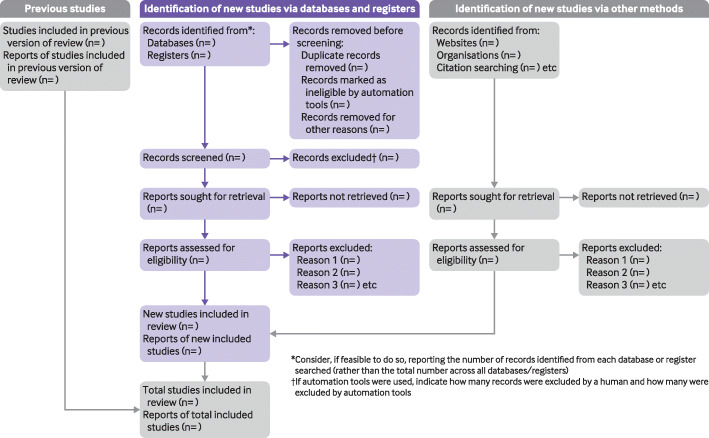
- PRISMA 2020 consists of a 27-item checklist, an expanded checklist detailing reporting recommendations for each item, the PRISMA 2020 abstract checklist, and revised flow diagrams for original and updated reviews.
- Noteworthy changes include inclusion of the abstract reporting checklist within PRISMA 2020; moving protocol and registration to a new Other section with a sub-item on amendments; recommending full search strategies for all databases, registers, and websites; more detail on reviewer screening, data collection, and automation; splitting synthesis methods into six sub-items and synthesis results into four sub-items; and adding items on certainty assessment, competing interests, and availability of data, code, and other materials.
- Development drew on reviews of reporting completeness, 60 documents providing reporting guidance, a survey to which 110 of 220 invited methodologists and journal editors responded, a 21-member two-day in-person meeting in September 2018 in Edinburgh, and feedback from 15 of 22 invited systematic reviewers.
- PRISMA 2009 was cited in over 60,000 reports (Scopus, August 2020) and endorsed by almost 200 journals and systematic review organisations; evidence from observational studies suggests its use is associated with more complete reporting, although more could be done to improve adherence.
Methods
- Guideline update: PRISMA 2020 was developed by adapting the EQUATOR Network’s guidance for developing health research reporting guidelines, identifying incompletely reported PRISMA 2009 items, reviewing 60 guidance documents, surveying methodologists and journal editors, discussing findings at a 21-member two-day meeting, and iteratively revising drafts with co-authors.
- Scope: designed primarily for systematic reviews of studies evaluating effects of health interventions, irrespective of included study design; applicable to other interventions and objectives, reviews with or without synthesis, mixed-methods reviews, and original, updated, or living systematic reviews.
- Analysis: no empirical meta-analysis is reported; the paper presents consensus-based reporting guidance, checklists, and flow diagram templates.
Limitations
- The paper states that it is unclear which strategies should be used to increase adherence to reporting guidelines, because of 31 interventions proposed, the effects of only 11 have been evaluated, mostly in observational studies at high risk of bias due to confounding.
- The paper states PRISMA 2020 is not intended to guide systematic review conduct, assess conduct or methodological quality, or inform reporting of systematic review protocols; separate tools and statements exist for those purposes.
- Evident from the text: PRISMA 2020 is a reporting guideline and consensus statement, not an empirical evaluation of its own impact; the paper notes future research is needed on barriers and facilitators, think-aloud studies, and reliability studies.
Model-written summary. Check it against the paper before relying on it.
Integrity signals
Registry
Cites
Statistics
Figures
Verification
Claims the paper makes
24 Valid · 0 Not valid · 1 Not checked · 25 Own results and interpretations
The sources with a verdict support this claim; the rest weren’t checked yet, have no full text we could read, or their verdicts aren’t rated yet.
In the paper
“Evidence from observational studies suggests that use of the PRISMA 2009 statement is associated with more complete reporting of systematic reviews [17–20], although more could be done to improve adherence to the guideline [21].”
What the sources say
- Supportedcites [17] Page MJ Shamseer L Altman DG Epidemiology and reporting characteristics of systematic reviews of biomedical research: a cross-sectional study PLoS Med 2016 13 e1002028 10.1371/journal.pmed.1002028 27218655 PMC4878797 source
The Results section reports that nearly all 26 characteristics were reported more often in therapeutic systematic reviews that self-reported using PRISMA. The Discussion describes mention of PRISMA as associated with more complete reporting, while cautioning that mention may only be a surrogate for actual use. (LLM, conf=0.92)
- Supportedcites [18] Panic N Leoncini E de Belvis G Ricciardi W Boccia S Evaluation of the endorsement of the preferred reporting items for systematic reviews and meta-analysis (PRISMA) statement on the quality of published systematic review and meta-analyses PLoS One 2013 8 e83138 10.1371/journal.pone.0083138 24386151 PMC3873291 source
The Abstract Results report higher adherence to the PRISMA reporting checklist after gastroenterology and hepatology journals endorsed PRISMA (90.1% versus 83.1%). The evidence concerns journal endorsement; the same section says that explicitly referencing PRISMA in an individual manuscript was not associated with better reporting. (LLM, conf=0.88)
- Not checked — no full text of the sourcecites [19] Agha RA Fowler AJ Limb C Impact of the mandatory implementation of reporting guidelines on reporting quality in a surgical journal: a before and after study Int J Surg 2016 30 169 172 10.1016/j.ijsu.2016.04.032 27112835 source
- Not checked — no full text of the sourcecites [20] Leclercq V Beaudart C Ajamieh S Rabenda V Tirelli E Bruyère O Meta-analyses indexed in PsycINFO had a better completeness of reporting when they mention PRISMA J Clin Epidemiol 2019 115 46 54 10.1016/j.jclinepi.2019.06.014 31254618 source
hedgedstates an association- Asserted: passes — The authors put it forward as true.
- Checkable: passes — It can be checked against evidence.
- Load-bearing: unclear — It is unclear whether the paper’s conclusions depend on it.
- Based: passes — The paper gives a reason why it holds.
- Supported
Every source the paper cites for this claim was checked and supports it.
In the paper
“technological advances have enabled the use of natural language processing and machine learning to identify relevant evidence [22–24]”
What the sources say
- Supportedcites [22] O’Mara-Eves A Thomas J McNaught J Miwa M Ananiadou S Using text mining for study identification in systematic reviews: a systematic review of current approaches Syst Rev 2015 4 5 10.1186/2046-4053-4-5 25588314 PMC4320539 source
The Results section on the suitability of text mining describes natural language processing techniques for improving how studies are classified. The Results section on review updates also describes machine-learning features used to classify studies, and the Discussion notes advances in text-mining technology. Together, these support the broad claim about using these technologies to identify relevant evidence. (LLM, conf=0.88)
- Supportedcites [23] Marshall IJ Noel-Storr A Kuiper J Thomas J Wallace BC Machine learning for identifying randomized controlled trials: an evaluation and practitioner’s guide Res Synth Methods 2018 9 602 614 10.1002/jrsm.1287 29314757 PMC6030513 source
The Aims section describes evaluating machine learning to identify RCTs in health research databases, and the Discussion reports that these approaches outperform traditional filters for systematic reviews. The paper also places its text-classification methods within NLP, supporting the broad claim about using these technologies to identify relevant evidence. (LLM, conf=0.88)
- Supportedcites [24] Marshall IJ Wallace BC Toward systematic review automation: a practical guide to using machine learning tools in research synthesis Syst Rev 2019 8 163 10.1186/s13643-019-1074-9 31296265 PMC6621996 source
The Search section (page not available in our copy) says that machine learning can use a small set of relevant articles to identify other relevant articles and describes semantic search by concept. The methods introduction explains how machine learning classifies articles for inclusion or exclusion, supporting the claim that these technologies can identify relevant evidence. (LLM, conf=0.91)
plainstates a cause- Asserted: passes — The authors put it forward as true.
- Checkable: passes — It can be checked against evidence.
- Load-bearing: unclear — It is unclear whether the paper’s conclusions depend on it.
- Based: passes — The paper gives a reason why it holds.
- Supported
The cited sources support only part of this claim — read each source’s verdict below.
In the paper
“We evaluated the reporting completeness of published systematic reviews [17, 21, 36, 37]”
§ The PRISMA 2020 statement: an updated guideline for reporting systematic reviews > Discussion
What the sources say
- Supportedcites [17] Page MJ Shamseer L Altman DG Epidemiology and reporting characteristics of systematic reviews of biomedical research: a cross-sectional study PLoS Med 2016 13 e1002028 10.1371/journal.pmed.1002028 27218655 PMC4878797 source
The Methods > Data Analysis section says the study assessed whether 26 characteristics of published systematic reviews were reported, and the Discussion > Explanation of Results and Implications discusses how complete that reporting was (page numbers unavailable). This supports citing the paper as an evaluation of reporting completeness. The PRISMA 2020 development context is the citing authors’ framing, not a finding attributed to this 2016 paper. (LLM, conf=0.91)
- Supportedcites [21] Page MJ Moher D Evaluations of the uptake and impact of the preferred reporting items for systematic reviews and meta-analyses (PRISMA) statement and extensions: a scoping review Syst Rev 2017 6 263 10.1186/s13643-017-0663-8 29258593 PMC5738221 source
The Methods section says the authors pooled studies assessing how often published systematic reviews adhered to PRISMA reporting items. The Results section reports their pooled assessment of adherence across 57 studies, supporting the citation’s use as an example of evaluating reporting completeness. (LLM, conf=0.90)
- Supportedcites [36] Page MJ Altman DG Shamseer L Reproducible research practices are underused in systematic reviews of biomedical interventions J Clin Epidemiol 2018 94 8 18 10.1016/j.jclinepi.2017.10.017 29113936 source
The Discussion (p. 20) reports the authors’ assessment of how completely published systematic reviews reported data needed to recreate their meta-analyses and other reproducible research practices. This supports the citation for evaluating reporting completeness; the PRISMA 2020 development context belongs to the citing document, not to this source. (LLM, conf=0.90)
- Partly supportedcites [37] Page MJ Altman DG McKenzie JE Flaws in the application and interpretation of statistical analyses in systematic reviews of therapeutic interventions were common: a cross-sectional analysis J Clin Epidemiol 2018 95 7 18 10.1016/j.jclinepi.2017.11.022 29203419 sourceExperimental — accuracy not yet measured
The Methods (section 2.3) and Results (section 3.6) show that the paper assessed whether selected statistical methods and their rationales were reported in published systematic reviews. It did not assess the completeness of reporting across the reviews as a whole. The citing authors’ PRISMA 2020 development context is their own framing, not a finding attributed to this source. (LLM, conf=0.82)
plain- Asserted: passes — The authors put it forward as true.
- Checkable: passes — It can be checked against evidence.
- Load-bearing: passes — The paper’s conclusions depend on it.
- Based: passes — The paper gives a reason why it holds.
- Supported
Every source the paper cites for this claim was checked and supports it.
In the paper
“new methods have been developed to assess the risk of bias in results of included studies [28, 29]”
What the sources say
- Supportedcites [28] Sterne JAC Savović J Page MJ RoB 2: a revised tool for assessing risk of bias in randomised trials BMJ 2019 366 l4898 10.1136/bmj.l4898 31462531 source
The Summary Points state that the authors developed and piloted RoB 2, a revised tool for assessing risk of bias in randomised trials, and that it produces a judgment for each result assessed. The introduction places risk-of-bias assessment in the context of studies included in systematic reviews. This paper therefore supports the claim as an example of a new method, specifically for randomised trials. (LLM, conf=0.93)
- Supportedcites [29] Sterne JA Hernán MA Reeves BC ROBINS-I: a tool for assessing risk of bias in non-randomised studies of interventions BMJ 2016 355 i4919 10.1136/bmj.i4919 27733354 PMC5062054 source
The Discussion says ROBINS-I was developed primarily for systematic reviews. The ‘Assessing a specific study’ section describes judging risk of bias for an outcome and result in each included non-randomised study, supporting the claim as an example of a new method. (LLM, conf=0.92)
plain- Asserted: passes — The authors put it forward as true.
- Checkable: passes — It can be checked against evidence.
- Load-bearing: unclear — It is unclear whether the paper’s conclusions depend on it.
- Based: passes — The paper gives a reason why it holds.
- Supported
Every source the paper cites for this claim was checked and supports it.
In the paper
“We identified PRISMA 2009 items that were often reported incompletely by examining the results of studies investigating the transparency of reporting of published reviews [17, 21, 36, 37].”
§ The PRISMA 2020 statement: an updated guideline for reporting systematic reviews > Development of PRISMA 2020
What the sources say
- Supportedcites [17] Page MJ Shamseer L Altman DG Epidemiology and reporting characteristics of systematic reviews of biomedical research: a cross-sectional study PLoS Med 2016 13 e1002028 10.1371/journal.pmed.1002028 27218655 PMC4878797 source
The Results (Reporting Characteristics of SRs; page unavailable) quantify incomplete reporting of review characteristics, including review flow and reasons for excluding studies. The Discussion (Explanation of Results and Implications; page unavailable) says reporting of many systematic reviews remains poor despite PRISMA 2009 and explains how individual PRISMA items may be reported incompletely. This supports using the study’s results to identify frequently incomplete reporting items. (LLM, conf=0.90)
- Supportedcites [21] Page MJ Moher D Evaluations of the uptake and impact of the preferred reporting items for systematic reviews and meta-analyses (PRISMA) statement and extensions: a scoping review Syst Rev 2017 6 263 10.1186/s13643-017-0663-8 29258593 PMC5738221 source
In Results (“Evaluations of SR adherence to the PRISMA Statement”), the review pools studies of published systematic reviews and identifies PRISMA items with low reporting adherence. It also reports nine items adhered to by fewer than 67% of reviews published in 2010 or later. The supplied passages do not give page numbers. (LLM, conf=0.94)
- Supportedcites [36] Page MJ Altman DG Shamseer L Reproducible research practices are underused in systematic reviews of biomedical interventions J Clin Epidemiol 2018 94 8 18 10.1016/j.jclinepi.2017.10.017 29113936 source
The Introduction (p. 6) describes studies finding low adherence to a PRISMA reporting item. This paper also examines published systematic reviews and reports incomplete reporting of that item in the Discussion (p. 20), making it a relevant study for identifying incompletely reported PRISMA items. (LLM, conf=0.90)
- Supportedcites [37] Page MJ Altman DG McKenzie JE Flaws in the application and interpretation of statistical analyses in systematic reviews of therapeutic interventions were common: a cross-sectional analysis J Clin Epidemiol 2018 95 7 18 10.1016/j.jclinepi.2017.11.022 29203419 source
The Results (sections 3.5 and 3.6) examine published systematic reviews and report frequent omissions in how statistical analyses were described, including missing rationales for subgroup and sensitivity analyses. This supports citing the paper as a study whose results could be examined to identify incompletely reported items; the identification of PRISMA 2009 items is the citing authors’ own step. (LLM, conf=0.86)
plain- Asserted: passes — The authors put it forward as true.
- Checkable: passes — It can be checked against evidence.
- Load-bearing: passes — The paper’s conclusions depend on it.
- Based: passes — The paper gives a reason why it holds.
- Supported
5 more claims · 2 with their cited sources checked
Create a free account to see all 50 claims and to verify the 3 references still open.
- Probably not a substantial claim. 36
- It may state two separate claims as one. 14
- The quote only partly states this claim. 1
Claims other papers make about this one
Each is checked against this paper’s own text: does it say what the citing paper says it does?
The source backs part of the claim, not all of it — or backs it for a different population, condition or comparison.
In the citing paper
“The PRISMA 2020 statement was designed primarily to provide guidance for systematic reviews of studies that evaluate the effects of interventions.”
From Extension of the PRISMA 2020 statement for living systematic reviews (PRISMA-LSR): checklist and explanation (2024) · cites this paper as [10]
Experimental — accuracy not yet measuredThe source backs part of the claim, not all of it — or backs it for a different population, condition or comparison.
In the citing paper
“This systematic review followed the PRISMA-NMA (Preferred Reporting Items for Systematic Review and Meta-Analyses extension for Network Meta-Analysis) 2020 statement for designing and reporting [38].”
From Assessing the Effectiveness of Digital Health Behavior Strategies on Type 2 Diabetes Management: Systematic Review and Network Meta-Analysis (2025) · cites this paper as [38]
Experimental — accuracy not yet measuredThe source backs part of the claim, not all of it — or backs it for a different population, condition or comparison.
In the citing paper
“This review was planned, conducted, and reported according to the updated guidelines for reporting systematic reviews of the 2020 Preferred Reporting Items for Systematic Reviews and Meta-Analyses (PRISMA) (Page et al., 2021).”
From A Competency Framework for AI Literacy: Variations by Different Learner Groups and an Implied Learning Pathway (2025) · cites this paper as Page et al., 2021
Experimental — accuracy not yet measuredThe source backs part of the claim, not all of it — or backs it for a different population, condition or comparison.
In the citing paper
“First, a systematic review was conducted, based on the PRISMA (Preferred Reporting Items for Systematic Review and Meta-Analysis) methodology (Page et al. 2021) to identify studies about the interaction of citizens with digital public services.”
From Recommendations for digital inclusion in the use of European digital public services (2025) · cites this paper as Page et al. 2021
Experimental — accuracy not yet measuredThe source backs part of the claim, not all of it — or backs it for a different population, condition or comparison.
In the citing paper
“This meta-analytical review was conducted and reported in accordance with the PRISMA 2020 guidelines (Page et al., 2021).”
From Child Maltreatment as a Risk Factor for Rejection Sensitivity: A Three-Level Meta-Analytic Review (2024) · cites this paper as Page et al., 2021
Experimental — accuracy not yet measured
41 more claims about this paper
Create a free account to see every claim other papers make about this one.
Citations
Cites
Preferred Reporting Items for Systematic Reviews and Meta-Analyses: the PRISMA statement
Moher, D., Liberati, A., Tetzlaff, J., Altman, D. G., & for the PRISMA Group (2009) · BMJ · doi:10.1136/bmj.b2535 · Cited by 83,823
Self-citationPreferred Reporting Items for Systematic Reviews and Meta-Analyses: The PRISMA Statement
Moher, D., Liberati, A., Tetzlaff, J., Altman, D. G., & The PRISMA Group (2009) · PLoS Medicine · doi:10.1371/journal.pmed.1000097 · Cited by 64,042
Self-citationPreferred reporting items for systematic reviews and meta-analyses: the PRISMA Statement.
(2009) · PubMed Central · Cited by 44,859
Self-citationPRISMA Extension for Scoping Reviews (PRISMA-ScR): Checklist and Explanation
Tricco, A. C., Lillie, E., Zarin, W., O'Brien, K. K., Colquhoun, H., Levac, D., Moher, D., Peters, M. D. J., Horsley, T., Weeks, L., et al. (2018) · Annals of Internal Medicine · doi:10.7326/m18-0850 · Cited by 43,565
Self-citationPreferred reporting items for systematic reviews and meta-analyses: The PRISMA statement
Moher, D., Liberati, A., Tetzlaff, J., Altman, D. G., & the PRISMA Group* (2009) · Annals of Internal Medicine · doi:10.7326/0003-4819-151-4-200908180-00135 · Cited by 37,554
Self-citationRoB 2: a revised tool for assessing risk of bias in randomised trials
Sterne, J. A. C., Savović, J., Page, M. J., Elbers, R. G., Blencowe, N. S., Boutron, I., Cates, C. J., Cheng, H.-Y., Corbett, M. S., Eldridge, S. M., et al. (2019) · BMJ · doi:10.1136/bmj.l4898 · Cited by 34,787
Self-citationLiberati, A., Altman, D. G., Tetzlaff, J., Mulrow, C., Gøtzsche, P. C., Ioannidis, J. P. A., Clarke, M., Devereaux, P. J., Kleijnen, J., & Moher, D. (2009) · PLoS Medicine · doi:10.1371/journal.pmed.1000100 · Cited by 28,164
Self-citationPRISMA-P Group, Moher, D., Shamseer, L., Clarke, M., Ghersi, D., Liberati, A., Petticrew, M., Shekelle, P., & Stewart, L. A. (2015) · Systematic Reviews · doi:10.1186/2046-4053-4-1 · Cited by 26,223
Self-citationDermyshi, E., Wang, Y., Yan, C., Hong, W., Qiu, G., Gong, X., & Zhang, T. (2017) · Neonatology · doi:10.1159/000454668 · Cited by 24,451
ROBINS-I: a tool for assessing risk of bias in non-randomised studies of interventions
Sterne, J. A., Hernán, M. A., Reeves, B. C., Savović, J., Berkman, N. D., Viswanathan, M., Henry, D., Altman, D. G., Ansari, M. T., Boutron, I., et al. (2016) · BMJ · doi:10.1136/bmj.i4919 · Cited by 20,329
Self-citation
Research works printed but not linked: 1
- Liberati A, Altman DG, Tetzlaff J, et al. The PRISMA statement for reporting. systematic reviews and meta-analyses of studies that evaluate health care. interventions: explanation and elaboration. PLoS Med. 2009;6:e1000100. 10.1371/journal.pmed.1000100. PMC2707010 19621070 · DOI · Paper page
Cited by
Items 6,301–6,400 of 14,579
Bibliometric analysis of artificial intelligence algorithms used for microbial fuel cell research
Coy-Aceves, L. E., & Corona-Vásquez, B. (2022) · Water Practice & Technology · doi:10.2166/wpt.2022.116 · Cited by 10
Muddaloor, P., Farinango, M., Ansary, A., Dakka, A., Nazir, Z., Shamim, H., Jean, M., Umair, M., & Khan, S. (2022) · Cureus · doi:10.7759/cureus.29880 · Cited by 13
Gigola, F., Carletti, V., Coletta, R., Certini, M., Riccio, M. D., Bortolotti, C., & Morabito, A. (2022) · Children · doi:10.3390/children9101582 · Cited by 9
MICE Industry Survival: A Systematic Literature Review
Wee, H., Kamarulzaman, N. D., & Anas, M. S. (2022) · International Journal of Academic Research in Business and Social Sciences · doi:10.6007/ijarbss/v12-i11/15622 · Cited by 12
Hamer, J., Desbrow, B., & Irwin, C. G. (2022) · International Journal of Sports Science & Coaching · doi:10.1177/17479541221140188 · Cited by 13
Barclay, E. G. (2022) · The Open Review · doi:10.47967/tor2022col/vol8.02 · Cited by 8
Raison, A., & Soubelet, A. (2022) · European Journal of Trauma & Dissociation · doi:10.1016/j.ejtd.2022.100310 · Cited by 12
Court date reminders reduce court nonappearance: A meta‐analysis
Zottola, S. A., Crozier, W. E., Aritürk, D., & Desmarais, S. L. (2022) · Criminology & Public Policy · doi:10.1111/1745-9133.12610 · Cited by 10
Quality of life in stroke patients with dysphagia: a systematic review.
Rjoob, M. A., Hassan, N. F. H. N., Aziz, M. A. A., Zakaria, M. N., & Mustafar, M. F. B. M. (2022) · PubMed Central · Cited by 33
Challenges of interprofessional geriatric practice in home care settings: an integrative review
Song, Y., Jung, M. Y., Park, S., Hasnain, M., & Gruss, V. A. (2023) · Home Health Care Services Quarterly · doi:10.1080/01621424.2022.2164541 · Cited by 10
Marshall, S. D., Gabiazon, R., Persaud, P., & Nagamatsu, L. S. (2023) · Ageing Research Reviews · doi:10.1016/j.arr.2023.101859 · Cited by 11
Hemati, G., Imani, M. M., Choubsaz, P., Inchingolo, F., Sharifi, R., Sadeghi, M., & Tadakamadla, S. K. (2023) · Children · doi:10.3390/children10020232 · Cited by 12
Abdildin, Y. G., Tapinova, K., Nabidollayeva, F., & Viderman, D. (2023) · Pain Management · doi:10.2217/pmt-2022-0065 · Cited by 8
Pritchard, M. W., Lewis, S. R., Robinson, A., Gibson, S. V., Chuter, A., Copeland, R. J., Lawson, E., & Smith, A. F. (2023) · EClinicalMedicine · doi:10.1016/j.eclinm.2022.101806 · Cited by 9
Urban and peri-urban agriculture for sustainability and wellbeing: A response
Rao, N., Patil, S., Singh, C., & Roy, P. (2023) · Sustainable Cities and Society · doi:10.1016/j.scs.2023.104462 · Cited by 11
Teng, C. L., Lee, V. K. M., Ganeson, M., Sulaiman, L. H., & Bujang, M. A. (2023) · Malaysian Journal of Medical Sciences · doi:10.21315/mjms2023.30.1.14 · Cited by 8
Budia, J., de la Hera, C. M. A., Fernández-Muñóz, J. J., Fernández, A. B., & Félix-Alcántara, M. P. (2023) · Clinical Psychology & Psychotherapy · doi:10.1002/cpp.2845 · Cited by 9
Allen, J. P., Kim, E. K., & Jimerson, S. R. (2023) · School Psychology Review · doi:10.1080/2372966x.2023.2178769 · Cited by 11
Tanucan, J. C. M., Alejandro, B. A., & Corcino, R. B. (2023) · International Journal of Learning Teaching and Educational Research · doi:10.26803/ijlter.22.3.21 · Cited by 16
Sari, D. P., & Hadi, E. N. (2023) · Jurnal Ilmiah Permas Jurnal Ilmiah STIKES Kendal · doi:10.32583/pskm.v13i2.761 · Cited by 8
Efficacy of gelfoam middle ear packing in type-1 tympanoplasty: systematic review and meta-analysis
Albazee, E., Abu‐Zaid, A., Alshammari, B., Salamah, M. A., Alolaywi, A. N., Almobarak, A. A., & Hagr, A. A. (2023) · European Archives of Oto-Rhino-Laryngology · doi:10.1007/s00405-023-07975-1 · Cited by 8
“We followed the guidelines of the Cochrane Handbook for Systematic Reviews of Interventions [10] as well as the Preferred Reporting Items for Systematic Reviews and Meta-analyses (PRISMA) statement [11] when this study was prepared.”
MethodResearch Landscape on Student Suicide: A Bibliometric and Visual Analysis of 62 Years (1959-2021)
Srivastava, K., & Saxena, A. (2023) · Indian Journal of Psychological Medicine · doi:10.1177/02537176231160658 · Cited by 8
Risk Factors for Mortality in Patients With Cerebral Palsy: A Systematic Review and Meta-Analysis
Aldharman, S. S., Alhamad, F. S., Alharbi, R. M., Almutairi, Y. S., Alhomsi, M. W. M., AlZahrani, S. A., Alayyaf, A. S., Alabdullatif, N. H., Saeedu, S. S. B., & Alnaaim, S. A. (2023) · Cureus · doi:10.7759/cureus.39327 · Cited by 9
A Systematic Review of Post-Work Core Temperature Cooling Rates Conferred by Passive Rest
Brearley, M. B., Berry, R., Hunt, A. P., & Pope, R. (2023) · Biology · doi:10.3390/biology12050695 · Cited by 10
Lim, C., & Oh, H. (2023) · Annals of Occupational and Environmental Medicine · doi:10.35371/aoem.2023.35.e11 · Cited by 8
O’Boyle, E. H., Götz, M., & Zivic, D. C. (2023) · Journal of Business and Psychology · doi:10.1007/s10869-023-09890-y · Cited by 9
Aldhaleei, W. A., Bhagavathula, A. S., Wallace, M. B., DeVault, K. R., & Faubion, S. S. (2023) · Menopause The Journal of The North American Menopause Society · doi:10.1097/gme.0000000000002214 · Cited by 8
Batu, E. D., Şener, S., Çam, V., Ayaz, N. A., & Özen, S. (2023) · BioDrugs · doi:10.1007/s40259-023-00613-6 · Cited by 8
“The MEDLINE/PubMed and Scopus databases were searched using keywords addressing pediatric BD and different biologic DMARDs, from the inception of these databases until 15 November 2022, according to the PRISMA guidelines [19].”
Schmitter, P., & Ashworth, S. (2023) · IOP Conference Series Earth and Environmental Science · doi:10.1088/1755-1315/1176/1/012012 · Cited by 13
Ahmed, A., Dujaili, J. A., Chuah, L., Hashmi, F. K., Le, L. K., Khanal, S., Awaisu, A., & Chaiyakunapruk, N. (2023) · Applied Health Economics and Health Policy · doi:10.1007/s40258-023-00818-4 · Cited by 11
Mekiten, O., Yitzhaky, A., Gould, N. L., Rosenblum, K., & Hertzberg, L. (2023) · Journal of Psychiatric Research · doi:10.1016/j.jpsychires.2023.06.013 · Cited by 10
Xu, H., Stjernswärd, S., Glasdam, S., & Fu, C. (2023) · Death Studies · doi:10.1080/07481187.2023.2228730 · Cited by 9
Κώστας, Α., Paraschou, V., Spanos, D., & Sofos, A. (2023) · Springer eBooks · doi:10.1007/978-3-031-34291-2_14 · Cited by 11
Pressure-Based Posture Classification Methods and Algorithms: A Systematic Review
Fonseca, L., Ribeiro, F., & Metrôlho, J. C. (2023) · Computers · doi:10.3390/computers12050104 · Cited by 11
Nixon, A., Robillard, R., Leveille, C., Douglass, A. B., Porteous, M., & Veitch, J. A. (2023) · LEUKOS The Journal of the Illuminating Engineering Society of North America · doi:10.1080/15502724.2023.2219017 · Cited by 10
Awad, A. K., Gad, E. R., Abdelgalil, M. S., Elsaeidy, A. S., Ahmed, O., & Elbadawy, M. A. (2023) · BMC Pediatrics · doi:10.1186/s12887-023-04180-1 · Cited by 8
Menjot, P., Bettahi, L., Leclercq, A., Durieux, N., & Remacle, A. (2023) · Journal of Voice · doi:10.1016/j.jvoice.2023.06.021 · Cited by 11
Bodén, E., Sveréus, F., Olm, F., & Lindstedt, S. (2023) · Cancers · doi:10.3390/cancers15153827 · Cited by 8
Pregnancy, parenthood, and fertility in the orthopaedic surgeon
Morgan, C., Li, L., Kasetti, P., Varma, R. K., & Liddle, A. D. (2023) · The Bone & Joint Journal · doi:10.1302/0301-620x.105b8.bjj-2023-0253.r1 · Cited by 8
Awad, A. K., Elbadawy, M. A., Sayed, A., Abdelgalil, M. S., Abdelmawla, A., & Ahmed, A. (2023) · Indian Journal of Thoracic and Cardiovascular Surgery · doi:10.1007/s12055-023-01553-0 · Cited by 8
Choices and Challenges With Treatment of Myasthenia Gravis in Pregnancy: A Systematic Review
Kumar, L., Kachhadia, M. P., Kaur, J., Patel, H., Noor, K., Gohel, R. G., Kaur, P., Raiyani, S., Gohel, V. A., & Vasavada, A. M. (2023) · Cureus · doi:10.7759/cureus.42772 · Cited by 9
Pregnancy rate, maternal and neonatal outcomes among breast cancer survivors: A systematic review
Azizi, M., Ebrahimi, E., Moghadam, Z. B., Shahhosseini, Z., & Modarres, M. (2023) · Nursing Open · doi:10.1002/nop2.1941 · Cited by 9
Recent Trends in the Management of Eosinophilic Esophagitis: A Systematic Review
Dutta, P., Shah-Riar, P., Bushra, S. S., Haque, S. N., RAFA, Z. I., Hawa, F. N., Chakrabarty, S., Nath, S. D., Afrin, H., Shama, N., et al. (2023) · Cureus · doi:10.7759/cureus.43221 · Cited by 8
Ekrikpo, U. E., Obiagwu, P., Udo, A. I. A., Chukwuonye, I. I., Noubiap, J. J., Okpechi‐Samuel, U. S., Udoudo, U.-A. N., Tannor, E. K., Ngoka, S. C., Mbah, I. O., et al. (2023) · Pan African Medical Journal · doi:10.11604/pamj.2023.45.153.40741 · Cited by 8
“This study was registered with the International Prospective Register of Systematic Reviews (PROSPERO) under number CRD42022349859 and was conducted in accordance with the updated Preferred Reporting Items for Systematic Reviews and Meta-Analyses (PRISMA) [21] framework.”
MethodHamzoian, H., & Zograbyan, V. (2023) · Cureus · doi:10.7759/cureus.43424 · Cited by 11
Treatment of pediatric ocular rosacea: A systematic review
Khaslavsky, S., Starkey, S. Y., Avraham, S., Kashetsky, N., & Mukovozov, I. (2023) · Annales de Dermatologie et de Vénéréologie · doi:10.1016/j.annder.2023.05.004 · Cited by 8
Wang, L., Deng, J.-Y., Li, K., Yin, S., & Zhu, P.-Y. (2023) · Asian Journal of Surgery · doi:10.1016/j.asjsur.2023.08.048 · Cited by 8
Bhalloo, I., & Molnar, M. T. (2023) · Perspectives of the ASHA Special Interest Groups · doi:10.1044/2023_persp-23-00041 · Cited by 14
Kalaitzopoulou, I., Theodoridis, X., Kotzakioulafi, E., Evripidou, K., & Chourdakis, M. (2023) · Children · doi:10.3390/children10091481 · Cited by 12
Systematic Review of Research on Reality Technology-Based Forest Education
Choi, S., Ha, S., & Choe, J. (2023) · Forests · doi:10.3390/f14091815 · Cited by 8
Kiyak, C., Ijezie, O. A., Ackah, J. A., Armstrong, M., Cowen, J. E., Çetinkaya, D., Burianová, H., & Akudjedu, T. N. (2023) · Clinical Neuroradiology · doi:10.1007/s00062-023-01344-5 · Cited by 9
Ain, Q. U., Özkaya, C., Amin, A., Moreno, C. G., Brennan‐Wilson, A., Thurston, A., MacKenzie, A., Comrie‐Thomson, L., Lagdon, S., Stark, P., et al. (2023) · International Journal of Educational Research Open · doi:10.1016/j.ijedro.2023.100267 · Cited by 7
Success of Xenografts in Alveolar Ridge Preservation Based on Histomorphometric Outcomes
Khan, R. S., Aslam, M., Ucer, C., & Wright, S. (2023) · Dentistry Journal · doi:10.3390/dj11090215 · Cited by 8
Sotagliflozin vs Dapagliflozin: A Systematic Review Comparing Cardiovascular Mortality
Iyer, N., Hussein, S., Singareddy, S., Vijay Prabhu, S. N., Jaramillo, A. P., Yasir, M. B., & Nath, T. S. (2023) · Cureus · doi:10.7759/cureus.45525 · Cited by 11
Shaw, A., Mander, S. L., Parkes, B., & Wood, F. R. (2023) · Frontiers in Energy Research · doi:10.3389/fenrg.2023.1268270 · Cited by 9
Kung, T. F. C., Wilkinson, C. M., Liddle, L. J., & Colbourne, F. (2023) · PLoS ONE · doi:10.1371/journal.pone.0292033 · Cited by 8
miRNA Associated With Glucose Transporters in Oral Squamous Cell Carcinoma: A Systematic Review
Priyadharshini, R., Yuwanati, M. B., Sekaran, S., & Senthilmurugan, M. (2023) · Cureus · doi:10.7759/cureus.46057 · Cited by 11
Bampoh, D. K., Sdunzik, J., Sinfield, J. V., McDavid, L., & Burgess, W. (2023) · Business Strategy & Development · doi:10.1002/bsd2.301 · Cited by 9
Wang, Y., Chen, X., Wei, W., Ding, Y., Guo, R., Jia, X., & Wang, J. (2023) · Frontiers in Pharmacology · doi:10.3389/fphar.2023.1169292 · Cited by 12
Thapa, D., Chair, S. Y., Chong, M. S., Poudel, R. R., Melesse, T. G., Choi, K. C., & Tam, H. L. (2023) · Heart & Lung · doi:10.1016/j.hrtlng.2023.10.002 · Cited by 8
RetractedChronic endometritis and assisted reproduction: a systematic review and meta-analysis
Veiga, E. C. D. A., Soares, J. M., Samama, M., Ikeda, F., Francisco, L. S., Sartor, A., Urbanetz, L. A. M. L., Baracat, E. C., & Ueno, J. (2023) · Revista da Associação Médica Brasileira · doi:10.1590/1806-9282.20230792 · Cited by 15
Coyte, B., Betihavas, V., Devenish, S., & Foster, K. (2023) · Paramedicine · doi:10.1177/27536386231206501 · Cited by 16
Marcos‐Frutos, D., López-Alonso, V., Mera-González, I., Sánchez, J. A., Colomer‐Poveda, D., & Márquez, G. (2023) · Journal of Clinical Medicine · doi:10.3390/jcm12216724 · Cited by 9
“This systematic review adheres to the Preferred Reporting Items for Systematic Re-views and Meta-Analyses (PRISMA) statement [21].”
BackgroundMethodNursetiawati, S., Siregar, J. S., & Josua, D. P. (2022) · Heliyon · doi:10.1016/j.heliyon.2023.e20618 · Cited by 13
Sierra, J. C., Álvarez-Muelas, A., & Sánchez-Fuentes, M. D. M. (2023) · Current Sexual Health Reports · doi:10.1007/s11930-023-00375-w · Cited by 8
Operational Research for, with, and by citizens: An overview
Aubert, A. H., & Lienert, J. (2023) · European Journal of Operational Research · doi:10.1016/j.ejor.2023.10.037 · Cited by 9
Jalilian, N., Pakzad, R., Shahbazi, M., Edrisi, S.-R., Haghani, K., Jalilian, M., & Bakhtiyari, S. (2023) · Cardiovascular Therapeutics · doi:10.1155/2023/1092263 · Cited by 10
Bahrami, R., Pourhajibagher, M., & Gharibpour, F. (2023) · International Orthodontics · doi:10.1016/j.ortho.2023.100821 · Cited by 8
Vardić, A., Puljak, L., Galić, T., Viskić, J., Kuliš, E., & Peričić, T. P. (2023) · BMC Oral Health · doi:10.1186/s12903-023-03658-9 · Cited by 8
Assessment of substance exposures in nail clipping samples: A systematic review
Bandoli, G., Anunziata, F., Bogdan, R., Zilverstand, A., Chaiyachati, B. H., Gurka, K. K., Sullivan, E. L., Croff, J. M., & Bakhireva, L. N. (2023) · Drug and Alcohol Dependence · doi:10.1016/j.drugalcdep.2023.111038 · Cited by 8
Hayton, T., Gross, A., Basson, A., Olson, K., Ang, O., Milne, N., & Pool, J. J. M. (2023) · Journal of Manual & Manipulative Therapy · doi:10.1080/10669817.2023.2269038 · Cited by 8
Soleimani, H., Saeedian, B., Pasebani, Y., Babajani, N., Pashapour‐Yeganeh, A., Bahiraie, P., Navid, H., Amin, A., Samsky, M. D., Nanna, M. G., et al. (2023) · ESC Heart Failure · doi:10.1002/ehf2.14633 · Cited by 9
Rodríguez, M. D. P. G., Llamas, J. M. C., Falcón, I. G., & Hurtado, I. G. (2023) · REICE Revista Iberoamericana sobre Calidad Eficacia y Cambio en Educación · doi:10.15366/reice2024.22.1.007 · Cited by 11
Uthman, O. A., Court, R. A., Anjorin, S., Enderby, J., Al-Khudairy, L., Nduka, C. U., Mistry, H., Meléndez‐Torres, G. J., Taylor‐Phillips, S., & Clarke, A. (2023) · Health Technology Assessment · doi:10.3310/nmfg0214 · Cited by 10
Ingwersen, E. W., Rijssenbeek, P. M. W., Marquering, H. A., Kazemier, G., & Daams, F. D. (2023) · Pancreatology · doi:10.1016/j.pan.2023.12.007 · Cited by 10
Srivarathan, A., Kristiansen, M., & Jensen, A. N. (2024) · BMJ Open · doi:10.1136/bmjopen-2023-076209 · Cited by 13
Effectiveness of Probiotics in Patients With Constipation: A Systematic Review and Meta-Analysis
Mora, N. G., & Jaramillo, A. P. (2024) · Cureus · doi:10.7759/cureus.52013 · Cited by 12
“This systematic review adhered to the guidelines of the Preferred Reporting Items for Systematic Reviews and Meta-Analyses (PRISMA) [14].”
MethodValenzuela-López, L., Verdú, M. M., Cuenca‐Zaldívar, J. N., & Romero, J. P. (2024) · Archives of Physical Medicine and Rehabilitation · doi:10.1016/j.apmr.2023.12.013 · Cited by 9
Systematic Reviews and Synthesis without Meta-Analysis on Hydrotherapy for Pain Control in Labor
Mellado-García, E., Díaz‐Rodríguez, L., Cortés‐Martín, J., Sánchez-García, J. C., Piqueras-Sola, B., Macías, J. C. H., & Rodríguez-Blanque, R. (2024) · Healthcare · doi:10.3390/healthcare12030373 · Cited by 8
“The preparation of this report followed the methodology of a systematic review using the guidelines provided by the Preferred Reporting Items for Systematic Reviews and Meta-Analyses (PRISMA) [14] guidelines and the Synthesis Without Meta-Analysis (SWiM) extension [15].”
MethodA systematic review of the childbearing needs of single-child couples
Shirvan, F. S., Moradi, M., & Roudsari, R. L. (2024) · BMC Women s Health · doi:10.1186/s12905-024-02928-0 · Cited by 10
Leporace, M., Lancellotta, V., Baccolini, V., Calabria, F. F., Castrovillari, F., Filippiadis, D. K., Tagliaferri, L., & Iezzi, R. (2024) · La radiologia medica · doi:10.1007/s11547-024-01780-4 · Cited by 8
Dagli, N., Haque, M., & Kumar, S. (2024) · Cureus · doi:10.7759/cureus.53508 · Cited by 9
Cancer Screening Services: What Do Indigenous Communities Want? A Systematic Review
Han, E., Srinivasa, S., Gurney, J., & Koea, J. (2024) · JCO Global Oncology · doi:10.1200/go.23.00035 · Cited by 11
Morris, B. J., Rivin, B. E., Sheldon, M., & Krieger, J. N. (2024) · Cureus · doi:10.7759/cureus.54772 · Cited by 15
“The systematic review was conducted in compliance with the 2020 Preferred Reporting Items for Systematic Reviews and Meta-Analyses (PRISMA) guidelines [13], including an update [14] and a related webpage [15].”
MethodShah, M. P., Saleem, S., Attar, B. M., Cui, C., & Mutneja, H. R. (2024) · Cureus · doi:10.7759/cureus.55079 · Cited by 8
Cheung, J. C., Sorgi, K. M., Ciesinski, N. K., & McCloskey, M. S. (2024) · Suicide and Life-Threatening Behavior · doi:10.1111/sltb.13051 · Cited by 13
Gonete, K. A., Angaw, D. A., & Gezie, L. D. (2024) · BMC Pediatrics · doi:10.1186/s12887-024-04635-z · Cited by 8
Education, Nutrition, and Psychology Effects on Preventing the Female Athlete Triad
Patel, B., Schneider, N., Vanguri, P. R., & Issac, L. (2024) · Cureus · doi:10.7759/cureus.55380 · Cited by 19
Shevchenko, I., Şerban, D., Dascălu, A. M., Tribus, L. C., Aliuş, C., Cristea, B. M., Suceveanu, A., Voiculescu, D.-I., Dumitrescu, D., BOBIRCA, F. T., et al. (2024) · Cureus · doi:10.7759/cureus.55290 · Cited by 9
de Koning, K. J., Adriaansens, C. M. E. M., Noorlag, R., de Bree, R., & van Es, R. J. J. (2024) · Cancers · doi:10.3390/cancers16061148 · Cited by 9
Ma, L.-J., & Tibble, H. (2024) · Journal of Asthma and Allergy · doi:10.2147/jaa.s445450 · Cited by 8
Muslim Women's Experiences with Infertility
Abdelnabi, S. (2024) · MCN The American Journal of Maternal/Child Nursing · doi:10.1097/nmc.0000000000001022 · Cited by 8
Xu, N., Gong, P., Xu, S., Chen, Y., Dai, M., Jia, Z., & Lin, X. (2024) · PLoS ONE · doi:10.1371/journal.pone.0298533 · Cited by 8
Dagli, N., Haque, M., & Kumar, S. (2024) · Cureus · doi:10.7759/cureus.57430 · Cited by 14
Anderson, J., Trevella, C., & Burn, A. (2024) · PLoS ONE · doi:10.1371/journal.pone.0297865 · Cited by 10
Künzel, R. G., Elgazzar, M., Bain, P. A., Kirschbaum, C., Papatheodorou, S., & Gelaye, B. (2024) · Psychoneuroendocrinology · doi:10.1016/j.psyneuen.2024.107041 · Cited by 11
Nudging Public Health Behaviors to Prevent COVID-19: A Systematic Review
Lee, C. S., Lim, K. K., & Kim, H. K. (2024) · Health Communication · doi:10.1080/10410236.2024.2317567 · Cited by 13
A systematic review and meta-analysis on efficacy and safety of Ganaxolone in epilepsy
Khan, P. M., Saini, S., Hussain, S., Majid, H., Gupta, S., & Agarwal, N. B. (2024) · Expert Opinion on Pharmacotherapy · doi:10.1080/14656566.2024.2342413 · Cited by 8
Value of preclinical systematic reviews and meta-analyses in pediatric research
Romantsik, O., Bank, M., Menon, J. M. L., Malhotra, A. K., & Bruschettini, M. (2024) · Pediatric Research · doi:10.1038/s41390-024-03197-1 · Cited by 11
Bernal, I. C., Moon, S., Hotta, M., & Newman, M. I. (2024) · Cureus · doi:10.7759/cureus.58335 · Cited by 8
“To ensure transparency, the 2020 preferred reporting issues of systemic review and meta-analyses (PRIMA) guidelines were followed in this review [11].”
Method
Metadata
- Authors
- Page, M. J., McKenzie, J. E., Bossuyt, P. M., Boutron, I., Hoffmann, T. C., Mulrow, C. D., Shamseer, L., Tetzlaff, J. M., Akl, E. A., Brennan, S. E., Chou, R., Glanville, J., Grimshaw, J. M., Hróbjartsson, A., Lalu, M. M., Li, T., Loder, E. W., Mayo-Wilson, E., McDonald, S., McGuinness, L. A., Stewart, L. A., Thomas, J., Tricco, A. C., Welch, V. A., Whiting, P., & Moher, D.
- Affiliations
- Monash University (AU)
- Amsterdam University Medical Centers (NL)
- Inserm (FR)
- Bond University (AU)
- The University of Texas at San Antonio Health Science Center (US)
- University of Ottawa (CA)
- McMaster University (CA)
- Oregon Health & Science University (US)
- University of York (GB)
- University of Southern Denmark (DK)
- Ottawa Hospital (CA)
- Johns Hopkins University (US)
- Brigham and Women's Hospital (US)
- University of Bristol (GB)
- University College London (GB)
- St. Michael's Hospital (CA)
- Corresponding author
- Page, Matthew J.
- ORCID
- Page, Matthew J.
- McKenzie, Joanne E.
- Bossuyt, Patrick M.
- Boutron, Isabelle
- Hoffmann, Tammy C.
- Mulrow, Cynthia D.
- Shamseer, Larissa
- Tetzlaff, Jennifer M.
- Akl, Elie A.
- Brennan, Sue E.
- Chou, Roger
- Glanville, Julie
- Grimshaw, Jeremy M.
- Hróbjartsson, Asbjørn
- Lalu, Manoj M.
- Li, Tianjing
- Loder, Elizabeth W.
- McDonald, Steve
- McGuinness, Luke A.
- Stewart, Lesley A.
- Thomas, James
- Tricco, Andrea C.
- Welch, Vivian A.
- Whiting, Penny
- Moher, David
- Venue
- Systematic Reviews
- Published
- 2021-03-29
- Volume
- 10
- Issue
- 1
- Pages
- 89-89
- ISSN
- 2046-4053 (ISSN-L)
- PMC
- PMC8008539
- OpenAlex
- W3144543375
- Semantic Scholar
- f4de50b3dc5d1d850d281ef0cfefb80be2af34f2
- Cited by
- 13,874
- References
- 79
- Citations by year
- 2026: 1504 · 2025: 4332 · 2024: 3201 · 2023: 2847 · 2022: 1643 · 2021: 342
- FWCI
- 83.45
- Type
- journal article
- Language
- en
- Open access
- gold
- doi.org
- Licence
- cc-by
- creativecommons.org/licenses/by/4.0/ (tdm)
- creativecommons.org/licenses/by/4.0/ (vor)
- Locations
- Systematic Reviews (publishedVersion, cc-by)
- PubMed Central (publishedVersion, cc-by)
- PubMed (publishedVersion)
- Pure Amsterdam UMC (publishedVersion, cc-by)
- Bond University Research Portal (Bond University) (submittedVersion, other-oa)
- Monash University Research Portal (Monash University) (submittedVersion, cc-by)
- uO Research (University of Ottawa) (submittedVersion, public-domain)
- Data Archiving and Networked Services (DANS) (submittedVersion, other-oa)
- DOAJ (DOAJ: Directory of Open Access Journals) (submittedVersion, cc-by-sa)
- Bristol Research (University of Bristol) (submittedVersion, cc-by)
- University of Southern Denmark Research Portal (University of Southern Denmark) (submittedVersion, cc-by)
- Zenodo (CERN European Organization for Nuclear Research) (submittedVersion, cc-by)
- Funders
- University of Ottawa (Tier 1)
- National Institute for Health and Care Research (DRF-2018-11-ST2-048)
- National Institutes of Health
- Medical Research Council
- Australian Research Council (DE200101618)
- National Health and Medical Research Council (1088535, 1154607, 1143429)
- National Eye Institute (UG1EY020522)
- Topics
- Social Sciences › Decision Sciences › Statistics, Probability and Uncertainty › Meta-analysis and systematic reviews
- Health Sciences › Medicine › Public Health, Environmental and Occupational Health › Clinical practice guidelines implementation
- Social Sciences › Library and Information Sciences › Academic Publishing and Open Access
- Keywords
- PRISMA 2020, reporting guidelines, abstracts, reporting checklist, transparency
- MeSH terms
- Systematic Reviews as Topic, Humans, Publishing, Quality Control
About these checks
Registry, retraction, Cites and statistics results are computed, not judged, with one exception: a printed reference that no index lists is read once by a model before it counts as a citation error. Claims are extracted by a model and kept only when their quote appears verbatim in the text; each cited source is then checked, with a model’s help, for whether it says what the claim relies on. Those verdicts can be wrong — read the claim’s quote and the cited source before relying on one.
The claim verdicts this report counts are experimental: their accuracy is not yet measured.
A language model drew the claims from the paper on 2026-10-10, under version 3 of the claim definition (model deepseek-v4.1-flash, prompt extract-v3).
A second model labelled each claim on 2026-10-10 (model jev-1.13-20260917, definition revision gold-guideline-v0.2).
Cited sources are checked with a language model’s help (gpt-6-sol).
Statistics and arithmetic are recomputed, not judged.
Confidence bands are shown only for fields calibrated on our annotated test set. None is calibrated yet, so no band is shown.
What counts as a claim ›How we measure confidence ›How we check this ›
Are you an author, or do you see a problem with this page? Request a review
Data sources
Bibliographic data: Semantic Scholar, OpenAlex, Crossref.
Contains information from the Semantic Scholar Academic Graph Datasets, made available under the ODC Attribution License (ODC-BY 1.0).
Semantic Scholar’s data is described in: Kinney, R., et al. (2023). The Semantic Scholar Open Data Platform. arXiv:2301.10140.
