

Under detection of depression in primary care settings in low and middle-income countries: a systematic review and meta-analysis
Open accessPublished version of a preprint
The DOI matches its Crossref record; 45 of the 45 references it cites were found in a registry or an index.
Abstract
Background: Depression is one of the commonest mental disorders in primary care but is poorly identified. The objective of this review was to determine the level of detection of depression by primary care clinicians and its determinants in studies from low- to middle-income countries (LMICs). Methods: A systematic review and meta-analysis was conducted using PubMed, PsycINFO, MEDLINE, EMBASE, LILAC, and AJOL with no restriction of year of publication. Risk of bias within studies was evaluated with the Effective Public Health Practice Project (EPHPP). “Gold standard” diagnosis for the purposes of this review was based on the 9-item Patient Health Questionnaire (PHQ-9; cutoff scores of 5 and 10), other standard questionnaires and interview scales or expert diagnosis. Meta-analysis was conducted excluding studies on special populations. Analyses of pooled data were stratified by diagnostic approaches. Results: A total of 3159 non-duplicate publications were screened. Nine publications, 2 multi-country studies, and 7 single-country studies, making 12 country-level reports, were included. Overall methodological quality of the studies was good. Depression detection was 0.0% in four of the twelve reports and < 12% in another five. PHQ-9 was the main tool used: the pooled detection in two reports that used PHQ-9 at a cutoff point of 5 (combined sample size = 1426) was 3.9% (95% CI = 2.3%, 5.5%); in four reports that used PHQ-9 cutoff score of 10 (combined sample size = 5481), the pooled detection was 7.0% (95% CI = 3.9%, 10.2%). Severity of depression and suicidality were significantly associated with detection. Conclusions: While the use of screening tools is an important limitation, the extremely low detection of depression by primary care clinicians poses a serious threat to scaling up mental healthcare in LMICs. Interventions to improve detection should be prioritized. Systematic review registration: PROSPERO CRD42016039704 .
Overview
The claims and statistics of this paper haven’t been checked yet.
Free: it reads the open-access text and checks the first 5 claims that cite a source we can check. Create a free account to check every claim.
Integrity signals
Registry
Cites
Statistics
Figures
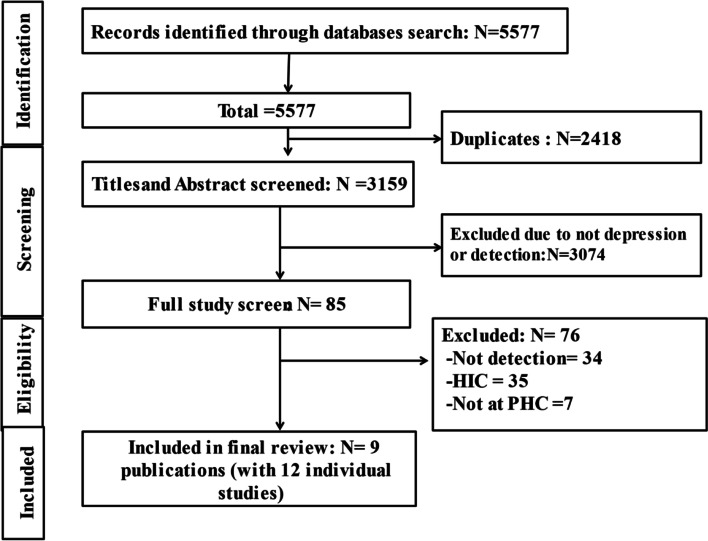
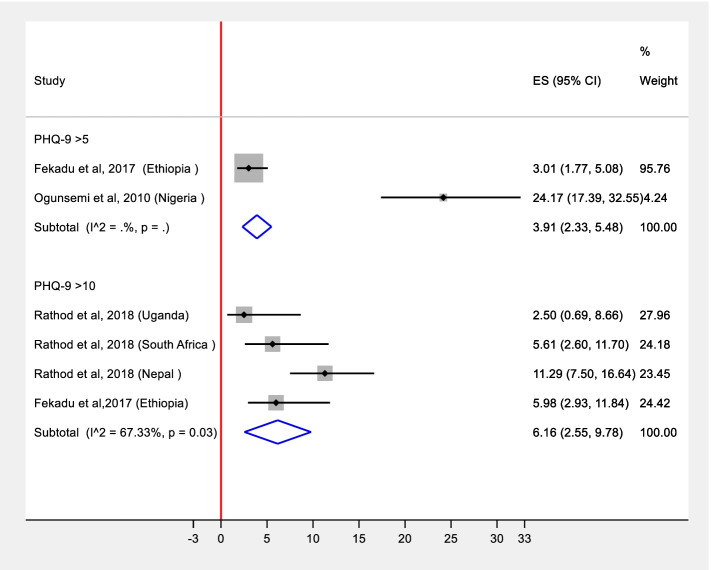
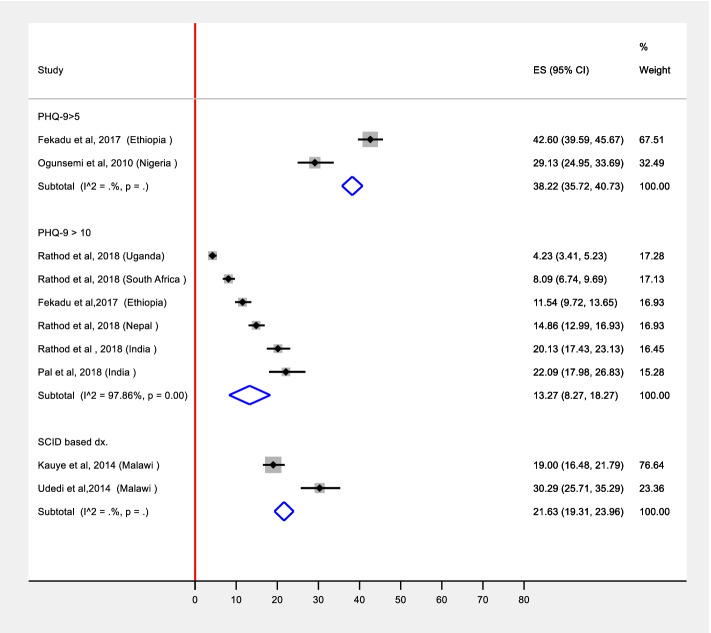
Verification
Claims the paper makes
The claims and statistics of this paper haven’t been checked yet.
Free: it reads the open-access text and checks the first 5 claims that cite a source we can check. Create a free account to check every claim.
Claims other papers make about this one
Each is checked against this paper’s own text: does it say what the citing paper says it does?
The source backs part of the claim, not all of it — or backs it for a different population, condition or comparison.
In the citing paper
“Most individuals with MDD access men tal health care initially through the primary care system, where measurement- based care is rarely implemented 102- 104 .”
From Treatment‐resistant depression: definition, prevalence, detection, management, and investigational interventions (2023) · cites this paper as [102]
Experimental — accuracy not yet measured
Self-check
Percentages, sums and reported differences re-computed from the paper’s own numbers.
The self-check needs the paper’s full text.
Citations
Cites
Vandenbroucke, J. P., von Elm, E., Altman, D. G., Gøtzsche, P. C., Mulrow, C. D., Pocock, S. J., Poole, C., Schlesselman, J. J., Egger, M., & Initiative, F. T. S. (2007) · PLoS Medicine · doi:10.1371/journal.pmed.0040297 · Cited by 8,613
Depression, chronic diseases, and decrements in health: results from the World Health Surveys
Moussavi, S., Chatterji, S., Verdes, E., Tandon, A., Patel, V., & Ustun, B. (2007) · The Lancet · doi:10.1016/s0140-6736(07)61415-9 · Cited by 4,070 · cited 1×
“It is a relatively common condition in primary health care (PHC), affecting up to 20% of attendees [2, 3] and adding to the burden on the healthcare system [4].”
BackgroundSelf-citationVandenbroucke, J. P., von Elm, E., Altman, D. G., Gøtzsche, P. C., Mulrow, C. D., Pocock, S. J., Poole, C., Schlesselman, J. J., & Egger, M. (2014) · International Journal of Surgery · doi:10.1016/j.ijsu.2014.07.014 · Cited by 2,969
Clinical diagnosis of depression in primary care: a meta-analysis
Mitchell, A. J., Vaze, A., & Rao, S. (2009) · The Lancet · doi:10.1016/s0140-6736(09)60879-5 · Cited by 1,251 · cited 4×
“Longer duration of untreated illness negatively influences the course and outcome of depression [6–8]; however, more than 50% of potential cases of depression remain undetected in high income countries [2].”
BackgroundResultInfluentialUndertreatment of people with major depressive disorder in 21 countries
Thornicroft, G., Chatterji, S., Evans-Lacko, S., Gruber, M., Sampson, N., Aguilar-Gaxiola, S., Al-Hamzawi, A., Alonso, J., Andrade, L., Borges, G., et al. (2017) · British Journal of Psychiatry · doi:10.1192/bjp.bp.116.188078 · Cited by 1,121 · cited 2×
“For example, a recent global report on adequacy of treatment for depression showed that only about 4% of people with depression receive minimally adequate treatment in LMICs compared with 20% in non-LMICs [34].”
BackgroundSelf-citationHarbord, R. M., & Higgins, J. P. T. (2008) · The Stata Journal: Promoting communications on statistics and Stata · doi:10.1177/1536867x0800800403 · Cited by 897 · cited 2×
“, the requirements for running a random effects model were fulfilled [25].”
BackgroundLund, C., Tomlinson, M., De Silva, M., Fekadu, A., Shidhaye, R., Jordans, M., Petersen, I., Bhana, A., Kigozi, F., Prince, M., et al. (2012) · PLoS Medicine · doi:10.1371/journal.pmed.1001359 · Cited by 584
Self-citationMental Illness in General Health Care: An International Study
Morriss, R. (1995) · BMJ · doi:10.1136/bmj.311.7006.696a · Cited by 528
Wang, J., Wu, X., Lai, W., Long, E., Zhang, X., Li, W., Zhu, Y., Chen, C., Zhong, X., Liu, Z., et al. (2017) · BMJ Open · doi:10.1136/bmjopen-2017-017173 · Cited by 486 · cited 1×
“In fact, a recent systematic review reports higher prevalence of depression and depressive symptoms among outpatients in developing countries than outpatients from developed countries [33].”
BackgroundKeynejad, R. C., Dua, T., Barbui, C., & Thornicroft, G. (2018) · Evidence Based Mental Health · doi:10.1136/eb-2017-102750 · Cited by 341 · cited 1×
“The large treatment gap and the global effort to improve access to treatment for mental disorders [15, 16], necessitates making appropriate use of the PHC system to address the treatment gap.”
BackgroundSelf-citation
Research works printed but not linked: 1
- Sterne JA. Meta-analysis in Stata: an updated collection from the Stata Journal: StataCorp LP; 2009.
Cited by
Items 101–135 of 135
Prevalence of depression in a large regionally representative population sample in Côte d’Ivoire
Jäggi, L., Falgas‐Bagué, I., Koné, S., Probst-Hensch, N. M., & Fink, G. (2025) · BMC Public Health · doi:10.1186/s12889-025-24879-3
“While this conservative threshold is not without limitations, it was chosen to minimize the risk of misclassification in mild cases—a concern previously noted in the literature and attributed to socio-cultural influences and the limited contextual validation of the tool in similar settings [8, 20].”
Estudio bibliométrico sobre las investigaciones psicométricas del PHQ-9 en la base de datos scopus
Aranguren, I. G. C., Morán, M. O., Vega, J. V., Rodríguez, J. A., Barraza, E. W. L., & Segovia, J. L. (2025) · Revista Vive · doi:10.33996/revistavive.v8i24.444
Caldichoury, N., Morales-Asencio, B., Coronado, J.-C., Castellanos-Alvarenga, L. M., Quispe-Ayala, C., Saldías, C., Espinoza, D. E. S., Ripoll-Córdoba, D., Laura, W. N. B., Martínez, J., et al. (2025) · Frontiers in Psychiatry · doi:10.3389/fpsyt.2025.1652072
Kumar, M., Ruikar, M., & Surya, V. L. (2024) · Figshare · doi:10.6084/m9.figshare.26634693
Παπαδοπούλου, Ε. Ι. (2023) · University of Thessaly Institutional Repository (University of Thessaly) · doi:10.26253/heal.uth.37754
Kohrt, B. A., Turner, E. L., Gurung, D., Wang, X., Neupane, M., Luitel, N. P., Kartha, M. R., Poudyal, A., Singh, R., Rai, S., et al. (2022) · Figshare · doi:10.6084/m9.figshare.20086187
Self-citationHenking, C. (2025) · Oxford University Research Archive (ORA) (University of Oxford) · doi:10.5287/ora-agy51nexd
Teusen, C. H. R., Schneider, A., & München, T. U. (2024)
Recognition of depression by nurses in primary healthcare in Zimbabwe: Cross-sectional study
Muduma, S., Kaiyo-Utete, M., Senter, Z., Machando, D., Hallgren, K. A., Williams, E. C., Chibanda, D., Abas, M., Mavunganidze, P., Thornicroft, G., et al. (2026) · Cambridge Prisms Global Mental Health · doi:10.1017/gmh.2026.10130
Self-citationWang, X., & Qin, A. (2026) · BMC Public Health · doi:10.1186/s12889-026-26374-9
“Notably, depressive symptoms remain substantially under-recognised in primary care settings [45, 46].”
DALE: Semantically Disentangled LoRA Expert Mixture for Depression Detection in Psychiatric Dialogue
Ding, J., Li, D., Han, Q., Lv, T., Wang, J., Lin, H., Luo, L., & Sun, Y. (2025) · IEEE International Conference on Bioinformatics and Biomedicine (BIBM) · doi:10.1109/bibm66473.2025.11356998
“Given this complexity and the urgent need for more accessible mental-health care, scalable automated tools that can mirror multi-dimensional clinical reasoning are highly desirable [14].”
Ohse, J., Hadžić, B., Peperkorn, N., Ploen, M., Fox, J., Neukirch, J., Rätsch, M., & Shiban, Y. (2026) · Computers in Human Behavior Reports · doi:10.1016/j.chbr.2026.100968
Ales, M. W., Dowrick, C. F., Ariba, A. J., Mugambi, J., Tavares, A. L. B., Kassai, R., Lionis, C. D., & Rodrigues, S. B. (2026) · BMC Family Practice · doi:10.1186/s12875-026-03213-9
“However, practical models for implementing systematic depression screening in real-world clinical settings remain limited, especially in LMIC contexts [3].”
chisanga, M. (2026) · ScholarWorks (Walden University)
Okeke, U. (2026) · ScholarWorks (Walden University)
Luitel, N. P., Pudasaini, K., Lamichhane, B., Gautam, K., & Jordans, M. J. D. (2026) · PLoS ONE · doi:10.1371/journal.pone.0347605
Barish, J. N. (2026) · Carolina Digital Repository (University of North Carolina at Chapel Hill) · doi:10.17615/mybk-7k54
Mental health of people attending non-psychiatric outpatient clinics
Younas, S., & Sahu, S. (2026) · Elsevier eBooks · doi:10.1016/b978-0-443-27346-9.00011-x
Bifftu, B. B., Thomas, S. J., & Win, K. T. (2026) · BMC Health Services Research · doi:10.1186/s12913-026-14897-1
“Despite these high prevalence rates and consequences, the recognition of mental health disorders in health-care settings remains low, ranging from 0 to 28% in low-income countries [12] and around 48% in high-income countries [13].”
Multi‐Modal AI Approach in Depression Detection and Treatment: A Systematic Review of Last Decade
Khare, S. K., Nadimi, E. S., Acharya, U. R., & Blanes‐Vidal, V. (2026) · Wiley Interdisciplinary Reviews Data Mining and Knowledge Discovery · doi:10.1002/widm.70106
Duarte, F. O., Masili, M., Camillo, L., Bianchi, J., de Godoy, K. F., Fragelli, B. D. D. L., Rodolpho, J. M. D. A., Prado, J. D. A., Speglich, C., & Anibal, F. D. F. (2026) · BMC Medical Informatics and Decision Making · doi:10.1186/s12911-026-03632-9
“It is estimated that over 50% of potential depression cases remain undiagnosed, and individuals who initiate treatment often encounter unstructured and inadequate access to appropriate care [23, 50].”
Al-amshaw, M. Z., Shakir, I. A., Ali, W., Sakr, H. A., Altayeb, M., & Gomaa, I. A. (2026) · Journal of Soft Computing and Data Mining · doi:10.30880/jscdm.2026.07.02.025
Amune, P. (2026) · ScholarWorks (Walden University)
Ridho, R. (2026) · The Indonesian Journal of General Medicine · doi:10.70070/2ngfy621
Staff Education to Enhance PHQ-9 Depression Screening Compliance
Chukwu, C. (2026) · ScholarWorks (Walden University)
Huarcaya-Victoria, J., Quispe, M. B. R., Reyes, B. C. B., Carrasco, A. G. M., & Flores-Cohaila, J. A. (2025) · LA Referencia (Red Federada de Repositorios Institucionales de Publicaciones Científicas)
Bhatia, K., & Arora, R. (2026) · Advances in intelligent systems research/Advances in Intelligent Systems Research · doi:10.2991/978-94-6239-789-7_44
AOR: adaptive orthogonal regression for depression feature selection with incomplete EEG channels
Dong, W., Gong, Z., Xu, X., Liu, K., Wei, F., & Zhuo, L. (2026) · Journal of Neural Engineering · doi:10.1088/1741-2552/aeb32f
Branch Immanuvel, A., Baibussinova, A., Khismetova, Z. A., Jobalayeva, B., Tanatarova, G., Kudaibergenova, N., Rizaev, J. A., & Shaltynov, A. (2026) · International Journal of Environmental Research and Public Health · doi:10.3390/ijerph23101317
So, M. K. P., Tsang, J. T. Y., Chan, L. S. H., Chan, J. N. L., Tiwari, A., & Chu, A. M. Y. (2026) · PLoS ONE · doi:10.1371/journal.pone.0359556
“However, more than 50% of potential depression cases remain undetected in high-income countries, with even lower detection rates in low-and middle-income countries [8].”
Михайловна, К. В., Burkovskaya, Y. V., & Timofeeva, A. S. (2026) · Problems of Social Hygiene Public Health and History of Medicine · doi:10.32687/0869-866x-2026-34-s2-1114-1119
Adesina, M. A., Taiwo, P., Oladele, R. I., Ajayi, T., & Lawal, H. (2026) · Mental Health Science · doi:10.1002/mhs2.70061
Perspective Chapter: Mental Health Integration in Primary Medical Care
Msheik, A., Al-Saad, N., Peralta, R. R., Mokdad, Z. A., Illeyyan, A., Mohamad, A. R. E., AlShurbaji, F., Ahmed, A., Maadhadi, M. A., Bauzá, P., et al. (2026) · IntechOpen eBooks · doi:10.5772/intechopen.1017502
Magallón-Botaya, R., Méndez-López, F., Oliván-Blázquez, B., Silva-Aycaguer, L. C., Lerma-Irureta, D., & Bartolomé-Moreno, C. (2023) · doi:10.3389/fpubh.2023.1007238.s001
Metadata
- Authors
- Fekadu, A., Demissie, M., Birhane, R., Medhin, G., Bitew, T., Hailemariam, M., Minaye, A., Habtamu, K., Milkias, B., Petersen, I., Patel, V., Cleare, A. J., Mayston, R., Thornicroft, G., Alem, A., Hanlon, C., & Prince, M.
- Affiliations
- Brighton and Sussex Medical School (GB)
- Addis Ababa University (ET)
- University of KwaZulu-Natal (ZA)
- Harvard University (US)
- King's College London (GB)
- Corresponding author
- Fekadu, Abebaw
- ORCID
- Venue
- Systematic Reviews
- Published
- 2022-02-05
- Volume
- 11
- Issue
- 1
- Pages
- 21-21
- ISSN
- 2046-4053 (ISSN-L)
- PMC
- PMC8818168
- OpenAlex
- W4221133563
- Cited by
- 111
- References
- 45
- Citations by year
- 2026: 18 · 2025: 28 · 2024: 19 · 2023: 29 · 2022: 9
- FWCI
- 3.18
- Type
- journal article
- Language
- en
- Open access
- gold
- doi.org
- Licence
- cc-by
- creativecommons.org/licenses/by/4.0 (tdm)
- creativecommons.org/licenses/by/4.0 (vor)
- Locations
- Systematic Reviews (publishedVersion, cc-by)
- medRxiv (acceptedVersion, cc-by-nc-nd)
- PubMed Central (publishedVersion, cc-by)
- PubMed (publishedVersion)
- DOAJ (DOAJ: Directory of Open Access Journals) (submittedVersion, cc-by-sa)
- Edinburgh Research Explorer (University of Edinburgh) (submittedVersion, cc-by)
- Funders
- UK Medical Research Council (MRC) and the UK Department for International Development (MR/M025470/1)
- Topics
- Health Sciences › Medicine › Psychiatry and Mental health › Mental Health Treatment and Access
- Social Sciences › Psychology › Experimental and Cognitive Psychology › Anxiety, Depression, Psychometrics, Treatment, Cognitive Processes
- Health Sciences › Medicine › Family Practice › Primary Care and Health Outcomes
- Keywords
- depression detection, primary care, low- and middle-income countries, PHQ-9, depression screening, underdiagnosis, access to mental health care, depression severity, suicidality, screening cut-off values
- MeSH terms
- Depression, Developing Countries, Humans, Income, Primary Health Care, Surveys and Questionnaires
About these checks
Registry, retraction, Cites and statistics results are computed, not judged, with one exception: a printed reference that no index lists is read once by a model before it counts as a citation error. Claims are extracted by a model and kept only when their quote appears verbatim in the text; each cited source is then checked, with a model’s help, for whether it says what the claim relies on. Those verdicts can be wrong — read the claim’s quote and the cited source before relying on one.
Statistics and arithmetic are recomputed, not judged.
Confidence bands are shown only for fields calibrated on our annotated test set. None is calibrated yet, so no band is shown.
What counts as a claim ›How we measure confidence ›How we check this ›
Are you an author, or do you see a problem with this page? Request a review
Data sources
Bibliographic data: Semantic Scholar, OpenAlex, Crossref.
Contains information from the Semantic Scholar Academic Graph Datasets, made available under the ODC Attribution License (ODC-BY 1.0).
Semantic Scholar’s data is described in: Kinney, R., et al. (2023). The Semantic Scholar Open Data Platform. arXiv:2301.10140.
