

Methods and guidance on conducting, reporting, publishing, and appraising living systematic reviews: a scoping review
Open accessPublished version of a preprint
The DOI matches its Crossref record; 28 of the 28 references it cites were found in a registry or an index.
Abstract
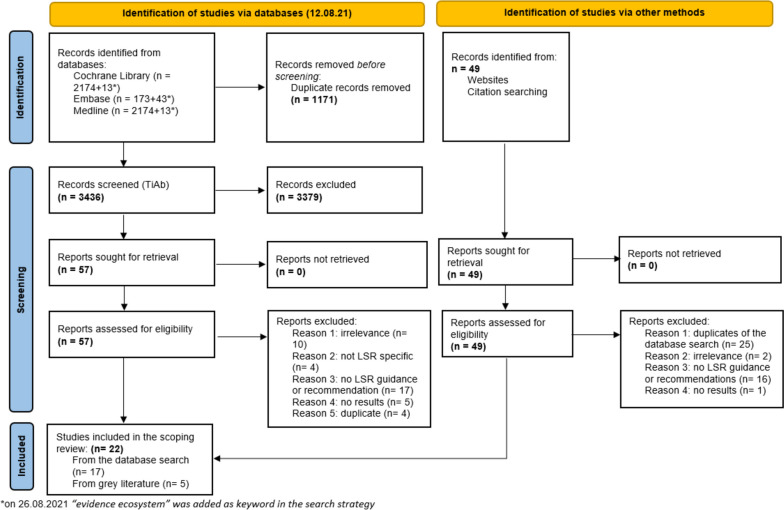
Background and objective: The living systematic review (LSR) approach is based on ongoing surveillance of the literature and continual updating. Most currently available guidance documents address the conduct, reporting, publishing, and appraisal of systematic reviews (SRs), but are not suitable for LSRs per se and miss additional LSR-specific considerations. In this scoping review, we aim to systematically collate methodological guidance literature on how to conduct, report, publish, and appraise the quality of LSRs and identify current gaps in guidance. Methods: A standard scoping review methodology was used. We searched MEDLINE (Ovid), EMBASE (Ovid), and The Cochrane Library on August 28, 2021. As for searching gray literature, we looked for existing guidelines and handbooks on LSRs from organizations that conduct evidence syntheses. The screening was conducted by two authors independently in Rayyan, and data extraction was done in duplicate using a pilot-tested data extraction form in Excel. Data was extracted according to four pre-defined categories for (i) conducting, (ii) reporting, (iii) publishing, and (iv) appraising LSRs. We mapped the findings by visualizing overview tables created in Microsoft Word. Results: Of the 21 included papers, methodological guidance was found in 17 papers for conducting, in six papers for reporting, in 15 papers for publishing, and in two papers for appraising LSRs. Some of the identified key items for (i) conducting LSRs were identifying the rationale, screening tools, or re-revaluating inclusion criteria. Identified items of (ii) the original PRISMA checklist included reporting the registration and protocol, title, or synthesis methods. For (iii) publishing, there was guidance available on publication type and frequency or update trigger, and for (iv) appraising, guidance on the appropriate use of bias assessment or reporting funding of included studies was found. Our search revealed major evidence gaps, particularly for guidance on certain PRISMA items such as reporting results, discussion, support and funding, and availability of data and material of a LSR. Conclusion: Important evidence gaps were identified for guidance on how to report in LSRs and appraise their quality. Our findings were applied to inform and prepare a PRISMA 2020 extension for LSR.
Overview
The claims and statistics of this paper haven’t been checked yet.
Free: it reads the open-access text and checks the first 5 claims that cite a source we can check. Create a free account to check every claim.
Integrity signals
Registry
Cites
Statistics
Figures
Verification
Claims the paper makes
The claims and statistics of this paper haven’t been checked yet.
Free: it reads the open-access text and checks the first 5 claims that cite a source we can check. Create a free account to check every claim.
Claims other papers make about this one
Each is checked against this paper’s own text: does it say what the citing paper says it does?
The cited source says what the claim attributes to it.
In the citing paper
“Similarly, for quality and risk of bias assessment, updating could be regular, at a defined time interval, or occur once new evidence has been identified for inclusion.”
From Extension of the PRISMA 2020 statement for living systematic reviews (PRISMA-LSR): checklist and explanation (2024) · cites this paper as [20]
The cited source says what the claim attributes to it.
In the citing paper
“Only one paper identified by that scoping review reported on the frequency of certainty of evidence assessment, which was after regular updating. 20”
From Extension of the PRISMA 2020 statement for living systematic reviews (PRISMA-LSR): checklist and explanation (2024) · cites this paper as [20]
The cited source says what the claim attributes to it.
In the citing paper
“For example, a scoping review of the methodological literature and guidance on how to conduct, report, publish, and appraise the quality of LSRs found that the frequency for data abstraction could be determined by the continuous search (trigger dependent); immediately after study identification; or once new evidence has been identified for inclusion.”
From Extension of the PRISMA 2020 statement for living systematic reviews (PRISMA-LSR): checklist and explanation (2024) · cites this paper as [20]
The cited source says what the claim attributes to it.
In the citing paper
“For data synthesis, updating could occur immediately after new study inclusion; on a continuous basis; or once new evidence has been identified for inclusion.”
From Extension of the PRISMA 2020 statement for living systematic reviews (PRISMA-LSR): checklist and explanation (2024) · cites this paper as [20]
Self-check
Percentages, sums and reported differences re-computed from the paper’s own numbers.
The self-check needs the paper’s full text.
Citations
Cites
The PRISMA 2020 statement: An updated guideline for reporting systematic reviews
Page, M. J., McKenzie, J. E., Bossuyt, P. M., Boutron, I., Hoffmann, T. C., Mulrow, C. D., Shamseer, L., Tetzlaff, J. M., Akl, E. A., Brennan, S. E., et al. (2021) · BMJ · doi:10.1136/bmj.n71 · Cited by 108,283
Self-citationPRISMA Extension for Scoping Reviews (PRISMA-ScR): Checklist and Explanation
Tricco, A. C., Lillie, E., Zarin, W., O'Brien, K. K., Colquhoun, H., Levac, D., Moher, D., Peters, M. D. J., Horsley, T., Weeks, L., et al. (2018) · Annals of Internal Medicine · doi:10.7326/m18-0850 · Cited by 43,565 · cited 1×
“…guidance of the Joanna Briggs Institute [6] and applied the following steps: Moreover, we adhered to the Preferred Reporting Items for Systematic Reviews and Meta-Analyses extension for Scoping Reviews (PRISMA-ScR) checklist (see Supplement Table 2) for transparent reporting of the results [9].”
MethodSelf-citationScoping studies: towards a methodological framework
Arksey, H., & O'Malley, L. (2005) · International Journal of Social Research Methodology · doi:10.1080/1364557032000119616 · Cited by 36,742
The PRISMA 2020 statement: an updated guideline for reporting systematic reviews
Page, M. J., McKenzie, J. E., Bossuyt, P. M., Boutron, I., Hoffmann, T. C., Mulrow, C. D., Shamseer, L., Tetzlaff, J. M., Akl, E. A., Brennan, S. E., et al. (2021) · Systematic Reviews · doi:10.1186/s13643-021-01626-4 · Cited by 13,874 · cited 4×
“While the recent update of the “Pre-ferred Reporting Items for Systematic reviews and Meta-Analyses” (PRISMA) can be used for reporting LSRs, the statement indicates there may be some additional considerations that need to be addressed [4].”
MethodInfluentialSelf-citationShea, B. J., Reeves, B. C., Wells, G., Thuku, M., Hamel, C., Moran, J., Moher, D., Tugwell, P., Welch, V., Kristjansson, E., et al. (2017) · BMJ · doi:10.1136/bmj.j4008 · Cited by 10,636 · cited 2×
“Also, the AMSTAR 2—Assessing the Methodological Quality of Systematic Reviews—tool [5] which was developed for the critical appraisal of the quality of SRs, does not consider LSRs.”
MethodJBI Manual for Evidence Synthesis
(2020) · JBI eBooks · doi:10.46658/jbimes-20-01 · Cited by 4,165
Peters, M., Godfrey, C., McInerney, P., Munn, Z., Tricco, A., & Khalil, H. (2019) · JBI Reviewer's Manual · doi:10.46658/jbirm-20-01 · Cited by 2,222
Living systematic review: 1. Introduction-the why, what, when, and how
Elliott, J. H., Synnot, A., Turner, T., Simmonds, M., Akl, E. A., McDonald, S., Salanti, G., Meerpohl, J., MacLehose, H., Hilton, J., et al. (2017) · Journal of Clinical Epidemiology · doi:10.1016/j.jclinepi.2017.08.010 · Cited by 655 · cited 2×
“Regular searches ensure that the SR includes the latest available evidence and remains up-to-date [2].”
BackgroundSelf-citationLiving Systematic Reviews: An Emerging Opportunity to Narrow the Evidence-Practice Gap
Elliott, J. H., Turner, T., Clavisi, O., Thomas, J., Higgins, J. P. T., Mavergames, C., & Gruen, R. L. (2014) · PLoS Medicine · doi:10.1371/journal.pmed.1001603 · Cited by 596 · cited 7×
“…( N = 8/17) • Set up auto alerts to provide a regular feed of new citations [14] • Continuous search (e.g., varying between weekly and monthly) [1, 3, 13, 14, 16, 19, 28, 29] Database ( N = 2/17) • Bibliographic databases, clinical trials registries, gray literature [3, 14] Who ( N = 1/17) •…”
BackgroundMethodInfluentialLiving systematic reviews: 2. Combining human and machine effort
Thomas, J., Noel-Storr, A., Marshall, I., Wallace, B., McDonald, S., Mavergames, C., Glasziou, P., Shemilt, I., Synnot, A., Turner, T., et al. (2017) · Journal of Clinical Epidemiology · doi:10.1016/j.jclinepi.2017.08.011 · Cited by 355 · cited 6×
“…update process including RoB assessment starts [29] Who ( N = 0/17) a How ( N = 2/17) • Machine learning-assisted RoB tools (e.g., RobotReviewer) [25] • AI-assited tools [26] Data synthesis with meta-analysis (if applicable) Frequency ( N = 5/17) • Immediately after new study inclusion [22, 24]…”
BackgroundMethodInfluentialSelf-citationLiving systematic reviews: 4. Living guideline recommendations.
Akl, E. A., Meerpohl, J. J., Elliott, J., Kahale, L. A., Schünemann, H. J., Agoritsas, T., Hilton, J., Perron, C., Akl, E., Hodder, R., et al. (2017) · Journal of Clinical Epidemiology · doi:10.1016/j.jclinepi.2017.08.009 · Cited by 328 · cited 7×
“Also, we note that some papers provide very broad guidance on several aspects of publishing a LSR [3, 14, 19, 29].”
BackgroundMethodInfluentialSelf-citationLiving systematic reviews: 3. Statistical methods for updating meta-analyses
Simmonds, M. C., Salanti, G., McKenzie, J. E., Elliott, J., Agoritsas, T., Hilton, J., Perron, C., Akl, E. A., Hodder, R. K., Pestridge, C., et al. (2017) · Journal of Clinical Epidemiology · doi:10.1016/j.jclinepi.2017.08.008 · Cited by 163 · cited 3×
“Criteria/rationale for conducting LSR Rationale ( N = 10/17) • High prevalence of condition/RQ [13, 15] • Existing results change [3, 15] • Priority for decision making [3, 20, 22, 26, 27, 29] • Low certainty of evidence or rapidly emerging evidence [3, 15, 18, 21, 26, 27, 29]”
BackgroundMethodSelf-citationRavaud, P., Créquit, P., Williams, H. C., Meerpohl, J. J., Craig, J. C., & Boutron, I. (2020) · Journal of Clinical Epidemiology · doi:10.1016/j.jclinepi.2020.01.027 · Cited by 78 · cited 2×
“Criteria/rationale for conducting LSR Rationale ( N = 10/17) • High prevalence of condition/RQ [13, 15] • Existing results change [3, 15] • Priority for decision making [3, 20, 22, 26, 27, 29] • Low certainty of evidence or rapidly emerging evidence [3, 15, 18, 21, 26, 27, 29]”
BackgroundFeasibility and acceptability of living systematic reviews: results from a mixed-methods evaluation
Millard, T., Synnot, A., Elliott, J., Green, S., McDonald, S., & Turner, T. (2019) · Systematic Reviews · doi:10.1186/s13643-019-1248-5 · Cited by 77 · cited 5×
“Also, we note that some papers provide very broad guidance on several aspects of publishing a LSR [3, 14, 19, 29].”
BackgroundInfluentialAccumulation Bias in meta-analysis: the need to consider time in error control
ter Schure, J., & Grünwald, P. (2019) · F1000Research · doi:10.12688/f1000research.19375.1 · Cited by 40 · cited 3×
“…no evidence a • Searched study registries are recommended [3] • Searched reference list/gray literature is recommended [3] ( • Accumulation bias [24] • If new relevant methods emerged that would be appropriate to integrate into the methods it is recommended (risk of bias tools) new evidence…”
BackgroundMethodFuture of evidence ecosystem series: 2. current opportunities and need for better tools and methods
Créquit, P., Boutron, I., Meerpohl, J., Williams, H. C., Craig, J., & Ravaud, P. (2020) · Journal of Clinical Epidemiology · doi:10.1016/j.jclinepi.2020.01.023 · Cited by 36 · cited 8×
“…existing structured data sources (e.g., clinical trials registries) [25] How ( N = 6/17) • AI, machine learning, and automated structured data [3, 13, • Crowd-sourcing [13, 26, 27] Quality & bias assessment Frequency ( N = 2/17) • Regular updating, at a defined time interval [3] • Once new…”
BackgroundInfluentialLiving systematic reviews at The BMJ
Macdonald, H., Loder, E., & Abbasi, K. (2020) · BMJ · doi:10.1136/bmj.m2925 · Cited by 35 · cited 2×
“Criteria/rationale for conducting LSR Rationale ( N = 10/17) • High prevalence of condition/RQ [13, 15] • Existing results change [3, 15] • Priority for decision making [3, 20, 22, 26, 27, 29] • Low certainty of evidence or rapidly emerging evidence [3, 15, 18, 21, 26, 27, 29]”
BackgroundPRISMA flow diagrams for living systematic reviews: a methodological survey and a proposal
Kahale, L. A., Elkhoury, R., El Mikati, I., Pardo-Hernandez, H., Khamis, A. M., Schünemann, H. J., Haddaway, N. R., & Akl, E. A. (2021) · F1000Research · doi:10.12688/f1000research.51723.1 · Cited by 33 · cited 1×
“The search strategy was initially developed by a researcher experienced in developing literature search strategies with support from an information specialist (LH), as part of a larger project to develop an extension of the PRISMA 2020 statement for LSRs [10, 11].”
MethodSelf-citationLerner, I., Créquit, P., Ravaud, P., & Atal, I. (2019) · Journal of Clinical Epidemiology · doi:10.1016/j.jclinepi.2018.12.001 · Cited by 28 · cited 1×
“…• Information specialists or librarians, using technological enablers [3] Screening tool ( N = 10/17) • Computer-supported & automated [3, 13–15, 17, 19, 26–29] • Continuous database search with push notification [25, 26] • Guidance on eligibility: machine-learning classifier, crowdsourced…”
A systematic review that is ``rapid'' and ``living'': A specific answer to the COVID-19 pandemic
Négrini, S., Ceravolo, M. G., Côté, P., & Arienti, C. (2021) · Journal of Clinical Epidemiology · doi:10.1016/j.jclinepi.2021.05.025 · Cited by 27 · cited 4×
“Criteria/rationale for conducting LSR Rationale ( N = 10/17) • High prevalence of condition/RQ [13, 15] • Existing results change [3, 15] • Priority for decision making [3, 20, 22, 26, 27, 29] • Low certainty of evidence or rapidly emerging evidence [3, 15, 18, 21, 26, 27, 29]”
BackgroundInfluentialKhamis, A. M., Kahale, L. A., Hernandez, H. P., Schünemann, H. J., & Akl, E. A. (2019) · F1000Research · doi:10.12688/f1000research.18005.2 · Cited by 26
Self-citationLiving Systematic Reviews and Other Approaches for Updating Evidence
Lansky, A. J., & Wethington, H. R. (2020) · American Journal of Public Health · doi:10.2105/ajph.2020.305920 · Cited by 23 · cited 2×
“…methodological expertise [20] • Team of clinicians, researchers, and graduate students with SR expertise [29] Funding Funding ( N = 4/17) • Impact on maintaining LSR [3] • Direct funding for personnel [19], a consistent flow of funding to research groups is needed [13, 16] pre-defined items.”
BackgroundLiving systematic review: new inputs and challenges
Vergara-Merino, L., Verdejo, C., Carrasco, C., & Vargas-Peirano, M. (2020) · Medwave · doi:10.5867/medwave.2020.11.8092 · Cited by 18 · cited 2×
“Criteria/rationale for conducting LSR Rationale ( N = 10/17) • High prevalence of condition/RQ [13, 15] • Existing results change [3, 15] • Priority for decision making [3, 20, 22, 26, 27, 29] • Low certainty of evidence or rapidly emerging evidence [3, 15, 18, 21, 26, 27, 29]”
BackgroundIannizzi, C., Akl, E. A., Kahale, L. A., Dorando, E., Aminat, A. M., Barker, J. M., McKenzie, J. E., Haddaway, N., Piechotta, V., & Skoetz, N. (2021) · F1000Research · doi:10.12688/f1000research.55108.1 · Cited by 15 · cited 1×
“A protocol elaborating on the detailed methodology of this scoping review was already published [7].”
MethodSelf-citationKhamis, A. M., Kahale, L. A., Pardo-Hernandez, H., Schünemann, H. J., & Akl, E. A. (2019) · F1000Research · doi:10.12688/f1000research.18005.1 · Cited by 14 · cited 1×
“The search strategy was initially developed by a researcher experienced in developing literature search strategies with support from an information specialist (LH), as part of a larger project to develop an extension of the PRISMA 2020 statement for LSRs [10, 11].”
MethodSelf-citationStay alive! What are living systematic reviews and what are their advantages and challenges?
Winters, M., de Vos, R., van Middelkoop, M., Rathleff, M. S., & Weir, A. (2020) · British Journal of Sports Medicine · doi:10.1136/bjsports-2020-103490 · Cited by 13 · cited 1×
“…up auto alerts to provide a regular feed of new citations [14] • Continuous search (e.g., varying between weekly and monthly) [1, 3, 13, 14, 16, 19, 28, 29] Database ( N = 2/17) • Bibliographic databases, clinical trials registries, gray literature [3, 14] Who ( N = 1/17) • Information specialists…”
BackgroundEnabling Living Systematic Reviews and Clinical Guidelines through Semantic Technologies
Slaughter, L. A., Berntsen, C. F., Brandt, L., & Mavergames, C. (2015) · D-Lib Magazine · doi:10.1045/january2015-slaughter · Cited by 9
COVID-19 Technology-Enabled Living Systematic Reviews to Enhance Knowledge Translation
Harrington, L. (2021) · AACN Advanced Critical Care · doi:10.4037/aacnacc2021948 · Cited by 5 · cited 3×
“…1/17) • Information specialists or librarians, using technological enablers [3] Screening tool ( N = 10/17) • Computer-supported & automated [3, 13–15, 17, 19, 26–29] • Continuous database search with push notification [25, 26] • Guidance on eligibility: machine-learning classifier, crowdsourced…”
Background
Research works printed but not linked: 2
- Thomas J, Askie L, Berlin J, Elliott J, Ghersi D, Simmonds M, et al. Chapter 22: Prospective approaches to accumulating evidence. In: Higgins JPT TJ, Chandler J, Cumpston M, Li T, Page MJ, Welch VA (editors), editor. Cochrane Handbook for Systematic Reviews of Interventions version 62 (updated February 2021): Cochrane; 2021.
- Xu J Deng H A brief introduction of living systematic review [Chinese] J Chin J Evid-Based Med 2020 20 244 248
Cited by
Akl, E. A., Khabsa, J., Iannizzi, C., Piechotta, V., Kahale, L. A., Barker, J. M., McKenzie, J. E., Page, M. J., & Skoetz, N. (2024) · BMJ · doi:10.1136/bmj-2024-079183 · Cited by 103
“21 The discussion was informed by the findings of the background studies and members’ experience undertaking LSRs.”
InfluentialSelf-citationHøjlund, M., Kafalı, H. Y., Kırmızı, B., Fusar‐Poli, P., Correll, C. U., Cortese, S., Sabé, M., Fiedorowicz, J. G., Saraf, G., Zein, J., et al. (2025) · European Neuropsychopharmacology · doi:10.1016/j.euroneuro.2025.09.011 · Cited by 25
Salutogenic Marketing in Preventive Dentistry
Siripipatthanakul, S., & Phuangsuwan, P. (2024) · Advances in medical technologies and clinical practice book series · doi:10.4018/979-8-3693-3872-8.ch009 · Cited by 14
Nurse Specialist in the Organ and Tissue Donation Process with Coordination Role: A Scoping Review
Longo, D., Ramacciati, N., & Giusti, G. D. (2025) · Nursing Reports · doi:10.3390/nursrep15020039 · Cited by 19
“…a body of knowledge, identify any gaps in research [27,28], provide a background [29], and understand the extent of knowledge present in an emerging field, including the heterogeneity of types of studies [30], without carrying out an in-depth analysis of the data obtained from each reference [31].”
Mansilla, C., Wang, Q., Piggott, T., Bragge, P., Waddell, K., Guyatt, G., Sweetman, A., & Lavis, J. N. (2024) · Implementation Science · doi:10.1186/s13012-024-01396-2 · Cited by 12
Metadata
- Authors
- Iannizzi, C., Akl, E. A., Anslinger, E., Weibel, S., Kahale, L. A., Aminat, A. M., Piechotta, V., & Skoetz, N.
- Affiliations
- University of Cologne (DE)
- McMaster University (CA)
- Universitätsklinikum Würzburg (DE)
- Cochrane Canada (CA)
- American University of Beirut (LB)
- Corresponding author
- Iannizzi, Claire
- Venue
- Systematic Reviews
- Published
- 2023-12-14
- Volume
- 12
- Issue
- 1
- Pages
- 238-238
- ISSN
- 2046-4053 (ISSN-L)
- PMC
- PMC10722674
- OpenAlex
- W4389734106
- Semantic Scholar
- b6020f8989607781929d26c4fa923bd58a441134
- Cited by
- 31
- References
- 28
- Citations by year
- 2026: 16 · 2025: 10 · 2024: 5
- FWCI
- 2.19
- Type
- journal article
- Language
- en
- Open access
- gold
- doi.org
- Licence
- cc-by
- creativecommons.org/licenses/by/4.0 (tdm)
- creativecommons.org/licenses/by/4.0 (vor)
- Locations
- Systematic Reviews (publishedVersion, cc-by)
- Research Square (acceptedVersion, cc-by)
- PubMed Central (publishedVersion, cc-by)
- PubMed (publishedVersion)
- Kölner Universitäts PublikationsServer (Universität zu Köln) (submittedVersion, other-oa)
- DOAJ (DOAJ: Directory of Open Access Journals) (submittedVersion, cc-by-sa)
- Informationszentrum Lebenswissenschaften (ZB MED) (submittedVersion, cc-by)
- Funders
- Bundesministerium für Bildung und Forschung (01KX2021)
- Universitätsklinikum Köln
- Topics
- Social Sciences › Decision Sciences › Statistics, Probability and Uncertainty › Meta-analysis and systematic reviews
- Health Sciences › Medicine › Public Health, Environmental and Occupational Health › Clinical practice guidelines implementation
- Social Sciences › Sociology and Political Science › Delphi Technique in Research
- Keywords
- methodological recommendations, reporting guidelines, PRISMA, review updating, evidence gaps, bias assessment, funding disclosure
- MeSH terms
- Systematic Reviews as Topic, Humans, Publishing, Bias, MEDLINE, Checklist, Research Report
About these checks
Registry, retraction, Cites and statistics results are computed, not judged, with one exception: a printed reference that no index lists is read once by a model before it counts as a citation error. Claims are extracted by a model and kept only when their quote appears verbatim in the text; each cited source is then checked, with a model’s help, for whether it says what the claim relies on. Those verdicts can be wrong — read the claim’s quote and the cited source before relying on one.
Statistics and arithmetic are recomputed, not judged.
Confidence bands are shown only for fields calibrated on our annotated test set. None is calibrated yet, so no band is shown.
What counts as a claim ›How we measure confidence ›How we check this ›
Are you an author, or do you see a problem with this page? Request a review
Data sources
Bibliographic data: Semantic Scholar, OpenAlex, Crossref.
Contains information from the Semantic Scholar Academic Graph Datasets, made available under the ODC Attribution License (ODC-BY 1.0).
Semantic Scholar’s data is described in: Kinney, R., et al. (2023). The Semantic Scholar Open Data Platform. arXiv:2301.10140.
