

Does application of honey improve surgical outcome in pilonidal cyst excision with secondary intention healing? A prospective randomized placebo-controlled clinical trial
The DOI matches its Crossref record; 3 of the 3 references it cites were found in a registry or an index.
Abstract
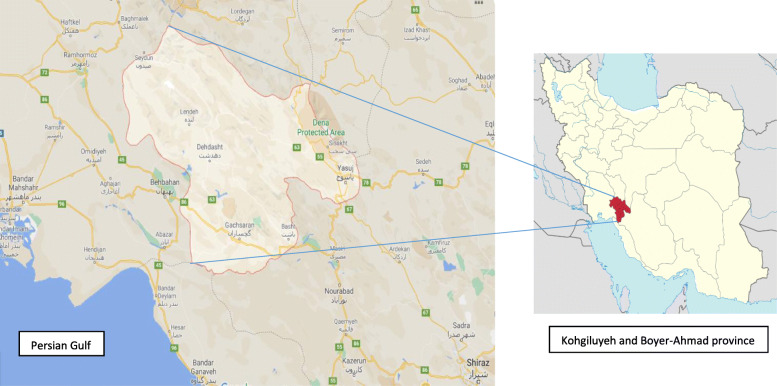
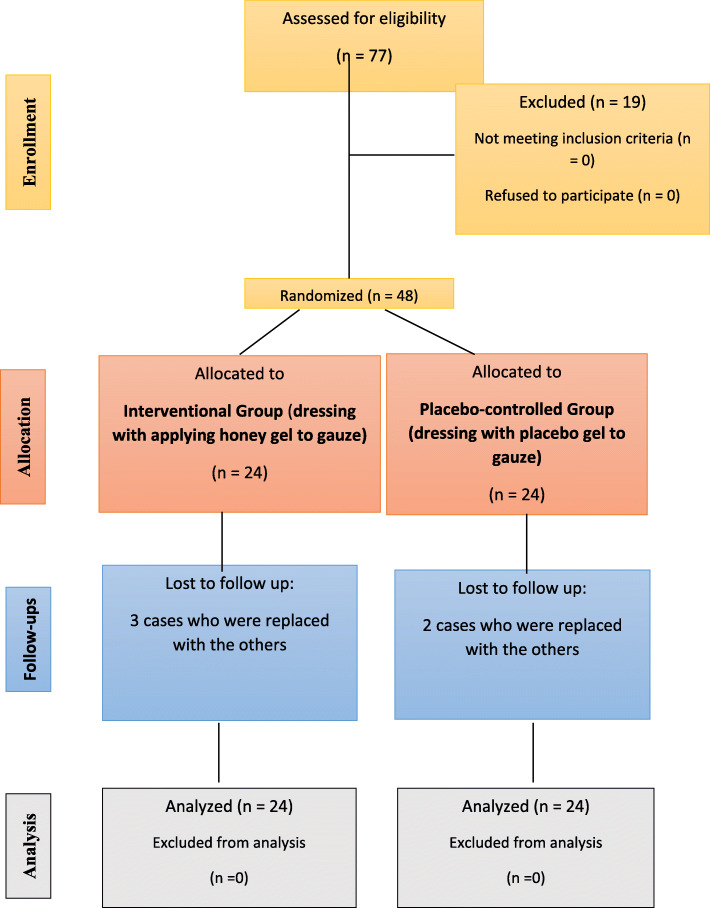
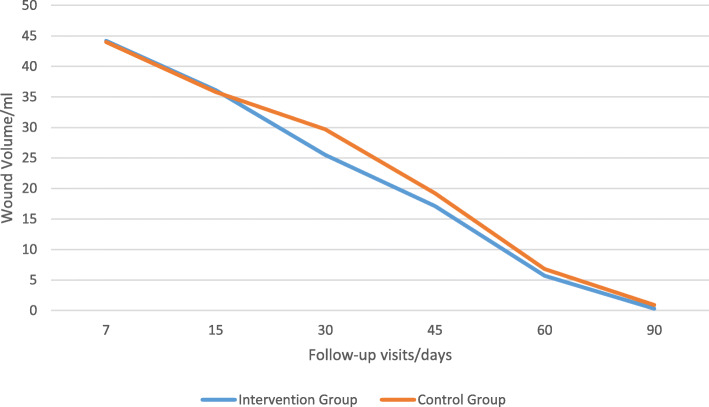
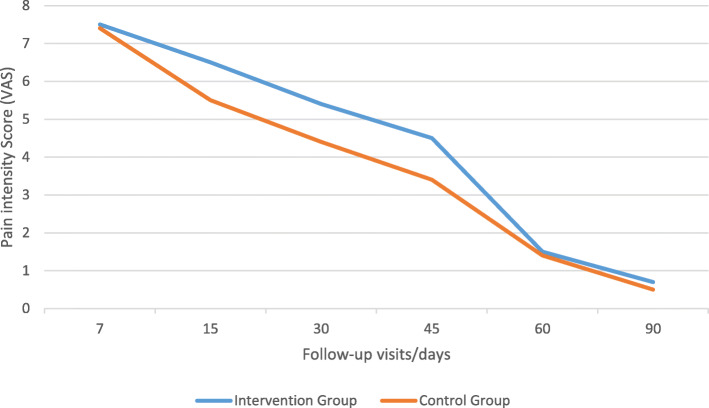
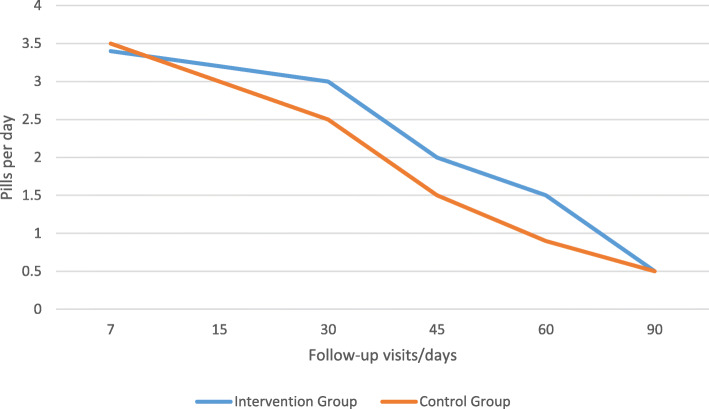
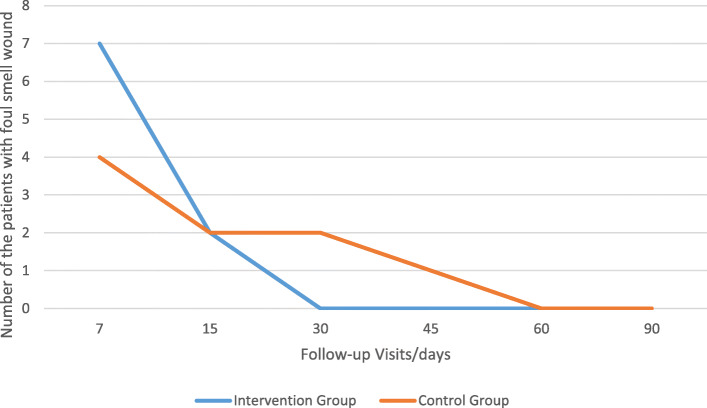
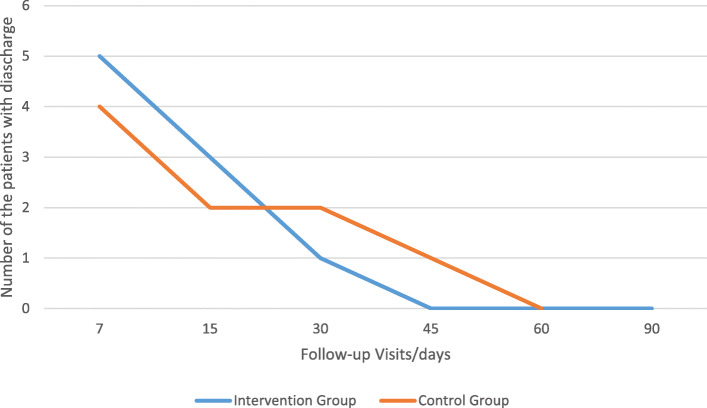
Background: Pilonidal sinus disease (PSD) is a common chronic inflammatory debilitating illness caused by ingrowth of hair into the skin. Excision and healing by secondary intention is one of the acceptable managements. The post-operative wound care needs frequent and time-consuming follow-ups. Honey is considered to be a traditional remedy for wound healing. The current study aimed at finding if application of honey could improve surgical outcome in pilonidal cyst excision with secondary intention healing. Methods: This study was designed as a randomized placebo-controlled parallel assignment interventional (clinical trial) study conducted at the surgical ward of Shahid Beheshti Hospital affiliated to the Yasuj University of Medical sciences, Yasuj, Iran, and was consisted of the 48 patients who underwent surgical resection for PSD with secondary intention healing (24 patients in intervention and placebo-controlled groups). The main element of honey medicinal gel was the unheated natural honey of Dena Biosphere Reserve within the Zagros Mountains. Patients' wounds were visited by a surgeon and a nurse on the days 7, 15, 30, 45, 60, and 90 post-operation. The surgical outcomes including the time to complete wound healing, pain intensity, odor, discharge at the site of surgery, use of analgesics, the time of to return to the daily activities, and occurring of any side effects including infection, erythema, and bleeding were all recorded. Results: In intervention group, there was significantly lower wound healing time, the lower time to return to the daily activities, lower mean wound volume at the days of 30, 45, 60, and 90 of the follow-up, higher mean post-operative pain level at the days of 15, 30, 45, 60, and 90 of the follow-up, and more usage of analgesics at the days of 15, 30, 45, and 60 of the follow-up. There was no significant difference between intervention and placebo-controlled groups according to the foul smell and fluid discharge at the site of the operation. There were no side effects and complications in both groups of the study. Conclusions: Application of honey after resection surgery with secondary wound healing is associated with a better surgical outcome and could eventually decrease healing time and reduce duration of return to normal activities, but could increase post-operation pain and analgesic consumption, and no effect on foul smell and discharge. Trial registration: The project was found to be in accordance to the ethical principles and the national norms and standards for conducting research in Iran with the approval ID and date of IR.YUMS.REC.1399.088 and 2020.05.30 respectively, and is the result of a residency dissertation to get the specialty in general surgery, which has been registered with the research project number 960508 in the Vice Chancellor for Research and Technology Development of Yasuj University of Medical Sciences, Yasuj, Iran, URL: https://ethics.research.ac.ir/EthicsProposalViewEn.php?id=144742
Overview
The claims and statistics of this paper haven’t been checked yet.
Free: it reads the open-access text and checks the first 5 claims that cite a source we can check. Create a free account to check every claim.
Integrity signals
Registry
Cites
Statistics
Figures
Verification
Claims the paper makes
The claims and statistics of this paper haven’t been checked yet.
Free: it reads the open-access text and checks the first 5 claims that cite a source we can check. Create a free account to check every claim.
Claims other papers make about this one
Each is checked against this paper’s own text: does it say what the citing paper says it does?
The cited source says what the claim attributes to it.
In the citing paper
“Many studies have consistently demonstrated the potential of honey in expediting wound healing across various wound types [7,8,9,10,11].”
From Efficacy and Safety of Honey Dressings in the Management of Chronic Wounds: An Updated Systematic Review and Meta-Analysis (2024) · cites this paper as [11]
Self-check
Percentages, sums and reported differences re-computed from the paper’s own numbers.
The self-check needs the paper’s full text.
Citations
Cites
THE INTERNATIONAL CONFERENCE ON HARMONIZATION GOOD CLINICAL PRACTICE GUIDELINE
Dixon, J. R. (1999) · Quality Assurance · doi:10.1080/105294199277860 · Cited by 504
Honey for Wound Healing, Ulcers, and Burns; Data Supporting Its Use in Clinical Practice
Al-Waili, N., Salom, K., & Al-Ghamdi, A. A. (2011) · The Scientific World JOURNAL · doi:10.1100/tsw.2011.78 · Cited by 314
Clinical usage of honey as a wound dressing: an update
Molan, P., & Betts, J. A. (2004) · Journal of Wound Care · doi:10.12968/jowc.2004.13.9.26708 · Cited by 206
Research works printed but not linked: 39
- Alam F Islam MA Gan SH Khalil MI Honey: a potential therapeutic agent for managing diabetic wounds Evid Based Complement Alternat Med 2014 2014 169130 10.1155/2014/169130 25386217 PMC4216698 · DOI
- Al-Hassan HK Francis IM Neglén P Primary closure or secondary granulation after excision of pilonidal sinus? Acta Chir Scand 1990 156 10 695 699 2264427
- Al-Waili NS Saloom KY Effects of topical honey on post-operative wound infections due to gram positive and gram-negative bacteria following caesarean sections and hysterectomies Eur J Med Res 1999 4 3 126 130 10085281
- Anyanechi CE Saheeb BD Honey and wound dehiscence: a study of surgical wounds in the mandibular bed Niger J Clin Pract 2015 18 2 251 255 10.4103/1119-3077.151054 25666002 · DOI
- Basson NJ Grobler SR Antimicrobial activity of two South African honeys produced from indigenous Leucospermum cordifolium and Erica species on selected micro-organisms BMC Complement Altern Med 2008 8 1 41 10.1186/1472-6882-8-41 18627601 PMC2478674 · DOI
- Carlsson AM Assessment of chronic pain. I. Aspects of the reliability and validity of the visual analogue scale Pain. 1983 16 1 87 101 10.1016/0304-3959(83)90088-X 6602967 · DOI · Paper page
- Dorai AA Wound care with traditional, complementary and alternative medicine Indian J Plast Surg 2012 45 2 418 424 10.4103/0970-0358.101331 23162243 PMC3495394 · DOI
- Dunford C Cooper R Molan P White R The use of honey in wound management Nurs Stand 2000 15 11 63 68 10.7748/ns2000.11.15.11.63.c2952 11971572 · DOI · Paper page
- Elhorbity MA Gertallah LM Mansour MI Arafa AS Mahmoud BR Food bee honey versus conventional antiseptic in local management of acute infected wounds J Surgery Emerg Med 2018 1 15
- Febriyenti F Fitria N Mohtar N Umar S Noviza D Rineldi S Honey gel and film for burn wound Int J Drug De 2014 6 1 6
- Gencosmanoglu R Inceoglu R Modified lay-open (incision, curettage, partial lateral wall excision and marsupialization) versus total excision with primary closure in the treatment of chronic sacrococcygeal pilonidal sinus: a prospective, randomized clinical trial with a complete two-year follow-up Int J Colorectal Dis 2005 20 5 415 422 10.1007/s00384-004-0710-5 15714292 · doi:10.1007/s00384-004-0710-5
- Goharshenasan P Amini S Atria A Abtahi H Khorasani G Topical Application of Honey on Surgical Wounds: A Randomized Clinical Trial Forsch Komplementmed 2016 23 1 12 15 10.1159/000441994 26977860 · DOI
- Hamdan MF. Rapid response to: McCallum IJ, King PM, Bruce J. Healing by primary closure versus open healing after surgery for pilonidal sinus: systematic review and meta-analysis. BMJ. 2008;336(7649):868–71. https://www.bmj.com/rapid-response/2011/11/01/honey-dressings-and-pilonidal-sinus. Accessed 7 Apr 2008. PMC2323096 18390914 · DOI · Paper page
- Hameed KK Outcome of surgery for chronic natal cleft pilonidal sinus: a randomized trial of open compared with closed technique Med Forum Mon 2001 12 5 20 23
- Harris C Laforet K Sibbald RG Pilonidal sinus wounds: etiology and evidence-based management Wound Care Canada (Conference Highlights) 2012 28 29
- Harris C Sibbald RG Mufti A Somayaji R Pilonidal sinus disease: 10 steps to optimize care Adv Skin Wound Care 2016 29 10 469 478 10.1097/01.ASW.0000491324.29246.96 27632444 · doi:10.1097/01.asw.0000491324.29246.96
- Harris CL Holloway S Development of an evidence-based protocol for care of pilonidal sinus wounds healing by secondary intent using a modified Reactive Delphi procedure. Part 2: methodology, analysis and results Int Wound J 2012 9 2 173 188 10.1111/j.1742-481X.2011.00925.x 22296455 PMC7950799 · DOI
- Harris CL Laforet K Sibbald RG Bishop R Twelve common mistakes in pilonidal sinus care Adv Skin Wound Care 2012 25 7 324 332 10.1097/01.ASW.0000416004.70465.8a 22713784 · doi:10.1097/01.asw.0000416004.70465.8a
- Hermanns R Rodrigues B A case report: pilonidal sinus management with medical-grade honey J Eur Wound Manag Assoc 2019 20 1 73 78 10.35279/jewma201905.08 · DOI
- Khawaja HT Bryan S Weaver PC Treatment of natal cleft sinus: a prospective clinical and economic evaluation BMJ. 1992 304 6837 1282 1283 10.1136/bmj.304.6837.1282 1606429 PMC1881859 · doi:10.1136/bmj.304.6837.1282
- Kronborg O Christensen K Zimmermann-Nielsen C Chronic pilonidal disease: A randomized trial with a complete 3-year follow-up Br J Surg 1985 72 4 303 304 10.1002/bjs.1800720418 3886069 · doi:10.1002/bjs.1800720418
- Kuckelman JP Pilonidal Disease: Management and Definitive Treatment Dis Colon Rectum 2018 61 7 775 777 10.1097/DCR.0000000000001121 29771799 · doi:10.1097/dcr.0000000000001121
- Lazaridou A, Elbaridi N, Edwards RR, Berde CB. Chapter 5 - Pain Assessment, in: Honorio T. Benzon, Srinivasa N. Raja, Spencer S. Liu, Scott M. Fishman, Steven P. Cohen, Essentials of Pain Medicine (Fourth Edition), Elsevier, 2018,Pages 39-46.e1, ISBN 9780323401968, 10.1016/B978-0-323-40196-8.00005-X · DOI
- Mahmood F Hussain A Akingboye A Pilonidal sinus disease: Review of current practice and prospects for endoscopic treatment Ann Med Surg (Lond) 2020 57 212 217 10.1016/j.amsu.2020.07.050 32793341 PMC7415633 · doi:10.1016/j.amsu.2020.07.050
- McIntosh CD Thomson CE Honey dressing versus paraffin tulle gras following toenail surgery J Wound Care 2006 15 3 133 136 10.12968/jowc.2006.15.3.26877 16550669 · DOI · Paper page
- Misirlioglu A Eroglu S Karacaoglan N Akan M Akoz T Yildirim S Use of honey as an adjunct in the healing of split-thickness skin graft donor site Dermatol Surg 2003 29 2 168 172 10.1046/j.1524-4725.2003.29043.x 12562348 · doi:10.1046/j.1524-4725.2003.29043.x
- Nikpour M Ahmad Shirvani M Azadbakht M Zanjani R Mousavi E The effect of honey gel on abdominal wound healing in cesarean section: a triple blind randomized clinical trial Oman Med J 2014 4 255 259 10.5001/omj.2014.68 PMC4137579 25170405 · DOI
- Pereira S Ângelo P Ferreira L Using honey-based dressings in post-operative wound dehiscence Wounds. 2012 8 97 99
- Salih AM, Kakamad FH, Salih RQ, Mohammed SH, Habibullah IJ, Hammood ZD, et al. Nonoperative management of pilonidal sinus disease: one more step toward the ideal management therapy-a randomized controlled trial. Surgery. 2018 S0039-6060(17)30886-3. 10.1016/j.surg.2017.12.014. 29402447 · doi:10.1016/j.surg.2017.12.014
- Singh H, Agrawal M, Singh NK, Kaul RK, Nabi G. Pilonidal disease-review article. Ann Int Med Den Res 2017; 3(2):SG18-SG27. 10.21276/aimdr.2017.3.2.SG5 · doi:10.21276/aimdr.2017.3.2.sg5
- Søndenaa K Nesvik I Andersen E Søreide JA Recurrent pilonidal sinus after excision with closed or open treatment: final result of a randomised trial Eur J Surg 1996 162 3 237 240 8695740
- Steele SR Perry WB Mills S Buie WD Standards practice task force of the American Society of Colon and Rectal Surgeons. Practice parameters for the management of pilonidal disease Dis Colon Rectum 2013 56 9 1021 1027 10.1097/DCR.0b013e31829d2616 23929010 · DOI
- Thomas M, Hamdan M, Hailes S, Walker M. Manuka honey as an effective treatment for chronic pilonidal sinus wounds. J Wound Care 2011; 20(11):528, 530-3. 10.12968/jowc.2011.20.11.528, 533 22240847 · DOI
- Vardi A Barzilay Z Linder N Cohen HA Paret G Barzilai A Local application of honey for treatment of neonatal postoperative wound infection Acta Paediatr 1998 87 4 429 432 10.1080/08035259850157048 9628301 · doi:10.1080/08035259850157048
- Vasei N Jahangiri K Application of honey in treatment of surgical wound of Pilonidal Sinus: a randomized clinical trial Payesh 2008 7 4 375 378
- Vermeulen H Ubbink DT Goossens A de Vos R Legemate DA Systematic review of dressings and topical agents for surgical wounds healing by secondary intention Br J Surg 2005 92 6 665 672 10.1002/bjs.5055 15912490 · DOI · Paper page
- Woo KY Kwong EW Jimenez C Bishop R Topical agents and dressings for pilonidal sinus wound healing by secondary intention: a scoping review Surg Technol Int 2015 26 57 63 26054992
- Yaghoobi R Kazerouni A Kazerouni O Evidence for clinical use of honey in wound healing as an anti-bacterial, anti-inflammatory anti-oxidant and anti-viral agent: a review Jundishapur J Nat Pharm Prod 2013 8 3 100 104 10.17795/jjnpp-9487 24624197 PMC3941901 · DOI · Paper page
- Zhong B How to calculate sample size in randomized controlled trial? J Thorac Dis 2009 1 1 51 54 22263004 PMC3256489
Cited by
Tang, Y., Chen, L., & Ran, X. (2024) · Nutrients · doi:10.3390/nu16152455 · Cited by 51
Kusyati, E., Iswanti, D. I., Mujahidah, S., & Mayangsari, D. (2026) · International Journal of Public Health Science (IJPHS) · doi:10.11591/ijphs.v15i2.26951
Metadata
- Authors
- Salehi, V., Yavari Barhaghtalab, M. J., Mehrabi, S., Iraji, A., Sadat, S. A., Yusefi, S. H., & Malekzadeh, J. M.
- Venue
- Perioperative Medicine
- Published
- 2022-01-10
- Volume
- 11
- Issue
- 1
- ISSN
- 2047-0525
- PMC
- PMC8744332
- Cited by
- 10
- References
- 3
- Language
- en
- Licence
- creativecommons.org/licenses/by/4.0 (tdm)
- creativecommons.org/licenses/by/4.0 (vor)
About these checks
Registry, retraction, Cites and statistics results are computed, not judged, with one exception: a printed reference that no index lists is read once by a model before it counts as a citation error. Claims are extracted by a model and kept only when their quote appears verbatim in the text; each cited source is then checked, with a model’s help, for whether it says what the claim relies on. Those verdicts can be wrong — read the claim’s quote and the cited source before relying on one.
Statistics and arithmetic are recomputed, not judged.
Confidence bands are shown only for fields calibrated on our annotated test set. None is calibrated yet, so no band is shown.
What counts as a claim ›How we measure confidence ›How we check this ›
Are you an author, or do you see a problem with this page? Request a review
Data sources
Bibliographic data: Semantic Scholar, OpenAlex, Crossref.
Contains information from the Semantic Scholar Academic Graph Datasets, made available under the ODC Attribution License (ODC-BY 1.0).
Semantic Scholar’s data is described in: Kinney, R., et al. (2023). The Semantic Scholar Open Data Platform. arXiv:2301.10140.
