

Antibiotic prescribing in general medical and surgical specialties: a prospective cohort study
Open accessThe DOI matches its Crossref record; 35 of the 35 references it cites were found in a registry or an index.
Abstract
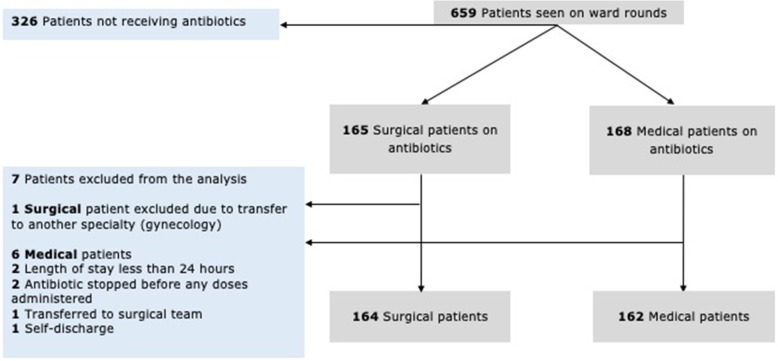
Background: Qualitative work has described the differences in prescribing practice across medical and surgical specialties. This study aimed to understand if specialty impacts quantitative measures of prescribing practice. Methods: We prospectively analysed the antibiotic prescribing across general medical and surgical teams for acutely admitted patients. Over a 12-month period (June 2016 – May 2017) 659 patients (362 medical, 297 surgical) were followed for the duration of their hospital stay. Antibiotic prescribing across these cohorts was assessed using Chi-squared or Wilcoxon rank-sum, depending on normality of data. The t-test was used to compare age and length of stay. A logistic regression model was used to predict escalation of antibiotic therapy. Results: Surgical patients were younger (p < 0.001) with lower Charlson Comorbidity Index scores (p < 0.001). Antibiotics were prescribed for 45% (162/362) medical and 55% (164/297) surgical patients. Microbiological results were available for 26% (42/164) medical and 29% (48/162) surgical patients, of which 55% (23/42) and 48% (23/48) were positive respectively. There was no difference in the spectrum of antibiotics prescribed between surgery and medicine (p = 0.507). In surgery antibiotics were 1) prescribed more frequently (p = 0.001); 2) for longer (p = 0.016); 3) more likely to be escalated (p = 0.004); 4) less likely to be compliant with local policy (p < 0.001) than medicine. Conclusions: Across both specialties, microbiology investigation results are not adequately used to diagnose infections and optimise their management. There is significant variation in antibiotic decision-making (including escalation patterns) between general surgical and medical teams. Antibiotic stewardship interventions targeting surgical specialties need to go beyond surgical prophylaxis. It is critical to focus on of review the patients initiated on therapeutic antibiotics in surgical specialties to ensure that escalation and continuation of therapy is justified.
Overview
The claims and statistics of this paper haven’t been checked yet.
Free: it reads the open-access text and checks the first 5 claims that cite a source we can check. Create a free account to check every claim.
Integrity signals
Registry
Cites
Statistics
Figures
Verification
Claims the paper makes
The claims and statistics of this paper haven’t been checked yet.
Free: it reads the open-access text and checks the first 5 claims that cite a source we can check. Create a free account to check every claim.
Claims other papers make about this one
Each is checked against this paper’s own text: does it say what the citing paper says it does?
The cited source says what the claim attributes to it.
In the citing paper
“This may lead to irrational and overuse of antibiotics in surgical specialties.8”
From Rationalizing irrational prescribing—infection-related attitudes and practices across paediatric surgery specialties in a hospital in South India (2024) · cites this paper as [8]
Self-check
Percentages, sums and reported differences re-computed from the paper’s own numbers.
The self-check needs the paper’s full text.
Citations
Cites
Validation of a combined comorbidity index
Charlson, M., Szatrowski, T. P., Peterson, J., & Gold, J. (1994) · Journal of Clinical Epidemiology · doi:10.1016/0895-4356(94)90129-5 · Cited by 6,587
Interventions to improve antibiotic prescribing practices for hospital inpatients
Davey, P., Brown, E., Charani, E., Fenelon, L., Gould, I. M., Holmes, A., Ramsay, C. R., Wiffen, P. J., & Wilcox, M. (2013) · Cochrane Database of Systematic Reviews · doi:10.1002/14651858.cd003543.pub3 · Cited by 1,864
Self-citationCosgrove, S. E. (2006) · Clinical Infectious Diseases · doi:10.1086/499406 · Cited by 1,271
Interventions to improve antibiotic prescribing practices for hospital inpatients
Davey, P., Marwick, C. A., Scott, C. L., Charani, E., McNeil, K., Brown, E., Gould, I. M., Ramsay, C. R., & Michie, S. (2017) · Cochrane Database of Systematic Reviews · doi:10.1002/14651858.cd003543.pub4 · Cited by 1,068
Self-citationAn introduction to power and sample size estimation
Jones, S. R., Carley, S., & Harrison, M. (2003) · Emergency Medicine Journal · doi:10.1136/emj.20.5.453 · Cited by 643
Vital signs: improving antibiotic use among hospitalized patients.
Fridkin, S. K., Baggs, J. M., Fagan, R. P., Magill, S. S., Pollack, L. A., Malpiedi, P. J., Slayton, R. B., Khader, K., Rubin, M. A., Jones, M., et al. (2014) · PubMed Central · Cited by 495
Hecker, M. T., Aron, D. C., Patel, N. P., Lehmann, M. K., & Donskey, C. J. (2003) · Archives of Internal Medicine · doi:10.1001/archinte.163.8.972 · Cited by 495
Cumulative Antibiotic Exposures Over Time and the Risk of Clostridium difficile Infection
Stevens, V., Dumyati, G., Fine, L. S., Fisher, S. G., & van Wijngaarden, E. (2011) · Clinical Infectious Diseases · doi:10.1093/cid/cir301 · Cited by 446
Clinical Characteristics and Treatment Patterns Among Patients With Ventilator-Associated Pneumonia
Kollef, M. H., Morrow, L. E., Niederman, M. S., Leeper, K. V., Anzueto, A., Benz-Scott, L., & Rodino, F. J. (2006) · Chest · doi:10.1378/chest.129.5.1210 · Cited by 322
C-reactive protein elevation and disease activity in patients with coronary artery disease
Arroyo-Espliguero, R. (2004) · European Heart Journal · doi:10.1016/j.ehj.2003.12.017 · Cited by 228
Research works printed but not linked: 1
- Department of Health. Start smart -then focus antimicrobial stewardship toolkit for English hospitals about Public Health England. 2014.
Cited by
Menz, B. D., Charani, E., Gordon, D. L., Leather, A. J., Moonesinghe, S. R., & Phillips, C. J. (2021) · Infection and Drug Resistance · doi:10.2147/idr.s319780 · Cited by 118
“used as a safety net to allay the surgeons fears of SSI and post-operative complications.(158) A systematic review of”
MethodSelf-citationTen golden rules for optimal antibiotic use in hospital settings: the WARNING call to action
Worldwide Antimicrobial Resistance National/International Network Group (WARNING) Collaborators, Sartelli, M., Barie, P. S., Coccolini, F., Abbas, M., Abbo, L. M., Abdukhalilova, G., Abraham, Y., Abubakar, S., Abu‐Zidan, F. M., et al. (2023) · World Journal of Emergency Surgery · doi:10.1186/s13017-023-00518-3 · Cited by 136
Self-citationKoch, C., Edinger, F., Fischer, T., Brenck, F., Hecker, A., Katzer, C., Markmann, M., Sander, M., & Schneck, E. (2020) · World Journal of Emergency Surgery · doi:10.1186/s13017-020-00343-y · Cited by 79
“Besides more frequent and longer prescription, antibiotics were more likely to be escalated in surgical patients [28].”
BackgroundSingh, S., Mendelson, M., Surendran, S., Bonaconsa, C., Mbamalu, O., Nampoothiri, V., Boutall, A., Hampton, M., Dhar, P., Pennel, T., et al. (2021) · Clinical Microbiology and Infection · doi:10.1016/j.cmi.2020.12.013 · Cited by 41
Self-citationUsing digital health technologies to optimise antimicrobial use globally
Rawson, T. M., Zhu, N., Galiwango, R. M., Cocker, D., Islam, M. S., Myall, A., Vasikasin, V., Wilson, R. C., Shafiq, N., Das, S., et al. (2024) · The Lancet Digital Health · doi:10.1016/s2589-7500(24)00198-5 · Cited by 43
Self-citationVeepanattu, P., Singh, S. K., Mendelson, M., Nampoothiri, V., Edathadatil, F., Surendran, S., Bonaconsa, C., Mbamalu, O. N., Ahuja, S., Birgand, G., et al. (2020) · International Journal of Infectious Diseases · doi:10.1016/j.ijid.2020.08.057 · Cited by 45
Self-citationAhuja, S., Peiffer‐Smadja, N., Peven, K., White, M. C., Leather, A. J. M., Singh, S. K., Mendelson, M., Holmes, A. H., Birgand, G., & Sevdalis, N. (2021) · Annals of Surgery · doi:10.1097/sla.0000000000004909 · Cited by 40
“AMR resulting from antimicrobial overuse threatens society’s long-term capacity to effectively deliver highquality perioperative care and healthcare overall.(8)”
BackgroundSelf-citationBirgand, G., Dhar, P., & Holmes, A. H. (2023) · British journal of surgery · doi:10.1093/bjs/znad302 · Cited by 42
Self-citationSchmiemann, G., Hoffmann, F., Hamprecht, A. G., & Jobski, K. (2022) · BMC Family Practice · doi:10.1186/s12875-022-01816-6 · Cited by 29
Understanding antibiotic prophylaxis prescribing in pediatric surgical specialties
Malone, S. M., Seigel, N. S., Newland, J. G., Saito, J. M., & McKay, V. R. (2020) · Infection Control & Hospital Epidemiology · doi:10.1017/ice.2020.71 · Cited by 26
Feasibility study of hospital antimicrobial stewardship analytics using electronic health records
Dutey‐Magni, P., Gill, M. J., McNulty, D., Sohal, G., Hayward, A. C., Shallcross, L. J., Anderson, N., Crayton, E., Forbes, G., Jhass, A., et al. (2021) · JAC-Antimicrobial Resistance · doi:10.1093/jacamr/dlab018 · Cited by 22
Why we prescribe antibiotics for too long in the hospital setting: a systematic scoping review
Janssen, R. M. E., Oerlemans, A. J. M., van der Hoeven, J. G., ten Oever, J., Schouten, J. A., & Hulscher, M. (2022) · Journal of Antimicrobial Chemotherapy · doi:10.1093/jac/dkac162 · Cited by 22
Choosing Wisely internationally – helpful recommendations for antimicrobial stewardship!
Jung, N., Tometten, L., & Draenert, R. (2023) · Infection · doi:10.1007/s15010-023-02005-y · Cited by 21
Antimicrobial Resistance: KAP of Healthcare Professionals at a Tertiary-Level Hospital in Nepal
Cheoun, M.-L., Heo, J., & Kim, W. (2021) · International Journal of Environmental Research and Public Health · doi:10.3390/ijerph181910062 · Cited by 20
Antibiotic prescribing practices in general surgery: a mixed methods quality improvement project
Lamb, G., Phillips, G., Charani, E., Holmes, A. H., & Satta, G. (2021) · Infection Prevention in Practice · doi:10.1016/j.infpip.2021.100166 · Cited by 18
“Similarly, Charani describes a “defensive antibiotic decision-making” pattern seen in surgical antibiotic prescribing, which is primarily driven by surgical outcome data and the short-term procedure success [10].”
BackgroundMethodSelf-citationWorkflow disruptions and surgical performance: past, present and future
Wiegmann, D. A., & Sundt, T. M. (2019) · BMJ Quality & Safety · doi:10.1136/bmjqs-2018-008670 · Cited by 13
Kalkan, İ. A., Çınar, G., Pehlivanlı, A., ÜRKMEZ, F., TOPALOĞLU, İ. E., AKYOL, B., Onay-Beşikçi, A., Azap, A., & Memikoğlu, K. O. (2020) · TURKISH JOURNAL OF MEDICAL SCIENCES · doi:10.3906/sag-2004-164 · Cited by 12
Jamaluddin, N. A. H., Periyasamy, P. R., Lau, C. L., Ponnampalavanar, S. S. L., Lai, P. S. M., Loong, L. S., Sidik, T. M. I. T. A. B., Ramli, R., Tan, T. L., Kori, N., et al. (2024) · Frontiers in Pharmacology · doi:10.3389/fphar.2024.1381843 · Cited by 11
Idensohn, P., Woodmansey, E. J., Bruwer, F., Cole, W., Günther, B. E., Hoxha, K., Lakshmanan, V., Probst, A., Ramos, P., Smith, G., et al. (2026) · Journal of Wound Care · doi:10.12968/jowc.2026.0302 · Cited by 13
Parker, H., Frost, J., Day, J., Bethune, R. M., Kajamaa, A. M., Hand, K. S. P., Robinson, S., & Mattick, K. L. (2022) · PLoS ONE · doi:10.1371/journal.pone.0271454 · Cited by 12
“A recent prospective cohort study [19], comparing antimicrobial prescribing between general surgery and general medicine, found that in surgery antimicrobials are prescribed more frequently and for longer durations; they are also more likely to be escalated (to broader-spectrum agents which are active against a wider…”
BackgroundBacterial infections in COVID-19 patients: a review
Grinbaum, R. S., & Kiffer, C. R. V. (2021) · Revista da Associação Médica Brasileira · doi:10.1590/1806-9282.20210812 · Cited by 10
Impact and Sustainability of Antibiotic Stewardship on Antibiotic Prescribing in Visceral Surgery
Gruber, M. M., Weber, A., Jung, J., Werner, J., & Draenert, R. (2021) · Antibiotics · doi:10.3390/antibiotics10121518 · Cited by 12
Wojcik, G., Ring, N., Willis, D. S., Williams, B., & Kydonaki, K. (2023) · Psychology and Health · doi:10.1080/08870446.2023.2182894 · Cited by 8
“Prior research has also identified inconsistencies in the provision of information between various specialities, leading to the lack of adequate information to make an appropriate decision on whether to stop, continue or alter the treatment (Charani et al., 2019).”
Nguyen, A. V., Kien, H., Hoàng, L. H., Cuong, N. H., Quang, H. X., Le, T. D., Ta, T. B., Viet, T. T., Thuc, L. C., Hung, D., et al. (2024) · Infection and Drug Resistance · doi:10.2147/idr.s472025 · Cited by 7
“42,43 We observed generally elevated resistance rates across various antimicrobial agents among patients in non-surgical wards compared to the surgical wards.”
BackgroundCharani, E., Dlamini, S. K., Koch, A. S., Singh, S. K., Hodes, R., Laxminarayan, R., Batheja, D., Ramugondo, E. L., Mukherjee, A. S., & Mendelson, M. (2024) · Wellcome Open Research · doi:10.12688/wellcomeopenres.20193.1 · Cited by 8
Self-citationAntibiotic stewardship in UK surgical departments: challenges and possible solutions
Callan, R., & Loud, E. (2021) · British Journal of Hospital Medicine · doi:10.12968/hmed.2020.0692 · Cited by 7
Peddireddy, M., Mahin, J., Uppu, A., & Padi, S. S. V. (2021) · Journal of Pharmaceutical Research International · doi:10.9734/jpri/2021/v33i41b32339 · Cited by 6
“This is acceptable as use of a single antibiotic per prescription minimizes polypharmacy, lessens diseases complications caused by drug-drug interactions, and has lower risk of adverse drug reactions which includes AMR as well [9,17].”
BackgroundInfluentialRaut, N., Chaudhary, A. A., Patil, H., Shidhaye, S., Khobragade, R., Umekar, M. J., Ali, M. A. M., & Trivedi, R. (2026) · Pathogens · doi:10.3390/pathogens15040414 · Cited by 8
Piscaglia, M., Sierra, D. M., Millán, A. H., Poo, M. T. G., Rodríguez‐Baño, J., & López, M. D. D. T. (2025) · Antimicrobial Resistance and Infection Control · doi:10.1186/s13756-025-01601-x · Cited by 7
“Furthermore, up to 60% of surgical patients receive postoperative antibiotics during hospitalization, and nearly 50% are discharged with antibiotics [11].”
Parker, H., Frost, J., Britten, N., Robinson, S., & Mattick, K. L. (2020) · Systematic Reviews · doi:10.1186/s13643-020-01477-5 · Cited by 7
Birgand, G., Biccard, B. M., Deslandes, A., Mbamalu, O. N., Bonaconsa, C., Boutall, A., Mendelson, M., Léone, M., Ndoli, J. M., Leather, A. J. M., et al. (2023) · British Journal of Anaesthesia · doi:10.1016/j.bja.2023.10.023 · Cited by 5
Self-citationPerioperative Antibiotikaprophylaxe – die neue S3-Leitlinie
Draenert, R., Weber, A., Jung, J., & Arenz, L. (2025) · Die Anaesthesiologie · doi:10.1007/s00101-025-01567-w · Cited by 5
Antibiotic prescribing behavior among physicians in Asia: a multinational survey
Wiboonchutikula, C., Kim, H. B., Honda, H., Loo, A. Y. X., Cheng, V. C., Camins, B. C., Jantarathaneewat, K., Apisarnthanarak, P., Rutjanawech, S., & Apisarnthanarak, A. (2023) · Antimicrobial Stewardship & Healthcare Epidemiology · doi:10.1017/ash.2023.190 · Cited by 6
Gruber, M. M., Weber, A., Jung, J., Strehlau, A., Tsilimparis, N., & Draenert, R. (2023) · Infection · doi:10.1007/s15010-023-02056-1 · Cited by 7
Pastena, M. D., Paiella, S., Lionetto, G., Casciani, F., Sereni, E., Pea, A., Malleo, G., & Salvia, R. (2025) · Annals of Surgery · doi:10.1097/sla.0000000000006870 · Cited by 4
Frei, N., Dräger, S., Weisser, M., & Osthoff, M. F. (2022) · International Journal of Infectious Diseases · doi:10.1016/j.ijid.2022.09.025 · Cited by 4
Surendran, S., Nampoothiri, V., Dhar, P., Holmes, A., Singh, S., & Charani, E. (2024) · JAC-Antimicrobial Resistance · doi:10.1093/jacamr/dlae105 · Cited by 3
Self-citationPanchawagh, S., Pol, A., Bhosale, U., Bhopale, V., & Bhosale, A. (2022) · International Journal of Basic & Clinical Pharmacology · doi:10.18203/2319-2003.ijbcp20223354 · Cited by 3
Strategies to improve antimicrobial stewardship in surgery: insights from an ethnographic study
Parker, H., Day, J., Frost, J., Bethune, R. B., Hollyman, M., Hand, K., Kajamaa, A. M., & Mattick, K. L. (2026) · BMJ Open · doi:10.1136/bmjopen-2025-112333 · Cited by 2
“16 It is recognised that AMS interventions tailored to the social and infrastructural context are more likely to lead to improvement, 17–19 and that historically most AMS interventions have not been theoretically informed 20 or used the most effective behaviour change techniques.”
Sørensen, T. M., Scahill, K., Weese, J. S., Allerton, F., Jessen, L. R., & from the European Network for Optimization of Antimicrobial Therapy (ENOVAT) guidelines and the ESCMID Study Group for Veterinary Microbiology (ESGVM) (2026) · Journal of Small Animal Practice · doi:10.1111/jsap.70055 · Cited by 2
“In human hospitals, surgeons have been found to prescribe antimicrobials more frequently and for longer courses than their medical colleagues (Charani, de Barra, et al., 2019).”
Somakumar, S., Raj, S., Rodrigues, G. S., & Rajesh, V. (2024) · Indian Journal of Pharmaceutical Education and Research · doi:10.5530/ijper.58.2s.36 · Cited by 2
Dahuii, F. A., Tabatabaei, S. M., & Metanat, M. (2022) · International Journal of Infection · doi:10.5812/iji.119575 · Cited by 2
Hearsey, D., Bamford, K. B., Hutton, M., Wade, L., Coates, H., Ramsay, E., Alberts, B., & Powell, N. (2022) · Antibiotics · doi:10.3390/antibiotics11111575 · Cited by 1
Deslandes, A., Christou, N., Baillet, P., Hajjar, J., Marre, P., Johanet, H., Léone, M., & Birgand, G. (2025) · Antimicrobial Resistance and Infection Control · doi:10.1186/s13756-025-01576-9 · Cited by 1
“Surgeons described themselves as focused on immediate tasks, sometimes favoring short-term outcomes, whereas anesthetists tended to anticipate long-term outcomes [4, 35, 36].”
Garrod lecture: achieving the UNGA AMR mortality reduction goals
Laxminarayan, R. (2026) · Journal of Antimicrobial Chemotherapy · doi:10.1093/jac/dkag082 · Cited by 1
Liang, L., Wang, T. T., Lee, C., Burris, B. J., Choi, D. D., & Peacock, Z. S. (2026) · Journal of Oral and Maxillofacial Surgery · doi:10.1016/j.joms.2026.06.026 · Cited by 1
People with Diabetes Group, Bawab, N., People with Diabetes Group, on behalf of co-investigators of ASPIRES, coinvestigators, A. S., Consortia, O. B. O. A. S. R.-D., Moullin, J. C., Bugnon, O., Perraudin, C., Morrow, A., et al. (2020) · Implementation Science · doi:10.1186/s13012-020-01062-3 · Cited by 1
Gulia, A., Khandelia, H., Dhikav, V., & Anand, S. (2024) · Pediatric Surgery International · doi:10.1007/s00383-024-05883-x · Cited by 1
“It has been demonstrated that up to 60% of surgical patients receive postoperative antibiotics while in hospital, and up to 50% are discharged on anti-biotics [6].”
Dutey‐Magni, P., Gill, M. J., McNulty, D., Sohal, G., Hayward, A. C., & Shallcross, L. J. (2020) · Research Square · doi:10.21203/rs.3.rs-33072/v1 · Cited by 1
“This study is novel in attempting to measure clinical constructs that normally require manual audits or point prevalence surveys [19, 40].”
BackgroundPROPHYLAXIS AND POST SURGICAL ANTIBIOTIC UTILIZATION PATTERN IN TERTIARY CARE TEACHING HOSPITAL
Kumari, S., Bagati, K. D., Bala Krishnan, S., & Dutta, S. (2021) · Indian Journal Of Applied Research · doi:10.36106/ijar/3401468
Evaluation of antibiotic escalation in response to nurse-driven inpatient sepsis screen
Furukawa, D., Dieringer, T. D., Wong, M. D., Tong, J. T., Cader, I. A., Wisk, L. E., Han, M. A., Gupta, S., Kerbel, R. B., Uslan, D. Z., et al. (2021) · Antimicrobial Stewardship & Healthcare Epidemiology · doi:10.1017/ash.2021.232
Singh, S. K., Mendelson, M., Surendran, S., Bonaconsa, C., Mbamalu, O. N., Nampoothiri, V., Boutall, A., Hampton, M. I., Dhar, P., Pennel, T. C., et al. (2020) · Research Square · doi:10.21203/rs.3.rs-76635/v1
“Consultant Surgeon (15), Hospital B, CVTS”
Self-citationAdesanya, O. A., Bowler, N., Tafuri, S. M., Cruz-Bendezú, A., & Whalen, M. J. (2024) · Urologic Clinics of North America · doi:10.1016/j.ucl.2024.06.005
Aashari, M. A., Aghazadeh, P., Esfehani, K. J., Hessam, R., Rezai, M., Dezfooli, S. T., & Javan, A. (2024) · Avicenna Journal of Clinical Microbiology and Infection · doi:10.34172/ajcmi.3552
Emerging Trends in Real-World Pharmacoepidemiology: 2023
Salahudeen, M., Kao, L.-T., Pizzol, T. D. S. D., & Peterson, G. (2025) · Frontiers research topics · doi:10.3389/978-2-8325-6265-9
The Role of Minimally Invasive Surgery in Addressing Antimicrobial Resistance
Falola, A. F. (2025) · SN Comprehensive Clinical Medicine · doi:10.1007/s42399-025-01884-6
“Compared to medical patients, surgical patients are more likely to be administered anti-biotics, with as many as 60% being given antibiotics after surgery, and as many as 50% of them being discharged on antibiotics [7–9].”
Malli, I. A., & AlTamimi, J. O. (2025) · Clinical Epidemiology and Global Health · doi:10.1016/j.cegh.2025.102117
Surgeons’ Contributions to Antibiotic Stewardship and Resistance Prevention
Birgand, G., Jacquet, N., Johanet, H., Christou, N., Castel, P., Baillet, P., & Pulcini, C. (2025) · JAMA Network Open · doi:10.1001/jamanetworkopen.2025.21165
Ntabaza, V. N., Pardo, A., Nachtergael, A., Bamps, J., Bakari, S. A., Duez, P., Patris, S., & Kahumba, B. (2025) · Current Therapeutic Research · doi:10.1016/j.curtheres.2025.100807
“10 , 63 , 64 The duration of the recommended antimicrobial prophylaxis being generally 24 hours for most surgeries and 48 hours for cardiac surgeries.”
Schmiemann, G., Hoffmann, F., Hamprecht, A., & Jobski, K. (2022) · Figshare · doi:10.6084/m9.figshare.20472399
Parker, H., Frost, J., Britten, N., Robinson, S., & Mattick, K. (2020) · Figshare · doi:10.6084/m9.figshare.13077531
Ismail, F. I., LASKER, T. M. A., NAZEEM, A. S., Anwaru, S., & LUYOONA, F. (2025) · The Maldives National Journal of Research · doi:10.62338/dxadwz60
Jin, J. Z., Men, V., Wang, M., & Hill, A. G. (2026) · World Journal of Surgery · doi:10.1002/wjs.70255
Maharjan, R., Dewasy, B. L., Singh, R. K., Tuladhar, R., Singh, P. R., Pokharel, H. P., & Singh, A. (2025) · Tribhuvan University Journal of Microbiology · doi:10.3126/tujm.v12i1.88436
On Patient Safety: What We Can Do to Mitigate Antibiotic Resistance
Rickert, J. B. (2026) · Clinical Orthopaedics and Related Research · doi:10.1097/corr.0000000000003892
Xie, P., Jiao, S., Liu, J., Xie, J., Wang, Y., Zhang, Y., Lu, L., Guo, Y., & Bai, P. (2026) · Naunyn-Schmiedeberg s Archives of Pharmacology · doi:10.1007/s00210-026-05512-5
“In its severe form, AP is associated with a mortality rate of up to 30% (Chan and Shelat 2024; Charani et al. 2019a).”
InfluentialHoriuchi, H., Tagashira, Y., Takizawa, A., Takahashi, K., & Gu, Y. (2026) · JAC-Antimicrobial Resistance · doi:10.1093/jacamr/dlag133
Kaur, B., Elizabeth, S., Varghese, J., Tom, C., Sharath Chandra, B. J., Mahale, R., Sinha, V., Ramesh, M., Chalasani, S. H., & Sayed, J. (2025) · Bulletin of Pharmaceutical Research · doi:10.21276/bpr.2025.15.3.1
Hussan, J., Nargis, J., & Khan, H. (2026) · Journal of Pak International Medical College · doi:10.64911/zdkzj049
Tariq, K., Rehman, I., & Nadeem, U. (2026) · Journal of Surgery and Advanced Medical Research · doi:10.68041/jsamr.v1i3/03
“Intravenous antibiotic prescriptions predominated as expected in the group of hospitalized surgical patients who would need high blood concentrations of antibiotics in the peri-operative period 23 .”
Metadata
- Authors
- Charani, E., de Barra, E., Rawson, T. M., Gill, D., Gilchrist, M., Naylor, N. R., & Holmes, A. H.
- Affiliations
- National Institute for Health and Care Research (GB)
- Imperial College London (GB)
- Imperial College Healthcare NHS Trust (GB)
- Corresponding author
- Charani, E.
- Venue
- Antimicrobial Resistance & Infection Control
- Published
- 2019-09-13
- Volume
- 8
- Issue
- 1
- Pages
- 151-151
- ISSN
- 2047-2994 (ISSN-L)
- PMC
- PMC6743118
- OpenAlex
- W2972688644
- Semantic Scholar
- 524b387e9c7d1e0fac4f83ed8eadee8043a724ed
- Cited by
- 62
- References
- 35
- Citations by year
- 2026: 10 · 2025: 8 · 2024: 8 · 2023: 7 · 2022: 8 · 2021: 11 · 2020: 9 · 2019: 1
- FWCI
- 4.71
- Type
- journal article
- Language
- en
- Open access
- gold
- doi.org
- Licence
- cc-by
- creativecommons.org/licenses/by/4.0/ (tdm)
- creativecommons.org/licenses/by/4.0/ (vor)
- Locations
- Antimicrobial Resistance and Infection Control (publishedVersion, cc-by)
- PubMed Central (publishedVersion, cc-by)
- PubMed (publishedVersion)
- St George's Online Research Archive (St George's University of London) (acceptedVersion)
- DOAJ (DOAJ: Directory of Open Access Journals) (submittedVersion, cc-by-sa)
- Figshare (submittedVersion, cc-by)
- Spiral (Imperial College London) (submittedVersion, other-oa)
- Funders
- Programme Development Grants (HPRU-2012-10047)
- Economic and Social Research Council (ES/P008313/1)
- Topics
- Health Sciences › Medicine › Infectious Diseases › Antibiotic Use and Resistance
- Health Sciences › Medicine › Surgery › Surgical site infection prevention
- Health Sciences › Health Professions › General Health Professions › Healthcare cost, quality, practices
- Keywords
- antibiotic prescribing, general surgery, internal medicine, antibiotic escalation, acute hospitalization, microbiological analysis, antibiotic stewardship, perioperative antibiotic prophylaxis, prescribing variation, length of hospital stay, comorbidities
- MeSH terms
- Clinical Decision-Making, Antimicrobial Stewardship, Anti-Bacterial Agents, Humans, Practice Patterns, Physicians', Drug Prescriptions, Prospective Studies, Specialties, Surgical, Logistic Models
About these checks
Registry, retraction, Cites and statistics results are computed, not judged, with one exception: a printed reference that no index lists is read once by a model before it counts as a citation error. Claims are extracted by a model and kept only when their quote appears verbatim in the text; each cited source is then checked, with a model’s help, for whether it says what the claim relies on. Those verdicts can be wrong — read the claim’s quote and the cited source before relying on one.
Statistics and arithmetic are recomputed, not judged.
Confidence bands are shown only for fields calibrated on our annotated test set. None is calibrated yet, so no band is shown.
What counts as a claim ›How we measure confidence ›How we check this ›
Are you an author, or do you see a problem with this page? Request a review
Data sources
Bibliographic data: Semantic Scholar, OpenAlex, Crossref.
Contains information from the Semantic Scholar Academic Graph Datasets, made available under the ODC Attribution License (ODC-BY 1.0).
Semantic Scholar’s data is described in: Kinney, R., et al. (2023). The Semantic Scholar Open Data Platform. arXiv:2301.10140.
