

The DOI matches its Crossref record; 159 of the 159 references it cites were found in a registry or an index.
Implementation and impact of pediatric antimicrobial stewardship programs: a systematic scoping review
Open accessAbstract
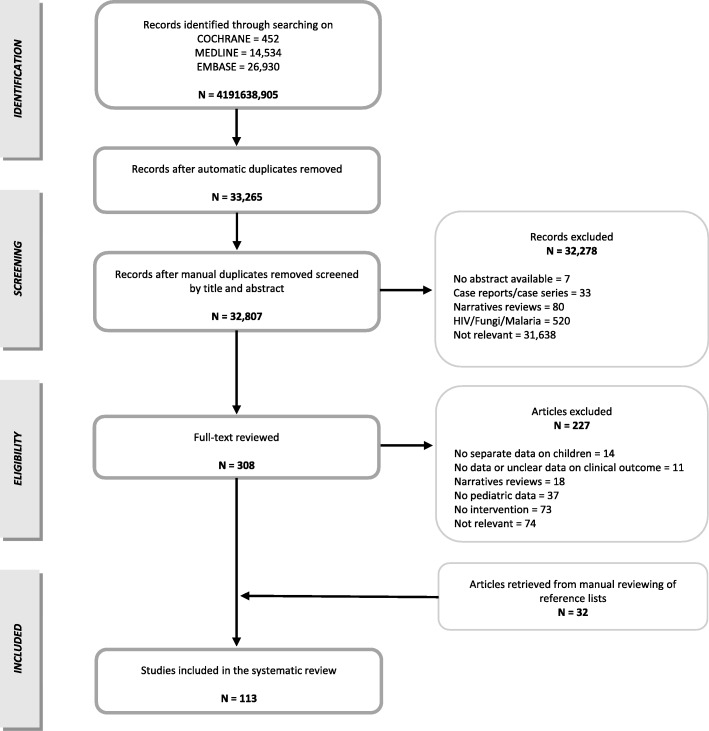
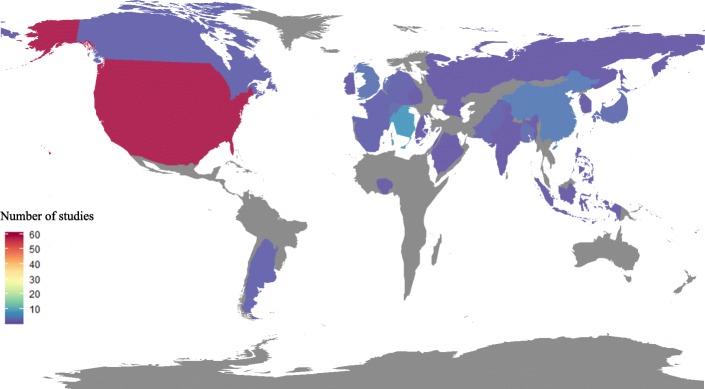
Abstract Background Antibiotics are the most common medicines prescribed to children in hospitals and the community, with a high proportion of potentially inappropriate use. Antibiotic misuse increases the risk of toxicity, raises healthcare costs, and selection of resistance. The primary aim of this systematic review is to summarize the current state of evidence of the implementation and outcomes of pediatric antimicrobial stewardship programs (ASPs) globally. Methods MEDLINE, Embase and Cochrane Library databases were systematically searched to identify studies reporting on ASP in children aged 0–18 years and conducted in outpatient or in-hospital settings. Three investigators independently reviewed identified articles for inclusion and extracted relevant data. Results Of the 41,916 studies screened, 113 were eligible for inclusion in this study. Most of the studies originated in the USA (52.2%), while a minority were conducted in Europe (24.7%) or Asia (17.7%). Seventy-four (65.5%) studies used a before-and-after design, and sixteen (14.1%) were randomized trials. The majority (81.4%) described in-hospital ASPs with half of interventions in mixed pediatric wards and ten (8.8%) in emergency departments. Only sixteen (14.1%) studies focused on the costs of ASPs. Almost all the studies (79.6%) showed a significant reduction in inappropriate prescriptions. Compliance after ASP implementation increased. Sixteen of the included studies quantified cost savings related to the intervention with most of the decreases due to lower rates of drug administration. Seven studies showed an increased susceptibility of the bacteria analysed with a decrease in extended spectrum beta-lactamase producers E. coli and K. pneumoniae; a reduction in the rate of P. aeruginosa carbapenem resistance subsequent to an observed reduction in the rate of antimicrobial days of therapy; and, in two studies set in outpatient setting, an increase in erythromycin-sensitive S. pyogenes following a reduction in the use of macrolides. Conclusions Pediatric ASPs have a significant impact on the reduction of targeted and empiric antibiotic use, healthcare costs, and antimicrobial resistance in both inpatient and outpatient settings. Pediatric ASPs are now widely implemented in the USA, but considerable further adaptation is required to facilitate their uptake in Europe, Asia, Latin America and Africa.
Overview
The claims and statistics of this paper haven’t been checked yet.
Run the check — free, no account needed. It reads the open-access text and checks the sources it cites.
Integrity signals
Registry
Cites
Statistics
Figures
Verification
Claims the paper makes
The claims and statistics of this paper haven’t been checked yet.
Run the check — free, no account needed. It reads the open-access text and checks the sources it cites.
Claims other papers make about this one
Each is checked against this paper’s own text: does it say what the citing paper says it does?
The cited source says what the claim attributes to it.
In the citing paper
“A systematic review, on implementation of AMS in paediatrics, identified more than half the included studies were from the USA, with 18% (20/113) studies from Asia.16”
From Rationalizing irrational prescribing—infection-related attitudes and practices across paediatric surgery specialties in a hospital in South India (2024) · cites this paper as [16]
Self-check
Percentages, sums and reported differences re-computed from the paper’s own numbers.
The self-check needs the paper’s full text.
Citations
Cites
Liberati, A., Altman, D. G., Tetzlaff, J., Mulrow, C., Gøtzsche, P. C., Ioannidis, J. P. A., Clarke, M., Devereaux, P. J., Kleijnen, J., & Moher, D. (2009) · PLoS Medicine · doi:10.1371/journal.pmed.1000100 · Cited by 28,164
Liberati, A., Altman, D. G., Tetzlaff, J., Mulrow, C., Gotzsche, P. C., Ioannidis, J. P. A., Clarke, M., Devereaux, P. J., Kleijnen, J., & Moher, D. (2009) · BMJ · doi:10.1136/bmj.b2700 · Cited by 17,648
Guidance for conducting systematic scoping reviews
Peters, M. D. J., Godfrey, C. M., Khalil, H., McInerney, P., Parker, D., & Soares, C. B. (2015) · International Journal of Evidence-Based Healthcare · doi:10.1097/xeb.0000000000000050 · Cited by 7,472
Bad Bugs, No Drugs: No ESKAPE! An Update from the Infectious Diseases Society of America
Boucher, H. W., Talbot, G. H., Bradley, J. S., Edwards, J. E., Gilbert, D. N., Rice, L. B., Scheld, M., Spellberg, B. J., & Bartlett, J. (2008) · Clinical Infectious Diseases · doi:10.1086/595011 · Cited by 5,092
Dellit, T. H., Owens, R. C., McGowan, J. E., Gerding, D. N., Weinstein, R. A., Burke, J. P., Huskins, W. C., Paterson, D. L., Fishman, N. O., Carpenter, C. F., et al. (2006) · Clinical Infectious Diseases · doi:10.1086/510393 · Cited by 3,414
Interventions to improve antibiotic prescribing practices for hospital inpatients
Davey, P. G., Brown, E. M., Charani, E., Fenelon, L. E., Gould, I. M., Holmes, A. H., Ramsay, C. R., Wiffen, P. J., & Wilcox, M. A. (2013) · Cochrane Database of Systematic Reviews · doi:10.1002/14651858.cd003543.pub3 · Cited by 1,893
Spellberg, B. J., Guidos, R., Gilbert, D. N., Bradley, J. S., Boucher, H. W., Scheld, W. M., Bartlett, J. G., Edwards, J. E., & the Infectious Diseases Society of America (2007) · Clinical Infectious Diseases · doi:10.1086/524891 · Cited by 1,689
Cosgrove, S. E. (2006) · Clinical Infectious Diseases · doi:10.1086/499406 · Cited by 1,271
The World Health Organization Global Action Plan for antimicrobial resistance
Mendelson, M., & Matsoso, M. P. (2015) · South African Medical Journal · doi:10.7196/samj.9644 · Cited by 1,190
Interventions to improve antibiotic prescribing practices for hospital inpatients
Davey, P., Marwick, C. A., Scott, C. L., Charani, E., McNeil, K., Brown, E., Gould, I. M., Ramsay, C. R., & Michie, S. (2017) · Cochrane Database of Systematic Reviews · doi:10.1002/14651858.cd003543.pub4 · Cited by 1,068
Research works printed but not linked: 3
- M.M. Tolín Hernani, V. Cruzado Nuevo, E. Sanavia Morán, A. Rodríguez Sánchez-de la Blanca, J. Saavedra Lozano, R. Rodríguez Fernández,et al., [Evolution of the antibiotics prescription in a pediatric emergency service]. Acta Pediatr Esp. 2010; 68(11): 541–546 doi:
- Berild D, Abrahamsen TG, Andresen S, Bjørløw E, Haug O, Kossenko IM, et al. A controlled intervention study to improve antibiotic use in a Russian paediatric hospital. Int J Antimicrob Agents. 2008;31(5):478–83. https://doi.org/10.1016/j.ijantimicag.2008.01.009. · DOI
- Stille C, Rifas-Shiman J, Kleinman K, Kotch JB, Finkelstein JA. Trial Promoting Judicious Antibiotic Use. Ann Fam Med. 2008;6(3):206–12. https://doi.org/10.1370/afm.839.Meyers. · DOI
Cited by
Sorted by citations
Antimicrobial Stewardship: Fighting Antimicrobial Resistance and Protecting Global Public Health
Majumder, M. A. A., Rahman, S., Cohall, D., Bharatha, A., Singh, K., Haque, M., & Hilaire, M. G.-S. (2020) · Infection and Drug Resistance · doi:10.2147/idr.s290835 · Cited by 694
Endale, H., Mathewos, M., & Abdeta, D. (2023) · Infection and Drug Resistance · doi:10.2147/idr.s428837 · Cited by 348
Extensively and multidrug-resistant bacterial strains: case studies of antibiotics resistance
Almutairy, B. S. (2024) · Frontiers in Microbiology · doi:10.3389/fmicb.2024.1381511 · Cited by 86
COVID-19 and Antimicrobial Resistance: A Review
Adebisi, Y. A., Alaran, A. J., Okereke, M., Oke, G. I., Oladunni, A. A., Olaoye, O. C., Oladunjoye, I. O., Azeez, Y. O., Ukor, N. A., & Lucero‐Prisno, D. E. (2021) · Infectious Diseases Research and Treatment · doi:10.1177/11786337211033870 · Cited by 77
Brave New World of Artificial Intelligence: Its Use in Antimicrobial Stewardship—A Systematic Review
Pinto-de-Sá, R., Sousa‐Pinto, B., & Costa‐de‐Oliveira, S. (2024) · Antibiotics · doi:10.3390/antibiotics13040307 · Cited by 75
Metadata
- Authors
- Donà, D., Barbieri, E., Daverio, M., Lundin, R., Giaquinto, C., Zaoutis, T., & Sharland, M.
- Affiliations
- University of Padua (IT)
- PENTA Foundation (IT)
- Children's Hospital of Philadelphia (US)
- St George's, University of London (GB)
- Corresponding author
- Barbieri, E.
- Venue
- Antimicrobial Resistance & Infection Control
- Published
- 2020-01-03
- Volume
- 9
- Issue
- 1
- Pages
- 3-3
- ISSN
- 2047-2994 (ISSN-L)
- PMC
- PMC6942341
- OpenAlex
- W2998803677
- Cited by
- 199
- References
- 159
- Citations by year
- 2026: 29 · 2025: 39 · 2024: 32 · 2023: 31 · 2022: 21 · 2021: 32 · 2020: 15
- FWCI
- 3.60
- Type
- journal article
- Language
- en
- Update notices
- correction (2020-05-07)
- Open access
- gold
- doi.org
- Locations
- Antimicrobial Resistance and Infection Control (publishedVersion, cc-by)
- PubMed Central (publishedVersion, cc-by)
- PubMed (publishedVersion)
- St George's Online Research Archive (St George's University of London) (acceptedVersion)
- DOAJ (DOAJ: Directory of Open Access Journals) (submittedVersion)
- Padua Research Archive (University of Padova) (submittedVersion)
- Padua Research Archive (University of Padova) (submittedVersion, cc-by)
- Topics
- Health Sciences › Medicine › Infectious Diseases › Antibiotic Use and Resistance
- Health Sciences › Medicine › Surgery › Surgical site infection prevention
- Health Sciences › Medicine › Microbiology (medical) › Antibiotic Resistance in Bacteria
- Keywords
- antibiotic misuse, inappropriate antibiotic prescribing, antimicrobial resistance, health care costs, empirical antibiotic therapy, extended-spectrum beta-lactamase, carbapenem resistance, macrolide resistance, implementation outcomes
- MeSH terms
- Antimicrobial Stewardship, Anti-Bacterial Agents, Asia, Bacteria, Bacterial Infections, Child, Europe, Humans, Pediatrics, United States, Global Health, Drug Resistance, Bacterial, Inappropriate Prescribing, Prescription Drug Misuse
About these checks
Registry, retraction, Cites and statistics results are computed, not judged, with one exception: a printed reference that no index lists is read once by a model before it counts as a citation error. Claims are extracted by a model and kept only when their quote appears verbatim in the text; each cited source is then checked, with a model’s help, for whether it says what the claim relies on. Those verdicts can be wrong — read the claim’s quote and the cited source before relying on one.
Statistics and arithmetic are recomputed, not judged.
Confidence bands are shown only for fields calibrated on our annotated test set. None is calibrated yet, so no band is shown.
What counts as a claim ›How we measure confidence ›How we check this ›
Are you an author, or do you see a problem with this page? Request a review
