

Indoor air quality, hygiene practices and the antimicrobial resistance profiles of airborne bacteria in selected areas of a tertiary health facility in Ibadan, Nigeria
Open accessThe DOI matches its Crossref record; 26 of the 26 references it cites were found in a registry or an index; 4 of the 14 sources its claims cite were checked for support.
Abstract
Hospital indoor air is contaminated with multidrug-resistant bacteria, and this contributes to their spread. However, there is limited information linking environmental and atmospheric factors to the levels of these resistant bacteria in indoor hospital air. Hence, this study assessed the levels of multi-drug resistant bacteria in the indoor air of a tertiary hospital and the contributing environmental and atmospheric factors. This cross-sectional study observed hygiene practices, sanitary conditions, occupancy ratio, activity rates, temperature and humidity levels in selected indoor areas of University College Hospital, Ibadan. Airborne bacteria were sampled with their loads via a volumetric sampler, and they were tested for susceptibility against 13 antibiotics via the disk diffusion method. Data was collected twice daily, thrice weekly for two weeks, and analyzed using SPSS version 26. The hygiene practices observed varied across the sampled areas with the office area (10.00 ± 0.00) and psychiatry (9.17 ± 0.41) wards showing best practices, and the laundry area (6.00 ± 0.00) with the worst, sanitary conditions also followed a similar pattern. The study identified 93 bacterial isolates from the MacConkey agar, Staphylococcus aureus (33.3%), Bacillus species (31.18%), Klebsiella pneumoniae (15.05%), Escherichia coli (10.75%), and Coagulase-negative Staphylococcus (9.68%). The mean bacterial load (CFU/m 3 ) varied significantly across sampled areas ( p < 0.01): Laundry (2962.96 ± 547.59) > Children Emergency Ward (2537.03 ± 551.67) > Neurosurgery (2310.19 ± 560.31) > Psychiatry (1828.70 ± 431.93) > Office (421.30 ± 311.09), with the exception of office area, the loads were above the WHO acceptable limit of 1000 CFU/m 3 . Bacterial load correlated negatively with hygiene practices and sanitary conditions, but positively with occupancy ratio, activity levels, humidity and temperature, all p < 0.01. The identified bacteria exhibited a high multidrug resistance, this includes the identification of Methicillin Resistant Staphylococcus aureus and extended spectrum beta lactamases producing Escherichia coli and Klebsiella pneumoniae . Healthcare environments, particularly indoor air remains highly contaminated with multidrug-resistant bacteria, with environmental factors like hygiene, sanitation, occupancy, activity, and atmospheric factors like temperature and humidity contributing to their spread. Therefore, improved environmental practices, routine indoor air surveillance and antimicrobial stewardship is advocated.
Overview
CoChat Summary
## TL;DR
This cross-sectional study in five areas of University College Hospital, Ibadan found that indoor air bacterial loads were highest where hygiene, sanitation, occupancy, activity, temperature, and humidity were less favorable, and most sampled areas exceeded the WHO limit of 1000 CFU/m3. The airborne isolates included common nosocomial pathogens and showed high multidrug resistance, including MRSA and ESBL-producing *E. coli* and *K. pneumoniae*.
## Key findings
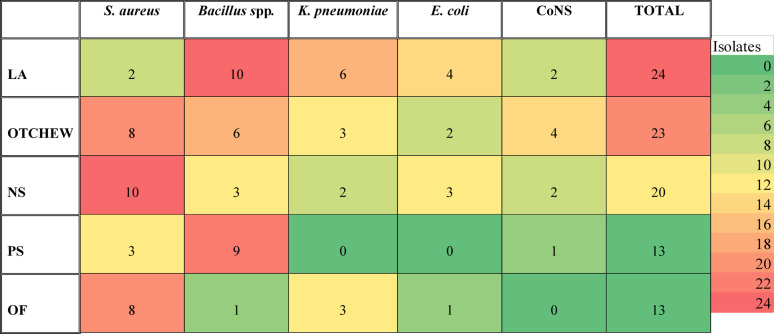
- A total of 93 bacterial isolates were recovered: *Staphylococcus aureus* 33.33% (31), *Bacillus* spp. 31.18% (29), *Klebsiella pneumoniae* 15.05% (14), *Escherichia coli* 10.75% (10), and coagulase-negative staphylococci 9.68% (9).
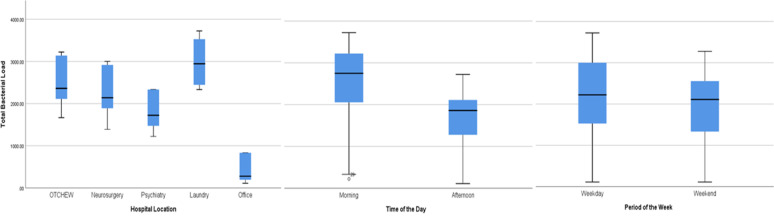
- Mean bacterial load differed significantly across areas (F = 47.85, p < 0.01): Laundry 2962.96 ± 547.59 CFU/m3, Children Emergency Ward 2537.03 ± 551.67, Neurosurgery 2310.19 ± 560.31, Psychiatry 1828.70 ± 431.93, and Office 421.30 ± 311.09; all except the office were above the WHO acceptable limit of 1000 CFU/m3.
- Bacterial load was negatively correlated with sanitary score (r = −0.50, p = 0.01) and hygiene score (r = −0.47, p = 0.01), and positively correlated with occupancy score (r = 0.64, p < 0.01), activity levels (r = 0.61, p < 0.01), temperature (r = 0.56, p < 0.01), and relative humidity (r = 0.72, p < 0.01).
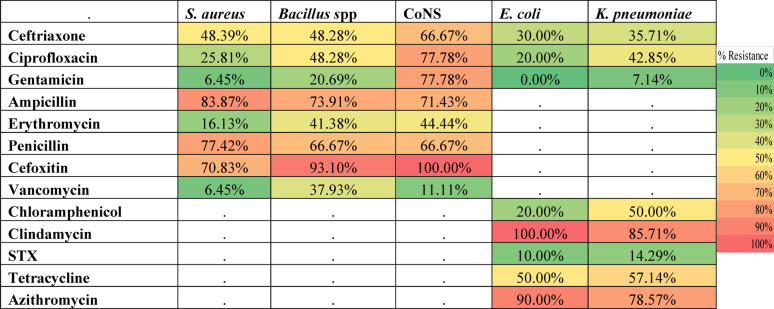
- Resistance was high: *S. aureus* showed resistance to ampicillin (83.87%), cefoxitin (70.83%), and penicillin (77.42%); *K. pneumoniae* showed 85.71% resistance to clindamycin and *E. coli* 100% resistance to clindamycin; gentamicin remained effective for most isolates, with over 85% susceptibility among gram-positive isolates and 92.86% (*K. pneumoniae*) / 100% (*E. coli*) susceptibility among gram-negatives.
## Methods
- Design and setting: Descriptive cross-sectional study with field and laboratory components across 5 locations in University College Hospital, Ibadan: Children emergency ward, Neurosurgery, Psychiatry, Laundry, and Office.
- Data/sample collection: Hygiene practices, sanitary conditions, occupancy ratio, activity level, temperature, and humidity were observed/measured twice daily, thrice weekly for 2 weeks; 60 agar plates were sampled from 15 Feb to 1 Mar 2025 using a single-stage volumetric air sampler.
- Analysis: Isolates were identified by colony morphology, Gram staining, and biochemical tests, then tested against 13 antibiotics using disk diffusion; data were analyzed in SPSS v26 with mean/SD, Pearson correlation, and ANOVA.
## Limitations
- The paper states that fungi were not included, and only bacteria were isolated and studied.
- It states that identification relied on morphological and biochemical methods rather than DNA-based molecular methods.
- It states that the hospital areas were purposively selected and sampling covered only two weeks, limiting geographic and temporal scope.
Model-written summary. Check it against the paper before relying on it.
Integrity signals
Registry
Cites
Statistics
Figures
Verification
Claims the paper makes
4 Valid · 0 Not valid · 6 Not checked · 63 Own results and interpretations
The cited sources support only part of this claim — read each source’s verdict below.
In the paper
“Airborne multidrug-resistant organisms (MDROs), such as Methicillin-resistant Staphylococcus aureus (MRSA) and multidrug-resistant Pseudomonas aeruginosa, are frequently detected in hospital air, particularly in ICUs and surgical wards.”
§ Indoor air quality, hygiene practices and the antimicrobial resistance profiles of airborne bacteria in selected areas of a tertiary health facility in Ibadan, Nigeria > Introduction
What the sources say
- Not checked — no full text of the sourcecites [8] Gao M, Lu T, Qian H, Zhang Q, Wang M. Atmospheric antimicrobial resistome driven by air pollutants. Sci Total Environ. 2023;902:165942. 10.1016/j.scitotenv.2023.165942. 37543315 source
- Partly supportedcites [23] Solomon FB, Wadilo FW, Arota AA, Abraham YL. Antimicrobial resistant airborne bacteria and their multidrug resistance pattern at a university teaching referral hospital in South Ethiopia. Ann Clin Microbiol Antimicrob. 2017;16(1):29. 10.1186/s12941-017-0204-2. 28403894 PMC5389437 sourceExperimental — accuracy not yet measured
The Results (page unavailable) report airborne bacteria in the hospital’s ICU and operating theatre, including S. aureus and P. aeruginosa; the MDR-pattern table identifies multidrug-resistant P. aeruginosa. The Discussion reports 39% MRSA prevalence and says most resistant isolates were found in the ICU. The paper does not establish that these organisms are particularly frequent in surgical wards relative to other hospital areas, or that the findings generalize beyond this hospital. (LLM, conf=0.84)
plainstates an association- Asserted: passes — The authors put it forward as true.
- Checkable: passes — It can be checked against evidence.
- Load-bearing: passes — The paper’s conclusions depend on it.
- Based: passes — The paper gives a reason why it holds.
The cited sources support only part of this claim — read each source’s verdict below.
In the paper
“Poor hygiene practices and sanitary conditions contribute to the persistence of pathogenic microorganisms in hospital indoor air [15].”
§ Indoor air quality, hygiene practices and the antimicrobial resistance profiles of airborne bacteria in selected areas of a tertiary health facility in Ibadan, Nigeria > Introduction
What the sources say
- Partly supportedcites [15] Kotgire S, Akhtar R, Damle A, Siddiqui S, Padekar H. Bioaerosol assessment of indoor air in hospital wards from a tertiary care hospital. Indian J Microbiol Res. 2020;7(1):28–34. 10.18231/j.ijmr.2020.007. sourceExperimental — accuracy not yet measured
The paper's Conclusion and Recommendations (point 4) does attribute ward microbial load to sanitary failures — 'the microbial load in the hospital wards may be due to the presence of attached unhygienic toilets and poor waste management system' — and point 8 adds poor housekeeping (dry sweeping/mopping, shaking linen) as a means of aerolising dust-borne micro-organisms, so the hygiene/sanitation-to-airborne-load link is present. However, the source states this as a possibility ('may be due to', 'may increase the possibility of entrance of pollutants from unhygienic external environment', point 3), whereas the citing sentence asserts it as an established contributor; the source also speaks of microbial load and sources of infection rather than of 'persistence' of pathogens in air. The pathogen identification (Staphylococcus aureus, Candida spp, Section 3.2) is reported separately from the hygiene attribution. (LLM, conf=0.72)
plainstates a cause- Asserted: passes — The authors put it forward as true.
- Checkable: passes — It can be checked against evidence.
- Load-bearing: passes — The paper’s conclusions depend on it.
- Based: passes — The paper gives a reason why it holds.
- Partly supported
The cited sources support only part of this claim — read each source’s verdict below.
In the paper
“These studies also relied predominantly on conventional settle plate methods for microbial sampling, with inherent limitations of providing only semi-quantitative data influenced by air current [1, 2].”
§ Indoor air quality, hygiene practices and the antimicrobial resistance profiles of airborne bacteria in selected areas of a tertiary health facility in Ibadan, Nigeria > Introduction
What the sources say
- Not matchedcites [1] Agwaranze DI, Ogodo AC, Ezeonu CS, Brow STC, Nwaneri CB, Husie LM. Microbiological assessment of indoor and outdoor air quality in a general hospital in North-East Nigeria. Res J Microbiol. 2020;15:9–14.
Its entry has no title and year that we can search by.
- Partly supportedcites [2] Atalay YA, Mengistie E, Tolcha A, Birhan B, Asmare G, Gebeyehu NA, et al. Indoor air bacterial load and antimicrobial resistance pattern of isolates at Adare General Hospital in Hawassa, Ethiopia. Front Public Health. 2023;11:1194850. 10.3389/fpubh.2023.1194850. 38026319 PMC10653387 sourceExperimental — accuracy not yet measured
Methods and materials (Sites and sample collection; page unavailable) says this Ethiopian study used settle plates. The Discussion (Limitations of the study; page unavailable) says environmental parameters can affect passive sampling and lead to under- or overestimation. The paper does not establish that Nigerian studies predominantly used this method or say that it provides only semi-quantitative data influenced specifically by air currents. (LLM, conf=0.87)
plainstates a cause- Asserted: passes — The authors put it forward as true.
- Checkable: passes — It can be checked against evidence.
- Load-bearing: passes — The paper’s conclusions depend on it.
- Based: passes — The paper gives a reason why it holds.
- Not matched
A result the paper reports from its own data — it cites no other source for it, so there is none to check. The quote shows it is in the paper.
In the paper
“Activity levels were consistently lower in the afternoon (9.07 ± 3.12) compared to the morning (11.33 ± 3.871) across all hospital areas.”
§ Indoor air quality, hygiene practices and the antimicrobial resistance profiles of airborne bacteria in selected areas of a tertiary health facility in Ibadan, Nigeria > Results > Environmental and meteorological conditions
plainstates an association- Asserted: passes — The authors put it forward as true.
- Checkable: passes — It can be checked against evidence.
- Load-bearing: unclear — It is unclear whether the paper’s conclusions depend on it.
- Based: passes — The paper gives a reason why it holds.
A result the paper reports from its own data — it cites no other source for it, so there is none to check. The quote shows it is in the paper.
In the paper
“Again, across all hospital areas, there was an higher conformity to proper hygiene practices in the morning (8.53 ± 1.04) compared to the afternoon (7.37 ± 1.00).”
§ Indoor air quality, hygiene practices and the antimicrobial resistance profiles of airborne bacteria in selected areas of a tertiary health facility in Ibadan, Nigeria > Results > Environmental and meteorological conditions
plainstates an association- Asserted: passes — The authors put it forward as true.
- Checkable: passes — It can be checked against evidence.
- Load-bearing: unclear — It is unclear whether the paper’s conclusions depend on it.
- Based: passes — The paper gives a reason why it holds.
43 more claims
Create a free account to see all 73 claims and to verify the 1 reference still open.
- It may state two separate claims as one. 18
- Probably not a substantial claim. 10
Citations
Cites
The index of microbial air contamination
Pasquarella, C., Pitzurra, O., & Savino, A. (2000) · Journal of Hospital Infection · doi:10.1053/jhin.2000.0820 · Cited by 380 · cited 1×
“Distinct colonies were enumerated and expressed as CFU/m 3 [20].”
Indoor hospital air and the impact of ventilation on bioaerosols: a systematic review
Stockwell, R. E., Ballard, E. L., O'Rourke, P., Knibbs, L. D., Morawska, L., & Bell, S. C. (2019) · Journal of Hospital Infection · doi:10.1016/j.jhin.2019.06.016 · Cited by 179 · cited 1×
“These are often associated with increased morbidity, prolonged hospital stays, and higher healthcare costs [24].”
Gandara, A., Mota, L. C., Flores, C. M., Perez, H. R., Green, C. F., & Gibbs, S. G. (2006) · Environmental Health Perspectives · doi:10.1289/ehp.9585 · Cited by 117 · cited 1×
“…like elevated temperatures enhancing bacterial metabolism and biofilm formation [13], supporting our observation that laundry, with the highest temperature, also had the highest indoor air bacteria load, and office with the lowest temperature having the least bacterial presence [7, 28].”
Time-resolved spread of antibiotic resistance genes in highly polluted air
Zhang, T., Li, X., Wang, M., Chen, H., Yang, Y., Chen, Q.-L., & Yao, M. (2019) · Environment International · doi:10.1016/j.envint.2019.03.006 · Cited by 91 · cited 1×
“In addition, temporal trends showed higher airborne bacterial loads in the morning, aligning with other studies that linked this to overnight accumulation and morning cleaning [6, 30].”
Shobowale, E., Adegunle, B., & Onyedibe, K. (2016) · Nigerian Medical Journal · doi:10.4103/0300-1652.184058 · Cited by 89 · cited 1×
“…and high bacterial load, a finding consistent with studies in Nigeria hospitals that have associated hospital acquired infections with poor hand hygiene training [21], low compliance among healthcare workers [22], and lack of adequate sanitary and hygiene infrastructure by many hospitals [18].”
Solomon, F. B., Wadilo, F. W., Arota, A. A., & Abraham, Y. L. (2017) · Annals of Clinical Microbiology and Antimicrobials · doi:10.1186/s12941-017-0204-2 · Cited by 86 · cited 2×
“S. aureus exhibited 80% methicillin resistance, indicating methicillin-resistant S. aureus (MRSA) consistent with a study in South Ethiopia [23].”
Onyedibe, K. I., Shehu, N. Y., Pires, D., Isa, S. E., Okolo, M. O., Gomerep, S. S., Ibrahim, C., Igbanugo, S. J., Odesanya, R. U., Olayinka, A., et al. (2020) · Antimicrobial Resistance and Infection Control · doi:10.1186/s13756-020-0693-1 · Cited by 79 · cited 1×
“…and high bacterial load, a finding consistent with studies in Nigeria hospitals that have associated hospital acquired infections with poor hand hygiene training [21], low compliance among healthcare workers [22], and lack of adequate sanitary and hygiene infrastructure by many hospitals [18].”
Gizaw, Z., Gebrehiwot, M., & Yenew, C. (2016) · Multidisciplinary Respiratory Medicine · doi:10.1186/s40248-016-0061-4 · Cited by 73 · cited 1×
“This study observed a high microbial load above the WHO ≤ 1000 CFU/m 3 guideline for indoor air microbial load [12] [14] and another in Gondar University Teaching Hospital in Northwestern Ethiopia that reported an average of 1468 CFU/m 3 [9].”
Impacts of indoor surface finishes on bacterial viability
Hu, J., Maamar, S. B., Glawe, A. J., Gottel, N., Gilbert, J. A., & Hartmann, E. M. (2019) · Indoor Air · doi:10.1111/ina.12558 · Cited by 55 · cited 1×
“Some studies in China also reported similar observations, like elevated temperatures enhancing bacterial metabolism and biofilm formation [13], supporting our observation that laundry, with the highest temperature, also had the highest indoor air bacteria load, and office with the lowest…”
Zhao, Y., Wang, Q., Chen, Z., Mao, D., & Luo, Y. (2020) · Environmental Pollution · doi:10.1016/j.envpol.2020.115620 · Cited by 52 · cited 1×
“Also, several studies have also showed that high humidity stabilizes ARGs [10] and promotes airborne transmission [31], emphasizing that meteorological conditions in poorly ventilated hospitals drive bacterial proliferation and resistance development [8, 26].”
Multidrug-resistant Enterobacteriaceae from indoor air of an urban wastewater treatment plant
Teixeira, J. V., Cecílio, P., Gonçalves, D., Vilar, V. J. P., Pinto, E., & Ferreira, H. (2016) · Environmental Monitoring and Assessment · doi:10.1007/s10661-016-5382-4 · Cited by 51 · cited 1×
“Also, several studies have also showed that high humidity stabilizes ARGs [10] and promotes airborne transmission [31], emphasizing that meteorological conditions in poorly ventilated hospitals drive bacterial proliferation and resistance development [8, 26].”
Hassan, A., & Zeeshan, M. (2022) · Atmospheric Pollution Research · doi:10.1016/j.apr.2022.101382 · Cited by 47 · cited 1×
“A finding similar to other studies that observed higher bacterial loads in hospitals with higher clinical activities [11] and high-traffic areas [17].”
Onyedibe, K. I., Shehu, N. Y., Igbanugo, J. S., Okolo, M. O., Gomerep, S. S., Isa, S. E., & Egah, D. Z. (2019) · Nigerian Journal of Clinical Practice · doi:10.4103/njcp.njcp_204_18 · Cited by 35 · cited 1×
“…and high bacterial load, a finding consistent with studies in Nigeria hospitals that have associated hospital acquired infections with poor hand hygiene training [21], low compliance among healthcare workers [22], and lack of adequate sanitary and hygiene infrastructure by many hospitals [18].”
Atmospheric antibiotic resistome driven by air pollutants
Gao, M., Zhang, Q., Lei, C., Lu, T., & Qian, H. (2023) · Science of The Total Environment · doi:10.1016/j.scitotenv.2023.165942 · Cited by 33
Kayta, G., Manilal, A., Tadesse, D., & Siraj, M. (2022) · PLoS ONE · doi:10.1371/journal.pone.0271022 · Cited by 27 · cited 1×
“This study observed a high microbial load above the WHO ≤ 1000 CFU/m 3 guideline for indoor air microbial load [12] [14] and another in Gondar University Teaching Hospital in Northwestern Ethiopia that reported an average of 1468 CFU/m 3 [9].”
Investigation on the ambient air quality in a hospital environment
Ayodele, C. O., Fakinle, B. S., Jimoda, L. A., & Sonibare, J. A. (2016) · Sustainable Environment · doi:10.1080/23311843.2016.1215281 · Cited by 26 · cited 1×
“According to our study, areas with higher temperature and humidity, such as the laundry and OTCHEW, had elevated bacterial loads, aligning with studies in Ethiopia [2] and Nigeria [3] that warm, humid conditions favor microbial growth.”
Habibi, N., Uddin, S., Behbehani, M., Mustafa, A. S., Alfouzan, W. A., Al-Sarawi, H. A., Safar, H. A., Alatar, F., & Sawan, R. A. (2024) · International Journal of Environmental Research and Public Health · doi:10.3390/ijerph21080983 · Cited by 19 · cited 1×
“Also, several studies have also showed that high humidity stabilizes ARGs [10] and promotes airborne transmission [31], emphasizing that meteorological conditions in poorly ventilated hospitals drive bacterial proliferation and resistance development [8, 26].”
Yang, Q., Zhang, M., Tu, Z., Sun, Y., Zhao, B., Cheng, Z., Chen, L., Zhong, Z., Ye, Y., & Xia, Y. (2024) · Applied Microbiology and Biotechnology · doi:10.1007/s00253-024-13326-9 · Cited by 17 · cited 1×
“In addition, weekdays also had higher airborne bacterial loads than weekends, suspected to be due to increased human activity, as observed by Yang et al. [29].”
Bioaerosol assessment of indoor air in hospital wards from a tertiary care hospital
Kotgire, S., Akhtar, R., Damle, A., Siddiqui, S., & Padekar, H. (2020) · Indian Journal of Microbiology Research · doi:10.18231/j.ijmr.2020.007 · Cited by 15 · cited 2×
“Poor hygiene practices and sanitary conditions contribute to the persistence of pathogenic microorganisms in hospital indoor air [15].”
Atalay, Y. A., Mengistie, E., Tolcha, A., Birhan, B., Asmare, G., Gebeyehu, N. A., & Gelaw, K. A. (2023) · Frontiers in Public Health · doi:10.3389/fpubh.2023.1194850 · Cited by 15
Intra-hospital microbiome variability is driven by accessibility and clinical activities
Chibwe, K., Sundararaju, S., Zhang, L., Tsui, C. K. M., Tang, P., & Ling, F. (2024) · Microbiology Spectrum · doi:10.1128/spectrum.00296-24 · Cited by 14
Antibiotic resistance of airborne bacterial populations in a hospital environment
Tamsi, N. S. F., Latif, M. T., Othman, M., Bakar, F. D. A., Yusoff, H. M., Noraini, N. M. R., Zahaba, M., & Sahani, M. (2022) · Environmental Monitoring and Assessment · doi:10.1007/s10661-022-10291-6 · Cited by 12 · cited 1×
“K. pneumoniae and E. coli showed a high resistance to cephalosporins and fluoroquinolones, comparative to the findings of studies in Ethiopia [2] and Malaysia [25].”
Leili, M., Afrasiabi, S., Rostami, R., Khazaei, M., Roshani, M., & Tarin, Z. (2024) · Scientific Reports · doi:10.1038/s41598-024-59463-z · Cited by 12
Fernandes, J. J., de Aguiar, P. A. D. F., Mendes‐Rodrigues, C., & Martins, C. H. G. (2023) · Aerobiologia · doi:10.1007/s10453-023-09792-9 · Cited by 11 · cited 1×
“In addition, temporal trends showed higher airborne bacterial loads in the morning, aligning with other studies that linked this to overnight accumulation and morning cleaning [6, 30].”
Leta, D., Aragaw, K., & Merid, Y. (2014) · OALib · doi:10.4236/oalib.preprints.1200012 · Cited by 10 · cited 1×
“A finding similar to other studies that observed higher bacterial loads in hospitals with higher clinical activities [11] and high-traffic areas [17].”
Wang, Q., Yang, S., Sun, S., Wang, L., Yang, G., Luo, J., Sun, Y., Li, X., Wang, N., & Chen, B. (2023) · Environmental Science and Pollution Research · doi:10.1007/s11356-023-29492-8 · Cited by 9 · cited 1×
“…like elevated temperatures enhancing bacterial metabolism and biofilm formation [13], supporting our observation that laundry, with the highest temperature, also had the highest indoor air bacteria load, and office with the lowest temperature having the least bacterial presence [7, 28].”
Research works printed but not linked: 4
- Agwaranze DI, Ogodo AC, Ezeonu CS, Brow STC, Nwaneri CB, Husie LM. Microbiological assessment of indoor and outdoor air quality in a general hospital in North-East Nigeria. Res J Microbiol. 2020;15:9–14.
- CLSI. Performance standards for antimicrobial resistance testing 33rd edition. Clin Lab Stand Inst. 2016;35:16–38.
- Heseltine E, Rosen J. WHO guidelines for indoor air quality: Dampness and mould. 2009. World Health Organization. https://www.ncbi.nlm.nih.gov/books/NBK143941/. 23785740
- Osaro EF, Ufuoma IO, Dorcas AO. Hospital indoor airborne microflora in private and government-owned hospitals in Benin City, Nigeria. World J Med Sci. 2008;3(1):34–8.
Cited by
Airborne Antibiotic-Resistant Bacteria—Challenge for Healthcare Environments
Kauch, K., Mainka, A., & Brągoszewska, E. (2026) · Atmosphere · doi:10.3390/atmos17060617
Olmpasalis, I., Tselebonis, A., Stefanis, C., Giorgi, E., Stavropoulou, E., Nena, E., Tsigalou, C., Boukouvala, S., Constantinidis, T. C., Kontogiorgis, C. A., et al. (2026) · Hygiene · doi:10.3390/hygiene6030053
“…detection of re-https sistant strains, with the difference that, in the present study, more sophisticated phenotypic resistance profiles were recorded, which suggests a possible detection of phenotypically resistant isolates in shared hospital microenvironments with lower microbial load [80–83].”
Mazutti, A. R., Gontijo, É. E. L., Eugênio, F., Alves, P. C., & da Silva, M. G. (2026) · Aerobiology · doi:10.3390/aerobiology4030017
“Bacteria-temperature correlation r = 0.25 r = 0.17 Wards, operating rooms, and ICU wards recorded the highest bacterial load (average of 1282.67 CFU/m 3 ), explained by the high flow of people, lower access restriction, and ventilation variability, favoring the dispersion of bioaerosols [19,22,31].”
Influential
Metadata
- Authors
- Fabiyi, O. C., & Ana, G. R.
- Affiliations
- University of Ibadan (NG)
- Corresponding author
- Fabiyi, Oluwadamilare Caleb
- Venue
- Antimicrobial Resistance & Infection Control
- Published
- 2026-03-22
- Volume
- 15
- Issue
- 1
- ISSN
- 2047-2994 (ISSN-L)
- PMC
- PMC13130432
- OpenAlex
- W7140037630
- Cited by
- 3
- References
- 25
- Citations by year
- 2026: 3
- FWCI
- 9.50
- Type
- journal article
- Language
- en
- Open access
- gold
- doi.org
- Licence
- cc-by-nc-nd
- creativecommons.org/licenses/by-nc-nd/4.0 (tdm)
- creativecommons.org/licenses/by-nc-nd/4.0 (vor, 39 d)
- Locations
- Antimicrobial Resistance and Infection Control (publishedVersion, cc-by-nc-nd)
- PubMed Central (publishedVersion, cc-by-nc-nd)
- PubMed (publishedVersion)
- DOAJ (DOAJ: Directory of Open Access Journals) (submittedVersion, cc-by-sa)
- Topics
- Physical Sciences › Environmental Science › Health, Toxicology and Mutagenesis › Indoor Air Quality and Microbial Exposure
- Health Sciences › Medicine › Pulmonary and Respiratory Medicine › Infection Control and Ventilation
- Health Sciences › Medicine › Infectious Diseases › Infection Control in Healthcare
- Keywords
- indoor air quality, airborne bacteria, multidrug-resistant bacteria, antimicrobial resistance, sanitary conditions, bacterial load, Staphylococcus aureus, methicillin-resistant Staphylococcus aureus, extended-spectrum beta-lactamase, Klebsiella pneumoniae, Escherichia coli, coagulase-negative staphylococci
- MeSH terms
- Air Microbiology, Anti-Bacterial Agents, Bacteria, Cross-Sectional Studies, Humans, Hygiene, Microbial Sensitivity Tests, Nigeria, Air Pollution, Indoor, Drug Resistance, Multiple, Bacterial, Tertiary Care Centers
About these checks
Registry, retraction, Cites and statistics results are computed, not judged, with one exception: a printed reference that no index lists is read once by a model before it counts as a citation error. Claims are extracted by a model and kept only when their quote appears verbatim in the text; each cited source is then checked, with a model’s help, for whether it says what the claim relies on. Those verdicts can be wrong — read the claim’s quote and the cited source before relying on one.
The claim verdicts this report counts are experimental: their accuracy is not yet measured.
A language model drew the claims from the paper on 2026-10-10, under version 3 of the claim definition (model deepseek-v4.1-flash, prompt extract-v3).
A second model labelled each claim on 2026-10-10 (model jev-1.13-20260917, definition revision gold-guideline-v0.2).
Cited sources are checked with a language model’s help (gpt-6-sol and qwen3.8-omni-flash).
Statistics and arithmetic are recomputed, not judged.
Confidence bands are shown only for fields calibrated on our annotated test set. None is calibrated yet, so no band is shown.
What counts as a claim ›How we measure confidence ›How we check this ›
Are you an author, or do you see a problem with this page? Request a review
Data sources
Bibliographic data: Semantic Scholar, OpenAlex, Crossref.
Contains information from the Semantic Scholar Academic Graph Datasets, made available under the ODC Attribution License (ODC-BY 1.0).
Semantic Scholar’s data is described in: Kinney, R., et al. (2023). The Semantic Scholar Open Data Platform. arXiv:2301.10140.
