

The DOI matches its Crossref record; 307 of the 308 references it cites were found in a registry or an index.
Circadian disruption and sleep disorders in neurodegeneration
Open accessAbstract
Disruptions of circadian rhythms and sleep cycles are common among neurodegenerative diseases and can occur at multiple levels. Accumulating evidence reveals a bidirectional relationship between disruptions of circadian rhythms and sleep cycles and neurodegenerative diseases. Circadian disruption and sleep disorders aggravate neurodegeneration and neurodegenerative diseases can in turn disrupt circadian rhythms and sleep. Importantly, circadian disruption and various sleep disorders can increase the risk of neurodegenerative diseases. Thus, harnessing the circadian biology findings from preclinical and translational research in neurodegenerative diseases is of importance for reducing risk of neurodegeneration and improving symptoms and quality of life of individuals with neurodegenerative disorders via approaches that normalize circadian in the context of precision medicine. In this review, we discuss the implications of circadian disruption and sleep disorders in neurodegenerative diseases by summarizing evidence from both human and animal studies, focusing on the bidirectional links of sleep and circadian rhythms with prevalent forms of neurodegeneration. These findings provide valuable insights into the pathogenesis of neurodegenerative diseases and suggest a promising role of circadian-based interventions.
Overview
The claims and statistics of this paper haven’t been checked yet.
Run the check — free, no account needed. It reads the open-access text and checks the sources it cites.
Integrity signals
Registry
Cites
Statistics
Figures
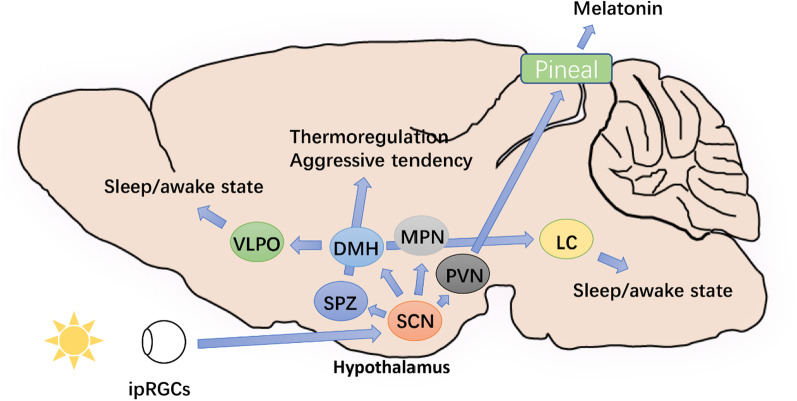
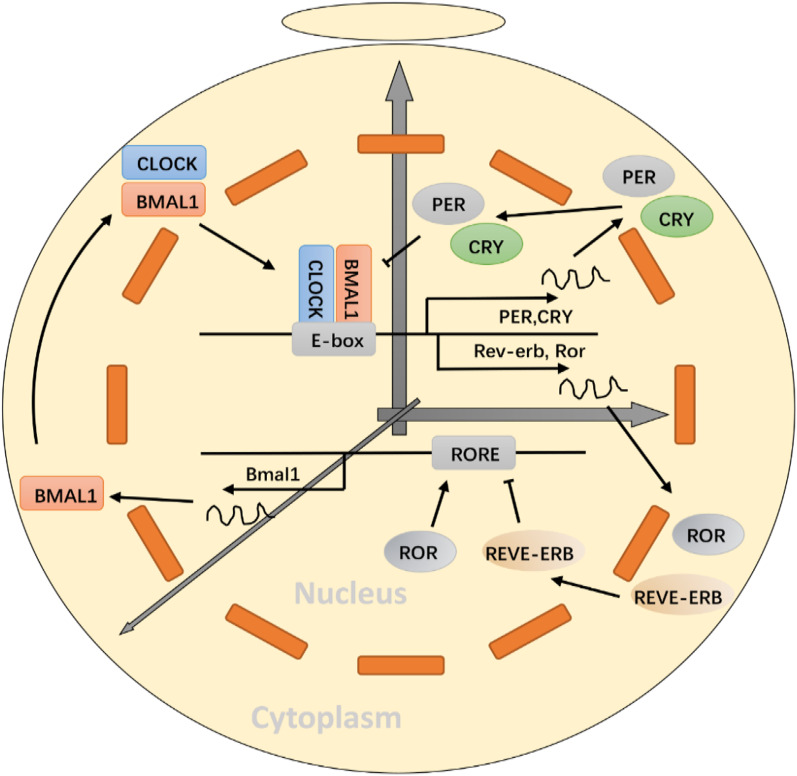
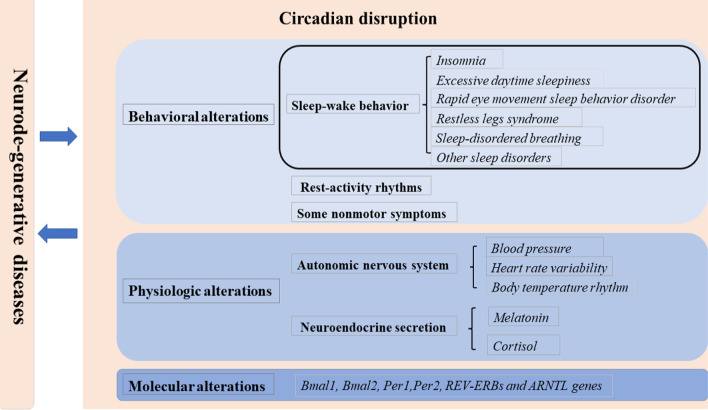
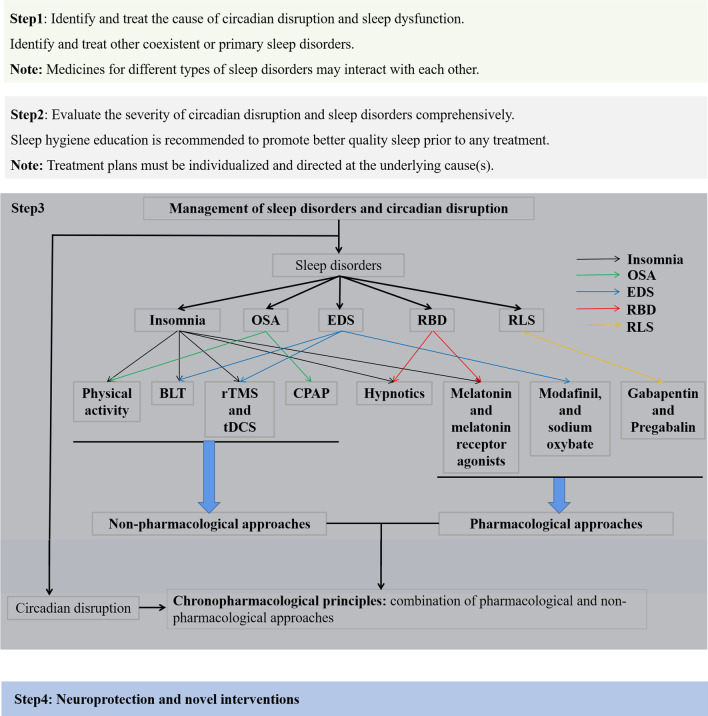
Verification
Claims the paper makes
The claims and statistics of this paper haven’t been checked yet.
Run the check — free, no account needed. It reads the open-access text and checks the sources it cites.
Claims other papers make about this one
Each is checked against this paper’s own text: does it say what the citing paper says it does?
The source backs part of the claim, not all of it — or backs it for a different population, condition or comparison.
In the citing paper
“This is similarly observed for Alzheimer’s disease and Alzheimer‐related dementias, where chronodisruption is labelled as both a causative factor and physiological consequence of this neurodegenerative, neuroinflammatory disease [40].”
From Ocular light exposure interventions for sleep, circadian rhythms, rest-activity cycles, mood, and cognitive function in older adults: An Overview of Cochrane and non-Cochrane Systematic Reviews (2025) · cites this paper as [40]
Experimental — accuracy not yet measured
Self-check
Percentages, sums and reported differences re-computed from the paper’s own numbers.
The self-check needs the paper’s full text.
Citations
Cites
Sleep Drives Metabolite Clearance from the Adult Brain
Xie, L., Kang, H., Xu, Q., Chen, M. J., Liao, Y., Thiyagarajan, M., O’Donnell, J., Christensen, D. J., Nicholson, C., Iliff, J. J., et al. (2013) · Science · doi:10.1126/science.1241224 · Cited by 5,411
Diagnosis and management of dementia with Lewy bodies: Fourth consensus report of the DLB Consortium
McKeith, I. G., Boeve, B. F., Dickson, D. W., Halliday, G., Taylor, J.-P., Weintraub, D., Aarsland, D., Galvin, J., Attems, J., Ballard, C. G., et al. (2017) · Neurology · doi:10.1212/wnl.0000000000004058 · Cited by 4,476
Be smart, exercise your heart: Exercise effects on brain and cognition
Hillman, C. H., Erickson, K. I., & Kramer, A. F. (2008) · Nature Reviews Neuroscience · doi:10.1038/nrn2298 · Cited by 3,563
Prevalence of Cerebral Amyloid Pathology in Persons Without Dementia: A Meta-analysis
Jansen, W. J., Ossenkoppele, R., Knol, D. L., Tijms, B. M., Scheltens, P., Verhey, F. R. J., Visser, P. J., Aalten, P., Aarsland, D., Alcolea, D., et al. (2015) · JAMA · doi:10.1001/jama.2015.4668 · Cited by 1,610
Postuma, R. B., Iranzo, Á., Hu, M., Högl, B., Boeve, B. F., Manni, R., Oertel, W. H., Arnulf, I., Ferini‐Strambi, L., Puligheddu, M., et al. (2019) · Brain · doi:10.1093/brain/awz030 · Cited by 1,189
Yaffe, K., Laffan, A. M., Harrison, S. L., Redline, S., Spira, A. P., Ensrud, K. E., Ancoli-Israel, S., & Stone, K. L. (2011) · JAMA · doi:10.1001/jama.2011.1115 · Cited by 1,137
Schenck, C. H., Bundlie, S. R., & Mahowald, M. W. (1996) · Neurology · doi:10.1212/wnl.46.2.388 · Cited by 1,083
Zhao, Q.-F., Tan, L., Wang, H.-F., Jiang, T., Tan, M.-S., Tan, L., Xu, W., Li, J.-Q., Wang, J., Lai, T.-J., et al. (2016) · Journal of Affective Disorders · doi:10.1016/j.jad.2015.09.069 · Cited by 916
Neuronal activity regulates the regional vulnerability to amyloid-β deposition
Bero, A. W., Yan, P., Roh, J. H., Cirrito, J. R., Stewart, F. R., Raichle, M. E., Lee, J.-M., & Holtzman, D. M. (2011) · Nature Neuroscience · doi:10.1038/nn.2801 · Cited by 880
Mechanisms linking circadian clocks, sleep, and neurodegeneration
Musiek, E. S., & Holtzman, D. M. (2016) · Science · doi:10.1126/science.aah4968 · Cited by 878
Cited by
Sorted by citations
Suresh, S., Ankul Singh, S., Rushendran, R., Vellapandian, C., & Prajapati, B. G. (2023) · Frontiers in Neurology · doi:10.3389/fneur.2023.1303111 · Cited by 93
Duan, W.-X., Wang, F., Liu, J., & Liu, C. (2023) · Neuroscience Bulletin · doi:10.1007/s12264-023-01123-9 · Cited by 91
Self-citationWearables in Chronomedicine and Interpretation of Circadian Health
Gubin, D. G., Weinert, D., Stefani, O., Otsuka, K., Borisenkov, M. F., & Cornélissen, G. (2025) · Diagnostics · doi:10.3390/diagnostics15030327 · Cited by 75
Başer, K. H. C., Haskologlu, I. C., & Erdağ, E. (2025) · Molecules · doi:10.3390/molecules30091888 · Cited by 60
Relationship Between Sleep Disturbances and Chronic Pain: A Narrative Review
Jain, S. V., Panjeton, G. D., & Martins, Y. C. (2024) · Clinics and Practice · doi:10.3390/clinpract14060209 · Cited by 54
Metadata
- Authors
- Shen, Y., Lv, Q.-K., Xie, W.-Y., Gong, S.-Y., Zhuang, S., Liu, J.-Y., Mao, C.-J., & Liu, C.-F.
- Affiliations
- Second Affiliated Hospital of Soochow University (CN)
- Soochow University (CN)
- Corresponding author
- Liu, Chun-feng
- Venue
- Translational Neurodegeneration
- Published
- 2023-02-13
- Volume
- 12
- Issue
- 1
- Pages
- 8-8
- ISSN
- 2047-9158 (ISSN-L)
- PMC
- PMC9926748
- OpenAlex
- W4320483859
- Cited by
- 171
- References
- 308
- Citations by year
- 2026: 50 · 2025: 71 · 2024: 35 · 2023: 15
- FWCI
- 6.46
- Type
- journal article
- Language
- en
- Open access
- gold
- doi.org
- Locations
- Translational Neurodegeneration (publishedVersion, cc-by)
- PubMed Central (publishedVersion, cc-by)
- PubMed (publishedVersion)
- DOAJ (DOAJ: Directory of Open Access Journals) (submittedVersion, cc-by-sa)
- Funders
- National Natural Science Foundation of China (82071420)
- Discipline Construction Program of the Second Affiliated Hospital of Soochow University (XKTJ-XK202001)
- Suzhou Medical and Health Technology Innovation Project (SKJY2021090)
- Topics
- Life Sciences › Neuroscience › Endocrine and Autonomic Systems › Circadian rhythm and melatonin
- Life Sciences › Neuroscience › Cognitive Neuroscience › Sleep and Wakefulness Research
- Social Sciences › Psychology › Experimental and Cognitive Psychology › Sleep and related disorders
- Keywords
- circadian rhythm disruption, circadian rhythm, sleep disorders, neurodegenerative diseases, precision medicine, neurodegeneration pathogenesis
- MeSH terms
- Animals, Circadian Rhythm, Humans, Quality of Life, Sleep, Sleep Wake Disorders, Neurodegenerative Diseases
About these checks
Registry, retraction, Cites and statistics results are computed, not judged, with one exception: a printed reference that no index lists is read once by a model before it counts as a citation error. Claims are extracted by a model and kept only when their quote appears verbatim in the text; each cited source is then checked, with a model’s help, for whether it says what the claim relies on. Those verdicts can be wrong — read the claim’s quote and the cited source before relying on one.
Statistics and arithmetic are recomputed, not judged.
Confidence bands are shown only for fields calibrated on our annotated test set. None is calibrated yet, so no band is shown.
What counts as a claim ›How we measure confidence ›How we check this ›
Are you an author, or do you see a problem with this page? Request a review
