

Proprioceptive precision is impaired in Ehlers-Danlos syndrome
Open accessThe DOI matches its Crossref record; 37 of the 37 references it cites were found in a registry or an index.
Abstract
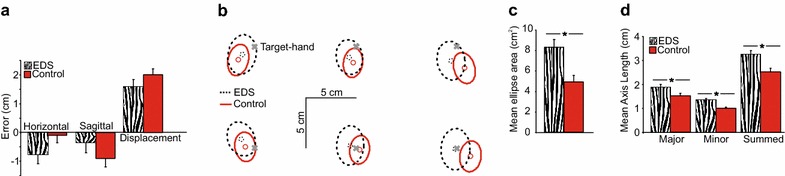
It has been suggested that people with Ehlers-Danlos syndrome (EDS), or other similar connective tissue disorders, may have proprioceptive impairments, the reason for which is still unknown. We recently found that EDS patients were less precise than healthy controls when estimating their felt hand's position relative to visible peripheral reference locations, and that this deficit was positively correlated with the severity of joint hypermobility. We further explore proprioceptive abilities in EDS by having patients localize their non-dominant left hand at a greater number of workspace locations than in our previous study. Additionally, we explore the relationship between chronic pain and proprioceptive sensitivity. We found that, although patients were just as accurate as controls, they were not as precise. Patients showed twice as much scatter than controls at all locations, but the degree of scatter did not positively correlate with chronic pain scores. This further supports the idea that a proprioceptive impairment pertaining to precision is present in EDS, but may not relate to the magnitude of chronic pain.
Overview
The claims and statistics of this paper haven’t been checked yet.
Free: it reads the open-access text and checks the first 5 claims that cite a source we can check. Create a free account to check every claim.
Integrity signals
Registry
Cites
Statistics
Figures
Verification
Claims the paper makes
The claims and statistics of this paper haven’t been checked yet.
Free: it reads the open-access text and checks the first 5 claims that cite a source we can check. Create a free account to check every claim.
Claims other papers make about this one
Each is checked against this paper’s own text: does it say what the citing paper says it does?
In the citing paper
“Like autism, EDS/HSD also frequently presents with coordination and proprioceptive deficits and may lead to further complications and injury in these HCTD [52,89,90].”
From The Relationship between Autism and Ehlers-Danlos Syndromes/Hypermobility Spectrum Disorders (2020) · cites this paper as [90]
Self-check
Percentages, sums and reported differences re-computed from the paper’s own numbers.
The self-check needs the paper’s full text.
Citations
Cites
The McGill Pain Questionnaire: Major properties and scoring methods
Melzack, R. (1975) · Pain · doi:10.1016/0304-3959(75)90044-5 · Cited by 6,845 · cited 2×
“If none of the words in a set applied, they made no selection (Melzack 1975).”
BackgroundMethodGoble, D. J., Coxon, J. P., Wenderoth, N., Van Impe, A., & Swinnen, S. P. (2009) · Neuroscience & Biobehavioral Reviews · doi:10.1016/j.neubiorev.2008.08.012 · Cited by 426
Dysautonomia in the joint hypermobility syndrome
Gazit, Y., Nahir, A. M., Grahame, R., & Jacob, G. (2003) · The American Journal of Medicine · doi:10.1016/s0002-9343(03)00235-3 · Cited by 390 · cited 1×
“Although symptomatology can vary across, or sometimes within, each of the subtypes, the most common variants (classic and hypermobility) often present with hypermobile joints, atypical skin (possibly doughy, stretchy, saggy, atrophic, thin, translucent, and/or fragile), chronic pain, chronic fatigue, dysautonomia, dev…”
BackgroundThe Measurement of Lumbar Proprioception in Individuals With and Without Low Back Pain
Gill, K. P., & Callaghan, M. J. (1998) · Spine · doi:10.1097/00007632-199802010-00017 · Cited by 334 · cited 3×
“2010), and proprioceptive deficits have been observed in other chronic pain populations (Gill and Callaghan 1998; Knox et al. 2006; Lewis et al. 2010; Tsay et al. 2015), we considered the possibility that pain might be influencing our results, as well.”
BackgroundClinical and genetic aspects of Ehlers-Danlos syndrome, classic type
Malfait, F., Wenstrup, R. J., & De Paepe, A. (2010) · Genetics in Medicine · doi:10.1097/gim.0b013e3181eed412 · Cited by 293 · cited 1×
“Although symptomatology can vary across, or sometimes within, each of the subtypes, the most common variants (classic and hypermobility) often present with hypermobile joints, atypical skin (possibly doughy, stretchy, saggy, atrophic, thin, translucent, and/or fragile), chronic pain, chronic fatigue, dysautonomia, dev…”
BackgroundTinkle, B. T., Bird, H. A., Grahame, R., Lavallee, M., Levy, H. P., & Sillence, D. (2009) · American Journal of Medical Genetics Part A · doi:10.1002/ajmg.a.33070 · Cited by 290 · cited 1×
“Because the genetic etiology of HMS is still unknown, in addition to it having a virtually indistinguishable presentation from EDS hypermobility type (Tinkle et al. 2009), we will consider results obtained from HMS studies to be applicable to EDS hypermobility type.”
MethodDoes limb proprioception drift?
Wann, J., & Ibrahim, S. (1992) · Experimental Brain Research · doi:10.1007/bf00230024 · Cited by 271 · cited 2×
“On 50% of these trials, the left target-hand was illuminated using three white light emitting diodes (LEDs), and was therefore visible, for 1 s (Wann and Ibrahim 1992; Desmurget et al. 2000; Brown et al. 2003).”
MethodEffect of articular disease and total knee arthroplasty on knee joint-position sense
Barrack, R. L., Skinner, H. B., Cook, S. D., & Haddad, R. J. (1983) · Journal of Neurophysiology · doi:10.1152/jn.1983.50.3.684 · Cited by 260
Bleeding and bruising in patients with Ehlers–Danlos syndrome and other collagen vascular disorders
Paepe, A. D., & Malfait, F. (2004) · British Journal of Haematology · doi:10.1111/j.1365-2141.2004.05220.x · Cited by 241 · cited 2×
“2003; De Paepe and Malfait 2004; Malfait et al.”
BackgroundInfluentialPain in Ehlers-Danlos Syndrome Is Common, Severe, and Associated with Functional Impairment
Voermans, N. C., Knoop, H., Bleijenberg, G., & van Engelen, B. G. (2010) · Journal of Pain and Symptom Management · doi:10.1016/j.jpainsymman.2009.12.026 · Cited by 237 · cited 2×
“It is plausible that our observed deficit is being influenced by chronic pain, which is common in both EDS subtypes we studied (Sacheti et al. 1997; Voermans et al. 2010).”
Background
Cited by
Gensemer, C., Burks, R., Kautz, S., Judge, D. P., Lavallee, M., & Norris, R. A. (2021) · Developmental Dynamics · doi:10.1002/dvdy.220 · Cited by 149
The Relationship between Autism and Ehlers-Danlos Syndromes/Hypermobility Spectrum Disorders
Casanova, E. L., Baeza-Velasco, C., Buchanan, C. B., & Casanova, M. F. (2020) · Journal of Personalized Medicine · doi:10.3390/jpm10040260 · Cited by 109
“There has also been a number of studies investigating joint hypermobility (irrespective of HCTD) and its relationship to neurodevelopmental conditions such as autism and ADHD [25–28].”
BackgroundInfluentialMusculoskeletal Conditions in a Pediatric Population with Ehlers-Danlos Syndrome
Stern, C. M., Pepin, M. J., Stoler, J. M., Kramer, D. E., Spencer, S. A., & Stein, C. J. (2017) · The Journal of Pediatrics · doi:10.1016/j.jpeds.2016.10.078 · Cited by 56
“Female patients had a higher median number of visits compared with male patients (5 vs 3; P = .014) There was no statistically significant association between number of visits and type of EDS.”
ResultInfluentialRecognizing and effectively managing hypermobility-related conditions
Russek, L. N., Stott, P., & Simmonds, J. (2019) · Physical Therapy · doi:10.1093/ptj/pzz078 · Cited by 37
Reychler, G., Liistro, G., Pierard, G., Hermanns‐Lê, T., & Manicourt, D. H. (2018) · American Journal of Medical Genetics Part A · doi:10.1002/ajmg.a.61016 · Cited by 33
Dupuy, E. G., Leconte, P., Vlamynck, E., Sultan, A., Chesneau, C., Denise, P., Besnard, S., Bienvenu, B., & Decker, L. M. (2017) · Frontiers in Human Neuroscience · doi:10.3389/fnhum.2017.00283 · Cited by 32
“Lastly, unlike previous studies which found no effect for PI and CG, our study suggested their efficacy on postural stability in hEDS patients (Hijmans et al., 2009; Dankerl et al., 2016).”
BackgroundResultManagement of shoulder instability in hypermobility-type Ehlers-Danlos syndrome
Broida, S. E., Sweeney, A. P., Gottschalk, M. B., & Wagner, E. R. (2021) · JSES Reviews Reports and Techniques · doi:10.1016/j.xrrt.2021.03.002 · Cited by 29
Hip Instability in Ballet Dancers a Narrative Review
Vera, A. M., Nho, S. J., Mather, R. C. “., Wuerz, T. H., & Harris, J. D. (2021) · Journal of Dance Medicine & Science · doi:10.12678/1089-313x.091521c · Cited by 27
Small fiber neuropathy in hypermobile Ehlers Danlos syndrome/hypermobility spectrum disorder
Fernandez, A., Aubry‐Rozier, B., Vautey, M., Berna, C., & Suter, M. R. (2022) · Journal of Internal Medicine · doi:10.1111/joim.13539 · Cited by 27
Robbins, S. M. K., Cossette‐Levasseur, M., Kikuchi, K., Sarjeant, J., Shiu, Y., Azar, C., & Hazel, E. M. (2019) · Arthritis Care & Research · doi:10.1002/acr.24067 · Cited by 26
“vation patterns during gait in the EDS group might be a result of deficits in the neural subsystem, such as proprioception impairments, which have been demonstrated previously (5,8).”
BackgroundFracture incidence in Ehlers-Danlos syndrome – A population-based case-control study
Rolfes, M., Deyle, D. R., King, K. S., Hand, J. L., Graff, A. H., & Derauf, C. (2019) · Child Abuse & Neglect · doi:10.1016/j.chiabu.2019.03.008 · Cited by 36
Wang, T. J., Stecco, A., Hakim, A. J., & Schleip, R. (2025) · International Journal of Molecular Sciences · doi:10.3390/ijms26125587 · Cited by 21
“These correlations underscore the complex interplay between immune function, connective tissue integrity, and autonomic regulation in hypermobility-related syndromes.”
Nisticò, V., Iacono, A., Goeta, D., Tedesco, R., Giordano, B., Faggioli, R., Priori, A., Gambini, O., & Demartini, B. (2022) · Frontiers in Psychiatry · doi:10.3389/fpsyt.2022.943098 · Cited by 15
“Neurodevelopmental comorbidities frequently co-occur in EDS, especially impaired proprioception (24).”
BackgroundDiep, D., Fau, V., Wdowik, S., Bienvenu, B., Bénateau, H., & Veyssière, A. (2016) · Revue de Stomatologie de Chirurgie Maxillo-faciale et de Chirurgie Orale · doi:10.1016/j.revsto.2016.07.009 · Cited by 15
Baeza‐Velasco, C., Bourdon, C., Polanco-Carrasco, R., de Jouvencel, M., Gély-Nargeot, M.-C., Gompel, A., & Hamonet, C. (2017) · Rheumatology International · doi:10.1007/s00296-017-3659-8 · Cited by 14
Guinchat, V., Vlamynck, E., Diaz, L., Chambon, C., Pouzenc, J., Cravero, C., Baeza-Velasco, C., Hamonet, C., Xavier, J., & Cohen, D. (2020) · Children · doi:10.3390/children7070077 · Cited by 13
Change in gliding properties of the iliotibial tract in hypermobile Ehlers–Danlos Syndrome
Wang, T. J., Stecco, A., Schleip, R., Stecco, C., & Pirri, C. (2023) · Journal of Ultrasound · doi:10.1007/s40477-023-00775-7 · Cited by 13
“The low shear strain in hEDS compared with non-hEDS counterparts suggest that this process may be amplified in hEDS and may be associated with the high prevalence of joint instability [20] and proprioceptive dysfunction [21, 22].”
BackgroundFascial thickness and stiffness in hypermobile Ehlers‐Danlos syndrome
Wang, T. J., & Stecco, A. (2021) · American Journal of Medical Genetics Part C Seminars in Medical Genetics · doi:10.1002/ajmg.c.31948 · Cited by 11
Bénistan, K., Pontier, B., Leblond, C., Flageul, O., Guicher, G. L., Enjalbert, M., & Gillas, F. (2023) · Healthcare · doi:10.3390/healthcare11131862 · Cited by 10
“Other studies focused on proprioception, which helps to protect joints from hyperextension and damage [19] and was found to be impaired in patients with hEDS [20].”
BackgroundRobbins, S. M. K., Wolfe, R., Chang, Y., Lavoie, M., Preston, E., & Hazel, E. M. (2021) · Clinical Biomechanics · doi:10.1016/j.clinbiomech.2021.105515 · Cited by 9
Tan, T., Cao, B.-Y., Liang, W.-M., Lou, S., Han, Z., Ji, Y., & Xiao, J. Z. (2024) · BMC Complementary Medicine and Therapies · doi:10.1186/s12906-024-04649-1 · Cited by 7
“LBP, low core strength, decreased dynamic balance and motor coordination, and impaired lumbar proprioception are common in patients with CNSLBP [16].”
BackgroundTaupinard, E., Torres, P., & Cohen, D. (2023) · Neuropsychiatrie de l Enfance et de l Adolescence · doi:10.1016/j.neurenf.2023.04.002 · Cited by 7
Sensing hand position in Ehlers-Danlos syndrome
Clayton, H. A., Hart, B. M. ’., & Henriques, D. Y. P. (2021) · Somatosensory & Motor Research · doi:10.1080/08990220.2021.1973403 · Cited by 7
“We assumed that was due to the challenging nature of the task used, such that even those with mild levels of joint hypermobility would be likely to show proprioceptive impairments [4].”
BackgroundResultInfluentialSelf-citationA clinical update on hypermobile Ehlers-Danlos syndrome during pregnancy, birth and beyond
Pezaro, S., Pearce, G., & Reinhold, E. J. (2021) · British Journal of Midwifery · doi:10.12968/bjom.2021.29.9.492 · Cited by 7
Biomechanical Aspects of Joint Hypermobility
Lamari, N. M., & Beighton, P. (2023) · In clinical practice · doi:10.1007/978-3-031-34914-0_5 · Cited by 4
Impairment of lung volume perception and breathing control in hypermobile Ehlers-Danlos syndrome
Hakimi, A., Bergoin, C., Jesus, A. D., Hermand, É., Fabre, C., & Mucci, P. (2024) · Scientific Reports · doi:10.1038/s41598-024-58890-2 · Cited by 4
Postural analysis in a pediatric cohort of patients with Ehlers-Danlos Syndrome: a pilot study
Lisi, C., Monteleone, S., Tinelli, C., Rinaldi, B., Natali, G. D., & Savasta, S. (2020) · Minerva Pediatrics · doi:10.23736/s0026-4946.17.04681-3 · Cited by 4
Fenner, R., Norris, R. A., & Maitland, A. L. (2025) · Current Opinion in Allergy and Clinical Immunology · doi:10.1097/aci.0000000000001136 · Cited by 3
Hand Joint Hypermobility among Dental Students—A Cross-Sectional Study
Sangalli, L., Alabsy, M., Lingle, D., Khazaal, N., West-Pelak, E., & Mitchell, J. C. (2023) · Applied Sciences · doi:10.3390/app13127158 · Cited by 2
“Unfortunately, individuals with peripheral joint hypermobility have been found to have lower proprioception [12,13], which may result in inappropriate pressure, further hyperflexion of supporting muscles, and an increased risk of musculoskeletal symptoms and injuries [14–20].”
BackgroundBenign Joint Hypermobility is not Benign
Gerwin, R. D. (2015) · MYOPAIN · doi:10.3109/10582452.2016.1156289 · Cited by 2
“EDS patients also show disturbances in proprioception and balance (11).”
BackgroundLee, S., Bourque, J., Noël, L., Hazel, E., Ramsay, E., Bélice, R., & Robbins, S. M. K. (2024) · Disability and Rehabilitation · doi:10.1080/09638288.2024.2361137 · Cited by 2
“…individuals with heds compared to age-matched healthy adults [2]. this discovery, in combination with other studies illustrating similar findings [5,6], highlights the importance of targeted interventions aimed at improving proprioceptive and general balance capacities in this population in…”
Boulu, X., Karam, J. D., & Schmidt, J. (2025) · BMC Musculoskeletal Disorders · doi:10.1186/s12891-025-09318-z · Cited by 1
“Relative to the general population, patients with HSD or hEDS have a greater prevalence of chronic pain syndromes [3], chronic fatigue [4], proprioceptive dysfunction [5], and poor quality of life (QoL) [6], – all of which are difficult to manage.”
Emerging Clinical Concepts in Pain Management of Ehlers-Danlos Syndrome
Banerjee, R. C., Ramsey, M. E., Buras, B. E., Potharaju, P., Shekoohi, S., Abd-Elsayed, A. A., & Kaye, A. D. (2026) · Current Pain and Headache Reports · doi:10.1007/s11916-026-01532-1 · Cited by 1
Does it take the joints to stretch a mind? The ADHD and General Joint Hypermobility connection
Kacperczyk, J., Czyż, W., Wójcikiewicz, M., Arczewski, F., Dziedzic, K., Kulbacka, J., Wojszczyk, M., Zys, D., Pasek, P., & Ryniecka, J. (2025) · Quality in Sport · doi:10.12775/qs.2025.37.57296 · Cited by 1
Garcia‐Fischer, I., Abber, S. R., Silvernale, C. J., Rodis, J., Murray, H. B., & Staller, K. D. (2025) · International Journal of Eating Disorders · doi:10.1002/eat.24576 · Cited by 1
Tissue Fragility and Ehlers-Danlos Syndrome Global Aggravation by Osteopathic Manipulations
Hamonet, C. (2019) · Online Journal of Neurology and Brain Disorders · doi:10.32474/ojnbd.2019.03.000159 · Cited by 1
“Clinical manifestations of Ehlers-Danlos syndrome then appear as the consequences of proprioception disorder [2,3].”
BackgroundSnowdon, N., & Dadla, S. A. (2023) · International Journal of Therapy and Rehabilitation · doi:10.12968/ijtr.2022.0148 · Cited by 1
Physiotherapy for Joint Hypermobility Disorders
Lamari, N. M., & Beighton, P. (2023) · In clinical practice · doi:10.1007/978-3-031-34914-0_13 · Cited by 1
Dupuy, E. G. (2019) · theses.fr (ABES) · doi:10.70675/59928b47zcd1bz41a9zb9a1z9177b8810472 · Cited by 1
Sokurenko, L. M. (2017) · The Ukrainian Journal of Clinical Surgery
Brock, I., & Hamonet, C. (2024) · Elsevier eBooks · doi:10.1016/b978-0-323-95082-4.00027-x
Posterior rib cage and shoulder blade pain
Zingman, A., & Thorpe, E. (2024) · Elsevier eBooks · doi:10.1016/b978-0-323-95082-4.00066-9
Prise en charge du syndrome d’Ehlers-Danlos par le pédicure-podologue en cabinet de ville
Chapon, V. (2025) · Revue du Podologue · doi:10.1016/j.revpod.2025.04.005
Visuomotor Learning and Proprioception Across Development
Clayton, H. A. (2022) · York University Digital Library (York University)
Self-citationHuft, K., Gaydos, E. F., White, J. N., Pascual‐Diaz, S., Schubert-Hjalmarsson, E., Harrison, N., Moua, L., Hoeppli, M., Biggs, E. E., Stinson, J., et al. (2026) · Pain · doi:10.1097/j.pain.0000000000003999
“It is feasible that proprioception and motor function deficits at the cerebellar level during such tasks could exacerbate proprioceptive challenges already inherent to HD 18 and may contribute to the susceptibility of patients to recurrent microtraumas.”
Bucci, M. P., Dewberry, L. S., Staiger, E. A., Allen, K., & Brooks, S. A. (2026) · Journal of Equine Veterinary Science · doi:10.1016/j.jevs.2026.106178
Audio-vestibular manifestations of Ehlers-Danlos syndrome
Cherchi, M. (2026) · Future Rare Diseases · doi:10.1080/23995270.2026.2701706
Diagnostische Verfahren zur Bestimmung der Faszienelastizität
(2026) · Elsevier eBooks · doi:10.1016/b978-3-437-55038-6.00006-3
Ehlers-Danlos Sendromunda Terapötik Egzersiz Yaklaşımlarının İncelenmesi: Bir Derleme
Alkaya, E., & Altunbilek, E. U. (2026) · Yüksek İhtisas Üniversitesi Sağlık Bilimleri Dergisi · doi:10.51261/yiu.2026.1902821
Huang, I. (2026) · Elsevier eBooks · doi:10.1016/b978-0-443-23516-0.00127-6
Tinkle, B. T. (2026) · American Journal of Medical Genetics Part A · doi:10.1002/ajmg.a.70324
Castori, M. (2026) · Expert Opinion on Pharmacotherapy · doi:10.1080/14656566.2026.2753024
Metadata
- Authors
- Clayton, H. A., Jones, S. A. H., & Henriques, D. Y. P.
- Affiliations
- York University (CA)
- Dalhousie University (CA)
- Corresponding author
- Henriques, Denise Y P
- Venue
- SpringerPlus
- Published
- 2015-07-07
- Volume
- 4
- Issue
- 1
- Pages
- 323-323
- ISSN
- 2193-1801 (ISSN-L)
- PMC
- PMC4493259
- OpenAlex
- W1641937948
- Cited by
- 50
- References
- 37
- Citations by year
- 2026: 9 · 2025: 6 · 2024: 5 · 2023: 7 · 2022: 3 · 2021: 5 · 2020: 4 · 2019: 5 · 2018: 1 · 2017: 2 · 2016: 2 · 2015: 1
- FWCI
- 1.37
- Type
- journal article
- Language
- en
- Open access
- diamond
- doi.org
- Locations
- SpringerPlus (publishedVersion, cc-by)
- Europe PMC (PubMed Central) (publishedVersion, cc-by)
- PubMed Central (publishedVersion, cc-by)
- PubMed (publishedVersion)
- Topics
- Life Sciences › Biochemistry, Genetics and Molecular Biology › Genetics › Connective tissue disorders research
- Life Sciences › Neuroscience › Cognitive Neuroscience › Tactile and Sensory Interactions
- Life Sciences › Neuroscience › Cognitive Neuroscience › Motor Control and Adaptation
- Keywords
- Ehlers-Danlos syndrome, proprioception, joint hypermobility, chronic pain, connective tissue diseases
About these checks
Registry, retraction, Cites and statistics results are computed, not judged, with one exception: a printed reference that no index lists is read once by a model before it counts as a citation error. Claims are extracted by a model and kept only when their quote appears verbatim in the text; each cited source is then checked, with a model’s help, for whether it says what the claim relies on. Those verdicts can be wrong — read the claim’s quote and the cited source before relying on one.
Statistics and arithmetic are recomputed, not judged.
Confidence bands are shown only for fields calibrated on our annotated test set. None is calibrated yet, so no band is shown.
What counts as a claim ›How we measure confidence ›How we check this ›
Are you an author, or do you see a problem with this page? Request a review
Data sources
Bibliographic data: Semantic Scholar, OpenAlex, Crossref.
Contains information from the Semantic Scholar Academic Graph Datasets, made available under the ODC Attribution License (ODC-BY 1.0).
Semantic Scholar’s data is described in: Kinney, R., et al. (2023). The Semantic Scholar Open Data Platform. arXiv:2301.10140.
