

Proprioceptive precision is impaired in Ehlers-Danlos syndrome
Open accessThe DOI matches its Crossref record; 37 of the 37 references it cites were found in a registry or an index.
Abstract
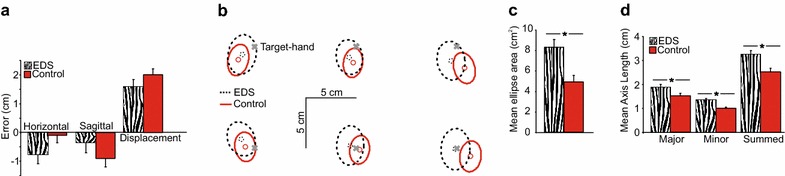
It has been suggested that people with Ehlers-Danlos syndrome (EDS), or other similar connective tissue disorders, may have proprioceptive impairments, the reason for which is still unknown. We recently found that EDS patients were less precise than healthy controls when estimating their felt hand's position relative to visible peripheral reference locations, and that this deficit was positively correlated with the severity of joint hypermobility. We further explore proprioceptive abilities in EDS by having patients localize their non-dominant left hand at a greater number of workspace locations than in our previous study. Additionally, we explore the relationship between chronic pain and proprioceptive sensitivity. We found that, although patients were just as accurate as controls, they were not as precise. Patients showed twice as much scatter than controls at all locations, but the degree of scatter did not positively correlate with chronic pain scores. This further supports the idea that a proprioceptive impairment pertaining to precision is present in EDS, but may not relate to the magnitude of chronic pain.
Overview
The claims and statistics of this paper haven’t been checked yet.
Free: it reads the open-access text and checks the first 5 claims that cite a source we can check. Create a free account to check every claim.
Integrity signals
Registry
Cites
Statistics
Figures
Verification
Claims the paper makes
The claims and statistics of this paper haven’t been checked yet.
Free: it reads the open-access text and checks the first 5 claims that cite a source we can check. Create a free account to check every claim.
Claims other papers make about this one
Each is checked against this paper’s own text: does it say what the citing paper says it does?
In the citing paper
“Like autism, EDS/HSD also frequently presents with coordination and proprioceptive deficits and may lead to further complications and injury in these HCTD [52,89,90].”
From The Relationship between Autism and Ehlers-Danlos Syndromes/Hypermobility Spectrum Disorders (2020) · cites this paper as [90]
Self-check
Percentages, sums and reported differences re-computed from the paper’s own numbers.
The self-check needs the paper’s full text.
Citations
Cites
The McGill Pain Questionnaire: Major properties and scoring methods
Melzack, R. (1975) · Pain · doi:10.1016/0304-3959(75)90044-5 · Cited by 6,845 · cited 2×
“If none of the words in a set applied, they made no selection (Melzack 1975).”
BackgroundMethodGoble, D. J., Coxon, J. P., Wenderoth, N., Van Impe, A., & Swinnen, S. P. (2009) · Neuroscience & Biobehavioral Reviews · doi:10.1016/j.neubiorev.2008.08.012 · Cited by 426
Dysautonomia in the joint hypermobility syndrome
Gazit, Y., Nahir, A. M., Grahame, R., & Jacob, G. (2003) · The American Journal of Medicine · doi:10.1016/s0002-9343(03)00235-3 · Cited by 390 · cited 1×
“Although symptomatology can vary across, or sometimes within, each of the subtypes, the most common variants (classic and hypermobility) often present with hypermobile joints, atypical skin (possibly doughy, stretchy, saggy, atrophic, thin, translucent, and/or fragile), chronic pain, chronic fatigue, dysautonomia, dev…”
BackgroundThe Measurement of Lumbar Proprioception in Individuals With and Without Low Back Pain
Gill, K. P., & Callaghan, M. J. (1998) · Spine · doi:10.1097/00007632-199802010-00017 · Cited by 334 · cited 3×
“2010), and proprioceptive deficits have been observed in other chronic pain populations (Gill and Callaghan 1998; Knox et al. 2006; Lewis et al. 2010; Tsay et al. 2015), we considered the possibility that pain might be influencing our results, as well.”
BackgroundClinical and genetic aspects of Ehlers-Danlos syndrome, classic type
Malfait, F., Wenstrup, R. J., & De Paepe, A. (2010) · Genetics in Medicine · doi:10.1097/gim.0b013e3181eed412 · Cited by 293 · cited 1×
“Although symptomatology can vary across, or sometimes within, each of the subtypes, the most common variants (classic and hypermobility) often present with hypermobile joints, atypical skin (possibly doughy, stretchy, saggy, atrophic, thin, translucent, and/or fragile), chronic pain, chronic fatigue, dysautonomia, dev…”
BackgroundTinkle, B. T., Bird, H. A., Grahame, R., Lavallee, M., Levy, H. P., & Sillence, D. (2009) · American Journal of Medical Genetics Part A · doi:10.1002/ajmg.a.33070 · Cited by 290 · cited 1×
“Because the genetic etiology of HMS is still unknown, in addition to it having a virtually indistinguishable presentation from EDS hypermobility type (Tinkle et al. 2009), we will consider results obtained from HMS studies to be applicable to EDS hypermobility type.”
MethodDoes limb proprioception drift?
Wann, J., & Ibrahim, S. (1992) · Experimental Brain Research · doi:10.1007/bf00230024 · Cited by 271 · cited 2×
“On 50% of these trials, the left target-hand was illuminated using three white light emitting diodes (LEDs), and was therefore visible, for 1 s (Wann and Ibrahim 1992; Desmurget et al. 2000; Brown et al. 2003).”
MethodEffect of articular disease and total knee arthroplasty on knee joint-position sense
Barrack, R. L., Skinner, H. B., Cook, S. D., & Haddad, R. J. (1983) · Journal of Neurophysiology · doi:10.1152/jn.1983.50.3.684 · Cited by 260
Bleeding and bruising in patients with Ehlers–Danlos syndrome and other collagen vascular disorders
Paepe, A. D., & Malfait, F. (2004) · British Journal of Haematology · doi:10.1111/j.1365-2141.2004.05220.x · Cited by 241 · cited 2×
“2003; De Paepe and Malfait 2004; Malfait et al.”
BackgroundInfluentialPain in Ehlers-Danlos Syndrome Is Common, Severe, and Associated with Functional Impairment
Voermans, N. C., Knoop, H., Bleijenberg, G., & van Engelen, B. G. (2010) · Journal of Pain and Symptom Management · doi:10.1016/j.jpainsymman.2009.12.026 · Cited by 237 · cited 2×
“It is plausible that our observed deficit is being influenced by chronic pain, which is common in both EDS subtypes we studied (Sacheti et al. 1997; Voermans et al. 2010).”
BackgroundRombaut, L., Malfait, F., Cools, A., De Paepe, A., & Calders, P. (2010) · Disability and Rehabilitation · doi:10.3109/09638280903514739 · Cited by 236 · cited 1×
“…License (http://creativecommons.org/licenses/by/4.0/), which permits unrestricted use, distribution, and reproduction in any medium, provided you give appropriate credit to the original author(s) and the source, provide a link to the Creative Commons license, and indicate if changes were made.”
BackgroundInfluentialCastori, M. (2012) · ISRN Dermatology · doi:10.5402/2012/751768 · Cited by 222 · cited 5×
“Background Ehlers–Danlos syndrome (EDS) is a group of genetic connective tissue disorders that can afflict up to 2% of individuals (Castori 2012).”
BackgroundInfluentialSensory Recalibration of Hand Position Following Visuomotor Adaptation
Cressman, E. K., & Henriques, D. Y. P. (2009) · Journal of Neurophysiology · doi:10.1152/jn.00514.2009 · Cited by 218 · cited 2×
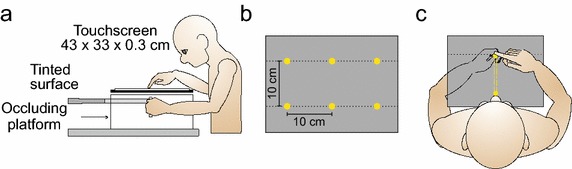
“On each trial, the robotic manipulandum was programmed to restrict subjects’ active movement of their left hand along a straight path from one of the six target-hand locations to one of the five remaining target-hand locations (dashed lines in Figure 2c; see Cressman and Henriques (2009) for details about active place…”
BackgroundMethodSelf-citationAge-related changes in proprioception and sensation of joint position
Kaplan, F. S., Nixon, J. E., Reitz, M., Rindfleish, L., & Tucker, J. (1985) · Acta Orthopaedica Scandinavica · doi:10.3109/17453678508992984 · Cited by 217 · cited 1×
“2007), or are asked to reproduce a joint angle from memory using the same or opposite arm (Kaplan et al. 1985; Adamo et al. 2007).”
BackgroundTHE EFFECT OF THE HYPERMOBILITY SYNDROME ON KNEE JOINT PROPRIOCEPTION
HALL, M. G., FERRELL, W. R., STURROCK, R. D., HAMBLEN, D. L., & BAXENDALE, R. H. (1995) · Rheumatology · doi:10.1093/rheumatology/34.2.121 · Cited by 214 · cited 8×
“Abbreviations EDS: Ehlers–Danlos syndrome; HMS: hypermobility syndrome; GTA: greater Toronto area; PRI-R: Pain Response Index, ranked; LEDs: light emitting diodes.”
BackgroundMethodInfluentialChronic pain is a manifestation of the Ehlers-Danlos syndrome
Sacheti, A., Szemere, J., Bernstein, B., Tafas, T., Schechter, N., & Tsipouras, P. (1997) · Journal of Pain and Symptom Management · doi:10.1016/s0885-3924(97)00007-9 · Cited by 186 · cited 1×
“Although symptomatology can vary across, or sometimes within, each of the subtypes, the most common variants (classic and hypermobility) often present with hypermobile joints, atypical skin (possibly doughy, stretchy, saggy, atrophic, thin, translucent, and/or fragile), chronic pain, chronic fatigue, dysautonomia, dev…”
BackgroundTsay, A., Allen, T. J., Proske, U., & Giummarra, M. J. (2015) · Neuroscience & Biobehavioral Reviews · doi:10.1016/j.neubiorev.2015.03.004 · Cited by 162 · cited 1×
“2010), and proprioceptive deficits have been observed in other chronic pain populations (Gill and Callaghan 1998; Knox et al. 2006; Lewis et al. 2010; Tsay et al. 2015), we considered the possibility that pain might be influencing our results, as well.”
BackgroundŞahin, N., Başkent, A., Çakmak, A., Sallı, A., Uğurlu, H., & Berker, E. (2008) · Rheumatology International · doi:10.1007/s00296-008-0566-z · Cited by 161 · cited 8×
“Abbreviations EDS: Ehlers–Danlos syndrome; HMS: hypermobility syndrome; GTA: greater Toronto area; PRI-R: Pain Response Index, ranked; LEDs: light emitting diodes.”
BackgroundMethodInfluentialLimb Position Drift: Implications for Control of Posture and Movement
Brown, L. E., Rosenbaum, D. A., & Sainburg, R. L. (2003) · Journal of Neurophysiology · doi:10.1152/jn.00013.2003 · Cited by 160
AGE-RELATED DIFFERENCES IN UPPER LIMB PROPRIOCEPTIVE ACUITY
ADAMO, D. E. (2007) · Perceptual and Motor Skills · doi:10.2466/pms.104.3.1297-1309 · Cited by 155 · cited 1×
“2007), or are asked to reproduce a joint angle from memory using the same or opposite arm (Kaplan et al. 1985; Adamo et al. 2007).”
BackgroundWherever is my arm? Impaired upper limb position accuracy in Complex Regional Pain Syndrome
Lewis, J. S., Kersten, P., McPherson, K. M., Taylor, G. J., Harris, N., McCabe, C. S., & Blake, D. R. (2010) · Pain · doi:10.1016/j.pain.2010.02.007 · Cited by 143 · cited 1×
“2010), and proprioceptive deficits have been observed in other chronic pain populations (Gill and Callaghan 1998; Knox et al. 2006; Lewis et al. 2010; Tsay et al. 2015), we considered the possibility that pain might be influencing our results, as well.”
BackgroundSmith, T. O., Jerman, E., Easton, V., Bacon, H., Armon, K., Poland, F., & Macgregor, A. J. (2013) · Rheumatology International · doi:10.1007/s00296-013-2790-4 · Cited by 132 · cited 1×
“While joint matching tasks, or motion threshold detection paradigms, are commonly used to examine proprioception in patients exhibiting joint hypermobility (Hall et al. 1995; Sahin et al. 2008; Rombaut et al. 2010a; Smith et al. 2013), we used a paradigm which allowed us to precisely place the hand at a greater number…”
MethodProprioceptive localization of the left and right hands
Jones, S. A. H., Cressman, E. K., & Henriques, D. Y. P. (2009) · Experimental Brain Research · doi:10.1007/s00221-009-2079-8 · Cited by 128 · cited 1×
“This suggests that chronic pain is likely not contributing to the observed proprioceptive deficit shown in this study.”
Self-citationMapping Proprioception across a 2D Horizontal Workspace
Wilson, E. T., Wong, J. D., & Gribble, P. L. (2010) · PLoS ONE · doi:10.1371/journal.pone.0011851 · Cited by 126 · cited 1×
“While some studies have found that how well healthy people localize their unseen hand varies with the location in space (Jones et al. 2010; Wilson et al. 2010), in the current study, we found only small target-dependent effects for both accuracy and precision.”
BackgroundRombaut, L., Paepe, A. D., Malfait, F., Cools, A. M. J., & Calders, P. (2009) · Clinical Rheumatology · doi:10.1007/s10067-009-1320-y · Cited by 125 · cited 3×
“…License (http://creativecommons.org/licenses/by/4.0/), which permits unrestricted use, distribution, and reproduction in any medium, provided you give appropriate credit to the original author(s) and the source, provide a link to the Creative Commons license, and indicate if changes were made.”
BackgroundMethodInfluentialThe perceived position of the hand in space
Haggard, P., Newman, C., Blundell, J., & Andrew, H. (2000) · Perception & Psychophysics · doi:10.3758/bf03205556 · Cited by 118 · cited 1×
“While there are many ways to measure hand proprioception, one of the main methods involves subjects reaching to the current location of an unseen body part, in this case the hand (Lovelace 1989; Baud-Bovy and Viviani 1998; Haggard et al. 2000; Sarlegna and Sainburg 2007).”
MethodSarlegna, F. R., & Sainburg, R. L. (2006) · Experimental Brain Research · doi:10.1007/s00221-006-0613-5 · Cited by 113 · cited 2×
“2000; Sarlegna and Sainburg 2007).”
MethodProprioception does not quickly drift during visual occlusion
Desmurget, M., Vindras, P., Gréa, H., Viviani, P., & Grafton, S. T. (2000) · Experimental Brain Research · doi:10.1007/s002210000473 · Cited by 93
Pointing to Kinesthetic Targets in Space
Baud‐Bovy, G., & Viviani, P. (1998) · Journal of Neuroscience · doi:10.1523/jneurosci.18-04-01528.1998 · Cited by 79 · cited 2×
“While there are many ways to measure hand proprioception, one of the main methods involves subjects reaching to the current location of an unseen body part, in this case the hand (Lovelace 1989; Baud-Bovy and Viviani 1998; Haggard et al. 2000; Sarlegna and Sainburg 2007).”
MethodQuantitative measurements of joint mobility in adolescents.
Fairbank, J. C. T., Pynsent, P. B., & Phillips, H. (1984) · Annals of the Rheumatic Diseases · doi:10.1136/ard.43.2.288 · Cited by 71
Knox, J. J., Beilstein, D. J., Charles, S. D., Aarseth, G. A., Rayar, S., Treleaven, J. M., & Hodges, P. W. (2006) · Clinical Journal of Pain · doi:10.1097/01.ajp.0000210997.53082.c9 · Cited by 57 · cited 1×
“2010), and proprioceptive deficits have been observed in other chronic pain populations (Gill and Callaghan 1998; Knox et al. 2006; Lewis et al. 2010; Tsay et al. 2015), we considered the possibility that pain might be influencing our results, as well.”
BackgroundA task-dependent effect of memory and hand-target on proprioceptive localization
Jones, S. A. H., Fiehler, K., & Henriques, D. Y. P. (2012) · Neuropsychologia · doi:10.1016/j.neuropsychologia.2012.02.031 · Cited by 44
Self-citationProprioceptive sensitivity in Ehlers-Danlos syndrome patients
Clayton, H. A., Cressman, E. K., & Henriques, D. Y. P. (2013) · Experimental Brain Research · doi:10.1007/s00221-013-3656-4 · Cited by 25 · cited 2×
“Given that EDS patients, who exhibit joint hypermobility, seem to have some proprioceptive impairments that vary across the workspace (Clayton et al. 2013), our goal was to further examine proprioceptive sensitivity in EDS across a greater number of workspace locations, and to see how they differ compared to healthy c…”
BackgroundSelf-citationVision and Kinesthesis in Accuracy of Hand Movement
Lovelace, E. A. (1989) · Perceptual and Motor Skills · doi:10.2466/pms.1989.68.3.707 · Cited by 17 · cited 5×
“For the most part, healthy individuals are quite good at localizing their unseen hand using proprioception (and efferent signals) (Lovelace 1989; Haggard et al.”
BackgroundMethodInfluentialLee, D., Henriques, D. Y. P., Snider, J., Song, D. D., & Poizner, H. (2013) · Neuroscience · doi:10.1016/j.neuroscience.2013.04.009 · Cited by 15 · cited 1×
“Rombaut et al. (2010a) later compared proprioceptive abilities and vibratory perception sense in EDS hypermobility type patients to those of age and gender-matched controls.”
BackgroundSelf-citationReach endpoint errors do not vary with movement path of the proprioceptive target
Jones, S. A. H., Byrne, P., Fiehler, K., & Henriques, D. Y. P. (2012) · Journal of Neurophysiology · doi:10.1152/jn.00901.2011 · Cited by 12
Self-citationEhlers-Danlos syndromes: Revised nosology, Villefranche, 1997
Beighton, P., Paepe, A. D., Steinmann, B., Tsipouras, P., & Wenstrup, R. J. (1998) · American Journal of Medical Genetics · doi:10.1002/(sici)1096-8628(19980428)77:1<31::aid-ajmg8>3.0.co;2-o
Cited by
Gensemer, C., Burks, R., Kautz, S., Judge, D. P., Lavallee, M., & Norris, R. A. (2021) · Developmental Dynamics · doi:10.1002/dvdy.220 · Cited by 149
The Relationship between Autism and Ehlers-Danlos Syndromes/Hypermobility Spectrum Disorders
Casanova, E. L., Baeza-Velasco, C., Buchanan, C. B., & Casanova, M. F. (2020) · Journal of Personalized Medicine · doi:10.3390/jpm10040260 · Cited by 109
“There has also been a number of studies investigating joint hypermobility (irrespective of HCTD) and its relationship to neurodevelopmental conditions such as autism and ADHD [25–28].”
BackgroundInfluentialMusculoskeletal Conditions in a Pediatric Population with Ehlers-Danlos Syndrome
Stern, C. M., Pepin, M. J., Stoler, J. M., Kramer, D. E., Spencer, S. A., & Stein, C. J. (2017) · The Journal of Pediatrics · doi:10.1016/j.jpeds.2016.10.078 · Cited by 56
“Female patients had a higher median number of visits compared with male patients (5 vs 3; P = .014) There was no statistically significant association between number of visits and type of EDS.”
ResultInfluentialRecognizing and effectively managing hypermobility-related conditions
Russek, L. N., Stott, P., & Simmonds, J. (2019) · Physical Therapy · doi:10.1093/ptj/pzz078 · Cited by 37
Reychler, G., Liistro, G., Pierard, G., Hermanns‐Lê, T., & Manicourt, D. H. (2018) · American Journal of Medical Genetics Part A · doi:10.1002/ajmg.a.61016 · Cited by 33
Metadata
- Authors
- Clayton, H. A., Jones, S. A. H., & Henriques, D. Y. P.
- Affiliations
- York University (CA)
- Dalhousie University (CA)
- Corresponding author
- Henriques, Denise Y P
- Venue
- SpringerPlus
- Published
- 2015-07-07
- Volume
- 4
- Issue
- 1
- Pages
- 323-323
- ISSN
- 2193-1801 (ISSN-L)
- PMC
- PMC4493259
- OpenAlex
- W1641937948
- Cited by
- 50
- References
- 37
- Citations by year
- 2026: 9 · 2025: 6 · 2024: 5 · 2023: 7 · 2022: 3 · 2021: 5 · 2020: 4 · 2019: 5 · 2018: 1 · 2017: 2 · 2016: 2 · 2015: 1
- FWCI
- 1.37
- Type
- journal article
- Language
- en
- Open access
- diamond
- doi.org
- Locations
- SpringerPlus (publishedVersion, cc-by)
- Europe PMC (PubMed Central) (publishedVersion, cc-by)
- PubMed Central (publishedVersion, cc-by)
- PubMed (publishedVersion)
- Topics
- Life Sciences › Biochemistry, Genetics and Molecular Biology › Genetics › Connective tissue disorders research
- Life Sciences › Neuroscience › Cognitive Neuroscience › Tactile and Sensory Interactions
- Life Sciences › Neuroscience › Cognitive Neuroscience › Motor Control and Adaptation
- Keywords
- Ehlers-Danlos syndrome, proprioception, joint hypermobility, chronic pain, connective tissue diseases
About these checks
Registry, retraction, Cites and statistics results are computed, not judged, with one exception: a printed reference that no index lists is read once by a model before it counts as a citation error. Claims are extracted by a model and kept only when their quote appears verbatim in the text; each cited source is then checked, with a model’s help, for whether it says what the claim relies on. Those verdicts can be wrong — read the claim’s quote and the cited source before relying on one.
Statistics and arithmetic are recomputed, not judged.
Confidence bands are shown only for fields calibrated on our annotated test set. None is calibrated yet, so no band is shown.
What counts as a claim ›How we measure confidence ›How we check this ›
Are you an author, or do you see a problem with this page? Request a review
Data sources
Bibliographic data: Semantic Scholar, OpenAlex, Crossref.
Contains information from the Semantic Scholar Academic Graph Datasets, made available under the ODC Attribution License (ODC-BY 1.0).
Semantic Scholar’s data is described in: Kinney, R., et al. (2023). The Semantic Scholar Open Data Platform. arXiv:2301.10140.
