

The DOI matches its Crossref record; 207 of the 207 references it cites were found in a registry or an index.
Extracellular matrix stiffness: mechanisms in tumor progression and therapeutic potential in cancer
Open accessAbstract
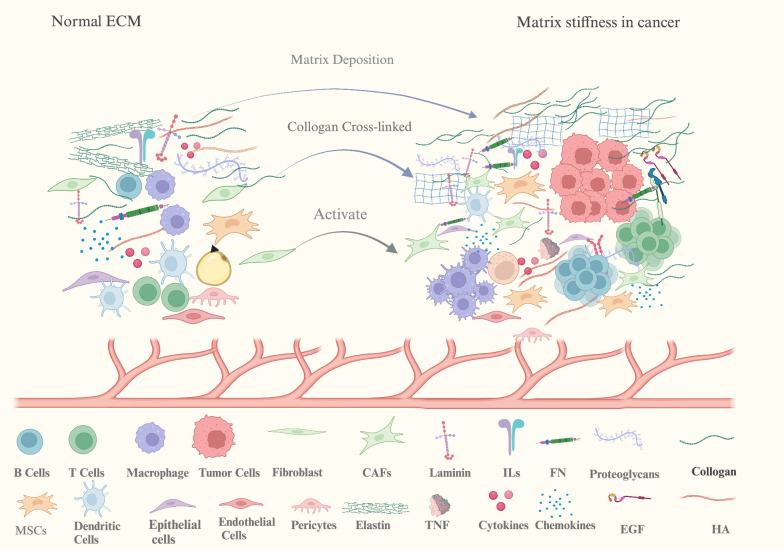
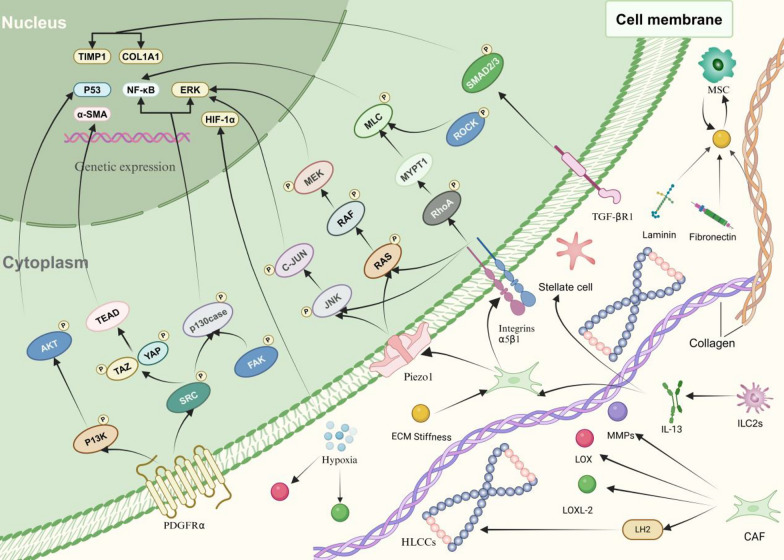
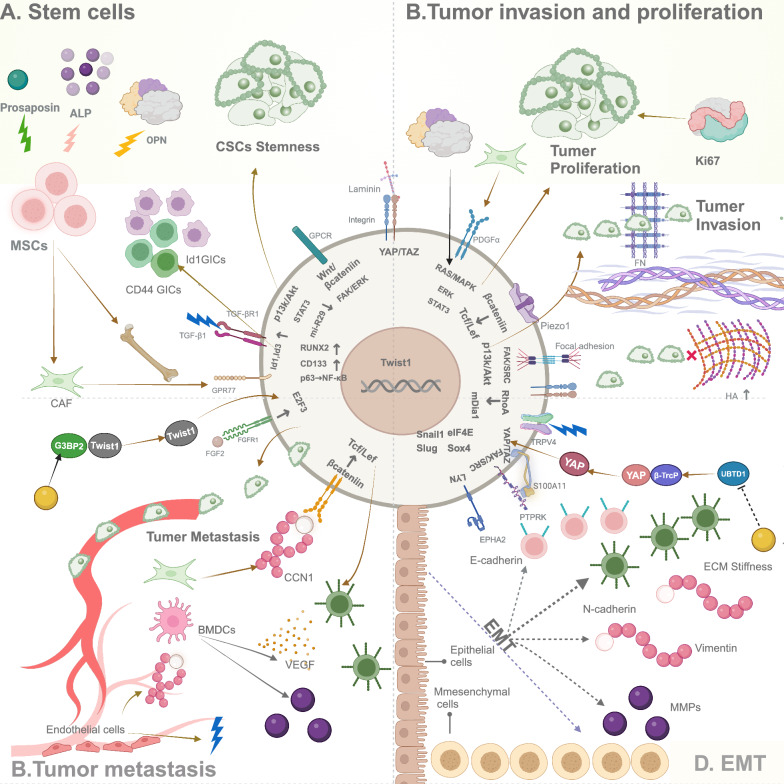
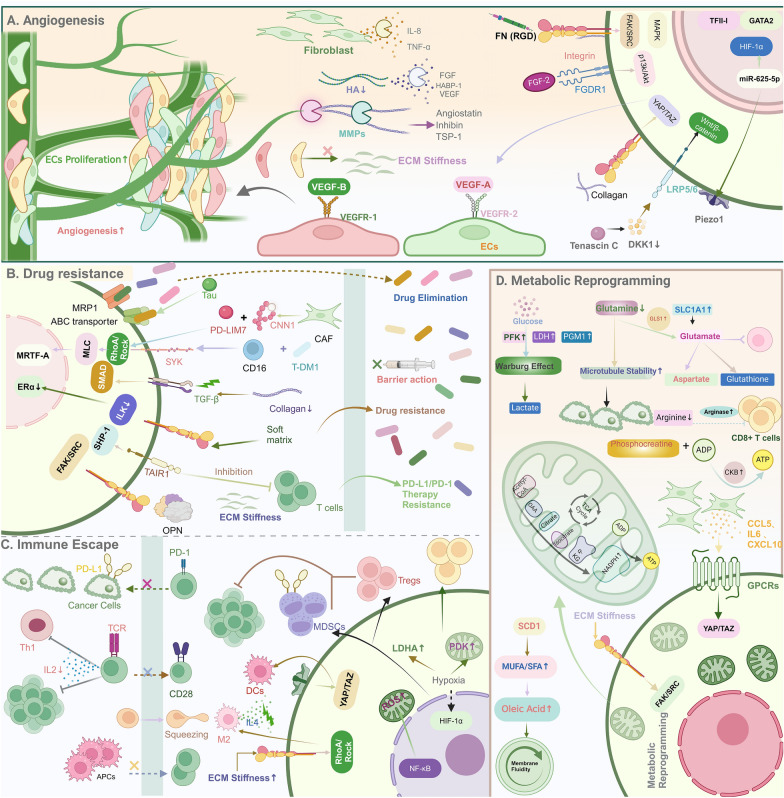
Tumor microenvironment (TME) is a complex ecosystem composed of both cellular and non-cellular components that surround tumor tissue. The extracellular matrix (ECM) is a key component of the TME, performing multiple essential functions by providing mechanical support, shaping the TME, regulating metabolism and signaling, and modulating immune responses, all of which profoundly influence cell behavior. The quantity and cross-linking status of stromal components are primary determinants of tissue stiffness. During tumor development, ECM stiffness not only serves as a barrier to hinder drug delivery but also promotes cancer progression by inducing mechanical stimulation that activates cell membrane receptors and mechanical sensors. Thus, a comprehensive understanding of how ECM stiffness regulates tumor progression is crucial for identifying potential therapeutic targets for cancer. This review examines the effects of ECM stiffness on tumor progression, encompassing proliferation, migration, metastasis, drug resistance, angiogenesis, epithelial-mesenchymal transition (EMT), immune evasion, stemness, metabolic reprogramming, and genomic stability. Finally, we explore therapeutic strategies that target ECM stiffness and their implications for tumor progression.
Overview
The claims and statistics of this paper haven’t been checked yet.
Run the check — free, no account needed. It reads the open-access text and checks the sources it cites.
Integrity signals
Registry
Cites
Statistics
Figures
Verification
Claims the paper makes
The claims and statistics of this paper haven’t been checked yet.
Run the check — free, no account needed. It reads the open-access text and checks the sources it cites.
Claims other papers make about this one
Each is checked against this paper’s own text: does it say what the citing paper says it does?
The cited source says what the claim attributes to it.
In the citing paper
“However, beyond acting as a physical barrier, ECM stiffness also triggers mechanotransduction pathways that profoundly influence tumor cell behavior [91,92]. Mechanical cues generated by a stiffened matrix are sensed through integrin-based focal adhesions and transmitted via cytoskeletal tension to activate intracellular signaling cascades, including Yes-associated protein/Transcriptional coactiv”
From Modeling Tumor Microenvironment Complexity In Vitro: Spheroids as Physiologically Relevant Tumor Models and Strategies for Their Analysis (2025) · cites this paper as [92]
Self-check
Percentages, sums and reported differences re-computed from the paper’s own numbers.
The self-check needs the paper’s full text.
Citations
Cites
Items 201–207 of 207
Aref, Z., & Quax, P. H. A. (2021) · International Journal of Molecular Sciences · doi:10.3390/ijms22168909 · Cited by 13 · cited 1×
“To date, commonly used materials include collagen, gelatin, polyethylene glycol (PEG), Matrigel, gelatin, hyaluronic acid, chitosan, and alginate [197].”
Stein, A., Thomopoulou, P. H. N., Frias, C., Pütz, S. M., Varela, P. F., Wilke, N. L., Mariappan, A., Neudörfl, J., Fedorov, A. Y., Gopalakrishnan, J., et al. (2022) · ACS Omega · doi:10.1021/acsomega.1c04659 · Cited by 13
Wu, C., Sun, W., Shen, D., Li, H., Tong, X., & Guo, Y. C. (2023) · Discover Oncology · doi:10.1007/s12672-023-00613-6 · Cited by 12 · cited 1×
“TIMP is a natural inhibitor of MMPs [137], but due to its low bioavailability, potential side effects, and toxicity, its clinical application is limited and it has not been widely used to inhibit MMPs in clinical practice [139].”
Targeting Collagen Pathways as an HFpEF Therapeutic Strategy
Bonanni, A., Vinci, R., d’Aiello, A., Grimaldi, M. C., Sario, M. D., Tarquini, D., Proto, L., Severino, A., Pedicino, D., & Liuzzo, G. (2023) · Journal of Clinical Medicine · doi:10.3390/jcm12185862 · Cited by 12 · cited 1×
“Another new class of glucose-lowering drugs, sodium-glucose cotransporter 2 inhibitors, such as dapagliflozin, reduces AGE-mediated consequences of AGEs and RAGEs (receptor-mediated AGEs) and their downstream signaling interactions in diabetic rats [119].”
Pashaei, M., Farhadi, E., Kavosi, H., Madreseh, E., Enayati, S., Mahmoudi, M., & Amirzargar, A. (2024) · Inflammopharmacology · doi:10.1007/s10787-024-01536-6 · Cited by 9
Pal, R., Boyapelly, K., Sk, M. A., Hosamani, K. R., & Matada, G. S. P. (2024) · ChemistrySelect · doi:10.1002/slct.202401216 · Cited by 7 · cited 1×
“Notably, only DDR2 Activation of Fibrous Collagen, specifically types I and III [190].”
Paul Bornstein (1934–2013), a pioneer of matrix biology and pathology
Labat‐Robert, J., & Robert, L. (2014) · Pathologie Biologie · doi:10.1016/j.patbio.2014.02.008 · Cited by 1 · cited 1×
“Cross-linking of collagen and elastic fibers, along with the presence of highly ordered matrix fibers, significantly influences matrix stiffness [23].”
Cited by
Sorted by citations
Shah, S., & D’Souza, G. G. M. (2025) · Cells · doi:10.3390/cells14100732 · Cited by 83
“In these settings, increased stiffness not only impedes drug penetration but also fosters an aggressive tumor phenotype and enhances resistance to chemotherapeutic agents [92,98].”
Recent progress in immune evasion mechanisms of triple-negative breast cancer
Yang, Y., & Wang, W. (2025) · Journal of Translational Medicine · doi:10.1186/s12967-025-07370-w · Cited by 56
The extracellular matrix in inflammation and cancer
Zhang, W., Xiang, Y., Lu, C., Wang, F., Ren, H., Wu, H., & Yan, M. (2026) · Molecular Biomedicine · doi:10.1186/s43556-026-00415-6 · Cited by 34
Tumor microenvironment in breast cancer: cellular crosstalk, pathways, and therapeutic insights
Sharma, M., Kumar, U., & Singh, S. (2025) · Molecular Biology Reports · doi:10.1007/s11033-025-11231-6 · Cited by 20
Targeting angiogenesis: Lessons from 25 years of normalizing tumor vasculature
Subudhi, S., Lee, S., & Jain, R. K. (2026) · Cell · doi:10.1016/j.cell.2026.03.016 · Cited by 26
Metadata
- Authors
- Zhang, M., & Zhang, B.
- Affiliations
- China Three Gorges University (CN)
- Corresponding author
- Zhang, Bin
- Venue
- Experimental Hematology & Oncology
- Published
- 2025-04-10
- Volume
- 14
- Issue
- 1
- Pages
- 54-54
- ISSN
- 2162-3619 (ISSN-L)
- PMC
- PMC11984264
- OpenAlex
- W4409339209
- Cited by
- 269
- References
- 205
- Citations by year
- 2026: 199 · 2025: 70
- FWCI
- 32.05
- Type
- journal article
- Language
- en
- Open access
- gold
- doi.org
- Locations
- Experimental Hematology and Oncology (publishedVersion, cc-by)
- PubMed Central (publishedVersion, cc-by)
- PubMed (publishedVersion)
- DOAJ (DOAJ: Directory of Open Access Journals) (submittedVersion, cc-by-sa)
- Topics
- Life Sciences › Biochemistry, Genetics and Molecular Biology › Cell Biology › Cellular Mechanics and Interactions
- Health Sciences › Medicine › Oncology › Cancer Cells and Metastasis
- Life Sciences › Biochemistry, Genetics and Molecular Biology › Molecular Biology › TGF-β signaling in diseases
- Keywords
- extracellular matrix stiffness, tumor microenvironment, tumor progression, mechanotransduction, metastasis, drug resistance, angiogenesis, epithelial-mesenchymal transition, immune evasion, cancer stemness, metabolic reprogramming, genome stability
About these checks
Registry, retraction, Cites and statistics results are computed, not judged, with one exception: a printed reference that no index lists is read once by a model before it counts as a citation error. Claims are extracted by a model and kept only when their quote appears verbatim in the text; each cited source is then checked, with a model’s help, for whether it says what the claim relies on. Those verdicts can be wrong — read the claim’s quote and the cited source before relying on one.
Statistics and arithmetic are recomputed, not judged.
Confidence bands are shown only for fields calibrated on our annotated test set. None is calibrated yet, so no band is shown.
What counts as a claim ›How we measure confidence ›How we check this ›
Are you an author, or do you see a problem with this page? Request a review
