

MetaEuk—sensitive, high-throughput gene discovery, and annotation for large-scale eukaryotic metagenomics
Open accessPublished version of a preprint
The DOI matches its Crossref record; 66 of the 66 references it cites were found in a registry or an index.
Abstract
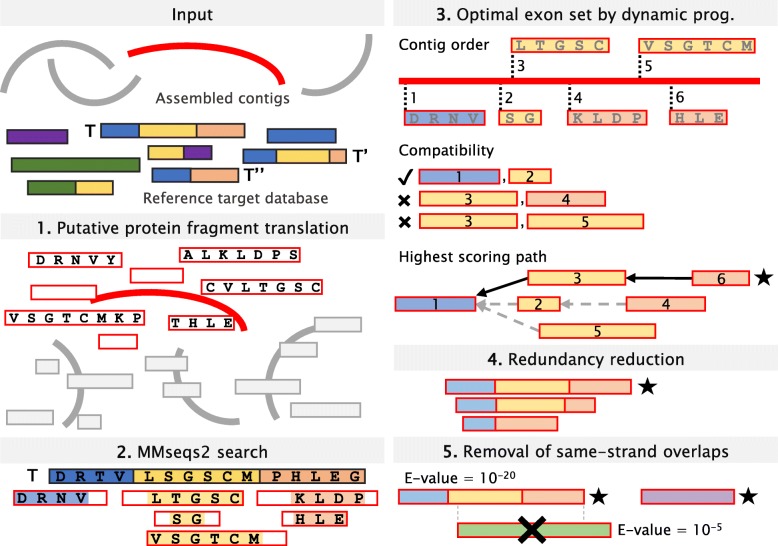
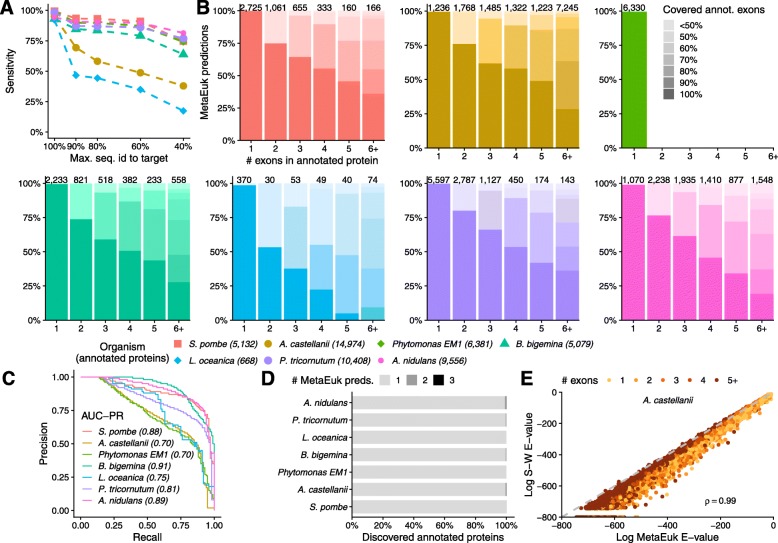
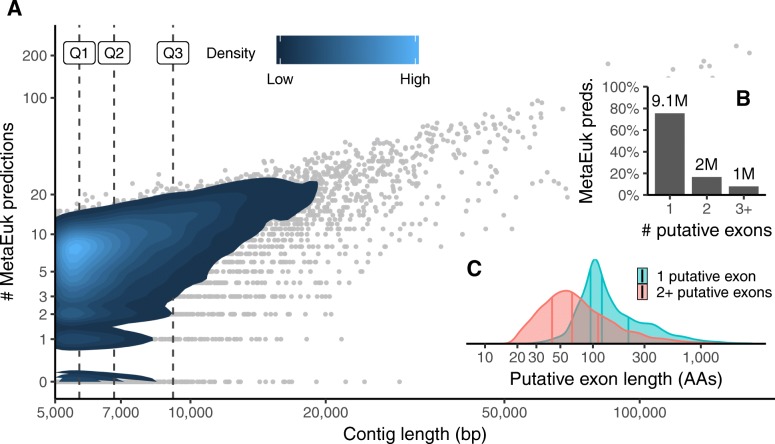
Background: Metagenomics is revolutionizing the study of microorganisms and their involvement in biological, biomedical, and geochemical processes, allowing us to investigate by direct sequencing a tremendous diversity of organisms without the need for prior cultivation. Unicellular eukaryotes play essential roles in most microbial communities as chief predators, decomposers, phototrophs, bacterial hosts, symbionts, and parasites to plants and animals. Investigating their roles is therefore of great interest to ecology, biotechnology, human health, and evolution. However, the generally lower sequencing coverage, their more complex gene and genome architectures, and a lack of eukaryote-specific experimental and computational procedures have kept them on the sidelines of metagenomics. Results: MetaEuk is a toolkit for high-throughput, reference-based discovery, and annotation of protein-coding genes in eukaryotic metagenomic contigs. It performs fast searches with 6-frame-translated fragments covering all possible exons and optimally combines matches into multi-exon proteins. We used a benchmark of seven diverse, annotated genomes to show that MetaEuk is highly sensitive even under conditions of low sequence similarity to the reference database. To demonstrate MetaEuk’s power to discover novel eukaryotic proteins in large-scale metagenomic data, we assembled contigs from 912 samples of the Tara Oceans project. MetaEuk predicted >12,000,000 protein-coding genes in 8 days on ten 16-core servers. Most of the discovered proteins are highly diverged from known proteins and originate from very sparsely sampled eukaryotic supergroups. Conclusion: The open-source (GPLv3) MetaEuk software ( https://github.com/soedinglab/metaeuk ) enables large-scale eukaryotic metagenomics through reference-based, sensitive taxonomic and functional annotation.
Overview
The claims and statistics of this paper haven’t been checked yet.
Free: it reads the open-access text and checks the first 5 claims that cite a source we can check. Create a free account to check every claim.
Integrity signals
Registry
Cites
Statistics
Figures
Verification
Claims the paper makes
The claims and statistics of this paper haven’t been checked yet.
Free: it reads the open-access text and checks the first 5 claims that cite a source we can check. Create a free account to check every claim.
Self-check
Percentages, sums and reported differences re-computed from the paper’s own numbers.
The self-check needs the paper’s full text.
Citations
Cites
Trimmomatic: a flexible trimmer for Illumina sequence data
Bolger, A. M., Lohse, M., & Usadel, B. (2014) · Bioinformatics · doi:10.1093/bioinformatics/btu170 · Cited by 65,548 · cited 1×
“38 [59] with 582 parameters ILLUMINACLIP:TruSeq3-PE.”
RAxML version 8: a tool for phylogenetic analysis and post-analysis of large phylogenies
Stamatakis, A. (2014) · Bioinformatics · doi:10.1093/bioinformatics/btu033 · Cited by 32,291 · cited 4×
“We aligned these sequences using MAFFT [44] and constructed the maximum-likelihood phylogeny using RAxML [45].”
MethodInfluentialLi, D., Liu, C.-M., Luo, R., Sadakane, K., & Lam, T.-W. (2015) · Bioinformatics · doi:10.1093/bioinformatics/btv033 · Cited by 9,893 · cited 4×
“The resulting reads were 584 then assembled with MEGAHIT [38] with default parameters.”
MethodInfluentialUniProt: the Universal Protein knowledgebase
Apweiler, R. (2004) · Nucleic Acids Research · doi:10.1093/nar/gkh131 · Cited by 7,498 · cited 8×
“For datasets (4, 5), we first down-loaded candidate proteins from the UniProt database by searching for the five domains and restricting taxonomy: archaea (bacteria).”
BackgroundMethodInfluentialCanu: scalable and accurate long-read assembly via adaptive k -mer weighting and repeat separation
Koren, S., Walenz, B. P., Berlin, K., Miller, J. R., Bergman, N. H., & Phillippy, A. M. (2017) · Genome Research · doi:10.1101/gr.215087.116 · Cited by 7,304
Primary production of the biosphere: Integrating terrestrial and oceanic components
Field, C. B., Behrenfeld, M. J., Randerson, J. T., & Falkowski, P. (1998) · Science · doi:10.1126/science.281.5374.237 · Cited by 6,371 · cited 1×
“They account for roughly half of the global primary productivity 49 in the oceans, mostly by photosynthesis [8], are key contributors to the carbon and nitrogen 50 cycles through carbon-dioxide fixation, organic matter degradation, and denitrification [9,10], 51 and have been shown to be a source for chemically bioact…”
BackgroundInteractive Tree Of Life (iTOL) v4: recent updates and new developments
Letunic, I., & Bork, P. (2019) · Nucleic Acids Research · doi:10.1093/nar/gkz239 · Cited by 5,925 · cited 1×
“Tree visualization was 625 performed in iTOL [62].”
MethodMMseqs2 enables sensitive protein sequence searching for the analysis of massive data sets
Steinegger, M., & Söding, J. (2017) · Nature Biotechnology · doi:10.1038/nbt.3988 · Cited by 4,840
UniProt: the universal protein knowledgebase
The UniProt Consortium (2017) · Nucleic Acids Research · doi:10.1093/nar/gkw1099 · Cited by 4,436
Korf, I. (2004) · BMC Bioinformatics · doi:10.1186/1471-2105-5-59 · Cited by 3,192
Cited by
Items 301–319 of 319
Annual life-history strategy hitchhikes low-light adaptation in a clonal seagrassPreprint
Zhang, X., Zhang, F., Suonan, Z., Zhang, Y., Li, Y., Li, X. F., Kim, S. H., Zhou, Y., Lee, K., & Yu, L. (2026) · bioRxiv (Cold Spring Harbor Laboratory) · doi:10.64898/2026.06.29.735426
Martínez, P., Casanova-Chiclana, A., Urdaniz, I., Blanco, A. S. B. S., Ramilo, A., Ríos-Castro, R., Cruz, F., Gómez-Garrido, J., Gut, M., Alioto, T., et al. (2026) · Scientific Reports · doi:10.1038/s41598-026-60679-4
Zhou, H., Yan, L., Zhang, L., Wang, R. T., Xu, S., Xu, B., Wu, X., & Li, X. (2026) · Food Research International · doi:10.1016/j.foodres.2026.120175
Tobias, P. A., Edwards, R. J., Botting, J. L., di Lorenzo, G., Inácio, V., Diniz, I., Silva, M. D. C., Guerra‐Guimarães, L., Várzea, V., Park, R., et al. (2026) · G3 Genes Genomes Genetics · doi:10.1093/g3journal/jkag214 · Cited by 1
“1.2) with gene predictions (Levy Karin et al. 2020; Manni et al. 2021) in genome mode and the database basidiomyco-ta_odb10.”
InfluentialTamanna, N., Alam, M. N. U., Airin, A. A., Shozib, H. B., Islam, M. R., & Seraj, Z. I. (2026) · Microbial Genomics · doi:10.1099/mgen.0.001804
FAIRyMAGs - a series of FAIR Galaxy workflows for the generation of metagenome assembled genomesPreprint
Zierep, P. F., Ansari, M., Bühler, P., Faack, S., Fosso, B., Defazio, G., Beracochea, M., Sanchez, S., Alexandra, H., & Batut, B. (2026) · bioRxiv (Cold Spring Harbor Laboratory) · doi:10.64898/2026.07.31.741430
“Similarly, Galaxy already provides a broad range of tools for eukaryotic genome analysis, including Tiara (Karlicki et al. 2022) for sequence classification, MetaEuk (Levy Karin et al. 2020) for gene prediction, and BUSCO (Simão et al. 2015) for genome completeness assessment.”
Shumaker, K. A., Taylor, K., Gray, S. J., & Bochman, M. L. (2026) · bioRxiv (Cold Spring Harbor Laboratory) · doi:10.64898/2026.08.06.743242
Küsel, K., Singavarapu, B., Human, Z. R., Patoine, G., Heintz‐Buschart, A., Bei, Q., Wegner, C., Eisenhauer, N., Buscot, F., Guerra, C. A., et al. (2026) · Research Square · doi:10.21203/rs.3.rs-9962094/v1
Soil Pathobiome in Agroecosystems and Forests
Jędryczka, M., Bełka, M., Berg, G., Hannula, S. E., Koczyk, G., Nannipieri, P., Pietramellara, G., & Frąc, M. (2026) · Plant Pathology · doi:10.1111/ppa.70261
Chromosome-scale genome assembly and annotation of the Vietnamese indica rice cultivar Khang Dan 18Preprint
Trung, N. Q., Do, H. D. K., Vu, M. T., & Hoang, N. V. (2026) · bioRxiv (Cold Spring Harbor Laboratory) · doi:10.64898/2026.08.15.742683
Chua, A. C. Y., Narang, V., Lim, E. J.-K., Nayak, S., Glidden, D., Christensen, P., Chandramouli, V., Shah, K., Tan, S. X., Suwanarusk, R., et al. (2026) · bioRxiv (Cold Spring Harbor Laboratory) · doi:10.64898/2026.08.21.746107
Álvarez-Saravia, D., Rosenbaum, A., Straub, D., Downie, J., Borry, M., Fedewa, G., Hübner, A., Lundin, D., Yepes-García, J., McDonald, J., et al. (2026) · Bioinformatics · doi:10.1093/bioinformatics/btag628
“When domain classification is enabled, eukaryotic bins are instead annotated with MetaEuk (Levy Karin et al. 2020), providing fast and sensitive gene prediction on their contigs.”
Adaptation of the Australian Parastagonospora nodorum population to alterations in the host
Phan, H. T. T., Shankar, M., Jones, D., Furuki, E., Rybak, K., Kamphuis, F. L., Golzar, H., & Oliver, R. P. (2026) · Physiological and Molecular Plant Pathology · doi:10.1016/j.pmpp.2026.103510
Extremozymes for food fermentation: Integrating AI, metagenomics, and protein engineering
Ansari, S. K., Shah, N. H., Elboughdiri, N., Chaudhary, A. A., Ali, M. A. M., & Wani, A. K. (2026) · International Journal of Biological Macromolecules · doi:10.1016/j.ijbiomac.2026.154351
Izumi, M., & Oka, T. (2026) · Microbiology Resource Announcements · doi:10.1128/mra.00921-26
Cui, Z., He, Z., Wang, H., Wang, H., Niu, B., Ye, T., Su, X., Teen, L. P., Leaw, C. P., Gong, Z., et al. (2026) · Harmful Algae · doi:10.1016/j.hal.2026.103239 · Cited by 1
Nelson, D. R., Plouviez, M., Daakour, S., Jaiswal, A. K., Fu, W., Amin, S. A., & Salehi‐Ashtiani, K. (2026) · SSRN Electronic Journal · doi:10.64898/2026.09.23.753693
Codon-aware multi-scale feature fusion for metagenomic sequence classification
Qian, Y., Song, Q., Xie, X., & Deng, L. (2026) · PLoS ONE · doi:10.1371/journal.pone.0359090
“Alignment-based tools such as Kaiju [44] and MetaEuk [45] assign taxonomic labels by searching for close matches within reference databases; however, their performance is constrained by the coverage and completeness of existing eukaryotic reference genomes [41].”
Kärrnäs, E., Hansson, C., Yapar, E., Rota, J., & Wahlberg, N. (2026) · Systematic Entomology · doi:10.1111/syen.70075
Metadata
- Authors
- Levy Karin, E., Mirdita, M., & Söding, J.
- Affiliations
- Max Planck Institute for Biophysical Chemistry (DE)
- Corresponding author
- Söding, Johannes
- Venue
- Microbiome
- Published
- 2020-04-03
- Volume
- 8
- Issue
- 1
- Pages
- 48-48
- ISSN
- 2049-2618 (ISSN-L)
- PMC
- PMC7126354
- OpenAlex
- W3014607123
- Semantic Scholar
- 689ac3c43de8448651b8dde8d9416a3ee0929cc1
- Cited by
- 299
- References
- 65
- Citations by year
- 2026: 51 · 2025: 64 · 2024: 72 · 2023: 52 · 2022: 33 · 2021: 21 · 2020: 5
- FWCI
- 8.96
- Type
- journal article
- Language
- en
- Open access
- gold
- doi.org
- Licence
- cc-by
- creativecommons.org/licenses/by/4.0/ (tdm)
- creativecommons.org/licenses/by/4.0/ (vor)
- Locations
- Microbiome (publishedVersion, cc-by)
- bioRxiv (Cold Spring Harbor Laboratory) (acceptedVersion, cc-by)
- PubMed Central (publishedVersion, cc-by)
- PubMed (publishedVersion)
- DOAJ (DOAJ: Directory of Open Access Journals) (submittedVersion, cc-by-sa)
- GoeScholar The Publication Server of the Georg-August-Universität Göttingen (Georg-August-Universität Göttingen) (submittedVersion, cc-by)
- MPG.PuRe (Max Planck Society) (submittedVersion, other-oa)
- Funders
- Horizon 2020 Framework Programme (685778)
- Topics
- Life Sciences › Biochemistry, Genetics and Molecular Biology › Molecular Biology › Genomics and Phylogenetic Studies
- Physical Sciences › Environmental Science › Ecology › Environmental DNA in Biodiversity Studies
- Life Sciences › Agricultural and Biological Sciences › Ecology, Evolution, Behavior and Systematics › Protist diversity and phylogeny
- Keywords
- genome annotation, Tara Oceans, eukaryotic supergroups, taxonomic annotation, functional annotation, metagenomic contigs
- MeSH terms
- Algorithms, Sequence Analysis, DNA, Computational Biology, Databases, Genetic, Metagenome, Metagenomics, Eukaryota, High-Throughput Screening Assays, Molecular Sequence Annotation, Microbiota
About these checks
Registry, retraction, Cites and statistics results are computed, not judged, with one exception: a printed reference that no index lists is read once by a model before it counts as a citation error. Claims are extracted by a model and kept only when their quote appears verbatim in the text; each cited source is then checked, with a model’s help, for whether it says what the claim relies on. Those verdicts can be wrong — read the claim’s quote and the cited source before relying on one.
Statistics and arithmetic are recomputed, not judged.
Confidence bands are shown only for fields calibrated on our annotated test set. None is calibrated yet, so no band is shown.
What counts as a claim ›How we measure confidence ›How we check this ›
Are you an author, or do you see a problem with this page? Request a review
Data sources
Bibliographic data: Semantic Scholar, OpenAlex, Crossref.
Contains information from the Semantic Scholar Academic Graph Datasets, made available under the ODC Attribution License (ODC-BY 1.0).
Semantic Scholar’s data is described in: Kinney, R., et al. (2023). The Semantic Scholar Open Data Platform. arXiv:2301.10140.
