

The DOI matches its Crossref record; 264 of the 264 references it cites were found in a registry or an index.
Triangulating nutrigenomics, metabolomics and microbiomics toward personalized nutrition and healthy living
Open accessAbstract
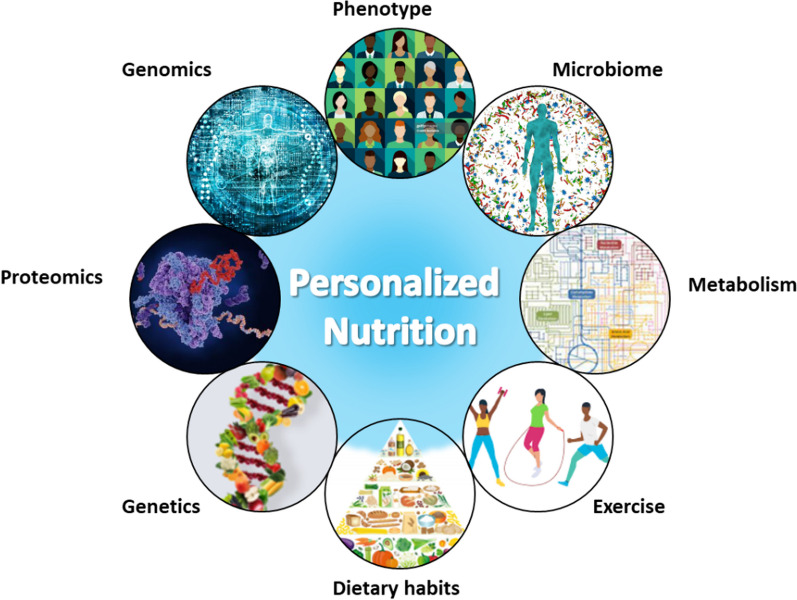
The unique physiological and genetic characteristics of individuals influence their reactions to different dietary constituents and nutrients. This notion is the foundation of personalized nutrition. The field of nutrigenetics has witnessed significant progress in understanding the impact of genetic variants on macronutrient and micronutrient levels and the individual's responsiveness to dietary intake. These variants hold significant value in facilitating the development of personalized nutritional interventions, thereby enabling the effective translation from conventional dietary guidelines to genome-guided nutrition. Nevertheless, certain obstacles could impede the extensive implementation of individualized nutrition, which is still in its infancy, such as the polygenic nature of nutrition-related pathologies. Consequently, many disorders are susceptible to the collective influence of multiple genes and environmental interplay, wherein each gene exerts a moderate to modest effect. Furthermore, it is widely accepted that diseases emerge because of the intricate interplay between genetic predisposition and external environmental influences. In the context of this specific paradigm, the utilization of advanced "omic" technologies, including epigenomics, transcriptomics, proteomics, metabolomics, and microbiome analysis, in conjunction with comprehensive phenotyping, has the potential to unveil hitherto undisclosed hereditary elements and interactions between genes and the environment. This review aims to provide up-to-date information regarding the fundamentals of personalized nutrition, specifically emphasizing the complex triangulation interplay among microbiota, dietary metabolites, and genes. Furthermore, it highlights the intestinal microbiota's unique makeup, its influence on nutrigenomics, and the tailoring of dietary suggestions. Finally, this article provides an overview of genotyping versus microbiomics, focusing on investigating the potential applications of this knowledge in the context of tailored dietary plans that aim to improve human well-being and overall health.
Overview
The claims and statistics of this paper haven’t been checked yet.
Run the check — free, no account needed. It reads the open-access text and checks the sources it cites.
Integrity signals
Registry
Cites
Statistics
Figures
Verification
Claims the paper makes
The claims and statistics of this paper haven’t been checked yet.
Run the check — free, no account needed. It reads the open-access text and checks the sources it cites.
Claims other papers make about this one
Each is checked against this paper’s own text: does it say what the citing paper says it does?
The source backs part of the claim, not all of it — or backs it for a different population, condition or comparison.
In the citing paper
“On the other hand, nutrigenetics and nutrigenomics offer promising conceptual frameworks for understanding how genetic variants affect nutrient response and how diet can modulate gene expression [143,144].”
From The Seven Methods for the Evaluation of Nutritional Status—ABCDEFG: Narrative Review (2026) · cites this paper as [143]
Experimental — accuracy not yet measured
Self-check
Percentages, sums and reported differences re-computed from the paper’s own numbers.
The self-check needs the paper’s full text.
Citations
Cites
1 retracted
RETRACTED ARTICLE: Role of the gut microbiome in chronic diseases: a narrative review
Vijay, A., & Valdes, A. M. (2022) · European Journal of Clinical Nutrition · doi:10.1038/s41430-021-00991-6 · Cited by 361
RetractedAn obesity-associated gut microbiome with increased capacity for energy harvest
Turnbaugh, P. J., Ley, R. E., Mahowald, M. A., Magrini, V., Mardis, E. R., & Gordon, J. I. (2006) · Nature · doi:10.1038/nature05414 · Cited by 12,444
Diet rapidly and reproducibly alters the human gut microbiome
David, L. A., Maurice, C. F., Carmody, R. N., Gootenberg, D. B., Button, J. E., Wolfe, B. E., Ling, A. V., Devlin, A. S., Varma, Y., Fischbach, M. A., et al. (2014) · Nature · doi:10.1038/nature12820 · Cited by 10,100
A core gut microbiome in obese and lean twins
Turnbaugh, P. J., Hamady, M., Yatsunenko, T., Cantarel, B. L., Duncan, A., Ley, R. E., Sogin, M. L., Jones, W. J., Roe, B. A., Affourtit, J. P., et al. (2009) · Nature · doi:10.1038/nature07540 · Cited by 7,823
Obesity alters gut microbial ecology
Ley, R. E., Bäckhed, F., Turnbaugh, P., Lozupone, C. A., Knight, R. D., & Gordon, J. I. (2005) · Proceedings of the National Academy of Sciences · doi:10.1073/pnas.0504978102 · Cited by 6,176
Gibson, G. R., Hutkins, R., Sanders, M. E., Prescott, S. L., Reimer, R. A., Salminen, S. J., Scott, K., Stanton, C., Swanson, K. S., Cani, P. D., et al. (2017) · Nature Reviews Gastroenterology & Hepatology · doi:10.1038/nrgastro.2017.75 · Cited by 5,634
Revised Estimates for the Number of Human and Bacteria Cells in the Body
Sender, R., Fuchs, S., & Milo, R. (2016) · PLOS Biology · doi:10.1371/journal.pbio.1002533 · Cited by 5,425
den Besten, G., van Eunen, K., Groen, A. K., Venema, K., Reijngoud, D.-J., & Bakker, B. M. (2013) · Journal of Lipid Research · doi:10.1194/jlr.r036012 · Cited by 5,048
Intestinal microbiota metabolism of l-carnitine, a nutrient in red meat, promotes atherosclerosis
Koeth, R. A., Wang, Z., Levison, B. S., Buffa, J. A., Org, E., Sheehy, B. T., Britt, E. B., Fu, X., Wu, Y., Li, L., et al. (2013) · Nature Medicine · doi:10.1038/nm.3145 · Cited by 4,386
Gut Microbiota from Twins Discordant for Obesity Modulate Metabolism in Mice
Ridaura, V. K., Faith, J. J., Rey, F. E., Cheng, J., Duncan, A. E., Kau, A. L., Griffin, N. W., Lombard, V., Henrissat, B., Bain, J. R., et al. (2013) · Science · doi:10.1126/science.1241214 · Cited by 3,788
Research works printed but not linked: 4
- American Chemical Society National Historic Chemical Landmarks. The Discovery of Vitamin C by Albert Szent-Györgyi. Accessed 20 Jul 2023 from http://www.acs.org/content/acs/en/education/whatischemistry/landmarks/szentgyorgyi.html
- Zhang H, Chen Y, Wang Z, Xie G, Liu M, Yuan B, Chai H, Wang W, Cheng P. Implications of gut microbiota in neurodegenerative diseases. Front Immunol. 2022;13:785644. · DOI
- Gophna U. Microbiology. Guts Dietary Habits Sci. 2011;334:45–6.
- Zmora N, Zilberman-Schapira G, Suez J, Mor U, Dori-Bachash M, Bashiardes S, et al. Personalized gut mucosal colonization resistance to empiric probiotics is associated with unique host and microbiome features. Cell. 2018;174:1388. https://doi.org/10.1016/j.cell.2018.08.041. · DOI · Paper page
Cited by
Sorted by citations
Items 101–131 of 131
Microbiome-Driven Food Allergies and Precision Therapeutic Innovations
Thusoo, S., & Adepwar, R. V. (2026) · Advances in computational intelligence and robotics book series · doi:10.4018/979-8-3373-3121-8.ch006
Ahmed, N., Prajapati, H., Chauhan, M. R., Raval, V. H., Sehrawat, N., & Singh, N. A. (2025) · De Gruyter eBooks · doi:10.1515/9783112205150-007
Advanced methods and technological advances in personalized microbiome research
Rana, S., Joshi, V., Kumar, P., Kumar, M., & Sahoo, G. C. (2026) · Elsevier eBooks · doi:10.1016/b978-0-443-40483-2.00002-9
HMMS in clinical therapy and precision medicine
Duan, L. (2026) · Elsevier eBooks · doi:10.1016/b978-0-443-31402-5.00004-9
Duah, I. O. (2026) · Global Perspectives on Nutrition · doi:10.1093/gpnutr/woag008
Sandra, F., Scania, A. E., Dewi, N. M., Ranggaini, D., Halim, J., Pakpahan, A., & Lee, K. H. (2026) · International Journal of Microbiology · doi:10.1155/ijm/5597426
Personalized Nutrition as an Exposomic Factor in Population Health
Tyukavin, A. I., Vlasov, T. D., Perelygin, V. V., Tan, M., & Suchkov, S. V. (2026) · Pharmacy Formulas · doi:10.17816/phf703761
Elobeid, T., Muhaid, H., & Hamad, A. (2026) · Elsevier eBooks · doi:10.1016/b978-0-443-40501-3.00003-0
Utilization of AI in diet–disease relationships
Singh, S. (2026) · Elsevier eBooks · doi:10.1016/b978-0-443-40501-3.00018-2
Role of AI in advanced application of emerging food technologies
Chandra, A., Srinivas, C. J., & Kardile, N. B. (2026) · Elsevier eBooks · doi:10.1016/b978-0-443-40501-3.00004-2
Xu, K., Berthiller, F., Krska, R., & Schwartz, H. (2026) · Journal of Agricultural and Food Chemistry · doi:10.1021/acs.jafc.5c16870
Murtazin, A. A., Islamgulov, A. K., & Malievsky, V. A. (2026) · Consilium Medicum · doi:10.26442/20751753.2026.5.203517
Riad, O. K. M., Selim, H. M. R. M., & Omran, M. E. (2026) · Discover Sustainability · doi:10.1007/s43621-026-03350-2
Global trends in traditional diets: adapting to modern health concerns
Kabeer, D. A., Vinu, W., Safad, A. K., Pramitha, M., & Zouhal, H. (2026) · Elsevier eBooks · doi:10.1016/b978-0-443-45513-1.00014-0
Kumar, Y., & Dey, S. (2026) · Springer eBooks · doi:10.1007/978-3-032-24505-2_7
Manzoor, M. F., Afraz, M. T., Waseem, M., & Ahmed, Z. (2026) · Foods · doi:10.3390/foods15142471
Precision nutrition in autoimmune diseases
la Cruz-Mosso, U. D., Macias, G. A., Campos-López, B., García, P. E. M., Alvarez-Chavez, Y. A., Muro-Dávalos, P. F., Cortes-Baltazar, J. A., Pesqueda-Cendejas, K., & Ramos-López, O. (2026) · Advances in food and nutrition research · doi:10.1016/bs.afnr.2026.07.002
Molecular Mechanisms Associated with Metabolic Dysfunction: Contributions of Nutritional Genomics
Delmicon, N. E., Franco, N. D. R., Corsi, G. C., Cho, R. M. K. K., Vidal, H. C., & Rogero, M. M. (2026) · Metabolites · doi:10.3390/metabo16070501
Prasad, M., Krishnamoorthy, K., Srinivasan, M. K., & Thiruvengadam, M. (2026) · Elsevier eBooks · doi:10.1016/b978-0-443-43810-3.00008-7
Reytor-González, C., Román-Galeano, N. M., Jimenez, J. C. C., Oentiono, O. Y., Yoong, W. A., Montalván, M., & Simancas‐Racines, D. (2026) · Frontiers in Nutrition · doi:10.3389/fnut.2026.1844337
Innovations and Emerging Trends in Probiotic Antifungal Research
Deepthi, B., V, Rao, K. P., Achar, P. N., & Sreenivasa, M. Y. (2026) · Springer eBooks · doi:10.1007/978-981-92-0002-3_23
Microbiota and nutrigenomics: beneficial allies or hidden threats
Hazaimeh, R. A., Ogunkunle, N. F., Yakubu, M., & Boateng, J. (2026) · Food & Function · doi:10.1039/d5fo04705f
Precision pediatrics: Implementing personalized nutrition in infant care
Latif, S., & Khalid, N. (2026) · Nutrition and Health · doi:10.1177/02601060261480381
A Comprehensive Review of Patent Trends in Personalized Nutrition Using Medicinal Plants Across Asia
Park, S., Park, J. H., Son, S. C., & Hwang, J. (2026) · Journal of Medicinal Food · doi:10.1177/1096620x261486097
Ramadan, M., Jobe, A., & Vijayan, R. (2026) · Frontiers in Nutrition · doi:10.3389/fnut.2026.1916937
Meat and meat Products as Functional Food
Latif, R., & Nawaz, T. (2026) · Elsevier eBooks · doi:10.1016/b978-0-443-34071-0.00010-5
Applications of artificial intelligence in personalized nutrition interventions
Zhang, Y., Feng, M., Xue, Q., Ma, R., & Liu, F. (2026) · Frontiers in Nutrition · doi:10.3389/fnut.2026.1974199
Gupta, A., & Sarethy, I. P. (2026) · Journal of Ethnic Foods · doi:10.1186/s42779-026-00331-8
Food for thought: Functional foods and microbial metabolites in diet-microbiome-brain communication
Tutu, C. O., Asiedu, B. K., Akonor, P. T., Acheampong, R., Obeng, R., Owusu-Bempah, J., Mahama, S., Wiafe‐Kwagyan, M., Nartey, J., Antwi, B., et al. (2026) · Journal of Functional Foods · doi:10.1016/j.jff.2026.107529
APAYDIN, M. B., & Ergin, R. (2026) · Metabolites · doi:10.3390/metabo16100796
Metadata
- Authors
- Lagoumintzis, G., & Patrinos, G. P.
- Affiliations
- University of Patras (GR)
- Corresponding author
- Lagoumintzis, George
- Patrinos, George P.
- Venue
- Human Genomics
- Published
- 2023-12-08
- Volume
- 17
- Issue
- 1
- Pages
- 109-109
- ISSN
- 1473-9542 (ISSN-L)
- 1479-7364
- PMC
- PMC10704648
- OpenAlex
- W4389463305
- Cited by
- 132
- References
- 264
- Citations by year
- 2026: 64 · 2025: 55 · 2024: 13
- FWCI
- 5.09
- Type
- journal article
- Language
- en
- Open access
- gold
- doi.org
- Locations
- Human Genomics (publishedVersion, cc-by)
- PubMed Central (publishedVersion, cc-by)
- PubMed (publishedVersion)
- DOAJ (DOAJ: Directory of Open Access Journals) (submittedVersion, cc-by-sa)
- Funders
- University of Patras
- Topics
- Life Sciences › Biochemistry, Genetics and Molecular Biology › Genetics › Nutrition, Genetics, and Disease
- Life Sciences › Biochemistry, Genetics and Molecular Biology › Molecular Biology › Gut microbiota and health
- Life Sciences › Pharmacology, Toxicology and Pharmaceutics › Pharmacology › Pharmacogenetics and Drug Metabolism
- Keywords
- personalized nutrition, nutrigenomics, nutrigenetics, metabolomics, microbiome, gut microbiota, gene-environment interaction, polygenic traits, dietary metabolites, healthy living
- MeSH terms
- Healthy Lifestyle, Humans, Nutritional Status, Genetic Predisposition to Disease, Nutrigenomics, Metabolomics
About these checks
Registry, retraction, Cites and statistics results are computed, not judged, with one exception: a printed reference that no index lists is read once by a model before it counts as a citation error. Claims are extracted by a model and kept only when their quote appears verbatim in the text; each cited source is then checked, with a model’s help, for whether it says what the claim relies on. Those verdicts can be wrong — read the claim’s quote and the cited source before relying on one.
Statistics and arithmetic are recomputed, not judged.
Confidence bands are shown only for fields calibrated on our annotated test set. None is calibrated yet, so no band is shown.
What counts as a claim ›How we measure confidence ›How we check this ›
Are you an author, or do you see a problem with this page? Request a review
