

Reduction in depressive symptoms predicts improvement in eating disorder symptoms in interpersonal psychotherapy: results from a naturalistic study
Open accessThe DOI matches its Crossref record; 51 of the 55 references it cites were found in a registry or an index.
Abstract
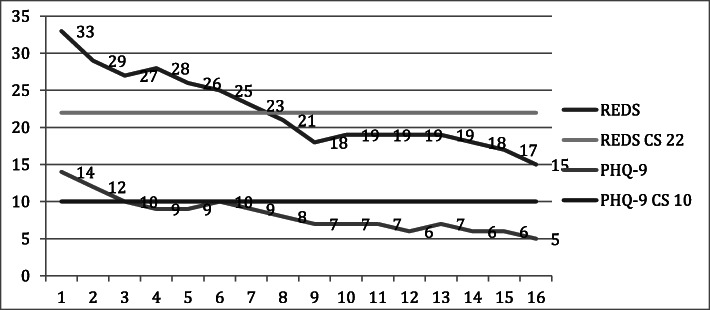
Background: Interpersonal psychotherapy (IPT) can be effective for both Bulimia Nervosa (BN) and co-occurring depression. While changes in symptoms of Eating disorder (ED) and depression have been found to correlate, it is unclear how they interact during treatment and in which order the symptoms decrease. Methods: Thirty-one patients with BN and depressive symptoms received IPT using the manual IPT-BNm in a naturalistic design. The outcome was measured with the Eating Disorder Examination Questionnaire (EDE-Q) and the Montgomery Åsberg Depression Rating Scale (MADRS-S). Symptom improvement at each session was measured with Repeated Evaluation of Eating Disorder Symptoms (REDS) and the Patient Health Questionnaire-9 (PHQ-9). Results: Significant improvements with large effect sizes were found on both ED symptoms and depression. The rates of change were linear for both BN and depression. A strong correlation between reduction of depressive symptoms and ED symptoms was found. Depressive symptom reduction at one session predicted improvement of ED symptoms at the next session. Conclusions: IPT-BNm had an effect on both BN and co-occurring depressive symptoms. The analyses indicated that reduction in depressive symptoms preceded reduction in bulimic symptoms.
Overview
The claims and statistics of this paper haven’t been checked yet.
Free: it reads the open-access text and checks the first 5 claims that cite a source we can check. Create a free account to check every claim.
Integrity signals
Registry
Cites
Statistics
Figures
Verification
Claims the paper makes
The claims and statistics of this paper haven’t been checked yet.
Free: it reads the open-access text and checks the first 5 claims that cite a source we can check. Create a free account to check every claim.
Claims other papers make about this one
Each is checked against this paper’s own text: does it say what the citing paper says it does?
The source backs part of the claim, not all of it — or backs it for a different population, condition or comparison.
In the citing paper
“It is well known that improvement in one set of symptoms often results in the resolution of or improvement in related symptoms of other disorders, which exist in a network with each other (see #10 in Figure 1) (147, 236–238).”
From The integrated treatment of eating disorders, posttraumatic stress disorder, and psychiatric comorbidity: a commentary on the evolution of principles and guidelines (2023) · cites this paper as [147]
Experimental — accuracy not yet measured
Self-check
Percentages, sums and reported differences re-computed from the paper’s own numbers.
The self-check needs the paper’s full text.
Citations
Cites
Diagnostic and Statistical Manual of Mental Disorders
Williams, J. B. W., & First, M. (2013) · Encyclopedia of Social Work · doi:10.1093/acrefore/9780199975839.013.104 · Cited by 109,519
The PHQ-9: Validity of a brief depression severity measure
Kroenke, K., Spitzer, R. L., & Williams, J. B. W. (2001) · Journal of General Internal Medicine · doi:10.1046/j.1525-1497.2001.016009606.x · Cited by 44,910
Diagnostic and Statistical Manual of Mental Disorders
American Psychiatric Association (2022) · doi:10.1176/appi.books.9780890425787 · Cited by 23,476
Multilevel analysis : an introduction to basic and advanced multilevel modeling
Snijders, T. A. B., & Bosker, R. (1999) · Cited by 14,026
Spitzer, R. L. (1999) · JAMA · doi:10.1001/jama.282.18.1737 · Cited by 9,802
Biases in dynamic models with fixed effects
Nickell, S. (1981) · Econometrica · doi:10.2307/1911408 · Cited by 8,735
Jacobson, N. S., & Truax, P. (1991) · Journal of Consulting and Clinical Psychology · doi:10.1037/0022-006x.59.1.12 · Cited by 7,770
Lippa, N. C., & Sanderson, S. C. (2013) · Human Heredity · doi:10.1159/000353712 · Cited by 6,078
Cognitive behaviour therapy for eating disorders: a “transdiagnostic” theory and treatment
Fairburn, C. G., Cooper, Z., & Shafran, R. (2003) · Behaviour Research and Therapy · doi:10.1016/s0005-7967(02)00088-8 · Cited by 3,374
Manea, L., Gilbody, S., & McMillan, D. (2012) · Canadian Medical Association Journal · doi:10.1503/cmaj.110829 · Cited by 1,966
Frank, E. (1991) · Archives of General Psychiatry · doi:10.1001/archpsyc.1991.01810330075011 · Cited by 1,959
Löwe, B., Kroenke, K., Herzog, W., & Gräfe, K. (2004) · Journal of Affective Disorders · doi:10.1016/s0165-0327(03)00198-8 · Cited by 1,558
Dynamic Structural Equation Models
Asparouhov, T., Hamaker, E. L., & Muthén, B. (2018) · Structural Equation Modeling: A Multidisciplinary Journal · doi:10.1080/10705511.2017.1406803 · Cited by 985
The role of mentalizing and epistemic trust in the therapeutic relationship.
Fonagy, P., & Allison, E. (2014) · Psychotherapy · doi:10.1037/a0036505 · Cited by 960
Cognitive Behavior Therapy and Eating Disorders
Weiss, F. (2008) · American Journal of Psychotherapy · doi:10.1176/appi.psychotherapy.2008.62.4.422 · Cited by 819
Agras, W. S., Walsh, B. T., Fairburn, C. G., Wilson, G. T., & Kraemer, H. C. (2000) · Archives of General Psychiatry · doi:10.1001/archpsyc.57.5.459 · Cited by 715
Eating Disorder Examination-Questionnaire
Hilbert, A., Tuschen-Caffier, B., Karwautz, A., Niederhofer, H., & Munsch, S. (2007) · Diagnostica · doi:10.1026/0012-1924.53.3.144 · Cited by 703
Svanborg, P., & Åsberg, M. (1994) · Acta Psychiatrica Scandinavica · doi:10.1111/j.1600-0447.1994.tb01480.x · Cited by 693
Eating disorder examination questionnaire (EDE-Q): norms for young adult women
Mond, J. M., Hay, P. J., Rodgers, B., & Owen, C. (2006) · Behaviour Research and Therapy · doi:10.1016/j.brat.2004.12.003 · Cited by 681
Outcomes of eating disorders: a systematic review of the literature
Berkman, N. D., Lohr, K. N., & Bulik, C. M. (2007) · International Journal of Eating Disorders · doi:10.1002/eat.20369 · Cited by 595
Fairburn, C. G. (1993) · Archives of General Psychiatry · doi:10.1001/archpsyc.1993.01820180009001 · Cited by 549
Three Psychological Treatments for Bulimia Nervosa: A Comparative Trial
Fairburn, C. G. (1991) · Archives of General Psychiatry · doi:10.1001/archpsyc.1991.01810290075014 · Cited by 529
Interpersonal Psychotherapy for Depression: A Meta-Analysis
Cuijpers, P., Geraedts, A. S., van Oppen, P., Andersson, G., Markowitz, J. C., & van Straten, A. (2011) · American Journal of Psychiatry · doi:10.1176/appi.ajp.2010.10101411 · Cited by 511
Self-citationIs Exposure Necessary? A Randomized Clinical Trial of Interpersonal Psychotherapy for PTSD
Markowitz, J. C., Petkova, E., Neria, Y., Van Meter, P. E., Zhao, Y., Hembree, E., Lovell, K., Biyanova, T., & Marshall, R. D. (2015) · American Journal of Psychiatry · doi:10.1176/appi.ajp.2014.14070908 · Cited by 383
Enhancing recovery rates: Lessons from year one of IAPT
Gyani, A., Shafran, R., Layard, R., & Clark, D. M. (2013) · Behaviour Research and Therapy · doi:10.1016/j.brat.2013.06.004 · Cited by 345
Fairburn, C. G., Bailey-Straebler, S., Basden, S., Doll, H. A., Jones, R., Murphy, R., O'Connor, M. E., & Cooper, Z. (2015) · Behaviour Research and Therapy · doi:10.1016/j.brat.2015.04.010 · Cited by 314
Interpersonal Psychotherapy for Mental Health Problems: A Comprehensive Meta-Analysis
Cuijpers, P., Donker, T., Weissman, M. M., Ravitz, P., & Cristea, I. A. (2016) · American Journal of Psychiatry · doi:10.1176/appi.ajp.2015.15091141 · Cited by 283
Defining remission by cut off score on the MADRS: selecting the optimal value
Hawley, C. J., Gale, T. M., & Sivakumaran, T. (2002) · Journal of Affective Disorders · doi:10.1016/s0165-0327(01)00451-7 · Cited by 266 · cited 1×
“By MADRS-S standards, 13–19 points indicate mild depression, 20–34 moderate depression, and more than 34 points severe depression [36].”
BackgroundReliability of the Eating Disorder Examination-Questionnaire in patients with binge eating disorder
Reas, D. L., Grilo, C. M., & Masheb, R. M. (2006) · Behaviour Research and Therapy · doi:10.1016/j.brat.2005.01.004 · Cited by 245
Puccio, F., Fuller‐Tyszkiewicz, M., Ong, D., & Krug, I. (2016) · International Journal of Eating Disorders · doi:10.1002/eat.22506 · Cited by 216
Mechanisms of change in interpersonal therapy (IPT)
Lipsitz, J. D., & Markowitz, J. C. (2013) · Clinical Psychology Review · doi:10.1016/j.cpr.2013.09.002 · Cited by 214
Linardon, J. (2018) · International Journal of Eating Disorders · doi:10.1002/eat.22897 · Cited by 174
Welch, E., Birgegård, A., Parling, T., & Ghaderi, A. (2011) · Behaviour Research and Therapy · doi:10.1016/j.brat.2010.10.010 · Cited by 167
Rapid response to eating disorder treatment: a systematic review and meta-analysis
Linardon, J., Brennan, L., & de la Piedad Garcia, X. (2016) · International Journal of Eating Disorders · doi:10.1002/eat.22595 · Cited by 143
The Guide to Interpersonal Psychotherapy
Weissman, M. M., Markowitz, J. C., & Klerman, G. L. (2017) · Oxford Clinical Psychology · doi:10.1093/med-psych/9780190662592.001.0001 · Cited by 141
How do psychological treatments work? Investigating mediators of change
Murphy, R., Cooper, Z., Hollon, S. D., & Fairburn, C. G. (2009) · Behaviour Research and Therapy · doi:10.1016/j.brat.2008.10.001 · Cited by 137
Interpersonal Psychotherapy for Eating Disorders
Murphy, R., Straebler, S., Basden, S., Cooper, Z., & Fairburn, C. G. (2012) · Clinical Psychology & Psychotherapy · doi:10.1002/cpp.1780 · Cited by 117
Screening for depression: Rasch analysis of the dimensional structure of the PHQ-9 and the HADS-D
Kendel, F., Wirtz, M. A., Dunkel, A., Lehmkuhl, E., Hetzer, R., & Regitz‐Zagrosek, V. (2009) · Journal of Affective Disorders · doi:10.1016/j.jad.2009.07.004 · Cited by 96
Birgegård, A., Björck, C., & Clinton, D. (2010) · European Eating Disorders Review · doi:10.1002/erv.1003 · Cited by 83
Recent Research on Bulimia Nervosa
Wade, T. D. (2018) · Psychiatric Clinics of North America · doi:10.1016/j.psc.2018.10.002 · Cited by 70
Current and Emerging Directions in the Treatment of Eating Disorders
Brown, T. A., & Keel, P. K. (2012) · Substance Abuse: Research and Treatment · doi:10.4137/sart.s7864 · Cited by 58 · cited 2×
“effect on the outcome is the high co-morbidity with depression [3].”
BackgroundHow much therapy is enough? Comparing dose-effect and good-enough models in two different settings.
Falkenström, F., Josefsson, A., Berggren, T., & Holmqvist, R. (2016) · Psychotherapy · doi:10.1037/pst0000039 · Cited by 57
Self-citationInterpersonal psychotherapy for eating disorders: current perspectives
Miniati, M., Callari, A., Maglio, A., & Calugi, S. (2018) · Psychology Research and Behavior Management · doi:10.2147/prbm.s120584 · Cited by 53
Arcelus, J., Whight, D., Langham, C., Baggott, J., McGrain, L., Meadows, L., & Meyer, C. (2009) · European Eating Disorders Review · doi:10.1002/erv.932 · Cited by 39
Falkenström, F., Solomonov, N., & Rubel, J. A. (2020) · Psychotherapy Research · doi:10.1080/10503307.2020.1769875 · Cited by 31 · cited 1×
“A recent simulation study [50] on a similar SEM model as the one used in the present study showed that with N = 50 and T = 5, i.”
Self-citationA Brief Form of Interpersonal Psychotherapy for Adult Patients with Bulimic Disorders: A Pilot Study
Arcelus, J., Whight, D., Brewin, N., & McGrain, L. (2012) · European Eating Disorders Review · doi:10.1002/erv.2164 · Cited by 21
New Insights into the Prevention and Treatment of Bulimia Nervosa
Hay, P. (2011) · InTech eBooks · doi:10.5772/805 · Cited by 13
Interpersonal Problems in People with Bulimia Nervosa and the Role of Interpersonal Psychotherapya
Arcelus, J., Whight, D., & Haslam, M. (2011) · InTech eBooks · doi:10.5772/19212 · Cited by 5
Interpersonal psychotherapy for eating disorders with co-morbid depression: A pilot study
Bäck, M., Gustafsson, S. A., & Holmqvist, R. (2017) · European Journal of Psychotherapy & Counselling · doi:10.1080/13642537.2017.1386226 · Cited by 5
Self-citationAssessment of eating disorders: interview or self-report questionnaire
Fairburn, C. G., & Beglin, S. J. (1994) · International Journal of Eating Disorders · doi:10.1002/1098-108x(199412)16:4<363::aid-eat2260160405>3.0.co;2-# · cited 1×
“The Eating Disorder Examination Questionnaire (EDEQ) is a widely used self-report measure of ED psychopathology [29, 30], derived from the EDE- interview [31], and has satisfactory validity and reliability [32, 33].”
Method(1987) · doi:10.1002/1098-108x(198701)6:1<1::aid-eat2260060102>3.0.co;2-9
Research works printed but not linked: 6
- (UK) NGA Eating disorders: recognition and treatment 2017 London National Institute for Health and Care Excellence (UK) 28654225
- Law R Curriculum for practitioner training in interpersonal psychotherapy (trainee). IAPT/NHS/UK 2011
- Whight D Meadows L McGrain L Langham C Baggott J Arcelus J IPT-BN (m) interpersonal psychotherapy for bulimia spectrum disorders: a treatment guide 2011 Leicestershire Troubador
- Falsdalen Riegler U Sundin S Standardization and validation of the self-report questionnaire KUS-P: How normal is your eating disturbance? Normering och validering av självskattnings-formuläret kus-p. Hur ätstörd är normalt att vara? [Master] 2009
- Muthén LK Muthén BO Mplus user’s guide 1998 Los Angeles Muthén & Muthén
- Bohart AC The client is the most important common factor: Clients’ self-healing capacities and psychotherapy J Psychother Integr 2000 10 127 149 · DOI
Cited by
Mountjoy, M., Ackerman, K. E., Bailey, D. M., Burke, L. M., Constantini, N., Hackney, A. C., Heikura, I. A., Melin, A., Pensgaard, A. M., Stellingwerff, T., et al. (2023) · British Journal of Sports Medicine · doi:10.1136/bjsports-2023-106994 · Cited by 974
Eck, K., Quick, V., & Byrd-Bredbenner, C. (2022) · Nutrients · doi:10.3390/nu14183876 · Cited by 67
Brewerton, T. D. (2023) · Frontiers in Psychiatry · doi:10.3389/fpsyt.2023.1149433 · Cited by 46
Advances in Psychotherapy for Eating Disorders
Staples, C., Grunewald, W., Smith, A. R., & Rancourt, D. (2021) · Advances in Psychiatry and Behavioral Health · doi:10.1016/j.ypsc.2021.05.007 · Cited by 13
Eating disorder symptoms and corresponding evidence-based treatments: a narrative review
Ortiz, A. M. L., Peters, A. S., Webber, K. T., Butler, R. M., Fitterman-Harris, H. F., & Levinson, C. A. (2026) · Journal of Eating Disorders · doi:10.1186/s40337-025-01485-7 · Cited by 9
“IPT-BN focuses on interpersonal events related to ED symptoms and has been shown to reduce both depression and EDs [11].”
Metadata
- Authors
- Bäck, M., Falkenström, F., Gustafsson, S. A., Andersson, G., & Holmqvist, R.
- Affiliations
- Linköping University (SE)
- Örebro University (SE)
- Corresponding author
- Bäck, Malin
- Venue
- Journal of Eating Disorders
- Published
- 2020-07-03
- Volume
- 8
- Issue
- 1
- Pages
- 33-33
- ISSN
- 2050-2974 (ISSN-L)
- PMC
- PMC7333417
- OpenAlex
- W3038357242
- Cited by
- 8
- References
- 55
- Citations by year
- 2026: 2 · 2025: 1 · 2023: 2 · 2022: 2 · 2021: 1
- FWCI
- 0.50
- Type
- journal article
- Language
- en
- Open access
- gold
- doi.org
- Licence
- cc-by
- creativecommons.org/licenses/by/4.0 (tdm)
- creativecommons.org/licenses/by/4.0 (vor)
- Locations
- Journal of Eating Disorders (publishedVersion, cc-by)
- PubMed Central (publishedVersion, cc-by)
- PubMed (publishedVersion)
- DOAJ (DOAJ: Directory of Open Access Journals) (submittedVersion, cc-by-sa)
- Funders
- Linköpings Universitet
- Topics
- Social Sciences › Psychology › Clinical Psychology › Eating Disorders and Behaviors
- Social Sciences › Psychology › Experimental and Cognitive Psychology › Anxiety, Depression, Psychometrics, Treatment, Cognitive Processes
- Health Sciences › Nursing › Nutrition and Dietetics › Nutrition, Health and Food Behavior
- Keywords
- interpersonal psychotherapy, bulimia nervosa, depressive symptoms, eating disorder symptoms, symptom interactions, treatment outcomes
About these checks
Registry, retraction, Cites and statistics results are computed, not judged, with one exception: a printed reference that no index lists is read once by a model before it counts as a citation error. Claims are extracted by a model and kept only when their quote appears verbatim in the text; each cited source is then checked, with a model’s help, for whether it says what the claim relies on. Those verdicts can be wrong — read the claim’s quote and the cited source before relying on one.
Statistics and arithmetic are recomputed, not judged.
Confidence bands are shown only for fields calibrated on our annotated test set. None is calibrated yet, so no band is shown.
What counts as a claim ›How we measure confidence ›How we check this ›
Are you an author, or do you see a problem with this page? Request a review
Data sources
Bibliographic data: Semantic Scholar, OpenAlex, Crossref.
Contains information from the Semantic Scholar Academic Graph Datasets, made available under the ODC Attribution License (ODC-BY 1.0).
Semantic Scholar’s data is described in: Kinney, R., et al. (2023). The Semantic Scholar Open Data Platform. arXiv:2301.10140.
