

Associations of self-repression with disordered eating and symptoms of other psychopathologies for men and women
Open accessPublished version of a preprint
The DOI matches its Crossref record; 69 of the 69 references it cites were found in a registry or an index.
Abstract
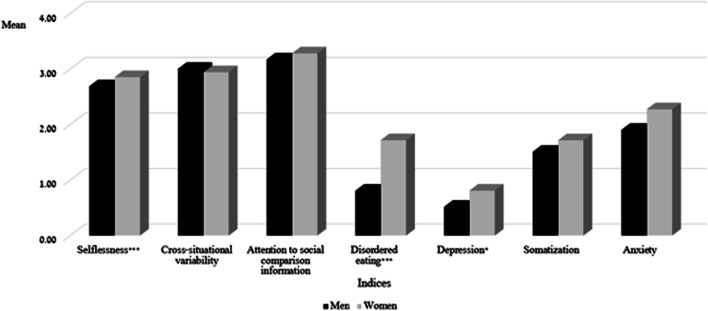
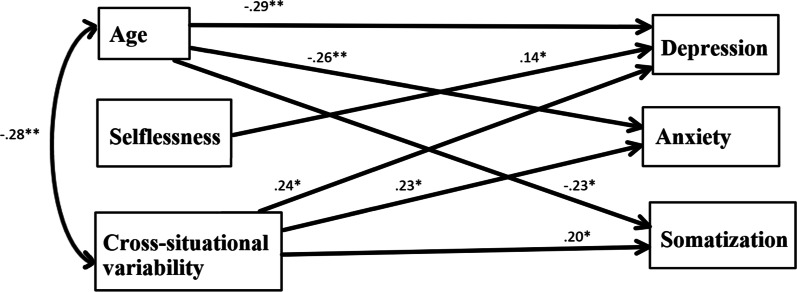
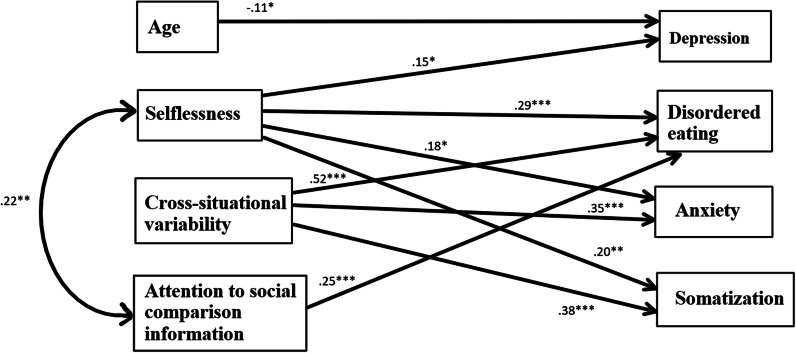
Background: Disordered eating has been found to be associated with constructs involving self-repression, such as selflessness (the tendency to relinquish one’s needs for others’), and concern for appropriateness (an alertness to information about social comparison and tendency to vary one’s behavior in different social situations). This study aimed to examine associations between these self-repression variables and symptoms of general psychopathology for women and men in a community sample. Methods: Two hundred and thirty-six participants (92 men) aged 18–76 (M = 29.11 ± 10.10) volunteered to complete online measures of disordered eating, concern for appropriateness (cross-situational variability and attention to social comparison information), selflessness, and symptoms of depression, anxiety and somatization. Structural equation models were built to assess pathways between the study variables for men and women separately. Results: A MANOVA 2*7 design showed that women scored significantly higher than men on measures of selflessness, disordered eating and depression. For men, selflessness scores were positively and significantly associated only with depression scores. Cross-situational variability scores were positively associated with depression, somatization and anxiety scores. For women, selflessness scores were positively and significantly associated with depression, disordered eating, somatization and anxiety scores. Cross-situational variability scores were positively and significantly associated with depression, anxiety and somatization scores but not with disordered eating scores. Attention to Social Comparison Information scores were positively and significantly associated only with disordered eating scores. Conclusions: Self-repression is more closely linked to psychopathology in women than in men. For men, self-suppression seems to be associated with symptoms of internalizing disorders, but not disordered eating. Even for women, it appears that self-repression is not connected exclusively with disordered eating, but with symptoms of psychopathology in general. Future research should explore why self-suppression plays such a central role in women’s psychopathology.
Overview
The claims and statistics of this paper haven’t been checked yet.
Free: it reads the open-access text and checks the first 5 claims that cite a source we can check. Create a free account to check every claim.
Integrity signals
Registry
Cites
Statistics
Figures
Verification
Claims the paper makes
The claims and statistics of this paper haven’t been checked yet.
Free: it reads the open-access text and checks the first 5 claims that cite a source we can check. Create a free account to check every claim.
Claims other papers make about this one
Each is checked against this paper’s own text: does it say what the citing paper says it does?
The check wasn’t confident either way, so it gives no verdict — never disputed.
In the citing paper
“The World Mental Health Survey estimated the annual prevalence of MDD to be 4.4% and the lifetime prevalence to be approximately 10% -15%36,37.”
From Temporal and spatial trend analysis of all-cause depression burden based on Global Burden of Disease (GBD) 2019 study (2024) · cites this paper as [37]
Experimental — accuracy not yet measured
Self-check
Percentages, sums and reported differences re-computed from the paper’s own numbers.
The self-check needs the paper’s full text.
Citations
Cites
Diagnostic and Statistical Manual of Mental Disorders
American Psychiatric Association (2013) · doi:10.1176/appi.books.9780890425596 · Cited by 116,369
The PHQ-9: Validity of a brief depression severity measure
Kroenke, K., Spitzer, R. L., & Williams, J. B. W. (2001) · Journal of General Internal Medicine · doi:10.1046/j.1525-1497.2001.016009606.x · Cited by 44,910
Alternative Ways of Assessing Model Fit
Browne, M. W., & Cudeck, R. (1992) · Sociological Methods & Research · doi:10.1177/0049124192021002005 · Cited by 27,200
Significance tests and goodness of fit in the analysis of covariance structures.
Bentler, P. M., & Bonett, D. G. (1980) · Psychological Bulletin · doi:10.1037//0033-2909.88.3.588 · Cited by 19,023
Lippa, N. C., & Sanderson, S. C. (2013) · Human Heredity · doi:10.1159/000353712 · Cited by 6,078
Salk, R. H., Hyde, J. S., & Abramson, L. Y. (2017) · Psychological Bulletin · doi:10.1037/bul0000102 · Cited by 2,622
Measurement of Consumer Susceptibility to Interpersonal Influence
Bearden, W. O., Netemeyer, R. G., & Teel, J. E. (1989) · Journal of Consumer Research · doi:10.1086/209186 · Cited by 2,320
The American Psychiatric Association (APA)
Strentz, T. (2017) · Psychological Aspects of Crisis Negotiation · doi:10.1201/9781315150581-3 · Cited by 1,850
Psychosomatic Families: Anorexia Nervosa in Context
Minuchin, S., Rosman, B. L., & Baker, L. (1978) · Harvard University Press eBooks · doi:10.4159/harvard.9780674418233 · Cited by 1,607
The beauty myth: how images of beauty are used against women
(1992) · Choice Reviews Online · doi:10.5860/choice.29-3031 · Cited by 1,257
Revision of the Self-Monitoring Scale.
Lennox, R. D., & Wolfe, R. N. (1984) · Journal of Personality and Social Psychology · doi:10.1037//0022-3514.46.6.1349 · Cited by 1,225
Impression Management Theory and Social Psychological Research
(1981) · Elsevier eBooks · doi:10.1016/c2013-0-11591-7 · Cited by 677
Impression management versus intrapsychic explanations in social psychology: A useful dichotomy?
Tetlock, P. E., & Manstead, A. S. R. (1985) · Psychological Review · doi:10.1037//0033-295x.92.1.59 · Cited by 500
Bearden, W. O., & Rose, R. L. (1990) · Journal of Consumer Research · doi:10.1086/209231 · Cited by 455
Social heuristics and social roles: Intuition favors altruism for women but not for men.
Rand, D. G., Brescoll, V. L., Everett, J. A. C., Capraro, V., & Barcelo, H. (2016) · Journal of Experimental Psychology: General · doi:10.1037/xge0000154 · Cited by 330
Self and identity : fundamental issues
Ashmore, R. D., & Jussim, L. J. (1997) · Cited by 303
The role of materialism, religiosity, and demographics in subjective well-being
La Barbera, P. A., & G�rhan, Z. (1997) · Psychology and Marketing · doi:10.1002/(sici)1520-6793(199701)14:1<71::aid-mar5>3.0.co;2-l · Cited by 291
Treating the Self: Elements of Clinical Self Psychology
Wolf, E. S. (1988) · Medical Entomology and Zoology · Cited by 280
Fasting Girls: The History of Anorexia Nervosa
Brumberg, J. J. (1988) · Medical Entomology and Zoology · Cited by 268
Inhibited expression of negative emotions and interpersonal orientation in anorexia nervosa
Geller, J., Cockell, S. J., Hewitt, P. L., Goldner, E. M., & Flett, G. L. (2000) · International Journal of Eating Disorders · doi:10.1002/1098-108x(200007)28:1<8::aid-eat2>3.0.co;2-u · Cited by 248
The Hungry Self: Women, Eating and Identity
Chernin, K. (1994) · Cited by 222
Sex and gender in psychopathology: DSM–5 and beyond.
Hartung, C. M., & Lefler, E. K. (2019) · Psychological Bulletin · doi:10.1037/bul0000183 · Cited by 220
Schaef, A. W. (1981) · HarperSanFrancisco eBooks · Cited by 214
Meta-analysis of gender differences in body appreciation
He, J., Sun, S., Zickgraf, H. F., Lin, Z., & Fan, X. (2020) · Body Image · doi:10.1016/j.bodyim.2020.02.011 · Cited by 203
Handbook of Psychotherapy for Anorexia Nervosa and Bulimia
DiBella, G. A. W. (1986) · American Journal of Psychotherapy · doi:10.1176/appi.psychotherapy.1986.40.3.476 · Cited by 187
Yun, D., & Silk, K. J. (2011) · Health Communication · doi:10.1080/10410236.2010.549814 · Cited by 152
Bruch, H., Czyzewski, D. I., & Suhr, M. A. (1988) · Virtual Defense Library (Ministerio de Defensa) · Cited by 146
Male‐female giving differentials: are women more altruistic?
Simmons, W. O., & Emanuele, R. (2007) · Journal of Economic Studies · doi:10.1108/01443580710830989 · Cited by 139
Westen, D., Moses, M. J., Silk, K. R., Lohr, N. E., Cohen, R., & Segal, H. (1992) · Journal of Personality Disorders · doi:10.1521/pedi.1992.6.4.382 · Cited by 119
Perry, J. A., Silvera, D. H., Neilands, T. B., Rosenvinge, J. H., & Hanssen, T. (2007) · Eating Behaviors · doi:10.1016/j.eatbeh.2007.01.007 · Cited by 93
Zaitsoff, S. L., Geller, J., & Srikameswaran, S. (2002) · European Eating Disorders Review · doi:10.1002/erv.418 · Cited by 90
Sexual, body-image, and personality attitudes in anorexia nervosa
Leon, G. R., Lucas, A. R., Colligan, R. C., Ferdinande, R. J., & Kamp, J. D. (1985) · Research on Child and Adolescent Psychopathology · doi:10.1007/bf00910645 · Cited by 82
Bardone‐Cone, A. M., Thompson, K. A., & Miller, A. J. (2020) · Journal of Personality · doi:10.1111/jopy.12448 · Cited by 81
Self Psychological Reflections on the Origins of Eating Disorders
Geist, R. A. (1989) · Journal of the American Academy of Psychoanalysis · doi:10.1521/jaap.1.1989.17.1.5 · Cited by 75
Campbell, R., Boone, L., Vansteenkiste, M., & Soenens, B. (2018) · Journal of Clinical Psychology · doi:10.1002/jclp.22628 · Cited by 72 · cited 1×
“The toll of selflessness and its link with disordered eating may be due in part to an association between eating pathology and the frustration of psychological needs [32], whereby people whose psychological needs are not met focus on meeting those of others, as a form of self-sacrifice.”
BackgroundDimensions of Social Competence: Personality and Coping Style Correlates
Miller, M. L., Omens, R. S., & Delvadia, R. (1991) · Personality and Individual Differences · doi:10.1016/0191-8869(91)90185-e · Cited by 65
Consumer susceptibility to interpersonal influence and attributional sensitivity
Netemeyer, R. G., Bearden, W. O., & Teel, J. E. (1992) · Psychology & Marketing · doi:10.1002/mar.4220090504 · Cited by 62
Geller, J., Zaitsoff, S. L., & Srikameswaran, S. (2002) · International Journal of Eating Disorders · doi:10.1002/eat.10083 · Cited by 58
Association of fear of terror with low-grade inflammation among apparently healthy employed adults
Melamed, S., Shirom, A., Toker, S., Berliner, S., & Shapira, I. (2004) · Psychosomatic Medicine · doi:10.1097/01.psy.0000130963.52755.b9 · Cited by 51 · cited 1×
“In this study a Hebrew translation of the Patient Health Questionnaire-9 used in previous research was employed [55].”
MethodGigi, I., Bachner‐Melman, R., & Ari, L. L. (2015) · Appetite · doi:10.1016/j.appet.2015.12.027 · Cited by 50
Self-citationRejection of life in anorexic and bulimic patients
Bachar, E., Latzer, Y., Canetti, L., Gur, E., Berry, E. M., & Bonne, O. (2002) · International Journal of Eating Disorders · doi:10.1002/eat.10003 · Cited by 42
Women, Girls, and Psychotherapy
Vásquez, M. J. T. (1994) · Contemporary Psychology · doi:10.1037/034434 · Cited by 42
Sense of Self: Its Place in Personality Disturbance, Psychopathology, and Normal Experience
Basten, C., & Touyz, S. W. (2019) · Review of General Psychology · doi:10.1177/1089268019880884 · Cited by 41
Bachar, E., Gur, E., Canetti, L., Berry, E. M., & Stein, D. J. (2010) · European Eating Disorders Review · doi:10.1002/erv.984 · Cited by 38
"Fasting Girls": Reflections on Writing the History of Anorexia Nervosa
Brumberg, J. J. (1985) · Monographs of the Society for Research in Child Development · doi:10.2307/3333866 · Cited by 34
Gooldin, S. (2003) · Body & Society · doi:10.1177/1357034x030092002 · Cited by 34
Construct Validity of the Concern For Appropriateness Scale
Cutler, B. L., & Wolfe, R. N. (1985) · Journal of Personality Assessment · doi:10.1207/s15327752jpa4903_19 · Cited by 32
The Contributions of Self Psychology to the Treatment of Anorexia and Bulimia
Bachar, E. (1998) · American Journal of Psychotherapy · doi:10.1176/appi.psychotherapy.1998.52.2.147 · Cited by 32
The relationship between selflessness levels and the severity of anorexia nervosa symptomatology
Bachner‐Melman, R., Zohar, A. H., Ebstein, R. P., & Bachar, E. (2007) · European Eating Disorders Review · doi:10.1002/erv.740 · Cited by 31
Self-citationConcern for Appropriateness Scale and Behavioral Conformity
Johnson, M. A. (1989) · Journal of Personality Assessment · doi:10.1207/s15327752jpa5303_13 · Cited by 30
Bio-Psycho-Social Contributions to Understanding Eating Disorders
Stein, D., & Latzer, Y. (2016) · Springer eBooks · doi:10.1007/978-3-319-32742-6 · Cited by 27
The EDE-Q in Hebrew: Structural and Convergent/Divergent Validity in a Population Sample.
Zohar, A. H., Ari, L. L., & Bachner‐Melman, R. (2018) · PubMed · Cited by 26
Self-citationKyrios, M., Nelson, B., Ahern, C., Fuchs, T. A. E., & Parnas, J. (2015) · Psychopathology · doi:10.1159/000438876 · Cited by 26
Somatization: a perspective from self psychology.
Rodin, G. (1991) · Journal of American Academy of Psychoanalysis and Dynamic Psychiatry · doi:10.1521/jaap.1.1991.19.3.367 · Cited by 25
Anorexia Nervosa and Anorexia Mirabilis
Harris, J. C. (2014) · JAMA Psychiatry · doi:10.1001/jamapsychiatry.2013.2765 · Cited by 23
Celuch, K. G., & Slama, M. E. (1995) · Journal of Applied Social Psychology · doi:10.1111/j.1559-1816.1995.tb01813.x · Cited by 22
Narcissism and Eating Characteristics in Young Nonclinical Women
Brunton, J., Lacey, J. H., & Waller, G. (2005) · The Journal of Nervous and Mental Disease · doi:10.1097/01.nmd.0000152784.01448.fe · Cited by 21
Bachner‐Melman, R., Zohar, A. H., Elizur, Y., Kremer, I., Golan, M., & Ebstein, R. P. (2009) · Eating and Weight Disorders - Studies on Anorexia Bulimia and Obesity · doi:10.1007/bf03327789 · Cited by 20
Self-citationMyszkowski, N., Storme, M., Zenasni, F., & Lubart, T. (2014) · Canadian Journal of Behavioural Science/Revue canadienne des sciences du comportement · doi:10.1037/a0033107 · Cited by 19
The inter‐relationship between diet, selflessness, and disordered eating in Australian women
Collins, M., & Quinton, S. (2020) · Brain and Behavior · doi:10.1002/brb3.1774 · Cited by 14
Disordered Eating Attitudes and Behaviors: Gender Differences in Adolescence and Young Adulthood
Ivanova, M. R., Bakova, D. R., Semerdjieva, M. A., Torniova, B., Tilov, B. G., & Raykova, E. (2017) · Journal of Women s Health Care · doi:10.4172/2167-0420.1000368 · Cited by 14
Tolmacz, R., Bachner-Melman, R., Lev-Ari, L., & Brondvine, D. (2021) · Eating and Weight Disorders · doi:10.1007/s40519-021-01283-5 · Cited by 10
Self-citationBeebe, L. H., & Gunther, M. E. (2012) · Issues in Mental Health Nursing · doi:10.3109/01612840.2011.653043 · Cited by 9
Pinus, U., Canetti, L., Bonne, O. B., & Bachar, E. (2017) · Eating and Weight Disorders - Studies on Anorexia Bulimia and Obesity · doi:10.1007/s40519-017-0444-3 · Cited by 8
Bachner‐Melman, R., Ari, L. L., Levin, R., & Lichtenberg, P. (2016) · International Journal of Clinical and Experimental Hypnosis · doi:10.1080/00207144.2016.1131591 · Cited by 7
Self-citationSupplemental Material for Sex and Gender in Psychopathology: DSM–5 and Beyond
(2019) · Psychological Bulletin · doi:10.1037/bul0000183.supp · Cited by 4
Evidence Basis for Psychodynamic Self-Psychology in Eating Disorders - A Review Paper.
Bachar, E. (2018) · PubMed · Cited by 3
Self-Sacrificing or Victimized?
Kinukawa (2021) · Journal of Feminist Studies in Religion · doi:10.2979/jfemistudreli.37.1.18 · Cited by 1
Assessment of eating disorders: interview or self-report questionnaire
Fairburn, C. G., & Beglin, S. J. (1994) · International Journal of Eating Disorders · doi:10.1002/1098-108x(199412)16:4<363::aid-eat2260160405>3.0.co;2-#
Research works printed but not linked: 16
- Cawood RL Self in relationship in women who engage in disordered eating 1998 Gainesville University of Florida
- Bruch H The golden cage 1978 Cambridge Harvard University Press
- Selvini-Palazzoli M Self-starvation 1974 London Chaucer Publishing
- Goodsit A Garner D Garfinkel PE Eating disorders: a self psychological perspective Handbook of psychotherapy for eating disorders 1997 New York Guilford Press 55 82
- Bagley PM. The young hunger artists: the portrayal of eating disorders by Contemporary Austrian women writers. Intercult Promen. 2012;1(1):76. http://clok.uclan.ac.uk/2123/1/2123_BAGLEY_article_FINAL.pdf
- Claude-Pierre P The secret language of eating disorders 1997 Sydney Bantam
- Fairburn CG Cooper Z O’Connor M The eating disorder examination Int J Eat Disorder 1993 6 1 8
- Derogatis LR BSI-18: Brief Symptom Inventory 18-administration, scoring, and procedures manual 2000 Minneapolis NCS Pearson
- Gilbar O Ben-Zur H Adult Israeli community norms for the Brief Symptom Inventory (BSI) Int J Stress Manag 2002 9 1 1 10 · doi:10.1023/a:1013097816238
- Chambers H The wasting heroine in German fiction by women, 1770–1914 Mod Lang Rev 2006 101 2 573 575
- Palazzoli MS L'anoressia mentale 1963 Milan Feltrinelli
- Orbach S Fat is a feminist issue 1978 London Arrow Books
- Orbach S Hunger strike 1986 London Faber
- Lawrence M Pennycook W Anorexic experience 1984 London Women's Press
- MacLeod S The art of starvation 1982 New York Schocken Books
- Olson G Reading eating disorders: writings on bulimia and anorexia as confessions of American culture 2003 Frankfurt am Main Lang
Cited by
Piao, J., Huang, Y., Han, C., Li, Y., Xu, Y., Liu, Y., & He, X. (2022) · European Child & Adolescent Psychiatry · doi:10.1007/s00787-022-02040-4 · Cited by 264
Liu, J., Liu, Y., Ma, W., Tong, Y., & Zheng, J. (2024) · Scientific Reports · doi:10.1038/s41598-024-62381-9 · Cited by 160
Chen, X.-D., Li, F., Zuo, H., & Zhu, F. (2025) · Depression and Anxiety · doi:10.1155/da/5553491 · Cited by 97
Gender differences in mental health among late adolescents: A cross-lagged panel network analysis
Zhu, K., & Xue, S. (2025) · Journal of Affective Disorders · doi:10.1016/j.jad.2025.119595 · Cited by 16
Zegarra-López, A., Bona, G. L. V.-D., Romero-Montenegro, D., Santisteban, B. F., Prieto-Molinari, D. E., & Montoya-Cuadrao, M. (2022) · International Journal of Environmental Research and Public Health · doi:10.3390/ijerph192315576 · Cited by 14
Metadata
- Authors
- Bachner-Melman, R., Watermann, Y., Lev-Ari, L., & Zohar, A. H.
- Affiliations
- Ruppin Academic Center (IL)
- Venue
- Journal of Eating Disorders
- Published
- 2022-03-21
- Volume
- 10
- Issue
- 1
- Pages
- 41-41
- ISSN
- 2050-2974 (ISSN-L)
- PMC
- PMC8935791
- OpenAlex
- W4220787191
- Cited by
- 6
- References
- 69
- Citations by year
- 2026: 1 · 2025: 2 · 2024: 1 · 2022: 2
- FWCI
- 1.14
- Type
- journal article
- Language
- en
- Open access
- gold
- doi.org
- Licence
- cc-by
- creativecommons.org/licenses/by/4.0 (tdm)
- creativecommons.org/licenses/by/4.0 (vor)
- Locations
- Journal of Eating Disorders (publishedVersion, cc-by)
- Research Square (acceptedVersion, cc-by)
- PubMed Central (publishedVersion, cc-by)
- PubMed (publishedVersion)
- DOAJ (DOAJ: Directory of Open Access Journals) (submittedVersion)
- Topics
- Social Sciences › Psychology › Clinical Psychology › Eating Disorders and Behaviors
- Social Sciences › Psychology › Experimental and Cognitive Psychology › Anxiety, Depression, Psychometrics, Treatment, Cognitive Processes
- Health Sciences › Medicine › Psychiatry and Mental health › Psychosomatic Disorders and Their Treatments
- Keywords
- self-repression, altruism, disordered eating, depression, anxiety, somatization, psychopathology, sex differences, internalizing disorders, self-suppression
About these checks
Registry, retraction, Cites and statistics results are computed, not judged, with one exception: a printed reference that no index lists is read once by a model before it counts as a citation error. Claims are extracted by a model and kept only when their quote appears verbatim in the text; each cited source is then checked, with a model’s help, for whether it says what the claim relies on. Those verdicts can be wrong — read the claim’s quote and the cited source before relying on one.
Statistics and arithmetic are recomputed, not judged.
Confidence bands are shown only for fields calibrated on our annotated test set. None is calibrated yet, so no band is shown.
What counts as a claim ›How we measure confidence ›How we check this ›
Are you an author, or do you see a problem with this page? Request a review
Data sources
Bibliographic data: Semantic Scholar, OpenAlex, Crossref.
Contains information from the Semantic Scholar Academic Graph Datasets, made available under the ODC Attribution License (ODC-BY 1.0).
Semantic Scholar’s data is described in: Kinney, R., et al. (2023). The Semantic Scholar Open Data Platform. arXiv:2301.10140.
