

A case series of group-based ketamine-assisted psychotherapy for patients in residential treatment for eating disorders with comorbid depression and anxiety disorders
Open accessThe DOI matches its Crossref record; 37 of the 37 references it cites were found in a registry or an index.
Abstract
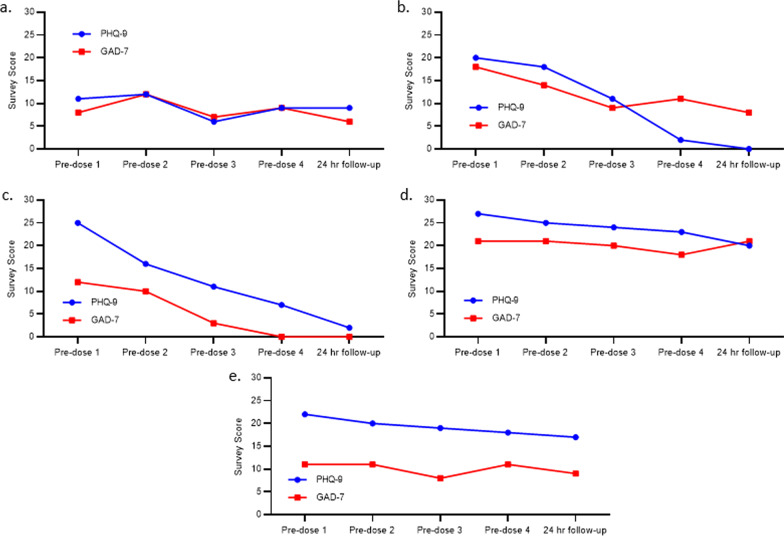
Background: Depression and anxiety outcome measures, safety/tolerability, patient satisfaction, and ease of implementation of group-based ketamine-assisted psychotherapy (G-KAP) delivered to patients in intensive residential eating disorder (ED) treatment were assessed. Case presentation: This study reports on five participants with a diagnosis of an ED and comorbid mood and anxiety disorders who received weekly intramuscular ketamine injections in a group setting over 4 weeks. Measures of anxiety (GAD-7) and depression (PHQ-9) were administered pre-dose, 4-h post-dose, and 24-h post dose. Four of the 5 participants experienced clinically significant improvements on the PHQ-9 score (i.e., change greater than 5) while 2 of the 5 participants experienced clinically significant improvements on the GAD-7 score (i.e., change greater than 4) from pre-dose to 24-h post-dose after the last ketamine session. Dosing sessions were well tolerated, and no serious adverse events were reported. Clinical observations and participant reports corroborated improvements in depression and anxiety symptoms, good tolerability of ketamine treatment, and practical implementation of the G-KAP protocol in a residential ED treatment center. Conclusions: This study suggests the potential utility of G-KAP as an adjunct to intensive, specialized ED treatment. Overall, this novel, cross-diagnostic intervention warrants future research to further explore its appropriateness in a treatment setting.
Overview
The claims and statistics of this paper haven’t been checked yet.
Free: it reads the open-access text and checks the first 5 claims that cite a source we can check. Create a free account to check every claim.
Integrity signals
Registry
Cites
Statistics
Figures
Verification
Claims the paper makes
The claims and statistics of this paper haven’t been checked yet.
Free: it reads the open-access text and checks the first 5 claims that cite a source we can check. Create a free account to check every claim.
Claims other papers make about this one
Each is checked against this paper’s own text: does it say what the citing paper says it does?
The cited source says what the claim attributes to it.
In the citing paper
“though there was no follow-up on ED symptoms [122]”
From Ketamine in neuropsychiatric disorders: an update (2024) · cites this paper as [122]
The cited source says what the claim attributes to it.
In the citing paper
“A case series (n = 5) found significant improvements in anxiety and depression measures after ketamine-assisted psychotherapy in a residential ED treatment center”
From Ketamine in neuropsychiatric disorders: an update (2024) · cites this paper as [122]
Self-check
Percentages, sums and reported differences re-computed from the paper’s own numbers.
The self-check needs the paper’s full text.
Citations
Cites
A Brief Measure for Assessing Generalized Anxiety Disorder: The GAD-7
Spitzer, R. L., Kroenke, K., Williams, J. B. W., & Löwe, B. (2006) · Archives of Internal Medicine · doi:10.1001/archinte.166.10.1092 · Cited by 31,765 · cited 1×
“Generalized Anxiety Disorder Scale‐7 (GAD‐7) The GAD-7 is a 7-item questionnaire designed to measure symptoms of anxiety [34].”
BackgroundThe PHQ-9: A New Depression Diagnostic and Severity Measure
Kroenke, K., & Spitzer, R. L. (2002) · Psychiatric Annals · doi:10.3928/0048-5713-20020901-06 · Cited by 5,898 · cited 1×
“Patient Health Questionnaire‐9 (PHQ‐9) The PHQ-9 is a 9-item questionnaire designed to measure the range and severity of symptoms of depression [32].”
BackgroundThe theory and practice of group psychotherapy.
Gullickson, T., & Ramser, P. (1996) · Contemporary Psychology: A Journal of Reviews · doi:10.1037/002652 · Cited by 1,894
Mechanisms of ketamine action as an antidepressant
Zanos, P., & Gould, T. D. (2018) · Molecular Psychiatry · doi:10.1038/mp.2017.255 · Cited by 1,127 · cited 4×
“The dissociative effects of ketamine appear to be dose-dependent and are commonly described as having an extracorporeal sensation that can be accompanied by synesthetic hallucinations, even when given at a subanesthetic doses [1, 9].”
BackgroundInfluentialTreasure, J., Claudino, A. M., & Zucker, N. (2010) · The Lancet · doi:10.1016/s0140-6736(09)61748-7 · Cited by 658
Toussaint, A., Hüsing, P., Gumz, A., Wingenfeld, K., Härter, M., Schramm, E., & Löwe, B. (2020) · Journal of Affective Disorders · doi:10.1016/j.jad.2020.01.032 · Cited by 641 · cited 1×
“The minimal clinically significant change on the GAD-7 was defined as a 4-point change [35].”
MethodA Consensus Statement on the Use of Ketamine in the Treatment of Mood Disorders
Sanacora, G., Frye, M. A., McDonald, W., Mathew, S. J., Turner, M. S., Schatzberg, A. F., Summergrad, P., Nemeroff, C. B., & for the American Psychiatric Association (APA) Council of Research Task Force on Novel Biomarkers and Treatments (2017) · JAMA Psychiatry · doi:10.1001/jamapsychiatry.2017.0080 · Cited by 576 · cited 1×
“A conventional course of ketamine for sustained benefit typically requires multiple infusions at a high-frequency during an induction period, typically 6 sessions over 2–3 weeks, followed by lower-frequency treatment during maintenance treatment [11, 36].”
BackgroundPsychiatric Comorbidities of Female Inpatients With Eating Disorders
Blinder, B. J., Cumella, E. J., & Sanathara, V. A. (2006) · Psychosomatic Medicine · doi:10.1097/01.psy.0000221254.77675.f5 · Cited by 423
Bioavailability, pharmacokinetics, and analgesic activity of ketamine in humans
Clements, J. A., Nimmo, W. S., & Grant, I. S. (1982) · Journal of Pharmaceutical Sciences · doi:10.1002/jps.2600710516 · Cited by 420 · cited 1×
“dissociation and slight increases in blood pressure which have been observed to resolve upon elimination of ketamine from the system [1, 7, 8].”
BackgroundKhalsa, S. S., Portnoff, L. C., McCurdy-McKinnon, D., & Feusner, J. D. (2017) · Journal of Eating Disorders · doi:10.1186/s40337-017-0145-3 · Cited by 401 · cited 4×
“While the results among sufferers of EDs can be regarded as modest, they remain promising and point to the need for further research, in particular to treat psychiatric comorbidities.”
BackgroundInfluential
Research works printed but not linked: 1
- Bulik CM Anxiety, depression and eating disorders 2002 New York Guilford Publications
Cited by
Ketamine in neuropsychiatric disorders: an update
Johnston, J. N., Kadriu, B., Kraus, C., Henter, I. D., & Zarate, C. A. (2024) · Neuropsychopharmacology · doi:10.1038/s41386-023-01632-1 · Cited by 108
“A case series ( n = 5) found signi fi cant improvements in anxiety and depression measures after ketamine-assisted psychotherapy in a residential ED treatment center, though there was no follow-up on ED symptoms [122].”
BackgroundMethodInfluentialKetamine and psychotherapy for the treatment of psychiatric disorders: Systematic review
Kew, B. M., Porter, R. J., Douglas, K. M., Glue, P., Mentzel, C. L., & Beaglehole, B. (2023) · BJPsych Open · doi:10.1192/bjo.2023.53 · Cited by 69
Psychedelics in the treatment of eating disorders: Rationale and potential mechanisms
Calder, A. E., Mock, S., Friedli, N., Pasi, P., & Hasler, G. (2023) · European Neuropsychopharmacology · doi:10.1016/j.euroneuro.2023.05.008 · Cited by 55
Established and emerging treatments for eating disorders
Bryson, C., Douglas, D., & Schmidt, U. H. (2024) · Trends in Molecular Medicine · doi:10.1016/j.molmed.2024.02.009 · Cited by 48
Electrochemical and biosensor techniques to monitor neurotransmitter changes with depression
Dunham, K. E., & Venton, B. J. (2024) · Analytical and Bioanalytical Chemistry · doi:10.1007/s00216-024-05136-9 · Cited by 34
“Likewise, depression is commonly diagnosed with other illnesses, such as anxiety and eating disorders [3].”
BackgroundKeeler, J. L., Treasure, J. L., Himmerich, H., Brendle, M., Moore, C., & Robison, R. J. (2023) · Frontiers in Psychiatry · doi:10.3389/fpsyt.2023.1181447 · Cited by 30
“an eating disorder recovery programme; (23), or a ketogenic diet; (21, 24)], and it is unclear how ketamine as a solitary intervention impacts outcomes in patients with eating disorders.”
BackgroundSelf-citationFan, Y., Zhao, L., Deng, Z., Li, M., Huang, Z., Zhu, M., & Xu, W. (2022) · Frontiers in Psychiatry · doi:10.3389/fpsyt.2022.936283 · Cited by 28
“For example, eating disorders and attention deficit hyperactivity disorder were not considered in this study (46, 47).”
BackgroundKetamine and Zinc: Treatment of Anorexia Nervosa Via Dual NMDA Receptor Modulation
Mitchell, J., Hermens, D. F., Bennett, M. R., Can, A., & Lagopoulos, J. (2023) · CNS Drugs · doi:10.1007/s40263-022-00984-4 · Cited by 23
“it was helpful to catch the vision of what life could be like without them”, and “the effect of easing my rigidity toward ED rules was extremely helpful at making me face challenges that were normally too anxiety provoking to face alone ([235], pg.”
BackgroundResultTsang, V. W. L., Ragazan, D. C., Kryskow, P., Walsh, Z., & Dames, S. (2023) · Journal of Psychoactive Drugs · doi:10.1080/02791072.2023.2253798 · Cited by 17
“…(intramuscular) ketamine-assisted therapy for inpatients with eating disorders and comorbid depression or anxiety disorders whereby clinically significant improvements to PHQ-9 and GAD-7 scores were observed without serious adverse events following four weekly sessions (Robison et al. 2022).”
Therapeutic Protocols Using Ketamine and Esketamine for Depressive Disorders: A Systematic Review
FREIND, J. M. K., Beserra, F. R., Menezes, B. S., & Mograbi, D. C. (2023) · Journal of Psychoactive Drugs · doi:10.1080/02791072.2023.2248989 · Cited by 13
“Some KAP or Ketamine Psychedelic Therapy (KPT) studies were not published in the last 10 years (Krupitsky and Grinenko 1997; Krupitsky et al. 2007), did not focus on unipolar depression (Ragnhildstveit et al. 2021; Robison et al. 2022) or did not have a clinical trial design (Joneborg et al. 2022).”
Timek, A., Daniels-Brady, C., & Ferrando, S. J. (2024) · Journal of Eating Disorders · doi:10.1186/s40337-024-01039-3 · Cited by 11
“One case series examined ketamine use with group psychotherapy whereas our patient underwent individual therapy [15].”
BackgroundCuerva, K., Spirou, D., Cuerva, A., Delaquis, C. P., & Raman, J. (2024) · European Eating Disorders Review · doi:10.1002/erv.3101 · Cited by 11
Elwyn, R., Mitchell, J., Kohn, M. R., Driver, C., Hay, P., Lagopoulos, J., & Hermens, D. F. (2023) · Neuroscience & Biobehavioral Reviews · doi:10.1016/j.neubiorev.2023.105122 · Cited by 11
Ketamine-assisted psychotherapies for mental disorders: A historical overview and systematic review
Veraart, J. K. E., Schimmers, N., Breeksema, J. J., Seybert, C., Kamphuis, J., Huber, L. F. T., Rota, A., Coerts, D. T., Oliveira-Maia, A. J., & Schoevers, R. A. (2026) · Clinical Psychology Review · doi:10.1016/j.cpr.2026.102706 · Cited by 9
Dunham, K. E., Khaled, K. H., Weizman, L., & Venton, B. J. (2024) · Journal of Neurochemistry · doi:10.1111/jnc.16070 · Cited by 9
“…feeding had not been characterized in Drosophila , several new clinical studies have shown that microdosing ketamine increases appetite and has positive effects on patients with co-morbid eating disorders and depression (Ragnhildstveit et al., 2022 ; Robison et al., 2022 ; Schwartz et al., 2021 ).”
BackgroundBeyond the numbers: reimagining healing with psychedelics for eating disorders
Lafrance, A., Spriggs, M. J., Gukasyan, N., & Peck, S. K. (2024) · Journal of Eating Disorders · doi:10.1186/s40337-024-01111-y · Cited by 9
“A group-based ketamine study also indicated the potential for this medicine to be used in residential ED treatment to target co-morbid symptoms [11].”
BackgroundSelf-citationKetamine-Assisted Psychotherapy for Treatment-Resistant Depression: a Systematic Review
Gomes, A. M., & Novais, F. (2025) · Current Treatment Options in Psychiatry · doi:10.1007/s40501-025-00346-z · Cited by 8
The pharmacological treatment of anxiety in people with eating disorders: A systematic review
Morris, R. C., Keeler, J. L., Treasure, J. L., & Himmerich, H. (2025) · Pharmacological Research · doi:10.1016/j.phrs.2025.107782 · Cited by 8
Psychedelics and psychoanalysis: The journey from talking cure to transformation
Lichtenstein, J., & Hoeh, N. R. (2024) · Journal of Psychedelic Studies · doi:10.1556/2054.2024.00373 · Cited by 9
Bevione, F., Lacidogna, M. C., Lavalle, R., Daga, G. A., & Preti, A. (2025) · Eating and Weight Disorders - Studies on Anorexia Bulimia and Obesity · doi:10.1007/s40519-025-01771-y · Cited by 7
Escobedo-Aedo, P. J., Serrand, C., Kabani, S., & Estric, C. (2025) · Journal of Eating Disorders · doi:10.1186/s40337-025-01232-y · Cited by 6
“The few existing publications [14, 26–30] have used ketamine treatment in patients with EDs and concomitant depressive disorders or suicidal risk, which might act as a distractor factor due to the already known anti-depressor and anti-suicidal effect of ketamine [24].”
Trimmel, M., Renner, A., & Kaltenboeck, A. (2024) · International Journal of Mental Health Nursing · doi:10.1111/inm.13425 · Cited by 7
Wassenaar, E., Blalock, D. V., Duffy, A., Riddle, M. C., Weeks, H., Mehler, P., & Rienecke, R. D. (2025) · Journal of Psychiatric Research · doi:10.1016/j.jpsychires.2025.05.055 · Cited by 6
Dahlgren, C., Tverrli, E., & Stewart, L. (2025) · Journal of Eating Disorders · doi:10.1186/s40337-025-01313-y · Cited by 4
Simpson, R. J., & Juruena, M. F. (2026) · Psychopharmacology · doi:10.1007/s00213-026-07003-0 · Cited by 5
Flynn, L., Rondeau, M., Kršák, M., & Shannon, S. (2025) · Psychedelic Medicine · doi:10.1089/psymed.2024.0050 · Cited by 4
Swainson, J., Grewal, P., Polard, S., Borle, C., Gutierrez, G., Zhang, Y., Winkler, O., Burback, L., Khullar, A., McIntyre, R. S., et al. (2026) · npj Mental Health Research · doi:10.1038/s44184-026-00226-1 · Cited by 3
“Three retrospective reports described patients in outpatient group therapy programs 62,63,65 , and one reportedon patients in a residential eating disorder program 61 .”
Maguire, J. (2024) · Studies in Clinical Social Work Transforming Practice Education and Research · doi:10.1080/28376811.2024.2371792 · Cited by 2
Ketamine for treatment resistant depression in individuals with eating disorders: a comparison study
Wassenaar, E., Blalock, D. V., Duffy, A., Riddle, M. C., O’Melia, A. M., Weeks, H., Mehler, P. S., & Rienecke, R. D. (2025) · Journal of Eating Disorders · doi:10.1186/s40337-025-01448-y · Cited by 1
Eramo, B., Sepe, C., Friuli, M., Campagna, A., Romano, A., & Gaetani, S. (2026) · Pharmacological Research · doi:10.1016/j.phrs.2026.108279 · Cited by 1
Ketamine-assisted therapy within a community of practice: a novel approach to disordered eating
Jeletzky, L., Dames, S., Kryskow, P., & Tsang, V. W. L. (2025) · Therapeutic Advances in Psychopharmacology · doi:10.1177/20451253251356980 · Cited by 1
Efficacy of Ketamine-Assisted Psychotherapy in Treatment-Resistant Depression - a case series
Teixeira, M. C. D. C. P. (2025) · Portuguese National Funding Agency for Science, Research and Technology (RCAAP Project by FCT) · doi:10.34626/th9y-gj95
Alapizco, I., & Alapizco, I. (2024) · UA Campus Repository (The University of Arizona) · Cited by 1
An Educational Intervention on the Efficacy of Ketamine- Assisted Psychotherapy for Anxiety
Meaux, A., & Meaux, A. (2024) · UA Campus Repository (The University of Arizona)
Innovative Pharmacological Approaches to Eating Disorder Treatment
Keshen, A. R., Touyz, S. W., Lacroix, E., Hay, P., & McElroy, S. L. (2025) · Psychiatric Clinics of North America · doi:10.1016/j.psc.2025.08.014
Ketamine or Esketamine in Special Populations of Patients With Treatment-Resistant Depression
Grabarczyk, Ł., Wolfermann, S. R., Oniszczuk, H., & Radkowski, P. (2026) · Medical Science Monitor · doi:10.12659/msm.950601
Ketamine in clinical psychiatry and addictology - a narrative review
Vašíček, O., & Páleníček, T. (2026) · Psychiatrie pro praxi · doi:10.36290/psy.2026.004
Morris, R. C., Gundogan, A., Lawrence, V. C., Himmerich, H., Treasure, J. L., & Keeler, J. L. (2026) · BMC Medicine · doi:10.1186/s12916-026-04929-2
“However, group-based ketamine yielded positive preliminary results in a case series of five individuals with an ED [118].”
Mertens, L. J., & Kunz, L. C. (2026) · Elsevier eBooks · doi:10.1016/b978-3-437-21293-2.00015-0
Martinelli, M. K., Weinman, J., Coughlin, J. W., & Schreyer, C. C. (2026) · Elsevier eBooks · doi:10.1016/b978-0-443-40344-6.00101-0
Group psychedelic-assisted therapy for mental health conditions: a mixed-methods systematic review
Tsang, V. W. L., Bhatia, F., Ferrey, A. E., & Hartmann‐Boyce, J. (2026) · Frontiers in Public Health · doi:10.3389/fpubh.2026.1788352
“Qualitative, mixed-methods, or descriptive narrative data were reported in 18 papers (10, 11, 14, 18, 19, 21, 24–30 , 37–41).”
InfluentialAnalysis of psychiatric contraindications to the use of ketamine as an adjunct in psychotherapy
Zaika, V., & Tytarenko, Y. (2026) · Psychosomatic Medicine and General Practice · doi:10.26766/pmgp.v11i3.741
Metadata
- Authors
- Robison, R., Lafrance, A., Brendle, M., Smith, M., Moore, C., Ahuja, S., Richards, S., Hawkins, N., & Strahan, E.
- Affiliations
- University of Utah (US)
- Wilfrid Laurier University (CA)
- Corresponding author
- Robison, Reid
- Venue
- Journal of Eating Disorders
- Published
- 2022-05-06
- Volume
- 10
- Issue
- 1
- Pages
- 65-65
- ISSN
- 2050-2974 (ISSN-L)
- PMC
- PMC9077943
- OpenAlex
- W4229078353
- Cited by
- 36
- References
- 37
- Citations by year
- 2026: 7 · 2025: 10 · 2024: 9 · 2023: 9 · 2022: 1
- FWCI
- 4.34
- Type
- journal article
- Language
- en
- Open access
- gold
- doi.org
- Licence
- cc-by
- creativecommons.org/licenses/by/4.0 (tdm)
- creativecommons.org/licenses/by/4.0 (vor)
- Locations
- Journal of Eating Disorders (publishedVersion, cc-by)
- PubMed Central (publishedVersion, cc-by)
- PubMed (publishedVersion)
- DOAJ (DOAJ: Directory of Open Access Journals) (submittedVersion)
- Topics
- Health Sciences › Medicine › Pharmacology (medical) › Treatment of Major Depression
- Social Sciences › Psychology › Clinical Psychology › Eating Disorders and Behaviors
- Health Sciences › Medicine › Psychiatry and Mental health › Electroconvulsive Therapy Studies
- Keywords
- ketamine-assisted psychotherapy, group therapy, eating disorders, comorbid depression, anxiety disorders, residential treatment, intramuscular ketamine, adjunctive therapy, tolerability, treatment safety, patient satisfaction, mood and anxiety symptoms
About these checks
Registry, retraction, Cites and statistics results are computed, not judged, with one exception: a printed reference that no index lists is read once by a model before it counts as a citation error. Claims are extracted by a model and kept only when their quote appears verbatim in the text; each cited source is then checked, with a model’s help, for whether it says what the claim relies on. Those verdicts can be wrong — read the claim’s quote and the cited source before relying on one.
Statistics and arithmetic are recomputed, not judged.
Confidence bands are shown only for fields calibrated on our annotated test set. None is calibrated yet, so no band is shown.
What counts as a claim ›How we measure confidence ›How we check this ›
Are you an author, or do you see a problem with this page? Request a review
Data sources
Bibliographic data: Semantic Scholar, OpenAlex, Crossref.
Contains information from the Semantic Scholar Academic Graph Datasets, made available under the ODC Attribution License (ODC-BY 1.0).
Semantic Scholar’s data is described in: Kinney, R., et al. (2023). The Semantic Scholar Open Data Platform. arXiv:2301.10140.
