

A case series of group-based ketamine-assisted psychotherapy for patients in residential treatment for eating disorders with comorbid depression and anxiety disorders
Open accessThe DOI matches its Crossref record; 37 of the 37 references it cites were found in a registry or an index.
Abstract
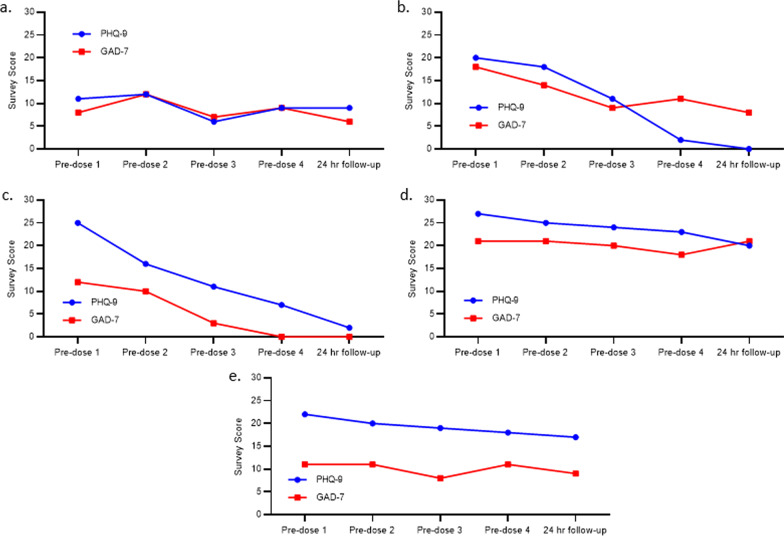
Background: Depression and anxiety outcome measures, safety/tolerability, patient satisfaction, and ease of implementation of group-based ketamine-assisted psychotherapy (G-KAP) delivered to patients in intensive residential eating disorder (ED) treatment were assessed. Case presentation: This study reports on five participants with a diagnosis of an ED and comorbid mood and anxiety disorders who received weekly intramuscular ketamine injections in a group setting over 4 weeks. Measures of anxiety (GAD-7) and depression (PHQ-9) were administered pre-dose, 4-h post-dose, and 24-h post dose. Four of the 5 participants experienced clinically significant improvements on the PHQ-9 score (i.e., change greater than 5) while 2 of the 5 participants experienced clinically significant improvements on the GAD-7 score (i.e., change greater than 4) from pre-dose to 24-h post-dose after the last ketamine session. Dosing sessions were well tolerated, and no serious adverse events were reported. Clinical observations and participant reports corroborated improvements in depression and anxiety symptoms, good tolerability of ketamine treatment, and practical implementation of the G-KAP protocol in a residential ED treatment center. Conclusions: This study suggests the potential utility of G-KAP as an adjunct to intensive, specialized ED treatment. Overall, this novel, cross-diagnostic intervention warrants future research to further explore its appropriateness in a treatment setting.
Overview
The claims and statistics of this paper haven’t been checked yet.
Free: it reads the open-access text and checks the first 5 claims that cite a source we can check. Create a free account to check every claim.
Integrity signals
Registry
Cites
Statistics
Figures
Verification
Claims the paper makes
The claims and statistics of this paper haven’t been checked yet.
Free: it reads the open-access text and checks the first 5 claims that cite a source we can check. Create a free account to check every claim.
Claims other papers make about this one
Each is checked against this paper’s own text: does it say what the citing paper says it does?
The cited source says what the claim attributes to it.
In the citing paper
“though there was no follow-up on ED symptoms [122]”
From Ketamine in neuropsychiatric disorders: an update (2024) · cites this paper as [122]
The cited source says what the claim attributes to it.
In the citing paper
“A case series (n = 5) found significant improvements in anxiety and depression measures after ketamine-assisted psychotherapy in a residential ED treatment center”
From Ketamine in neuropsychiatric disorders: an update (2024) · cites this paper as [122]
Self-check
Percentages, sums and reported differences re-computed from the paper’s own numbers.
The self-check needs the paper’s full text.
Citations
Cites
A Brief Measure for Assessing Generalized Anxiety Disorder: The GAD-7
Spitzer, R. L., Kroenke, K., Williams, J. B. W., & Löwe, B. (2006) · Archives of Internal Medicine · doi:10.1001/archinte.166.10.1092 · Cited by 31,765 · cited 1×
“Generalized Anxiety Disorder Scale‐7 (GAD‐7) The GAD-7 is a 7-item questionnaire designed to measure symptoms of anxiety [34].”
BackgroundThe PHQ-9: A New Depression Diagnostic and Severity Measure
Kroenke, K., & Spitzer, R. L. (2002) · Psychiatric Annals · doi:10.3928/0048-5713-20020901-06 · Cited by 5,898 · cited 1×
“Patient Health Questionnaire‐9 (PHQ‐9) The PHQ-9 is a 9-item questionnaire designed to measure the range and severity of symptoms of depression [32].”
BackgroundThe theory and practice of group psychotherapy.
Gullickson, T., & Ramser, P. (1996) · Contemporary Psychology: A Journal of Reviews · doi:10.1037/002652 · Cited by 1,894
Mechanisms of ketamine action as an antidepressant
Zanos, P., & Gould, T. D. (2018) · Molecular Psychiatry · doi:10.1038/mp.2017.255 · Cited by 1,127 · cited 4×
“The dissociative effects of ketamine appear to be dose-dependent and are commonly described as having an extracorporeal sensation that can be accompanied by synesthetic hallucinations, even when given at a subanesthetic doses [1, 9].”
BackgroundInfluentialTreasure, J., Claudino, A. M., & Zucker, N. (2010) · The Lancet · doi:10.1016/s0140-6736(09)61748-7 · Cited by 658
Toussaint, A., Hüsing, P., Gumz, A., Wingenfeld, K., Härter, M., Schramm, E., & Löwe, B. (2020) · Journal of Affective Disorders · doi:10.1016/j.jad.2020.01.032 · Cited by 641 · cited 1×
“The minimal clinically significant change on the GAD-7 was defined as a 4-point change [35].”
MethodA Consensus Statement on the Use of Ketamine in the Treatment of Mood Disorders
Sanacora, G., Frye, M. A., McDonald, W., Mathew, S. J., Turner, M. S., Schatzberg, A. F., Summergrad, P., Nemeroff, C. B., & for the American Psychiatric Association (APA) Council of Research Task Force on Novel Biomarkers and Treatments (2017) · JAMA Psychiatry · doi:10.1001/jamapsychiatry.2017.0080 · Cited by 576 · cited 1×
“A conventional course of ketamine for sustained benefit typically requires multiple infusions at a high-frequency during an induction period, typically 6 sessions over 2–3 weeks, followed by lower-frequency treatment during maintenance treatment [11, 36].”
BackgroundPsychiatric Comorbidities of Female Inpatients With Eating Disorders
Blinder, B. J., Cumella, E. J., & Sanathara, V. A. (2006) · Psychosomatic Medicine · doi:10.1097/01.psy.0000221254.77675.f5 · Cited by 423
Bioavailability, pharmacokinetics, and analgesic activity of ketamine in humans
Clements, J. A., Nimmo, W. S., & Grant, I. S. (1982) · Journal of Pharmaceutical Sciences · doi:10.1002/jps.2600710516 · Cited by 420 · cited 1×
“dissociation and slight increases in blood pressure which have been observed to resolve upon elimination of ketamine from the system [1, 7, 8].”
BackgroundKhalsa, S. S., Portnoff, L. C., McCurdy-McKinnon, D., & Feusner, J. D. (2017) · Journal of Eating Disorders · doi:10.1186/s40337-017-0145-3 · Cited by 401 · cited 4×
“While the results among sufferers of EDs can be regarded as modest, they remain promising and point to the need for further research, in particular to treat psychiatric comorbidities.”
BackgroundInfluentialKetamine: Current applications in anesthesia, pain, and critical care
Kurdi, M., Theerth, K., & Deva, R. (2014) · Anesthesia: Essays and Researches · doi:10.4103/0259-1162.143110 · Cited by 392 · cited 1×
“The dissociative effects of ketamine appear to be dose-dependent and are commonly described as having an extracorporeal sensation that can be accompanied by synesthetic hallucinations, even when given at a subanesthetic doses [1, 9].”
BackgroundRandomized Controlled Crossover Trial of Ketamine in Obsessive-Compulsive Disorder: Proof-of-Concept
Rodriguez, C. I., Kegeles, L. S., Levinson, A., Feng, T., Marcus, S. M., Vermes, D., Flood, P., & Simpson, H. B. (2013) · Neuropsychopharmacology · doi:10.1038/npp.2013.150 · Cited by 386
Kishimoto, T., Chawla, J. M., Hagi, K., Zarate, C. A., Kane, J. M., Bauer, M., & Correll, C. U. (2016) · Psychological Medicine · doi:10.1017/s0033291716000064 · Cited by 359 · cited 2×
“, ketamine-assisted psychotherapy, KAP) [4, 10, 11].”
BackgroundKetamine administration in depressive disorders: a systematic review and meta-analysis
Fond, G., Loundou, A., Rabu, C., Macgregor, A., Lançon, C., Brittner, M., Micoulaud-Franchi, J.-A., Richieri, R., Courtet, P., Abbar, M., et al. (2014) · Psychopharmacology · doi:10.1007/s00213-014-3664-5 · Cited by 339
Dore, J., Turnipseed, B., Dwyer, S., Turnipseed, A., Andries, J., Ascani, G., Monnette, C., Huidekoper, A., Strauss, N., & Wolfson, P. (2019) · Journal of Psychoactive Drugs · doi:10.1080/02791072.2019.1587556 · Cited by 217 · cited 2×
“, ketamine-assisted psychotherapy, KAP) [4, 10, 11].”
BackgroundEnhancing the clinical utility of depression screening
Kroenke, K. (2012) · Canadian Medical Association Journal · doi:10.1503/cmaj.112004 · Cited by 216 · cited 1×
“The minimal clinically significant change on the PHQ-9 was defined as a 5-point change [33].”
MethodSingle Versus Repeated Sessions of Ketamine-Assisted Psychotherapy for People with Heroin Dependence
Krupitsky, E. M., Burakov, A. M., Dunaevsky, I. V., Romanova, T. N., Slavina, T. Y., & Grinenko, A. Y. (2007) · Journal of Psychoactive Drugs · doi:10.1080/02791072.2007.10399860 · Cited by 183
(2016) · Springer eBooks · doi:10.1007/978-3-319-20790-2 · Cited by 128
Anorexia Nervosa and Comorbid Psychopathology
Marucci, S., Ragione, L. D., De Iaco, G., Mococci, T., Vicini, M., Guastamacchia, E., & Triggiani, V. (2018) · Endocrine, Metabolic & Immune Disorders - Drug Targets · doi:10.2174/1871530318666180213111637 · Cited by 124
Yao, N., Skiteva, O., Zhang, X., Svenningsson, P., & Chergui, K. (2018) · Molecular Psychiatry · doi:10.1038/mp.2017.239 · Cited by 118 · cited 1×
“Ketamine’s NMDA receptor antagonism also induces neuroplasticity, facilitating the formation of new neural connections and restructuring of thought patterns, making ketamine a potentially powerful substance as an adjunct to psychotherapy [12, 13].”
BackgroundMartinotti, G., Chiappini, S., Pettorruso, M., Mosca, A., Miuli, A., Di Carlo, F., D’Andrea, G., Collevecchio, R., Di Muzio, I., Sensi, S. L., et al. (2021) · Brain Sciences · doi:10.3390/brainsci11070856 · Cited by 111
Administration of ketamine for unipolar and bipolar depression
Kraus, C., Rabl, U., Vanicek, T., Carlberg, L., Popovic, A., Spies, M., Bartova, L., Gryglewski, G., Papageorgiou, K., Lanzenberger, R., et al. (2017) · International Journal of Psychiatry in Clinical Practice · doi:10.1080/13651501.2016.1254802 · Cited by 110
Ketamine as treatment for post-traumatic stress disorder: a review
Liriano, F., Hatten, C., & Schwartz, T. L. (2019) · Drugs in Context · doi:10.7573/dic.212305 · Cited by 103
Treatment of compulsive behaviour in eating disorders with intermittent ketamine infusions
Mills, I. (1998) · QJM · doi:10.1093/qjmed/91.7.493 · Cited by 87 · cited 1×
“[19] administered infusions of 20 mg per hour of ketamine for 10 h to treat 15 patients with chronic and severe ED.”
BackgroundRemission from Chronic Anorexia Nervosa With Ketogenic Diet and Ketamine: Case Report
Scolnick, B., Zupec-Kania, B., Calabrese, L., Aoki, C., & Hildebrandt, T. (2020) · Frontiers in Psychiatry · doi:10.3389/fpsyt.2020.00763 · Cited by 68 · cited 2×
“[20] described an instance where an individual with severe and enduring anorexia nervosa received a short series of titrated intravenous ketamine infusions, combined with dietary interventions, leading to complete remission for a period of 6 months.”
BackgroundKetamine as a Treatment for Anorexia Nervosa: A Narrative Review
Keeler, J. L., Treasure, J. L., Juruena, M. F., Kan, C., & Himmerich, H. (2021) · Nutrients · doi:10.3390/nu13114158 · Cited by 61 · cited 4×
“While the results among sufferers of EDs can be regarded as modest, they remain promising and point to the need for further research, in particular to treat psychiatric comorbidities.”
BackgroundInfluentialMartín, J., Arostegui, I., Loroño, A., Padierna, A., Najera‐Zuloaga, J., & Quintana, J. M. (2019) · European Eating Disorders Review · doi:10.1002/erv.2677 · Cited by 55 · cited 1×
“[28] among 520 patients with an ED, it was found that depressive and anxiety symptoms were related to ED symptoms, health status, and medical comorbidity, among other variables [28].”
BackgroundFewell, L. K., Levinson, C. A., & Stark, L. (2017) · Eating and Weight Disorders - Studies on Anorexia Bulimia and Obesity · doi:10.1007/s40519-016-0357-6 · Cited by 52 · cited 1×
“[29] recommend a focus on depressive and worry symptoms among ED patients in higher levels of care on the basis of their research which showed that these features predicted higher levels of ED symptomatology and psychological impairment at discharge and at 1-year follow-up.”
BackgroundSzarmach, J., Cubała, W. J., Włodarczyk, A., & Wiglusz, M. S. (2019) · Psychiatria Danubina · Cited by 51
Schwartz, T., Trunko, M. E., Feifel, D., Lopez, E., Peterson, D., Frank, G. K. W., & Kaye, W. (2021) · Clinical Case Reports · doi:10.1002/ccr3.3869 · Cited by 48 · cited 1×
“[21] reported on four patients with enduring ED and treatment-resistant depression treated with repeat intramuscular (IM) ketamine at 4–6 week intervals over 12 + months.”
BackgroundGlue, P., Medlicott, N. J., Neehoff, S., Surman, P., Lam, F., Hung, N., & Hung, C.-T. (2020) · Therapeutic Advances in Psychopharmacology · doi:10.1177/2045125320922474 · Cited by 42
Ingram, R., Kang, H., Lightman, S., Jane, D. E., Bortolotto, Z. A., Collingridge, G. L., Lodge, D., & Volianskis, A. (2018) · Neuropharmacology · doi:10.1016/j.neuropharm.2018.06.008 · Cited by 36 · cited 1×
“Ketamine’s NMDA receptor antagonism also induces neuroplasticity, facilitating the formation of new neural connections and restructuring of thought patterns, making ketamine a potentially powerful substance as an adjunct to psychotherapy [12, 13].”
BackgroundRagnhildstveit, A., Jackson, L. K., Cunningham, S. R., Good, L., Tanner, Q., Roughan, M., & Henrie-Barrus, P. (2021) · Frontiers in Psychiatry · doi:10.3389/fpsyt.2021.764112 · Cited by 36
Abdallah, C. G., Roache, J. D., Averill, L. A., Young-McCaughan, S., Martini, B., Gueorguieva, R., Amoroso, T., Southwick, S. M., Guthmiller, K., López-Roca, A. L., et al. (2019) · Contemporary Clinical Trials · doi:10.1016/j.cct.2019.04.009 · Cited by 33
Toward specific ways to combine ketamine and psychotherapy in treating depression
Hasler, G. (2020) · CNS Spectrums · doi:10.1017/s1092852919001007 · Cited by 29 · cited 1×
“, ketamine-assisted psychotherapy, KAP) [4, 10, 11].”
Effectiveness and Safety of Ketamine for Unipolar Depression: a Systematic Review
Memon, R. I., Naveed, S., Faquih, A. E., Fida, A., Abbas, N., Chaudhary, A. M. D., & Qayyum, Z. (2020) · Psychiatric Quarterly · doi:10.1007/s11126-020-09830-6 · Cited by 24 · cited 1×
“In a recent systematic review study of 35 randomized controlled trials of ketamine for unipolar depression, intravenous ketamine was effective in 70% of the included studies (21/30) and oral and intranasal ketamine were demonstrated to be effective in five studies total [6].”
BackgroundArylcyclohexamines (Ketamine, Phencyclidine, and Analogues)
Ho, J. H., & Dargan, P. I. (2016) · Springer eBooks · doi:10.1007/978-3-319-20790-2_124-1 · Cited by 10 · cited 1×
“Introduction Ketamine is a dissociative arycyclohexylamine derivative and an antagonist of the N-methyl-D-aspartate (NMDA)receptor [1, 2].”
Background
Research works printed but not linked: 1
- Bulik CM Anxiety, depression and eating disorders 2002 New York Guilford Publications
Cited by
Ketamine in neuropsychiatric disorders: an update
Johnston, J. N., Kadriu, B., Kraus, C., Henter, I. D., & Zarate, C. A. (2024) · Neuropsychopharmacology · doi:10.1038/s41386-023-01632-1 · Cited by 108
“A case series ( n = 5) found signi fi cant improvements in anxiety and depression measures after ketamine-assisted psychotherapy in a residential ED treatment center, though there was no follow-up on ED symptoms [122].”
BackgroundMethodInfluentialKetamine and psychotherapy for the treatment of psychiatric disorders: Systematic review
Kew, B. M., Porter, R. J., Douglas, K. M., Glue, P., Mentzel, C. L., & Beaglehole, B. (2023) · BJPsych Open · doi:10.1192/bjo.2023.53 · Cited by 69
Psychedelics in the treatment of eating disorders: Rationale and potential mechanisms
Calder, A. E., Mock, S., Friedli, N., Pasi, P., & Hasler, G. (2023) · European Neuropsychopharmacology · doi:10.1016/j.euroneuro.2023.05.008 · Cited by 55
Established and emerging treatments for eating disorders
Bryson, C., Douglas, D., & Schmidt, U. H. (2024) · Trends in Molecular Medicine · doi:10.1016/j.molmed.2024.02.009 · Cited by 48
Electrochemical and biosensor techniques to monitor neurotransmitter changes with depression
Dunham, K. E., & Venton, B. J. (2024) · Analytical and Bioanalytical Chemistry · doi:10.1007/s00216-024-05136-9 · Cited by 34
“Likewise, depression is commonly diagnosed with other illnesses, such as anxiety and eating disorders [3].”
Background
Metadata
- Authors
- Robison, R., Lafrance, A., Brendle, M., Smith, M., Moore, C., Ahuja, S., Richards, S., Hawkins, N., & Strahan, E.
- Affiliations
- University of Utah (US)
- Wilfrid Laurier University (CA)
- Corresponding author
- Robison, Reid
- Venue
- Journal of Eating Disorders
- Published
- 2022-05-06
- Volume
- 10
- Issue
- 1
- Pages
- 65-65
- ISSN
- 2050-2974 (ISSN-L)
- PMC
- PMC9077943
- OpenAlex
- W4229078353
- Cited by
- 36
- References
- 37
- Citations by year
- 2026: 7 · 2025: 10 · 2024: 9 · 2023: 9 · 2022: 1
- FWCI
- 4.34
- Type
- journal article
- Language
- en
- Open access
- gold
- doi.org
- Licence
- cc-by
- creativecommons.org/licenses/by/4.0 (tdm)
- creativecommons.org/licenses/by/4.0 (vor)
- Locations
- Journal of Eating Disorders (publishedVersion, cc-by)
- PubMed Central (publishedVersion, cc-by)
- PubMed (publishedVersion)
- DOAJ (DOAJ: Directory of Open Access Journals) (submittedVersion)
- Topics
- Health Sciences › Medicine › Pharmacology (medical) › Treatment of Major Depression
- Social Sciences › Psychology › Clinical Psychology › Eating Disorders and Behaviors
- Health Sciences › Medicine › Psychiatry and Mental health › Electroconvulsive Therapy Studies
- Keywords
- ketamine-assisted psychotherapy, group therapy, eating disorders, comorbid depression, anxiety disorders, residential treatment, intramuscular ketamine, adjunctive therapy, tolerability, treatment safety, patient satisfaction, mood and anxiety symptoms
About these checks
Registry, retraction, Cites and statistics results are computed, not judged, with one exception: a printed reference that no index lists is read once by a model before it counts as a citation error. Claims are extracted by a model and kept only when their quote appears verbatim in the text; each cited source is then checked, with a model’s help, for whether it says what the claim relies on. Those verdicts can be wrong — read the claim’s quote and the cited source before relying on one.
Statistics and arithmetic are recomputed, not judged.
Confidence bands are shown only for fields calibrated on our annotated test set. None is calibrated yet, so no band is shown.
What counts as a claim ›How we measure confidence ›How we check this ›
Are you an author, or do you see a problem with this page? Request a review
Data sources
Bibliographic data: Semantic Scholar, OpenAlex, Crossref.
Contains information from the Semantic Scholar Academic Graph Datasets, made available under the ODC Attribution License (ODC-BY 1.0).
Semantic Scholar’s data is described in: Kinney, R., et al. (2023). The Semantic Scholar Open Data Platform. arXiv:2301.10140.
