

Changes in eating behavior through lifestyle treatment in women with polycystic ovary syndrome (PCOS): a randomized controlled trial
Open accessThe DOI matches its Crossref record; 71 of the 75 references it cites were found in a registry or an index.
Abstract
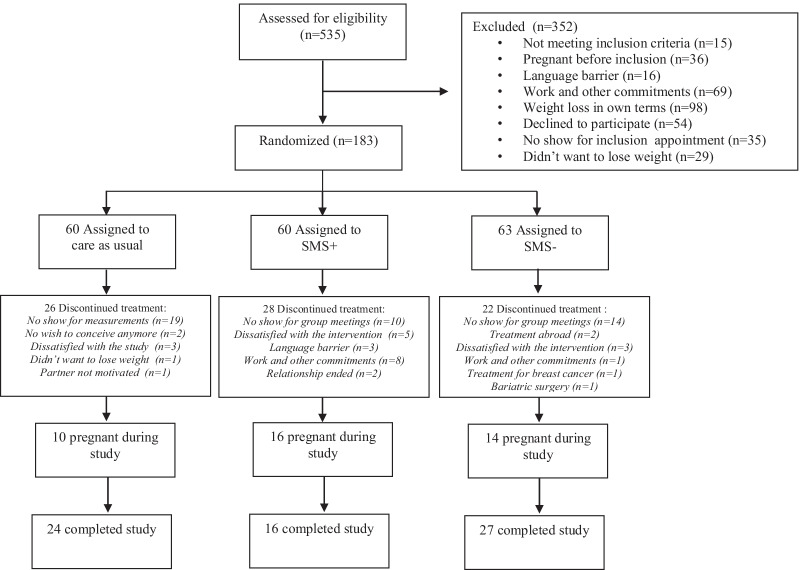
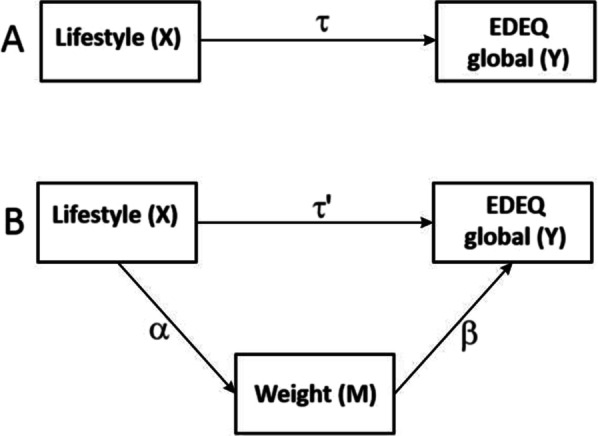
Background: Eating behaviors like emotional eating, external eating and restrained eating play an important role in weight gain and weight loss in the general population. Improvements in eating behavior are important for long-term weight. This has not yet been studied in women with Polycystic Ovary Syndrome (PCOS). The aim of this study is to examine if a three-component lifestyle intervention (LI) is effective for improving disordered eating behavior in women with PCOS. Methods: Women diagnosed with PCOS (N = 183), with a body mass index (BMI) > 25 kg/m 2 and trying to achieve a pregnancy were either assigned to 1 year of 20 group sessions of cognitive behavioral therapy (CBT) combined with nutritional advice and exercise with or without additional feedback through Short Message Service (SMS) or Care As Usual (CAU), which includes the advice to lose weight using publicly available services. Results: The Eating Disorder Examination Questionnaire (EDEQ) scores worsened in CAU (47.5%) and improved in the LI (4.2%) at 12 months. The difference between the LI and CAU was significant ( P = 0.007) and resulted in a medium to large effect size (Cohen’s d: − 0.72). No significant differences were observed in EDEQ scores between LI with SMS compared to LI without SMS (Cohen’s d: 0.28; P = 0.399). Also, weight loss did not mediate the changes in eating behavior. An overall completion rate of 67/183 (36.6%) was observed. Conclusions: A three-component CBT lifestyle program resulted in significant improvements in disordered eating behavior compared to CAU. Changes in disordered eating behavior are important for long-term weight loss and mental health. Trial registration : NTR, NTR2450. Registered 2 August 2010, https://www.trialregister.nl/trial/2344
Overview
The claims and statistics of this paper haven’t been checked yet.
Free: it reads the open-access text and checks the first 5 claims that cite a source we can check. Create a free account to check every claim.
Integrity signals
Registry
Cites
Statistics
Figures
Verification
Claims the paper makes
The claims and statistics of this paper haven’t been checked yet.
Free: it reads the open-access text and checks the first 5 claims that cite a source we can check. Create a free account to check every claim.
Claims other papers make about this one
Each is checked against this paper’s own text: does it say what the citing paper says it does?
The source backs part of the claim, not all of it — or backs it for a different population, condition or comparison.
In the citing paper
“A previous 3-component lifestyle intervention consisting of diet, exercise, and cognitive behavioral therapy, facilitated using texting to track patients’ food intake, physical activity, and mood, can effectively improve eating disorder and mood in patients with PCOS and contribute to weight loss [8,9].”
From Efficacy of WeChat-Based Digital Intervention Versus Metformin in Women With Polycystic Ovary Syndrome: Randomized Controlled Trial (2024) · cites this paper as [9]
Experimental — accuracy not yet measured
Self-check
Percentages, sums and reported differences re-computed from the paper’s own numbers.
The self-check needs the paper’s full text.
Citations
Cites
Diagnostic and Statistical Manual of Mental Disorders
American Psychiatric Association (2013) · doi:10.1176/appi.books.9780890425596 · Cited by 116,369
Applied Longitudinal Data Analysis: Modeling Change and Event Occurrence
Singer, J. D., & Willett, J. B. (2003) · doi:10.1093/acprof:oso/9780195152968.001.0001 · Cited by 10,647
(2004) · Fertility and Sterility · doi:10.1016/j.fertnstert.2003.10.004 · Cited by 9,050 · cited 1×
“reproductive (irregular menstrual cycles, hirsutism, acne and infertility) and metabolic (insulin resistance, metabolic syndrome, prediabetes and type 2 diabetes) [5, 6].”
BackgroundCohen, J. (1992) · Psychological Bulletin · doi:10.1037//0033-2909.112.1.155 · Cited by 8,771
The Rotterdam ESHRE/ASRM-sponsored PCOS consensus workshop group (2004) · Human Reproduction · doi:10.1093/humrep/deh098 · Cited by 6,138 · cited 1×
“The diagnosis of PCOS requires at least two out of three of the following criteria: (1) oligo-ovulation or anovulation (irregular or no menstrual cycle), (2) clinical hyperandrogenism (hirsutism) and/or biochemical signs of hyperandrogenism (elevated free androgen index or elevated testosterone levels), (3) polycystic…”
MethodLippa, N. C., & Sanderson, S. C. (2013) · Human Heredity · doi:10.1159/000353712 · Cited by 6,078
Comparison of Beck Depression Inventories -IA and -II in psychiatric outpatients
Beck, A. T., Steer, R. A., Ball, R., & Ranieri, W. F. (1996) · Journal of Personality Assessment · doi:10.1207/s15327752jpa6703_13 · Cited by 5,965 · cited 1×
“Scores of 0–13 indicate minimal depression, 14–19 (mild depression), 20–28 (moderate depression) and 29–63 (severe depression) [43].”
The prevalence and correlates of eating disorders in the National Comorbidity Survey Replication
Hudson, J. I., Hiripi, E., Pope, H. G., & Kessler, R. C. (2007) · Biological Psychiatry · doi:10.1016/j.biopsych.2006.03.040 · Cited by 4,973 · cited 1×
“This is in line with the general population where higher depression scores were related to eating disorders [63].”
ResultStatistical Analysis With Missing Data
Ghosh, S. (1988) · Technometrics · doi:10.1080/00401706.1988.10488446 · Cited by 4,576
Linear Mixed Models for Longitudinal Data
Molenberghs, G., & Verbeke, G. (2000) · Springer Series in Statistics · doi:10.1007/978-1-4419-0300-6 · Cited by 2,646
Research works printed but not linked: 5
- Teede H Deeks A Moran L Polycystic ovary syndrome: a complex condition with psychological, reproductive and metabolic manifestations that impacts on health across the lifespan BMC Med 2010 8 41 10.1186/1741-7015-8-41 20591140 PMC2909929 · DOI · Paper page
- Teede H Deeks A Moran L Polycystic ovary syndrome: a complex condition with psychological, reproductive and metabolic manifestations that impacts on health across the lifespan BMC Med 2010 8 41 10.1186/1741-7015-8-41 20591140 PMC2909929 · DOI · Paper page
- Fairburn CG Beglin SJ Eating disorder examination questionnaire Cognit Behav Ther Eat Disord 2008 309 313
- Roderick JAL, Donald BR. Statistical analysis with missing data: John Wiley and Sons, Inc.; 1986.
- Jiskoot G, Dietz de Loos A, Beerthuizen A, Timman R, Busschbach J, Laven J. Weight reduction through a cognitive behavioral therapy lifestyle intervention in polycystic ovary syndrome (PCOS): the primary outcome of a randomized controlled trial. Obesity. 2020;in press. PMC7702123 32969197 · DOI · Paper page
Cited by
The Role of Lifestyle Interventions in PCOS Management: A Systematic Review
Gautam, R., Maan, P., Jyoti, A., Kumar, A., Malhotra, N., & Arora, T. (2025) · Nutrients · doi:10.3390/nu17020310 · Cited by 115
Prevalence and Etiology of Eating Disorders in Polycystic Ovary Syndrome: A Scoping Review
Lalonde-Bester, S., Malik, M., Masoumi, R., Ng, K., Sidhu, S., Ghosh, M., & Vine, D. (2024) · Advances in Nutrition · doi:10.1016/j.advnut.2024.100193 · Cited by 45
“Increased adiposity may contribute to the development of EDs via impairment of the hypothalamic-neuroregulation of energy balance and food intake, and this applies to those with PCOS and overweight-obesity as we observed in several studies [67,68,88, 93,96].”
BackgroundMethodResultInfluentialDilimulati, D., Shao, X., Wang, L., Cai, M., Zhang, Y., Lu, J., Wang, Y., Liu, H., Kuang, M., Chen, H., et al. (2024) · Journal of Medical Internet Research · doi:10.2196/55883 · Cited by 17
“…3-component lifestyle intervention consisting of diet, exercise, and cognitive behavioral therapy, facilitated using texting to track patients’ food intake, physical activity, and mood, can effectively improve eating disorder and mood in patients with PCOS and contribute to weight loss [8,9].”
Xie, M., Yang, Y., & Zhang, J. (2024) · Frontiers in Endocrinology · doi:10.3389/fendo.2024.1297841 · Cited by 13
Pesonen, E., Nurkkala, M., Niemelä, M., Morin-Papunen, L. C., Tapanainen, J. S., Jämsä, T. J., Korpelainen, R., Ollila, M., & Piltonen, T. (2023) · Obesity · doi:10.1002/oby.23681 · Cited by 12
“On the other hand, the lifestyle intervention in question resulted in improvements in depression, body-image distress [38], and disordered eating behavior [44] in women with PCOS, independent of weight loss.”
BackgroundPanchpuri, M., Kisku, A., Painuli, R., Pant, G., & Kumar, C. (2026) · Inflammopharmacology · doi:10.1007/s10787-026-02117-5 · Cited by 14
Smart Diagnostic System For Early Detection And Prediction Of Polycystic Ovary Syndrome
Harish, K. K., Dhivyanchali, M. N., Devi, K. N., Krishnamoorthy, N. V., Sree, R. D., & Dharanidharan, R. (2023) · International Conference on Computer Communication and Informatics (ICCCI) · doi:10.1109/iccci56745.2023.10128560 · Cited by 10
“Changes in their eating disorder habits of critical for mental health and weight loss for long term founded by Geranne Jiskoot, Reinier Beerthuizen, Alexandra de Loos, and Jan Busschbach [7] .”
BackgroundPesonen, E., Nurkkala, M., Ollila, M., Hurskainen, E., Morin-Papunen, L. C., Jämsä, T. J., Korpelainen, R., Niemelä, M., & Piltonen, T. (2024) · Fertility and Sterility · doi:10.1016/j.fertnstert.2024.09.042 · Cited by 9
Impact of Reducing Obesity in PCOS: Methods and Treatment Outcomes
Dzienny, A. C., & Seifer, D. B. (2025) · Journal of Personalized Medicine · doi:10.3390/jpm15110518 · Cited by 7
“The improvement in depression was independent of weight loss and androgen level [81,82].”
Dietary Factors and the Risk of Depression among Women with Polycystic Ovary Syndrome
Łagowska, K., Bajerska, J., & Pieczyńska-Zając, J. M. (2024) · Nutrients · doi:10.3390/nu16060763 · Cited by 7
“It should be taken into account that women with PCOS also have an increased risk of eating disorders and, additionally, experience phenomena such as emotional eating, dietary restrictions, and episodes of overeating and compulsive exercise [10].”
BackgroundKataoka, J., Stener‐Victorin, E., Schmidt, J., & Larsson, I. (2024) · Acta Obstetricia Et Gynecologica Scandinavica · doi:10.1111/aogs.14867 · Cited by 6
Dutkiewicz, J., Okręglicka, K., & Nitsch-Osuch, A. (2023) · Annals of Agricultural and Environmental Medicine · doi:10.26444/aaem/166585 · Cited by 5
“The odds for disordered eating happen to be up to four times higher in women with PCOS, compared to the healthy population, and should be appropriately and systematically screened, assessed, and treated, as they are of particular concern in women of this group [17].”
BackgroundSkin deep: dermatologic challenges in PCOS through the female lifespan
Oğuz, S. H., Armağan, B. Y., & Yildiz, B. O. (2026) · Expert Review of Endocrinology & Metabolism · doi:10.1080/17446651.2026.2632020 · Cited by 3
“Cognitive behavioral therapy, especially when integrated with lifestyle modifications, has demonstrated efficacy in ameliorating depression, anxiety, obesity, and eating disorders in limited randomized controlled trials [134–136].”
LIFE STYLE MODIFICATION FOR PCOS: SYSTEMATIC REVIEW AND META ANALYSIS
Kaleeswari, G., & Rajalakshmi, S. (2025) · International Journal of Innovative Research in Health Science · doi:10.63349/ijirhs.202469 · Cited by 1
Yin, M. X. C., Huang, M.-Y., Zhao, Y.-F., & Chen, X.-Y. (2026) · Best Practice & Research Clinical Obstetrics & Gynaecology · doi:10.1016/j.bpobgyn.2026.102719 · Cited by 1
Jafarnejad, A., Pourrajab, B., Mighani, S., Hajiluian, G., Nameni, G., Dabbaghabdollahi, P., Ebrahimi, M. A., & Eftekharian, M. (2026) · Clinical Nutrition Open Science · doi:10.1016/j.nutos.2026.100655 · Cited by 1
Polikistik Over Sendromunun Beslenme Tedavisinde Berberinin Yeri
Döngel, H. E., & Göbel, P. (2022) · Avrasya Sağlık Bilimleri Dergisi · doi:10.53493/avrasyasbd.1085272 · Cited by 1
El-Adham, A. F. M., & Shehata, R. (2022) · Tanta Scientific Nursing Journal · doi:10.21608/tsnj.2022.274254 · Cited by 3
“Jiskoot et al. (2022) [23] added that treatment by a three-component lifestyle program that combined nutritional advice, exercise and cognitive behavioral therapy resulted in a medium to large effect size and significant improvements in eating disorders behavior in women with PCOS.”
BackgroundMethodHe, S., Yue, Z., & Yi, Q. (2024) · Fertility and Sterility · doi:10.1016/j.fertnstert.2024.10.007
INFLUÊNCIA DO ESTILO DE VIDA NA SÍNDROME DO OVÁRIO POLICÍSTICO
Carvalho, M. N., & Côrtes, L. S. (2025) · Revista Foco · doi:10.54751/revistafoco.v18n10-024 · Cited by 1
Chen, H., Wang, Y., Xu, F., Huang, Z., & Chen, W. (2025) · Journal of Medical Internet Research · doi:10.2196/77709 · Cited by 2
“This integrative approach would not only address root causes of nonadherence but also improve patient engagement and satisfaction [60].”
Grzelak, M., & Kulikowska, E. (2026) · International Journal of Innovative Technologies in Social Science · doi:10.31435/ijitss.2(50).2026.5970
Xu, W., Lu, C., Xu, J., & Wang, L. (2026) · Neuroscience & Biobehavioral Reviews · doi:10.1016/j.neubiorev.2026.106846
Prins, K., Meng, L., McLuskey, A., Huisman, M., Steenbergen, J., Delhanty, P. J. D., & Visser, J. A. (2026) · American Journal of Physiology-Endocrinology and Metabolism · doi:10.1152/ajpendo.00108.2026
Study on Quality of Life in Women with and Without Polycystic Ovarian Syndrome
Kadam, S. K. P. (2023) · Journal of chemical health risks
da Silva, R. A. B., & NASCIMENTO, F. G. D. (2026) · Revista JRG de Estudos Acadêmicos · doi:10.55892/jrg.v9i21.3911
Metadata
- Authors
- Jiskoot, G., de Loos, A. D., Timman, R., Beerthuizen, A., Laven, J., & Busschbach, J.
- Affiliations
- Erasmus MC (NL)
- Corresponding author
- Jiskoot, Geranne
- Venue
- Journal of Eating Disorders
- Published
- 2022-05-17
- Volume
- 10
- Issue
- 1
- Pages
- 69-69
- ISSN
- 2050-2974 (ISSN-L)
- PMC
- PMC9116037
- OpenAlex
- W4280609244
- Cited by
- 23
- References
- 75
- Citations by year
- 2026: 8 · 2025: 4 · 2024: 7 · 2023: 3 · 2022: 1
- FWCI
- 3.43
- Type
- journal article
- Language
- en
- Open access
- gold
- doi.org
- Licence
- cc-by
- creativecommons.org/licenses/by/4.0 (tdm)
- creativecommons.org/licenses/by/4.0 (vor)
- Locations
- Journal of Eating Disorders (publishedVersion, cc-by)
- Research Square (acceptedVersion, cc-by)
- PubMed Central (publishedVersion, cc-by)
- PubMed (publishedVersion)
- EUR Research Repository (Erasmus University Rotterdam) (publishedVersion, cc-by)
- EUR Research Repository (Erasmus University Rotterdam) (submittedVersion, cc-by)
- DOAJ (DOAJ: Directory of Open Access Journals) (submittedVersion, cc-by-sa)
- Topics
- Social Sciences › Psychology › Clinical Psychology › Eating Disorders and Behaviors
- Health Sciences › Medicine › Reproductive Medicine › Ovarian function and disorders
- Health Sciences › Nursing › Nutrition and Dietetics › Nutrition, Health and Food Behavior
- Keywords
- polycystic ovary syndrome, dietary habits, disordered eating, lifestyle intervention, cognitive behavioral therapy, nutritional advice, physical activity, weight loss, emotional eating, external eating, dietary restraint, Eating Disorder Examination Questionnaire
About these checks
Registry, retraction, Cites and statistics results are computed, not judged, with one exception: a printed reference that no index lists is read once by a model before it counts as a citation error. Claims are extracted by a model and kept only when their quote appears verbatim in the text; each cited source is then checked, with a model’s help, for whether it says what the claim relies on. Those verdicts can be wrong — read the claim’s quote and the cited source before relying on one.
Statistics and arithmetic are recomputed, not judged.
Confidence bands are shown only for fields calibrated on our annotated test set. None is calibrated yet, so no band is shown.
What counts as a claim ›How we measure confidence ›How we check this ›
Are you an author, or do you see a problem with this page? Request a review
Data sources
Bibliographic data: Semantic Scholar, OpenAlex, Crossref.
Contains information from the Semantic Scholar Academic Graph Datasets, made available under the ODC Attribution License (ODC-BY 1.0).
Semantic Scholar’s data is described in: Kinney, R., et al. (2023). The Semantic Scholar Open Data Platform. arXiv:2301.10140.
