

Lithium as add-on to quetiapine XR in adult patients with acute mania: a 6-week, multicenter, double-blind, randomized, placebo-controlled study
Open accessThe DOI matches its Crossref record; 49 of the 49 references it cites were found in a registry or an index.
Abstract
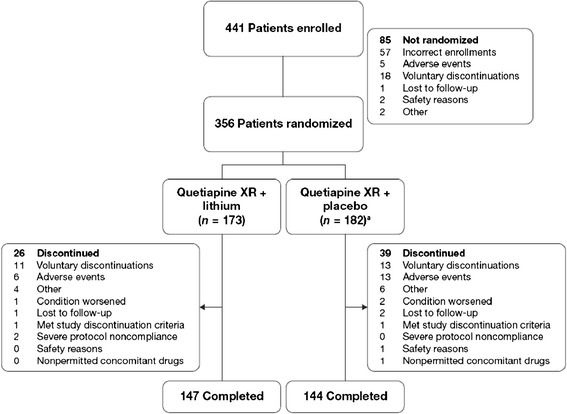
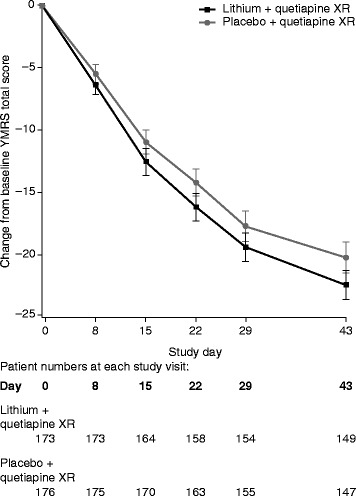
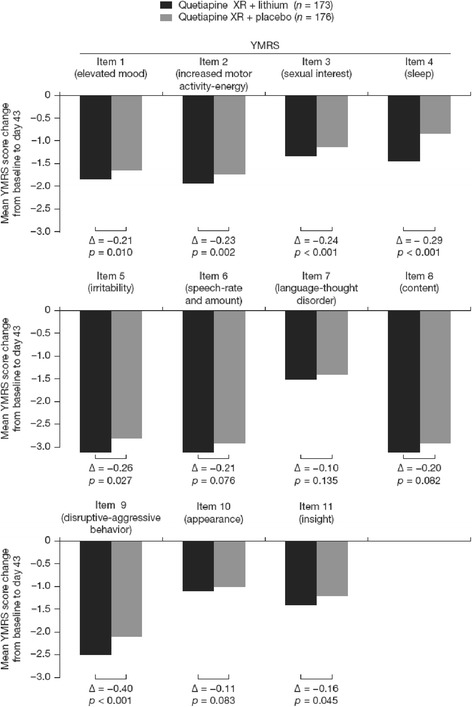
Quetiapine extended release (XR) and lithium are treatments with proven efficacy in acute mania. This randomized study evaluated the efficacy and safety of lithium or placebo as add-on to quetiapine XR in adult patients with manic or mixed symptoms of bipolar I disorder. In this 6-week, double-blind study (Trial D144AC00003), adult patients with DSM-IV-TR-diagnosed bipolar I disorder (current episode manic or mixed), a Young Mania Rating Scale (YMRS) total score ≥20, and score ≥4 on two of four core YMRS items were administered quetiapine XR (400 to 800 mg/day) and randomly assigned to receive add-on lithium (600 to 1,800 mg/day) or placebo. The primary efficacy end point was change in the YMRS total score from baseline to day 43, analyzed using a mixed-model for repeated measures (MMRM) approach. Secondary efficacy and safety end points were also measured. Rating scales were administered by trained staff. Three hundred fifty-six patients treated with quetiapine XR were randomized to add-on lithium (n = 173) or placebo (n = 183). Two hundred ninety-one patients (81.7%) completed the study. At day 43, least squares mean change in YMRS total score was -22.8 for add-on lithium and -20.1 for add-on placebo, a statistically significant treatment group difference of -2.69 (p < 0.001). On secondary measures, add-on lithium was associated with significant improvements in response, remission, illness severity, and overall illness versus add-on placebo (p < 0.05). The number needed to treat was 9.1 for response and 7.9 for remission for add-on lithium compared with add-on placebo. Lithium in combination with quetiapine XR was generally well tolerated, with a similar profile to quetiapine XR in combination with placebo. The addition of lithium to quetiapine XR therapy was associated with significantly greater efficacy than placebo as add-on and was generally well tolerated in patients with acute bipolar I mania. This study was registered under Clinicaltrials.gov Identifier NCT00931723.
Overview
The claims and statistics of this paper haven’t been checked yet.
Free: it reads the open-access text and checks the first 5 claims that cite a source we can check. Create a free account to check every claim.
Integrity signals
Registry
Cites
Statistics
Figures
Verification
Claims the paper makes
The claims and statistics of this paper haven’t been checked yet.
Free: it reads the open-access text and checks the first 5 claims that cite a source we can check. Create a free account to check every claim.
Claims other papers make about this one
Each is checked against this paper’s own text: does it say what the citing paper says it does?
The cited source says what the claim attributes to it.
In the citing paper
“Specifically, lithium plus quetiapine showed superiority to quetiapine alone.147”
Self-check
Percentages, sums and reported differences re-computed from the paper’s own numbers.
The self-check needs the paper’s full text.
Citations
Cites
The Positive and Negative Syndrome Scale (PANSS) for schizophrenia.
Kay, S. R., Fiszbein, A., & Opler, L. A. (1987) · Schizophrenia Bulletin · doi:10.1093/schbul/13.2.261 · Cited by 21,378 · cited 1×
“1997), Positive and Negative Syndrome Scale (PANSS) total and activation and positive subscales (Kay et al. 1987), and Montgomery-Åsberg Depression Rating Scale (MADRS) (Montgomery and Asberg 1979).”
MethodA new depression scale designed to be sensitive to change
Montgomery, S. A., & Åsberg, M. (1979) · British Journal of Psychiatry · doi:10.1192/bjp.134.4.382 · Cited by 13,962 · cited 4×
“Secondary outcome measures included changes to day 43 in scores for individual YMRS items, Clinical Global Impressions for Bipolar Disorder-Severity of Illness (CGI-BP-S), CGI-BP-Change (CGI-BP-C) (Spearing et al. 1997), Positive and Negative Syndrome Scale (PANSS) total and activation and positive subscales (Kay et a…”
MethodInfluential(1976) · Medical Entomology and Zoology · Cited by 8,899
A Rating Scale for Mania: Reliability, Validity and Sensitivity
Young, R. C., Biggs, J. T., Ziegler, V. E., & Meyer, D. A. (1978) · British Journal of Psychiatry · doi:10.1192/bjp.133.5.429 · Cited by 8,744
Posner, K., Brown, G. K., Stanley, B., Brent, D. A., Yershova, K. V., Oquendo, M. A., Currier, G. W., Melvin, G. A., Greenhill, L., Shen, S., et al. (2011) · American Journal of Psychiatry · doi:10.1176/appi.ajp.2011.10111704 · Cited by 5,157
A RATING SCALE FOR EXTRAPYRAMIDAL SIDE EFFECTS
SIMPSON, G. M., B., M., B., G., ANGUS, J. W. S., P., F. R. C., & M., D. P. (1970) · Acta Psychiatrica Scandinavica · doi:10.1111/j.1600-0447.1970.tb02066.x · Cited by 3,264 · cited 1×
“Extrapyramidal symptoms (EPS) were assessed by TEAEs, changes in EPS rating scales (Simpson-Angus Scale [SAS] (Simpson and Angus 1970), Abnormal Involuntary Movement Scale [AIMS] (Guy 1976), and Barnes Akathisia Rating Scale (BARS) (Barnes 1989)), worsening of SAS, AIMS, or BARS score category, and initiation of antic…”
MethodA Rating Scale for Drug-Induced Akathisia
Barnes, T. R. E. (1989) · British Journal of Psychiatry · doi:10.1192/bjp.154.5.672 · Cited by 2,170
Manic-Depressive Illness: Bipolar Disorders and Recurrent Depression
Goodwin, F. K., & Jamison, K. R. (2007) · Medical Entomology and Zoology · Cited by 1,325
Goodwin, G., Haddad, P., Ferrier, I., Aronson, J., Barnes, T., Cipriani, A., Coghill, D., Fazel, S., Geddes, Jr., Grunze, H., et al. (2016) · Journal of Psychopharmacology · doi:10.1177/0269881116636545 · Cited by 1,309 · cited 2×
“Guidelines typically recommend lithium, divalproex, or an atypical antipsychotic in the treatment of acute mania, frequently as monotherapy initially, with combination therapy in cases of inadequate response (Connolly and Thase 2011; Goodwin 2009; Grunze et al. 2009; Nivoli et al. 2011; Yatham et al. 2009).”
BackgroundYatham, L. N., Kennedy, S. H., Parikh, S. V., Schaffer, A., Beaulieu, S., Alda, M., O’Donovan, C., MacQueen, G., McIntyre, R. S., Sharma, V., et al. (2013) · Bipolar Disorders · doi:10.1111/bdi.12025 · Cited by 1,217
Research works printed but not linked: 2
- American Psychiatric Association Diagnostic and Statistical Manual of Mental Disorders, Fourth Edition, Text Revision 2000 Washington, DC American Psychiatric Association
- First MB Williams JBW Spitzer RL Gibbon M Structured Clinical Interview for DSM-IV-TR Axis I Disorders, Clinical Trials Version (SCID-CT) 2007 New York Biometrics Research, New York State Psychiatric Institute
Cited by
Yatham, L. N., Kennedy, S. H., Parikh, S. V., Schaffer, A., Bond, D. J., Frey, B. N., Sharma, V., Goldstein, B. I., Rej, S., Beaulieu, S., et al. (2018) · Bipolar Disorders · doi:10.1111/bdi.12609 · Cited by 1,852
“Specifically, lithium plus quetiapine showed superiority to quetiapine alone (148).”
BackgroundFountoulakis, K. N., Tohen, M., & Zarate, C. A. (2022) · European Neuropsychopharmacology · doi:10.1016/j.euroneuro.2021.10.003 · Cited by 146
Fountoulakis, K. N., Yatham, L., Grunze, H., Vieta, E., Young, A., Blier, P., Kasper, S., & Moeller, H. J. (2016) · International Journal of Neuropsychopharmacology · doi:10.1093/ijnp/pyw100 · Cited by 116
“Similarly, combination of lithium (600–1800 mg/d) and quetiapine XR (400–800 mg/d) was superior to quetiapine plus placebo (Bourin et al., 2014) in treating acute mania.”
Treatment of bipolar disorder: Review of evidence regarding quetiapine and lithium
Ketter, T. A., Miller, S., Dell’Osso, B. M., & Wang, P. W. (2015) · Journal of Affective Disorders · doi:10.1016/j.jad.2015.11.002 · Cited by 62
“Patients included in the acute placebo-controlled studies were assessed to have a lower likelihood of responding to monotherapy alone, because of the presence of severe manic symptoms (Bourin et al., 2014; Sachs et al., 2004; Yatham et al., 2007).”
BackgroundInfluentialLithium in Bipolar Disorder: Optimizing Therapy Using Prolonged-Release Formulations
Girardi, P., Brugnoli, R., Manfredi, G., & Sani, G. (2016) · Drugs in R&D · doi:10.1007/s40268-016-0139-7 · Cited by 61
“quetiapine extended-release (XR) for 6 weeks [39].”
Pacchiarotti, I., Anmella, G., Colomer, L., & Vieta, E. (2020) · Acta Psychiatrica Scandinavica · doi:10.1111/acps.13209 · Cited by 51
“Also, combination therapy has been suggested more efficacious than SGA monotherapy (48, 49).”
BackgroundSeverus, E., Bauer, M., & Geddes, J. R. (2018) · Pharmacopsychiatry · doi:10.1055/a-0627-7489 · Cited by 46
“[30] and lithium’s proven acute antimanic efficacy [36], even in combination with quetiapine [37], we should perhaps”
BackgroundSelf-citationKorean Medication Algorithm Project for Bipolar Disorder 2018 (KMAP-BP 2018): Fourth Revision
Woo, Y. S., Bahk, W.-M., Lee, J. G., Jeong, J.-H., Kim, M.-D., Sohn, I., Shim, S.-H., Jon, D.-I., Seo, J. S., Min, K. J., et al. (2018) · Clinical Psychopharmacology and Neuroscience · doi:10.9758/cpn.2018.16.4.434 · Cited by 35
On the phenomenology of auditory verbal hallucinations in affective and non-affective psychosis
Toh, W. L., Thomas, N., Hollander, Y., & Rossell, S. L. (2020) · Psychiatry Research · doi:10.1016/j.psychres.2020.113147 · Cited by 28
Galling, B., Garcia, M. A., Osuchukwu, U., Hagi, K., & Correll, C. U. (2015) · Expert Opinion on Drug Safety · doi:10.1517/14740338.2015.1053457 · Cited by 28
“Whereas two compared haloperidol monotherapy (n = 16) with the addition of either lithium (studies = 1, n = 7) [46] or carbamazepine (n = 11) [46], the remaining study compared quetiapine XR monotherapy (n = 182) with the addition of lithium (n = 173) [32].”
BackgroundInfluentialA miRNome analysis of drug-free manic psychotic bipolar patients versus healthy controls
Tabano, S. M., Caldiroli, A., Terrasi, A., Colapietro, P., Grassi, S., Carnevali, G. S., Fontana, L., Serati, M., Vaira, V., Altamura, A. C., et al. (2019) · European Archives of Psychiatry and Clinical Neuroscience · doi:10.1007/s00406-019-01057-2 · Cited by 28
Korean Medication Algorithm for Bipolar Disorder 2018: Comparisons with Other Treatment Guidelines
Jeong, J., Bahk, W., Woo, Y. S., Lee, J. G., Kim, M.-D., Sohn, I., Shim, S.-H., Jon, D., Seo, J. S., Kim, W. K., et al. (2019) · Clinical Psychopharmacology and Neuroscience · doi:10.9758/cpn.2019.17.2.155 · Cited by 25
An overview of pharmacotherapy for bipolar I disorder
Morsel, A., Morrens, M., & Sabbe, B. (2018) · Expert Opinion on Pharmacotherapy · doi:10.1080/14656566.2018.1426746 · Cited by 24
“Results related to adjunctive quetiapine for bipolar mania are unclear with studies demonstrating greater efficacy than a mood stabilizer alone [75] or quetiapine monotherapy [76], and another study failing to show superior efficacy [77].”
BackgroundJeong, J., Bahk, W., Woo, Y. S., Yoon, B.-H., Lee, J. G., Kim, W., Sohn, I., Park, S., Shim, S.-H., Seo, J. S., et al. (2023) · Clinical Psychopharmacology and Neuroscience · doi:10.9758/cpn.2023.21.1.32 · Cited by 21
“of combination therapy over monotherapy in terms of efficacy for mania, a conclusion based on results from clinical trials and meta-analyses [42-47].”
Tajika, A., Hori, H., Iga, J., Koshikawa, Y., Ogata, H., Ogawa, Y., Watanabe, K., Kato, T., Matsuo, K., & Kato, M. (2022) · The International Journal of Neuropsychopharmacology · doi:10.1093/ijnp/pyac050 · Cited by 23
“, 2018) comparing AUG therapy and MS monotherapy and 6 studies (Biederman et al., 1979; Möller et al., 1989; Chou et al., 1999; Müller-Oerlinghausen et al., 2000; Bourin et al., 2014; Moosavi et al., 2014) comparing AUG therapy and AP monotherapy.”
BackgroundMixed states in bipolar disorder – changes in DSM-5 and current treatment recommendations
Betzler, F., Stöver, L., Sterzer, P., & Köhler, S. (2017) · International Journal of Psychiatry in Clinical Practice · doi:10.1080/13651501.2017.1311921 · Cited by 25
Goldberg, J. F. (2019) · FOCUS The Journal of Lifelong Learning in Psychiatry · doi:10.1176/appi.focus.20190008 · Cited by 20
Buoli, M., Esposito, C. M., Godio, M., Caldiroli, A., Serati, M., & Altamura, A. C. (2017) · Journal of Psychopharmacology · doi:10.1177/0269881117705098 · Cited by 12
“Manic Episodes were defined by a YMRS score ⩾20 (Bourin et al., 2014).”
Mengistu, M. E., Handebo, S., Kassaw, A. T., Dagnew, E. M., Mekonnen, G. A., & Birarra, M. K. (2023) · Annals of General Psychiatry · doi:10.1186/s12991-023-00444-3 · Cited by 9
“These medications had good pharmacological tolerability and serum monitoring profiles than lithium [39].”
BackgroundGao, K., Arnold, J. G., Prihoda, T. J., Quinones, M. P., Singh, V. K., Schinagle, M., Conroy, C. M., D’Arcangelo, N., Bai, Y., Calabrese, J. R., et al. (2025) · Psychopharmacology Bulletin · doi:10.64719/pb.4604 · Cited by 10
An algorithm for pharmacological treatment of mania during hospitalisation
Kessing, L. V., Christensen, E. M., Larsen, S. K., Kyster, N. B., Pedersen, L., Legind, C. S., Hansen, L., Vejstrup, B., Faurholt‐Jepsen, M., Baandrup, L., et al. (2024) · Danish Medical Journal · doi:10.61409/a08230525 · Cited by 3
Shafiq, S., Ronksley, P. E., Elliott, M. J., Bulloch, A. G. M., & Patten, S. B. (2025) · The Canadian Journal of Psychiatry · doi:10.1177/07067437251355643 · Cited by 2
Severus, E., Laber, E. B., & Lipkovich, I. A. (2015) · Current Treatment Options in Psychiatry · doi:10.1007/s40501-015-0050-9 · Cited by 2
Self-citationJafari‐Sabet, M., Amiri, S., Emami, S., Aghamiri, H., Fatahi, N., & Keyhanfar, F. (2022) · Research Square · doi:10.22038/ijbms.2023.69714.15177 · Cited by 2
“Multiple clinical studies have documented that treatment with quetiapine plus lithium is generally well-tolerated in patients with acute bipolar disorder (BPD) and has greater efficacy than quetiapine alone (46).”
Fornaro, M., Lorenzo, C. D., Kishi, T., & Daray, F. M. (2026) · Journal of Affective Disorders · doi:10.1016/j.jad.2026.122329 · Cited by 2
Treatment of Mania with Lithium
Bauer, M., & Gitlin, M. J. (2016) · Springer eBooks · doi:10.1007/978-3-319-31214-9_6 · Cited by 1
Combination Therapies and Switching of Agents in Depression and Bipolar Disorders
Folsche, T., Maier, H. B., Hillemacher, T., & Frieling, H. (2022) · Springer eBooks · doi:10.1007/978-3-030-62059-2_437 · Cited by 1
Drug therapy for bipolar disorder: A review of efficacy evidence
Bourin, M. (2023) · Archives of Depression and Anxiety · doi:10.17352/2455-5460.000085 · Cited by 1
Self-citationII Klinika Psychiatryczna, I. P. I. N., Święcicki, Ł., Stefanowski, B., & II Klinika Psychiatryczna, I. P. I. N. (2017) · Psychiatria i Psychologia Kliniczna · doi:10.15557/pipk.2017.0005
Lithium in der Langzeittherapie der bipolaren Störung — was gibt es Neues?
Petzold, J., Bauer, M., & Severus, E. (2017) · DNP - Der Neurologe und Psychiater · doi:10.1007/s15202-017-1742-3
Self-citationPlanning Clinical Trials: The Main Step in Developing New Drugs
Bourin, M. (2017) · SOJ Pharmacy & Pharmaceutical Sciences · doi:10.15226/2374-6866/4/5/00170
“This period, which can be obtained without treatment, or under placebo, or sometimes by symptomatic treatment, allows evaluation of the state of patients without active treatment and can also be used, on the basis of specific criteria, to select the pre-included patients who will finally be included in the trial [13].”
BackgroundSelf-citationGuidelines on Mood Stabilizers
Gfesser, J., & Kittel‐Schneider, S. (2020) · Springer eBooks · doi:10.1007/978-3-319-56015-1_117-1
Combination Therapies and Switching of Agents in Depression and Bipolar Disorders
Folsche, T., Maier, H. B., Hillemacher, T., & Frieling, H. (2021) · Springer eBooks · doi:10.1007/978-3-319-56015-1_437-1 · Cited by 1
Revisión Sistemática del Tratamiento del Trastorno Bipolar con Características Mixtas
García, M. P., López-Cortacans, G., & García, R. P. (2022) · Revista Colombiana de Psiquiatría · doi:10.1016/j.rcp.2022.06.003
Guidelines on Mood Stabilizers
Gfesser, J., & Kittel‐Schneider, S. (2022) · Springer eBooks · doi:10.1007/978-3-030-62059-2_117
Buckley, P. F., & Foster, A. E. (2024) · American Psychiatric Association Publishing eBooks · doi:10.1176/appi.books.9781615375523.as28
Almeida, J., Spelber, D., & Smith, T. L. (2024) · American Psychiatric Association Publishing eBooks · doi:10.1176/appi.books.9781615375523.as37 · Cited by 2
Mengistu, M. E., Berassa, S. H., Kassaw, A. T., Dagnew, E. M., Mekonnen, G. A., & Birarra, M. K. (2024) · Figshare · doi:10.6084/m9.figshare.26580794
Schoenleber, A., Quinlivan, E., Jelinek, L., Miegel, F. S., Bermpohl, F., Moritz, S., Schreiter, S., & Friedel, E. (2026) · Clinical Psychology & Psychotherapy · doi:10.1002/cpp.70294
Clinical Pharmacology of Bipolar Disorder: An Updated Review of Pharmacotherapeutic Strategies
Bourin, M. (2026) · Journal of Psychology and Psychotherapy Research · doi:10.12974/2313-1047.2026.13.04
“Quetiapine is also effective in acute mania but typically requires higher doses (600–800 mg/day), frequently resulting in significant sedation [63].”
Self-citation
Metadata
- Authors
- Bourin, M. S., Severus, E., Schronen, J. P., Gass, P., Szamosi, J., Eriksson, H., & Chandrashekar, H.
- Affiliations
- Université de Nantes (FR)
- Technische Universität Dresden (DE)
- Heidelberg University (DE)
- AstraZeneca (Sweden) (SE)
- Corresponding author
- Bourin, Michel S
- Venue
- International Journal of Bipolar Disorders
- Published
- 2014-11-08
- Volume
- 2
- Issue
- 1
- Pages
- 14-14
- ISSN
- 2194-7511 (ISSN-L)
- PMC
- PMC4224669
- OpenAlex
- W2132972638
- Cited by
- 40
- References
- 49
- Citations by year
- 2026: 2 · 2025: 2 · 2024: 4 · 2023: 3 · 2022: 5 · 2021: 2 · 2020: 3 · 2019: 3 · 2018: 5 · 2017: 5 · 2016: 3 · 2015: 3
- FWCI
- 2.80
- Type
- journal article
- Language
- en
- Open access
- gold
- doi.org
- Locations
- International Journal of Bipolar Disorders (publishedVersion, cc-by)
- PubMed Central (publishedVersion, cc-by)
- PubMed (publishedVersion)
- Funders
- AstraZeneca
- Topics
- Health Sciences › Medicine › Psychiatry and Mental health › Bipolar Disorder and Treatment
- Health Sciences › Medicine › Psychiatry and Mental health › Schizophrenia research and treatment
- Health Sciences › Medicine › Pharmacology (medical) › Treatment of Major Depression
- Keywords
- lithium, quetiapine extended release, acute mania, bipolar I disorder, adjunctive therapy, Young Mania Rating Scale, manic symptoms, mixed states, treatment response and remission, drug safety
About these checks
Registry, retraction, Cites and statistics results are computed, not judged, with one exception: a printed reference that no index lists is read once by a model before it counts as a citation error. Claims are extracted by a model and kept only when their quote appears verbatim in the text; each cited source is then checked, with a model’s help, for whether it says what the claim relies on. Those verdicts can be wrong — read the claim’s quote and the cited source before relying on one.
Statistics and arithmetic are recomputed, not judged.
Confidence bands are shown only for fields calibrated on our annotated test set. None is calibrated yet, so no band is shown.
What counts as a claim ›How we measure confidence ›How we check this ›
Are you an author, or do you see a problem with this page? Request a review
Data sources
Bibliographic data: Semantic Scholar, OpenAlex, Crossref.
Contains information from the Semantic Scholar Academic Graph Datasets, made available under the ODC Attribution License (ODC-BY 1.0).
Semantic Scholar’s data is described in: Kinney, R., et al. (2023). The Semantic Scholar Open Data Platform. arXiv:2301.10140.
