

Lithium as add-on to quetiapine XR in adult patients with acute mania: a 6-week, multicenter, double-blind, randomized, placebo-controlled study
Open accessThe DOI matches its Crossref record; 49 of the 49 references it cites were found in a registry or an index.
Abstract
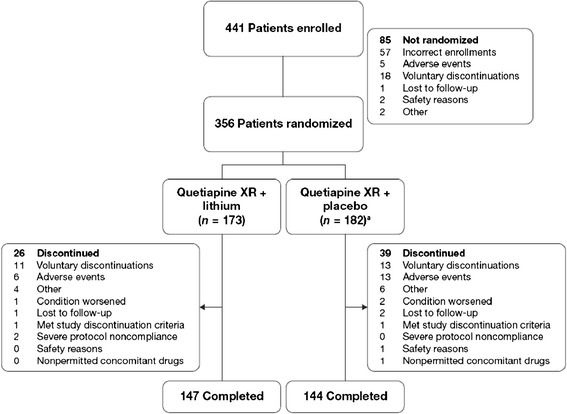
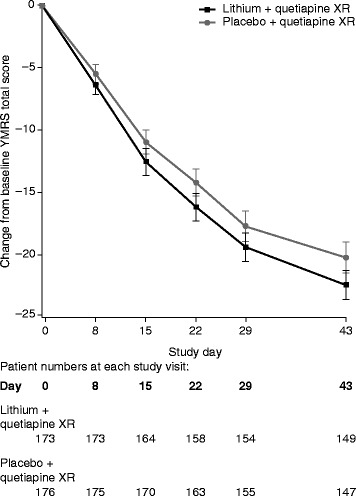
Quetiapine extended release (XR) and lithium are treatments with proven efficacy in acute mania. This randomized study evaluated the efficacy and safety of lithium or placebo as add-on to quetiapine XR in adult patients with manic or mixed symptoms of bipolar I disorder. In this 6-week, double-blind study (Trial D144AC00003), adult patients with DSM-IV-TR-diagnosed bipolar I disorder (current episode manic or mixed), a Young Mania Rating Scale (YMRS) total score ≥20, and score ≥4 on two of four core YMRS items were administered quetiapine XR (400 to 800 mg/day) and randomly assigned to receive add-on lithium (600 to 1,800 mg/day) or placebo. The primary efficacy end point was change in the YMRS total score from baseline to day 43, analyzed using a mixed-model for repeated measures (MMRM) approach. Secondary efficacy and safety end points were also measured. Rating scales were administered by trained staff. Three hundred fifty-six patients treated with quetiapine XR were randomized to add-on lithium (n = 173) or placebo (n = 183). Two hundred ninety-one patients (81.7%) completed the study. At day 43, least squares mean change in YMRS total score was -22.8 for add-on lithium and -20.1 for add-on placebo, a statistically significant treatment group difference of -2.69 (p < 0.001). On secondary measures, add-on lithium was associated with significant improvements in response, remission, illness severity, and overall illness versus add-on placebo (p < 0.05). The number needed to treat was 9.1 for response and 7.9 for remission for add-on lithium compared with add-on placebo. Lithium in combination with quetiapine XR was generally well tolerated, with a similar profile to quetiapine XR in combination with placebo. The addition of lithium to quetiapine XR therapy was associated with significantly greater efficacy than placebo as add-on and was generally well tolerated in patients with acute bipolar I mania. This study was registered under Clinicaltrials.gov Identifier NCT00931723.
Overview
The claims and statistics of this paper haven’t been checked yet.
Free: it reads the open-access text and checks the first 5 claims that cite a source we can check. Create a free account to check every claim.
Integrity signals
Registry
Cites
Statistics
Figures
Verification
Claims the paper makes
The claims and statistics of this paper haven’t been checked yet.
Free: it reads the open-access text and checks the first 5 claims that cite a source we can check. Create a free account to check every claim.
Claims other papers make about this one
Each is checked against this paper’s own text: does it say what the citing paper says it does?
The cited source says what the claim attributes to it.
In the citing paper
“Specifically, lithium plus quetiapine showed superiority to quetiapine alone.147”
Self-check
Percentages, sums and reported differences re-computed from the paper’s own numbers.
The self-check needs the paper’s full text.
Citations
Cites
The Positive and Negative Syndrome Scale (PANSS) for schizophrenia.
Kay, S. R., Fiszbein, A., & Opler, L. A. (1987) · Schizophrenia Bulletin · doi:10.1093/schbul/13.2.261 · Cited by 21,378 · cited 1×
“1997), Positive and Negative Syndrome Scale (PANSS) total and activation and positive subscales (Kay et al. 1987), and Montgomery-Åsberg Depression Rating Scale (MADRS) (Montgomery and Asberg 1979).”
MethodA new depression scale designed to be sensitive to change
Montgomery, S. A., & Åsberg, M. (1979) · British Journal of Psychiatry · doi:10.1192/bjp.134.4.382 · Cited by 13,962 · cited 4×
“Secondary outcome measures included changes to day 43 in scores for individual YMRS items, Clinical Global Impressions for Bipolar Disorder-Severity of Illness (CGI-BP-S), CGI-BP-Change (CGI-BP-C) (Spearing et al. 1997), Positive and Negative Syndrome Scale (PANSS) total and activation and positive subscales (Kay et a…”
MethodInfluential(1976) · Medical Entomology and Zoology · Cited by 8,899
A Rating Scale for Mania: Reliability, Validity and Sensitivity
Young, R. C., Biggs, J. T., Ziegler, V. E., & Meyer, D. A. (1978) · British Journal of Psychiatry · doi:10.1192/bjp.133.5.429 · Cited by 8,744
Posner, K., Brown, G. K., Stanley, B., Brent, D. A., Yershova, K. V., Oquendo, M. A., Currier, G. W., Melvin, G. A., Greenhill, L., Shen, S., et al. (2011) · American Journal of Psychiatry · doi:10.1176/appi.ajp.2011.10111704 · Cited by 5,157
A RATING SCALE FOR EXTRAPYRAMIDAL SIDE EFFECTS
SIMPSON, G. M., B., M., B., G., ANGUS, J. W. S., P., F. R. C., & M., D. P. (1970) · Acta Psychiatrica Scandinavica · doi:10.1111/j.1600-0447.1970.tb02066.x · Cited by 3,264 · cited 1×
“Extrapyramidal symptoms (EPS) were assessed by TEAEs, changes in EPS rating scales (Simpson-Angus Scale [SAS] (Simpson and Angus 1970), Abnormal Involuntary Movement Scale [AIMS] (Guy 1976), and Barnes Akathisia Rating Scale (BARS) (Barnes 1989)), worsening of SAS, AIMS, or BARS score category, and initiation of antic…”
MethodA Rating Scale for Drug-Induced Akathisia
Barnes, T. R. E. (1989) · British Journal of Psychiatry · doi:10.1192/bjp.154.5.672 · Cited by 2,170
Manic-Depressive Illness: Bipolar Disorders and Recurrent Depression
Goodwin, F. K., & Jamison, K. R. (2007) · Medical Entomology and Zoology · Cited by 1,325
Goodwin, G., Haddad, P., Ferrier, I., Aronson, J., Barnes, T., Cipriani, A., Coghill, D., Fazel, S., Geddes, Jr., Grunze, H., et al. (2016) · Journal of Psychopharmacology · doi:10.1177/0269881116636545 · Cited by 1,309 · cited 2×
“Guidelines typically recommend lithium, divalproex, or an atypical antipsychotic in the treatment of acute mania, frequently as monotherapy initially, with combination therapy in cases of inadequate response (Connolly and Thase 2011; Goodwin 2009; Grunze et al. 2009; Nivoli et al. 2011; Yatham et al. 2009).”
BackgroundYatham, L. N., Kennedy, S. H., Parikh, S. V., Schaffer, A., Beaulieu, S., Alda, M., O’Donovan, C., MacQueen, G., McIntyre, R. S., Sharma, V., et al. (2013) · Bipolar Disorders · doi:10.1111/bdi.12025 · Cited by 1,217
Posner, K., Oquendo, M. A., Gould, M., Stanley, B., & Davies, M. (2007) · American Journal of Psychiatry · doi:10.1176/ajp.2007.164.7.1035 · Cited by 1,025
Spearing, M. K., Post, R. M., Leverich, G. S., Brandt, D., & Nolen, W. (1997) · Psychiatry Research · doi:10.1016/s0165-1781(97)00123-6 · Cited by 978 · cited 9×
“Psychiatric disorders, including mania, were the most common AE leading to discontinuation, reported in two patients in the add-on lithium and seven patients in the Table 2 Mean changes from baseline to day 43 in primary and secondary efficacy measures (ITT set) Measure Quetiapine XR + Lithium (n = 173) Quetiapine XR…”
BackgroundInfluentialYatham, L. N., Kennedy, S. H., Schaffer, A., Parikh, S. V., Beaulieu, S., O'Donovan, C., MacQueen, G., McIntyre, R. S., Sharma, V., Ravindran, A., et al. (2009) · Bipolar Disorders · doi:10.1111/j.1399-5618.2009.00672.x · Cited by 570
Tohen, M., Chengappa, K. N. R., Suppes, T., Zarate, C. A., Calabrese, J. R., Bowden, C. L., Sachs, G. S., Kupfer, D. J., Baker, R. W., Risser, R. C., et al. (2002) · Archives of General Psychiatry · doi:10.1001/archpsyc.59.1.62 · Cited by 463 · cited 1×
“For example, when compared with a mood stabilizer alone, combinations including a mood stabilizer and olanzapine or asenapine are associated with weight gain, combinations including aripiprazole lead to greater risk of akathisia, and combinations including quetiapine are associated with increased somnolence (Geoffroy…”
ResultGoodwin, G., & Consensus Group of the British Association for Psychopharmacology (2009) · Journal of Psychopharmacology · doi:10.1177/0269881109102919 · Cited by 444 · cited 2×
“Guidelines typically recommend lithium, divalproex, or an atypical antipsychotic in the treatment of acute mania, frequently as monotherapy initially, with combination therapy in cases of inadequate response (Connolly and Thase 2011; Goodwin 2009; Grunze et al. 2009; Nivoli et al. 2011; Yatham et al. 2009).”
BackgroundFunctioning and Disability in Bipolar Disorder: An Extensive Review
Sanchez-Moreno, J., Martinez-Aran, A., Tabarés-Seisdedos, R., Torrent, C., Vieta, E., & Ayuso-Mateos, J. L. (2009) · Psychotherapy and Psychosomatics · doi:10.1159/000228249 · Cited by 443 · cited 1×
“Manic, depressed, or mixed symptoms range in severity and rate of onset and in their most extreme forms require hospitalization (Sanchez-Moreno et al. 2009).”
BackgroundGrunze, H., Vieta, E., Goodwin, G. M., Bowden, C., Licht, R. W., Möller, H.-J., Kasper, S., & WFSBP Task Force On Treatment Guidelines For Bipolar Disorders (2010) · The World Journal of Biological Psychiatry · doi:10.3109/15622970903555881 · Cited by 399
Grunze, H., Vieta, E., Goodwin, G. M., Bowden, C., Licht, R. W., Möller, H.-J., Kasper, S., WFSBP Task Force on Treatment Guide, Grunze, H., Vieta, E., et al. (2009) · The World Journal of Biological Psychiatry · doi:10.1080/15622970902823202 · Cited by 346
Smith, L. A., Cornelius, V., Warnock, A., Tacchi, M. J., & Taylor, D. (2007) · Bipolar Disorders · doi:10.1111/j.1399-5618.2007.00468.x · Cited by 270 · cited 1×
“as monotherapy offer additional efficacy and acceptable tolerability when used in combination (Brooks et al. 2011; Geoffroy et al. 2012; Sachs and Gardner-Schuster 2007; Smith et al. 2007).”
BackgroundSachs, G., Chengappa, K., Suppes, T., Mullen, J., Brecher, M., Devine, N., & Sweitzer, D. (2004) · Bipolar Disorders · doi:10.1111/j.1399-5618.2004.00115.x · Cited by 262 · cited 3×
“Direct comparison with previous studies - which compared a mood stabilizer combined with quetiapine IR against a mood stabilizer combined with placebo - is not possible (Sachs et al. 2004; Suppes et al. 2009; Vieta et al. 2008a; Yatham et al. 2004), although all these studies indicate the superior efficacy of combinat…”
ResultSuppes, T., Vieta, E., Liu, S., Brecher, M., Paulsson, B., & Trial 127 Investigators (2009) · American Journal of Psychiatry · doi:10.1176/appi.ajp.2008.08020189 · Cited by 230 · cited 4×
“2004) and in the prevention of recurrent mood disorder (Suppes et al. 2009; Vieta et al. 2008a).”
BackgroundMethodResultInfluentialVieta, E., Suppes, T., Eggens, I., Persson, I., Paulsson, B., & Brecher, M. (2008) · Journal of Affective Disorders · doi:10.1016/j.jad.2008.06.001 · Cited by 227
Novel Insights into Lithium’s Mechanism of Action: Neurotrophic and Neuroprotective Effects
Quiroz, J. A., Machado-Vieira, R., Zarate, Jr., & Manji, H. K. (2010) · Neuropsychobiology · doi:10.1159/000314310 · Cited by 226 · cited 1×
“2011) and lithium (Quiroz et al. 2010; Shim et al. 2012) are complementary and additive as combination therapy.”
BackgroundQuetiapine: preclinical studies, pharmacokinetics, drug interactions, and dosing.
Nemeroff, C. B., Kinkead, B. L., & Goldstein, J. M. (2002) · PubMed · Cited by 187
Suppes, T. M., Datto, C. J., Minkwitz, M. C., Nordenhem, A., Walker, C., & Darko, D. F. (2009) · Journal of Affective Disorders · doi:10.1016/j.jad.2009.10.007 · Cited by 183
Yatham, L. N., Paulsson, B., Mullen, J., & Vågerö, A. M. (2004) · Journal of Clinical Psychopharmacology · doi:10.1097/01.jcp.0000144887.66319.2f · Cited by 168
New treatment guidelines for acute bipolar depression: A systematic review
Nivoli, A. M. A., Colom, F., Murru, A., Pacchiarotti, I., Castro-Loli, P., González-Pinto, A., Fountoulakis, K. N., & Vieta, E. (2011) · Journal of Affective Disorders · doi:10.1016/j.jad.2010.05.018 · Cited by 161 · cited 2×
“Guidelines typically recommend lithium, divalproex, or an atypical antipsychotic in the treatment of acute mania, frequently as monotherapy initially, with combination therapy in cases of inadequate response (Connolly and Thase 2011; Goodwin 2009; Grunze et al. 2009; Nivoli et al. 2011; Yatham et al. 2009).”
BackgroundVieta, E., T’joen, C., McQuade, R. D., Carson, W. H., Marcus, R. N., Sanchez, R., Owen, R., & Nameche, L. (2008) · American Journal of Psychiatry · doi:10.1176/appi.ajp.2008.07101560 · Cited by 161
Ballenger, J. C. (2011) · Yearbook of Psychiatry and Applied Mental Health · doi:10.1016/j.ypsy.2010.10.088 · Cited by 146
The Clinical Management of Bipolar Disorder: A Review of Evidence-Based Guidelines
Connolly, K. R., & Thase, M. E. (2011) · The Primary Care Companion For CNS Disorders · doi:10.4088/pcc.10r01097 · Cited by 94 · cited 1×
“Guidelines typically recommend lithium, divalproex, or an atypical antipsychotic in the treatment of acute mania, frequently as monotherapy initially, with combination therapy in cases of inadequate response (Connolly and Thase 2011; Goodwin 2009; Grunze et al. 2009; Nivoli et al. 2011; Yatham et al. 2009).”
BackgroundSzegedi, A., Calabrese, J. R., Stet, L., Mackle, M., Zhao, J., & Panagides, J. (2012) · Journal of Clinical Psychopharmacology · doi:10.1097/jcp.0b013e31823f872f · Cited by 89 · cited 1×
“For example, when compared with a mood stabilizer alone, combinations including a mood stabilizer and olanzapine or asenapine are associated with weight gain, combinations including aripiprazole lead to greater risk of akathisia, and combinations including quetiapine are associated with increased somnolence (Geoffroy…”
ResultRelationship of Lithium Chloride Dose to Treatment Response in Acute Mania
Stokes, P. E., Kocsis, J. H., & Arcuni, O. J. (1976) · Archives of General Psychiatry · doi:10.1001/archpsyc.1976.01770090070006 · Cited by 61 · cited 1×
“24 mEq/kg/ day) lithium doses (Stokes et al. 1976).”
Efficacy of lithium in mania and maintenance therapy of bipolar disorder.
Bowden, C. L. (2000) · PubMed · Cited by 56
Paykel, E. (2008) · British Journal of Psychiatry · doi:10.1192/bjp.bp.107.042242 · Cited by 52
Cutler, A. J., Datto, C. J., Nordenhem, A., Minkwitz, M. C., Acevedo, L. D., & Darko, D. F. (2011) · Clinical Therapeutics · doi:10.1016/j.clinthera.2011.10.002 · Cited by 48 · cited 2×
“The combination of quetiapine XR with lithium was generally well tolerated, and reported AEs were consistent with the known safety profiles of these medications in bipolar disorder (Bowden 2000; Cutler et al. 2011; Suppes et al. 2010).”
BackgroundResultNord, M., Nyberg, S., Brogren, J., Jučaitė, A., Halldin, C., & Farde, L. (2011) · The International Journal of Neuropsychopharmacology · doi:10.1017/s1461145711000514 · Cited by 48 · cited 1×
“The pharmacological rationale for combining quetiapine and lithium also remains to be confirmed, although it may be conjectured that the mechanisms of action of quetiapine (Nemeroff et al. 2002; Nord et al. 2011) and lithium (Quiroz et al.”
BackgroundCombination Therapy for Manic Phases: A Critical Review of a Common Practice
Geoffroy, P. A., Etain, B., Henry, C., & Bellivier, F. (2012) · CNS Neuroscience & Therapeutics · doi:10.1111/cns.12017 · Cited by 47 · cited 3×
“For example, when compared with a mood stabilizer alone, combinations including a mood stabilizer and olanzapine or asenapine are associated with weight gain, combinations including aripiprazole lead to greater risk of akathisia, and combinations including quetiapine are associated with increased somnolence (Geoffroy…”
BackgroundResultSuppes, T. M., Vieta, E., Gustafsson, U., & Ekholm, B. (2013) · Depression and Anxiety · doi:10.1002/da.22136 · Cited by 46
Vieta, E., Suppes, T., Ekholm, B., Udd, M., & Gustafsson, U. (2012) · Journal of Affective Disorders · doi:10.1016/j.jad.2012.04.014 · Cited by 37 · cited 1×
“mood stabilizer alone) significantly reduced the risk of recurrence of a mood event, whether the index episode was manic, depressive, or mixed (Vieta et al. 2012) (p ≤ 0.”
BackgroundBrooks, J. O., Goldberg, J. F., Ketter, T. A., Miklowitz, D. J., Calabrese, J. R., Bowden, C. L., & Thase, M. E. (2010) · The Journal of Clinical Psychiatry · doi:10.4088/jcp.09m05214yel · Cited by 34
Adjunctive treatment of acute mania: a clinical overview
Sachs, G. S., & Gardner-Schuster, E. E. (2007) · Acta Psychiatrica Scandinavica · doi:10.1111/j.1600-0447.2007.01056.x · Cited by 33 · cited 1×
“as monotherapy offer additional efficacy and acceptable tolerability when used in combination (Brooks et al. 2011; Geoffroy et al. 2012; Sachs and Gardner-Schuster 2007; Smith et al. 2007).”
BackgroundEmsley, R. A., Turner, H. J., Schronen, J., Botha, K., Smit, R., & Oosthuizen, P. P. (2005) · The International Journal of Neuropsychopharmacology · doi:10.1017/s1461145705005067 · Cited by 28 · cited 1×
“In agreement with studies of quetiapine IR (Emsley et al. 2005), worsening of glycemic control was not observed during quetiapine XR treatment combined with lithium or placebo.”
ResultSelf-citationSuppes, T. M., Datto, C. J., Minkwitz, M. C., Nordenhem, A., Walker, C., & Darko, D. F. (2014) · Journal of Affective Disorders · doi:10.1016/j.jad.2014.07.007 · Cited by 26
Shim, S. S., Hammonds, M. D., Tatsuoka, C., & Feng, I. (2012) · Neuroscience Letters · doi:10.1016/j.neulet.2012.06.047 · Cited by 20 · cited 1×
“2011) and lithium (Quiroz et al. 2010; Shim et al. 2012) are complementary and additive as combination therapy.”
BackgroundQuetiapine: A Pharmacoeconomic Review of its Use in Bipolar Disorder
Plosker, G. L. (2012) · PharmacoEconomics · doi:10.2165/11208500-000000000-00000 · Cited by 18
How Assess Drugs in the Treatment of Acute Bipolar Mania?
Bourin, M., & Thibaut, F. (2013) · Frontiers in Pharmacology · doi:10.3389/fphar.2013.00004 · Cited by 17
Self-citationCombination quetiapine therapy in the long-term treatment of patients with bipolar I disorder.
Hardoy, M., Garofalo, A., Carpiniello, B., Calabrese, J., & Carta, M. G. (2005) · Clinical Practice and Epidemiology in Mental Health · doi:10.1186/1745-0179-1-7 · Cited by 13
Oral, T. (2005) · PubMed · Cited by 10
Interventions for Acute Mood Episodes in Patients With Bipolar Disorder
Garlow, S. J. (2008) · The Journal of Clinical Psychiatry · doi:10.4088/jcp.0208e05 · Cited by 4 · cited 1×
“or in any medium, provided the original work is p symptoms is a primary treatment goal (Garlow 2008; Oral 2005).”
Background
Research works printed but not linked: 2
- American Psychiatric Association Diagnostic and Statistical Manual of Mental Disorders, Fourth Edition, Text Revision 2000 Washington, DC American Psychiatric Association
- First MB Williams JBW Spitzer RL Gibbon M Structured Clinical Interview for DSM-IV-TR Axis I Disorders, Clinical Trials Version (SCID-CT) 2007 New York Biometrics Research, New York State Psychiatric Institute
Cited by
Yatham, L. N., Kennedy, S. H., Parikh, S. V., Schaffer, A., Bond, D. J., Frey, B. N., Sharma, V., Goldstein, B. I., Rej, S., Beaulieu, S., et al. (2018) · Bipolar Disorders · doi:10.1111/bdi.12609 · Cited by 1,852
“Specifically, lithium plus quetiapine showed superiority to quetiapine alone (148).”
BackgroundFountoulakis, K. N., Tohen, M., & Zarate, C. A. (2022) · European Neuropsychopharmacology · doi:10.1016/j.euroneuro.2021.10.003 · Cited by 146
Fountoulakis, K. N., Yatham, L., Grunze, H., Vieta, E., Young, A., Blier, P., Kasper, S., & Moeller, H. J. (2016) · International Journal of Neuropsychopharmacology · doi:10.1093/ijnp/pyw100 · Cited by 116
“Similarly, combination of lithium (600–1800 mg/d) and quetiapine XR (400–800 mg/d) was superior to quetiapine plus placebo (Bourin et al., 2014) in treating acute mania.”
Treatment of bipolar disorder: Review of evidence regarding quetiapine and lithium
Ketter, T. A., Miller, S., Dell’Osso, B. M., & Wang, P. W. (2015) · Journal of Affective Disorders · doi:10.1016/j.jad.2015.11.002 · Cited by 62
“Patients included in the acute placebo-controlled studies were assessed to have a lower likelihood of responding to monotherapy alone, because of the presence of severe manic symptoms (Bourin et al., 2014; Sachs et al., 2004; Yatham et al., 2007).”
BackgroundInfluentialLithium in Bipolar Disorder: Optimizing Therapy Using Prolonged-Release Formulations
Girardi, P., Brugnoli, R., Manfredi, G., & Sani, G. (2016) · Drugs in R&D · doi:10.1007/s40268-016-0139-7 · Cited by 61
“quetiapine extended-release (XR) for 6 weeks [39].”
Metadata
- Authors
- Bourin, M. S., Severus, E., Schronen, J. P., Gass, P., Szamosi, J., Eriksson, H., & Chandrashekar, H.
- Affiliations
- Université de Nantes (FR)
- Technische Universität Dresden (DE)
- Heidelberg University (DE)
- AstraZeneca (Sweden) (SE)
- Corresponding author
- Bourin, Michel S
- Venue
- International Journal of Bipolar Disorders
- Published
- 2014-11-08
- Volume
- 2
- Issue
- 1
- Pages
- 14-14
- ISSN
- 2194-7511 (ISSN-L)
- PMC
- PMC4224669
- OpenAlex
- W2132972638
- Cited by
- 40
- References
- 49
- Citations by year
- 2026: 2 · 2025: 2 · 2024: 4 · 2023: 3 · 2022: 5 · 2021: 2 · 2020: 3 · 2019: 3 · 2018: 5 · 2017: 5 · 2016: 3 · 2015: 3
- FWCI
- 2.80
- Type
- journal article
- Language
- en
- Open access
- gold
- doi.org
- Locations
- International Journal of Bipolar Disorders (publishedVersion, cc-by)
- PubMed Central (publishedVersion, cc-by)
- PubMed (publishedVersion)
- Funders
- AstraZeneca
- Topics
- Health Sciences › Medicine › Psychiatry and Mental health › Bipolar Disorder and Treatment
- Health Sciences › Medicine › Psychiatry and Mental health › Schizophrenia research and treatment
- Health Sciences › Medicine › Pharmacology (medical) › Treatment of Major Depression
- Keywords
- lithium, quetiapine extended release, acute mania, bipolar I disorder, adjunctive therapy, Young Mania Rating Scale, manic symptoms, mixed states, treatment response and remission, drug safety
About these checks
Registry, retraction, Cites and statistics results are computed, not judged, with one exception: a printed reference that no index lists is read once by a model before it counts as a citation error. Claims are extracted by a model and kept only when their quote appears verbatim in the text; each cited source is then checked, with a model’s help, for whether it says what the claim relies on. Those verdicts can be wrong — read the claim’s quote and the cited source before relying on one.
Statistics and arithmetic are recomputed, not judged.
Confidence bands are shown only for fields calibrated on our annotated test set. None is calibrated yet, so no band is shown.
What counts as a claim ›How we measure confidence ›How we check this ›
Are you an author, or do you see a problem with this page? Request a review
Data sources
Bibliographic data: Semantic Scholar, OpenAlex, Crossref.
Contains information from the Semantic Scholar Academic Graph Datasets, made available under the ODC Attribution License (ODC-BY 1.0).
Semantic Scholar’s data is described in: Kinney, R., et al. (2023). The Semantic Scholar Open Data Platform. arXiv:2301.10140.
