

The relationship between self-reported borderline personality features and prospective illness course in bipolar disorder
Open accessThe DOI matches its Crossref record; 46 of the 46 references it cites were found in a registry or an index.
Abstract
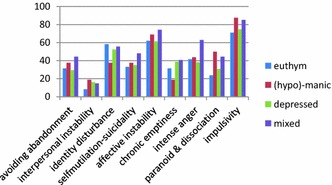
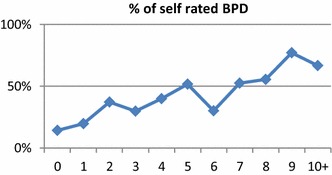
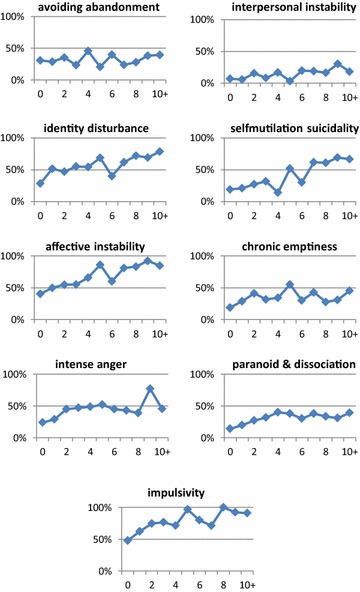
BACKGROUND: Although bipolar disorder (BD) and borderline personality disorder (BPD) share clinical characteristics and frequently co-occur, their interrelationship is controversial. Especially, the differentiation of rapid cycling BD and BPD can be troublesome. This study investigates the relationship between borderline personality features (BPF) and prospective illness course in patients with BD, and explores the effects of current mood state on self-reported BPF profiles. METHODS: The study included 375 patients who participated in the former Stanley Foundation Bipolar Network. All patients met DSM-IV criteria for bipolar-I disorder (n = 294), bipolar-II disorder (n = 72) or bipolar disorder NOS (n = 9). BPF were assessed with the self-rated Personality Diagnostic Questionnaire. Illness course was based on 1-year clinician rated prospective daily mood ratings with the life chart methodology. Regression analyses were used to estimate the relationships among these variables. RESULTS: Although correlations were weak, results showed that having more BPF at baseline is associated with a higher episode frequency during subsequent 1-year follow-up. Of the nine BPF, affective instability, impulsivity, and self-mutilation/suicidality showed a relationship to full-duration as well as brief episode frequency. In contrast all other BPF were not related to episode frequency. CONCLUSIONS: Having more BPF was associated with an unfavorable illness course of BD. Affective instability, impulsivity, and self-mutilation/suicidality are associated with both rapid cycling BD and BPD. Still, many core features of BPD show no relationship to rapid cycling BD and can help in the differential diagnosis.
Overview
The claims and statistics of this paper haven’t been checked yet.
Free: it reads the open-access text and checks the first 5 claims that cite a source we can check. Create a free account to check every claim.
Integrity signals
Registry
Cites
Statistics
Figures
Verification
Claims the paper makes
The claims and statistics of this paper haven’t been checked yet.
Free: it reads the open-access text and checks the first 5 claims that cite a source we can check. Create a free account to check every claim.
Claims other papers make about this one
Each is checked against this paper’s own text: does it say what the citing paper says it does?
The source backs part of the claim, not all of it — or backs it for a different population, condition or comparison.
In the citing paper
“Factors associated with overall good prognosis of BD include good treatment adherence, lack of early adversity, intermediate age at onset, good social support, and the absence of spontaneous rapid cycling406, 407 or features of a personality disorder.408”
From Canadian Network for Mood and Anxiety Treatments ( CANMAT ) and International Society for Bipolar Disorders ( ISBD ) 2018 guidelines for the management of patients with bipolar disorder (2018) · cites this paper as [408]
Experimental — accuracy not yet measured
Self-check
Percentages, sums and reported differences re-computed from the paper’s own numbers.
The self-check needs the paper’s full text.
Citations
Cites
A Rating Scale for Mania: Reliability, Validity and Sensitivity
Young, R. C., Biggs, J. T., Ziegler, V. E., & Meyer, D. A. (1978) · British Journal of Psychiatry · doi:10.1192/bjp.133.5.429 · Cited by 8,744 · cited 3×
“Abbreviations BD: bipolar disorder; BPD: borderline personality disorder; BPF: borderline personality features; SFBN: Stanley Foundation Bipolar Network; PDQ-4+: Personality Diagnostic Questionnaire; LCM: life chart methodology; YMRS: Young Mania Rating Scale; IDS-SR: inventory of depressive symptomatology.”
MethodMerikangas, K. R., Akiskal, H. S., Angst, J., Greenberg, P. E., Hirschfeld, R. M. A., Petukhova, M., & Kessler, R. C. (2007) · Archives of General Psychiatry · doi:10.1001/archpsyc.64.5.543 · Cited by 2,399
DSM-IV Personality Disorders in the National Comorbidity Survey Replication
Lenzenweger, M. F., Lane, M. C., Loranger, A. W., & Kessler, R. C. (2007) · Biological Psychiatry · doi:10.1016/j.biopsych.2006.09.019 · Cited by 1,352
Axis I Comorbidity of Borderline Personality Disorder
Zanarini, M. C., Frankenburg, F. R., Dubo, E. D., Sickel, A. E., Trikha, A., Levin, A., & Reynolds, V. (1998) · American Journal of Psychiatry · doi:10.1176/ajp.155.12.1733 · Cited by 977
The inventory for depressive symptomatology (IDS): Preliminary findings
John Rush, A., Giles, D. E., Schlesser, M. A., Fulton, C. L., Weissenburger, J., & Burns, C. (1986) · Psychiatry Research · doi:10.1016/0165-1781(86)90060-0 · Cited by 918 · cited 1×
“Mood state at baseline and at follow-up was measured by the inventory of depressive symptomatology (Rush et al. 1986; Bernstein et al. 2006) (IDS-SR) and the Young Mania Rating Scale (Young et al.”
MethodMcGlashan, T. H., Grilo, C. M., Skodol, A. E., Gunderson, J. G., Shea, M. T., Morey, L. C., Zanarini, M. C., & Stout, R. L. (2000) · Acta Psychiatrica Scandinavica · doi:10.1034/j.1600-0447.2000.102004256.x · Cited by 542 · cited 2×
“According to these authors, the most methodologically rigorous study (McGlashan et al. 2000) found that 12% of BPD patients met criteria for BD-I, and another 8% met criteria for BD-II.”
BackgroundPope, H. G. (1983) · Archives of General Psychiatry · doi:10.1001/archpsyc.1983.01790010025003 · Cited by 458
The Chestnut Lodge Follow-up Study: I. Follow-up Methodology and Study Sample
McGlashan, T. H. (1984) · Archives of General Psychiatry · doi:10.1001/archpsyc.1984.01790170047006 · Cited by 444
Characterizing affective instability in borderline personality disorder
Koenigsberg, H. W., Harvey, P. D., Mitropoulou, V., Schmeidler, J., New, A. S., Goodman, M., Silverman, J. M., Serby, M., Schopick, F., & Siever, L. J. (2002) · American Journal of Psychiatry · doi:10.1176/appi.ajp.159.5.784 · Cited by 379
Axis I diagnostic comorbidity and borderline personality disorder
Zimmerman, M., & Mattia, J. I. (1999) · Comprehensive Psychiatry · doi:10.1016/s0010-440x(99)90123-2 · Cited by 350 · cited 2×
“1996; Zimmerman and Mattia 1999; Deltito et al.”
Background
Research works printed but not linked: 3
- First MB Gibbo M Spitzer RL Williams JBW Structured clinical interview for DSM-IV axis I disorders: SCID-I/P (version 2.0) 1995 New York Biometrics Research Department
- First MB Gibbon M Spitzer RL Williams JBW Benjamin LS SCID-II personality questionnaire 1997 Washington, DC American Psychiatric Press
- Hyler SE Personality diagnostic questionnaire-4 (Unpublished test) 1994 New York New York State Psychiatric Institute (NYSPI)
Cited by
Yatham, L. N., Kennedy, S. H., Parikh, S. V., Schaffer, A., Bond, D. J., Frey, B. N., Sharma, V., Goldstein, B. I., Rej, S., Beaulieu, S., et al. (2018) · Bipolar Disorders · doi:10.1111/bdi.12609 · Cited by 1,852
Self-citationDifferential Diagnosis of Bipolar II Disorder and Borderline Personality Disorder
Bayes, A. J., Parker, G. B., & Paris, J. (2019) · Current Psychiatry Reports · doi:10.1007/s11920-019-1120-2 · Cited by 69
Clinical picture and treatment of bipolar affective disorder in children and adolescents
Cichoń, L., Janas-Kozik, M. H., Siwiec, A., & RYBAKOWSKI, J. K. (2018) · Psychiatria Polska · doi:10.12740/pp/onlinefirst/92740 · Cited by 62
“[35] which shows that the characteristics of”
Patel, R. S., Manikkara, G., & Chopra, A. (2019) · Medicina · doi:10.3390/medicina55010013 · Cited by 36
“Bipolar disorder and BPD share many common characteristics, and the most crucial overlapping feature is mood instability [5].”
BackgroundSalem, H., Ruiz, A., Hernandez, S., Wahid, K. A., CAO, F., Karnes, B., BEASLEY, S., Sanches, M., Ashtari, E., & Pigott, T. A. (2019) · Journal of Psychiatric Practice · doi:10.1097/pra.0000000000000392 · Cited by 30
Liu, P., & Wang, X. (2019) · Medical Science Monitor · doi:10.12659/msm.912662 · Cited by 26
“Due to these severe symptoms, widespread attention has been given to investigating the mechanism and progression of BPD to deepen understanding of the diagnosis and treatment and to deliver effective prevention and intervention measures against BPD [11,12].”
BackgroundSelf‐report screening instruments differentiate bipolar disorder and borderline personality disorder
Palmer, B. A., Pahwa, M., Geske, J. R., Kung, S., Nassan, M. M., Schak, K. M., Alarcón, R. D., Frye, M. A., & Singh, B. (2021) · Brain and Behavior · doi:10.1002/brb3.2201 · Cited by 27
“When the comorbidity is present, bipolar course of illness measures are increased (i.e., episode frequency, affective instability, impulsivity, and self- mutilation/suicidality) (Riemann et al., 2017).”
BackgroundSelf-citationAnona, K., Olaomi, O. A., Udegbe, E., Uwumiro, F. E., Tuaka, E.-B., Okafor, N., Adeyinka, A., Obijuru, C. N., Okpujie, V. O., Bojerenu, M. M., et al. (2023) · Journal of Affective Disorders · doi:10.1016/j.jad.2023.10.087 · Cited by 18
Relationship of comorbid personality disorders to prospective outcome in bipolar disorder
Post, R. M., Leverich, G. S., McElroy, S. L., Kupka, R., Suppes, T. M., Altshuler, L. L., Nolen, W. A., Frye, M. A., Keck, P. E., Grunze, H., et al. (2020) · Journal of Affective Disorders · doi:10.1016/j.jad.2020.07.031 · Cited by 16
“Borderline PD has some features, such as a ff ective instability, impulsivity, and self-mutilation/suicidality that overlap with rapid cycling bipolar disorder and have been found to be correlated with the frequency of episodes occurring over 1 year of prospective treatment (Riemann et al., 2017).”
BackgroundSelf-citationRiemann, G., Chrispijn, M., Kupka, R., Penninx, B. W. J. H., & Giltay, E. J. (2024) · Journal of Affective Disorders · doi:10.1016/j.jad.2024.07.101 · Cited by 11
Self-citationLéda‐Rêgo, G., Studart‐Bottó, P., Sarmento, S., Silva, T. C., Bezerra‐Filho, S., & Miranda‐Scippa, Â. (2023) · European Archives of Psychiatry and Clinical Neuroscience · doi:10.1007/s00406-023-01562-5 · Cited by 11
“Regarding borderline PD, it is told to provide unfavorable signature to illness course [37].”
BackgroundHsu, C., Wang, L., Lin, P., Hung, C., Yang, Y., Chen, Y.-M., & Kao, H. (2021) · Journal of Clinical Medicine · doi:10.3390/jcm10153294 · Cited by 9
“The aforementioned phenomena may be explained as follows: First, they reflect the diagnostic characteristics of the subgroup of the three PDs, such as affective instability and emotional liability in borderline PD (cluster B) and bipolar disorder [21,22], sharing the same symptoms of alexithymia in patients with borde…”
BackgroundHigher indexes of childhood trauma in borderline personality disorder compared with bipolar disorder
Jaworska-Andryszewska, P., & RYBAKOWSKI, J. K. (2022) · Psychiatria Polska · doi:10.12740/pp/140537 · Cited by 9
Chu, C., Tsai, S., Hsu, J.-W., Huang, K., Cheng, C., Su, T., Chen, T., Bai, Y., Liang, C., & Chen, M. (2021) · Journal of Affective Disorders · doi:10.1016/j.jad.2021.08.097 · Cited by 8
Sugawara, N., Adachi, N., Kubota, Y., Watanabe, Y., Miki, K., Azekawa, T., Edagawa, K., Katsumoto, E., Hongo, S., Goto, E., et al. (2022) · Journal of Psychiatric Research · doi:10.1016/j.jpsychires.2022.05.028 · Cited by 7
Aydın, E. F., & Laçin, T. K. (2024) · Frontiers in Psychiatry · doi:10.3389/fpsyt.2024.1444583 · Cited by 6
Riemann, G., Chrispijn, M., Weisscher, N., Regeer, E. J., & Kupka, R. (2021) · Frontiers in Psychiatry · doi:10.3389/fpsyt.2021.725381 · Cited by 5
“A study by our group confirmed that affective instability, impulsivity, and self-mutilation/suicidality were symptoms associated with both rapid cycling BD and BPD (21).”
BackgroundSelf-citationLee, Y., Lee, D., Jung, H., Cho, Y., Baek, J. H., & Hong, K. S. (2022) · BMC Psychiatry · doi:10.1186/s12888-022-04318-y · Cited by 5
“We additionally evaluated borderline personality traits generally observed in BD [12] as these traits could affect the course of overall illness [13].”
Are personality disorders in bipolar patients more frequent in the US than Europe?
Post, R. M., Leverich, G. S., McElroy, S. L., Kupka, R., Suppes, T. M., Altshuler, L. L., Nolen, W. A., Frye, M. A., Keck, P. E., Grunze, H., et al. (2022) · European Neuropsychopharmacology · doi:10.1016/j.euroneuro.2022.02.007 · Cited by 3
Self-citationde Ávila, G. B., Montezano, B. B., Souza, L. D. D. M., Cardoso, T. D. A., da Silva, R. A., Mondin, T. C., Moreira, F. P., & Jansen, K. (2022) · Psychiatry Research Communications · doi:10.1016/j.psycom.2022.100068 · Cited by 3
Borderline Personality Disorder: Impact, Overlap, and Comorbidities
Iqbal, S., French-Rosas, L. N., Banu, S., Han, J. Y., & Shah, A. A. (2020) · Psychiatric Annals · doi:10.3928/00485713-20191206-01 · Cited by 4
The Border between Bipolar Disorder and Personality Disorders
Ha, T. H. (2018) · 신경정신의학 · doi:10.4306/jknpa.2018.57.4.308 · Cited by 2
Other Psychiatric Comorbidities and Borderline Personality Disorder
Salavati, M., & Selby, E. A. (2024) · Springer eBooks · doi:10.1007/978-3-031-75503-3_16 · Cited by 1
Cichoń, L., Janas-Kozik, M. H., Chełmecka, E., Wilczyński, K. M., Jelonek, I., & RYBAKOWSKI, J. K. (2024) · Psychiatria Polska · doi:10.12740/pp/onlinefirst/175719 · Cited by 1
Can We Differentiate Borderline Personality Disorder from Bipolar Disorder?
Li, B., Valles, N., Saunders, J., Vyas, A., Naqvi, M. F., & Shah, A. A. (2020) · Psychiatric Annals · doi:10.3928/00485713-20191126-01
Bipolarité et trouble de la personnalité limite
Gourion, D. (2023) · Elsevier eBooks · doi:10.1016/b978-2-294-77180-4.00034-2
Llamo, N. D. H. (2022) · Universidad Peruana Cayetano Heredia Institutional Repository
Jang, E., Shin, Y.-E., Choi, M. J., Lee, H., Myung, W., Ha, T. H., Ahn, Y.-M., Ha, K., Hong, K. S., & Baek, J. H. (2026) · Journal of Affective Disorders · doi:10.1016/j.jad.2026.122639
Metadata
- Authors
- Riemann, G., Weisscher, N., Post, R. M., Altshuler, L., McElroy, S., Frye, M. A., Keck, P. E., Leverich, G. S., Suppes, T., Grunze, H., Nolen, W. A., & Kupka, R. W.
- Affiliations
- Saxion (NL)
- GGz centraal (NL)
- George Washington University (US)
- University of California, Los Angeles (US)
- Lindner Center of HOPE (US)
- Stanford Medicine (US)
- Paracelsus Medical University (AT)
- University Medical Center Groningen (NL)
- GGZ inGeest (NL)
- Corresponding author
- Riemann, Georg
- ORCID
- Venue
- International Journal of Bipolar Disorders
- Published
- 2017-09-25
- Volume
- 5
- Issue
- 1
- Pages
- 31-31
- ISSN
- 2194-7511 (ISSN-L)
- PMC
- PMC5610955
- OpenAlex
- W2741992138
- Cited by
- 28
- References
- 46
- Citations by year
- 2026: 1 · 2024: 4 · 2023: 3 · 2022: 6 · 2021: 4 · 2020: 3 · 2019: 4 · 2018: 3
- FWCI
- 2.25
- Type
- journal article
- Language
- en
- Open access
- gold
- doi.org
- Licence
- cc-by
- creativecommons.org/licenses/by/4.0 (tdm)
- Locations
- International Journal of Bipolar Disorders (publishedVersion, cc-by)
- Europe PMC (PubMed Central) (publishedVersion, cc-by)
- PubMed Central (publishedVersion, cc-by)
- PubMed (publishedVersion)
- Pure Amsterdam UMC (acceptedVersion, other-oa)
- DOAJ (DOAJ: Directory of Open Access Journals) (submittedVersion, cc-by-sa)
- University of Groningen research database (University of Groningen / Centre for Information Technology) (submittedVersion, cc-by)
- Data Archiving and Networked Services (DANS) (submittedVersion)
- Funders
- Nederlandse Organisatie voor Wetenschappelijk Onderzoek
- Stanley Medical Research Institute
- Topics
- Health Sciences › Medicine › Psychiatry and Mental health › Bipolar Disorder and Treatment
- Social Sciences › Psychology › Clinical Psychology › Personality Disorders and Psychopathology
- Social Sciences › Psychology › Experimental and Cognitive Psychology › Mental Health Research Topics
- Keywords
- bipolar disorder, borderline personality traits, borderline personality disorder, rapid cycling bipolar disorder, clinical course, episode frequency, neuroticism, impulsivity, self-mutilation, suicidality, differential diagnosis, mood states
About these checks
Registry, retraction, Cites and statistics results are computed, not judged, with one exception: a printed reference that no index lists is read once by a model before it counts as a citation error. Claims are extracted by a model and kept only when their quote appears verbatim in the text; each cited source is then checked, with a model’s help, for whether it says what the claim relies on. Those verdicts can be wrong — read the claim’s quote and the cited source before relying on one.
Statistics and arithmetic are recomputed, not judged.
Confidence bands are shown only for fields calibrated on our annotated test set. None is calibrated yet, so no band is shown.
What counts as a claim ›How we measure confidence ›How we check this ›
Are you an author, or do you see a problem with this page? Request a review
Data sources
Bibliographic data: Semantic Scholar, OpenAlex, Crossref.
Contains information from the Semantic Scholar Academic Graph Datasets, made available under the ODC Attribution License (ODC-BY 1.0).
Semantic Scholar’s data is described in: Kinney, R., et al. (2023). The Semantic Scholar Open Data Platform. arXiv:2301.10140.
