

Perceived social support and psychological wellbeing among Nepalese adolescents: the mediating role of self-esteem
Open accessThe DOI matches its Crossref record; 63 of the 63 references it cites were found in a registry or an index.
Abstract
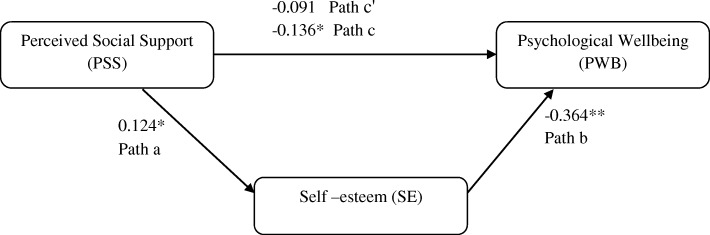
Background: Adolescence is characterized by unique, multiple physical, psychological and social development. Understanding the well-being of adolescents and the factors that contribute to it will help towards clarifying and defining ways to better help adolescents prepare for adult life. Therefore, the present study aims to find out the relationship between Perceived Social Support (PSS) and Psychological Well-Being (PWB) among Nepalese adolescence based on mediating role of Self-esteem (SE). Methods: The study was conducted among 348 adolescents studying in grade 9 and 10 of government secondary level schools of Pokhara Metropolitan city, Nepal. Data were collected through self-administered standard tools-Multidimensional Scale of Perceived Social Support (MSPSS), Rosenberg self-esteem scale (RSES) and General Health Questionnaire (GHQ-12). For statistical analysis descriptive statistics, correlation, regression and mediation analyses were used. The statistical significance of mediating effect of the tested model was examined through a path proposed by Baron and Kenny and Bootstrap method. Results: Overall, the finding suggests that PSS indirectly affects PWB of adolescents through mediating variable SE. Adolescents who perceive good social support had higher SE, which in turn contributed to their PWB. Furthermore, the study found no significant gender difference for PSS, SE and PWB. Also among various sources of PSS, both boys and girls were more oriented towards family for social support than friends and others. Conclusion: Adolescents who experience higher social support are likely to have higher SE and are more likely to have better PWB. The findings of the study will be useful to the parents, teachers, counselors, psychologist and researchers to develop strategies to enhance adolescent’s mental health.
Overview
The claims and statistics of this paper haven’t been checked yet.
Free: it reads the open-access text and checks the first 5 claims that cite a source we can check. Create a free account to check every claim.
Integrity signals
Registry
Cites
Statistics
Figures
Verification
Claims the paper makes
The claims and statistics of this paper haven’t been checked yet.
Free: it reads the open-access text and checks the first 5 claims that cite a source we can check. Create a free account to check every claim.
Claims other papers make about this one
Each is checked against this paper’s own text: does it say what the citing paper says it does?
The source backs part of the claim, not all of it — or backs it for a different population, condition or comparison.
In the citing paper
“Moreover, self-esteem and presence of meaning were positively affected by social support (Poudel et al., 2020; Li et al., 2021b), suggesting that individuals with a higher social support tend to view themselves positively and live a more meaningful life (Li et al., 2021a).”
From Mediator role of presence of meaning and self-esteem in the relationship of social support and death anxiety (2022) · cites this paper as Poudel et al., 2020
Experimental — accuracy not yet measuredThe source backs part of the claim, not all of it — or backs it for a different population, condition or comparison.
In the citing paper
“Previous researches on the interrelationships among social support, self-esteem, and presence of meaning show that these factors are positively correlated with each other (Zhang et al., 2019; Poudel et al., 2020; Li et al., 2021b).”
From Mediator role of presence of meaning and self-esteem in the relationship of social support and death anxiety (2022) · cites this paper as Poudel et al., 2020
Experimental — accuracy not yet measuredThe source backs part of the claim, not all of it — or backs it for a different population, condition or comparison.
In the citing paper
“thus higher social support is associated with less death anxiety via increasing self-esteem (Poudel et al., 2020).”
From Mediator role of presence of meaning and self-esteem in the relationship of social support and death anxiety (2022) · cites this paper as Poudel et al., 2020
Experimental — accuracy not yet measured
Self-check
Percentages, sums and reported differences re-computed from the paper’s own numbers.
The self-check needs the paper’s full text.
Citations
Cites
Baron, R. M., & Kenny, D. A. (1986) · Journal of Personality and Social Psychology · doi:10.1037/0022-3514.51.6.1173 · Cited by 91,532
(2013) · Cited by 44,563
Society and the Adolescent Self-Image
Rosenberg, M. (1965) · doi:10.1515/9781400876136 · Cited by 30,126
Stress, social support, and the buffering hypothesis
Cohen, S., & Wills, T. A. (1985) · Psychological Bulletin · doi:10.1037/0033-2909.98.2.310 · Cited by 18,093
The Multidimensional Scale of Perceived Social Support
Zimet, G. D., Dahlem, N. W., Zimet, S. G., & Farley, G. K. (1988) · Journal of Personality Assessment · doi:10.1207/s15327752jpa5201_2 · Cited by 13,339
(1979) · Medical Entomology and Zoology · Cited by 5,872
(1988) · NFER-Nelson eBooks · Cited by 5,560
Psychometric Characteristics of the Multidimensional Scale of Perceived Social Support
Zimet, G. D., Powell, S. S., Farley, G. K., Werkman, S., & Berkoff, K. A. (1990) · Journal of Personality Assessment · doi:10.1080/00223891.1990.9674095 · Cited by 4,855
Psychometric Characteristics of the Multidimensional Scale of Perceived Social Support
Zimet, G., Powell, S., Farley, G., Werkman, S., & Berkoff, K. (1990) · Journal of Personality Assessment · doi:10.1207/s15327752jpa5503&4_17 · Cited by 4,854
Baumeister, R. F., Campbell, J. D., Krueger, J. I., & Vohs, K. D. (2003) · Psychological Science in the Public Interest · doi:10.1111/1529-1006.01431 · Cited by 3,893
Research works printed but not linked: 1
- Ministry of Health Nepal, New ERA, ICF 2016 Nepal demographic and health survey key findings 2017 Kathmandu Ministry of Health Nepal
Cited by
Perceived Social Support and Stress: a Study of 1st Year Students in Ireland
McLean, L., Gaul, D., & Penco, R. (2023) · International Journal of Mental Health and Addiction · doi:10.1007/s11469-021-00710-z · Cited by 182
“Higher levels of social support have been found to be associated with improved psychological wellbeing (Glozah, 2013; Poudel et al., 2020; Reeve et al., 2013; Poots & Cassidy, 2020), with students that perceived social support positively found to be at a lower risk for mental health problems (Karaca et al.”
BackgroundBhattarai, D., Shrestha, N., & Paudel, S. (2020) · BMJ Open · doi:10.1136/bmjopen-2020-044042 · Cited by 70
Zhang, S., Xuyang, D., Xin, Z., Xuebin, C., & Jie, H. (2022) · Frontiers in Psychology · doi:10.3389/fpsyg.2022.865025 · Cited by 91
“Previous study already demonstrated the association of social support and mental health (Poudel et al., 2020).”
BackgroundAdolescents’ Self-Esteem and Life Satisfaction: Communication with Peers as a Mediator
Szczęśniak, M., Bajkowska, I., Czaprowska, A., & Sileńska, A. (2022) · International Journal of Environmental Research and Public Health · doi:10.3390/ijerph19073777 · Cited by 78
“Self-esteem is considered to be one of the crucial factors that impacts social development and functioning [38].”
BackgroundVilca-Pareja, V., de Somocurcio, A. L. R., Morales, R. D., & Zeballos, L. M. (2022) · International Journal of Environmental Research and Public Health · doi:10.3390/ijerph192416548 · Cited by 89
Yenen, E. T., & ÇARKIT, E. (2021) · Current Psychology · doi:10.1007/s12144-021-02306-1 · Cited by 59
“There are many studies showing that social support has a positive relationship with mental and physical health (Fenlason & Beehr, 1994; Gülaçtı, 2010; Hupcey, 1998; Poudel et al., 2020).”
BackgroundSafi, F., Areshtanab, H. N., Ghafourifard, M., & Ebrahimi, H. (2024) · BMC Nephrology · doi:10.1186/s12882-024-03629-4 · Cited by 80
“If a person sees himself supported in the three important aspects of social support (family, friends, and other significant persons), the person gains more confidence in his/her abilities to control his motivation, behavior, and social environment [50, 51].”
BackgroundKhan, A., Zeb, I., Zhang, Y., Fazal, S., & Ding, J. (2024) · Heliyon · doi:10.1016/j.heliyon.2024.e29472 · Cited by 56
“The correlation between PSS and MH has undergone extensive examination in different studies [33,34].”
BackgroundAnyanwu, M. U. (2023) · BMC Psychology · doi:10.1186/s40359-023-01039-z · Cited by 49
“Contrary to existing studies [8, 9, 20, 47, 56], age, gender, social support and academic performance were not associated with psychological distress in the present study.”
ResultKordzanganeh, Z., Bakhtiarpour, S., Hafezi, F., & Dashtbozorgi, Z. (2021) · Journal of Medical Education · doi:10.5812/jme.112142 · Cited by 52
“As a result, the anxiety will decrease, and the students’ social performance and selfefficacy will improve (28).”
BackgroundLuijten, C. C., van de Bongardt, D., & Nieboer, A. P. (2023) · Journal of Adolescence · doi:10.1002/jad.12175 · Cited by 44
Li, H., & Hao, F. (2025) · Scientific Reports · doi:10.1038/s41598-025-11952-5 · Cited by 39
“This result aligns with the findings of Poudel et al. 50 , who demonstrated that social support can further increase mental health by increasing self-esteem.”
Zhang, X., Wang, X., Wang, H., He, X., & Wang, X. (2022) · Frontiers in Public Health · doi:10.3389/fpubh.2022.764203 · Cited by 28
Deniz, E., & Toseeb, U. (2023) · Autism Research · doi:10.1002/aur.2987 · Cited by 33
“…as selfesteem has often been found as a negative correlate of internalizing and externalizing problems (Boyes et al., 2020; Cooper et al., 2017; Fernandes et al., 2021), and a positive correlate of wellbeing (Cooper et al., 2017; Corden et al., 2021; Padhy et al., 2011; Poudel et al., 2020).”
Jin, T., Chen, Y., & Zhang, K. (2024) · Frontiers in Psychology · doi:10.3389/fpsyg.2024.1398801 · Cited by 45
“Additionally, adolescents with higher self-esteem perceive social support better, thereby promoting their psychological well-being (Poudel et al., 2020).”
BackgroundCherewick, M., Lama, R., Rai, R. P., Dukpa, C., Mukhia, D., Giri, P., & Matergia, M. (2024) · PLOS Global Public Health · doi:10.1371/journal.pgph.0003904 · Cited by 49
Tannous-Haddad, L., Barel, E., & Tzischinsky, O. (2024) · Frontiers in Psychology · doi:10.3389/fpsyg.2024.1474177 · Cited by 30
Liu, X., Zeng, J., Zhang, Y., Chen, S., Ran, F., & Liu, Y. (2023) · Current Psychology · doi:10.1007/s12144-023-05263-z · Cited by 22
“Previous studies have found that providing adolescents with more social support can increase their self-esteem (Poudel et al., 2020).”
Pertiwi, E. M., Suminar, D. R., & Ardi, R. (2022) · Indigenous Jurnal Ilmiah Psikologi · doi:10.23917/indigenous.v7i3.19851 · Cited by 39
Family influences on oral PrEP use among adolescent girls and young women in Kenya and South Africa
Ndimande-Khoza, M. N., Katz, A. W. K., Delany‐Moretlwe, S., Travill, D., Rousseau, E., Omollo, V. O., Morton, J. F., Johnson, R. E., Bekker, L., Bukusi, E. A., et al. (2023) · PLoS ONE · doi:10.1371/journal.pone.0292529 · Cited by 17
Social Support and Left-Behind Children’s Social Adaptation: The Mediating Role of Self-Esteem
Peng, M., & Dai, B. (2023) · Social Indicators Research · doi:10.1007/s11205-023-03074-0 · Cited by 19
“Numerous previous studies have also found that self-esteem mediates the role of social support in influencing adolescents’ social cognition, affect, and behavior (Poudel et al., 2020 ; Sun et al., 2022 ; Zhang et al., 2022 ).”
BackgroundYichen, M., & Lu, C. (2023) · Children and Youth Services Review · doi:10.1016/j.childyouth.2023.107283 · Cited by 20
Dou, X., Lu, J., Yu, Y., Yi, Y., & Zhou, L. (2024) · Scientific Reports · doi:10.1038/s41598-024-71947-6 · Cited by 26
Nishida, C., Ishimoto, Y., Takizawa, Y., Katayama, T., & Matsumoto, Y. (2021) · International Journal of Educational Research Open · doi:10.1016/j.ijedro.2021.100034 · Cited by 19
Mukhlis, H., Hariri, H., Riswandi, R., Haenilah, E. Y., Sunyono, S., Maulina, D., & Fitriadi, F. (2024) · Journal of Education and Learning (EduLearn) · doi:10.11591/edulearn.v18i2.21136 · Cited by 26
“Most studies find no correlation between gender and psychological well-being [47], [48], although one study notes gender's significant impact on certain dimensions like life satisfaction and optimism [49].”
BackgroundInfluentialHuang, Y., Guan, Z., Yan, F., Wiley, J. A., Reynolds, N. R., Tang, S., & Sun, M. (2022) · Frontiers in Psychology · doi:10.3389/fpsyg.2022.1018097 · Cited by 13
“This indicates presence of meaning and self-esteem fully mediate the relationship, respectively, and sequentially (Krause, 2007; Xia and Yang, 2019; Poudel et al., 2020).”
BackgroundInfluentialSupervía, P. U., Salavera, C., Basterretxea, J. J., & Cosculluela, C. L. (2023) · Social Sciences · doi:10.3390/socsci12060329 · Cited by 23
“…(2012) point out the mediating role that self-esteem plays in the relationship between emotional intelligence and life satisfaction in adolescents; Poudel et al. (2020) emphasise the importance of the relationship between self-esteem, social support and psychological wellbeing; Wang and Kong…”
BackgroundYıldırım, M., Çağış, Z. G., Aziz, I. A., Rizzo, A., Turan, M. E., Nucera, G., Khabbache, H., Szarpak, Ł., Chirico, F., & Zaffina, S. (2024) · Acta Psychologica · doi:10.1016/j.actpsy.2024.104540 · Cited by 25
Shi, X., Li, J., Ji, X., Wu, Y., & Zang, S. (2024) · BMC Nursing · doi:10.1186/s12912-024-02546-z · Cited by 17
Azpiazu, L., Ramos-Díaz, E., Axpe, I., & Revuelta, L. (2024) · School Mental Health · doi:10.1007/s12310-024-09736-9 · Cited by 42
“Moreover, due to social factors, the family seems to provide a more continuous type of support during this developmental stage (Poudel et al., 2020), and stronger perceptions of the help provided by this context impacts self-concept, reflecting the individual’s feeling of their own positive…”
Kassis, W., Vasiou, A., Govaris, C., Favre, C. A., Aksoy, D., & Graf, U. (2023) · Education Sciences · doi:10.3390/educsci14010015 · Cited by 19
Moreno, A. G., & Jurado, M. D. M. M. (2023) · Healthcare · doi:10.3390/healthcare12010063 · Cited by 30
“During adolescence, one of the most relevant factors that promote psychological well-being is self-esteem [25].”
BackgroundChang, H. H., Wong, K. H., & Shen, Y. A. (2021) · Technological Forecasting and Social Change · doi:10.1016/j.techfore.2021.121262 · Cited by 15
Parental Attachment and Psychological Wellbeing in Adolescents: Mediating Role of Self-esteem
Singh, D. (2021) · Indian Journal of Youth and Adolescent Health · doi:10.24321/2349.2880.202103 · Cited by 12
Tang, L., Zhang, C., & Cui, Y. H. (2025) · Psychology in the Schools · doi:10.1002/pits.23405 · Cited by 19
“The MSPSS has been extensively used in previous studies and reported high internal reliability (e.g., Poudel, Gurung, and Khanal 2020; Zimet et al. 1988).”
Lifen, Z., & Ngai, S. S. (2022) · International Journal of Environmental Research and Public Health · doi:10.3390/ijerph19020657 · Cited by 17
Yang, X., Wang, J., Wang, T., Lin, H., Yang, Y., Chen, X., & Fu, C. (2023) · Translational Pediatrics · doi:10.21037/tp-22-676 · Cited by 15
Wang, G., Li, X., & Hu, Y. (2025) · Humanities and Social Sciences Communications · doi:10.1057/s41599-025-04857-1 · Cited by 18
“Poudel et al. (2020) found that perceived social support among Nepalese adolescents in fl uenced their psychological well-being through self-esteem.”
Ajimi, A., Matsushita, M., Mishima, K., Haga, N., Fujiwara, S., Ozono, K., Kubota, T., Kitaoka, T., Imagama, S., & Kitoh, H. (2021) · Clinical Pediatric Endocrinology · doi:10.1297/cpe.2021-0043 · Cited by 10
“In a survey of adolescents in Nepal, the psychological well-being was observed to be higher when they had support from family and friends (29).”
BackgroundNkrumah, J., Abuosi, A. A., & Nkrumah, R. B. (2021) · BMC Public Health · doi:10.1186/s12889-021-11652-5 · Cited by 9
Erol, M., & KÖKSAL, H. (2025) · Child Indicators Research · doi:10.1007/s12187-025-10221-1 · Cited by 20
“There are significant relationships between social support and psychological well-being, and individuals with a friend environment have higher levels of well-being (Kouvava et al., 2023; Poudel et al., 2020; Shin & Gyeong, 2023; Rehman et al., 2022).”
Stres Akademik dan Perceived Social Support sebagai Prediktor Kesehatan Mental Remaja Akhir
Salsabila, D. F., Hidayat, I. N., & Ramdani, Z. (2022) · Gadjah Mada Journal of Professional Psychology (GamaJPP) · doi:10.22146/gamajpp.76711 · Cited by 51
Ooi, H. X., Hamzah, A. B., & Thien, L. M. (2023) · Participatory Educational Research · doi:10.17275/per.23.49.10.3 · Cited by 20
Amjad, A. I., Aslam, S., & Sial, Z. A. (2024) · Frontiers in Education · doi:10.3389/feduc.2024.1431606 · Cited by 20
Perceived social support and self-esteem predict cyberbullying among rural left-behind adolescents
Wu, J., Shao, Y., & Zang, W. (2025) · Scientific Reports · doi:10.1038/s41598-025-10803-7 · Cited by 12
Murshid, M. E., Chen, S., Rahman, M. M., Islam, M. Z., Shimpuku, Y., Era, N. R., Kumar, S., & Haque, M. (2023) · Cureus · doi:10.7759/cureus.49605 · Cited by 14
Jiang, T., Hou, J., Wei, J., Mu, T., Zhu, G., Wang, X., Qu, D., Wu, H., Zhang, T., & Su, B. (2022) · Translational Behavioral Medicine · doi:10.1093/tbm/ibac017 · Cited by 8
Monika, M., Majeed, J., & Sharma, N. (2023) · Research Square · doi:10.21203/rs.3.rs-2595500/v1 · Cited by 23
Edet, B. E., Essien, E. A., Eleazu, F., Abang, R., Ochijele, E., & Daniel, F. M. (2024) · Acta Medica Academica · doi:10.5644/ama2006-124.421 · Cited by 18
“Social support also plays a critical role in mental well-being, particularly during adolescence, a phase characterized by heightened stress (13, 26).”
BackgroundGiri, R., Khadka, S., Chalise, A., Swar, K., & Paudel, S. (2024) · PLOS Global Public Health · doi:10.1371/journal.pgph.0002826 · Cited by 12
Aghaei, A., Qiao, S., Tam, C. C., Yuan, G. F., & Li, X. (2024) · Heliyon · doi:10.1016/j.heliyon.2024.e31328 · Cited by 9
“Previous studies suggested that individuals with a higher level of social support viewed themselves more positively and lived a more fulfilling life, which were the proxies of high self-esteem [55,56].”
Liu, Y., Wang, H., Bi, S., Li, X., Yang, X., & Wang, Y. (2024) · Children and Youth Services Review · doi:10.1016/j.childyouth.2024.107567 · Cited by 11
ÇEVRİMİÇİ ÇOCUK İSTİSMARI RİSKİ ÖLÇEĞİ’NİN TÜRK KÜLTÜRÜNE UYARLANMASI
Aktu, Y. (2024) · Pamukkale University Journal of Social Sciences Institute · doi:10.30794/pausbed.1431239 · Cited by 6
Jin, L., Pan, C., Li, D., Zhang, T., Zhao, C.-H., & Wu, Y. (2025) · International Journal of Mental Health Promotion · doi:10.32604/ijmhp.2025.057962 · Cited by 10
“Furthermore, previous studies have frequently employed involved local or regional samples [12,14].”
Aslan, Y., & Koçak, O. (2025) · The British Journal of Social Work · doi:10.1093/bjsw/bcaf083 · Cited by 7
Association of social support with sleep and subjective health outcomes in Ghanaian artisanal miners
Nyaaba, E., Abass, K., & Gyasi, R. M. (2025) · Scientific Reports · doi:10.1038/s41598-025-27679-2 · Cited by 5
Pola Asuh Otoritatif dan Psychological Well-Being Pada Remaja
Lestari, Y. I. (2022) · Psikobuletin Buletin Ilmiah Psikologi · doi:10.24014/pib.v3i2.16914 · Cited by 44
Zhao, Y., Wang, R., Li, H., Chen, C., Zhou, B., Weng, X., Hua, Y., Jia, Y., Wu, Y., & Li, Y. (2023) · Psychology Research and Behavior Management · doi:10.2147/prbm.s434765 · Cited by 5
“45 For the student cohort during the pandemic, the effects of social support remain somewhat unclear.”
BackgroundArani, Z. A., & Ramezani, T. (2024) · Journal of Human Behavior in the Social Environment · doi:10.1080/10911359.2024.2395397 · Cited by 7
“The results align with past research (Liu et al., 2020; Poudel et al., 2020), which indicates that regular social interactions can lead to positive emotions, a sense of stability in life, and the recognition of self-worth, all of which positively predict psychological well-being.”
SELF-ESTEEM AND DEPRESSION AMONG VIETNAMESE UNIVERSITY STUDENTS
Ho, T. T. Q., & Hoang, T. H. (2021) · UED Journal of Social Sciences Humanities and Education · doi:10.47393/jshe.v11i1.927 · Cited by 7
Valenzuela-García, B., Huitrón, I. C., Armenta, M. F., & Corral-Frías, N. S. (2022) · PsyEcology Bilingual Journal of Environmental Psychology · doi:10.1080/21711976.2022.2034288 · Cited by 6
“…in addition to those considered in this research, such as: self-esteem, personality, character strengths (GonzálezVillalobos & Marrero, 2017); physical and spiritual well-being (Morales, 2014); social support (family, friends and other significant people; Poudel et al., 2020), among others.”
BackgroundHolliman, A. J., Cheng, F., & Waldeck, D. (2022) · International Journal of Educational Psychology · doi:10.17583/ijep.8880 · Cited by 17
Impact of Social Care on Elderly Well-Being in Malaysia: A Mediating Role of the Waqf Fund
Fadzil, S. N. M., Osman, I., Ismail, S. B., Hashim, M. J., & Khamis, M. R. (2022) · International Academic Symposium of Social Science 2022 · doi:10.3390/proceedings2022082114 · Cited by 5
Gull, M., Kaur, N., & Akhouri, D. (2022) · Middle East Current Psychiatry · doi:10.1186/s43045-022-00264-3 · Cited by 8
Identifying predictors of university students' mental well-being during the COVID-19 pandemic
Hamzah, S. R., Musa, S. N. S., Badruldin, M. N. W. B., Amiludin, N. A., Zameram, Q. A., Kamaruzaman, M. J. M., Said, N. N., & Haniff, N. A. A. (2023) · Kontakt · doi:10.32725/kont.2023.003 · Cited by 9
“This finding is in line with the findings of Poudel et al. (2020), who suggest that those who experience greater social support have better mental well-being.”
ResultNicho-Almonacid, T. L., Melendrez-Ugarte, D. S., Palacios-Mizare, M. G., Arias-Gutierrez, M., & Olivas-Ugarte, L. O. (2023) · Propósitos y Representaciones · doi:10.20511/pyr2023.v11n3.1874 · Cited by 9
Video Game Time and Psychosocial Well-being in Chinese Children: the Mediating Role of Self-Esteem
Sun, X., & Li, X. (2024) · Journal of Child and Family Studies · doi:10.1007/s10826-024-02834-x · Cited by 7
“Speci fi cally, previous studies have con fi rmed the positive relationships of self-esteem with subjective and psychological well-being (Duy and Y ı ld ı z, 2019; Poudel et al., 2020).”
Shrestha, N., Koju, R., Dirghayu, K. C., Mahato, N. K., Poudyal, A., Subedi, R., Gautam, N., Vaidya, A., & Karki, S. (2023) · BMC Public Health · doi:10.1186/s12889-023-15396-2 · Cited by 6
“Supporting the findings from our study, a study conducted among Nepalese adolescents revealed their orientation towards support from family members than others [26].”
ResultInspiring social changemakers: what drives social enterprise dreams?
Nguyen, T. T. P. (2025) · Social enterprise journal · doi:10.1108/sej-07-2024-0109 · Cited by 8
The Relationship Between Happiness and Foreign Direct Investment in African Countries
Kariuki, C. W., & Karanu, J. W. (2024) · Economies · doi:10.3390/economies12120343 · Cited by 4
Analysing the Impact of Emotional Learning on Student Well-Being: An Empirical Study
Calaivanane, R., Kayarathya, J., & Oumagandan, M. (2025) · Journal of Information & Knowledge Management · doi:10.1142/s0219649225500042 · Cited by 9
Strength in Numbers: How Social Resources Travel Together to Increase Employee Engagement
Murray, P., Southey, K., Gibson, M., Sands, J., & Ong, D. L. T. (2025) · Asia Pacific Journal of Human Resources · doi:10.1111/1744-7941.70008 · Cited by 8
Liu, Y., Zheng, D., & Xu, J. B. (2025) · Journal Of Vacation Marketing · doi:10.1177/13567667251340405 · Cited by 6
The Effectiveness of Social Support in Adolescents to Overcome Low Self-Esteem: Scoping Review
Kurniawan, K., Khoirunnisa, K., Casman, C., Wijoyo, E. B., Azjunia, A. R., Nurpadillah, E. I., Cahyani, G., Fajri, I., Wardani, L. N., Nurfadillah, N. N., et al. (2023) · Jurnal Kesehatan Pasak Bumi Kalimantan · doi:10.30872/j.kes.pasmi.kal.v5i1.7517 · Cited by 4
Uzun, S. B., Gokmen, D., Saka, M. C., & Bashirov, F. (2023) · ALPHA PSYCHIATRY · doi:10.5152/alphapsychiatry.2023.221100 · Cited by 4
“13 In a study conducted with 80 schizophrenia patients in Taiwan, the responsiveness levels of the individuals were examined according to their PSP values, and the relationship between symptom severity and individual and social performance functionality was found to be significant, in parallel with…”
BackgroundDo Gender Differences Affect the Psychological Well-being of High Schoolers in Thailand?
Pumpuang, W., Vongsirimas, N., & Klainin‐Yobas, P. (2020) · Journal of Population and Social Studies · doi:10.25133/jpssv292021.013 · Cited by 10
“This is not consistent with the previous study of Poudel et al. (2020) , which found that three resources of social support could predict PWB.”
ResultCherewick, M., Matergia, M., Dukpa, C., Mukhia, D., Lama, R., Rai, R. P., & Giri, P. (2025) · European Journal of Investigation in Health Psychology and Education · doi:10.3390/ejihpe15120251 · Cited by 6
“In other LMIC, MSPSS scores have been inversely related to measures of mental distress and depression, anxiety, higher exposure to community violence and trauma, and other mental health conditions (Akhtar et al., 2010; Bruwer et al., 2008; Poudel et al., 2020).”
Faktor – Faktor yang Memengaruhi Self-Esteem Remaja: Literature Review
Ariyanti, V., & Purwoko, B. (2023) · TERAPUTIK Jurnal Bimbingan dan Konseling · doi:10.26539/teraputik.631389 · Cited by 35
“Sejalan penelitian yang telah dilakukan oleh Poudel bahwa tingkat self-esteem akan berkontribusi penuh terhadap psychological well-being remaja (Poudel et al., 2020).”
Kalkan, F., & Cemaloğlu, N. (2023) · International Journal of Contemporary Educational Research · doi:10.52380/ijcer.2023.10.2.485 · Cited by 6
“Social support improves the negative effects of burnout on individuals’ health (Ruisoto et al., 2021), increases their self-esteem (Cui et al., 2021; Poudel, Gurung, & Khanal, 2020), benefits subjective and psychological well-being (Brajša-Žganec, Kaliterna-* Lipovčan, & Hanzec, 2018; Poudel et…”
Social support on Reddit for antiretroviral therapy
Ming, Y. (2023) · Data Technologies and Applications · doi:10.1108/dta-08-2021-0229 · Cited by 3
Guta, N. M., Tulu, S., Midaksa, G., & Seid, K. (2023) · Heliyon · doi:10.1016/j.heliyon.2023.e18282 · Cited by 3
“Those who have good social support also possess a high level of psychological well-being and self-esteem [4].”
BackgroundAbbas, S., Chaudhry, W., & Khalil, A. (2023) · Qlantic Journal of Social Sciences and Humanities · doi:10.55737/qjssh.535930108 · Cited by 4
Blegur, J., Rajagukguk, C. P. M., Lumba, A. J. F., & Rosari, R. (2021) · Jurnal Pendidikan Progresif · doi:10.23960/jpp.v11.i2.202105 · Cited by 5
Hough, T. M., Labansat, H. A., Moore, T. F., Wallace, R., & Higgins, K. N. (2021) · Advanced Journal of Social Science · doi:10.21467/ajss.8.1.246-255 · Cited by 3
“Given its close association with these positive life outcomes, many researchers seek to isolate what factors or traits may facilitate the attainment of psychological well-being (Akhtar & Kroener-Herwig, 2019; Kardas et al., 2019; Poudel et al., 2020; Stevenson et al., 2019; Xia & Ma, 2020).”
BackgroundStress Reduction to Promote Resilience
Kramer, D. (2024) · Springer eBooks · doi:10.1007/978-3-031-66139-6_3 · Cited by 2
Likes, Shares, and Symptoms: The Hidden Toll of Early Adolescents’ Social Media Use on Well-Being
Vonk, L., Putrik, P., van Amelsvoort, T., Vanluydt, E., Delespaul, P., Levels, M., & Huijts, T. (2025) · International Journal of Environmental Research and Public Health · doi:10.3390/ijerph22010131 · Cited by 3
“The positive association between perceived social support and psychosocial health can be partly explained by better self-esteem [28].”
Akgündüz, Y., Bilen, O., Yıldız, N., Ergün, A., & Karademir, G. (2025) · İzmir İktisat Dergisi · doi:10.24988/ije.1452678 · Cited by 2
Yan, S., Wen, X., Huang, W., & Li, H. (2025) · Current Psychology · doi:10.1007/s12144-025-07769-0 · Cited by 2
“Extensive evidence showed the important role of perceived social support in enhancing psychological well-being (Poudel et al., 2020 ; Poots & Cassidy, 2020), such as mitigating the risk of mental health disorders (Karaca et al., 2019 ; Khallad & Jabr, 2016), elevating life satisfaction (Harikandei,…”
Dayimu, N., Leng, L., & Jilili, M. (2026) · BMC Psychology · doi:10.1186/s40359-026-04318-7 · Cited by 2
“Empirical research has demonstrated the negative association between social support and mental health [21–23].”
Stress, Belongingness, Self-Esteem: Pathways to Adolescent Well-being
Arslan, G., & Balkıs, M. (2026) · Child Indicators Research · doi:10.1007/s12187-026-10379-2 · Cited by 2
“Poudel et al. (2020) reported that adolescents who experience support from their social environment (family, friends, and others) are more likely to have better psychological well-being, and that self-esteem mediates the relationship between perceived social support and well-being.”
Peningkatan Kesejahteraan Psikologis Narapidana Wanita melalui Terapi Pemaafan
Praptomojati, A. (2022) · Gadjah Mada Journal of Professional Psychology (GamaJPP) · doi:10.22146/gamajpp.74069 · Cited by 22
Bano, Z., & Sitwat, A. (2021) · Pakistan Journal of Social Research · doi:10.52567/pjsr.v3i4.415 · Cited by 3
“Poudel et al. (2020) stated that adolescents experienced higher psychological well-being due to improved self-esteem while that self-esteem was the result of higher perceived social support.”
Guo, H., Kitcharoen, P., Phukao, D., & Poopan, S. (2022) · Journal of Education and Health Promotion · doi:10.4103/jehp.jehp_418_22 · Cited by 2
“,[20] which revealed that the variable of social support could significantly affect Nepalese adolescents’ psychological well‐being (P < 0.”
BackgroundLongitudinal perspective of the stigmatization of secondary school dropouts
Kim, Y. A., Lee, D. H., Heo, S.-J., & Kim, M. J. (2022) · Psychology in the Schools · doi:10.1002/pits.22847 · Cited by 4
Khoirunnisa, A., & Rosiana, D. (2023) · Bandung Conference Series Psychology Science · doi:10.29313/bcsps.v3i2.7404 · Cited by 16
Pehlivan, N. N., & Coşkun, H. (2023) · Cyprus Turkish Journal of Psychiatry and Psychology · doi:10.35365/ctjpp.23.3.01 · Cited by 4
Social Support and Self-Esteem as Predictors of Psychological Well-Being of Generation Z Students
Reo, G., Soetjiningsih, C. H., & Wijono, S. (2024) · Bulletin of Counseling and Psychotherapy · doi:10.51214/002024061036000 · Cited by 6
“( Poudel et al., 2020; Rosita, 2021; Hamzah et al., 2023).”
MethodResultGebregergis, W. T., & Csukonyi, C. (2025) · The Hungarian Educational Research Journal · doi:10.1556/063.2025.00357 · Cited by 8
Li, S., Shang, L., Gong, N., & Zhang, L. (2025) · Journal of Affective Disorders · doi:10.1016/j.jad.2025.119799 · Cited by 3
Metadata
- Authors
- Poudel, A., Gurung, B., & Khanal, G. P.
- Affiliations
- Tribhuvan University (NP)
- Pokhara Academy of Health Sciences (NP)
- Corresponding author
- Poudel, Anju
- Venue
- BMC Psychology
- Published
- 2020-05-01
- Volume
- 8
- Issue
- 1
- Pages
- 43-43
- ISSN
- 2050-7283 (ISSN-L)
- PMC
- PMC7195718
- OpenAlex
- W3023224224
- Semantic Scholar
- 471929087e61da86b1c4ec0cfe456b5e5226849d
- Cited by
- 177
- References
- 62
- Citations by year
- 2026: 18 · 2025: 37 · 2024: 42 · 2023: 37 · 2022: 26 · 2021: 12 · 2020: 5
- FWCI
- 26.75
- Type
- journal article
- Language
- en
- Open access
- gold
- doi.org
- Licence
- cc-by
- creativecommons.org/licenses/by/4.0/ (tdm)
- creativecommons.org/licenses/by/4.0/ (vor)
- Locations
- BMC Psychology (publishedVersion, cc-by)
- PubMed Central (publishedVersion, cc-by)
- PubMed (publishedVersion)
- DOAJ (DOAJ: Directory of Open Access Journals) (submittedVersion, cc-by-sa)
- Topics
- Social Sciences › Psychology › Developmental and Educational Psychology › Psychosocial Factors Impacting Youth
- Social Sciences › Psychology › Social Psychology › Psychological Well-being and Life Satisfaction
- Social Sciences › Psychology › Clinical Psychology › Child and Adolescent Psychosocial and Emotional Development
- Keywords
- perceived social support, psychological well-being, self-esteem, adolescents, mediation, gender differences, family support, adolescent mental health, high school students
- MeSH terms
- Adolescent, Female, Humans, Male, Mental Health, Nepal, Surveys and Questionnaires, Self Concept, Social Support
About these checks
Registry, retraction, Cites and statistics results are computed, not judged, with one exception: a printed reference that no index lists is read once by a model before it counts as a citation error. Claims are extracted by a model and kept only when their quote appears verbatim in the text; each cited source is then checked, with a model’s help, for whether it says what the claim relies on. Those verdicts can be wrong — read the claim’s quote and the cited source before relying on one.
Statistics and arithmetic are recomputed, not judged.
Confidence bands are shown only for fields calibrated on our annotated test set. None is calibrated yet, so no band is shown.
What counts as a claim ›How we measure confidence ›How we check this ›
Are you an author, or do you see a problem with this page? Request a review
Data sources
Bibliographic data: Semantic Scholar, OpenAlex, Crossref.
Contains information from the Semantic Scholar Academic Graph Datasets, made available under the ODC Attribution License (ODC-BY 1.0).
Semantic Scholar’s data is described in: Kinney, R., et al. (2023). The Semantic Scholar Open Data Platform. arXiv:2301.10140.
