

Perceived social support and psychological wellbeing among Nepalese adolescents: the mediating role of self-esteem
Open accessThe DOI matches its Crossref record; 63 of the 63 references it cites were found in a registry or an index.
Abstract
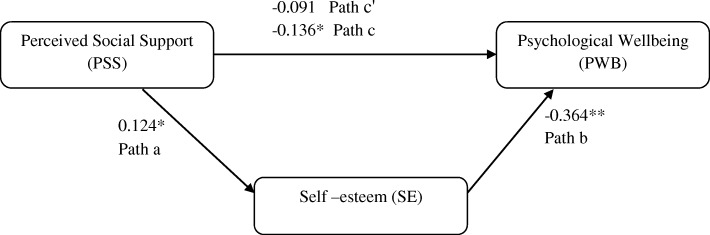
Background: Adolescence is characterized by unique, multiple physical, psychological and social development. Understanding the well-being of adolescents and the factors that contribute to it will help towards clarifying and defining ways to better help adolescents prepare for adult life. Therefore, the present study aims to find out the relationship between Perceived Social Support (PSS) and Psychological Well-Being (PWB) among Nepalese adolescence based on mediating role of Self-esteem (SE). Methods: The study was conducted among 348 adolescents studying in grade 9 and 10 of government secondary level schools of Pokhara Metropolitan city, Nepal. Data were collected through self-administered standard tools-Multidimensional Scale of Perceived Social Support (MSPSS), Rosenberg self-esteem scale (RSES) and General Health Questionnaire (GHQ-12). For statistical analysis descriptive statistics, correlation, regression and mediation analyses were used. The statistical significance of mediating effect of the tested model was examined through a path proposed by Baron and Kenny and Bootstrap method. Results: Overall, the finding suggests that PSS indirectly affects PWB of adolescents through mediating variable SE. Adolescents who perceive good social support had higher SE, which in turn contributed to their PWB. Furthermore, the study found no significant gender difference for PSS, SE and PWB. Also among various sources of PSS, both boys and girls were more oriented towards family for social support than friends and others. Conclusion: Adolescents who experience higher social support are likely to have higher SE and are more likely to have better PWB. The findings of the study will be useful to the parents, teachers, counselors, psychologist and researchers to develop strategies to enhance adolescent’s mental health.
Overview
The claims and statistics of this paper haven’t been checked yet.
Free: it reads the open-access text and checks the first 5 claims that cite a source we can check. Create a free account to check every claim.
Integrity signals
Registry
Cites
Statistics
Figures
Verification
Claims the paper makes
The claims and statistics of this paper haven’t been checked yet.
Free: it reads the open-access text and checks the first 5 claims that cite a source we can check. Create a free account to check every claim.
Claims other papers make about this one
Each is checked against this paper’s own text: does it say what the citing paper says it does?
The source backs part of the claim, not all of it — or backs it for a different population, condition or comparison.
In the citing paper
“Moreover, self-esteem and presence of meaning were positively affected by social support (Poudel et al., 2020; Li et al., 2021b), suggesting that individuals with a higher social support tend to view themselves positively and live a more meaningful life (Li et al., 2021a).”
From Mediator role of presence of meaning and self-esteem in the relationship of social support and death anxiety (2022) · cites this paper as Poudel et al., 2020
Experimental — accuracy not yet measuredThe source backs part of the claim, not all of it — or backs it for a different population, condition or comparison.
In the citing paper
“Previous researches on the interrelationships among social support, self-esteem, and presence of meaning show that these factors are positively correlated with each other (Zhang et al., 2019; Poudel et al., 2020; Li et al., 2021b).”
From Mediator role of presence of meaning and self-esteem in the relationship of social support and death anxiety (2022) · cites this paper as Poudel et al., 2020
Experimental — accuracy not yet measuredThe source backs part of the claim, not all of it — or backs it for a different population, condition or comparison.
In the citing paper
“thus higher social support is associated with less death anxiety via increasing self-esteem (Poudel et al., 2020).”
From Mediator role of presence of meaning and self-esteem in the relationship of social support and death anxiety (2022) · cites this paper as Poudel et al., 2020
Experimental — accuracy not yet measured
Self-check
Percentages, sums and reported differences re-computed from the paper’s own numbers.
The self-check needs the paper’s full text.
Citations
Cites
Baron, R. M., & Kenny, D. A. (1986) · Journal of Personality and Social Psychology · doi:10.1037/0022-3514.51.6.1173 · Cited by 91,532
(2013) · Cited by 44,563
Society and the Adolescent Self-Image
Rosenberg, M. (1965) · doi:10.1515/9781400876136 · Cited by 30,126
Stress, social support, and the buffering hypothesis
Cohen, S., & Wills, T. A. (1985) · Psychological Bulletin · doi:10.1037/0033-2909.98.2.310 · Cited by 18,093
The Multidimensional Scale of Perceived Social Support
Zimet, G. D., Dahlem, N. W., Zimet, S. G., & Farley, G. K. (1988) · Journal of Personality Assessment · doi:10.1207/s15327752jpa5201_2 · Cited by 13,339
(1979) · Medical Entomology and Zoology · Cited by 5,872
(1988) · NFER-Nelson eBooks · Cited by 5,560
Psychometric Characteristics of the Multidimensional Scale of Perceived Social Support
Zimet, G. D., Powell, S. S., Farley, G. K., Werkman, S., & Berkoff, K. A. (1990) · Journal of Personality Assessment · doi:10.1080/00223891.1990.9674095 · Cited by 4,855
Psychometric Characteristics of the Multidimensional Scale of Perceived Social Support
Zimet, G., Powell, S., Farley, G., Werkman, S., & Berkoff, K. (1990) · Journal of Personality Assessment · doi:10.1207/s15327752jpa5503&4_17 · Cited by 4,854
Baumeister, R. F., Campbell, J. D., Krueger, J. I., & Vohs, K. D. (2003) · Psychological Science in the Public Interest · doi:10.1111/1529-1006.01431 · Cited by 3,893
Global Self-Esteem and Specific Self-Esteem: Different Concepts, Different Outcomes
Rosenberg, M., Schooler, C., Schoenbach, C., & Rosenberg, F. (1995) · American Sociological Review · doi:10.2307/2096350 · Cited by 1,809
Age and Sex Differences in Perceptions of Networks of Personal Relationships
Furman, W. C., & Buhrmester, D. (1992) · Child Development · doi:10.1111/j.1467-8624.1992.tb03599.x · Cited by 1,645
Perceived support, received support, and adjustment to stressful life events
Wethington, E., & Kessler, R. C. (1986) · Journal of Health and Social Behavior · doi:10.2307/2136504 · Cited by 1,431
Age and Sex Differences in Perceptions of Networks of Personal Relationships
Furman, W., & Buhrmester, D. (1992) · Child Development · doi:10.2307/1130905 · Cited by 1,180
Trzesniewski, K. H., Donnellan, M. B., Moffitt, T. E., Robins, R. W., Poulton, R., & Caspi, A. (2006) · Developmental Psychology · doi:10.1037/0012-1649.42.2.381 · Cited by 1,024
Looking beyond psychopathology: The dual-factor model of mental health in youth
Suldo, S. M., & Shaffer, E. J. (2008) · School Psychology Review · doi:10.1080/02796015.2008.12087908 · Cited by 997
Social Support from Parents and Friends and Emotional Problems in Adolescence
Helsen, M., Vollebergh, W., & Meeus, W. (2000) · Journal of Youth and Adolescence · doi:10.1023/a:1005147708827 · Cited by 722
Global Increases in Individualism
Santos, H. C., Varnum, M. E. W., & Grossmann, I. (2017) · Psychological Science · doi:10.1177/0956797617700622 · Cited by 584
Parent and peer attachment in late childhood and early adolescence
Nickerson, A. B., & Nagle, R. J. (2005) · The Journal of Early Adolescence · doi:10.1177/0272431604274174 · Cited by 484
Bokhorst, C. L., Sumter, S. R., & Westenberg, P. M. (2010) · Social Development · doi:10.1111/j.1467-9507.2009.00540.x · Cited by 480
Parent‐Adolescent Relationships and Influences
Collins, W. A., & Laursen, B. (2004) · Handbook of Adolescent Psychology · doi:10.1002/9780471726746.ch11 · Cited by 465 · cited 1×
“adolescents’ emergence from family towards independence [5, 6].”
Kong, F., & You, X. (2013) · Social Indicators Research · doi:10.1007/s11205-011-9930-6 · Cited by 303 · cited 1×
“Similarly, among Chinese adolescents global self-esteem partially mediated the influence of social support on life satisfaction and positive affect [48].”
BackgroundEarly Adolescence and Prosocial/Moral Behavior I: The Role of Individual Processes
Fabes, R. A., Carlo, G., Kupanoff, K., & Laible, D. (1999) · The Journal of Early Adolescence · doi:10.1177/0272431699019001001 · Cited by 292
Cheng, S.-T., & Chan, A. C. M. (2004) · Personality and Individual Differences · doi:10.1016/j.paid.2004.01.006 · Cited by 250
Stress, self-esteem, and suicidal ideation in late adolescents.
Wilburn, V. R., & Smith, D. E. (2005) · PubMed · Cited by 246
Rueger, S. Y., Malecki, C. K., & Demaray, M. K. (2008) · School Psychology Quarterly · doi:10.1037/1045-3830.23.4.496 · Cited by 210
Use of Social Support: Gender and Personality Differences
Reevy, G. M., & Maslach, C. (2001) · Sex Roles · doi:10.1023/a:1011930128829 · Cited by 208 · cited 1×
“support can be emotional, instrumental, financial or informational [10].”
BackgroundThe Stressful Life Events Schedule for children and adolescents: development and validation
Williamson, D. E., Birmaher, B. B., Ryan, N. D., Shiffrin, T. P., Lusky, J. A., Protopapa, J., Dahl, R. E., & Brent, D. A. (2003) · Psychiatry Research · doi:10.1016/s0165-1781(03)00134-3 · Cited by 195
The effect of perceived social support on subjective well-being
Gülaçtı, F. (2010) · Procedia - Social and Behavioral Sciences · doi:10.1016/j.sbspro.2010.03.602 · Cited by 185
Sharaf, A. Y., Thompson, E. A., & Walsh, E. (2009) · Journal of Child and Adolescent Psychiatric Nursing · doi:10.1111/j.1744-6171.2009.00194.x · Cited by 180
Kong, F., Zhao, J., & You, X. (2013) · Social Indicators Research · doi:10.1007/s11205-012-0044-6 · Cited by 178
Tian, L., Liu, B., Huang, S., & Huebner, E. S. (2013) · Social Indicators Research · doi:10.1007/s11205-012-0123-8 · Cited by 173
Ratelle, C. F., Simard, K., & Guay, F. (2013) · Journal of Happiness Studies · doi:10.1007/s10902-012-9360-4 · Cited by 168
Chen, W., Zhang, D., Pan, Y., Hu, T., Liu, G., & Luo, S. (2016) · Personality and Individual Differences · doi:10.1016/j.paid.2016.12.009 · Cited by 163
High self-esteem among adolescents: Longitudinal trends, sex differences, and protective factors
Birndorf, S., Ryan, S., Auinger, P., & Aten, M. (2005) · Journal of Adolescent Health · doi:10.1016/j.jadohealth.2004.08.012 · Cited by 160
Gaylord‐Harden, N. K., Ragsdale, B. L., Mandara, J., Richards, M. H., & Petersen, A. C. (2006) · Journal of Youth and Adolescence · doi:10.1007/s10964-006-9115-9 · Cited by 159
Boudreault‐Bouchard, A., Dion, J., Hains, J., Vandermeerschen, J., Laberge, L., & Perron, M. (2013) · Journal of Adolescence · doi:10.1016/j.adolescence.2013.05.002 · Cited by 150
DuBois, D. L., Burk-Braxton, C., Swenson, L. P., Tevendale, H. D., Lockerd, E. M., & Moran, B. L. (2002) · Developmental Psychology · doi:10.1037//0012-1649.38.5.822 · Cited by 141
Emadpoor, L., Lavasani, M. G., & Shahcheraghi, S. M. (2015) · International Journal of Mental Health and Addiction · doi:10.1007/s11469-015-9608-4 · Cited by 113
Social Support and Well-Being in Early Adolescents: The Role of Mediating Variables
Yarcheski, A., Mahon, N. E., & Yarcheski, T. J. (2001) · Clinical Nursing Research · doi:10.1177/10547730122158851 · Cited by 112 · cited 2×
“In addition, though SE buffered the relationship between PSS and PWB, the effect was lower than that found in most of the other studies [14, 47].”
BackgroundResultPerceived social support and self-esteem in adolescence
Ikiz, F. E., & Cakar, F. S. (2010) · Procedia - Social and Behavioral Sciences · doi:10.1016/j.sbspro.2010.07.460 · Cited by 108
Adolescent gender differences in social support: Structure, function, and provider type
Colarossi, L. G. (2001) · Social Work Research · doi:10.1093/swr/25.4.233 · Cited by 102
Hashim, I. H. (2003) · School Psychology International · doi:10.1177/0143034303024002004 · Cited by 90
Kashyap, G. C., & Singh, S. K. (2017) · BMC Psychiatry · doi:10.1186/s12888-017-1253-y · Cited by 86
A Rasch and confirmatory factor analysis of the General Health Questionnaire (GHQ) - 12
Smith, A. B., Fallowfield, L. J., Stark, D., Velikova, G., & Jenkins, V. A. (2010) · Health and Quality of Life Outcomes · doi:10.1186/1477-7525-8-45 · Cited by 80
N. Glozah, F. (2013) · Open Journal of Medical Psychology · doi:10.4236/ojmp.2013.24022 · Cited by 78
Pettit, J. W., Lewinsohn, P. M., Seeley, J. R., ROBERTS, R. E., & Yaroslavsky, I. (2010) · Journal of Abnormal Psychology · doi:10.1037/a0020980 · Cited by 75
Beyond Mentoring: Alternative Sources and Functions of Developmental Support
Allen, T. D., & Finkelstein, L. M. (2003) · The Career Development Quarterly · doi:10.1002/j.2161-0045.2003.tb00615.x · Cited by 71
Karatzias, A., Chouliara, Z., Power, K., & Swanson, V. (2006) · Quality of Life Research · doi:10.1007/s11136-006-0064-2 · Cited by 70
(2015) · Cited by 60
Yıldız, M. A., & Karadaş, C. (2017) · Journals & Books Hosting (International Knowledge Sharing Platform) · Cited by 59
Ji, Y., Rana, C., Shi, C., & Zhong, Y. (2019) · Frontiers in Psychology · doi:10.3389/fpsyg.2019.02230 · Cited by 54
Perceived Social Support and Self-Esteem towards Gender Roles: Contributing Factors in Adolescents
Tam, C. L., Lee, T.-H., Har, W. M., & Pook, W.-L. (2011) · Asian Social Science · doi:10.5539/ass.v7n8p49 · Cited by 50 · cited 3×
“gender differences in SE and PSS were reported in the study conducted among the Malaysian adolescents [32].”
ResultInfluentialA Multilevel Analysis of Gender Differences in Psychological Distress Over Time
Botticello, A. (2009) · Journal of Research on Adolescence · doi:10.1111/j.1532-7795.2009.00591.x · Cited by 48
Individual and contextual parameters associated with adolescents’ domain specific self‐perceptions
Kokkinos, C. M., & Hatzinikolaou, S. (2010) · Journal of Adolescence · doi:10.1016/j.adolescence.2010.04.003 · Cited by 48
Effect of Perceived Social Support on Life Satisfaction of University Students
Mahanta, D., & Aggarwal, M. (2013) · Cited by 48
Adolescent stress through the eyes of high-risk teens.
LaRue, D. E., & Herrman, J. W. (2009) · PubMed · Cited by 44
ADOLESCENT SELF-ESTEEM, PROBLEM BEHAVIORS, AND PERCEIVED SOCIAL SUPPORT IN TURKEY
Siyez, D. M. (2008) · Social Behavior and Personality: an international journal · doi:10.2224/sbp.2008.36.7.973 · Cited by 41
Relationships with father and mother, self-esteem and academic achievement amongst college students
Baharudin, R., & Zulkefly, N. S. (2009) · Universiti Putra Malaysia Institutional Repository (Universiti Putra Malaysia) · Cited by 37
Sweet sixteen ... Adolescents’ problems and the peer group as source of support
Kirchler, E. M., Pombeni, M. L., & Palmonari, A. (1991) · European Journal of Psychology of Education · doi:10.1007/bf03172773 · Cited by 31 · cited 1×
“adolescents’ emergence from family towards independence [5, 6].”
The Correlation of Self-Esteem and Perceived Social Support
Budd, A., Buschman, C., & Esch, L. (2009) · Undergraduate research journal for the human sciences · Cited by 28
Relationship between Social Support and Self-Esteem of Adolescent Girls
Journals, I., Tahir, W. B.-E., Inam, A., & Raana, T. (2015) · Figshare · doi:10.6084/m9.figshare.1353182 · Cited by 16
The relationship of perceived social support with self-esteem among college-going students
Bhat, S. A. (2017) · International Journal of Advanced Research and Development · Cited by 6
Research works printed but not linked: 1
- Ministry of Health Nepal, New ERA, ICF 2016 Nepal demographic and health survey key findings 2017 Kathmandu Ministry of Health Nepal
Cited by
Perceived Social Support and Stress: a Study of 1st Year Students in Ireland
McLean, L., Gaul, D., & Penco, R. (2023) · International Journal of Mental Health and Addiction · doi:10.1007/s11469-021-00710-z · Cited by 182
“Higher levels of social support have been found to be associated with improved psychological wellbeing (Glozah, 2013; Poudel et al., 2020; Reeve et al., 2013; Poots & Cassidy, 2020), with students that perceived social support positively found to be at a lower risk for mental health problems (Karaca et al.”
BackgroundBhattarai, D., Shrestha, N., & Paudel, S. (2020) · BMJ Open · doi:10.1136/bmjopen-2020-044042 · Cited by 70
Zhang, S., Xuyang, D., Xin, Z., Xuebin, C., & Jie, H. (2022) · Frontiers in Psychology · doi:10.3389/fpsyg.2022.865025 · Cited by 91
“Previous study already demonstrated the association of social support and mental health (Poudel et al., 2020).”
BackgroundAdolescents’ Self-Esteem and Life Satisfaction: Communication with Peers as a Mediator
Szczęśniak, M., Bajkowska, I., Czaprowska, A., & Sileńska, A. (2022) · International Journal of Environmental Research and Public Health · doi:10.3390/ijerph19073777 · Cited by 78
“Self-esteem is considered to be one of the crucial factors that impacts social development and functioning [38].”
BackgroundVilca-Pareja, V., de Somocurcio, A. L. R., Morales, R. D., & Zeballos, L. M. (2022) · International Journal of Environmental Research and Public Health · doi:10.3390/ijerph192416548 · Cited by 89
Metadata
- Authors
- Poudel, A., Gurung, B., & Khanal, G. P.
- Affiliations
- Tribhuvan University (NP)
- Pokhara Academy of Health Sciences (NP)
- Corresponding author
- Poudel, Anju
- Venue
- BMC Psychology
- Published
- 2020-05-01
- Volume
- 8
- Issue
- 1
- Pages
- 43-43
- ISSN
- 2050-7283 (ISSN-L)
- PMC
- PMC7195718
- OpenAlex
- W3023224224
- Cited by
- 177
- References
- 62
- Citations by year
- 2026: 18 · 2025: 37 · 2024: 42 · 2023: 37 · 2022: 26 · 2021: 12 · 2020: 5
- FWCI
- 26.75
- Type
- journal article
- Language
- en
- Open access
- gold
- doi.org
- Licence
- cc-by
- creativecommons.org/licenses/by/4.0/ (tdm)
- creativecommons.org/licenses/by/4.0/ (vor)
- Locations
- BMC Psychology (publishedVersion, cc-by)
- PubMed Central (publishedVersion, cc-by)
- PubMed (publishedVersion)
- DOAJ (DOAJ: Directory of Open Access Journals) (submittedVersion, cc-by-sa)
- Topics
- Social Sciences › Psychology › Developmental and Educational Psychology › Psychosocial Factors Impacting Youth
- Social Sciences › Psychology › Social Psychology › Psychological Well-being and Life Satisfaction
- Social Sciences › Psychology › Clinical Psychology › Child and Adolescent Psychosocial and Emotional Development
- Keywords
- perceived social support, psychological well-being, self-esteem, adolescents, mediation, gender differences, family support, adolescent mental health, high school students
- MeSH terms
- Adolescent, Female, Humans, Male, Mental Health, Nepal, Surveys and Questionnaires, Self Concept, Social Support
About these checks
Registry, retraction, Cites and statistics results are computed, not judged, with one exception: a printed reference that no index lists is read once by a model before it counts as a citation error. Claims are extracted by a model and kept only when their quote appears verbatim in the text; each cited source is then checked, with a model’s help, for whether it says what the claim relies on. Those verdicts can be wrong — read the claim’s quote and the cited source before relying on one.
Statistics and arithmetic are recomputed, not judged.
Confidence bands are shown only for fields calibrated on our annotated test set. None is calibrated yet, so no band is shown.
What counts as a claim ›How we measure confidence ›How we check this ›
Are you an author, or do you see a problem with this page? Request a review
Data sources
Bibliographic data: Semantic Scholar, OpenAlex, Crossref.
Contains information from the Semantic Scholar Academic Graph Datasets, made available under the ODC Attribution License (ODC-BY 1.0).
Semantic Scholar’s data is described in: Kinney, R., et al. (2023). The Semantic Scholar Open Data Platform. arXiv:2301.10140.
